

Interaction between the microbiome and TP53 in human lung cancer
Open accessThe DOI matches its Crossref record; 55 of the 55 references it cites were found in a registry or an index.
Abstract
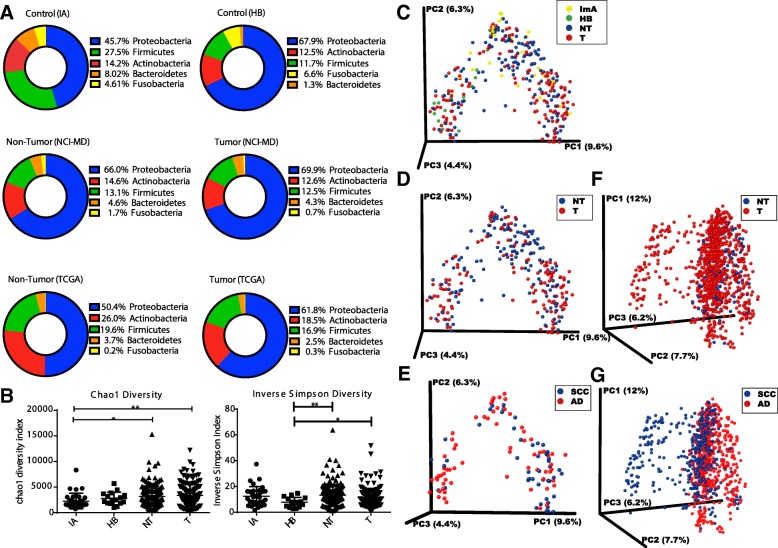
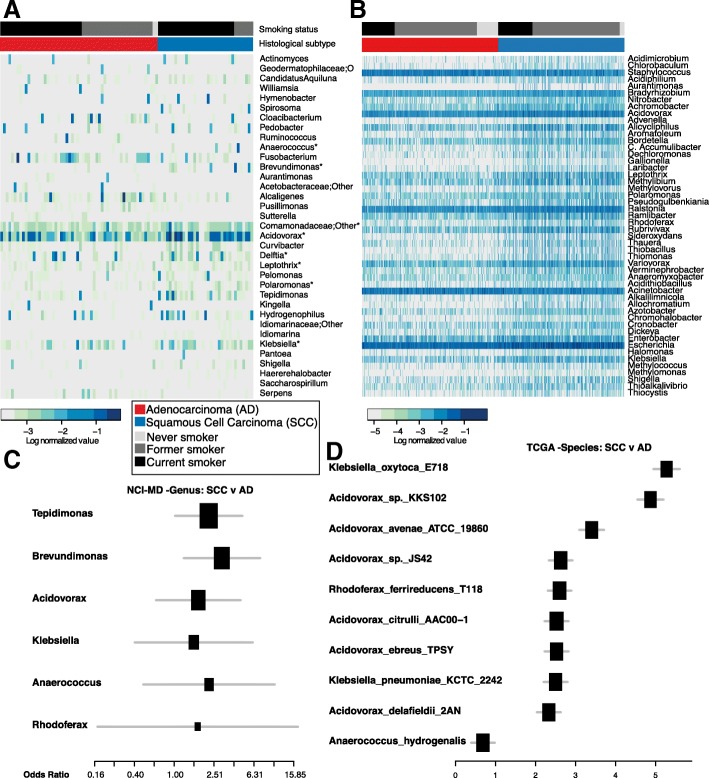
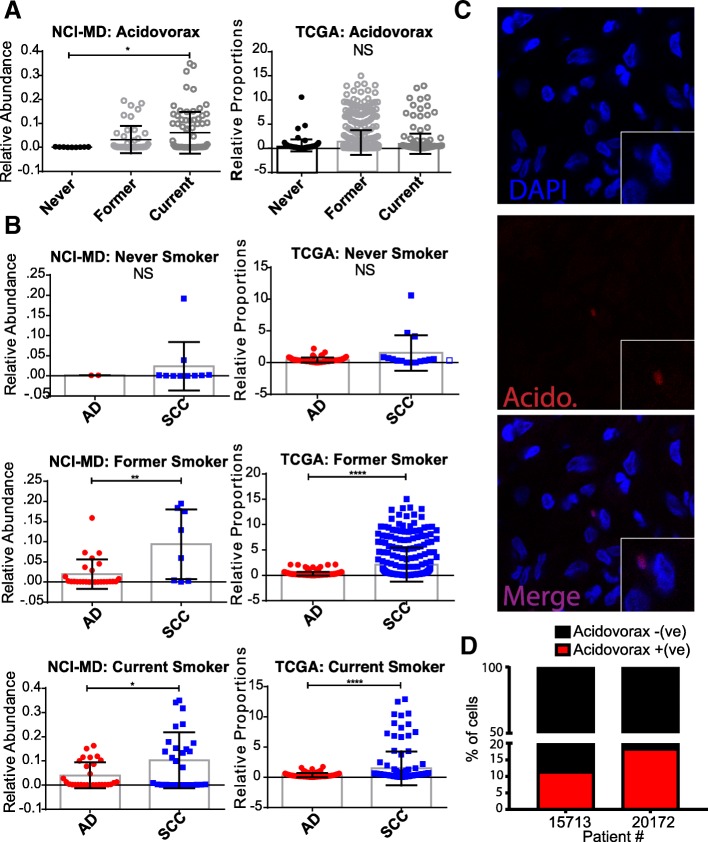
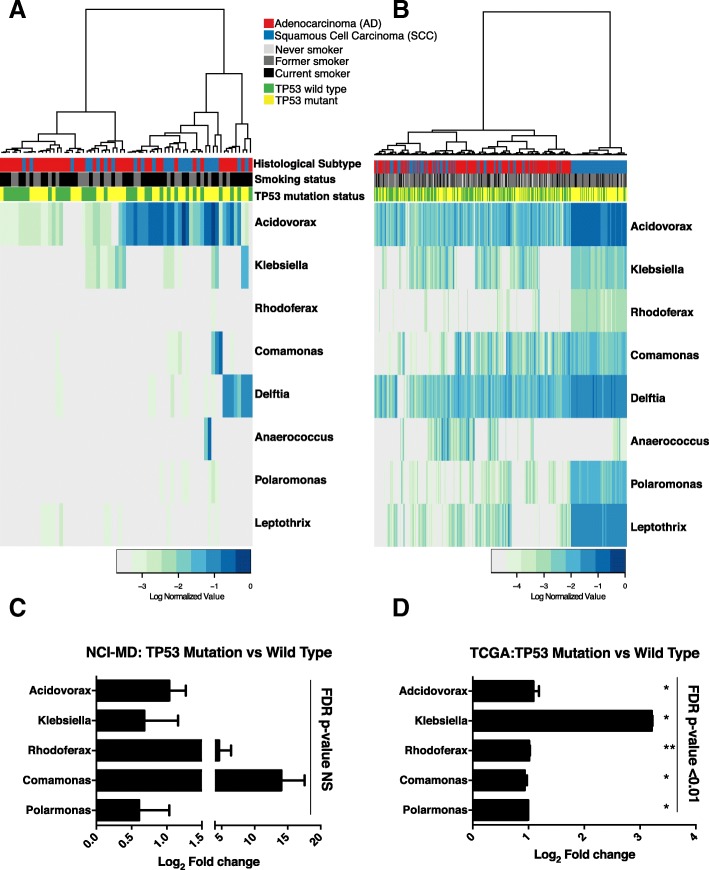
Background: Lung cancer is the leading cancer diagnosis worldwide and the number one cause of cancer deaths. Exposure to cigarette smoke, the primary risk factor in lung cancer, reduces epithelial barrier integrity and increases susceptibility to infections. Herein, we hypothesize that somatic mutations together with cigarette smoke generate a dysbiotic microbiota that is associated with lung carcinogenesis. Using lung tissue from 33 controls and 143 cancer cases, we conduct 16S ribosomal RNA (rRNA) bacterial gene sequencing, with RNA-sequencing data from lung cancer cases in The Cancer Genome Atlas serving as the validation cohort. Results: Overall, we demonstrate a lower alpha diversity in normal lung as compared to non-tumor adjacent or tumor tissue. In squamous cell carcinoma specifically, a separate group of taxa are identified, in which Acidovorax is enriched in smokers. Acidovorax temporans is identified within tumor sections by fluorescent in situ hybridization and confirmed by two separate 16S rRNA strategies. Further, these taxa, including Acidovorax , exhibit higher abundance among the subset of squamous cell carcinoma cases with TP53 mutations, an association not seen in adenocarcinomas. Conclusions: The results of this comprehensive study show both microbiome-gene and microbiome-exposure interactions in squamous cell carcinoma lung cancer tissue. Specifically, tumors harboring TP53 mutations, which can impair epithelial function, have a unique bacterial consortium that is higher in relative abundance in smoking-associated tumors of this type. Given the significant need for clinical diagnostic tools in lung cancer, this study may provide novel biomarkers for early detection.
Overview
The claims and statistics of this paper haven’t been checked yet.
Free: it reads the open-access text and checks the first 5 claims that cite a source we can check. Create a free account to check every claim.
Integrity signals
Registry
Cites
Statistics
Figures
Verification
Claims the paper makes
The claims and statistics of this paper haven’t been checked yet.
Free: it reads the open-access text and checks the first 5 claims that cite a source we can check. Create a free account to check every claim.
Claims other papers make about this one
Each is checked against this paper’s own text: does it say what the citing paper says it does?
The source backs part of the claim, not all of it — or backs it for a different population, condition or comparison.
In the citing paper
“it is also important to use mechanical tissue shearing in the DNA isolation protocol to ensure the complete recovery of DNA from within the cell wall of Gram-positive bacteria—a step not included in most standard DNA isolation protocols (6, 7).”
From The human tumor microbiome is composed of tumor type–specific intracellular bacteria (2020) · cites this paper as [6]
Experimental — accuracy not yet measuredThe cited source says what the claim attributes to it.
In the citing paper
“Intratumor bacteria have been reported in many tumor types (2-19)”
From The human tumor microbiome is composed of tumor type–specific intracellular bacteria (2020) · cites this paper as [6]
Self-check
Percentages, sums and reported differences re-computed from the paper’s own numbers.
The self-check needs the paper’s full text.
Citations
Cites
QIIME allows analysis of high-throughput community sequencing data
Caporaso, J. G., Kuczynski, J., Stombaugh, J., Bittinger, K., Bushman, F. D., Costello, E. K., Fierer, N., Peña, A. G., Goodrich, J. K., Gordon, J. I., et al. (2010) · Nature Methods · doi:10.1038/nmeth.f.303 · Cited by 34,887
(1968) · American Association of Industrial Nurses Journal · doi:10.1177/216507996801601208 · Cited by 8,798
Kozich, J. J., Westcott, S. L., Baxter, N. T., Highlander, S. K., & Schloss, P. D. (2013) · Applied and Environmental Microbiology · doi:10.1128/aem.01043-13 · Cited by 7,112
Comprehensive genomic characterization of squamous cell lung cancers
The Cancer Genome Atlas Research Network (2012) · Nature · doi:10.1038/nature11404 · Cited by 3,994
Commensal Bifidobacterium promotes antitumor immunity and facilitates anti–PD-L1 efficacy
Sivan, A., Corrales, L., Hubert, N., Williams, J. B., Aquino-Michaels, K., Earley, Z. M., Benyamin, F. W., Man Lei, Y., Jabri, B., Alegre, M.-L., et al. (2015) · Science · doi:10.1126/science.aac4255 · Cited by 3,888
Kostic, A. D., Chun, E., Robertson, L., Glickman, J. N., Gallini, C. A., Michaud, M., Clancy, T. E., Chung, D. C., Lochhead, P., Hold, G. L., et al. (2013) · Cell Host & Microbe · doi:10.1016/j.chom.2013.07.007 · Cited by 2,718
Rubinstein, M. R., Wang, X., Liu, W., Hao, Y., Cai, G., & Han, Y. W. (2013) · Cell Host & Microbe · doi:10.1016/j.chom.2013.07.012 · Cited by 2,476
Disordered Microbial Communities in Asthmatic Airways
Hilty, M., Burke, C., Pedro, H., Cardenas, P., Bush, A., Bossley, C., Davies, J., Ervine, A., Poulter, L., Pachter, L., et al. (2010) · PLoS ONE · doi:10.1371/journal.pone.0008578 · Cited by 1,824
Wu, S., Rhee, K.-J., Albesiano, E., Rabizadeh, S., Wu, X., Yen, H.-R., Huso, D. L., Brancati, F. L., Wick, E., McAllister, F., et al. (2009) · Nature Medicine · doi:10.1038/nm.2015 · Cited by 1,812
Escherichia coli Induces DNA Double-Strand Breaks in Eukaryotic Cells
Nougayrède, J.-P., Homburg, S., Taieb, F., Boury, M., Brzuszkiewicz, E., Gottschalk, G., Buchrieser, C., Hacker, J., Dobrindt, U., & Oswald, E. (2006) · Science · doi:10.1126/science.1127059 · Cited by 1,188
Research works printed but not linked: 1
- Sequence read archive. http://www.ncbi.nlm.nih.gov/bioproject/320383.
Cited by
Items 301–400 of 495
Zhu, Z., Peng, L., Gu, H., Tang, Y., Xiao, Y., He, H., Yang, M., Xiang, L., & Wang, Y. (2023) · Frontiers in Nutrition · doi:10.3389/fnut.2023.1142067 · Cited by 6
“Thirdly, persistent inflammationinduced generation of reactive oxygen/nitrogen species in the lungs may increase the risk of lung cancer (39, 40).”
BackgroundLi, J., Wu, G., Yang, J., Yan, J., Li, D., Wang, Q., Xia, Y., Zhu, J., Guo, B., Cheng, F., et al. (2023) · Frontiers in Oncology · doi:10.3389/fonc.2023.1163359 · Cited by 6
“In addition, Klebsiella, Comamonas, Acidovorax, Polarmonas, and Rhodoferax genera were more frequently found in small-cell carcinomas, but they were not found in adenocarcinoma (10).”
BackgroundVerma, D., Srivastava, A., Garg, P. K., Akhter, Y., Dubey, A. K., Mishra, S., & Deo, S. V. S. (2020) · Archives of Microbiology · doi:10.1007/s00203-020-02084-7 · Cited by 6
Microbes in Tumoral In Situ Tissues and in Tumorigenesis
Xue, F., Han, L., Ma, S., Zhao, L., Wang, L., Zhang, K., Yin, P., Guo, L., Wei, J., & Li, Q. (2020) · Frontiers in Cellular and Infection Microbiology · doi:10.3389/fcimb.2020.572570 · Cited by 6
Darawshy, F., Tsay, J.-C. J., Segal, L. N., & Pass, H. I. (2025) · Cancer Biomarkers · doi:10.1177/18758592251322045 · Cited by 5
“19 Furthermore Stone et al., demonstrated in a pre-clinical mouse model that exposure to Acidovorax temperans accelerated tumor development and burden through in fi ltration of proin fl ammatory cells with interleukin (IL)-17T cell polarization.”
Biomarkers for the diagnosis of indeterminate pulmonary nodules: are we there yet?
McGann, K. C., Khalil, T. A., Kammer, M. N., Ostrin, E. J., Pass, H. I., Tsay, J.-C. J., Segal, L. N., Potter, M., Deppen, S. A., Maldonado, F., et al. (2025) · Journal of Thoracic Disease · doi:10.21037/jtd-2024-2010 · Cited by 6
“These findings align with other prior work showing associations between enrichment with oral commensal microbiota and tumor protein 53 (TP53) mutated lung tumors, worse prognosis, and cancer progression (69,70).”
The microbiome and lung cancer: microbial effects on host immune responses and treatment outcomes
Bailey, A., Leuther, K. K., & Robinson, L. A. (2025) · Frontiers in Microbiomes · doi:10.3389/frmbi.2025.1606551 · Cited by 5
“Other studies showed a correlation of other microorganisms and speci fi c lung cancers, and they identi fi ed enriched taxa in patients who were chronic smokers (Greathouse et al., 2018).”
Lung microbiome dynamics in health and lung cancer
Kanteres, T., Angelakopoulou, I. M., Angelakopoulou, E. A., Tsolaki, F., Tagarakis, G. I., Manika, Κ., Exindari, M., & Gioula, G. (2025) · Microbial Genomics · doi:10.1099/mgen.0.001509 · Cited by 5
“Many studies have found decreased alpha-diversity in lung cancer (either when comparing patients to healthy/benign disease controls or tumours to paired non-tumour segments) in different sample types [65, 91–98], although some studies finding it increased [99–103] or unaltered [104] also exist.”
Microbiome-metabolome dysbiosis of bronchoalveolar lavage fluid of lung cancer patients
Wang, J., Su, W., Chen, Q., Zhou, J., Wang, X., Jiang, R., Li, J., & Xing, P. (2025) · Frontiers in Microbiology · doi:10.3389/fmicb.2025.1669172 · Cited by 5
“Greathouse discovered that five genera, including Klebsiella , were closely associated with mutations in the tumor protein p53 (TP53) in patients with lung squamous cell carcinoma (Greathouse et al., 2018).”
Intra-tumoral microbiota: Key modulators of tumor immunity and therapeutic potential
He, J., Tan, H. Z., Qiu, Y., Dan, Y., Wan, Q., Li, L., Wu, J., Song, Q., Chen, H., & Xu, B. (2025) · Genes & Diseases · doi:10.1016/j.gendis.2025.101963 · Cited by 5
Intratumoral microbiota in cancer: molecular mechanism and therapeutic strategies
Yu, Y., Guo, Z., Luo, Z., Dian, Y., Yang, X., Chen, X., Zeng, F., & Deng, G. (2026) · Molecular Biomedicine · doi:10.1186/s43556-026-00473-w · Cited by 5
“…squamous cell carcinoma enriches Klebsiella and Anaerococcus [188], while adenocarcinoma favors Acinetobacter and Staphylococcus [188]; advanced non-malignant tissues show increased Thermus [190], and smoking-associated tumors are enriched in Aspergillus , Agaricus , and Acidovorax [6, 191].”
Detection and analysis of lung microbiota in mice with lung cancer lacking the NLRP3 gene
Li, X., Zhao, C., Li, C., Zhang, M., Xie, Y., Feng, F., Yao, W., & Wang, N. (2022) · Biochemical and Biophysical Research Communications · doi:10.1016/j.bbrc.2022.11.059 · Cited by 5
A View of Myeloid Transformation through the Hallmarks of Cancer
Fernández-Maestre, I., Cai, S. F., & Levine, R. L. (2024) · Blood Cancer Discovery · doi:10.1158/2643-3230.bcd-24-0009 · Cited by 5
Klein, M. A., Pragman, A. A., & Wendt, C. H. (2022) · Seminars in Oncology · doi:10.1053/j.seminoncol.2022.06.011 · Cited by 5
Arvelo, F. A., Sojo, F. J., & Cotte, C. (2021) · Investigación Clínica · doi:10.22209/ic.v62n4a09 · Cited by 5
Charting the landscape of intratumoral microbiota in lung cancer: From bench to bedside
Yu, Y., Wu, K., Song, H., & Wang, K. (2025) · Biochimica et Biophysica Acta (BBA) - Reviews on Cancer · doi:10.1016/j.bbcan.2025.189348 · Cited by 4
Intratumoral Microbiota in Lung Cancer: Emerging Roles in TME Modulation and Immunotherapy Response
Yang, X., Yin, L., Tian, Z., & Zhou, Q. (2025) · International Journal of Molecular Sciences · doi:10.3390/ijms27010255 · Cited by 5
“At the driver-mutation level, TP53 alterations and their co-mutation patterns not only affect epithelial barrier integrity and immune-response programs but are also associated with specific microbial configurations and differential responses to ICIs [54–57].”
Zhang, R., Li, Z., Liu, X., Qiu, Z., Li, Y., Gao, C., & Guo, C. (2026) · Frontiers in Immunology · doi:10.3389/fimmu.2025.1653727 · Cited by 4
“In LUSC, the abundance of Pseudomonas putida str. KT2440 is signi fi cantly higher in tumors from younger male patients.”
InfluentialFeng, H., Chen, K., Xi, Z., Xia, B., Chen, X., Huang, Y., Huang, Z., Guo, J., Zhu, D., Ling, F., et al. (2026) · Nature Communications · doi:10.1038/s41467-026-68649-0 · Cited by 4
Existence and distribution of the microbiome in tumour tissues of children with hepatoblastoma
Cui, J., Li, X., Zhang, Q., Du, B., Ding, Z., Yan, C., Xue, G., Gan, L., Feng, J., Fan, Z., et al. (2024) · Heliyon · doi:10.1016/j.heliyon.2024.e39547 · Cited by 4
“Moreover, these three phyla are the main taxa in various tumour tissues, such as bones, breasts, colon, lungs, and ovaries [16,27 – 29], and are also the main members of the human intestinal microbiome [30].”
Zhao, T., Sun, N., Ding, J., Peng, Z., Han, F., & Qi, X. (2025) · Genes & Diseases · doi:10.1016/j.gendis.2025.101733 · Cited by 4
The intratumor microbiota and thyroid cancer: a review
Liu, S., Xiong, X., Hao, T., Shi, X., & Zhao, Y. (2025) · Frontiers in Endocrinology · doi:10.3389/fendo.2025.1536155 · Cited by 6
“Studies have showed that certain bacterial species could induce DNA damage both directly and indirectly, leading to genetic alterations that can drive carcinogenesis (56, 57).”
Xu, M., Guan, S., Zhong, C., Ma, M., Li, T., & Huang, G. (2025) · iMeta · doi:10.1002/imt2.70081 · Cited by 4
Microbial Diversity and Abundance in Pulmonary Tissue of Patients with Early-Stage Lung Cancer
Shouhua, Z., & Meilan, L. (2023) · Jundishapur Journal of Microbiology · doi:10.5812/jjm-137478 · Cited by 4
“(15) studied 143 lung cancer cases and sequenced lung tissue samples from the tumor site and adjacent areas.”
BackgroundContagious illness of tuberculosis and correlation with various types of cancer
Sundaram, K., & Prabhu, V. (2025) · Medicine in Microecology · doi:10.1016/j.medmic.2025.100123 · Cited by 4
Thwe, M. N., Moné, Y., Sen, B., Czerski, S., Azad, A., Earl, J. P., Hall, D. C., & Ehrlich, G. D. (2025) · Microorganisms · doi:10.3390/microorganisms13040807 · Cited by 5
“Species-specific microbiome analyses were performed on all specimens using our validated full-length 16S MCSMRT protocol as described with minor modifications [7,16–18].”
InfluentialSelf-citationLi, H., Leaman, A. A., & Zheng, Q. (2025) · Advances in clinical chemistry · doi:10.1016/bs.acc.2025.04.001 · Cited by 4
[Progress of Research on the Relationship between Lung Microbiome and Lung Cancer].
Su, Z., Jia, X., Fan, Y., Zhao, F., & Qiao, Y. (2022) · PubMed Central · doi:10.3779/j.issn.1009-3419.2021.102.53 · Cited by 4
Shimizu, M., Miyanaga, A., Seike, M., Matsuda, K., Matsumoto, M., Noro, R., Fujita, K., Mano, Y., Furuya, N., Kubota, K., et al. (2022) · Thoracic Cancer · doi:10.1111/1759-7714.14463 · Cited by 4
“Therefore, this microbiome may promote the occurrence and progression of disease.(18) Studies analyzing BALF samples detected Acidovorax in both patients with lung cancer and nonmalignant pulmonary diseases.”
BackgroundMbatha, S. Z., Mkhize‐Kwitshana, Z. L., Mulaudzi, T. V., Hull, R., & Dlamini, Z. (2023) · Springer eBooks · doi:10.1007/978-3-031-21506-3_8 · Cited by 4
Peng, Y.-L., Dong, Y., Sun, Q., Zhang, Y., Zhou, X., Li, X., Ma, Y., Liu, X., Li, R., Guo, F., et al. (2024) · Scientific Reports · doi:10.1038/s41598-023-50787-w · Cited by 4
“Mutations in the TP53 gene can lead to the loss of these functions, resulting in uncontrolled cell growth, genomic instability, and resistance to apoptosis, which ultimately leads to the development and progression of tumor, including LUAD 52,53 .”
Valsecchi, A. A., Ferrari, G., Paratore, C., Dionisio, R., Vignani, F., Sperone, P., Vellani, G., Novello, S., & Maïo, M. D. (2024) · Critical Reviews in Oncology/Hematology · doi:10.1016/j.critrevonc.2024.104328 · Cited by 4
Abril, A. G., Lanzi, P. G., & Notario, V. (2019) · Springer eBooks · doi:10.1007/978-3-030-21862-1_16 · Cited by 4
The Current Status of Cigarette Smoking and Air Pollution Associated Lung CancerPreprint
Ma, F. (2022) · Preprints.org · doi:10.20944/preprints202206.0056.v1 · Cited by 4
Introduction to microbiomes in health and diseases
Agrawal, P., Mendhey, P., Kumar, R., Patel, S., Kaushik, P. K., Dadsena, A., & Kumar, S. (2025) · International review of cytology · doi:10.1016/bs.ircmb.2024.12.010 · Cited by 3
A Novel nor@DHB Matrix for Direct Microbial Analysis in Lung Cancer Tissues
Shan, L., Xu, X., Huang, L., Li, D., Deng, Y., Xue, X., Guo, S., Huang, Y., Zhang, X., Yu, Y., et al. (2025) · Advanced Science · doi:10.1002/advs.202504038 · Cited by 3
Bulale, S., Shi, K., Wang, Y., Song, L., Zhang, M., Gong, Z., Zhao, Y., Xiong, Y., & He, L. (2025) · Sensors and Actuators B Chemical · doi:10.1016/j.snb.2025.138367 · Cited by 3
Sun, Y., Tong, J., Tan, Y., Liu, Y., Li, D., Yu, H., He, Y., Li, J., Jia, B., Xiong, H., et al. (2025) · BMC Microbiology · doi:10.1186/s12866-025-04237-4 · Cited by 3
“For example, Greathouse’s sequencing analyses of neoplastic and non-neoplastic lung tissues identified a higher alpha diversity within the microbiota of malignant tissues, with distinctive species differentials observed among various pathological classifications [13].”
Immune-oncology-microbiome axis in lung cancer: from carcinogenesis to therapy—a narrative review
Shen, M., Chen, Y., Chen, J., Yin, J., Xu, C., Wang, D., & Lv, T. (2025) · Translational Lung Cancer Research · doi:10.21037/tlcr-2025-737 · Cited by 3
“TP53 mutations, which are more common in smokers—especially those with squamous lung carcinoma—are often accompanied by an abundance of PAH-degrading bacteria like Acidovorax (41), suggesting microbes may exploit tobacco-altered niches to promote carcinogenesis.”
Wu, Y., Zhou, M., Wan, Y., Wei, K., Ma, S., Cheng, L., Lin, T., He, L., He, Y., & Zhou, F. (2026) · Frontiers in Microbiology · doi:10.3389/fmicb.2025.1695187 · Cited by 3
Species diversity and network diversity in the human lung cancer tissue microbiomes
Qiao, Y., Mei, J., & Ma, Z. S. (2024) · FEMS Microbiology Letters · doi:10.1093/femsle/fnae087 · Cited by 3
Gut microbiome and lung cancer: mechanisms, interactions, and dietary interventions
Chakraborty, J., Singh, N. L., & Das, B. K. (2025) · Gut Microbes Reports · doi:10.1080/29933935.2025.2501313 · Cited by 3
Li, Q., Hasan, N., Zhao, F., Xue, Y., Zhu, S., Lv, Y., Jiang, L., YANG, K. Y., Li, W., Zhang, Y., et al. (2025) · Infectious Agents and Cancer · doi:10.1186/s13027-025-00667-x · Cited by 3
“The results revealed that Proteobacteria was the predominant phylum in lung cancer and adjacent tissues, consistent with previous findings [125–127].”
Metagenomic characterization of the tracheobronchial microbiome in lung cancer
Bailey, A., Hogue, S., Pierce, C. M., Paul, S., Fuente, N. L., Thapa, R., Kim, Y., & Robinson, L. A. (2024) · Frontiers in Microbiomes · doi:10.3389/frmbi.2024.1457537 · Cited by 3
Diagnostic and Therapeutic Uses of the Microbiome in the Field of Oncology
Anipindi, M., & Bitetto, D. (2022) · Cureus · doi:10.7759/cureus.24890 · Cited by 3
“Preclinical studies show that germ-free mice and antibiotic-treated mice are less susceptible to lung cancer development induced by KRAS mutation and p53 loss [70].”
BackgroundDefining the baseline of pulmonary microbiota in healthy populations and influencing factors
Tang, Z., Yang, S., & He, Z. (2022) · Highlights in Science Engineering and Technology · doi:10.54097/hset.v11i.1264 · Cited by 3
The pan-cancer landscape of abnormal DNA methylation and intratumor microorganisms
Zhou, P., Lu, S. L., Chang, L., Liao, B., Cheng, M. L., Xu, X., Sui, X., Liu, F.-T., Zhang, M., Wang, Y., et al. (2023) · Neoplasia · doi:10.1016/j.neo.2023.100882 · Cited by 3
Shemuel, J., Angelique, P., Josephine, E., Fugaha, D. R., Gabriela, V., Alhusain, S., & Parikesit, A. A. (2023) · BERITA BIOLOGI · doi:10.55981/beritabiologi.2023.908 · Cited by 3
“According to Greathouse et al. (2018), this gene is a tumor suppressor gene that is crucial in preventing tumor development.”
Background[Sarcopenia: definition and clinical implications].
Kostka, T. (1999) · PubMed · Cited by 3
Li, J., Zhang, Z., Zhao, J., Liu, S., Feng, C. H., Deng, H., Liu, D., Zeng, J., Yu, Q., Zhou, D., et al. (2024) · PubMed Central · doi:10.1590/1414-431x2024e13550 · Cited by 2
“The functional inactivation or mutation of TP53 (tumor suppressor gene) can contribute to impairing epithelial function and promoting the generation of lung cancer, including NSCLC and SCLC (23,24).”
BackgroundExploring the Potency of Lower Respiratory Tract Microbiomeas Biomarkers for Lung Cancer
Rasheed, S. K., & Al-Khafaji, A. S. (2024) · Iraqi Journal of Science · doi:10.24996/ijs.2024.65.11.12 · Cited by 2
Wang, B., Zhang, B., & Li, C. (2025) · IET Systems Biology · doi:10.1049/syb2.70035 · Cited by 2
“Recent studies have demonstrated that certain intra-tumoralmicrobiomecandirectlyinteractwithTP53,resultinginits inactivation or further mutation [14].”
Effect of immune-related intratumoral microbiota and host gene expression on cancer prognosis
Fu, Q., Zhao, N., Li, X., Li, Y., Tian, T., Gao, L., Cao, Y., Wang, L., Liu, J., Wang, F., et al. (2025) · mSystems · doi:10.1128/msystems.01146-25 · Cited by 3
“Intratumoral microbiota can influence host gene expression, such as TP53 , ERK , and CYP2J2 , thereby promoting tumor progression (31, 32).”
Paul, D. (2025) · Springer eBooks · doi:10.1007/978-3-032-08808-6_12 · Cited by 3
The potential of MMP14 as a prognostic and immune biomarker in lung cancer
Xiao, J., Zhu, Z., Zhang, F., & Wang, X. (2026) · BMC Cancer · doi:10.1186/s12885-025-15539-1 · Cited by 2
“…advancements in tumor biology research have highlighted the significant predictive value of biomarkers such as tumor mutational burden (TMB), KRAS mutation status, TP53 mutation, tumor-infiltrating lymphocytes (TILs), and PD-L1 expression levels for clinical responses to immunotherapy [12–14].”
Analysis of intratumoural bacteria: Opportunities and challenges for cancer therapy
Jiang, X., Zhang, C., Cao, S., Peng, Y., Zhao, M., Zhang, X., & Gao, Y. (2026) · Acta Pharmaceutica Sinica B · doi:10.1016/j.apsb.2026.03.022 · Cited by 2
“F. nucleatum is strongly linked to mutations in the proto-oncogenes KRAS and BRAF 159,160 , and Acidovorax and Massilia are enriched in TP53 — mutated tumours in lung cancer, especially in squamous cell carcinoma 161,162 .”
Zhang, W., Zhao, W., Ye, L., Wang, H., Chen, Z., Liu, X., Li, Y., Zhang, Q., Zhang, H., Liu, Y., et al. (2026) · Journal of Translational Medicine · doi:10.1186/s12967-026-08109-x · Cited by 2
The role of the respiratory microbiome in acute and chronic respiratory diseases
Heinzinger, L. R., Segal, L. N., & Dickson, R. P. (2026) · Nature Reviews Microbiology · doi:10.1038/s41579-026-01377-w · Cited by 3
Ma, Q., Zeng, X., Li, X., You, L., Fu, X., You, F., & Ren, Y. (2023) · Chinese Science Bulletin (Chinese Version) · doi:10.1360/tb-2023-0474 · Cited by 2
Oncogene-addicted solid tumors and microbiome—lung cancer as a main character: a narrative review
Guardamagna, M., Meyer, M., Berciano‐Guerrero, M., Mesas-Ruiz, A., Cobo, M., Pérez-Ruiz, E., Cantero, A., Lavado-Valenzuela, R., Barragán, I., Oliver, J., et al. (2024) · Translational Lung Cancer Research · doi:10.21037/tlcr-24-216 · Cited by 2
“An abundance of Acidovorax and Klebsiella , from phylum Proteobacteria , was found in smokers as well as in patients diagnosed with squamous cell carcinoma, as compared with non-smokers or adenocarcinoma subtype (51).”
Immunoregulatory role of pulmonary microbiota in lung cancer: a bibliometric analysis
Jia, H., Gong, Y., Wei, H., Zhao, C., Zang, Q., & Lin, C. L. S. (2025) · Discover Oncology · doi:10.1007/s12672-025-02595-z · Cited by 2
“The lungs of squamous cell carcinoma patients are more enriched with bacteria like Acidovorax, Klebsiella, Rhodoferax, and Anaerococcus [55], while the pulmonary microbiota in adenocarcinoma patients is marked by the colonization of oral-related bacteria like Veillonella and Streptococcus spp,…”
Kak mikrobiom legkikh boretsia s bakterial'noi i virusnoi infektsiei
Pokhilenko, V. D. (2020) · TSNS Interaktiv Plus eBooks · doi:10.21661/r-551571 · Cited by 2
Microbiota and cancer (review of literature)
Vecherkovskaya, M. F., Tetz, G. V., & Tetz, V. (2021) · The Scientific Notes of the Pavlov University · doi:10.24884/1607-4181-2020-27-4-14-27 · Cited by 2
Understanding the Impact of the Microbiome on Lung Cancer
Goswami, A., Chandra, S., Adhikari, S., & Mandal, P. (2022) · Springer eBooks · doi:10.1007/978-981-16-8957-4_10 · Cited by 2
Correlation between Microbiota and Oncogenesis: Research Progress
宋, 晓. (2020) · Bioprocess · doi:10.12677/bp.2020.103003 · Cited by 2
Abramenko, I. V., Bilous, N. I., Aa, C., Dyagil, I., & Martina, Z. (2021) · Experimental Oncology · doi:10.32471/exp-oncology.2312-8852.vol-43-no-3.16474 · Cited by 1
Microbiota: its contribution to carcinogenesis and immunity in the lungs
Buslaev, V. Y., Minina, V. I., & Matskova, L. V. (2023) · Bulletin of Siberian Medicine · doi:10.20538/1682-0363-2023-1-103-112 · Cited by 1
Pragman, A. A., Hodgson, S. W., Wu, T., Zank, A., Kelly, R. F., Reilly, C. S., & Wendt, C. H. (2024) · Respiratory Research · doi:10.1186/s12931-024-02750-0 · Cited by 1
“Select microbes have been implicated in lung cancer development (e.g., M. tuberculosis [14]), but there is little consensus on how the lung microbiome—the entire community of organisms found in the lung or lower airways—may influence lung cancer development [15–22].”
BackgroundMicrobes and Cancer: Exploring the Interplay Between Pathogens and Tumorigenesis
Elwakil, B. H., & El‐Naggar, M. Y. (2024) · Springer eBooks · doi:10.1007/978-3-030-80962-1_382-1 · Cited by 1
The role and significance of the oncobiota in selected cancers: a review
Walczak, Ł. J., Kosikowska, U., & Herbet, M. (2025) · Clinical and Experimental Medicine · doi:10.1007/s10238-025-01598-y · Cited by 1
“In another study, the bacterium Acidovorax spp. was shown to be present in the microbiota of the lower respiratory tract of smokers [107].”
Microbial and Metabolomic Variations Correlated With Gastric Cancer Subtypes and Prognosis
Yang, Y., Wen, L., Lin, W., Chen, Y., Yang, R., He, C., Zhang, Y., Zhang, J., Wang, H., Wang, H., et al. (2025) · MicrobiologyOpen · doi:10.1002/mbo3.70139 · Cited by 1
“However, the specific mechanisms by which Acidovorax may impact cancer are not yet clear (Greathouse et al. 2018).”
Zhou, S., Gao, M., Dong, S., Wang, M., Xiao, H., Shu, Y., & Wang, X. (2025) · BMC Cancer · doi:10.1186/s12885-025-15387-z · Cited by 1
“These studies have revealed that lung adenocarcinoma tumor tissues harbor a distinct bacterial community, predominantly composed of Proteobacteria, Firmicutes, and Actinobacteria, with a microbial composition significantly different from that of adjacent normal lung tissue [6, 7].”
Gan, Y., Zhang, Y., Dong, X., & Lv, F. (2026) · MedComm – Biomaterials and Applications · doi:10.1002/mba2.70038 · Cited by 1
Li, T., Ye, Z., Yang, X.-H., He, C.-Y., & Xu, W.-N. (2026) · BMC Microbiology · doi:10.1186/s12866-026-04773-7 · Cited by 1
“Tumors harboring TP53 mutations have a unique bacterial consortium that is more likely to be observed in smoking-related tumor [30].”
A lung microbial signature for postoperative recurrence in stage I–II non-small cell lung cancer
Gu, C., Qi, Y., Xie, Y., Yang, L., Wang, G., Zhou, J., Ren, J., Liu, S., Zhu, G., Li, W., et al. (2026) · Respiratory Research · doi:10.1186/s12931-026-03609-2 · Cited by 1
“Additionally, elevated Acidovorax levels occur in smokers and TP53 -mutant LUSC tumors [23], further positioning the lung microbiota as promising biomarkers for cancer subtype classification and clinical outcome prediction.”
Xu, J., Zhang, Y., Shi, L., Wang, H., Zeng, M., & Lu, Z. (2026) · Microbiology Spectrum · doi:10.1128/spectrum.00450-25 · Cited by 1
huang, K., Zhang, S., Liu, J., Yang, C., Zeng, G., & Li, B. (2026) · Physiological Genomics · doi:10.1152/physiolgenomics.00300.2025 · Cited by 1
Liu, Y., Liu, J., Niu, D., Hu, L., Kou, F., Jiao, Y., Cao, W., Liu, Q., Fu, X., Hu, C., et al. (2026) · Journal of Translational Medicine · doi:10.1186/s12967-026-08078-1 · Cited by 1
Sohel, M., Aktar, S., Khatun, S., Hamidu, S., Nity, N. U., Kumar, S., Hossain, M. S., Sarker, M. R., Das, S. R., Dey, B. R., et al. (2026) · BioMed Research International · doi:10.1155/bmri/6359088 · Cited by 1
“Also, infection with Acidovorax in the lung causes mutations of tumor suppressor protein, including TP[53], which can cause LC pathogenesis [166, 167].”
Ali, H., Xie, B., Yang, J., & Nadeem, U. (2026) · Cancers · doi:10.3390/cancers18121948 · Cited by 1
The intratumoral microbiome as an emerging hub in cancer pathogenesis and precision oncology
Sun, J., Song, S., Luo, S., Qing, F. A. N., Li, X., Liu, H., & Wu, G. (2026) · Molecular Cancer · doi:10.1186/s12943-026-02762-y · Cited by 1
The Microbiome Associated with Lung Cancer
Tsay, J.-C. J., Murthy, V., & Segal, L. N. (2019) · Current cancer research · doi:10.1007/978-3-030-04155-7_8 · Cited by 1
Li, B., Huang, Z., Wang, Y., Xue, J., Xia, Y., Xu, Y., Yang, H., Liang, N., & Li, S. (2024) · PubMed Central · doi:10.3779/j.issn.1009-3419.2023.101.33 · Cited by 1
“Greathouse KL, et al. 2018 [21] 1255 (lung tumor)+”
InfluentialDuan, S., Shao, M., Zhang, C., Zhao, J., Zhu, F., Luo, N., Lei, L., Zhong, T., & Hu, T. (2024) · BMC Microbiology · doi:10.1186/s12866-024-03594-w · Cited by 1
“Bacteria like Capnocytophaga and Veillonella in saliva are recognized as potential biomarkers for the identification and classification of lung cancer [19, 20].”
BackgroundXie, J., Zhu, N., & Xu, W. (2025) · Frontiers in Cellular and Infection Microbiology · doi:10.3389/fcimb.2025.1513270 · Cited by 1
Commentary: Lung cancer and dysbiosis: Debugging the studies for the future
Pass, H. I. (2020) · Journal of Thoracic and Cardiovascular Surgery · doi:10.1016/j.jtcvs.2020.02.127 · Cited by 1
Characteristics of Microbiome in Lung Adenocarcinoma Tissue from Patients in Southwestern ChinaPreprint
Zhu, S., Zhao, Y., Bao, Y., Cui, Y., Zhu, X., He, X., Ye, M., & Chen, X. (2020) · Research Square · doi:10.21203/rs.3.rs-46069/v1 · Cited by 1
“Smoke is considered associated with both SCC and AD lung cancer while the association was stronger in SCC[15].”
BackgroundInfluentialZhang, H., Liu, C., Wang, S., Wang, Q., Xu, F., Jiang, H., Zhang, Y., Su, X., & Li, G. (2024) · eLife · doi:10.7554/elife.95453.1 · Cited by 2
Sampling of the Lung Microbiome in Patients Undergoing Lung ResectionPreprint
Pohlman, A. W., Marten, A. D., Noronha, M. F., Khemmani, M., Wolfe, A. J., & Abdelsattar, Z. M. (2026) · medRxiv · doi:10.64898/2026.08.22.26360295 · Cited by 1
Zhang, M., Zhang, Y., Han, Y., Zhao, X., & Sun, Y. (2021) · Materials Express · doi:10.1166/mex.2021.1991
Analysis of sputum microbial diversity in patients with different histological types of lung cancerPreprint
Ran, Z., Liu, J., Xin, C., Wang, F., Zeng, S., Xiao, H., Shen, X., Xiong, B., & Song, Z. (2021) · Research Square · doi:10.21203/rs.3.rs-436483/v1
The lung microbiome in end-stage Lymphangioleiomyomatosis
Ng, J., Pacheco–Rodriguez, G., Begley, L., Huang, Y. J., Poli, S., Perrella, M. A., Rosas, I. O., Moss, J., & El‐Chemaly, S. (2021) · Respiratory Research · doi:10.1186/s12931-021-01873-y
Luo, P., & Zhang, C. (2022) · Scientia Sinica Vitae · doi:10.1360/ssv-2021-0341
Network Pharmacology Revealed the mechanism of Platycodon grandiflorum in Lung Cancer TreatmentPreprint
Chen, X., Zhang, R., Wang, R., & Yao, C. (2020) · Research Square · doi:10.21203/rs.3.rs-58086/v1
Состав и фенотип опухолевой стромы как маркер прогноза заболевания
Kovaleva, O. V., Алексеевна, П. П., Петренко, А. А., & Грачев, А. Н. (2022) · Malignant tumours · doi:10.18027/2224-5057-2022-2-3s1-3-8 · Cited by 1
Integrating miRNAs and Bacterial DNA for Early Detection of Lung CancerPreprint
Shen, J., Zhou, H., Dhilipkannah, P., Sachdeva, A., Pickering, E. M., Holden, V. K., Deepak, J., Todd, N. W., Stass, S. A., & Jiang, F. (2023) · medRxiv · doi:10.1101/2023.03.23.23287641
Роль микробиоты в канцерогенезе
Kovaleva, O. V., Алексеевна, П. П., & Грачев, А. Н. (2023) · Malignant tumours · doi:10.18027/2224-5057-2023-13-3s1-64-71
Metadata
- Authors
- Greathouse, K. L., White, J. R., Vargas, A. J., Bliskovsky, V. V., Beck, J. A., von Muhlinen, N., Polley, E. C., Bowman, E. D., Khan, M. A., Robles, A. I., Cooks, T., Ryan, B. M., Padgett, N., Dzutsev, A. H., Trinchieri, G., Pineda, M. A., Bilke, S., Meltzer, P. S., Hokenstad, A. N., Stickrod, T. M., Walther-Antonio, M. R., Earl, J. P., Mell, J. C., Krol, J. E., Balashov, S. V., Bhat, A. S., Ehrlich, G. D., Valm, A., Deming, C., Conlan, S., Oh, J., Segre, J. A., & Harris, C. C.
- Affiliations
- National Institutes of Health (US)
- Resphera Biosciences (US)
- Mayo Clinic (US)
- Drexel University (US)
- Jackson Laboratory (US)
- Corresponding author
- Harris, Curtis C.
- ORCID
- Greathouse, K. Leigh
- White, James R.
- Beck, Jessica A.
- Polley, Eric C.
- Bowman, Elise D.
- Robles, Ana I.
- Cooks, Tomer
- Ryan, Bríd M.
- Trinchieri, Giorgio
- Pineda, Marbin A.
- Bilke, Sven
- Meltzer, Paul S.
- Walther-Antonio, Marina R.
- Earl, Joshua P.
- Mell, Joshua C.
- Bhat, Archana S.
- Ehrlich, Garth D.
- Valm, Alex
- Conlan, Sean
- Oh, Julia
- Harris, Curtis C.
- Venue
- Genome Biology
- Published
- 2018-08-24
- Volume
- 19
- Issue
- 1
- Pages
- 123-123
- ISSN
- 1465-6906 (ISSN-L)
- 1474-760X
- PMC
- PMC6109311
- OpenAlex
- W2888696120
- Semantic Scholar
- 67f1094d2164a99d3db9b2e3e4d9c95e7d6e47e7
- Cited by
- 446
- References
- 55
- Citations by year
- 2026: 39 · 2025: 83 · 2024: 70 · 2023: 68 · 2022: 72 · 2021: 56 · 2020: 41 · 2019: 16
- FWCI
- 10.05
- Type
- journal article
- Language
- en
- Update notices
- correction (2020-02-20)
- Open access
- gold
- doi.org
- Licence
- cc-by
- creativecommons.org/licenses/by/4.0/ (tdm)
- creativecommons.org/licenses/by/4.0/ (vor)
- Locations
- Genome biology (publishedVersion, cc-by)
- Europe PMC (PubMed Central) (publishedVersion, other-oa)
- PubMed Central (publishedVersion, cc-by)
- PubMed (publishedVersion)
- DOAJ (DOAJ: Directory of Open Access Journals) (submittedVersion, cc-by-sa)
- The Mouseion at the JAXlibrary (Jackson Laboratory) (submittedVersion, cc-by)
- Funders
- National Cancer Institute (Intramural)
- Topics
- Life Sciences › Biochemistry, Genetics and Molecular Biology › Molecular Biology › Gut microbiota and health
- Health Sciences › Dentistry › Periodontics › Oral microbiology and periodontitis research
- Life Sciences › Biochemistry, Genetics and Molecular Biology › Cancer Research › Cancer Genomics and Diagnostics
- Keywords
- lung cancer, microbiome, TP53 mutation, squamous cell carcinoma, cigarette smoking, bacterial dysbiosis, lung carcinogenesis, epithelial barrier integrity, lung adenocarcinoma, alpha diversity, early diagnosis biomarkers
- MeSH terms
- Smokers, Adult, Aged, Female, Humans, Lung Neoplasms, Male, Middle Aged, Mutation, Reproducibility of Results, Tumor Suppressor Protein p53, Neoplasms, Squamous Cell, Proteobacteria, Comamonadaceae, Biodiversity, Microbiota
About these checks
Registry, retraction, Cites and statistics results are computed, not judged, with one exception: a printed reference that no index lists is read once by a model before it counts as a citation error. Claims are extracted by a model and kept only when their quote appears verbatim in the text; each cited source is then checked, with a model’s help, for whether it says what the claim relies on. Those verdicts can be wrong — read the claim’s quote and the cited source before relying on one.
Statistics and arithmetic are recomputed, not judged.
Confidence bands are shown only for fields calibrated on our annotated test set. None is calibrated yet, so no band is shown.
What counts as a claim ›How we measure confidence ›How we check this ›
Are you an author, or do you see a problem with this page? Request a review
Data sources
Bibliographic data: Semantic Scholar, OpenAlex, Crossref.
Contains information from the Semantic Scholar Academic Graph Datasets, made available under the ODC Attribution License (ODC-BY 1.0).
Semantic Scholar’s data is described in: Kinney, R., et al. (2023). The Semantic Scholar Open Data Platform. arXiv:2301.10140.
