

Interaction between the microbiome and TP53 in human lung cancer
Open accessThe DOI matches its Crossref record; 55 of the 55 references it cites were found in a registry or an index.
Abstract
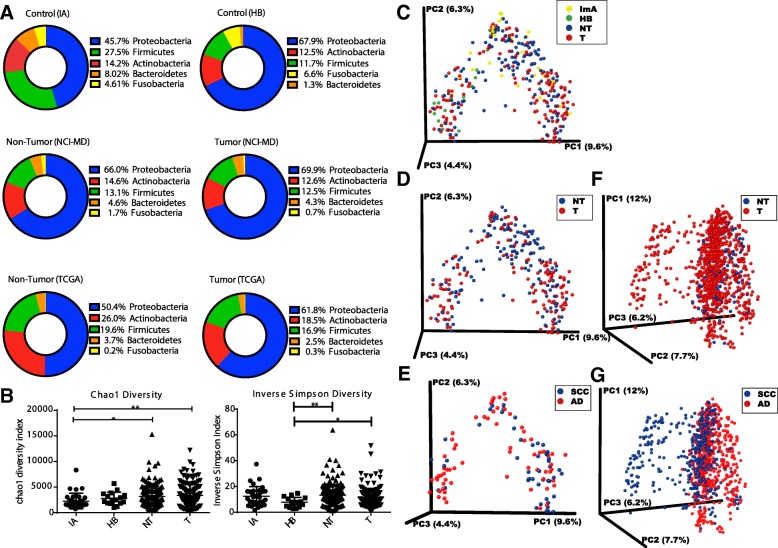
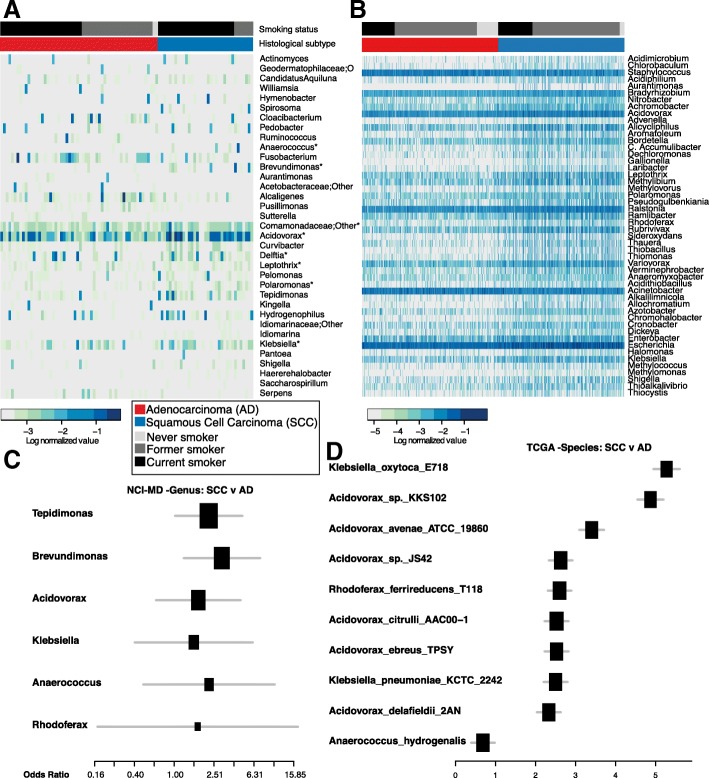
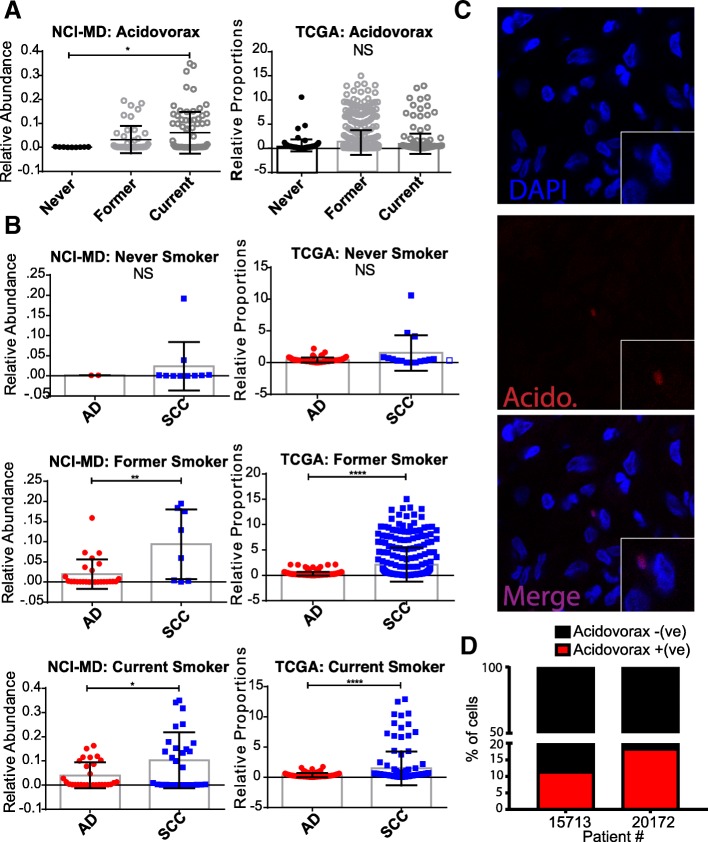
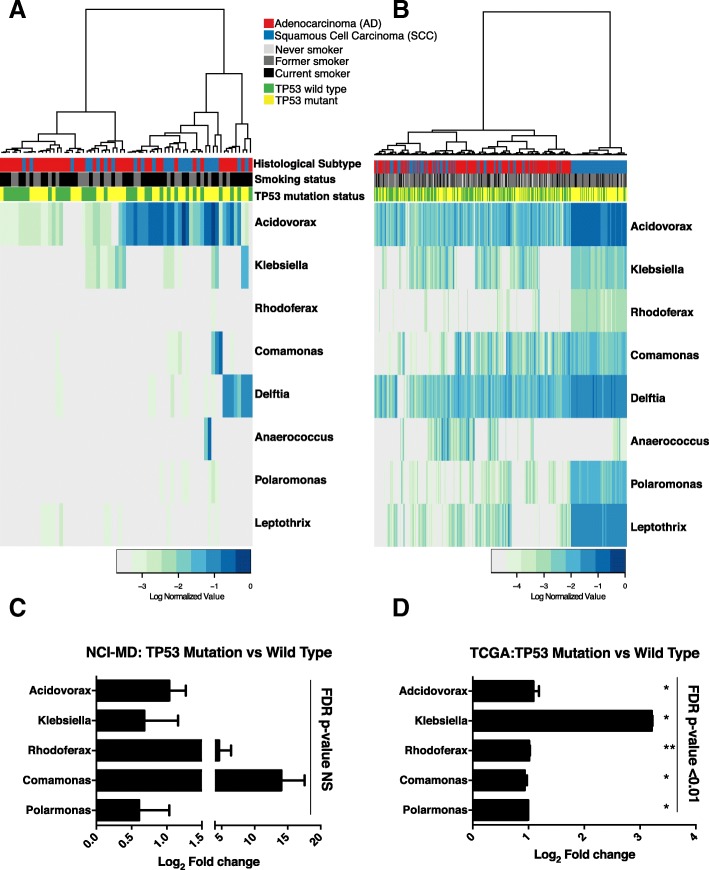
Background: Lung cancer is the leading cancer diagnosis worldwide and the number one cause of cancer deaths. Exposure to cigarette smoke, the primary risk factor in lung cancer, reduces epithelial barrier integrity and increases susceptibility to infections. Herein, we hypothesize that somatic mutations together with cigarette smoke generate a dysbiotic microbiota that is associated with lung carcinogenesis. Using lung tissue from 33 controls and 143 cancer cases, we conduct 16S ribosomal RNA (rRNA) bacterial gene sequencing, with RNA-sequencing data from lung cancer cases in The Cancer Genome Atlas serving as the validation cohort. Results: Overall, we demonstrate a lower alpha diversity in normal lung as compared to non-tumor adjacent or tumor tissue. In squamous cell carcinoma specifically, a separate group of taxa are identified, in which Acidovorax is enriched in smokers. Acidovorax temporans is identified within tumor sections by fluorescent in situ hybridization and confirmed by two separate 16S rRNA strategies. Further, these taxa, including Acidovorax , exhibit higher abundance among the subset of squamous cell carcinoma cases with TP53 mutations, an association not seen in adenocarcinomas. Conclusions: The results of this comprehensive study show both microbiome-gene and microbiome-exposure interactions in squamous cell carcinoma lung cancer tissue. Specifically, tumors harboring TP53 mutations, which can impair epithelial function, have a unique bacterial consortium that is higher in relative abundance in smoking-associated tumors of this type. Given the significant need for clinical diagnostic tools in lung cancer, this study may provide novel biomarkers for early detection.
Overview
The claims and statistics of this paper haven’t been checked yet.
Free: it reads the open-access text and checks the first 5 claims that cite a source we can check. Create a free account to check every claim.
Integrity signals
Registry
Cites
Statistics
Figures
Verification
Claims the paper makes
The claims and statistics of this paper haven’t been checked yet.
Free: it reads the open-access text and checks the first 5 claims that cite a source we can check. Create a free account to check every claim.
Claims other papers make about this one
Each is checked against this paper’s own text: does it say what the citing paper says it does?
The source backs part of the claim, not all of it — or backs it for a different population, condition or comparison.
In the citing paper
“it is also important to use mechanical tissue shearing in the DNA isolation protocol to ensure the complete recovery of DNA from within the cell wall of Gram-positive bacteria—a step not included in most standard DNA isolation protocols (6, 7).”
From The human tumor microbiome is composed of tumor type–specific intracellular bacteria (2020) · cites this paper as [6]
Experimental — accuracy not yet measuredThe cited source says what the claim attributes to it.
In the citing paper
“Intratumor bacteria have been reported in many tumor types (2-19)”
From The human tumor microbiome is composed of tumor type–specific intracellular bacteria (2020) · cites this paper as [6]
Self-check
Percentages, sums and reported differences re-computed from the paper’s own numbers.
The self-check needs the paper’s full text.
Citations
Cites
QIIME allows analysis of high-throughput community sequencing data
Caporaso, J. G., Kuczynski, J., Stombaugh, J., Bittinger, K., Bushman, F. D., Costello, E. K., Fierer, N., Peña, A. G., Goodrich, J. K., Gordon, J. I., et al. (2010) · Nature Methods · doi:10.1038/nmeth.f.303 · Cited by 34,887
(1968) · American Association of Industrial Nurses Journal · doi:10.1177/216507996801601208 · Cited by 8,798
Kozich, J. J., Westcott, S. L., Baxter, N. T., Highlander, S. K., & Schloss, P. D. (2013) · Applied and Environmental Microbiology · doi:10.1128/aem.01043-13 · Cited by 7,112
Comprehensive genomic characterization of squamous cell lung cancers
The Cancer Genome Atlas Research Network (2012) · Nature · doi:10.1038/nature11404 · Cited by 3,994
Commensal Bifidobacterium promotes antitumor immunity and facilitates anti–PD-L1 efficacy
Sivan, A., Corrales, L., Hubert, N., Williams, J. B., Aquino-Michaels, K., Earley, Z. M., Benyamin, F. W., Man Lei, Y., Jabri, B., Alegre, M.-L., et al. (2015) · Science · doi:10.1126/science.aac4255 · Cited by 3,888
Kostic, A. D., Chun, E., Robertson, L., Glickman, J. N., Gallini, C. A., Michaud, M., Clancy, T. E., Chung, D. C., Lochhead, P., Hold, G. L., et al. (2013) · Cell Host & Microbe · doi:10.1016/j.chom.2013.07.007 · Cited by 2,718
Rubinstein, M. R., Wang, X., Liu, W., Hao, Y., Cai, G., & Han, Y. W. (2013) · Cell Host & Microbe · doi:10.1016/j.chom.2013.07.012 · Cited by 2,476
Disordered Microbial Communities in Asthmatic Airways
Hilty, M., Burke, C., Pedro, H., Cardenas, P., Bush, A., Bossley, C., Davies, J., Ervine, A., Poulter, L., Pachter, L., et al. (2010) · PLoS ONE · doi:10.1371/journal.pone.0008578 · Cited by 1,824
Wu, S., Rhee, K.-J., Albesiano, E., Rabizadeh, S., Wu, X., Yen, H.-R., Huso, D. L., Brancati, F. L., Wick, E., McAllister, F., et al. (2009) · Nature Medicine · doi:10.1038/nm.2015 · Cited by 1,812
Escherichia coli Induces DNA Double-Strand Breaks in Eukaryotic Cells
Nougayrède, J.-P., Homburg, S., Taieb, F., Boury, M., Brzuszkiewicz, E., Gottschalk, G., Buchrieser, C., Hacker, J., Dobrindt, U., & Oswald, E. (2006) · Science · doi:10.1126/science.1127059 · Cited by 1,188
Research works printed but not linked: 1
- Sequence read archive. http://www.ncbi.nlm.nih.gov/bioproject/320383.
Cited by
Items 201–300 of 495
Xie, W., Sharma, A., Kaushik, H. K., Sharma, L., Nistha, Anwer, M. K., Sachdeva, M., Elossaily, G. M., Zhang, Y., Pillappan, R., et al. (2024) · Heliyon · doi:10.1016/j.heliyon.2024.e35336 · Cited by 16
“This finding has prompted inquiries into the potential significance of breast tissue microbiota in the context of breast cancer development, and it calls for additional exploration in this field [122].”
BackgroundThe oncomicrobiome: New insights into microorganisms in cancer
Ma, Y., Chen, T., Sun, T., Dilinuer, D., & Xiao, Y. (2024) · Microbial Pathogenesis · doi:10.1016/j.micpath.2024.107091 · Cited by 16
Tong, S., Huang, K., Xing, W., Chu, Y., Nie, C., Ji, L., Wang, W., Tian, G., Wang, B., & Yang, J. (2024) · Computational Biology and Chemistry · doi:10.1016/j.compbiolchem.2024.108274 · Cited by 16
Li, X., Jia, Y., Li, Y., Hei, H., Zhang, S., & Qin, J. (2025) · Frontiers in Immunology · doi:10.3389/fimmu.2025.1582166 · Cited by 16
“The crosstalk between metabolic reprogramming and microbiota regulates cancer progression. metabolic reprogramming can play a role in microbiota-mediated tumorigenesis, metastasis and drug resistance in different cancers. metabolic pathways (109).”
Qiu, Q., Lu, D., Liu, G., Yang, X., Li, J., Ren, H., Liu, J., Sun, B., & Zhang, Y. (2022) · Bioconjugate Chemistry · doi:10.1021/acs.bioconjchem.2c00407 · Cited by 16
James, B. A., Williams, J. L., & Nemesure, B. B. (2023) · Frontiers in Genetics · doi:10.3389/fgene.2023.1141058 · Cited by 16
“Current clinical TKIs that target EGFR mutations include erlotinib, getfitnib, and afatinib (Maemondo et al., 2010; Zhou et al., 2011; Sequist et al., 2013; Greathouse et al., 2018; Lusk et al., 2019b).”
BackgroundHarnessing Tissue Engineering Tools to Interrogate Host-Microbiota Crosstalk in Cancer
Udayasuryan, B., Nguyen, T. T. D., Slade, D. J., & Verbridge, S. S. (2020) · iScience · doi:10.1016/j.isci.2020.101878 · Cited by 16
“, 2012), high abundance of Acidovorax temporans in lung cancers with TP53 mutations (Greathouse et al., 2018), and variations in the oral and gut microbiome of patients with melanoma undergoing PD-1 immunotherapy (Gopalakrishnan et al.”
BackgroundMa, Q., Li, X., Jiang, H., Fu, X., You, L., You, F., & Ren, Y. (2023) · Critical Reviews in Microbiology · doi:10.1080/1040841x.2023.2247493 · Cited by 15
“F. nucleatum has also been detected in the oral cavity and tumor tissues of patients with lc. Greathouse et al. (Greathouse et al. 2018) showed that F. nucleatum was enriched in the tumor tissues of patients with lUSc compared to adjacent non-tumor tissues.”
Fine Particulate Matter Perturbs the Pulmonary Microbiota in Broiler Chickens
Zhou, Y., Xu, B., Wang, L.-Y., Zhang, C., & Li, S. (2023) · Animals · doi:10.3390/ani13182862 · Cited by 15
“The future research will focus on the specific mechanism of the pulmonary microbiota in lung injury induced by PM 2.5 .”
BackgroundInfluentialThe microbiome in the pathogenesis of lung cancer
Miao, S., & Qiu, H. (2023) · Apmis · doi:10.1111/apm.13359 · Cited by 15
“It has been proposed that the bacteria associated with LUSC are more diverse than those associated with LUAD, especially in male LUSC patients who smoke heavily [13].”
BackgroundQiu, J., Jiang, Y., Ye, N., Jin, G., Shi, H., & Qian, D. (2024) · Journal of Translational Medicine · doi:10.1186/s12967-024-05531-x · Cited by 15
“Higher levels of relative Acidovorax and Comamo-nas abundance have also been described in patients with LUSC who were smokers and harbored mutations in TP53 [36, 37].”
BackgroundTargeting Intratumoral Bacteria for Cancer Treatment
Shi, J., Liang, J., Li, Y., Zhang, Z., Sun, J. X., He, Z., Luo, C., Qu, X., Che, X., & Zhang, S. (2025) · Small · doi:10.1002/smll.202505651 · Cited by 15
Deepika, Alsharari, Z. D., Ahmad, M. F., Singh, J., Yadav, M., Kumari, A., Kumar, A., Matthews, K. R., Aluko, R. E., Raposo, A., et al. (2025) · Frontiers in Nutrition · doi:10.3389/fnut.2025.1624803 · Cited by 15
“In addition to the effect that cancer treatment has on tumors, a growing body of evidence suggests that it can also affect harmful microbiota (63).”
Zhou, S., Chen, M., Ding, R., Shui, L., Zhao, Q., & Luo, W. (2021) · Molecular Medicine Reports · doi:10.3892/mmr.2021.12191 · Cited by 15
Shi, L., Fan, Q., Zhou, B., Wu, J., Jin, M., Yu, D., Zhang, T., Song, J., & Liu, H. (2021) · Acta Biochimica et Biophysica Sinica · doi:10.3724/abbs.2021010 · Cited by 15
“Acidovorax exhibits higher abundance in lung squamous cell carcinoma with TP53 mutation but not in adenocarcinoma [40].”
BackgroundSitthirak, S., Suksawat, M., Phetcharaburanin, J., Wangwiwatsin, A., Klanrit, P., Namwat, N., Khuntikeo, N., Titapun, A., Jarearnrat, A., Sangkhamanon, S., et al. (2022) · PeerJ · doi:10.7717/peerj.13876 · Cited by 15
Bacteria and macrophages in the tumor microenvironment
Xu, S. S., Xiong, Y., Fu, B., Guo, D. L., Sha, Z., Lin, X., & Wu, H. (2023) · Frontiers in Microbiology · doi:10.3389/fmicb.2023.1115556 · Cited by 14
“(2019) Lung cancer Proteobacteria Acidovorax Greathouse et al.”
Emerging roles of intratumoral microbiota: a key to novel cancer therapies
Fang, P., Yang, H. J., Zhang, H., Shuai, D., Li, M., Chen, L., & Liu, L. (2025) · Frontiers in Oncology · doi:10.3389/fonc.2025.1506577 · Cited by 14
Yan, C., Chen, Y., Tian, Y., Hu, S., Wang, H., Zhang, X., Chu, Q., Huang, S., & Sun, W. (2025) · Cellular Oncology · doi:10.1007/s13402-025-01103-3 · Cited by 14
Harnessing the Microbiome in Cancer Immunotherapy: Regulation, Prediction, and Therapeutic Targeting
Zarour, H. M., & Trinchieri, G. (2025) · Annual Review of Immunology · doi:10.1146/annurev-immunol-082323-114522 · Cited by 15
Self-citationHammond, J. A., Gordon, E. A., Socarras, K. M., Mell, J. C., & Ehrlich, G. D. (2020) · Biochemical Society Transactions · doi:10.1042/bst20190713 · Cited by 14
Self-citationZhang, L., Gong, Y., Zhang, L., Liang, B., Xu, H., Hu, W., Jin, Z., Wu, X. J., Chen, X., Li, M., et al. (2022) · Frontiers in Oncology · doi:10.3389/fonc.2022.1034750 · Cited by 14
“The AKT1 and C-MYC proteins were shown to be directly related to the growth of lung cancer cells (51, 52), and TP53 was also found to affect the progression of lung cancer (53).”
BackgroundLiang, P., Deng, H., Zhao, Y., Chen, Y., Zhang, J., He, J., & Liang, W. (2023) · Translational Lung Cancer Research · doi:10.21037/tlcr-23-357 · Cited by 14
Ren, Y., Ma, Q., Zeng, X. F., Huang, C., Tan, S.-Y., Fu, X., Zheng, C., You, F., & Li, X. (2024) · BMC Microbiology · doi:10.1186/s12866-024-03280-x · Cited by 14
“It is worth mentioning that a related discovery was that primary or recurrent lung cancer had a more α diversity microbiota than healthy lung tissue [37].”
BackgroundTissue-associated microbial detection in cancer using human sequencing data
Rodriguez, R. M., Khadka, V. S., Menor, M., Hernandez, B. Y., & Deng, Y. (2020) · BMC Bioinformatics · doi:10.1186/s12859-020-03831-9 · Cited by 14
Chen, T., Liu, C., Chen, T., Chen, M., Liu, S., Lin, P., & Lin, K. M.-C. (2021) · International Journal of Molecular Sciences · doi:10.3390/ijms222112069 · Cited by 14
“Among those genes listed in Table 1 but not in Table 2, NUPR1, TP53, CDKN1A, FOXO1, ESR1, and HDAC1 were also identified in the response to TGF-β,1 with p-values ranging between 0.01 and 10−10; thus, these genes should be considered as common regulators.”
BackgroundInfluentialYe, L., Wu, B., Xu, Z., Ji, X., Guan, L., Li, P., Li, Y., Cheng, H., & Xiao, J. (2023) · Journal of Neuro-Oncology · doi:10.1007/s11060-023-04318-2 · Cited by 14
“Thus far, several studies have used this method to obtain evidence for the existence of intra-tumoral bacteria in lung [4], ovary [5], breast [6], melanoma [7], colorectal [8] and pancreatic [9] cancers.”
Gut and Intratumoral microbiota: Key to lung Cancer development and immunotherapy
Cai, J., Zhang, W., Zhu, S., Lin, T., Mao, R., Wu, N., Zhang, P., & Kang, M. (2025) · International Immunopharmacology · doi:10.1016/j.intimp.2025.114677 · Cited by 13
Okudela, K., Matsumura, M., Arai, H., & Woo, T. (2021) · Cancer Science · doi:10.1111/cas.15031 · Cited by 13
Lung microbiota and potential treatment of respiratory diseases
Zhou, Y., Liu, M., Liu, K., Wu, G., & Tan, Y. (2023) · Microbial Pathogenesis · doi:10.1016/j.micpath.2023.106197 · Cited by 13
Potential role of intratumor bacteria outside the gastrointestinal tract: More than passengers
Liu, Z., Hong, L., & Ling, Z. (2023) · Cancer Medicine · doi:10.1002/cam4.6298 · Cited by 13
Lung Microbiome in Lung Cancer: A New Horizon in Cancer Study
Kashyap, M. K., Dutt, N., Ahirwar, D. K., & Yadav, P. (2024) · Cancer Prevention Research · doi:10.1158/1940-6207.capr-24-0147 · Cited by 13
Modulating the gut microbiome in non-small cell lung cancer: Challenges and opportunities
Lee, J. B., Huang, Y., Oya, Y., Nützinger, J., Ang, Y. L. E., Sooi, K. W. X., Cho, B. C., & Soo, R. A. (2024) · Lung Cancer · doi:10.1016/j.lungcan.2024.107862 · Cited by 13
Wang, H., Hu, J., Ma, Y., Abulimiti, Y., & Zhou, Y. (2025) · International Journal of Medical Sciences · doi:10.7150/ijms.107026 · Cited by 13
Panel 3: Genomics, precision medicine and targeted therapies
Santos‐Cortez, R. L. P., Bhutta, M. F., Earl, J. P., Hafrén, L., Jennings, M. P., Mell, J. C., Pichichero, M. E., Ryan, A. F., Tateossian, H., & Ehrlich, G. D. (2019) · International Journal of Pediatric Otorhinolaryngology · doi:10.1016/j.ijporl.2019.109835 · Cited by 13
“1 New technologies for 16S rRNA sequencing for OM bacterial pathogens—Recently an improved pan-bacterial domain molecular diagnostic (MDx) that uses PCR and circular consensus reads (CCS) of the entire bacterial 16S rRNA (FL16S) gene on Pacific Bioscience (PacBio) 3rd-4th generation sequencers has been developed [55,5…”
Self-citationPulmonary Micro-Ecological Changes and Potential Microbial Markers in Lung Cancer Patients
Ran, Z., Liu, J., Wang, F., Xin, C., Xiong, B., & Song, Z. (2021) · Frontiers in Oncology · doi:10.3389/fonc.2020.576855 · Cited by 13
“Further investigation found that a number of microorganisms, including Acidovorax, Klebsiella, Rhodoferax, Comamonas, and Polarmonas, were more abundant in squamous cell carcinoma with TP53 mutations (89).”
BackgroundZhang, M., Zhang, Y., Han, Y., Zhao, X., & Sun, Y. (2022) · Translational Cancer Research · doi:10.21037/tcr-22-92 · Cited by 13
“In recent years, metagenomics tools have revealed some important PMs related to LC, such as Haemophilus influenzae , Granulicatella , Abiotrophia , Streptococcus pneumoniae, Acidotrophic bacteria, Klebsiella, Moraxella catarrhalis, and Mycobacterium tuberculosis, among others (6-9).”
BackgroundGene-Microbiome Co-expression Networks in Colon Cancer
Uriarte-Navarrete, I., Lemus, E. H., & de Anda‐Jáuregui, G. (2021) · Frontiers in Genetics · doi:10.3389/fgene.2021.617505 · Cited by 13
Author Correction: Interaction between the microbiome and TP53 in human lung cancer
Greathouse, K. L., White, J. R., Vargas, A. J., Bliskovsky, V. V., Beck, J. A., von Muhlinen, N., Polley, E. C., Bowman, E. D., Ma, K., Robles, A. I., et al. (2020) · Genome biology · doi:10.1186/s13059-020-01961-0 · Cited by 13
Self-citationKwiatkowska, A. M., Guzmán, J. A., Lafaurie, G. I., Castillo, D. M., & Cardona, A. F. (2025) · Translational Oncology · doi:10.1016/j.tranon.2025.102557 · Cited by 12
“Ten articles [17,20,24,26,32 – 34, 49, 50, 59 ] nullified changes in alpha diversity in the oral”
Adade, E. E., Lakhen, K. A., Lemus, A. A., & Valm, A. M. (2021) · Current Opinion in Endocrine and Metabolic Research · doi:10.1016/j.coemr.2021.04.005 · Cited by 12
Self-citationRespiratory Tract Oncobiome in Lung Carcinogenesis: Where Are We Now?
Czarnecka, K. H., Kordiak, J., Brzeziańska‐Lasota, E., & Pastuszak‐Lewandoska, D. (2023) · Cancers · doi:10.3390/cancers15204935 · Cited by 12
Zhou, L. Q., Huang, L., Xu, Q., Lv, Y., Wang, Z., Zhan, P., Han, H., Shao, Y. W., Lin, D., Lv, T., et al. (2021) · Frontiers in Oncology · doi:10.3389/fonc.2021.596542 · Cited by 12
“fragilis) led to gene mutations (35), tobacco exposure had an effect on intestinal microbiome and could also produce new gene mutations (36, 37).”
BackgroundChang, M. R., Rusanov, D. A., Arakelyan, J., Alshehri, M. M., Asaturova, A. V., Kireeva, G. S., Babak, M. V., & Ang, W. H. (2022) · Coordination Chemistry Reviews · doi:10.1016/j.ccr.2022.214923 · Cited by 12
Obesity and cancer: unravelling the microbiome’s hidden role
Gaskell, C., MacDonald, R. S., Aleem, E. A., & Bendriss, G. (2025) · Frontiers in Nutrition · doi:10.3389/fnut.2025.1602603 · Cited by 11
Mechanisms of inflammation-driven lung cancer: From external influences to internal regulation
Wu, J., He, Z., Zhuang, W., Xia, X., Li, Z., Mo, A., Chen, Y., Chen, R., & Qiao, G. (2025) · Clinical Immunology · doi:10.1016/j.clim.2025.110572 · Cited by 11
Isozaki, S., Konishi, H., Tanaka, H., Yamamura, C., Moriichi, K., Ogawa, N., & Fujiya, M. (2022) · BMC Microbiology · doi:10.1186/s12866-022-02530-0 · Cited by 11
“in the gut, which were decreased due to chemotherapy, can improve the efficacy of therapies for lung cancer [34].”
BackgroundIntratumor microbiota as a novel potential prognostic indicator in mesothelioma
Pentimalli, F., Krstic–Demonacos, M., Costa, C., Mutti, L., & Bakker, E. Y. (2023) · Frontiers in Immunology · doi:10.3389/fimmu.2023.1129513 · Cited by 11
Emerging cellular and molecular interactions between the lung microbiota and lung diseases
Li, X., & Meng, X. (2021) · Critical Reviews in Microbiology · doi:10.1080/1040841x.2021.1992345 · Cited by 11
“A study by Greathouse et al. (2018) found that the interaction among microorganisms, smoking, and the TP53 gene contributes to smoking-induced carcinogenesis.”
BackgroundBahuguna, A., & Dubey, S. K. (2023) · Biochimica et Biophysica Acta (BBA) - Reviews on Cancer · doi:10.1016/j.bbcan.2023.188956 · Cited by 11
Cancer Microbiome; Opportunities and Challenges
Nallanchakravarthula, S., Amruta, N., & Ramamurthy, C. (2020) · Endocrine Metabolic & Immune Disorders - Drug Targets · doi:10.2174/1871530320999200818134942 · Cited by 11
Delineating the nexus between gut-intratumoral microbiome and osteo-immune system in bone metastases
Kapoor, S., Gupta, M., Sapra, L., Kaur, T., & Srivastava, R. K. (2024) · Bone Reports · doi:10.1016/j.bonr.2024.101809 · Cited by 10
Distinct Airway Microbiome and Metabolite Profiles in Eosinophilic and Neutrophilic Asthma
Liu, S., Lin, Z., Zhou, J., Yang, X., You, L., Yang, Q., Li, T., Hu, Z., Zhan, X., Jiang, Y., et al. (2025) · Journal of Asthma and Allergy · doi:10.2147/jaa.s521800 · Cited by 10
“33,34 The presence of these bacteria may influence the local immune response, promoting the recruitment and activation of eosinophils, which are central to the inflammatory process in EA.”
McElderry, J. P., Zhang, T., Wei, Z., Hoang, P. H., Anyaso-Samuel, S., Sang, J., Khandekar, A., Hartman, C., Colón-Matos, F. J., Miraftab, M., et al. (2025) · Nature Communications · doi:10.1038/s41467-025-66780-y · Cited by 10
Shen, S., Yu, S., Yao, D., Wu, H., & Qian, Y. (2024) · Translational Cancer Research · doi:10.21037/tcr-24-107 · Cited by 10
“In addition, specific microbes have been identified in the lung tumor environment ( 5-7 ) and demonstrated to be involved in regulating tumor behavior and the local immune microenvironment through multiple mechanisms, including modulating microbiome dysbiosis, genotoxicity, and virulence effects as…”
Microbiome—Stealth Regulator of Breast Homeostasis and Cancer Metastasis
Furuta, S. (2024) · Cancers · doi:10.3390/cancers16173040 · Cited by 10
Zhou, Y. L., Leung, M. H. Y., Tong, X., Lee, J. Y. Y., & Lee, P. K. H. (2021) · Environmental Science & Technology · doi:10.1021/acs.est.1c03941 · Cited by 10
Ochi, T., Fujiki, R., Fukuyo, M., Rahmutulla, B., Nakagawa, T., Ota, M., Ikeda, J., Matsui, Y., Yoshino, I., Suzuki, H., et al. (2025) · Cancer Science · doi:10.1111/cas.70080 · Cited by 9
“Microbiome has been detected from lung cancer tumors [4], but studies have mainly focused on bacteria outside the tumor, such as sputum and bronchoalveolar lavage fluid [5, 6], with limited investigation of intratumoral bacteria [7, 8].”
Dynamic balance of the lung microbiome in health and respiratory diseases
Wang, X., Bi, L., Li, J., Liu, D., Li, W., & Wang, Z. (2025) · Chinese Medical Journal · doi:10.1097/cm9.0000000000003712 · Cited by 9
“Greathouse et al [110] noted that SCC with TP53 mutations disrupted normal epithelial function, thereby allowing specific microorganisms, such as Acidovorax , to colonize within tumor tissues.”
Shome, M., Gao, W., Engelbrektson, A. L., Song, L., Williams, S. A., Murugan, V., Park, J. G., Chung, Y., LaBaer, J., & Qiu, J. (2022) · Cancer Epidemiology Biomarkers & Prevention · doi:10.1158/1055-9965.epi-22-0384 · Cited by 9
The Anti- and Pro-Tumorigenic Role of Microbiota and Its Role in Anticancer Therapeutic Strategies
Greco, G., Zeppa, S. D., Agostini, D., Attisani, G., Stefanelli, C., Ferrini, F., Sestili, P., & Fimognari, C. (2022) · Cancers · doi:10.3390/cancers15010190 · Cited by 9
Polymerase Chain Reaction Chips for Biomarker Discovery and Validation in Drug Development
Vo, D.-K., & Trinh, K. T. L. (2025) · Micromachines · doi:10.3390/mi16030243 · Cited by 9
Zhang, Y., Wang, Y., Yang, J., Ji, L., Yao, Y., Ren, D., & Zhang, J. (2025) · Physiological Genomics · doi:10.1152/physiolgenomics.00204.2024 · Cited by 10
Jang, J. Y., Seo, J. H., Choi, J., Ryu, H. J., Yun, H., Ha, D. M., & Yang, J. (2025) · International Journal of Molecular Medicine · doi:10.3892/ijmm.2025.5560 · Cited by 9
[Research Progress and New Immunotherapy Strategies of Tumor Microenvironment Metabolism].
Peng, Y., Luo, X.-M., & Chen, J.-Y. (2023) · 四川大学学报:医学版 · doi:10.12182/20230560502 · Cited by 9
Gut Microbes’ Impact on Oncogenic Drivers: Location Matters
White, M. G., & Wargo, J. A. (2020) · Molecular Cell · doi:10.1016/j.molcel.2020.08.021 · Cited by 9
“, 2019) including associations with oncogenic drivers such as p53 (Greathouse et al., 2018).”
BackgroundComprehensive Analysis of the Immune and Prognostic Implication of MMP14 in Lung Cancer
Zheng, C., Lu, Q., Zhang, N., Jing, P., Zhang, J.-P., Wang, W.-P., & Li, G.-Z. (2021) · Disease Markers · doi:10.1155/2021/5917506 · Cited by 9
Liu, F., Lu, X., Tang, M., Chen, Y., & Zheng, X. E. (2025) · Cancer Management and Research · doi:10.2147/cmar.s499003 · Cited by 8
Recent Advances in Nanomedicine for Modulating Intratumoral Bacteria in Cancer Therapy
Zhang, Y., Zhang, H., Xu, J., Xu, Z., Lou, J., Zheng, Q., Yuan, S., Zhu, L., & Xu, X. (2025) · Molecular Pharmaceutics · doi:10.1021/acs.molpharmaceut.5c00677 · Cited by 8
Deng, X., Chen, X., Luo, Y., Que, J., & Chen, L. (2023) · Frontiers in Microbiology · doi:10.3389/fmicb.2023.1202454 · Cited by 8
“identified a correlation between Acidovorax, a bacterium associated with smoking, and the progression of lung squamous cell carcinoma harboring TP53 mutations (Greathouse et al., 2018).”
BackgroundA comprehensive insight of complex interplay of microbiota in pulmonary diseases
Yu, J., Li, P., Yu, Y., Ma, Y., Zuo, S., Chen, H., Guo, F., & Sun, Y. (2024) · Discover Medicine · doi:10.1007/s44337-024-00063-1 · Cited by 8
“• Acidovorax displayed higher abundance in cases of squamous cell carcinoma associated with TP53 mutations, a correlation not observed in adenocarcinoma [60].”
Intratumoral Microbiota: Insights from Anatomical, Molecular, and Clinical Perspectives
Lombardo, C., Fazio, R., Sinagra, M., Gattuso, G., Longo, F., Lombardo, C., Salmeri, M., Zanghì, G., & Loreto, C. (2024) · Journal of Personalized Medicine · doi:10.3390/jpm14111083 · Cited by 8
Palkovský, M., Modráčková, N., Bunešová, V., Liberko, M., & Soumarová, R. (2024) · In Vivo · doi:10.21873/invivo.13803 · Cited by 8
Yang, H., Zhang, J., Feng, H., Qi, F., Kong, F.-J., Zhu, W.-J., Liang, C., & Zhang, Z.-R. (2025) · Frontiers in Oncology · doi:10.3389/fonc.2024.1498524 · Cited by 8
“The correlation between the composition of intratumoral microbiota and gene mutations was also found in lung cancer (14).”
A Perspective on Lung Cancer and Lung Microbiome: Insight on Immunity
Emadi, R., Saki, S., Yousefi, P., & Tabibzadeh, A. (2025) · Immunity Inflammation and Disease · doi:10.1002/iid3.70145 · Cited by 8
Liu, S., Pan, Y., Zheng, C., Zheng, Q., Du, Y., Zheng, Y., Tang, H., Liu, X., Mou, J., Zeng, X. Y., et al. (2025) · mBio · doi:10.1128/mbio.03873-24 · Cited by 8
Holistic immunomodulation for small cell lung cancer
Leung, E. L., Fan, X., Huang, J., Huang, C., Lin, H., & Cao, Y. (2022) · Seminars in Cancer Biology · doi:10.1016/j.semcancer.2022.11.012 · Cited by 8
Socarras, K. M., Earl, J. P., Król, J. E., Bhat, A., Pabilonia, M., Harrison, M. H., Lang, S. P., Sen, B., Ahmed, A., Hester, M., et al. (2021) · Genetic Testing and Molecular Biomarkers · doi:10.1089/gtmb.2021.0088 · Cited by 8
“…a comprehensive, unbiased species-specific molecular diagnostic; this was accomplished by developing a long-read 16S microbiome assay that combined the breadth of traditional microbiome assays with the specificity of simplex/multiplex PCR-based assays (Earl et al. , 2018; Greathouse et al. , 2018).”
Self-citationRespiratory microbiome-host interaction on lung carcinogenesis, immunity, and immunotherapy
Wang, P., Ge, C., Jing, X., Han, Q., Wang, M., Huang, M., & Xiang, Z. (2025) · Frontiers in Immunology · doi:10.3389/fimmu.2025.1676302 · Cited by 7
“Aspects of genetic mutations and signaling pathways, microbiome-smoking interactions correlate with TP53 mutations in LUSC, particularly the enrichment of polycyclic aromatic hydrocarbon-degrading genera ( Acidovorax, Massilia ) in smokers ’ tumor microbiota (31).”
Liu, Y., Wang, S., Xiang, X., Du, Y., Xue, Q., Niu, Y., Peng, W., Ye, L., & Zhou, Q. (2026) · International Journal of Biological Sciences · doi:10.7150/ijbs.126977 · Cited by 7
“Conversely, some studies have reported increased α -diversity in tumor tissues [31-33], BALF [34, 35], and even saliva samples [36] from lung cancer patients compared with control groups, which predominantly comprised patients with specific respiratory diseases such as emphysema-only cases,…”
InfluentialRecent progress on drug delivery systems of regulating intratumoral bacteria for tumor therapy
Feng, J. Q., Liu, Y., Gong, L., Liu, C., Xiao, C., Chen, L., Jin, M., Gao, Z., Huang, W., & Li, Y. (2025) · Chinese Chemical Letters · doi:10.1016/j.cclet.2025.110907 · Cited by 7
Yuan, Q. M., Wu, H., Tan, H., Wang, X., Cao, Y., & Chen, G. (2025) · Cancers · doi:10.3390/cancers17132181 · Cited by 7
“Similarly, Proteobacteria , which encompass genera such as Escherichia , Salmonella , and Pseudomonas , have been shown to contribute to cancer-related inflammation, genotoxicity, and metabolic dysregulation [56–58].”
Human microbial dysbiosis as driver of gynecological malignancies
Mandal, S., Bandyopadhyay, S., Tyagi, K., & Roy, A. (2022) · Biochimie · doi:10.1016/j.biochi.2022.02.005 · Cited by 8
Pragmatic Expectancy on Microbiota and Non-Small Cell Lung Cancer: A Narrative Review
Stella, G. M., Scialò, F., Bortolotto, C., Agustoni, F., Sanci, V., Saddi, J., Casali, L., Corsico, A. G., & Bianco, A. (2022) · Cancers · doi:10.3390/cancers14133131 · Cited by 7
“, which is specifically associated with both squamous-cell histology and smoking habit [65].”
BackgroundWang, W., Liang, X., Kong, H., Yang, Y. P., Xia, Y., Wang, Q., Xia, A., & Geng, J. (2023) · Respiratory Research · doi:10.1186/s12931-023-02420-7 · Cited by 7
“show an increased alpha diversity (both Chao and Simpson indexes) in neoplastic lung tissue compared with normal lung [38].”
Background[Mechanism and Research Progress of Microbiome in the Development of Lung Cancer].
Liu, G., Gu, A., & Mingyan, E. (2020) · PubMed Central · doi:10.3779/j.issn.1009-3419.2020.101.38 · Cited by 7
Chau, J., & Zhang, J. (2021) · International Journal of Molecular Sciences · doi:10.3390/ijms22157900 · Cited by 7
“In a multirepository study of the respiratory microbiome of lung cancer patients, an overabundance of Proteobacteria and decrease in Firmicutes was identified [19].”
BackgroundDe- “bug”-ing the microbiome in lung cancer
Birla, P., & Shaikh, F. Y. (2022) · Cancer and Metastasis Reviews · doi:10.1007/s10555-022-10036-4 · Cited by 7
“found Acidovaorax was more abundant in former and current smokers as compared to never smokers with squamous cell carcinoma with TP53 mutations (n = 117), further validated by data from TCGA and florescence in situ hybridization of tumor samples [52].”
ResultHuman microbiota: A crucial gatekeeper in lung cancer initiation, progression, and treatment
Zhou, Y., & Chen, T. (2022) · Medicine in Microecology · doi:10.1016/j.medmic.2022.100055 · Cited by 7
Chen, M., Cui, Y., Liu, C., Tong, X., Wang, M., Wu, C., Liu, Y., Zhao, Y., & Chen, X. (2023) · Environmental Science and Pollution Research · doi:10.1007/s11356-023-25528-1 · Cited by 7
Zhao, M., Tian, J., Hou, W., Yin, L., & Li, W. (2024) · Frontiers in Microbiology · doi:10.3389/fmicb.2024.1416385 · Cited by 6
A scoring model based on bacterial lipopolysaccharide-related genes to predict prognosis in NSCLC
Bao, N., Zhang, X., Lin, C., Qiu, F., & Mo, G. (2024) · Frontiers in Genetics · doi:10.3389/fgene.2024.1408000 · Cited by 6
Yang, Y., Shen, J., Wei, S., Ye, M., Zhao, X., Zhou, J., Tong, L., Hu, J., Song, Y., Wu, S., et al. (2025) · BMC Microbiology · doi:10.1186/s12866-025-04325-5 · Cited by 6
“…microbiota is known to participate in immune modulation [45], our study revealed Firmicutes dominating healthy controls, mirroring findings from Morris et al. [46] and Segal et al. [47], while significant Proteobacteria enrichment in cancer that parallels the observations of Greathouse et al. [48].”
The interplay of the microbiome and breast cancer: beyond the gut: a narrative review
Singh, P. K., Rathi, D., Shweliya, M. A., Farooq, A., Anfaal, Z., Saleem, N. U. A., Hamza, M., Qadri, M., Rath, S., Hemida, M. F., et al. (2025) · Annals of Medicine and Surgery · doi:10.1097/ms9.0000000000004108 · Cited by 6
Wang, J., Su, Z., Zhang, X., Wang, S., Chen, X., Xu, X., He, B., & Zheng, Y. (2025) · Biomaterials · doi:10.1016/j.biomaterials.2025.123915 · Cited by 6
Kapoor, A., Gupta, A., Sansar, B., Mishra, B. K., Kallapura, G., Giridhar, P., & Kumar, R. (2026) · JCO oncology advances. · doi:10.1200/oa-25-00194 · Cited by 6
Dong, Y. W., Yi, L., Song, Q., & Yao, Y. (2022) · Frontiers in Genetics · doi:10.3389/fgene.2022.997319 · Cited by 6
Dhilipkannah, P., Sachdeva, A., Holden, V. K., & Jiang, F. (2024) · Current Oncology · doi:10.3390/curroncol31100444 · Cited by 6
“Fifth, we have demonstrated that circulating bacterial DNA can serve as plasma biomarkers for early lung cancer detection [34–36].”
BackgroundZhai, X., Lin, D., Shen, Y., Zhai, N., Fan, Y., Zhang, J., Lin, Y., Wang, Y., Zhou, Q., & Zheng, X. E. (2025) · Frontiers in Oncology · doi:10.3389/fonc.2024.1492571 · Cited by 6
“However, one previous study reported a signi fi cant enrichment of Acidovorax in lung squamous cell carcinomas carrying TP53 mutations with a history of smoking, which is inconsistent with our results and may be related to sequencing methods, manipulation, etc. (36).”
Mackenzie, G. G. (2021) · Elsevier eBooks · doi:10.1016/b978-0-12-823397-9.00003-x · Cited by 6
Metadata
- Authors
- Greathouse, K. L., White, J. R., Vargas, A. J., Bliskovsky, V. V., Beck, J. A., von Muhlinen, N., Polley, E. C., Bowman, E. D., Khan, M. A., Robles, A. I., Cooks, T., Ryan, B. M., Padgett, N., Dzutsev, A. H., Trinchieri, G., Pineda, M. A., Bilke, S., Meltzer, P. S., Hokenstad, A. N., Stickrod, T. M., Walther-Antonio, M. R., Earl, J. P., Mell, J. C., Krol, J. E., Balashov, S. V., Bhat, A. S., Ehrlich, G. D., Valm, A., Deming, C., Conlan, S., Oh, J., Segre, J. A., & Harris, C. C.
- Affiliations
- National Institutes of Health (US)
- Resphera Biosciences (US)
- Mayo Clinic (US)
- Drexel University (US)
- Jackson Laboratory (US)
- Corresponding author
- Harris, Curtis C.
- ORCID
- Greathouse, K. Leigh
- White, James R.
- Beck, Jessica A.
- Polley, Eric C.
- Bowman, Elise D.
- Robles, Ana I.
- Cooks, Tomer
- Ryan, Bríd M.
- Trinchieri, Giorgio
- Pineda, Marbin A.
- Bilke, Sven
- Meltzer, Paul S.
- Walther-Antonio, Marina R.
- Earl, Joshua P.
- Mell, Joshua C.
- Bhat, Archana S.
- Ehrlich, Garth D.
- Valm, Alex
- Conlan, Sean
- Oh, Julia
- Harris, Curtis C.
- Venue
- Genome Biology
- Published
- 2018-08-24
- Volume
- 19
- Issue
- 1
- Pages
- 123-123
- ISSN
- 1465-6906 (ISSN-L)
- 1474-760X
- PMC
- PMC6109311
- OpenAlex
- W2888696120
- Semantic Scholar
- 67f1094d2164a99d3db9b2e3e4d9c95e7d6e47e7
- Cited by
- 446
- References
- 55
- Citations by year
- 2026: 39 · 2025: 83 · 2024: 70 · 2023: 68 · 2022: 72 · 2021: 56 · 2020: 41 · 2019: 16
- FWCI
- 10.05
- Type
- journal article
- Language
- en
- Update notices
- correction (2020-02-20)
- Open access
- gold
- doi.org
- Licence
- cc-by
- creativecommons.org/licenses/by/4.0/ (tdm)
- creativecommons.org/licenses/by/4.0/ (vor)
- Locations
- Genome biology (publishedVersion, cc-by)
- Europe PMC (PubMed Central) (publishedVersion, other-oa)
- PubMed Central (publishedVersion, cc-by)
- PubMed (publishedVersion)
- DOAJ (DOAJ: Directory of Open Access Journals) (submittedVersion, cc-by-sa)
- The Mouseion at the JAXlibrary (Jackson Laboratory) (submittedVersion, cc-by)
- Funders
- National Cancer Institute (Intramural)
- Topics
- Life Sciences › Biochemistry, Genetics and Molecular Biology › Molecular Biology › Gut microbiota and health
- Health Sciences › Dentistry › Periodontics › Oral microbiology and periodontitis research
- Life Sciences › Biochemistry, Genetics and Molecular Biology › Cancer Research › Cancer Genomics and Diagnostics
- Keywords
- lung cancer, microbiome, TP53 mutation, squamous cell carcinoma, cigarette smoking, bacterial dysbiosis, lung carcinogenesis, epithelial barrier integrity, lung adenocarcinoma, alpha diversity, early diagnosis biomarkers
- MeSH terms
- Smokers, Adult, Aged, Female, Humans, Lung Neoplasms, Male, Middle Aged, Mutation, Reproducibility of Results, Tumor Suppressor Protein p53, Neoplasms, Squamous Cell, Proteobacteria, Comamonadaceae, Biodiversity, Microbiota
About these checks
Registry, retraction, Cites and statistics results are computed, not judged, with one exception: a printed reference that no index lists is read once by a model before it counts as a citation error. Claims are extracted by a model and kept only when their quote appears verbatim in the text; each cited source is then checked, with a model’s help, for whether it says what the claim relies on. Those verdicts can be wrong — read the claim’s quote and the cited source before relying on one.
Statistics and arithmetic are recomputed, not judged.
Confidence bands are shown only for fields calibrated on our annotated test set. None is calibrated yet, so no band is shown.
What counts as a claim ›How we measure confidence ›How we check this ›
Are you an author, or do you see a problem with this page? Request a review
Data sources
Bibliographic data: Semantic Scholar, OpenAlex, Crossref.
Contains information from the Semantic Scholar Academic Graph Datasets, made available under the ODC Attribution License (ODC-BY 1.0).
Semantic Scholar’s data is described in: Kinney, R., et al. (2023). The Semantic Scholar Open Data Platform. arXiv:2301.10140.
