

Single-cell transcriptomics unveils gene regulatory network plasticity
Open accessPublished version of a preprint
The DOI matches its Crossref record; 67 of the 68 references it cites were found in a registry or an index.
Abstract
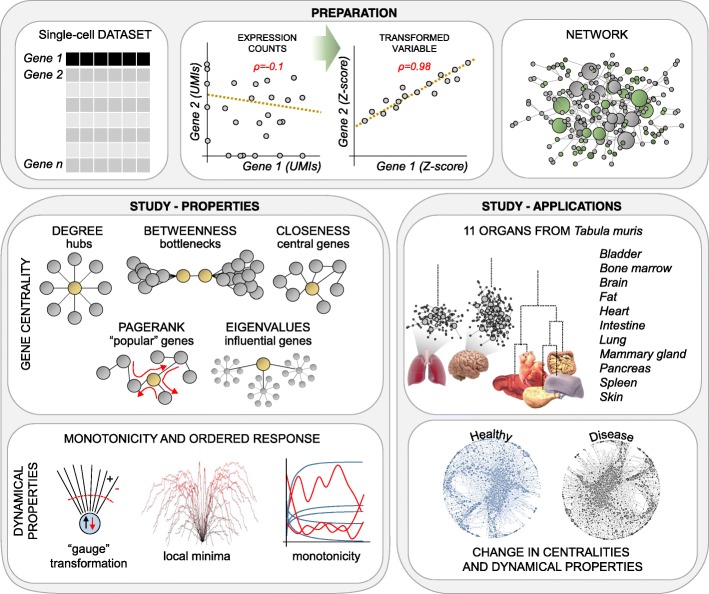
BACKGROUND: Single-cell RNA sequencing (scRNA-seq) plays a pivotal role in our understanding of cellular heterogeneity. Current analytical workflows are driven by categorizing principles that consider cells as individual entities and classify them into complex taxonomies. RESULTS: We devise a conceptually different computational framework based on a holistic view, where single-cell datasets are used to infer global, large-scale regulatory networks. We develop correlation metrics that are specifically tailored to single-cell data, and then generate, validate, and interpret single-cell-derived regulatory networks from organs and perturbed systems, such as diabetes and Alzheimer's disease. Using tools from graph theory, we compute an unbiased quantification of a gene's biological relevance and accurately pinpoint key players in organ function and drivers of diseases. CONCLUSIONS: Our approach detects multiple latent regulatory changes that are invisible to single-cell workflows based on clustering or differential expression analysis, significantly broadening the biological insights that can be obtained with this leading technology.
Overview
The claims and statistics of this paper haven’t been checked yet.
Free: it reads the open-access text and checks the first 5 claims that cite a source we can check. Create a free account to check every claim.
Integrity signals
Registry
Cites
Statistics
Figures
Verification
Claims the paper makes
The claims and statistics of this paper haven’t been checked yet.
Free: it reads the open-access text and checks the first 5 claims that cite a source we can check. Create a free account to check every claim.
Claims other papers make about this one
Each is checked against this paper’s own text: does it say what the citing paper says it does?
The cited source says what the claim attributes to it.
In the citing paper
“In this respect, gene-regulatory network (GRN) modelling approaches are promising as they reconstruct systematic gene–gene associations from unperturbed single-cell omics data6–11.”
From Dissecting cell identity via network inference and in silico gene perturbation (2023) · cites this paper as [8]
Self-check
Percentages, sums and reported differences re-computed from the paper’s own numbers.
The self-check needs the paper’s full text.
Citations
Cites
Scenic: single-cell regulatory network inference and clustering.
Aibar, S., González-Blas, C. B., Moerman, T., Huynh-Thu, V. A., Imrichova, H., Hulselmans, G., Rambow, F., Marine, J.-C., Geurts, P., Aerts, J., et al. (2017) · Nature Methods · doi:10.1038/nmeth.4463 · Cited by 6,520 · cited 1×
“More recently, Aibar and colleagues developed the first tool designed to infer transcription factors and their target genes from single-cell data [60].”
BackgroundA Unique Microglia Type Associated with Restricting Development of Alzheimer’s Disease
Keren-Shaul, H., Spinrad, A., Weiner, A., Matcovitch-Natan, O., Dvir-Szternfeld, R., Ulland, T. K., David, E., Baruch, K., Lara-Astaiso, D., Toth, B., et al. (2017) · Cell · doi:10.1016/j.cell.2017.05.018 · Cited by 5,493
Cell types in the mouse cortex and hippocampus revealed by single-cell RNA-seq
Zeisel, A., Muñoz-Manchado, A. B., Codeluppi, S., Lönnerberg, P., La Manno, G., Juréus, A., Marques, S., Munguba, H., He, L., Betsholtz, C., et al. (2015) · Science · doi:10.1126/science.aaa1934 · Cited by 3,124
Single-cell transcriptomics of 20 mouse organs creates a Tabula Muris
The Tabula Muris Consortium, coordination, O., coordination, L., processing, O. C. A., sequencing, L. P. A., analysis, C. D., annotation, C. T., Writing group, Supplemental text writing group, & Principal investigators (2018) · Nature · doi:10.1038/s41586-018-0590-4 · Cited by 2,842 · cited 6×
“We apply this new metric to generate global, large scale regulatory networks for 11 mouse organs (Tabula Muris Consortium et al., 2018), for pancreas tissue from healthy individuals and patients with type 2 diabetes (Segerstolpe et al., 2016), and for a mouse model of Alzheimer’s disease (Keren-Shaul et al., 2017).”
MethodInfluentialMolecular Architecture of the Mouse Nervous System
Zeisel, A., Hochgerner, H., Lönnerberg, P., Johnsson, A., Memic, F., van der Zwan, J., Häring, M., Braun, E., Borm, L. E., La Manno, G., et al. (2018) · Cell · doi:10.1016/j.cell.2018.06.021 · Cited by 2,552
Using GOstats to test gene lists for GO term association
Falcon, S., & Gentleman, R. (2007) · Bioinformatics · doi:10.1093/bioinformatics/btl567 · Cited by 2,015
Recovering Gene Interactions from Single-Cell Data Using Data Diffusion
van Dijk, D., Sharma, R., Nainys, J., Yim, K., Kathail, P., Carr, A. J., Burdziak, C., Moon, K. R., Chaffer, C. L., Pattabiraman, D., et al. (2018) · Cell · doi:10.1016/j.cell.2018.05.061 · Cited by 1,829 · cited 1×
“We further tested MAGIC, a Markov affinity-based graph imputation method, previously shown to be able to denoise count matrixes and to fill in missing transcripts [23].”
MethodSingle-Cell Transcriptome Profiling of Human Pancreatic Islets in Health and Type 2 Diabetes
Segerstolpe, Å., Palasantza, A., Eliasson, P., Andersson, E.-M., Andréasson, A.-C., Sun, X., Picelli, S., Sabirsh, A., Clausen, M., Bjursell, M. K., et al. (2016) · Cell Metabolism · doi:10.1016/j.cmet.2016.08.020 · Cited by 1,550
Itani, S. I., Ruderman, N. B., Schmieder, F., & Boden, G. (2002) · Diabetes · doi:10.2337/diabetes.51.7.2005 · Cited by 1,390
Scale-free networks in cell biology
Albert, R. (2005) · Journal of Cell Science · doi:10.1242/jcs.02714 · Cited by 1,215
Cited by
Items 101–200 of 221
Single-Cell RNA Sequencing Procedures and Data Analysis
Wolfien, M., David, R., & Galow, A.-M. (2021) · Exon Publications eBooks · doi:10.36255/exonpublications.bioinformatics.2021.ch2 · Cited by 21
“In addition, further algorithms are used to infer global, large-scale regulatory networks on organ scale and perturbed systems, such as diabetes and Alzheimer’s disease (81), or reconstruct networks by using scRNA-seq data of barcoded genotypes (82).”
BackgroundWarming during embryogenesis induces a lasting transcriptomic signature in fishes
Ripley, D. M., Garner, T., Hook, S. A., Veríssimo, A., Grunow, B., Moritz, T., Clayton, P., Shiels, H. A., & Stevens, A. (2023) · The Science of The Total Environment · doi:10.1016/j.scitotenv.2023.165954 · Cited by 14
Wang, S., Ding, P., Yuan, J., Wang, H., Zhang, X., Chen, D., Ma, D., Zhang, X., & Wang, F. (2022) · Scientific Reports · doi:10.1038/s41598-022-21496-7 · Cited by 14
Karri, K., & Waxman, D. J. (2023) · Toxicology and Applied Pharmacology · doi:10.1016/j.taap.2023.116550 · Cited by 14
Gao, S., Wu, Z., Feng, X., Kajigaya, S., Wang, X., & Young, N. S. (2020) · BMC Genomics · doi:10.1186/s12864-020-07241-2 · Cited by 12
Zhang, S., Wu, J., Zhu, X., Song, H., Ren, L., Tang, Q., Xu, X., Liu, C., Zhang, J., Hu, W., et al. (2021) · Molecular Therapy — Nucleic Acids · doi:10.1016/j.omtn.2021.09.005 · Cited by 12
SOX17/ETV2 improves the direct reprogramming of adult fibroblasts to endothelial cells
Grath, A., & Dai, G. (2024) · Cell Reports Methods · doi:10.1016/j.crmeth.2024.100732 · Cited by 12
“43 scRNA-seq could also be used to analyze reprogrammed cells at different time points throughout the re-programming process to visualize the cell-state transition from the original cell type into the final cell type.”
MethodTurki, T., & Taguchi, Y. (2021) · Computers in Biology and Medicine · doi:10.1016/j.compbiomed.2021.104257 · Cited by 11
Raharinirina, N. A., Peppert, F., von Kleist, M., Schütte, C., & Sunkara, V. (2021) · Patterns · doi:10.1016/j.patter.2021.100332 · Cited by 11
Dissecting and improving gene regulatory network inference using single-cell transcriptome data
Xue, L., Wu, Y., & Lin, Y. (2023) · Genome Research · doi:10.1101/gr.277488.122 · Cited by 12
“…animal development, tumor progression, and immune response (Bendall et al. 2014; Trapnell et al. 2014; Aibar et al. 2017; Chan et al. 2017; Matsumoto et al. 2017; Fiers et al. 2018; Iacono et al. 2019; Pratapa et al. 2020; Qiu et al. 2020, 2022; Van de Sande et al. 2020; Deshpande et al. 2022).”
Andersen, G. T., Ianevski, A., Resell, M., Pojskić, N., Rabben, H.-L., Geithus, S., Kodama, Y., Tomita, H., Kainov, D. E., Grønbech, J. E., et al. (2024) · npj Systems Biology and Applications · doi:10.1038/s41540-024-00455-0 · Cited by 9
“GO and MSigDB enrichments were performed to visualize overrepresentation of KEGG_CELL_ADHESION_MOLECULES_CAMS 77 .”
Sun, Y., Shim, W. J., Shen, S., Sinniah, E., Pham, D., Su, Z., Mizikovsky, D., White, M. D., Ho, J. W. K., Nguyen, Q. H., et al. (2023) · Nucleic Acids Research · doi:10.1093/nar/gkad307 · Cited by 10
Alghamdi, S., & Turki, T. (2024) · Scientific Reports · doi:10.1038/s41598-024-54923-y · Cited by 9
Predicting gene regulatory networks from cell atlases
Møller, A. F., & Natarajan, K. N. (2020) · Life Science Alliance · doi:10.26508/lsa.202000658 · Cited by 11
“We compared our atlas-scale GRN inference using SCENIC with an alternative published GRN method “bigSCale” (41) on TM-10× atlas considering the same gene-set of 11,245 genes.”
MethodWang, C., Xu, S., & Liu, Z. (2022) · IEEE Journal of Biomedical and Health Informatics · doi:10.1109/jbhi.2022.3199243 · Cited by 11
“Inferring the regulatory relationship between transcriptional regulators and target genes from gene expression data through reverse engineering is a widespread concern and one of the important goals in systems biology [4], [5], [6].”
BackgroundBhuvaneshwar, K., & Gusev, Y. (2024) · Briefings in Bioinformatics · doi:10.1093/bib/bbae098 · Cited by 12
Zhang, H., Sun, Y., & Du, X. (2024) · Frontiers in Bioscience-Landmark · doi:10.31083/j.fbl2908290 · Cited by 7
Zhou, C., Tuong, Z. K., Lukowski, S. W., Chandra, J., & Frazer, I. H. (2021) · ImmunoHorizons · doi:10.4049/immunohorizons.2100006 · Cited by 7
Mishra, B., Athar, M., & Mukhtar, M. S. (2021) · Scientific Reports · doi:10.1038/s41598-021-86742-w · Cited by 7
Qiu, J., Ma, L., Wang, T., Chen, J., Wang, D., Guo, Y., Li, Y., Ma, X., Chen, G., Luo, Y., et al. (2023) · Clinical & Translational Oncology · doi:10.1007/s12094-023-03083-y · Cited by 8
Nouri, N., Gaglia, G., Mattoo, H., de Rinaldis, E., & Savova, V. (2024) · Cell Reports Methods · doi:10.1016/j.crmeth.2024.100794 · Cited by 8
PseudoGA: cell pseudotime reconstruction based on genetic algorithm
Mondal, P. K., Saha, U. S., & Mukhopadhyay, I. (2021) · Nucleic Acids Research · doi:10.1093/nar/gkab457 · Cited by 9
“Effects of these simultaneous processes add to the heterogeneity in expression levels of thousands of genes at cellular level (9,10).”
Li, X., Rao, K., Chen, C., Zhang, Y., Zhou, J., Xu, M. J., Hua, Y., Li, J., & Chen, H. (2025) · npj Systems Biology and Applications · doi:10.1038/s41540-025-00564-4 · Cited by 8
“Step4: UseRpackage bigSCale2 toperformZ-score transformationon the processed matrix 51 , and use the transformed Z-score matrix to calculate the PCC network.”
Cha, J., Lavi, M., Kim, J., Shomron, N., & Lee, I. (2023) · Computational and Structural Biotechnology Journal · doi:10.1016/j.csbj.2023.03.036 · Cited by 6
Single-cell expression predicts neuron-specific protein homeostasis networks
Pechmann, S. (2024) · Open Biology · doi:10.1098/rsob.230386 · Cited by 6
“To circumvent the problem of missing values in single-cell expression data, the data were transformed to a vector of pairwise comparisons that by themselves were more robust [45].”
MethodLi, Z., Liu, X., Wang, L., Zhao, H., Wang, S., Yu, G., Wu, D., Chu, J., & Han, J. (2023) · Frontiers in Immunology · doi:10.3389/fimmu.2023.1281687 · Cited by 8
SCRN: Single-Cell Gene Regulatory Network Identification in Alzheimer's Disease
Zhu, W., Du, Z., Xu, Z., Yang, D., Chen, M., & Song, Q. (2024) · IEEE Transactions on Computational Biology and Bioinformatics · doi:10.1109/tcbb.2024.3424400 · Cited by 6
“Iacono et al. developed a novel computational framework for single-cell transcriptomic analysis, unveiling gene regulatory network plasticity and providing valuable insights into cellular heterogeneity and gene regulation [11].”
Statistical inference for cell type deconvolution
Xie, D., Gui, L., & Wang, J. (2026) · Journal of the Royal Statistical Society Series B (Statistical Methodology) · doi:10.1093/jrsssb/qkag054 · Cited by 8
Tong, H., Chen, H., & Williams, C. (2022) · Viruses · doi:10.3390/v14040837 · Cited by 6
“The most commonly used centrality measures for TRN include degree, betweenness, closeness, pagerank, and eigenvalue [36].”
BackgroundMethodA New Gene Set Identifies Senescent Cells and Predicts Senescence-Associated Pathways Across Tissues
(2021) · doi:10.21203/rs.3.rs-1034608/v1 · Cited by 6
Single-cell expression predicts neuron specific protein homeostasis networks
(2023) · doi:10.1101/2023.03.14.532571 · Cited by 6
Lasri, A., Shahrezaei, V., & Sturrock, M. (2022) · BMC Bioinformatics · doi:10.1186/s12859-022-04778-9 · Cited by 5
“70 For more accurate GRN reconstruction several authors have remarked that prepro71 cessing the data is important, mostly due to the sparse nature of the data [12, 13].”
BackgroundUthamacumaran, A. (2022) · Biological Cybernetics · doi:10.1007/s00422-022-00935-8 · Cited by 6
“Further, the computational studies claimed the presence of strange attractors may be indicators of complex adaptive behaviors such as tumor relapse/recurrence and aggressiv-ity in the tumor ecosystems (Itik and Banks 2010; Letellier et al. 2013; Khajanchi et al. 2018).”
BackgroundFoundation models in molecular biology
Si, Y., Zou, J., Gao, Y., Chuai, G., Liu, Q., & Chen, L. (2024) · Biophysics Reports · doi:10.52601/bpr.2024.240006 · Cited by 14
“2019; Iacono et al .”
Resilience function uncovers the critical transitions in cancer initiation
Li, Y., & Zhang, S. (2021) · Briefings in Bioinformatics · doi:10.1093/bib/bbab175 · Cited by 8
Perspectives on the use of super-enhancers as a defining feature of cell/tissue-identity genes
Dubois‐Chevalier, J., Dubois, V., Staels, B., Lefèbvre, P., & Eeckhoute, J. (2020) · Epigenomics · doi:10.2217/epi-2019-0290 · Cited by 5
Illuminating Dark Proteins using Reactome PathwaysPreprint
Brunson, T., Sanati, N., Matthews, L. R., Haw, R., Beavers, D., Shorser, S. I., Sevilla, C., Viteri, G., Conley, P., Rothfels, K., et al. (2023) · bioRxiv (Cold Spring Harbor Laboratory) · doi:10.1101/2023.06.05.543335 · Cited by 8
“To select the most reliable correlation, the correlation output from BigSCale2 was then loaded into a Java class to select the top 0.1% of positive correlations by following the approach described by Iacono et al [43].”
MethodInfluentialZhang, Y., Ding, D., Li, S., Pan, Q., Ru, J., Zhao, H., Yao, G., Wei, J., Wang, S., Hou, S., et al. (2025) · Poultry Science · doi:10.1016/j.psj.2025.104798 · Cited by 6
Single‐Nucleus RNA ‐Seq Reveals Aerobic Exercise‐Induced Remodeling of Spinal Cord Aging in Mice
Du, J., Hou, J., Du, N., & Zhang, X. (2025) · The FASEB Journal · doi:10.1096/fj.202503256r · Cited by 4
Becker, J., Sun, B., Alammari, F., Haerty, W., Vance, K. W., & Szele, F. G. (2022) · Stem Cell Reports · doi:10.1016/j.stemcr.2022.11.011 · Cited by 4
“scRNA-seq allows discovery of gene regulatory networks (GRNs) (Fiers et al., 2018; Iacono et al., 2019).”
Moeng, S., Chamorro, A., Jeon, M. S., Cai, J. J., & Ramos, K. S. (2025) · International Journal of Molecular Sciences · doi:10.3390/ijms26041690 · Cited by 5
“Long Non-Coding RNA (lncRNA) Regulatory Network Construction BigScale was used for comprehensive analysis of gene interactions across the entire dataset [67].”
Mishra, S. V., Srivastava, D., & Kumar, V. (2020) · Briefings in Bioinformatics · doi:10.1093/bib/bbaa360 · Cited by 5
Holding, A. N., Cook, H., & Markowetz, F. M. (2019) · Biochimica et Biophysica Acta (BBA) - Gene Regulatory Mechanisms · doi:10.1016/j.bbagrm.2019.194441 · Cited by 4
A bivariate zero-inflated negative binomial model and its applications to biomedical settingsPreprint
Cho, H., Liu, C., Preisser, J. S., & Wu, D. (2020) · bioRxiv (Cold Spring Harbor Laboratory) · doi:10.1101/2020.03.06.977728 · Cited by 4
Dozer: Debiased personalized gene co-expression networks for population-scale scRNA-seq dataPreprint
Lu, S., & Keleş, S. (2023) · bioRxiv (Cold Spring Harbor Laboratory) · doi:10.1101/2023.04.25.538290 · Cited by 4
“MetaCell (Baran et al., 2019) aggregated profiles of disjoint and homogeneous groups of cells to reduce sparsity in expression counts. bigSCale2 (Iacono et al., 2019) leveraged patterns of differential expression between clusters of cells to calculate correlations from transformed scRNA-seq data.”
Kaptijn, D., Losert, C., Korshevniuk, M., Oelen, R., Vochteloo, M., Deelen, P., Warmerdam, R., Kooijmans, A., Considine, D., Tsepilov, Y. A., et al. (2025) · bioRxiv (Cold Spring Harbor Laboratory) · doi:10.1101/2025.09.06.674678 · Cited by 4
“This suggests that co-eGenes function as regulatory hubs within gene regulatory networks, and such hubs have been reported to have higher importance for biological processes 22 .”
Single-cell network biology enabling cell-type-resolved disease genetics
Cha, J., & Lee, I. (2025) · Genomics & Informatics · doi:10.1186/s44342-025-00042-7 · Cited by 3
“This step controls the numerous false positives that can arise from imputation [25] or other forms of preprocessing such as metacell approaches [26] or count matrix transformations [27].”
A comparison of integration methods for single‐cell RNA sequencing data and ATAC sequencing data
Kan, Y., Wang, W., Qi, Y., Zhang, Z., Liang, X., & Jin, S. (2025) · Quantitative Biology · doi:10.1002/qub2.91 · Cited by 5
Li, J., Yang, Y., & Cui, Z. (2025) · Scientific Reports · doi:10.1038/s41598-025-98936-7 · Cited by 4
Sparse deconvolution of cell type medleys in spatial transcriptomics
Söğünmez, N., & Eroglu, D. (2025) · PLoS Computational Biology · doi:10.1371/journal.pcbi.1013169 · Cited by 4
Lian, B., Zhang, H., Wang, T., Wang, Y., Shang, X., Aziz, N. A., & Hu, J. (2025) · Briefings in Bioinformatics · doi:10.1093/bib/bbaf309 · Cited by 4
“However, inappropriate assumptions about gene expr ession distribution can lead to high false positive rates in gene regulation predictions [20, 21].”
A Global Similarity Learning for Clustering of Single-Cell RNA-Seq Data
Zhu, X., Guo, L., Xu, Y., Li, H., Liao, X., Wu, F., & Peng, X. (2019) · IEEE International Conference on Bioinformatics and Biomedicine (BIBM) · doi:10.1109/bibm47256.2019.8983200 · Cited by 3
“Single cell analysis could also be useful for understanding gene networks [9] [10] [11], epigenomics [12] [13] as well as for drug discovery [14] [15].”
BackgroundMulti-dimensional genomics information: origin, context,and technical bottlenecks
Yu, J. M. (2020) · Scientia Sinica Vitae · doi:10.1360/ssv-2019-0276 · Cited by 3
Gan, Y., Xin, Y., Hu, X., & Zou, G. (2021) · Computational Biology and Chemistry · doi:10.1016/j.compbiolchem.2021.107512 · Cited by 3
“In different cell types, some gene regulatory interactions may be very conserved and ubiquitous and many may only occur in certain tissues (Marbach et al., 2016; Iacono et al., 2019).”
Walsh, E. S., Ghashghaei, H. T., & Peng, X. (2021) · IEEE International Conference on Bioinformatics and Biomedicine (BIBM) · doi:10.1109/bibm52615.2021.9669819 · Cited by 3
Modeling human TBX5 haploinsufficiency predicts regulatory networks for congenital heart diseasePreprint
Kathiriya, I. S., Rao, K. S., Iacono, G., Devine, W. P., Blair, A. P., Hota, S. K., Lai, M. H., Garay, B. I., Thomas, R., Gong, H. Z., et al. (2019) · bioRxiv (Cold Spring Harbor Laboratory) · doi:10.1101/835603 · Cited by 3
Self-citationPeng, H., Xu, J., Liu, K., Liu, F., Zhang, A., & Zhang, X. (2023) · Briefings in Functional Genomics · doi:10.1093/bfgp/elad040 · Cited by 2
Şapcı, A. O. B., Lu, S., Yan, S., Ay, F., Taştan, Ö., & Keleş, S. (2023) · Bioinformatics · doi:10.1093/bioinformatics/btad592 · Cited by 4
“Thesematriceswerethenconvertedintounweightedadjacency matrices by keeping the top 5% of the edges (as commonly practiced in gene co-expression network construction from scRNA-seq (Iacono et al. , 2019)) based on absolute values of their correlations.”
MethodSung, E., Cha, J., Baek, S., & Lee, I. (2025) · Animal Cells and Systems · doi:10.1080/19768354.2025.2472002 · Cited by 2
“…co-expression links from scRNA-seq data, we selected three data pre-processing methods, one from each category: bigSCale (Iacono et al. 2018; Iacono et al. 2019) (ver.2.0.0) for data transformation, SAVER (Huang et al. 2018) (ver.1.1.2) for data imputation, and SuperCell (Bilous et al.…”
InfluentialAlsaggaf, I., Buchan, D. W. A., & Wan, C. (2025) · Bioinformatics · doi:10.1093/bioinformatics/btaf437 · Cited by 2
“…(scRNA-Seq) has greatly boosted the understanding and discovery of complex biological systems at a single-cell level, such as gene-regulatory logic (Iacono et al. 2019, Zhang et al. 2023, Yuan and Duren 2024), cell–cell communication (Tanay and Regev 2017, Almet et al. 2021, Wilk et al. 2024), and…”
scNetViz: from single cells to networks using Cytoscape
Choudhary, K., Meng, E. C., Díaz-Mejía, J. J., Bader, G. D., Pico, A. R., & Morris, J. H. (2021) · F1000Research · doi:10.12688/f1000research.52460.1 · Cited by 2
Medical Image Analysis Using Deep Learning and Distribution Pattern Matching Algorithm
Jaber, M. M., Yussof, S., Elameer, A. S., Weng, L. Y., Khalil, S., & Nayyar, A. (2022) · Computers, materials & continua/Computers, materials & continua (Print) · doi:10.32604/cmc.2022.023387 · Cited by 2
In search of a Drosophila core cellular network with single-cell transcriptome data
Yang, M. Y., Harrison, B. R., & Promislow, D. (2022) · G3 Genes Genomes Genetics · doi:10.1093/g3journal/jkac212 · Cited by 2
“Considerable computational effort has been expended to circumvent these challenges (Iacono et al. 2019; Pratapa et al. 2020; Feregrino and Tschopp 2021; Xu et al. 2022).”
InfluentialStromal STAT5-Mediated Trophic Activity Regulates Hematopoietic Niche Factors
Wang, Z., Emmel, G., Lim, H. S., Zhu, W., Kosters, A., Ghosn, E., Qiu, P., & Bunting, K. D. (2023) · Stem Cells · doi:10.1093/stmcls/sxad055 · Cited by 3
EVALUATING THE COMPLEXITY OF GENE COEXPRESSION ESTIMATION FOR SINGLE-CELL DATA
Zhang, J., & Singh, R. (2023) · Journal of Machine Learning for Modeling and Computing · doi:10.1615/jmachlearnmodelcomput.2023047230 · Cited by 2
Genome Restructuring around Innate Immune Genes in Monocytes in Alcohol-associated HepatitisPreprint
Kim, A., McMullen, M. R., Bellar, A., Streem, D. W., Dasarathy, J., Welch, N., & Dasarathy, S. (2024) · eLife · doi:10.1101/2024.08.07.607014 · Cited by 2
Volpato, V., Menassa, D. A., Sheshadri, P., Giussani, S., Rokicki, M., Cardo, L. F., Bafaloukou, M., Schalkamp, A.-K., Zaremba, A., Monzón‐Sandoval, J., et al. (2025) · medRxiv · doi:10.1101/2025.05.28.25328401 · Cited by 2
Jiang, J., Xu, J., Wang, P., Liu, Y., & Liu, Y. (2025) · Methods · doi:10.1016/j.ymeth.2025.11.006 · Cited by 1
Zhao, P., Jiang, Z., He, X., Tian, T., He, F., & Ma, X. (2026) · Biology · doi:10.3390/biology15020158 · Cited by 2
“With the development of high-throughput sequencing technology, transcriptomics has provided a powerful tool for dissecting the molecular regulatory networks of complex life processes [18,19].”
Paysan, D., Radhakrishnan, A., Zhang, X., Shivashankar, G. V., & Uhler, C. (2025) · Cell Systems · doi:10.1016/j.cels.2025.101293 · Cited by 5
Key Concepts in Transcriptomics Data Analysis in the Era of Next-Gen Sequencing
Kumar, S. (2026) · Advances in experimental medicine and biology · doi:10.1007/978-3-032-18966-0_11 · Cited by 1
Merelli, I., Beretta, S., Cesana, D., Gennari, A., Benedicenti, F., Spinozzi, G., Cesini, D., Montini, E., D’Agostino, D., & Calabria, A. (2023) · Database · doi:10.1093/database/baad069 · Cited by 1
“Some studies already approached transcriptomics analysis of single-cell datasets using network centrality for cellular heterogeneity (51), regulation of hematopoiesis (52) or plasticity (53).”
BackgroundSingle-cell multiomics to advance cell therapy
Goss, K. L., & Horwitz, E. M. (2024) · Cytotherapy · doi:10.1016/j.jcyt.2024.10.009 · Cited by 1
Inferring cellular heterogeneity of associations from single cell genomics
Levy, M., Frishberg, A., & Gat‐Viks, I. (2020) · Bioinformatics · doi:10.1093/bioinformatics/btaa151 · Cited by 1
Wei, H., Kong, W., & Wang, S. (2022) · Research Square · doi:10.21203/rs.3.rs-1411661/v1 · Cited by 1
Wang, Z., Zhou, L., Lee, C. M., Shi, J., Liu, L., Yang, X., Deng, Y., Liu, J. P., Wang, J., Zhu, W.-Y., et al. (2022) · bioRxiv (Cold Spring Harbor Laboratory) · doi:10.1101/2022.12.15.520572 · Cited by 3
Gong, Z., Li, M., Ang, K. S., Zhao, X. H., Ramachandra, C. J. A., Wang, X., Hausenloy, D. J., Wang, Y., Chen, Y., & Chen, J. (2025) · bioRxiv (Cold Spring Harbor Laboratory) · doi:10.64898/2025.12.12.693831 · Cited by 1
The human RNA-DNA interactome is cell type-specific and dynamicPreprint
Lambolez, A., Sahlén, P., Kang, W., Shu, X., Severin, J., Pracana, R., Abdelhamid, I., Dhaka, B., Vroland, C., Ranzani, V., et al. (2026) · bioRxiv (Cold Spring Harbor Laboratory) · doi:10.64898/2026.08.25.746868 · Cited by 1
The Methods and Tools for Molecular Network Construction
Cheung, F. K. M., & Qin, J. (2019) · Elsevier eBooks · doi:10.1016/b978-0-12-801238-3.11464-3
Banf, M., & Hartwig, T. (2021) · Computation · doi:10.3390/computation9120146
de Vries, D. H. (2022) · University of Groningen research database (University of Groningen / Centre for Information Technology) · doi:10.33612/diss.255266474
Stromal STAT5-Mediated Trophic Activity Regulates Hematopoietic Multipotent Progenitor Niche Factors
Wang, Z., Emmel, G., Lim, H. S., Zhu, W., Kosters, A., Ghosn, E., Qiu, P., & Bunting, K. D. (2022) · Blood · doi:10.1182/blood-2022-158988
Tan, F., Xuan, Y., Long, L., Yu, Y., Zhang, C., Liang, P., Wang, Y., Chen, M., Wen, J., & Chen, G. (2023) · BMC Genomics · doi:10.1186/s12864-023-09615-8
“The expression heterogeneity of prepuce cells is largely correlated with the composition of cell subtypes, while expression profiles of cell subpopulations are directly influenced by the gene regulatory networks (GRNs) formed by transcription factors (TFs) and downstream target genes [13–15].”
BackgroundJohnson, T. S., Yu, C. Y., Huang, Z., Xu, S., Wang, T., Dong, C., Shao, W., Zaid, M. I. A., Huang, X., Wang, Y., et al. (2022) · Figshare · doi:10.6084/m9.figshare.19106233
Johnson, T. S., Yu, C. Y., Huang, Z., Xu, S., Wang, T., Dong, C., Shao, W., Zaid, M. I. A., Huang, X., Wang, Y., et al. (2022) · Figshare · doi:10.6084/m9.figshare.19106227
Johnson, T. S., Yu, C. Y., Huang, Z., Xu, S., Wang, T., Dong, C., Shao, W., Zaid, M. I. A., Huang, X., Wang, Y., et al. (2022) · Figshare · doi:10.6084/m9.figshare.19106236
Johnson, T. S., Yu, C. Y., Huang, Z., Xu, S., Wang, T., Dong, C., Shao, W., Zaid, M. I. A., Huang, X., Wang, Y., et al. (2022) · Figshare · doi:10.6084/m9.figshare.19106239
Johnson, T. S., Yu, C. Y., Huang, Z., Xu, S., Wang, T., Dong, C., Shao, W., Zaid, M. I. A., Huang, X., Wang, Y., et al. (2022) · Figshare · doi:10.6084/m9.figshare.19106230
Luo, R., Gao, P., Chen, M., Wang, P., Li, Z., & Deng, Y. (2024) · Research Square · doi:10.21203/rs.3.rs-4759893/v1
System biological aspects related to binding and modeling pathways
Zargar, S. M., Farooq, A., Sofi, P. A., Sudan, J., Urwat, U., & Hussain, K. (2024) · Elsevier eBooks · doi:10.1016/b978-0-443-21923-8.00009-1
Multiscale Network Approaches to Decode the Complexity of Common Human Diseases
Wang, M., Liu, Y., Schadt, E., & Zhang, B. (2025) · Oxford University Press eBooks · doi:10.1093/med/9780197640654.003.0002
Genome Restructuring around Innate Immune Genes in Monocytes in Alcohol-associated HepatitisPreprint
Kim, A., McMullen, M. R., Bellar, A., Streem, D. W., Dasarathy, J., Welch, N., & Dasarathy, S. (2025) · eLife · doi:10.7554/elife.102626.1
Genome Restructuring around Innate Immune Genes in Monocytes in Alcohol-associated HepatitisPreprint
Kim, A., McMullen, M. R., Bellar, A., Streem, D. W., Dasarathy, J., Welch, N., & Dasarathy, S. (2026) · eLife · doi:10.7554/elife.102626
Intratumor Heterogeneity Through the Lens of Gene Regulatory NetworksPreprint
Rao, N., Sapoval, N., Nakhleh, L. K., & Zafar, H. (2025) · bioRxiv (Cold Spring Harbor Laboratory) · doi:10.1101/2025.04.01.646625
“Prior work in this area includes: general characterization of the GRNs [31] or quantification of the ITH [45], annotation of the protein-interaction networks with scRNA-seq expression data [66], studies targeting specific cancer hallmark pathways [30, 54] and comparisons of tumor-derived GRNs with…”
Yu, J. J., Gupta, N., Guo, M., Olatoke, T., & Xu, Y. J. (2025) · Seminars in Respiratory and Critical Care Medicine · doi:10.1055/a-2698-7273 · Cited by 2
“81,90,95”
Zhang, K., Lin, M., Zhu, L., Wang, Y., & He, W. (2025) · Biomedical Signal Processing and Control · doi:10.1016/j.bspc.2025.108868 · Cited by 2
Tan, F., Xuan, Y., Long, L., Yu, Y., Zhang, C., Liang, P., Wang, Y., Chen, M., Wen, J., & Chen, G. (2023) · Figshare · doi:10.6084/m9.figshare.24077045
Lasri, A., Shahrezaei, V., & Sturrock, M. (2022) · Figshare · doi:10.6084/m9.figshare.20098436
Metadata
- Authors
- Iacono, G., Massoni-Badosa, R., & Heyn, H.
- Affiliations
- Barcelona Institute of Science and Technology (ES)
- Universitat Pompeu Fabra (ES)
- Corresponding author
- Iacono, Giovanni
- Heyn, Holger
- Venue
- Genome Biology
- Published
- 2019-06-04
- Volume
- 20
- Issue
- 1
- Pages
- 110-110
- ISSN
- 1465-6906 (ISSN-L)
- 1474-760X
- PMC
- PMC6547541
- OpenAlex
- W2952382191
- Semantic Scholar
- 9f65fd25023d42de8e1d7f52eeedb1d28d43ea0b
- Cited by
- 218
- References
- 68
- Citations by year
- 2026: 17 · 2025: 26 · 2024: 18 · 2023: 35 · 2022: 38 · 2021: 43 · 2020: 32 · 2019: 9
- FWCI
- 10.50
- Type
- journal article
- Language
- en
- Open access
- gold
- doi.org
- Licence
- cc-by
- creativecommons.org/licenses/by/4.0/ (tdm)
- creativecommons.org/licenses/by/4.0/ (vor)
- Locations
- Genome biology (publishedVersion, cc-by)
- PubMed Central (publishedVersion, cc-by)
- PubMed (publishedVersion)
- DOAJ (DOAJ: Directory of Open Access Journals) (submittedVersion, cc-by-sa)
- Repositori digital de la UPF (Universitat Pompeu Fabra) (submittedVersion, cc-by)
- Funders
- Instituto de Salud Carlos III (CP14/00229)
- Ministerio de Economía, Industria y Competitividad, Gobierno de España (SAF2017-89109-P)
- Topics
- Life Sciences › Biochemistry, Genetics and Molecular Biology › Molecular Biology › Single-cell and spatial transcriptomics
- Life Sciences › Biochemistry, Genetics and Molecular Biology › Molecular Biology › Gene Regulatory Network Analysis
- Life Sciences › Biochemistry, Genetics and Molecular Biology › Molecular Biology › Bioinformatics and Genomic Networks
- Keywords
- gene regulatory networks, single-cell transcriptomics, regulatory network inference, correlation measures, network plasticity, graph theory, diabetes mellitus, Alzheimer's disease, cellular heterogeneity, organ function
- MeSH terms
- Alzheimer Disease, Animals, Diabetes Mellitus, Type 2, Feasibility Studies, Humans, Mice, Transgenic, Genes, Essential, Genomics, Gene Regulatory Networks, Single-Cell Analysis, Transcriptome
About these checks
Registry, retraction, Cites and statistics results are computed, not judged, with one exception: a printed reference that no index lists is read once by a model before it counts as a citation error. Claims are extracted by a model and kept only when their quote appears verbatim in the text; each cited source is then checked, with a model’s help, for whether it says what the claim relies on. Those verdicts can be wrong — read the claim’s quote and the cited source before relying on one.
Statistics and arithmetic are recomputed, not judged.
Confidence bands are shown only for fields calibrated on our annotated test set. None is calibrated yet, so no band is shown.
What counts as a claim ›How we measure confidence ›How we check this ›
Are you an author, or do you see a problem with this page? Request a review
Data sources
Bibliographic data: Semantic Scholar, OpenAlex, Crossref.
Contains information from the Semantic Scholar Academic Graph Datasets, made available under the ODC Attribution License (ODC-BY 1.0).
Semantic Scholar’s data is described in: Kinney, R., et al. (2023). The Semantic Scholar Open Data Platform. arXiv:2301.10140.
