

The DOI matches its Crossref record; 54 of the 54 references it cites were found in a registry or an index; 1 of the 9 sources its claims cite were checked for support.
Systematic assessment of tissue dissociation and storage biases in single-cell and single-nucleus RNA-seq workflows
Open accessPublished version of a preprint
Abstract
Background: Single-cell RNA sequencing has been widely adopted to estimate the cellular composition of heterogeneous tissues and obtain transcriptional profiles of individual cells. Multiple approaches for optimal sample dissociation and storage of single cells have been proposed as have single-nuclei profiling methods. What has been lacking is a systematic comparison of their relative biases and benefits. Results: Here, we compare gene expression and cellular composition of single-cell suspensions prepared from adult mouse kidney using two tissue dissociation protocols. For each sample, we also compare fresh cells to cryopreserved and methanol-fixed cells. Lastly, we compare this single-cell data to that generated using three single-nucleus RNA sequencing workflows. Our data confirms prior reports that digestion on ice avoids the stress response observed with 37 °C dissociation. It also reveals cell types more abundant either in the cold or warm dissociations that may represent populations that require gentler or harsher conditions to be released intact. For cell storage, cryopreservation of dissociated cells results in a major loss of epithelial cell types; in contrast, methanol fixation maintains the cellular composition but suffers from ambient RNA leakage. Finally, cell type composition differences are observed between single-cell and single-nucleus RNA sequencing libraries. In particular, we note an underrepresentation of T, B, and NK lymphocytes in the single-nucleus libraries. Conclusions: Systematic comparison of recovered cell types and their transcriptional profiles across the workflows has highlighted protocol-specific biases and thus enables researchers starting single-cell experiments to make an informed choice.
Overview
AI snapshot
Written from the paper’s full text.
TL;DR
This study systematically compares tissue dissociation, cell preservation, and single-cell versus single-nucleus RNA-seq workflows in adult mouse kidney, using 77,656 single-cell, 98,303 single-nucleus, and 15 bulk RNA-seq profiles. It finds protocol-specific biases: warm dissociation induces stress genes and depletes sensitive cell types, cryopreservation loses epithelial cells, methanol fixation preserves composition but causes ambient RNA leakage, and snRNA-seq underrepresents T, B, and NK lymphocytes.
Key findings
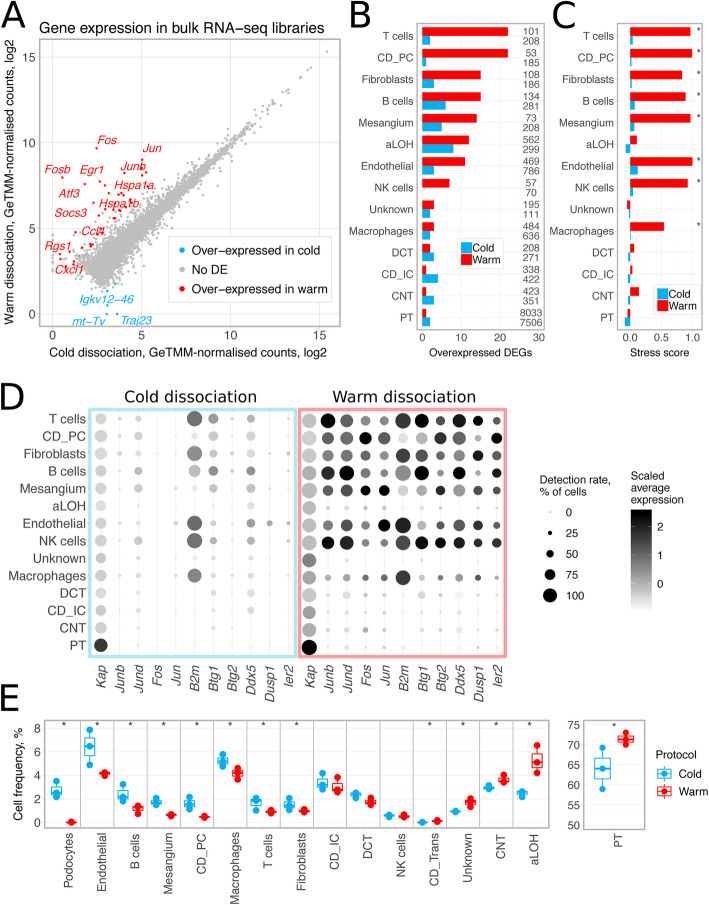
- Warm dissociation induced a stress response: bulk RNA-seq found 71 genes higher in warm-dissociated kidneys versus 5 in cold-dissociated kidneys (logFC > 2, FDR < 0.05), and scRNA-seq found 64 genes higher in warm-dissociated libraries in at least one cell type versus 20 in cold-dissociated libraries. Stress scores were significantly high in 8 of 14 cell types in warm-dissociated samples.
- Cell composition differed by dissociation protocol: podocytes were 0.03% in warm-dissociated samples versus 2.78% in cold-dissociated samples; aLOH cells were 4.99% versus 2.52%, and PT cells were 71.36% versus 63.34% in warm versus cold, respectively.
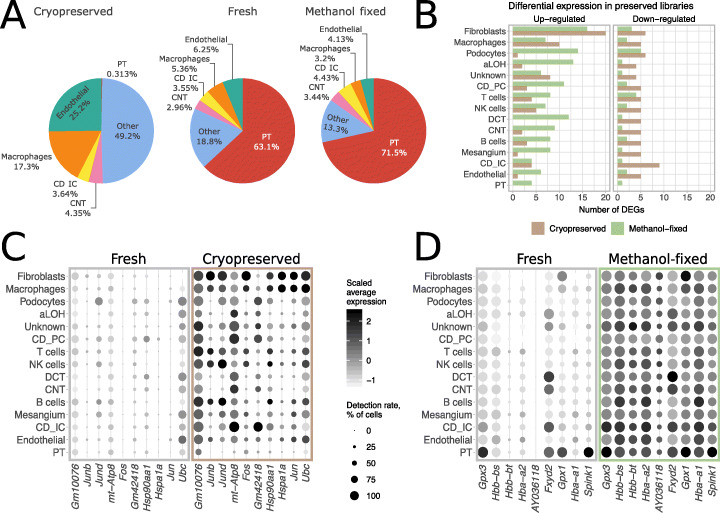
- Cryopreservation severely depleted epithelial cells: PT cells were 63.12% and 70.86% in fresh cold- and warm-dissociated samples but only 0.31% and 0.57% in cryopreserved samples; a repeat experiment showed PT at 55.55% fresh versus 7.65% cryopreserved. Only ~30% of cryopreserved cells were recovered, while methanol fixation better preserved composition but showed ambient RNA leakage.
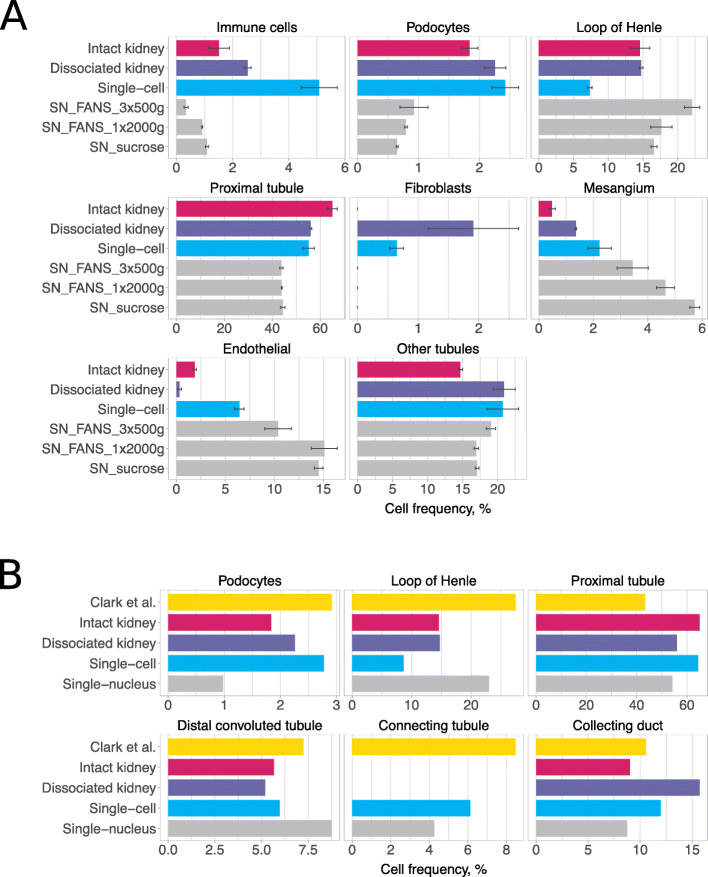
- Single-nucleus libraries underdetected immune cells: immune cells averaged 0.73% in snRNA-seq versus 6.03% in scRNA-seq; T, B, and NK cells were not detected in snRNA-seq, and podocytes were 0.7% in snRNA-seq versus 3.28% in scRNA-seq. snRNA-seq detected more genes per nucleus (median 1819) than scRNA-seq per cell (median 981).
Methods
- Adult mouse kidneys were used: male C57BL/6J mice (19 weeks) for the first dissociation/preservation series, and male Balb/c (18 weeks) or female Balb/c (15 weeks) mice for later scRNA-seq versus snRNA-seq comparisons, with biological triplicates.
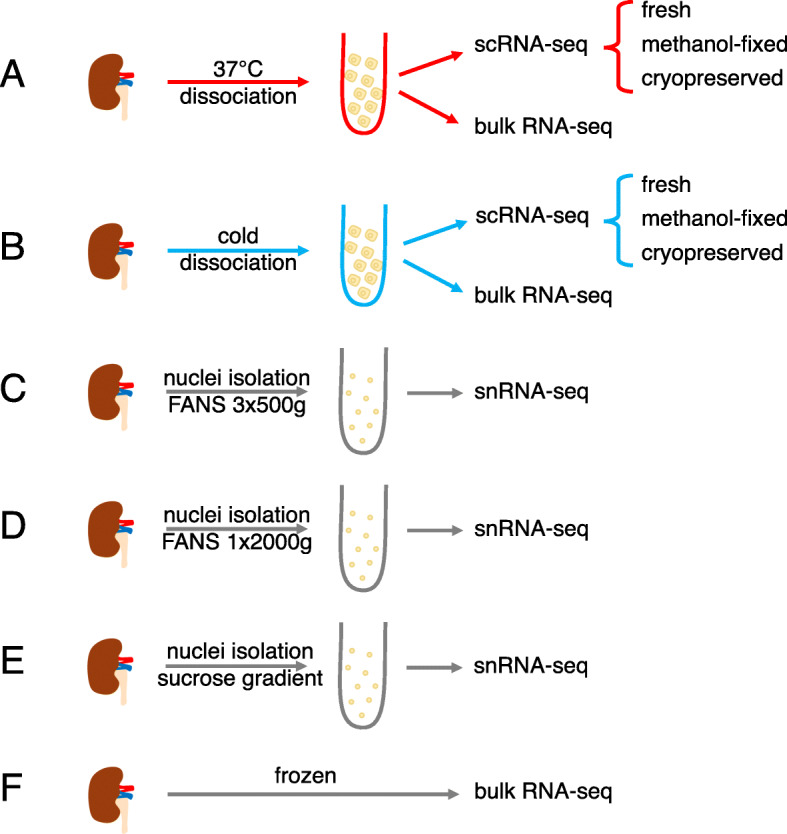
- Workflows compared two dissociation protocols (37 °C Miltenyi Multi Tissue Dissociation Kit 2 versus cold-active *Bacillus licheniformis* protease on ice), two preservation methods (methanol fixation and cryopreservation), and three single-nuclei isolation protocols (SN_FANS_3x500g, SN_FANS_1x2000g, SN_sucrose), plus bulk RNA-seq of intact and dissociated kidney.
- Libraries were profiled with 10x Genomics Chromium scRNA-seq/snRNA-seq and bulk RNA-seq; analyses included Cell Ranger, EmptyDrops, Seurat, scMatch annotation, edgeR/GeTMM, BSEQ-sc deconvolution, a 17-gene stress score, and Seurat cell-cycle scoring. Data are available at GSE141115.
Limitations
- Stated in the paper: bulk RNA-seq deconvolution is sensitive to the input marker gene list, may overlook rare and novel cell types, and cell abundance estimates from bulk data are influenced by both cell number and relative mRNA content; the authors note they lack a definitive “ground truth” for cell composition and did not use in vitro cell mixtures or spiking because these do not represent dissociation from solid tissue.
- Stated in the paper: flow cytometry still requires dissociation, and ISH/IHC/spatial methods only give proportions for sections examined rather than whole-organ estimates; a classifier able to distinguish mitotic cells from early G1 and late G2 is needed to fully dissect cell-cycle biases in snRNA-seq.
- Evident from the text: findings are restricted to adult mouse kidney, specific mouse strains/sexes, selected 10x chemistries, and particular dissociation, preservation, and nuclei-isolation protocols, so generalization to other tissues, species, or protocols is not established; some analyses excluded low-abundance cell types such as podocytes and transitional cells, and red blood cell depletion was not applied.
Model-written summary. Check it against the paper before relying on it.
Integrity signals
Registry
Cites
Statistics
Figures
Verification
Claims the paper makes
35 Own result · 20 Own interpretation · 6 Not checked yet · 4 Own method · 4 No basis given · 1 Supported
Every source the paper cites for this claim was checked and supports it.
In the paper
“Differential expression analysis identified 71 genes with higher expression in warm-dissociated kidneys and 5 genes with higher expression in cold-dissociated kidneys (logFC > 2, FDR < 0.05, edgeR exact test [27], Additional file 1).”
§ Systematic assessment of tissue dissociation and storage biases in single-cell and single-nucleus RNA-seq workflows > Results > Comparison of tissue dissociation protocols
What the sources say
- Supportedcites [27] Robinson MD, McCarthy DJ, Smyth GK. edgeR: a Bioconductor package for differential expression analysis of digital gene expression data. Bioinformatics. 2010;26:139–40. source
The citation is attached to “edgeR exact test,” not to the kidney gene counts. The Features section states that edgeR supports pairwise testing for differential expression and specifically describes its pairwise exact testing procedure. (LLM, conf=0.92)
plaincorrelational- Asserted: passes — The authors put it forward as true.
- Checkable: passes — It can be checked against evidence.
- Load-bearing: passes — The paper’s conclusions depend on it.
- Based: passes — The paper gives a reason why it holds.
- Supported
A result the paper reports from its own data — it cites no other source for it, so there is none to check. The quote shows it is in the paper.
In the paper
“Differential expression analysis identified 64 genes more highly expressed in warm-dissociated libraries in at least one cell type (Fig. 2b, Additional file 4)”
§ Systematic assessment of tissue dissociation and storage biases in single-cell and single-nucleus RNA-seq workflows > Results > Comparison of tissue dissociation protocols
plaincorrelational- Asserted: passes — The authors put it forward as true.
- Checkable: passes — It can be checked against evidence.
- Load-bearing: passes — The paper’s conclusions depend on it.
- Based: passes — The paper gives a reason why it holds.
A result the paper reports from its own data — it cites no other source for it, so there is none to check. The quote shows it is in the paper.
In the paper
“we identified cells such as those of the ascending loop of Henle (aLOH) and proximal tubule (PT), that were more abundant in warm-dissociated samples (aLOH 4.99% vs. 2.52% in cold, PT 71.36% vs. 63.34% in cold)”
§ Systematic assessment of tissue dissociation and storage biases in single-cell and single-nucleus RNA-seq workflows > Results > Comparison of tissue dissociation protocols
plaincorrelational- Asserted: passes — The authors put it forward as true.
- Checkable: passes — It can be checked against evidence.
- Load-bearing: passes — The paper’s conclusions depend on it.
- Based: passes — The paper gives a reason why it holds.
A result the paper reports from its own data — it cites no other source for it, so there is none to check. The quote shows it is in the paper.
In the paper
“Cell types more abundant in snRNA-seq libraries included loop of Henle and mesangial cells”
§ Systematic assessment of tissue dissociation and storage biases in single-cell and single-nucleus RNA-seq workflows > Results > Comparison of single-cell and single-nucleus sequencing protocols
plaincorrelational- Asserted: passes — The authors put it forward as true.
- Checkable: passes — It can be checked against evidence.
- Load-bearing: passes — The paper’s conclusions depend on it.
- Based: passes — The paper gives a reason why it holds.
In the paper
“Our data confirms prior reports that digestion on ice avoids the stress response observed with 37 °C dissociation.”
- Also stated in: § Comparison of tissue dissociation protocols · plain
“Bulk RNA-seq profiling of single-cell suspensions revealed induction of stress response genes in warm-dissociated samples.”
- Also stated in: § Discussion · plain
“Our findings corroborate this bias and show induction of heat shock proteins and immediate-early response genes in warm-dissociated libraries when compared to cold-dissociated libraries.”
§ Systematic assessment of tissue dissociation and storage biases in single-cell and single-nucleus RNA-seq workflows > Abstract > Results
What the sources say
- Not checked yetcites Adam et al. [18] Adam M, Potter AS, Potter SS. Psychrophilic proteases dramatically reduce single-cell RNA-seq artifacts: a molecular atlas of kidney development. Development. 2017;144:3625–32. source
plaindirect- Asserted: passes — The authors put it forward as true.
- Checkable: passes — It can be checked against evidence.
- Load-bearing: passes — The paper’s conclusions depend on it.
- Based: passes — The paper gives a reason why it holds.
- Also stated in: § Comparison of tissue dissociation protocols · plain
A result the paper reports from its own data — it cites no other source for it, so there is none to check. The quote shows it is in the paper.
In the paper
“Despite loading similar numbers of cells, the number of high-quality cells obtained from the cryopreserved samples after quality control and filtering (“Methods”) was substantially lower (~ 30%) than that of the fresh and methanol-fixed samples.”
§ Systematic assessment of tissue dissociation and storage biases in single-cell and single-nucleus RNA-seq workflows > Results > Comparison of cell preservation protocols
plaincorrelational- Asserted: passes — The authors put it forward as true.
- Checkable: passes — It can be checked against evidence.
- Load-bearing: passes — The paper’s conclusions depend on it.
- Based: passes — The paper gives a reason why it holds.
A result the paper reports from its own data — it cites no other source for it, so there is none to check. The quote shows it is in the paper.
In the paper
“In contrast, genes overexpressed in methanol-fixed cells were those highly expressed in tubular cells and hemoglobin genes”
§ Systematic assessment of tissue dissociation and storage biases in single-cell and single-nucleus RNA-seq workflows > Results > Comparison of cell preservation protocols
plaincorrelational- Asserted: passes — The authors put it forward as true.
- Checkable: passes — It can be checked against evidence.
- Load-bearing: passes — The paper’s conclusions depend on it.
- Based: passes — The paper gives a reason why it holds.
A result the paper reports from its own data — it cites no other source for it, so there is none to check. The quote shows it is in the paper.
In the paper
“Notably, the numbers of differentially expressed genes varied among cell types (Fig. 2b)”
§ Systematic assessment of tissue dissociation and storage biases in single-cell and single-nucleus RNA-seq workflows > Results > Comparison of tissue dissociation protocols
plaincorrelational- Asserted: passes — The authors put it forward as true.
- Checkable: passes — It can be checked against evidence.
- Load-bearing: passes — The paper’s conclusions depend on it.
- Based: passes — The paper gives a reason why it holds.
A result the paper reports from its own data — it cites no other source for it, so there is none to check. The quote shows it is in the paper.
In the paper
“Immune cells were detected at lower rates in snRNA-seq (average of 0.73%) than in scRNA-seq (average of 6.03%) across all experiments performed”
§ Systematic assessment of tissue dissociation and storage biases in single-cell and single-nucleus RNA-seq workflows > Results > Comparison of single-cell and single-nucleus sequencing protocols
plaincorrelational- Asserted: passes — The authors put it forward as true.
- Checkable: passes — It can be checked against evidence.
- Load-bearing: passes — The paper’s conclusions depend on it.
- Based: passes — The paper gives a reason why it holds.
A result the paper reports from its own data — it cites no other source for it, so there is none to check. The quote shows it is in the paper.
In the paper
“our analyses identified eight cell populations that were less abundant in warm-dissociated samples in comparison to cold-dissociated ones, including podocytes, mesangial cells, and endothelial cells (Fig. 2e left, chi-square test p value < 0.001).”
§ Systematic assessment of tissue dissociation and storage biases in single-cell and single-nucleus RNA-seq workflows > Results > Comparison of tissue dissociation protocols
plaincorrelational- Asserted: passes — The authors put it forward as true.
- Checkable: passes — It can be checked against evidence.
- Load-bearing: passes — The paper’s conclusions depend on it.
- Based: passes — The paper gives a reason why it holds.
- It may state two separate claims as one. 19
- Probably not a substantial claim. 8
- The quote only partly states this claim. 1
In the paper
“we estimated that approximately 1.51% should correspond to immune cells in Balb/c female mice and 4.84% in Balb/c male mice.”
§ Systematic assessment of tissue dissociation and storage biases in single-cell and single-nucleus RNA-seq workflows > Results > Comparison of single-cell and single-nucleus sequencing protocols
What the sources say
- Not checked yetcites [35] Baron M, Veres A, Wolock SL, Faust AL, Gaujoux R, Vetere A, et al. A single-cell transcriptomic map of the human and mouse pancreas reveals inter- and intra-cell population structure. Cell Syst. 2016;3:346–60.e4. source
hedged- Asserted: passes — The authors put it forward as true.
- Checkable: passes — It can be checked against evidence.
- Load-bearing: passes — The paper’s conclusions depend on it.
- Based: passes — The paper gives a reason why it holds.
It may state two separate claims as one.
- Rests on an assumption: BSEQ-sc deconvolution of bulk RNA-seq accurately estimates cell type proportions in intact kidney.
A result the paper reports from its own data — it cites no other source for it, so there is none to check. The quote shows it is in the paper.
In the paper
“Furthermore, macrophages were the only type of immune cells recovered in snRNA-seq libraries, whereas in scRNA-seq libraries we also detected T cells (1.38% on average), B cells (0.77%), and NK cells (0.65%).”
§ Systematic assessment of tissue dissociation and storage biases in single-cell and single-nucleus RNA-seq workflows > Results > Comparison of single-cell and single-nucleus sequencing protocols
plain- Asserted: passes — The authors put it forward as true.
- Checkable: passes — It can be checked against evidence.
- Load-bearing: passes — The paper’s conclusions depend on it.
- Based: passes — The paper gives a reason why it holds.
It may state two separate claims as one.
A result the paper reports from its own data — it cites no other source for it, so there is none to check. The quote shows it is in the paper.
In the paper
“In freshly profiled suspensions, PT composed 63.12% and 70.86% of all cells in cold- and warm-dissociated samples, respectively. In contrast, PT were scarcely detected in cryopreserved samples, at 0.31% and 0.57%, respectively”
§ Systematic assessment of tissue dissociation and storage biases in single-cell and single-nucleus RNA-seq workflows > Results > Comparison of cell preservation protocols
plain- Asserted: passes — The authors put it forward as true.
- Checkable: passes — It can be checked against evidence.
- Load-bearing: passes — The paper’s conclusions depend on it.
- Based: passes — The paper gives a reason why it holds.
It may state two separate claims as one.
A result the paper reports from its own data — it cites no other source for it, so there is none to check. The quote shows it is in the paper.
In the paper
“Notably, only ~ 33% and ~ 32% of cells were recovered after cryostorage in the first and the repeated experiment, respectively; the average viability estimated by the Countess was 86% and 75%, respectively.”
§ Systematic assessment of tissue dissociation and storage biases in single-cell and single-nucleus RNA-seq workflows > Results > Comparison of cell preservation protocols
hedged- Asserted: passes — The authors put it forward as true.
- Checkable: passes — It can be checked against evidence.
- Load-bearing: passes — The paper’s conclusions depend on it.
- Based: passes — The paper gives a reason why it holds.
It may state two separate claims as one.
A result the paper reports from its own data — it cites no other source for it, so there is none to check. The quote shows it is in the paper.
In the paper
“In contrast to the 64 genes with higher expression in the warm dissociation, only 20 genes had higher expression in the cold-dissociated cell populations, and only five of them (Hbb-bs, Hba-a1, Hba-a2, mt-Co1, Malat1) were identified in at least two cell types (Fig. 2b, Additional file 5).”
§ Systematic assessment of tissue dissociation and storage biases in single-cell and single-nucleus RNA-seq workflows > Results > Comparison of tissue dissociation protocols
plain- Asserted: passes — The authors put it forward as true.
- Checkable: passes — It can be checked against evidence.
- Load-bearing: unclear — It is unclear whether the paper’s conclusions depend on it.
- Based: passes — The paper gives a reason why it holds.
It may state two separate claims as one.
A result the paper reports from its own data — it cites no other source for it, so there is none to check. The quote shows it is in the paper.
In the paper
“Nevertheless, certain cell types were moderately underrepresented in the methanol-fixed samples in comparison to freshly profiled samples, with macrophages showing the largest reduction from 5.36 to 3.2% in cold-dissociated samples and from 4.28 to 2.54% in warm-dissociated samples.”
§ Systematic assessment of tissue dissociation and storage biases in single-cell and single-nucleus RNA-seq workflows > Results > Comparison of cell preservation protocols
plaindirect- Asserted: passes — The authors put it forward as true.
- Checkable: passes — It can be checked against evidence.
- Load-bearing: passes — The paper’s conclusions depend on it.
- Based: passes — The paper gives a reason why it holds.
It may state two separate claims as one.
A result the paper reports from its own data — it cites no other source for it, so there is none to check. The quote shows it is in the paper.
In the paper
“This comparison revealed significant underrepresentation (chi-square test p value < 0.001) of five kidney cell types in cryopreserved samples prepared with the cold dissociation protocol, three of which were also underrepresented in the cryopreserved warm dissociation samples”
§ Systematic assessment of tissue dissociation and storage biases in single-cell and single-nucleus RNA-seq workflows > Results > Comparison of cell preservation protocols
plaincorrelational- Asserted: passes — The authors put it forward as true.
- Checkable: passes — It can be checked against evidence.
- Load-bearing: passes — The paper’s conclusions depend on it.
- Based: passes — The paper gives a reason why it holds.
It may state two separate claims as one.
A result the paper reports from its own data — it cites no other source for it, so there is none to check. The quote shows it is in the paper.
In the paper
“The three nuclei isolation protocols yielded comparable results, with the most notable difference being a higher contamination with mitochondrial genes in SN_FANS_1x2000g”
§ Systematic assessment of tissue dissociation and storage biases in single-cell and single-nucleus RNA-seq workflows > Results > Comparison of single-cell and single-nucleus sequencing protocols
plain- Asserted: passes — The authors put it forward as true.
- Checkable: passes — It can be checked against evidence.
- Load-bearing: unclear — It is unclear whether the paper’s conclusions depend on it.
- Based: passes — The paper gives a reason why it holds.
It may state two separate claims as one.
None of the sources cited for this claim have been checked yet.
In the paper
“Differential expression analysis comparing individual cell types profiled by snRNA-seq and scRNA-seq suggested higher expression of long noncoding RNAs in snRNA-seq libraries and higher expression of genes related to mitochondrial and ribosomal functions in scRNA-seq, in agreement with previous reports [24, 26]”
§ Systematic assessment of tissue dissociation and storage biases in single-cell and single-nucleus RNA-seq workflows > Results > Comparison of single-cell and single-nucleus sequencing protocols
What the sources say
- Not checked yetcites [24] Bakken TE, Hodge RD, Miller JA, Yao Z, Nguyen TN, Aevermann B, et al. Single-nucleus and single-cell transcriptomes compared in matched cortical cell types. PLoS One. 2018;13:e0209648. source
- Not checked yetcites [26] Wu H, Kirita Y, Donnelly EL, Humphreys BD. Advantages of single-nucleus over single-cell RNA sequencing of adult kidney: rare cell types and novel cell states revealed in fibrosis. J Am Soc Nephrol. 2019;30:23–32. source
hedgedcorrelational- Asserted: passes — The authors put it forward as true.
- Checkable: passes — It can be checked against evidence.
- Load-bearing: passes — The paper’s conclusions depend on it.
- Based: passes — The paper gives a reason why it holds.
It may state two separate claims as one.
A result the paper reports from its own data — it cites no other source for it, so there is none to check. The quote shows it is in the paper.
In the paper
“This dataset comprised 23,108 cells, including 11,851 cells from cold- and 11,257 cells from warm-dissociated kidneys (“Methods”).”
§ Systematic assessment of tissue dissociation and storage biases in single-cell and single-nucleus RNA-seq workflows > Results > Comparison of tissue dissociation protocols
plain- Asserted: passes — The authors put it forward as true.
- Checkable: passes — It can be checked against evidence.
- Load-bearing: fails — The paper’s conclusions may not depend on it.
- Based: passes — The paper gives a reason why it holds.
Probably not a substantial claim. The paper’s conclusions may not depend on it. It may state two separate claims as one.
A result the paper reports from its own data — it cites no other source for it, so there is none to check. The quote shows it is in the paper.
In the paper
“The genes most commonly overexpressed across cell populations are shown in Fig. 2d and include immediate-early response genes such as Junb and Jund (differentially expressed in seven cell types) and Jun and Fos (differentially expressed in five cell types).”
§ Systematic assessment of tissue dissociation and storage biases in single-cell and single-nucleus RNA-seq workflows > Results > Comparison of tissue dissociation protocols
plaincorrelational- Asserted: passes — The authors put it forward as true.
- Checkable: passes — It can be checked against evidence.
- Load-bearing: unclear — It is unclear whether the paper’s conclusions depend on it.
- Based: passes — The paper gives a reason why it holds.
It may state two separate claims as one.
The paper states this without a source or data behind it here, so there is nothing to check it against. The quote shows it is in the paper.
In the paper
“Due to the reverse transcription inhibition of 3x SSC, the sample had to be loaded at a concentration of 0.125x SSC, resulting in an approximate cell capture of 4000–5000 cells.”
§ Systematic assessment of tissue dissociation and storage biases in single-cell and single-nucleus RNA-seq workflows > Methods > Single-cell RNA-seq library preparation
plaindirect- Asserted: passes — The authors put it forward as true.
- Checkable: passes — It can be checked against evidence.
- Load-bearing: fails — The paper’s conclusions may not depend on it.
- Based: passes — The paper gives a reason why it holds.
Probably not a substantial claim. The paper’s conclusions may not depend on it.
- Rests on an assumption: 3x SSC inhibits reverse transcription.
A result the paper reports from its own data — it cites no other source for it, so there is none to check. The quote shows it is in the paper.
In the paper
“This approach failed to identify cells of connecting tubule (CNT) and, instead, matched them to other similar cell types.”
§ Systematic assessment of tissue dissociation and storage biases in single-cell and single-nucleus RNA-seq workflows > Methods > Inferring cell identity
plaindirect- Asserted: passes — The authors put it forward as true.
- Checkable: passes — It can be checked against evidence.
- Load-bearing: unclear — It is unclear whether the paper’s conclusions depend on it.
- Based: passes — The paper gives a reason why it holds.
It may state two separate claims as one.
A result the paper reports from its own data — it cites no other source for it, so there is none to check. The quote shows it is in the paper.
In the paper
“To select genes for the stress response score, we looked at all genes induced in the warm-dissociated samples, and from that list, we manually selected genes which have been reported in the literature as stress-response-related genes.”
§ Systematic assessment of tissue dissociation and storage biases in single-cell and single-nucleus RNA-seq workflows > Methods > Stress response score
plaindirect- Asserted: passes — The authors put it forward as true.
- Checkable: passes — It can be checked against evidence.
- Load-bearing: passes — The paper’s conclusions depend on it.
- Based: passes — The paper gives a reason why it holds.
The quote only partly states this claim.
A conclusion the paper draws from its own results — it cites no other source for it, so there is none to check. The quote shows it is in the paper.
In the paper
“These findings suggest that these populations are sensitive to warm dissociation and consequently underrepresented.”
§ Systematic assessment of tissue dissociation and storage biases in single-cell and single-nucleus RNA-seq workflows > Results > Comparison of tissue dissociation protocols
hedgeddirect- Asserted: passes — The authors put it forward as true.
- Checkable: passes — It can be checked against evidence.
- Load-bearing: passes — The paper’s conclusions depend on it.
- Based: passes — The paper gives a reason why it holds.
It may state two separate claims as one.
A conclusion the paper draws from its own results — it cites no other source for it, so there is none to check. The quote shows it is in the paper.
In the paper
“The same set of transcripts contaminated most cell types suggesting methanol fixation damages cells and leads to ambient RNA contamination of droplets”
§ Systematic assessment of tissue dissociation and storage biases in single-cell and single-nucleus RNA-seq workflows > Results > Comparison of cell preservation protocols
hedgeddirect- Asserted: passes — The authors put it forward as true.
- Checkable: passes — It can be checked against evidence.
- Load-bearing: passes — The paper’s conclusions depend on it.
- Based: passes — The paper gives a reason why it holds.
It may state two separate claims as one.
A conclusion the paper draws from its own results — it cites no other source for it, so there is none to check. The quote shows it is in the paper.
In the paper
“Figure 4b and Additional file 2: Figure S8 show that for some cell types, such as podocytes, scRNA-seq yields proportions most similar to the quantitative renal anatomy estimates, whereas for other cell types, such as loop of Henle cells, snRNA-seq better captures cell composition.”
§ Systematic assessment of tissue dissociation and storage biases in single-cell and single-nucleus RNA-seq workflows > Results > Comparison of single-cell and single-nucleus sequencing protocols
plaincorrelational- Asserted: passes — The authors put it forward as true.
- Checkable: passes — It can be checked against evidence.
- Load-bearing: passes — The paper’s conclusions depend on it.
- Based: passes — The paper gives a reason why it holds.
It may state two separate claims as one.
A conclusion the paper draws from its own results — it cites no other source for it, so there is none to check. The quote shows it is in the paper.
In the paper
“Our results suggest that proportions of aLOH cells in cell suspensions were higher before they were loaded on the Chromium Controller and that they are somehow underrepresented.”
§ Systematic assessment of tissue dissociation and storage biases in single-cell and single-nucleus RNA-seq workflows > Results > Comparison of tissue dissociation protocols
hedgeddirect- Asserted: passes — The authors put it forward as true.
- Checkable: passes — It can be checked against evidence.
- Load-bearing: passes — The paper’s conclusions depend on it.
- Based: passes — The paper gives a reason why it holds.
It may state two separate claims as one.
A conclusion the paper draws from its own results — it cites no other source for it, so there is none to check. The quote shows it is in the paper.
In the paper
“Based on these estimates, some cell types, such as podocytes, appear to be better represented in scRNA-seq, whereas others, such as loop of Henle cells, were captured more effectively by snRNA-seq.”
§ Systematic assessment of tissue dissociation and storage biases in single-cell and single-nucleus RNA-seq workflows > Discussion
hedgedcorrelational- Asserted: passes — The authors put it forward as true.
- Checkable: passes — It can be checked against evidence.
- Load-bearing: passes — The paper’s conclusions depend on it.
- Based: passes — The paper gives a reason why it holds.
It may state two separate claims as one.
What the paper did — it cites no source for this, so there is none to check. The quote shows it is in the paper.
In the paper
“Complete tissue dissociation was also checked by examining under the microscope and confirming the absence of visible tissue chunks.”
§ Systematic assessment of tissue dissociation and storage biases in single-cell and single-nucleus RNA-seq workflows > Methods > Cold tissue dissociation
plain- Asserted: passes — The authors put it forward as true.
- Checkable: passes — It can be checked against evidence.
- Load-bearing: fails — The paper’s conclusions may not depend on it.
- Based: passes — The paper gives a reason why it holds.
Probably not a substantial claim. The paper’s conclusions may not depend on it.
What the paper did — it cites no source for this, so there is none to check. The quote shows it is in the paper.
In the paper
“All single-cell libraries were constructed in biological triplicate using the 10x Chromium 3′ workflow as per the manufacturers’ directions.”
§ Systematic assessment of tissue dissociation and storage biases in single-cell and single-nucleus RNA-seq workflows > Methods > Single-cell RNA-seq library preparation
plain- Asserted: passes — The authors put it forward as true.
- Checkable: passes — It can be checked against evidence.
- Load-bearing: fails — The paper’s conclusions may not depend on it.
- Based: passes — The paper gives a reason why it holds.
Probably not a substantial claim. The paper’s conclusions may not depend on it.
What the paper did — it cites no source for this, so there is none to check. The quote shows it is in the paper.
In the paper
“All libraries were quantified with qPCR using the NEBnext Library Quant Kit for Illumina and checked for fragment size using the TapeStation D1000 kit (Agilent).”
§ Systematic assessment of tissue dissociation and storage biases in single-cell and single-nucleus RNA-seq workflows > Methods > Sequencing
plain- Asserted: passes — The authors put it forward as true.
- Checkable: passes — It can be checked against evidence.
- Load-bearing: fails — The paper’s conclusions may not depend on it.
- Based: passes — The paper gives a reason why it holds.
Probably not a substantial claim. The paper’s conclusions may not depend on it. It may state two separate claims as one.
A conclusion the paper draws from its own results — it cites no other source for it, so there is none to check. The quote shows it is in the paper.
In the paper
“the observation likely stems from a higher rate of hemoglobin transcript degradation in warm tissue dissociation conditions.”
§ Systematic assessment of tissue dissociation and storage biases in single-cell and single-nucleus RNA-seq workflows > Discussion
hedgedconditional- Asserted: passes — The authors put it forward as true.
- Checkable: passes — It can be checked against evidence.
- Load-bearing: fails — The paper’s conclusions may not depend on it.
- Based: fails — The paper may give no reason why it holds.
Probably not a substantial claim. The paper’s conclusions may not depend on it. The paper may give no reason why it holds.
A conclusion the paper draws from its own results — it cites no other source for it, so there is none to check. The quote shows it is in the paper.
In the paper
“In addition, cell abundance estimates from bulk data would be influenced by both cell number and relative mRNA content of each cell.”
§ Systematic assessment of tissue dissociation and storage biases in single-cell and single-nucleus RNA-seq workflows > Discussion
hedgeddirect- Asserted: passes — The authors put it forward as true.
- Checkable: passes — It can be checked against evidence.
- Load-bearing: fails — The paper’s conclusions may not depend on it.
- Based: fails — The paper may give no reason why it holds.
Probably not a substantial claim. The paper’s conclusions may not depend on it. The paper may give no reason why it holds.
A conclusion the paper draws from its own results — it cites no other source for it, so there is none to check. The quote shows it is in the paper.
In the paper
“However, the approach is sensitive to the input marker gene list used and may overlook rare and novel cell types.”
§ Systematic assessment of tissue dissociation and storage biases in single-cell and single-nucleus RNA-seq workflows > Discussion
hedgedconditional- Asserted: passes — The authors put it forward as true.
- Checkable: passes — It can be checked against evidence.
- Load-bearing: unclear — It is unclear whether the paper’s conclusions depend on it.
- Based: passes — The paper gives a reason why it holds.
It may state two separate claims as one.
What the paper did — it cites no source for this, so there is none to check. The quote shows it is in the paper.
In the paper
“RNA was assessed for quantity and quality using the TapeStation 4200 RNA ScreenTape kit [Agilent; 5067-5576], which showed all RNA used had a RIN of > 8.”
§ Systematic assessment of tissue dissociation and storage biases in single-cell and single-nucleus RNA-seq workflows > Methods > Bulk RNA-seq library preparation
plain- Asserted: passes — The authors put it forward as true.
- Checkable: passes — It can be checked against evidence.
- Load-bearing: fails — The paper’s conclusions may not depend on it.
- Based: passes — The paper gives a reason why it holds.
Probably not a substantial claim. The paper’s conclusions may not depend on it.
The paper relies on this without support.
The biases observed in adult mouse kidney workflows generalize to other tissues and to human disease biology.
“From our experiments, we have confirmed several observations by others in the field that have direct relevance to designing single-cell experiments studying human disease biology.”
“Specifically, the depletion of epithelial cell types in cryopreserved samples is concerning given the majority of human cancers are epithelial in origin.”
The paper relies on this without support.
BSEQ-sc deconvolution of bulk RNA-seq accurately estimates cell type proportions in intact kidney.
“Using the bulk RNA-seq from intact kidneys (Fig. 1f) and BSEQ-sc [35] to predict the proportions of each cell type present, we estimated that approximately 1.51% should correspond to immune cells in Balb/c female mice and 4.84% in Balb/c male mice.”
The paper relies on this without support.
The reference expression profiles from previous mouse kidney studies accurately represent the cell types in the studied samples.
“Cells were classified into 15 cell types using scMatch [31] by comparing their expression to reference expression profiles from three previous mouse kidney studies [26, 32, 33], followed by gene signature-based refinement”
The paper relies on this without support.
3x SSC inhibits reverse transcription.
“Due to the reverse transcription inhibition of 3x SSC, the sample had to be loaded at a concentration of 0.125x SSC”
Claims other papers make about this one
Each is checked against this paper’s own text: does it say what the citing paper says it does?
The cited source says what the claim attributes to it.
In the citing paper
“Our inhibitor-based protocol offers much greater experimental and tissue-/cell-type flexibility than previously developed experimental and computational solutions for this pervasive issue (see additional discussion of some alternative methods in Supplementary Note 7)33,34,45,65,67,68.”
From Dissection of artifactual and confounding glial signatures by single-cell sequencing of mouse and human brain (2022) · cites this paper as [45]
The cited source says what the claim attributes to it.
In the citing paper
“However, emerging results from other tissues/cell types have begun to characterize dissociation artifacts following enzymatic digestion43–45,65,66.”
From Dissection of artifactual and confounding glial signatures by single-cell sequencing of mouse and human brain (2022) · cites this paper as [45]
Self-check
Percentages, sums and reported differences re-computed from the paper’s own numbers.
Each contradiction between two passages listed here was confirmed by an independent check.
Rated major: it would touch a result — a value a result rests on, reported and recomputed p-values on opposite sides of the significance level, two passages that conflict with no sign which is right, or a cited work retracted before this paper was published.
In the paper
§ Systematic assessment of tissue dissociation and storage biases in single-cell and single-nucleus RNA-seq workflows > Results > Comparison of single-cell and single-nucleus sequencing protocols
“In the third protocol, nuclei were initially washed using a 500g spin and then cleaned using a sucrose cushion”
§ Systematic assessment of tissue dissociation and storage biases in single-cell and single-nucleus RNA-seq workflows > Methods > Single-nuclei isolation
“The homogenate was then filtered through a 30-μm MACS Smart Strainer into a new 15-mL centrifuge tube. Subsequently, the homogenate was centrifuged at 2000g for 5 min at 4 °C.”
Rated minor: it would not touch a result — a value no result rests on, a p-value that stays on the same side of the significance level, or a conflict that is clerical, resolved elsewhere in the paper, or outside its own findings.
In the paper
§ Systematic assessment of tissue dissociation and storage biases in single-cell and single-nucleus RNA-seq workflows > Methods > Cryopreservation
“The following day, the cells were transferred to liquid nitrogen storage.”
§ Systematic assessment of tissue dissociation and storage biases in single-cell and single-nucleus RNA-seq workflows > Methods > Cryopreservation
“The samples were removed from − 80 °C and immediately placed into a 37 °C waterbath for 2–3 min to rapidly thaw.”
Rated minor: it would not touch a result — a value no result rests on, a p-value that stays on the same side of the significance level, or a conflict that is clerical, resolved elsewhere in the paper, or outside its own findings.
In the paper
§ Systematic assessment of tissue dissociation and storage biases in single-cell and single-nucleus RNA-seq workflows > Results > Comparison of tissue dissociation protocols
“PT 71.36% vs. 63.34% in cold”
§ Systematic assessment of tissue dissociation and storage biases in single-cell and single-nucleus RNA-seq workflows > Results > Comparison of cell preservation protocols
“In freshly profiled suspensions, PT composed 63.12% and 70.86% of all cells in cold- and warm-dissociated samples, respectively.”
Citations
Cites
Controlling the False Discovery Rate: A Practical and Powerful Approach to Multiple Testing
Benjamini, Y., & Hochberg, Y. (1995) · Journal of the Royal Statistical Society Series B: Statistical Methodology · doi:10.1111/j.2517-6161.1995.tb02031.x · Cited by 109,482
STAR: ultrafast universal RNA-seq aligner
Dobin, A., Davis, C. A., Schlesinger, F., Drenkow, J., Zaleski, C., Jha, S., Batut, P., Chaisson, M., & Gingeras, T. R. (2013) · Bioinformatics · doi:10.1093/bioinformatics/bts635 · Cited by 51,709
Robinson, M. D., McCarthy, D. J., & Smyth, G. K. (2010) · Bioinformatics · doi:10.1093/bioinformatics/btp616 · Cited by 41,364
featureCounts: an efficient general purpose program for assigning sequence reads to genomic features
Liao, Y., Smyth, G. K., & Shi, W. (2014) · Bioinformatics · doi:10.1093/bioinformatics/btt656 · Cited by 27,219
Integrating single-cell transcriptomic data across different conditions, technologies, and species
Butler, A., Hoffman, P., Smibert, P., Papalexi, E., & Satija, R. (2018) · Nature Biotechnology · doi:10.1038/nbt.4096 · Cited by 13,174
Fast, sensitive and accurate integration of single-cell data with Harmony
Korsunsky, I., Millard, N., Fan, J., Slowikowski, K., Zhang, F., Wei, K., Baglaenko, Y., Brenner, M., Loh, P.-R., & Raychaudhuri, S. (2019) · Nature Methods · doi:10.1038/s41592-019-0619-0 · Cited by 10,488
Massively parallel digital transcriptional profiling of single cells
Zheng, G. X. Y., Terry, J. M., Belgrader, P., Ryvkin, P., Bent, Z. W., Wilson, R., Ziraldo, S. B., Wheeler, T. D., McDermott, G. P., Zhu, J., et al. (2017) · Nature Communications · doi:10.1038/ncomms14049 · Cited by 7,353
Highly parallel genome-wide expression profiling of individual cells using nanoliter droplets.
Macosko, E. Z., Basu, A., Satija, R., Nemesh, J., Shekhar, K., Goldman, M., Tirosh, I., Bialas, A. R., Kamitaki, N., Martersteck, E. M., et al. (2015) · Cell · doi:10.1016/j.cell.2015.05.002 · Cited by 7,110
Dissecting the multicellular ecosystem of metastatic melanoma by single-cell RNA-seq
Tirosh, I., Izar, B., Prakadan, S. M., Wadsworth, M. H., Treacy, D., Trombetta, J. J., Rotem, A., Rodman, C., Lian, C., Murphy, G., et al. (2016) · Science · doi:10.1126/science.aad0501 · Cited by 4,944
The single-cell transcriptional landscape of mammalian organogenesis
Cao, J., Spielmann, M., Qiu, X., Huang, X., Ibrahim, D. M., Hill, A. J., Zhang, F., Mundlos, S., Christiansen, L., Steemers, F. J., et al. (2019) · Nature · doi:10.1038/s41586-019-0969-x · Cited by 4,490
Research works printed but not linked: 2
- Mus musculus ribosomal DNA, complete repeating unit. https://www.ncbi.nlm.nih.gov/nuccore/BK000964. Accessed 24 Jan 2019.
- Denisenko E, Guo B, Jones M, Hou R, de Kock L, Lassmann T, et al. Systematic assessment of tissue dissociation and storage biases in single-cell and single-nucleus RNA-seq workflows. Datasets. Gene Expression Omnibus. 2020. https://www.ncbi.nlm.nih.gov/geo/query/acc.cgi?acc=GSE141115. Accessed 11 May 2020.
Cited by
Sorted by citations
Items 201–300 of 716
Onoda, N., Kawabata, A., Hasegawa, K., Sakakura, M., Urakawa, I., Seki, M., Zenkoh, J., Suzuki, A., & Suzuki, Y. (2022) · DNA Research · doi:10.1093/dnares/dsac007 · Cited by 20
Live slow-frozen human tumor tissues viable for 2D, 3D, ex vivo cultures and single-cell RNAseq
Restivo, G., Tastanova, A., Balázs, Z., Panebianco, F., Diepenbruck, M., Ercan, C., Preca, B.-T., Hafner, J., Weber, W. P., Kurzeder, C., et al. (2022) · Communications Biology · doi:10.1038/s42003-022-04025-0 · Cited by 20
Single-cell and spatial sequencing application in pathology
Kim, Y., Choi, J., & Lee, S. H. (2023) · Journal of Pathology and Translational Medicine · doi:10.4132/jptm.2022.12.12 · Cited by 20
Renaut, S., Armero, V. E. S., Boudreau, D. K., Gaudreault, N., Desmeules, P., Thériault, S., Mathieu, P., Joubert, P., & Bossé, Y. (2024) · PLoS Genetics · doi:10.1371/journal.pgen.1011301 · Cited by 21
Poonpanichakul, T., Shiao, M., Jiravejchakul, N., Matangkasombut, P., Sirachainan, E., Charoensawan, V., & Jinawath, N. (2021) · Bioscience Reports · doi:10.1042/bsr20212093 · Cited by 20
Moinfar, A. A., & Theis, F. J. (2024) · bioRxiv (Cold Spring Harbor Laboratory) · doi:10.1101/2024.11.06.622266 · Cited by 22
Skarne, N., D’Souza, R. C. J., Palethorpe, H. M., Bradbrook, K. A., Gomez, G. A., & Day, B. W. (2025) · Acta Neuropathologica Communications · doi:10.1186/s40478-025-01928-x · Cited by 20
Cabanes‐Creus, M., Navarro, R. G., Liao, S. H. Y., Scott, S., Carlessi, R., Roca-Pinilla, R., Knight, M., Baltazar, G., Zhu, E., Jones, M., et al. (2023) · Molecular Therapy — Methods & Clinical Development · doi:10.1016/j.omtm.2022.12.014 · Cited by 20
Self-citationHamel, R., Peruzzotti‐Jametti, L., Ridley, K., Testa, V., Yu, B., Rowitch, D. H., Marioni, J. C., & Pluchino, S. (2023) · Heliyon · doi:10.1016/j.heliyon.2023.e18339 · Cited by 19
White Adipose Tissue Heterogeneity in the Single-Cell Era: From Mice and Humans to Cattle
Ford, H. R., Liu, Q., Fu, X., & Strieder‐Barboza, C. (2023) · Biology · doi:10.3390/biology12101289 · Cited by 21
Intra-tumoral T cells in pediatric brain tumors display clonal expansion and effector properties
Upadhye, A., Landeros, K. E. M., Ramírez-Suástegui, C., Schmiedel, B. J., Woo, E. B. C., Chee, S., Malicki, D. M., Coufal, N. G., Gonda, D. D., Levy, M. L., et al. (2024) · Nature Cancer · doi:10.1038/s43018-023-00706-9 · Cited by 19
The use of single-cell RNA-seq to study heterogeneity at varying levels of virus–host interactions
Swaminath, S., & Russell, A. B. (2024) · PLoS Pathogens · doi:10.1371/journal.ppat.1011898 · Cited by 19
Dai, R., Chu, T., Zhang, M., Wang, X., Jourdon, A., Wu, F., Mariani, J., Vaccarino, F. M., Lee, D., Fullard, J. F., et al. (2024) · Science Advances · doi:10.1126/sciadv.adh2588 · Cited by 18
Shi, R., Chen, H., Zhang, W., Leak, R. K., Lou, D., Chen, K., & Chen, J. (2024) · Journal of Cerebral Blood Flow & Metabolism · doi:10.1177/0271678x241305914 · Cited by 19
Allometry of cell types in planarians by single-cell transcriptomics
Emili, E., Pérez-Posada, A., Vanni, V., Salamanca-Díaz, D. A., Ródriguez-Fernández, D., Christodoulou, M. D., & Solana, J. (2025) · Science Advances · doi:10.1126/sciadv.adm7042 · Cited by 19
An era of single-cell genomics consortia
Ando, Y., Kwon, A. T.-J., & Shin, J. W. (2020) · Experimental & Molecular Medicine · doi:10.1038/s12276-020-0409-x · Cited by 20
Single-Cell Toolkits Opening a New Era for Cell Engineering
Lee, S., Kim, J., & Park, J.-E. (2021) · Molecules and Cells · doi:10.14348/molcells.2021.0002 · Cited by 20
Creation of a Single Cell RNASeq Meta-Atlas to Define Human Liver Immune Homeostasis
Rocque, B., Barbetta, A., Singh, P., Goldbeck, C. S., Helou, D. G., Loh, Y. E., Ung, N. M., Lee, J. S. H., Akbari, O., & Emamaullee, J. A. (2021) · Frontiers in Immunology · doi:10.3389/fimmu.2021.679521 · Cited by 21
scNym: Semi-supervised adversarial neural networks for single cell classificationPreprint
Kimmel, J. C., & Kelley, D. R. (2020) · bioRxiv (Cold Spring Harbor Laboratory) · doi:10.1101/2020.06.04.132324 · Cited by 19
Khosroabadi, Z., Azaryar, S., Dianat‐Moghadam, H., Amoozgar, Z., & Sharifi, M. (2025) · Molecular Medicine · doi:10.1186/s10020-025-01085-w · Cited by 18
Farbehi, N., Alinejad-Rokny, H., Chtanova, T., & Rnjak‐Kovacina, J. (2025) · Cell Biomaterials · doi:10.1016/j.celbio.2025.100099 · Cited by 19
The role of single-cell genomics in human genetics
Sreenivasan, V. K. A., Balachandran, S., & Spielmann, M. (2022) · Journal of Medical Genetics · doi:10.1136/jmedgenet-2022-108588 · Cited by 19
Guo, X., Ning, J., Chen, Y., Liu, G., Zhao, L., Fan, Y., & Sun, S. (2023) · Briefings in Functional Genomics · doi:10.1093/bfgp/elad011 · Cited by 19
Decoding the Human Epidermal Complexity at Single-Cell Resolution
Polito, M. P., Marini, G., Palamenghi, M., & Enzo, E. (2023) · International Journal of Molecular Sciences · doi:10.3390/ijms24108544 · Cited by 18
Single-cell genomic analysis of human cerebral organoids
Kanton, S., Treutlein, B., & Camp, J. G. (2020) · Methods in cell biology · doi:10.1016/bs.mcb.2020.03.013 · Cited by 18
Understanding the Adult Mammalian Heart at Single-Cell RNA-Seq Resolution
Marín‐Sedeño, E., de Morentin, X. M., Pérez-Pomares, J. M., Gómez-Cabrero, D., & Ruiz‐Villalba, A. (2021) · Frontiers in Cell and Developmental Biology · doi:10.3389/fcell.2021.645276 · Cited by 18
Schmidt, H. W., Conde, D., Pereira, W. J., Triozzi, P. M., Balmant, K. M., Dervinis, C., & Kirst, M. (2025) · Genome biology · doi:10.1186/s13059-025-03728-x · Cited by 19
Lu, J., Ren, J., Liu, J., Lu, M., Cui, Y., Liao, Y., Zhou, Y., Gao, Y., Tang, F., Wang, J., et al. (2023) · Cell Proliferation · doi:10.1111/cpr.13557 · Cited by 18
Single‐cell proteomics by mass spectrometry: Advances and implications in cancer research
Tan, Y. C., Low, T. Y., Lee, P. Y., & Lim, L. C. (2024) · PROTEOMICS · doi:10.1002/pmic.202300210 · Cited by 17
The immunoregulatory potential of eosinophil subsets
Noble, S., Mules, T. C., Gros, G. S. L., & Inns, S. J. (2024) · Immunology and Cell Biology · doi:10.1111/imcb.12819 · Cited by 17
Network-guided multiomic mapping of aortic valve calcification
Blaser, M. C., Kraler, S., Lüscher, T. F., & Aikawa, E. (2023) · Arteriosclerosis, Thrombosis, and Vascular Biology · doi:10.1161/atvbaha.122.318334 · Cited by 16
Delécluse, S., Baccianti, F., Zala, M., Steffens, A., Drenda, C., judt, D., Holland-Letz, T., Poirey, R., Sujobert, P., & Delecluse, H. (2025) · Nature Communications · doi:10.1038/s41467-025-59813-z · Cited by 16
The Biodiversity Cell Atlas: mapping the tree of life at cellular resolution
Sebé-Pedrós, A., Tanay, A., Lawniczak, M., Arendt, D., Aerts, S., Archibald, J. M., Arnone, M. I., Blaxter, M., Cleves, P. A., Coelho, S. M., et al. (2025) · Nature · doi:10.1038/s41586-025-09312-4 · Cited by 22
He, G., He, S., Jing, X., Dai, Y., Guo, X. N., Gao, J., & Zhang, W. (2025) · Oncogene · doi:10.1038/s41388-025-03635-2 · Cited by 19
Comparison of electrostatic and mechanical cell sorting with limited starting material
Staunstrup, N. H., Petersen, C. C., Fuglsang, T., Starnawska, A., Chernomorchenko, A., Qvist, P., & Schack, V. R. (2021) · Cytometry Part A · doi:10.1002/cyto.a.24523 · Cited by 16
Transcriptomic architecture of nuclei in the marmoset CNS
Lin, J., Kelly, H. M., Song, Y., Kawaguchi, R., Geschwind, D. H., Jacobson, S., & Reich, D. S. (2022) · Nature Communications · doi:10.1038/s41467-022-33140-z · Cited by 16
Roos, K., Rooda, I., Keif, R. S., Bouvy‐Liivrand, M., Smolander, O., Salumets, A., & Velthut‐Meikas, A. (2022) · Frontiers in Endocrinology · doi:10.3389/fendo.2022.945347 · Cited by 16
The progressive application of single-cell RNA sequencing technology in cardiovascular diseases
Yang, K., Huang, J.-Y., Zhou, P., Wang, Y., Xing, N., Yang, J., Lin, K.-X., Yi-fan, S., Lin, H.-B., & Li, R. (2022) · Biomedicine & Pharmacotherapy · doi:10.1016/j.biopha.2022.113604 · Cited by 17
Single‐Nucleus RNA‐Sequencing in Brain Tissue
Waag, R., & Bohacek, J. (2023) · Current Protocols · doi:10.1002/cpz1.919 · Cited by 15
Zhang, W., Han, B., Gao, C., Liu, X., Peng, Y., Gong, C., Hu, D., Wang, N., Tang, S., Zhang, B., et al. (2022) · European Journal of Pharmaceutics and Biopharmaceutics · doi:10.1016/j.ejpb.2022.09.012 · Cited by 15
Lischetti, U., Tastanova, A., Singer, F., Grob, L., Carrara, M., Cheng, P. F., Gómez, J. M. M., Sella, F., Haunerdinger, V., Beisel, C., et al. (2023) · Communications Biology · doi:10.1038/s42003-023-05182-6 · Cited by 15
In-silico and in-vitro morphometric analysis of intestinal organoids
Montes-Olivas, S., Legge, D., Lund, A., Fletcher, A. G., Williams, A. C., Marucci, L., & Homer, M. (2023) · PLoS Computational Biology · doi:10.1371/journal.pcbi.1011386 · Cited by 18
Tackling neurodegeneration in vitro with omics: a path towards new targets and drugs
Carraro, C., Montgomery, J. V., Klimmt, J., Paquet, D., Schultze, J. L., & Beyer, M. (2024) · Frontiers in Molecular Neuroscience · doi:10.3389/fnmol.2024.1414886 · Cited by 16
Llorà-Batlle, O., Farcas, A., Fransen, D., Floc’h, N., Talbot, S., Schwiening, A., Bojko, L., Calver, J., Josipović, N., Lashuk, K., et al. (2026) · Genome biology · doi:10.1186/s13059-026-04092-0 · Cited by 16
The normal and fibrotic mouse lung classified by spatial proteomic analysis
Ciccimarra, R., Bolognesi, M. M., Zoboli, M., Cattoretti, G., Stellari, F. F., & Ravanetti, F. (2022) · Scientific Reports · doi:10.1038/s41598-022-12738-9 · Cited by 16
Organotypic stromal cells impact endothelial cell transcriptome in 3D microvessel networks
Curtis, M. B., Kelly, N., Hughes, C. C. W., & George, S. C. (2022) · Scientific Reports · doi:10.1038/s41598-022-24013-y · Cited by 16
Sreenivasan, V. K. A., Dore, R., Resch, J., Maier, J., Dietrich, C., Henck, J., Balachandran, S., Mittag, J., & Spielmann, M. (2023) · Development · doi:10.1242/dev.201228 · Cited by 15
Dissecting the human kidney allograft transcriptome: single-cell RNA sequencing
Varma, E., Luo, X., & Muthukumar, T. (2020) · Current Opinion in Organ Transplantation · doi:10.1097/mot.0000000000000840 · Cited by 15
Lalman, C., Yang, Y., & Walker, J. L. (2025) · Cells · doi:10.3390/cells14171315 · Cited by 16
A guide to transcriptomic deconvolution in cancer
Dai, Y., Guo, S., Pan, Y., Castignani, C., Montierth, M. D., Loo, P. V., & Wang, W. (2025) · Nature reviews. Cancer · doi:10.1038/s41568-025-00886-9 · Cited by 15
Opportunities for High-plex Spatial Transcriptomics in Solid Organ Transplantation
Cross, A. R., Gartner, L., Hester, J., & Issa, F. (2023) · Transplantation · doi:10.1097/tp.0000000000004587 · Cited by 14
Dittmar, D. J., Pielmeier, F., Strieder, N., Fischer, A. H., Herbst, M., Stanewsky, H., Wenzl, N., Röseler, E., Eder, R., Gebhard, C., et al. (2024) · Nature Communications · doi:10.1038/s41467-024-47575-z · Cited by 16
Advanced sequencing-based high-throughput and long-read single-cell transcriptome analysis
Huang, S., Shi, W., Li, S., Fan, Q., Yang, C. J., Cao, J., & Wu, L. (2024) · Lab on a Chip · doi:10.1039/d4lc00105b · Cited by 14
Concepts and new developments in droplet-based single cell multi-omics
Chow, A., & Lareau, C. A. (2024) · Trends in biotechnology · doi:10.1016/j.tibtech.2024.07.006 · Cited by 16
Characterizing Fibroblast Heterogeneity in Diabetic Wounds Through Single-Cell RNA-Sequencing
Wang, H. H., Korah, M. M., Jing, S. L., Berry, C. E., Griffin, M., Longaker, M. T., & Januszyk, M. (2024) · Biomedicines · doi:10.3390/biomedicines12112538 · Cited by 14
Tendon cell and tissue culture: Perspectives and recommendations
Szczesny, S. E., & Corr, D. T. (2023) · Journal of Orthopaedic Research® · doi:10.1002/jor.25532 · Cited by 14
Wong, M., Wei, Y., & Ho, Y. (2023) · Current Opinion in HIV and AIDS · doi:10.1097/coh.0000000000000809 · Cited by 15
Understanding and Advancing Wound Healing in the Era of Multi-Omic Technology
Jing, S. L., Suh, E. J., Huang, K. X., Griffin, M., Wan, D. C., & Longaker, M. T. (2025) · Bioengineering · doi:10.3390/bioengineering13010051 · Cited by 16
Data-driven comparison of multiple high-dimensional single-cell expression profiles
Okada, D., Cheng, J. H., Zheng, C., & Yamada, R. (2021) · Journal of Human Genetics · doi:10.1038/s10038-021-00989-9 · Cited by 13
Single-cell transcriptome atlas of Drosophila gastrula 2.0
Sakaguchi, S., Mizuno, S., Okochi, Y., Tanegashima, C., Nishimura, O., Uemura, T., Kadota, M., Naoki, H., & Kondo, T. (2023) · Cell Reports · doi:10.1016/j.celrep.2023.112707 · Cited by 13
Spatial Transcriptomics in Thyroid Cancer: Applications, Limitations, and Future Perspectives
Song, C., Park, H.-J., & Kim, M. S. (2025) · Cells · doi:10.3390/cells14120936 · Cited by 13
Prada, M. L., Espinet, E., Mijošek, V., Schwartz, U., Lutsik, P., Tamas, R., Richter, M., Behrendt, A., Pohl, S. T., Benz, N. P., et al. (2021) · JCI Insight · doi:10.1172/jci.insight.140443 · Cited by 13
Geyer, F. H., Ritter, A., Kinn-Gurzo, S. S., Faehling, T., Li, J., Jarosch, A., Duong-Ngo, C., Vinca, E., Aljakouch, K., Orynbek, A., et al. (2025) · 癌症:英文版 · doi:10.1002/cac2.70015 · Cited by 12
Biomaterial-mediated Cell Atlas: an insight from single-cell and spatial transcriptomics
Yang, X., Huang, M., Chen, H., Dai, J., Chen, J., Chen, K., Zhou, J., Li, A., & Li, P. (2025) · Bioactive Materials · doi:10.1016/j.bioactmat.2025.07.047 · Cited by 14
Spatially Resolved Analytical Chemistry in Intact, Living Tissues
Belanger, M. C., Anbaei, P., Dunn, A. F., Kinman, A. W. L., & Pompano, R. R. (2020) · Analytical Chemistry · doi:10.1021/acs.analchem.0c03625 · Cited by 12
Isolating and cryopreserving pig skin cells for single-cell RNA sequencing study
Han, L., Jara, C. P., Wang, O., Shi, Y., Wu, X., Thibivilliers, S., Wóycicki, R. K., Carlson, M. A., Velander, W. H., ARAUJO, E. P. D., et al. (2022) · PLoS ONE · doi:10.1371/journal.pone.0263869 · Cited by 12
Cellular and Transcriptional Heterogeneity in the Intrahepatic Biliary Epithelium
Hrncir, H. R., & Gracz, A. D. (2022) · Gastro Hep Advances · doi:10.1016/j.gastha.2022.07.015 · Cited by 12
Chen, Y., Meng, X., Wan, R.-D., Cheng, R., Zhang, G., Zhang, Q., Hong-xian, Y., & Wei, Q. (2023) · PROTEOMICS · doi:10.1002/pmic.202200345 · Cited by 13
CATD: a reproducible pipeline for selecting cell-type deconvolution methods across tissues
Pournara, A. V., Miao, Z., Beker, O., Nolte, N., Brāzma, A., & Papatheodorou, I. (2024) · Bioinformatics Advances · doi:10.1093/bioadv/vbae048 · Cited by 12
Fava, A., Raychaudhuri, S., & Rao, D. A. (2021) · Rheumatic Disease Clinics of North America · doi:10.1016/j.rdc.2021.04.003 · Cited by 13
A pulmonologist's guide to perform and analyse cross-species single lung cell transcriptomics
Pennitz, P., Kirsten, H., Friedrich, V. D., Wyler, E., Goekeri, C., Obermayer, B., Heinz, G. A., Mashreghi, M., Büttner, M., Trimpert, J., et al. (2022) · European Respiratory Review · doi:10.1183/16000617.0056-2022 · Cited by 14
Jankelow, A. M., Almeida-Porada, G. D., Atala, A., Sawyer, S. W., & Porada, C. D. (2025) · Stem Cells Translational Medicine · doi:10.1093/stcltm/szaf055 · Cited by 11
Manchester, A. C., Ammons, D. T., Lappin, M. R., & DOW, S. W. (2024) · Frontiers in Immunology · doi:10.3389/fimmu.2024.1397590 · Cited by 11
Prudon, N., Cordero-Espinoza, L., Abarkan, M., Gurchenkov, B., Morel, C., Lepleux, M., Luca, V. D., Lartigue, M., Cabanas, H., Pujol, N., et al. (2024) · Neurotherapeutics · doi:10.1016/j.neurot.2024.e00436 · Cited by 11
Approaching the holistic transcriptome—convolution and deconvolution in transcriptomics
Wolfram-Schauerte, M., Vogel, T., Tuoken, H., Savitski, M. F., Simon, E., & Nieselt, K. (2025) · Briefings in Bioinformatics · doi:10.1093/bib/bbaf388 · Cited by 11
Advances in single-cell sequencing technology in the field of hepatocellular carcinoma
Qin, R., Zhao, H., He, Q., Li, F., Li, Y., & Zhao, H. (2022) · Frontiers in Genetics · doi:10.3389/fgene.2022.996890 · Cited by 11
Hoedjes, K. M., Grath, S., Posnien, N., Ritchie, M. G., Schlötterer, C., Abbott, J. K., Almudí, I., Coronado‐Zamora, M., Mitchell, E. D., Flatt, T., et al. (2024) · Molecular Ecology · doi:10.1111/mec.17382 · Cited by 12
Single‐Cell RNA Sequencing for Precision Oncology: Current State-of-Art
Seow, J. J. W., Wong, R. M. M., Pai, R., & Sharma, A. (2020) · Journal of the Indian Institute of Science · doi:10.1007/s41745-020-00178-1 · Cited by 11
Ninni, A., Zaccaria, F., Verteramo, L., Sciarretta, F., Silveira, L. S., Neto, J. C. R., Carotti, S., Nevi, L., Grumati, P., Patel, S., et al. (2025) · Nature Communications · doi:10.1038/s41467-025-60295-2 · Cited by 11
Harnessing the potential of spatial statistics for spatial omics data with pasta
Emons, M., Gunz, S., Crowell, H. L., Mallona, I., Kuehl, M. B., Furrer, R., & Robinson, M. D. (2025) · Nucleic Acids Research · doi:10.1093/nar/gkaf870 · Cited by 11
A practical guide to targeted single-cell RNA sequencing technologies
Moro, G., Brunner, E., & Basler, K. (2026) · Communications Biology · doi:10.1038/s42003-026-09675-y · Cited by 10
How single-cell techniques help us look into lung cancer heterogeneity and immunotherapy
Liao, P., Huang, Q., Zhang, J., Su, Y., Xiao, R., Luo, S., Wu, Z., Zhu, L., Li, J., & Hu, Q. (2023) · Frontiers in Immunology · doi:10.3389/fimmu.2023.1238454 · Cited by 10
High-parametric protein maps reveal the spatial organization in early-developing human lung
Sarıyar, S., Sountoulidis, A., Hansen, J. N., Salas, S. M., Mardamshina, M., Casals, A. M., Navarro, F. B., Andrusivová, Ž., Li, X., Czarnewski, P., et al. (2024) · Nature Communications · doi:10.1038/s41467-024-53752-x · Cited by 10
Transcriptome analysis of gene expression changes upon enzymatic dissociation in skeletal myoblasts
Miyawaki‐Kuwakado, A., Wu, Q., Harada, A., Tomimatsu, K., Fujii, T., Maehara, K., & Ohkawa, Y. (2021) · Genes to Cells · doi:10.1111/gtc.12870 · Cited by 10
Single-Cell Analysis for Whole-Organism Datasets
Pisco, A. O., Tojo, B. M., & McGeever, A. (2021) · Annual Review of Biomedical Data Science · doi:10.1146/annurev-biodatasci-092820-031008 · Cited by 11
The need to reassess single-cell RNA sequencing datasets: more is not always better
Ascensión, A. M., Araúzo-Bravo, M. J., & Izeta, A. (2021) · F1000Research · doi:10.12688/f1000research.54864.1 · Cited by 10
Chu, T., Wang, Z., Pe’er, D., & Danko, C. G. (2020) · bioRxiv (Cold Spring Harbor Laboratory) · doi:10.1101/2020.01.07.897900 · Cited by 12
Mistri, S. K., Hilton, B. M., Horrigan, K. J., Andretta, E. S., Savard, R., Dienz, O., Hampel, K. J., Gerrard, D. L., Rose, J. T., Sidiropoulos, N., et al. (2024) · eLife · doi:10.7554/elife.97229.3 · Cited by 10
Automatic quality control of single-cell and single-nucleus RNA-seq using valiDrops
Kavaliauskaite, G., & Madsen, J. G. S. (2023) · NAR Genomics and Bioinformatics · doi:10.1093/nargab/lqad101 · Cited by 11
Burgos-Ruiz, A. M., Geng, F., Pujol, G., Sanabria, E., Brethouwer, T., Almuedo‐Castillo, M., Ruiz‐Herrera, A., Tena, J. J., & Bogdanović, O. (2025) · Molecular Systems Biology · doi:10.1038/s44320-025-00157-7 · Cited by 9
A downsampling method enables robust clustering and integration of single-cell transcriptome data
Ren, J., Zhang, Q., Zhou, Y., Hu, Y., Lyu, X., Fang, H., Yang, J., Yu, R., Shi, X., & Li, Q. (2022) · Journal of Biomedical Informatics · doi:10.1016/j.jbi.2022.104093 · Cited by 11
Haimbaugh, A. S., Meyer, D. N., Akemann, C., Gurdziel, K., & Baker, T. R. (2022) · Frontiers in Toxicology · doi:10.3389/ftox.2022.821116 · Cited by 9
Bioinformatics in urology — molecular characterization of pathophysiology and response to treatment
Gheinani, A. H., Kim, J., You, S., & Adam, R. M. (2023) · Nature Reviews Urology · doi:10.1038/s41585-023-00805-3 · Cited by 9
Siaw, J. T., Merseburger, P., Borenäs, M., Jansson, C., Karlsson, J., Claeys, A., Jennische, E., Lind, D. E., Gisselsson, D., Palmer, R. H., et al. (2025) · The Journal of Pathology · doi:10.1002/path.6457 · Cited by 10
Liang, J., Shao, W., Liu, Q., Lu, Q., Gu, A., & Jiang, Z. (2021) · Frontiers in Cell and Developmental Biology · doi:10.3389/fcell.2021.714271 · Cited by 9
Integrative transcriptome analysis reveals TEKT2 and PIAS2 involvement in diabetic nephropathy
Li, Y., Lin, H., Shu, S., Sun, Y., Lai, W., Chen, W., Hu, Z., & Peng, H. (2022) · The FASEB Journal · doi:10.1096/fj.202200740rr · Cited by 9
Isolation of Nuclei from Flash-frozen Liver Tissue for Single-cell Multiomics
Strzelecki, M., Yin, K., Talavera-López, C. N., & Martinez‐Jimenez, C. P. (2022) · Journal of Visualized Experiments · doi:10.3791/64792-v · Cited by 9
Muramatsu, B., Suzuki, D. G., Suzuki, M., & Higashiyama, H. (2023) · The Anatomical Record · doi:10.1002/ar.25208 · Cited by 9
Spatial transcriptomics of tumor microenvironment in formalin-fixed paraffin-embedded breast cancerPreprint
Romanens, L., Chaskar, P., Tille, J., Ryser, S., Liaudet, N., Hu, K., Heimgartner, K., Kaya, G., Tsantoulis, P. K., & Labidi‐Galy, S. I. (2020) · bioRxiv (Cold Spring Harbor Laboratory) · doi:10.1101/2020.01.31.928143 · Cited by 9
Comparative analysis of nuclei isolation methods for brain single-nucleus RNA sequencing
Kersey, H. N., Acri, D. J., Dabin, L. C., Hartigan, K. A., Mustaklem, R., Park, J. H., & Kim, J. (2026) · Cell Reports Methods · doi:10.1016/j.crmeth.2026.101337 · Cited by 8
Metadata
- Authors
- Denisenko, E., Guo, B. B., Jones, M., Hou, R., de Kock, L., Lassmann, T., Poppe, D., Clément, O., Simmons, R. K., Lister, R., & Forrest, A. R. R.
- Affiliations
- The University of Western Australia (AU)
- The Kids Research Institute Australia (AU)
- Corresponding author
- Forrest, Alistair R. R.
- ORCID
- Venue
- Genome Biology
- Published
- 2020-06-02
- Volume
- 21
- Issue
- 1
- Pages
- 130-130
- ISSN
- 1465-6906 (ISSN-L)
- 1474-760X
- PMC
- PMC7265231
- OpenAlex
- W3030739213
- Semantic Scholar
- c1ec88ccea70a4d53e919faf8a30b50e74271c2b
- Cited by
- 686
- References
- 54
- Citations by year
- 2026: 138 · 2025: 96 · 2024: 118 · 2023: 118 · 2022: 100 · 2021: 83 · 2020: 33
- FWCI
- 27.50
- Type
- journal article
- Language
- en
- Open access
- gold
- doi.org
- Locations
- Genome biology (publishedVersion, cc-by)
- bioRxiv (Cold Spring Harbor Laboratory) (acceptedVersion, cc-by-nd)
- PubMed Central (publishedVersion, cc-by)
- PubMed (publishedVersion)
- UWA Profiles and Research Repository (UWA) (submittedVersion, cc-by)
- Adelaide Research & Scholarship (AR&S) (University of Adelaide) (submittedVersion, cc-by)
- DOAJ (DOAJ: Directory of Open Access Journals) (submittedVersion, cc-by-sa)
- Funders
- National Health and Medical Research Council (APP1154524)
- Topics
- Life Sciences › Biochemistry, Genetics and Molecular Biology › Molecular Biology › Single-cell and spatial transcriptomics
- Life Sciences › Biochemistry, Genetics and Molecular Biology › Molecular Biology › Genomics and Phylogenetic Studies
- Life Sciences › Biochemistry, Genetics and Molecular Biology › Molecular Biology › Molecular Biology Techniques and Applications
- Keywords
- tissue dissociation, single-cell RNA sequencing, single-nucleus RNA sequencing, cryopreservation, methanol fixation, kidney, cell type composition
- MeSH terms
- Animals, Cell Separation, Kidney, Male, Mice, Inbred C57BL, Stress, Physiological, Cryopreservation, Sequence Analysis, RNA, Single-Cell Analysis
About these checks
Registry, retraction, Cites and statistics results are computed, not judged, with one exception: a printed reference that no index lists is read once by a model before it counts as a citation error. Claims are extracted by a model and kept only when their quote appears verbatim in the text; each cited source is then checked, with a model’s help, for whether it says what the claim relies on. Those verdicts can be wrong — read the claim’s quote and the cited source before relying on one.
A language model drew the claims from the paper on 2026-10-10, under version 3 of the claim definition (model deepseek-v4.1-flash, prompt extract-v3).
A second model labelled each claim on 2026-10-10 (model jev-1.13-20260917, definition revision gold-guideline-v0.2).
Cited sources are checked with a language model’s help (gpt-6-sol).
Statistics and arithmetic are recomputed, not judged.
Confidence bands are shown only for fields calibrated on our annotated test set. None is calibrated yet, so no band is shown.
What counts as a claim ›How we measure confidence ›How we check this ›
Are you an author, or do you see a problem with this page? Request a review
