

Statistical and machine learning methods for spatially resolved transcriptomics data analysis
Open accessThe DOI matches its Crossref record; 117 of the 117 references it cites were found in a registry or an index.
Abstract
The recent advancement in spatial transcriptomics technology has enabled multiplexed profiling of cellular transcriptomes and spatial locations. As the capacity and efficiency of the experimental technologies continue to improve, there is an emerging need for the development of analytical approaches. Furthermore, with the continuous evolution of sequencing protocols, the underlying assumptions of current analytical methods need to be re-evaluated and adjusted to harness the increasing data complexity. To motivate and aid future model development, we herein review the recent development of statistical and machine learning methods in spatial transcriptomics, summarize useful resources, and highlight the challenges and opportunities ahead.
Overview
The claims and statistics of this paper haven’t been checked yet.
Free: it reads the open-access text and checks the first 5 claims that cite a source we can check. Create a free account to check every claim.
Integrity signals
Registry
Cites
Statistics
Figures
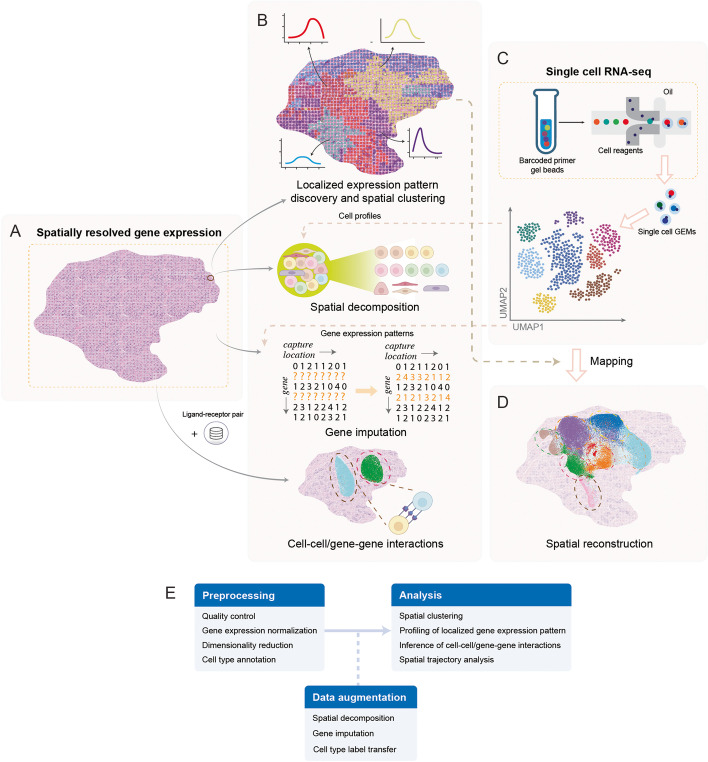
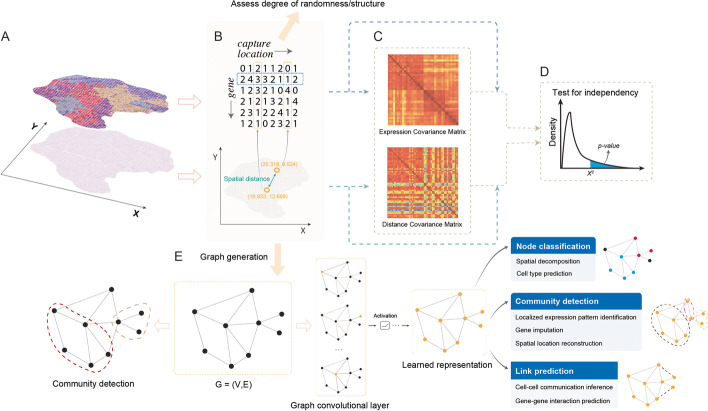
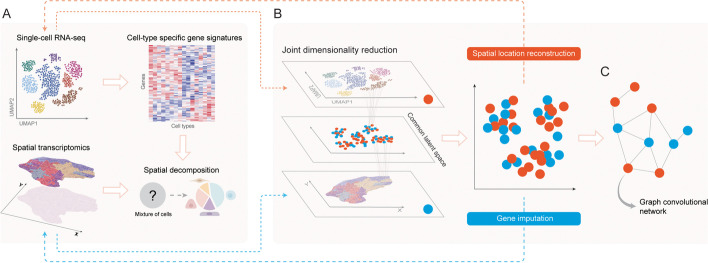
Verification
Claims the paper makes
The claims and statistics of this paper haven’t been checked yet.
Free: it reads the open-access text and checks the first 5 claims that cite a source we can check. Create a free account to check every claim.
Claims other papers make about this one
Each is checked against this paper’s own text: does it say what the citing paper says it does?
The cited source says what the claim attributes to it.
In the citing paper
“Deep learning methods have been applied to extract the interactions between cellular location and molecular phenotypes [125].”
From Challenges in AI-driven Biomedical Multimodal Data Fusion and Analysis (2025) · cites this paper as [125]
Self-check
Percentages, sums and reported differences re-computed from the paper’s own numbers.
The self-check needs the paper’s full text.
Citations
Cites
Comprehensive Integration of Single-Cell Data
Stuart, T., Butler, A., Hoffman, P., Hafemeister, C., Papalexi, E., Mauck, W. M., Hao, Y., Stoeckius, M., Smibert, P., & Satija, R. (2019) · Cell · doi:10.1016/j.cell.2019.05.031 · Cited by 15,453
Fast, sensitive and accurate integration of single-cell data with Harmony
Korsunsky, I., Millard, N., Fan, J., Slowikowski, K., Zhang, F., Wei, K., Baglaenko, Y., Brenner, M., Loh, P.-R., & Raychaudhuri, S. (2019) · Nature Methods · doi:10.1038/s41592-019-0619-0 · Cited by 10,488
Spatial reconstruction of single-cell gene expression data
Satija, R., Farrell, J. A., Gennert, D., Schier, A. F., & Regev, A. (2015) · Nature Biotechnology · doi:10.1038/nbt.3192 · Cited by 7,055 · cited 6×
“Based on this reference map, Seurat [50] projects scRNA-seq cells to spatial locations with a probabilistic score using a bimodal mixture model (Fig.”
BackgroundMethodInfluentialWeiss, K., Khoshgoftaar, T. M., & Wang, D. (2016) · Journal of Big Data · doi:10.1186/s40537-016-0043-6 · Cited by 6,260 · cited 1×
“To solve this problem, we may adapt the idea of transfer learning, which utilizes knowledge learned from similar domains where data is more accessible or better labeled [21].”
MethodVisualization and analysis of gene expression in tissue sections by spatial transcriptomics
Ståhl, P. L., Salmén, F., Vickovic, S., Lundmark, A., Navarro, J. F., Magnusson, J., Giacomello, S., Asp, M., Westholm, J. O., Huss, M., et al. (2016) · Science · doi:10.1126/science.aaf2403 · Cited by 3,834 · cited 1×
“In the past decade, the rapid development of spatial transcriptomics technology has facilitated biological discoveries in different domains [4, 13–15].”
BackgroundSpatially resolved, highly multiplexed RNA profiling in single cells
Chen, K. H., Boettiger, A. N., Moffitt, J. R., Wang, S., & Zhuang, X. (2015) · Science · doi:10.1126/science.aaa6090 · Cited by 2,969 · cited 2×
“It assumes a zero-inflated negative binomial (ZINB) distribution for scRNA-seq measurements, a Poisson distribution for single-molecule fluorescence in situ hybridization (smFISH) [3] measurements, and a negative binomial distribution for spatially resolved transcript amplicon readout mapping (starMAP) [76] measuremen…”
MethodDeep generative modeling for single-cell transcriptomics
Lopez, R., Regier, J., Cole, M. B., Jordan, M. I., & Yosef, N. (2018) · Nature Methods · doi:10.1038/s41592-018-0229-2 · Cited by 2,530 · cited 3×
“In terms of aggregating scRNA-seq data and spatial transcriptomics data, gimVI [37] and scVI [75] differ from other methods in their non-linearity, as many other methods are dependent”
BackgroundMethodSlide-seq: A scalable technology for measuring genome-wide expression at high spatial resolution
Rodriques, S. G., Stickels, R. R., Goeva, A., Martin, C. A., Murray, E., Vanderburg, C. R., Welch, J., Chen, L. M., Chen, F., & Macosko, E. Z. (2019) · Science · doi:10.1126/science.aaw1219 · Cited by 2,424 · cited 1×
“To analyze Slide-seq data, Rodriques et al. [6] propose to utilize non-negative matrix factorization (NMF) to derive metagenes from the scRNA-seq data.”
MethodStatistical Analysis and Modelling of Spatial Point Patterns
Illian, J., Penttinen, A., Stoyan, H., & Stoyan, D. (2007) · Wiley eBooks · doi:10.1002/9780470725160 · Cited by 1,848 · cited 1×
“Trendsceek [40] utilizes the marked point process theory [65], in which spatial locations are represented as points and expression levels as marks.”
MethodTranscriptome-scale super-resolved imaging in tissues by RNA seqFISH
Eng, C.-H. L., Lawson, M., Zhu, Q., Dries, R., Koulena, N., Takei, Y., Yun, J., Cronin, C., Karp, C., Yuan, G.-C., et al. (2019) · Nature · doi:10.1038/s41586-019-1049-y · Cited by 1,754
Cited by
Multimodal machine learning in precision health: A scoping review
Kline, A., Wang, H., Li, Y., Dennis, S., Hutch, M., Xu, Z., Wang, F., Cheng, F., & Luo, Y. (2022) · npj Digital Medicine · doi:10.1038/s41746-022-00712-8 · Cited by 528
Self-citationApplications of single-cell RNA sequencing in drug discovery and development
Van de Sande, B., Lee, J. S., Mutasa-Gottgens, E., Naughton, B., Bacon, W., Manning, J., Wang, Y., Pollard, J., Mendez, M., Hill, J., et al. (2023) · Nature Reviews Drug Discovery · doi:10.1038/s41573-023-00688-4 · Cited by 437
An Unsupervised Machine Learning Algorithms: Comprehensive Review
Naeem, S., Ali, A., Anam, S., & Ahmed, M. M. (2023) · International Journal of Computing and Digital Systems · doi:10.12785/ijcds/130172 · Cited by 289
“Develop models that detect trends in historical data and utilize those models to make forecasts to generate data-driven predictions [1], [2], [3].”
MethodClinical and translational values of spatial transcriptomics
Zhang, L., Chen, D., Song, D., Liu, X., Zhang, Y., Xu, X., & Wang, X. (2022) · Signal Transduction and Targeted Therapy · doi:10.1038/s41392-022-00960-w · Cited by 213
Spatial transcriptomics in health and disease
Jain, S. R., & Eadon, M. T. (2024) · Nature Reviews Nephrology · doi:10.1038/s41581-024-00841-1 · Cited by 186
“Each of these techniques has different underlying mathematical properties, which can lead to considerable variability in how cells or spots are defined 40–42 .”
Metadata
- Authors
- Zeng, Z., Li, Y., Li, Y., & Luo, Y.
- Affiliations
- Peking University (CN)
- Northwestern University (US)
- Corresponding author
- Luo, Yuan
- Venue
- Genome Biology
- Published
- 2022-03-25
- Volume
- 23
- Issue
- 1
- Pages
- 83-83
- ISSN
- 1465-6906 (ISSN-L)
- 1474-760X
- PMC
- PMC8951701
- OpenAlex
- W4221095552
- Semantic Scholar
- ad1c1fc6d1ee5ef416501317dbfd24045bc8b136
- Cited by
- 186
- References
- 113
- Citations by year
- 2026: 28 · 2025: 41 · 2024: 59 · 2023: 41 · 2022: 17
- FWCI
- 4.26
- Type
- journal article
- Language
- en
- Open access
- gold
- doi.org
- Licence
- cc-by
- creativecommons.org/licenses/by/4.0 (tdm)
- creativecommons.org/licenses/by/4.0 (vor)
- Locations
- Genome biology (publishedVersion, cc-by)
- PubMed Central (publishedVersion, cc-by)
- PubMed (publishedVersion)
- DOAJ (DOAJ: Directory of Open Access Journals) (submittedVersion)
- Funders
- National Institutes of Health (R01LM013337, 5UL1TR001422)
- Topics
- Life Sciences › Biochemistry, Genetics and Molecular Biology › Molecular Biology › Single-cell and spatial transcriptomics
- Life Sciences › Biochemistry, Genetics and Molecular Biology › Molecular Biology › Gene expression and cancer classification
- Social Sciences › Economics, Econometrics and Finance › Economics and Econometrics › Spatial and Panel Data Analysis
- Keywords
- spatial transcriptomics, statistical analysis, machine learning, single-cell transcriptomics, spatial location, data complexity
- MeSH terms
- Machine Learning, Data Analysis, Sequence Analysis, Single-Cell Analysis, Transcriptome
About these checks
Registry, retraction, Cites and statistics results are computed, not judged, with one exception: a printed reference that no index lists is read once by a model before it counts as a citation error. Claims are extracted by a model and kept only when their quote appears verbatim in the text; each cited source is then checked, with a model’s help, for whether it says what the claim relies on. Those verdicts can be wrong — read the claim’s quote and the cited source before relying on one.
Statistics and arithmetic are recomputed, not judged.
Confidence bands are shown only for fields calibrated on our annotated test set. None is calibrated yet, so no band is shown.
What counts as a claim ›How we measure confidence ›How we check this ›
Are you an author, or do you see a problem with this page? Request a review
Data sources
Bibliographic data: Semantic Scholar, OpenAlex, Crossref.
Contains information from the Semantic Scholar Academic Graph Datasets, made available under the ODC Attribution License (ODC-BY 1.0).
Semantic Scholar’s data is described in: Kinney, R., et al. (2023). The Semantic Scholar Open Data Platform. arXiv:2301.10140.
