

The multiple evolutionary origins of the eukaryotic N-glycosylation pathway
Open accessThe DOI matches its Crossref record; 125 of the 127 references it cites were found in a registry or an index.
Abstract
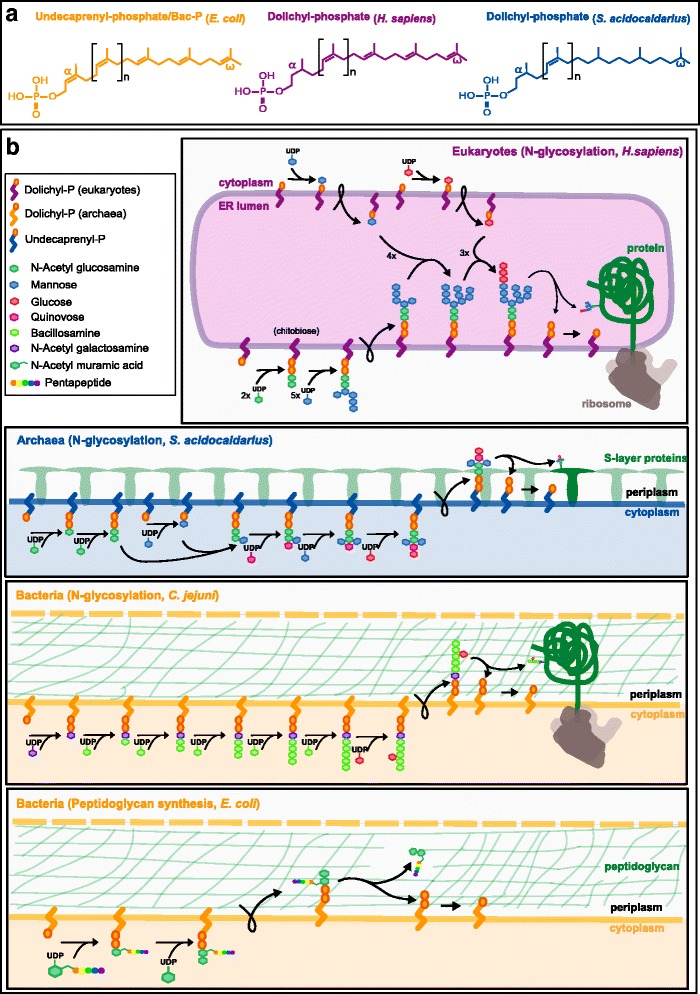
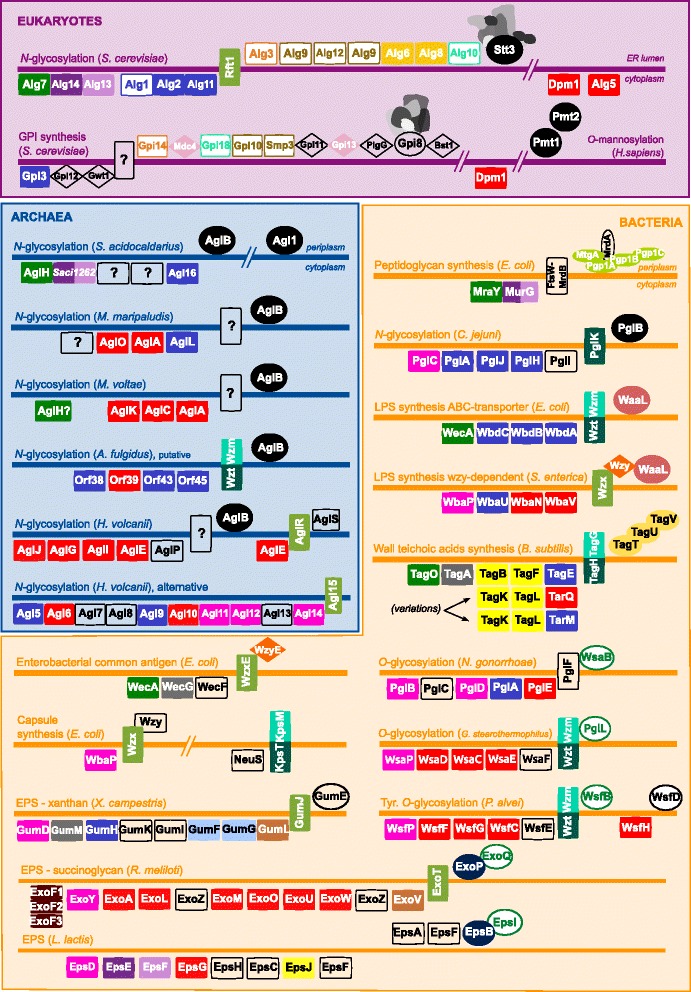
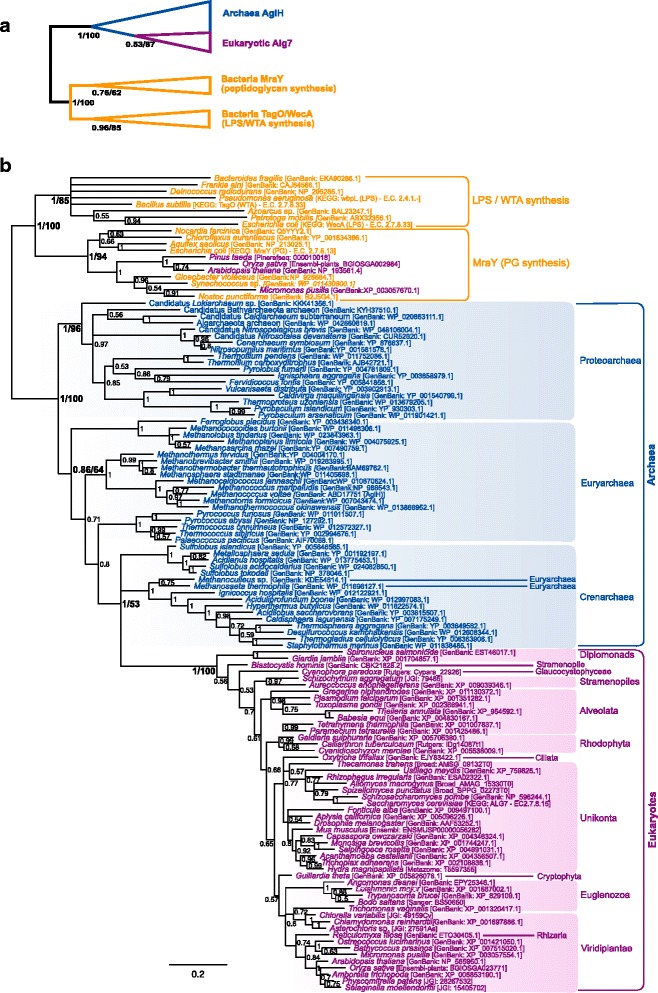
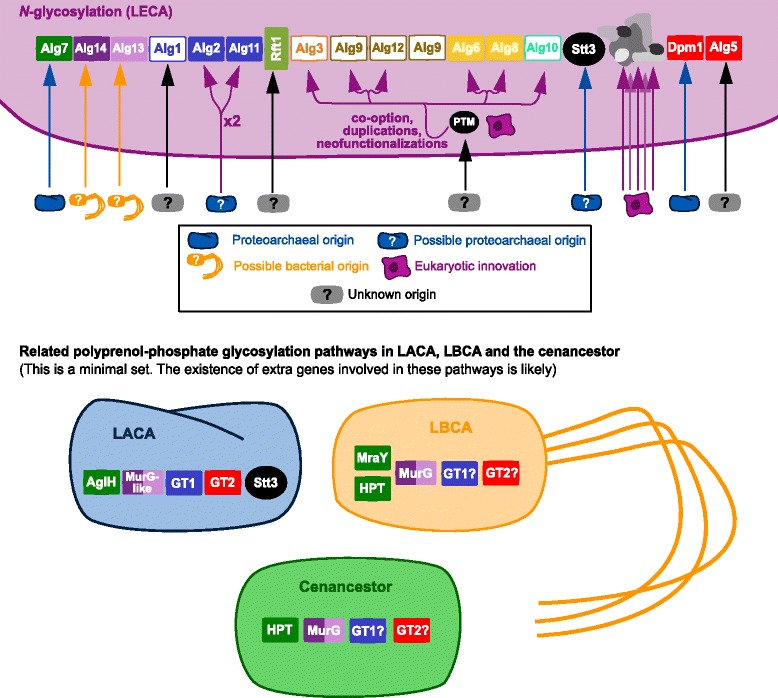
BACKGROUND: The N-glycosylation is an essential protein modification taking place in the membranes of the endoplasmic reticulum (ER) in eukaryotes and the plasma membranes in archaea. It shares mechanistic similarities based on the use of polyisoprenol lipid carriers with other glycosylation pathways involved in the synthesis of bacterial cell wall components (e.g. peptidoglycan and teichoic acids). Here, a phylogenomic analysis was carried out to examine the validity of rival hypotheses suggesting alternative archaeal or bacterial origins to the eukaryotic N-glycosylation pathway. RESULTS: The comparison of several polyisoprenol-based glycosylation pathways from the three domains of life shows that most of the implicated proteins belong to a limited number of superfamilies. The N-glycosylation pathway enzymes are ancestral to the eukaryotes, but their origins are mixed: Alg7, Dpm and maybe also one gene of the glycosyltransferase 1 (GT1) superfamily and Stt3 have proteoarchaeal (TACK superphylum) origins; alg2/alg11 may have resulted from the duplication of the original GT1 gene; the lumen glycosyltransferases were probably co-opted and multiplied through several gene duplications during eukaryogenesis; Alg13/Alg14 are more similar to their bacterial homologues; and Alg1, Alg5 and a putative flippase have unknown origins. CONCLUSIONS: The origin of the eukaryotic N-glycosylation pathway is not unique and less straightforward than previously thought: some basic components likely have proteoarchaeal origins, but the pathway was extensively developed before the eukaryotic diversification through multiple gene duplications, protein co-options, neofunctionalizations and even possible horizontal gene transfers from bacteria. These results may have important implications for our understanding of the ER evolution and eukaryogenesis. REVIEWERS: This article was reviewed by Pr. Patrick Forterre and Dr. Sergei Mekhedov (nominated by Editorial Board member Michael Galperin).
Overview
The claims and statistics of this paper haven’t been checked yet.
Free: it reads the open-access text and checks the first 5 claims that cite a source we can check. Create a free account to check every claim.
Integrity signals
Registry
Cites
Statistics
Figures
Verification
Claims the paper makes
The claims and statistics of this paper haven’t been checked yet.
Free: it reads the open-access text and checks the first 5 claims that cite a source we can check. Create a free account to check every claim.
Self-check
Percentages, sums and reported differences re-computed from the paper’s own numbers.
The self-check needs the paper’s full text.
Citations
Cites
Basic local alignment search tool
Altschul, S. F., Gish, W., Miller, W., Myers, E. W., & Lipman, D. J. (1990) · Journal of Molecular Biology · doi:10.1006/jmbi.1990.9999 · Cited by 98,669 · cited 1×
“all reciprocal BLASTp searches were carried out [60].”
BackgroundGapped BLAST and PSI-BLAST: a new generation of protein database search programs
Altschul, S. (1997) · Nucleic Acids Research · doi:10.1093/nar/25.17.3389 · Cited by 73,302
MUSCLE: multiple sequence alignment with high accuracy and high throughput
Edgar, R. C. (2004) · Nucleic Acids Research · doi:10.1093/nar/gkh340 · Cited by 44,662 · cited 1×
“31 [104], sequences were trimmed using the program NET of the MUST package [105] and preliminary phylogenies were reconstructed using FastTree v.”
MethodRAxML version 8: a tool for phylogenetic analysis and post-analysis of large phylogenies
Stamatakis, A. (2014) · Bioinformatics · doi:10.1093/bioinformatics/btu033 · Cited by 32,291
MrBayes 3.2: Efficient Bayesian Phylogenetic Inference and Model Choice Across a Large Model Space
Ronquist, F., Teslenko, M., van der Mark, P., Ayres, D. L., Darling, A., Höhna, S., Larget, B., Liu, L., Suchard, M. A., & Huelsenbeck, J. P. (2012) · Systematic Biology · doi:10.1093/sysbio/sys029 · Cited by 27,843
FastTree 2 – Approximately Maximum-Likelihood Trees for Large Alignments
Price, M. N., Dehal, P. S., & Arkin, A. P. (2010) · PLoS ONE · doi:10.1371/journal.pone.0009490 · Cited by 14,894
Creating the CIPRES Science Gateway for inference of large phylogenetic trees
Miller, M. A., Pfeiffer, W., & Schwartz, T. (2010) · 2010 Gateway Computing Environments Workshop (GCE) · doi:10.1109/gce.2010.5676129 · Cited by 11,228 · cited 3×
“plemented in the CIPRES Science Gateway [110].”
InfluentialTowards a natural system of organisms: proposal for the domains Archaea, Bacteria, and Eucarya.
Woese, C. R., Kandler, O., & Wheelis, M. L. (1990) · Proceedings of the National Academy of Sciences · doi:10.1073/pnas.87.12.4576 · Cited by 6,128
Raetz, C. R. H., & Whitfield, C. (2002) · Annual Review of Biochemistry · doi:10.1146/annurev.biochem.71.110601.135414 · Cited by 4,404
An Improved General Amino Acid Replacement Matrix
Le, S. Q., & Gascuel, O. (2008) · Molecular Biology and Evolution · doi:10.1093/molbev/msn067 · Cited by 3,127 · cited 1×
“The MrBayes analysis used a LG substitution model [111] and”
MethodHuerta-Cepas, J., Szklarczyk, D., Forslund, K., Cook, H., Heller, D., Walter, M. C., Rattei, T., Mende, D. R., Sunagawa, S., Kuhn, M., et al. (2016) · Nucleic Acids Research · doi:10.1093/nar/gkv1248 · Cited by 2,101 · cited 1×
“de/#/app/home, [102]) and OMA browser (http://omabrowser.”
Glycosyltransferases: Structures, Functions, and Mechanisms
Lairson, L. L., Henrissat, B., Davies, G. J., & Withers, S. G. (2008) · Annual Review of Biochemistry · doi:10.1146/annurev.biochem.76.061005.092322 · Cited by 2,079
Roles of N-Linked Glycans in the Endoplasmic Reticulum
Helenius, A., & Aebi, M. (2004) · Annual Review of Biochemistry · doi:10.1146/annurev.biochem.73.011303.073752 · Cited by 2,037 · cited 2×
“Since polyisoprenol-based N-glycosylation pathways are widespread in archaea and eukaryotes but uncommon in bacteria, it has been speculated that this pathway originated in archaea, was horizontally transferred to some bacteria [46, 47] and inherited in eukaryotes from their putative archaeal-related progenitor [34, 4…”
BackgroundOn the frequency of protein glycosylation, as deduced from analysis of the SWISS-PROT database
Apweiler, R. (1999) · Biochimica et Biophysica Acta (BBA) - General Subjects · doi:10.1016/s0304-4165(99)00165-8 · Cited by 1,855 · cited 3×
“More than half of all eukaryotic proteins are glycoproteins, and 90 % of those are N-glycosylated [33].”
BackgroundComplex archaea that bridge the gap between prokaryotes and eukaryotes
Spang, A., Saw, J. H., Jørgensen, S. L., Zaremba-Niedzwiedzka, K., Martijn, J., Lind, A. E., van Eijk, R., Schleper, C., Guy, L., & Ettema, T. J. G. (2015) · Nature · doi:10.1038/nature14447 · Cited by 1,324 · cited 4×
“Yet, these results are also compatible with other eukaryogenesis hypotheses, as other eocyte or archaeal-stem hypotheses of eukaryogenesis may also account for the proteoarchaeal origin of these proteins [8, 10, 11] and the possibility that these genes were horizontally transferred from a proteoarchaeon to a Fig.”
BackgroundResultInfluentialThe Hydrogen Hypothesis for the First Eukaryote
Martin, W., & Müller, M. (1998) · Nature · doi:10.1038/32096 · Cited by 1,282 · cited 1×
“archaeon [13, 14] or a previous bacterium/archaeon con-”
From the regulation of peptidoglycan synthesis to bacterial growth and morphology
Typas, A., Banzhaf, M., Gross, C. A., & Vollmer, W. (2012) · Nature Reviews Microbiology · doi:10.1038/nrmicro2677 · Cited by 1,273
An Evolving Hierarchical Family Classification for Glycosyltransferases
Coutinho, P. M., Deleury, E., Davies, G. J., & Henrissat, B. (2003) · Journal of Molecular Biology · doi:10.1016/s0022-2836(03)00307-3 · Cited by 1,211
The phagotrophic origin of eukaryotes and phylogenetic classification of Protozoa.
Cavalier-Smith, T. (2002) · International Journal of Systematic and Evolutionary Microbiology · doi:10.1099/00207713-52-2-297 · Cited by 993 · cited 1×
“The traditional three-domain tree of life posits that eukaryotes and archaea are sister groups [3–5] and, thus, it assumes that the mitochondrial ancestor was incorporated in a pre-existing proto-eukaryotic lineage [6, 7].”
BackgroundBiosynthesis and Assembly of Capsular Polysaccharides in Escherichia coli
Whitfield, C. (2006) · Annual Review of Biochemistry · doi:10.1146/annurev.biochem.75.103004.142545 · Cited by 990
Wall Teichoic Acids of Gram-Positive Bacteria
Brown, S., Santa Maria, J. P., & Walker, S. (2013) · Annual Review of Microbiology · doi:10.1146/annurev-micro-092412-155620 · Cited by 966
Finn, R. D., Clements, J., Arndt, W., Miller, B. L., Wheeler, T. J., Schreiber, F., Bateman, A., & Eddy, S. R. (2015) · Nucleic Acids Research · doi:10.1093/nar/gkv397 · Cited by 931 · cited 8×
“The high number of homologues of the GT1 enzymes detected in the three domains of life proved challenging to handle, so preliminary analyses were carried out to exclude the most distant GT1 homologues from the analysis and concentrate in the closest relatives to the eukaryotic sequences (see Methods).”
BackgroundInfluentialIwabe, N., Kuma, K., Hasegawa, M., Osawa, S., & Miyata, T. (1989) · Proceedings of the National Academy of Sciences · doi:10.1073/pnas.86.23.9355 · Cited by 902
Eukaryotic evolution, changes and challenges
Embley, T. M., & Martin, W. (2006) · Nature · doi:10.1038/nature04546 · Cited by 867 · cited 15×
“The phylogeny of the Rft1 homologues shows that the eukaryotic sequences form a monophyletic group (BPP = 0.99) supportive of their inheritance from LECA, but it is unable to clarify the relationship of the eukaryotic proteins with their prokaryotic relatives (Additional file 6).”
BackgroundInfluentialCAMPBELL, J. A., DAVIES, G. J., BULONE, V., & HENRISSAT, B. (1997) · Biochemical Journal · doi:10.1042/bj3260929u · Cited by 815
Evolution of the vacuolar H+-ATPase: implications for the origin of eukaryotes.
Gogarten, J. P., Kibak, H., Dittrich, P., Taiz, L., Bowman, E. J., Bowman, B. J., Manolson, M. F., Poole, R. J., Date, T., Oshima, T., et al. (1989) · Proceedings of the National Academy of Sciences · doi:10.1073/pnas.86.17.6661 · Cited by 781
Mechanisms and principles of N-linked protein glycosylation
Schwarz, F., & Aebi, M. (2011) · Current Opinion in Structural Biology · doi:10.1016/j.sbi.2011.08.005 · Cited by 695 · cited 2×
“Since polyisoprenol-based N-glycosylation pathways are widespread in archaea and eukaryotes but uncommon in bacteria, it has been speculated that this pathway originated in archaea, was horizontally transferred to some bacteria [46, 47] and inherited in eukaryotes from their putative archaeal-related progenitor [34, 4…”
BackgroundThe dolichol pathway of N-linked glycosylation
Burda, P., & Aebi, M. (1999) · Biochimica et Biophysica Acta (BBA) - General Subjects · doi:10.1016/s0304-4165(98)00127-5 · Cited by 651 · cited 6×
“These proteins appear to be unique to eukaryotes [46, 50], so their evolution has only been studied in this domain [59].”
BackgroundInfluentialGUIDANCE: a web server for assessing alignment confidence scores
Penn, O., Privman, E., Ashkenazy, H., Landan, G., Graur, D., & Pupko, T. (2010) · Nucleic Acids Research · doi:10.1093/nar/gkq443 · Cited by 624
MUST, a computer package of Management Utilities for Sequences and Trees
Philippe, H. (1993) · Nucleic Acids Research · doi:10.1093/nar/21.22.5264 · Cited by 600 · cited 1×
“31 [104], sequences were trimmed using the program NET of the MUST package [105] and preliminary phylogenies were reconstructed using FastTree v.”
MethodGenomic evidence for two functionally distinct gene classes
Rivera, M. C., Jain, R., Moore, J. E., & Lake, J. A. (1998) · Proceedings of the National Academy of Sciences · doi:10.1073/pnas.95.11.6239 · Cited by 543 · cited 1×
“homologues, while informational genes are more similar to archaeal ones [12].”
BackgroundAlbers, S.-V., & Meyer, B. H. (2011) · Nature Reviews Microbiology · doi:10.1038/nrmicro2576 · Cited by 542 · cited 1×
“In archaea, flagellins and cell wall S-layer proteins are N-glycosylated using similar pathways located in their cell membranes [36, 37].”
BackgroundProtein glycosylation in bacteria: sweeter than ever
Nothaft, H., & Szymanski, C. M. (2010) · Nature Reviews Microbiology · doi:10.1038/nrmicro2383 · Cited by 530 · cited 2×
“N-glycosylation systems are known [43].”
BackgroundExport-Mediated Assembly of Mycobacterial Glycoproteins Parallels Eukaryotic Pathways
VanderVen, B. C., Harder, J. D., Crick, D. C., & Belisle, J. T. (2005) · Science · doi:10.1126/science.1114347 · Cited by 472 · cited 1×
“O-mannosylation has been described in several bacteria including Mycobacteria [86, 87]–a suggestive result given the detection of the mycobacterialbased unknown domain DUF2029 in the distant lumen GT prokaryotic homologues.”
BackgroundThe biosynthesis of peptidoglycan lipid-linked intermediates
Bouhss, A., Trunkfield, A. E., Bugg, T. D. H., & Mengin-Lecreulx, D. (2008) · FEMS Microbiology Reviews · doi:10.1111/j.1574-6976.2007.00089.x · Cited by 446
Myosin domain evolution and the primary divergence of eukaryotes
Richards, T. A., & Cavalier-Smith, T. (2005) · Nature · doi:10.1038/nature03949 · Cited by 431
De Vuyst, L., De Vin, F., Vaningelgem, F., & Degeest, B. (2001) · International Dairy Journal · doi:10.1016/s0958-6946(01)00114-5 · Cited by 391 · cited 2×
“(EPS) synthesis of firmicutes [72, 73] has been reported to be split into the same protein domains as Alg14/Alg13 [62]; in the contrary, excavates and some amoebozoa have fused Alg14-Alg13 polypeptides (Table 1).”
BackgroundThe archaebacterial origin of eukaryotes
Cox, C. J., Foster, P. G., Hirt, R. P., Harris, S. R., & Embley, T. M. (2008) · Proceedings of the National Academy of Sciences · doi:10.1073/pnas.0810647105 · Cited by 389
The archaeal ‘TACK’ superphylum and the origin of eukaryotes
Guy, L., & Ettema, T. J. G. (2011) · Trends in Microbiology · doi:10.1016/j.tim.2011.09.002 · Cited by 347 · cited 1×
“Yet, these results are also compatible with other eukaryogenesis hypotheses, as other eocyte or archaeal-stem hypotheses of eukaryogenesis may also account for the proteoarchaeal origin of these proteins [8, 10, 11] and the possibility that these genes were horizontally transferred from a proteoarchaeon to a Fig.”
ResultRAMESH, M., MALIK, S., & LOGSDON, J. (2005) · Current Biology · doi:10.1016/s0960-9822(05)00028-x · Cited by 340
Moreira, D., & López-García, P. (1998) · Journal of Molecular Evolution · doi:10.1007/pl00006408 · Cited by 328
The two-domain tree of life is linked to a new root for the Archaea
Raymann, K., Brochier-Armanet, C., & Gribaldo, S. (2015) · Proceedings of the National Academy of Sciences · doi:10.1073/pnas.1420858112 · Cited by 296 · cited 3×
“That being said, I do not think that the work by Raymann et al. 2015 necessarily contradicts the proteoarchaeal monophily.”
BackgroundMethodInfluentialTranslocation of lipid-linked oligosaccharides across the ER membrane requires Rft1 protein
Helenius, J., Ng, D. T. W., Marolda, C. L., Walter, P., Valvano, M. A., & Aebi, M. (2002) · Nature · doi:10.1038/415447a · Cited by 294 · cited 1×
“Rft1 was suggested to be the eukaryotic N-glycosylation flippase [76] but the actual activity of this protein has been called into question [77–79].”
BackgroundEocytes: a new ribosome structure indicates a kingdom with a close relationship to eukaryotes.
Lake, J. A., Henderson, E., Oakes, M., & Clark, M. W. (1984) · Proceedings of the National Academy of Sciences · doi:10.1073/pnas.81.12.3786 · Cited by 294 · cited 1×
“Yet, these results are also compatible with other eukaryogenesis hypotheses, as other eocyte or archaeal-stem hypotheses of eukaryogenesis may also account for the proteoarchaeal origin of these proteins [8, 10, 11] and the possibility that these genes were horizontally transferred from a proteoarchaeon to a Fig.”
ResultJosset, L., Menachery, V. D., Gralinski, L. E., Agnihothram, S., Sova, P., Carter, V. S., Yount, B. L., Graham, R. L., Baric, R. S., & Katze, M. G. (2013) · mBio · doi:10.1128/mbio.00165-13 · Cited by 293
Biosynthesis of succinoglycan, a symbiotically important exopolysaccharide of Rhizobium meliloti
Reuber, T. L., & Walker, G. C. (1993) · Cell · doi:10.1016/0092-8674(93)90418-p · Cited by 289
Evolution of the eukaryotic membrane-trafficking system: origin, tempo and mode
Dacks, J. B., & Field, M. C. (2007) · Journal of Cell Science · doi:10.1242/jcs.013250 · Cited by 276
Samuelson, J., Banerjee, S., Magnelli, P., Cui, J., Kelleher, D. J., Gilmore, R., & Robbins, P. W. (2005) · Proceedings of the National Academy of Sciences · doi:10.1073/pnas.0409460102 · Cited by 268 · cited 10×
“These proteins appear to be unique to eukaryotes [46, 50], so their evolution has only been studied in this domain [59].”
BackgroundInfluentialVorhölter, F.-J., Schneiker, S., Goesmann, A., Krause, L., Bekel, T., Kaiser, O., Linke, B., Patschkowski, T., Rückert, C., Schmid, J., et al. (2008) · Journal of Biotechnology · doi:10.1016/j.jbiotec.2007.12.013 · Cited by 256
The PMT gene family: protein O-glycosylation in Saccharomyces cerevisiae is vital.
Gentzsch, M., & Tanner, W. (1996) · The EMBO Journal · doi:10.1002/j.1460-2075.1996.tb00961.x · Cited by 249 · cited 1×
“The PMTs carry out protein O-mannosylation, which is the transfer of a mannose residue from Dol-P-Man to a protein in the lumen side of the ER membrane [83, 84].”
BackgroundProtein O-mannosylation: Conserved from bacteria to humans
Lommel, M., & Strahl, S. (2009) · Glycobiology · doi:10.1093/glycob/cwp066 · Cited by 242 · cited 1×
“O-mannosylation has been described in several bacteria including Mycobacteria [86, 87]–a suggestive result given the detection of the mycobacterialbased unknown domain DUF2029 in the distant lumen GT prokaryotic homologues.”
BackgroundComplex Spliceosomal Organization Ancestral to Extant Eukaryotes
Collins, L., & Penny, D. (2005) · Molecular Biology and Evolution · doi:10.1093/molbev/msi091 · Cited by 240
The origin of the eukaryotic cell.
Gupta, R. S., & Golding, G. B. (1996) · PubMed · Cited by 239
Three monophyletic superfamilies account for the majority of the known glycosyltransferases
Liu, J., & Mushegian, A. (2003) · Protein Science · doi:10.1110/ps.0302103 · Cited by 234
The chimeric eukaryote: Origin of the nucleus from the karyomastigont in amitochondriate protists
Margulis, L., Dolan, M. F., & Guerrero, R. (2000) · Proceedings of the National Academy of Sciences · doi:10.1073/pnas.97.13.6954 · Cited by 233
Orlean, P., Albright, C., & Robbins, P. W. (1988) · Journal of Biological Chemistry · doi:10.1016/s0021-9258(19)77863-6 · Cited by 228
Modeling Protein Evolution with Several Amino Acid Replacement Matrices Depending on Site Rates
Le, S. Q., Dang, C. C., & Gascuel, O. (2012) · Molecular Biology and Evolution · doi:10.1093/molbev/mss112 · Cited by 223 · cited 1×
“The RaxML reconstructions used the LG + Γ model [112] and 4 rate categories.”
MethodKoiwa, H. (2003) · THE PLANT CELL ONLINE · doi:10.1105/tpc.013862 · Cited by 216 · cited 1×
“The N-OST that transfer the oligosaccharide from the lipid carrier to the acceptor protein have been genetically and biochemically described in eukaryotes [53, 89, 90], bacteria [44, 47] and archaea [91–95].”
The origin of the eukaryotic cell
Gupta, R. S., & Brian Golding, G. (1996) · Trends in Biochemical Sciences · doi:10.1016/s0968-0004(96)20013-1 · Cited by 214
An inside-out origin for the eukaryotic cell
Baum, D. A., & Baum, B. (2014) · BMC Biology · doi:10.1186/s12915-014-0076-2 · Cited by 211 · cited 4×
“The potential archaeal origin of eukaryotic N-glycosylation recently brought this pathway into the spotlight of eukaryogenesis debates [14].”
BackgroundResultInfluentialN-Linked Glycosylation in Archaea: a Structural, Functional, and Genetic Analysis
Jarrell, K. F., Ding, Y., Meyer, B. H., Albers, S.-V., Kaminski, L., & Eichler, J. (2014) · Microbiology and Molecular Biology Reviews · doi:10.1128/mmbr.00052-13 · Cited by 201 · cited 2×
“Not only the phylogenomic analyses are required to confirm evolutionary hypotheses, they also provide promising prokaryotic targets for the dynamic field of prokaryotic glycosylation characterization [36, 40].”
BackgroundAltenhoff, A. M., Škunca, N., Glover, N., Train, C.-M., Sueki, A., Piližota, I., Gori, K., Tomiczek, B., Müller, S., Redestig, H., et al. (2015) · Nucleic Acids Research · doi:10.1093/nar/gku1158 · Cited by 199 · cited 1×
“org/oma/home/, [103]) to make sure that no orthologues were missed in the Table 1.”
BackgroundMohammadi, T., Karczmarek, A., Crouvoisier, M., Bouhss, A., Mengin‐Lecreulx, D., & den Blaauwen, T. (2007) · Molecular Microbiology · doi:10.1111/j.1365-2958.2007.05851.x · Cited by 186 · cited 1×
“The resemblances between the eukaryotic Alg7-Alg13-Alg14 and the bacterial MraY-MurG complexes [69] could support the existence of a close evolutionary relationship between the eukaryotic N-glycosylation and the bacterial peptidoglycan synthesis pathways [49, 51].”
BackgroundThe universal tree of life: an update
Forterre, P. (2015) · Frontiers in Microbiology · doi:10.3389/fmicb.2015.00717 · Cited by 185 · cited 2×
“The paper would be better if Jonathan Lombard consider in parallel the Lake (eocyte/ proteoarchaea) scenario and the Woese’s scenario in which Archaea and Eukarya are sister groups forming a Lombard Biology Direct (2016) 11:36 Page 22 of 31 clade (Akarya, sensu Forterre, 2015).”
BackgroundOrigin and evolution of the peroxisomal proteome
Gabaldón, T., Snel, B., Zimmeren, F. V., Hemrika, W., Tabak, H., & Huynen, M. A. (2006) · Biology Direct · doi:10.1186/1745-6150-1-8 · Cited by 175
Eisenhaber, B., Maurer‐Stroh, S., Novatchkova, M., Schneider, G., & Eisenhaber, F. (2003) · BioEssays · doi:10.1002/bies.10254 · Cited by 167 · cited 1×
“2, [59]), which also takes place in the lumen side of the ER membrane [80].”
BackgroundThe origin of eukaryotes and their relationship with the Archaea: are we at a phylogenomic impasse?
Gribaldo, S., Poole, A. M., Daubin, V., Forterre, P., & Brochier-Armanet, C. (2010) · Nature Reviews Microbiology · doi:10.1038/nrmicro2426 · Cited by 159 · cited 1×
“There is only one 2010 reference indicating that it’s controversial (ref [18]).”
BackgroundThe hybrid nature of the Eukaryota and a consilient view of life on Earth
McInerney, J. O., O’Connell, M. J., & Pisani, D. (2014) · Nature Reviews Microbiology · doi:10.1038/nrmicro3271 · Cited by 158
Studies on the Function of Oligosaccharyl Transferase Subunits
Yan, Q., & Lennarz, W. J. (2002) · Journal of Biological Chemistry · doi:10.1074/jbc.m208136200 · Cited by 157 · cited 1×
“The N-OST that transfer the oligosaccharide from the lipid carrier to the acceptor protein have been genetically and biochemically described in eukaryotes [53, 89, 90], bacteria [44, 47] and archaea [91–95].”
Petitjean, C., Deschamps, P., López-García, P., & Moreira, D. (2015) · Genome Biology and Evolution · doi:10.1093/gbe/evu274 · Cited by 156 · cited 1×
“Some genes likely had archaeal ancestors– especially from the TACK superphylum, to which I will refer to as proteoarchaea [52].”
BackgroundThe KTR and MNN1 mannosyltransferase families of Saccharomyces cerevisiae
Lussier, M., Sdicu, A., & Bussey, H. (1999) · Biochimica et Biophysica Acta (BBA) - General Subjects · doi:10.1016/s0304-4165(98)00133-0 · Cited by 150 · cited 1×
“The PMTs carry out protein O-mannosylation, which is the transfer of a mannose residue from Dol-P-Man to a protein in the lumen side of the ER membrane [83, 84].”
BackgroundProtein O-mannosylation: What we have learned from baker's yeast
Loibl, M., & Strahl, S. (2013) · Biochimica et Biophysica Acta (BBA) - Molecular Cell Research · doi:10.1016/j.bbamcr.2013.02.008 · Cited by 150 · cited 2×
“Two types of Dpm exist [75, 85, 100]: yeast Dpm has a C-terminal transmembrane helix to interact with membranes, whereas human Dpm1 lacks this structure and requires supplementary subunits (Dpm2/Dpm3).”
BackgroundA congruent phylogenomic signal places eukaryotes within the Archaea
Williams, T. A., Foster, P. G., Nye, T. M. W., Cox, C. J., & Embley, T. M. (2012) · Proceedings of the Royal Society B: Biological Sciences · doi:10.1098/rspb.2012.1795 · Cited by 148
Broad spectrum O-linked protein glycosylation in the human pathogen Neisseria gonorrhoeae
Vik, Å., Aas, F. E., Anonsen, J. H., Bilsborough, S., Schneider, A., Egge-Jacobsen, W., & Koomey, M. (2009) · Proceedings of the National Academy of Sciences · doi:10.1073/pnas.0809504106 · Cited by 147
Chaban, B., Voisin, S., Kelly, J., Logan, S. M., & Jarrell, K. F. (2006) · Molecular Microbiology · doi:10.1111/j.1365-2958.2006.05226.x · Cited by 142
Gao, X.-D., Tachikawa, H., Sato, T., Jigami, Y., & Dean, N. (2005) · Journal of Biological Chemistry · doi:10.1074/jbc.m507569200 · Cited by 128 · cited 21×
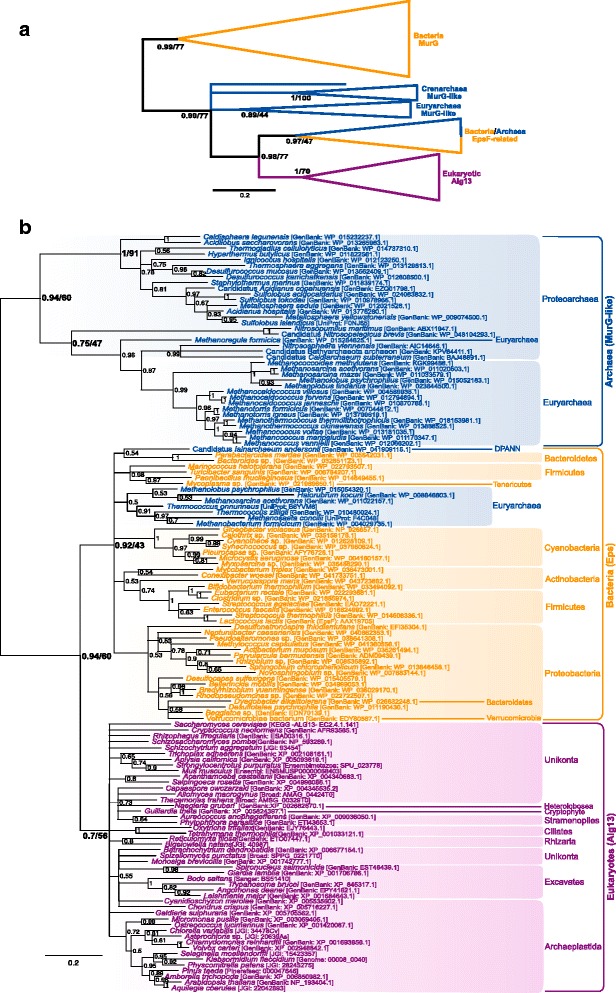
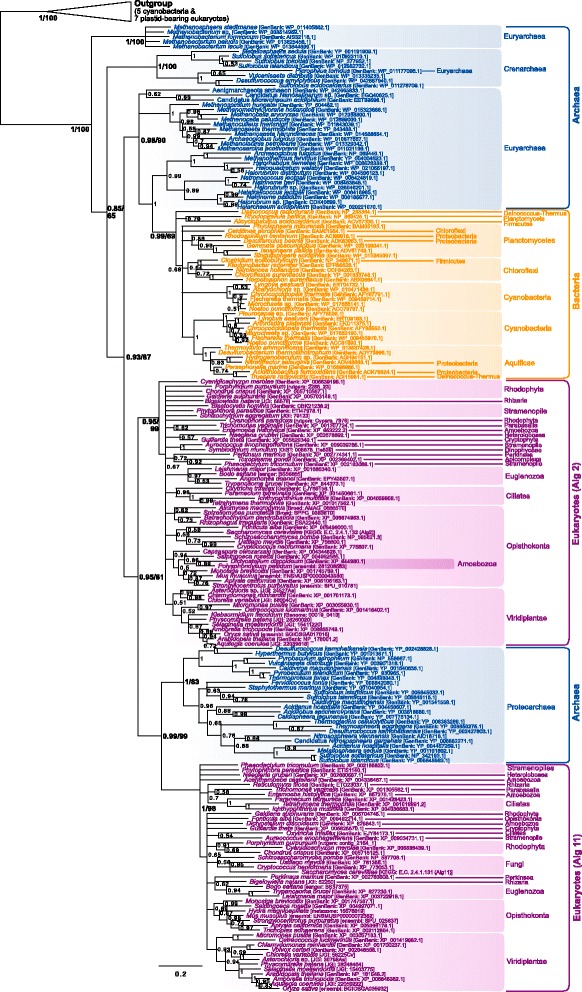
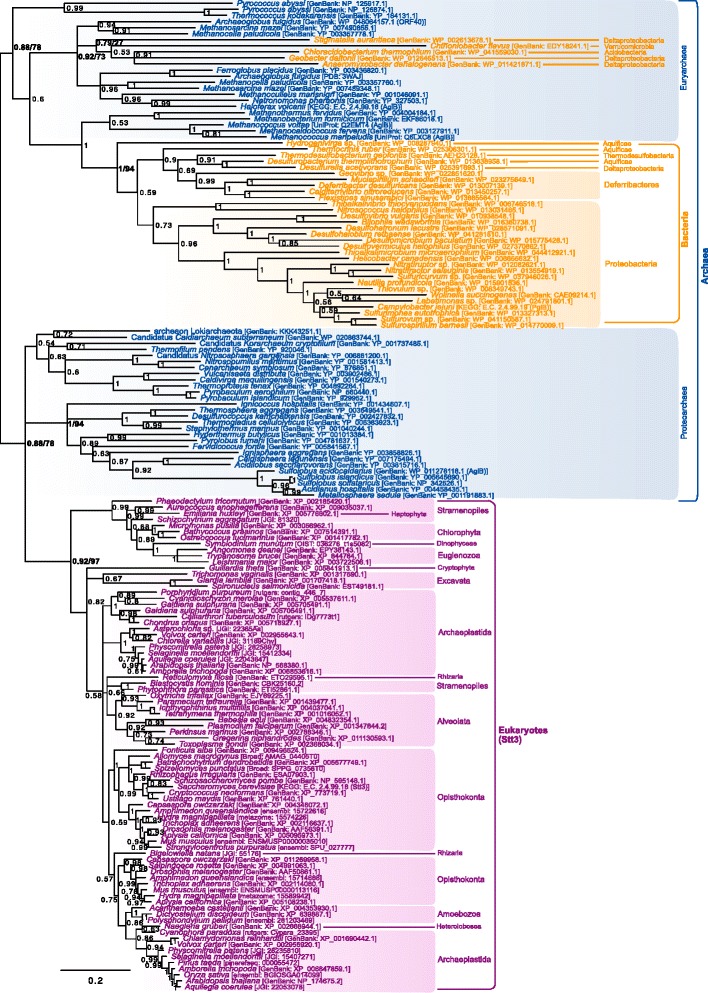
“Despite these difficulties, the wide distribution of Alg13/Alg14 orthologues across eukaryotes and their monophyly in all the phylogenies suggest that these proteins may have been ancestral to eukaryotes.”
BackgroundInfluentialLehrman, M. A. (1991) · Glycobiology · doi:10.1093/glycob/1.6.553 · Cited by 124
From peptidoglycan to glycoproteins: Common features of lipid-linked oligosaccharide biosynthesis
Bugg, T. (1994) · FEMS Microbiology Letters · doi:10.1016/0378-1097(94)90425-1 · Cited by 122 · cited 1×
“The resemblances between the eukaryotic Alg7-Alg13-Alg14 and the bacterial MraY-MurG complexes [69] could support the existence of a close evolutionary relationship between the eukaryotic N-glycosylation and the bacterial peptidoglycan synthesis pathways [49, 51].”
BackgroundRick, P. D., Barr, K., Sankaran, K., Kajimura, J., Rush, J. S., & Waechter, C. J. (2003) · Journal of Biological Chemistry · doi:10.1074/jbc.m301750200 · Cited by 121
Gabaldón, T., & Huynen, M. A. (2007) · PLoS Computational Biology · doi:10.1371/journal.pcbi.0030219 · Cited by 119 · cited 15×
“The phylogeny of the Rft1 homologues shows that the eukaryotic sequences form a monophyletic group (BPP = 0.99) supportive of their inheritance from LECA, but it is unable to clarify the relationship of the eukaryotic proteins with their prokaryotic relatives (Additional file 6).”
BackgroundInfluentialDolichol-phosphate mannose synthase: Structure, function and regulation
Maeda, Y., & Kinoshita, T. (2008) · Biochimica et Biophysica Acta (BBA) - General Subjects · doi:10.1016/j.bbagen.2008.03.005 · Cited by 119 · cited 3×
“These enzymes belong to the glycosyltransferase group 2 (GT2, [75]), which also comprises most GTs involved in the archaeal N-glycosylation pathways (Fig.”
BackgroundThe Common Ancestor of Archaea and Eukarya Was Not an Archaeon
Forterre, P. (2013) · Archaea · doi:10.1155/2013/372396 · Cited by 113
Heesen, S. T., Lehle, L., Weissmann, A., & Aebi, M. (1994) · European Journal of Biochemistry · doi:10.1111/j.1432-1033.1994.tb19996.x · Cited by 112 · cited 1×
“In eukaryotes, Alg5 is a Dol-P-glucose synthase [98] and Dpm is a Dol-P-mannose synthase also providing mannose to GPI synthesis and Omannosylation [99].”
BackgroundExtreme sweetness: protein glycosylation in archaea
Eichler, J. (2013) · Nature Reviews Microbiology · doi:10.1038/nrmicro2957 · Cited by 106 · cited 3×
“Not only the phylogenomic analyses are required to confirm evolutionary hypotheses, they also provide promising prokaryotic targets for the dynamic field of prokaryotic glycosylation characterization [36, 40].”
BackgroundMatsumoto, S., Shimada, A., Nyirenda, J., Igura, M., Kawano, Y., & Kohda, D. (2013) · Proceedings of the National Academy of Sciences · doi:10.1073/pnas.1309777110 · Cited by 104
Common Origin and Evolution of Glycosyltransferases Using Dol-P-monosaccharides as Donor Substrate
Oriol, R., Martínez-Duncker, I., Chantret, I., Mollicone, R., & Codogno, P. (2002) · Molecular Biology and Evolution · doi:10.1093/oxfordjournals.molbev.a004208 · Cited by 103 · cited 5×
“The eukaryotic GPI pathway was included notwithstanding being polyisoprenol-independent because its mannosyltransferases are the only known relatives of the eukaryotic N-glycosylation lumen GTs [59].”
BackgroundInfluentialColussi, P. A., Taron, C. H., Mack, J. C., & Orlean, P. (1997) · Proceedings of the National Academy of Sciences · doi:10.1073/pnas.94.15.7873 · Cited by 97 · cited 1×
“Two types of Dpm exist [75, 85, 100]: yeast Dpm has a C-terminal transmembrane helix to interact with membranes, whereas human Dpm1 lacks this structure and requires supplementary subunits (Dpm2/Dpm3).”
BackgroundProtein O-Glycosylation in Yeast
Lussier, M., Gentzsch, M., Sdicu, A.-M., Bussey, H., & Tanner, W. (1995) · Journal of Biological Chemistry · doi:10.1074/jbc.270.6.2770 · Cited by 91
S-layer nanoglycobiology of bacteria
Messner, P., Steiner, K., Zarschler, K., & Schäffer, C. (2008) · Carbohydrate Research · doi:10.1016/j.carres.2007.12.025 · Cited by 90
Bapteste, E., Charlebois, R. L., MacLeod, D., & Brochier, C. (2005) · Genome Biology · doi:10.1186/gb-2005-6-10-r85 · Cited by 89
Comparative Structural Biology of Eubacterial and Archaeal Oligosaccharyltransferases
Maita, N., Nyirenda, J., Igura, M., Kamishikiryo, J., & Kohda, D. (2010) · Journal of Biological Chemistry · doi:10.1074/jbc.m109.081752 · Cited by 88 · cited 4×
“Little is known about the function or evolution of the non-catalytic N-OST subunits [47].”
BackgroundInfluentialDoes Rft1 flip an N-glycan lipid precursor?
Frank, C. G., Sanyal, S., Rush, J. S., Waechter, C. J., & Menon, A. K. (2008) · Nature · doi:10.1038/nature07165 · Cited by 87
VanDyke, D. J., Wu, J., Logan, S. M., Kelly, J. F., Mizuno, S., Aizawa, S., & Jarrell, K. F. (2009) · Molecular Microbiology · doi:10.1111/j.1365-2958.2009.06671.x · Cited by 87
Gao, X. (2004) · Glycobiology · doi:10.1093/glycob/cwh072 · Cited by 82 · cited 4×
“This is in agreement with the observation that lumen GTs deletions have milder phenotypes than cytoplasmic GTs mutations [54].”
BackgroundResultInfluentialProtein tyrosine O-glycosylation--A rather unexplored prokaryotic glycosylation system
Zarschler, K., Janesch, B., Pabst, M., Altmann, F., Messner, P., & Schäffer, C. (2010) · Glycobiology · doi:10.1093/glycob/cwq035 · Cited by 81 · cited 7×
“alvei, which may supply periplasmic Bac-P-Glc to tyrosine O-glycosylation [101].”
BackgroundInfluentialMagidovich, H., & Eichler, J. (2009) · FEMS Microbiology Letters · doi:10.1111/j.1574-6968.2009.01775.x · Cited by 79 · cited 1×
“For instance, many HGTs and duplications of aglB have been reported in archaea and a close relationship between these proteins and eukaryotic Stt3 has been suggested [46, 47, 96, 97].”
BackgroundComplicated N-linked glycans in simple organisms
Schiller, B., Hykollari, A., Yan, S., Paschinger, K., & Wilson, I. B. H. (2012) · Biological Chemistry · doi:10.1515/hsz-2012-0150 · Cited by 78 · cited 4×
“In parasites, such losses may arguably have been a convenient mechanism to synthesize non-canonical N-glycans and escape the host defenses.”
BackgroundInfluentialMeyer, B. H., Zolghadr, B., Peyfoon, E., Pabst, M., Panico, M., Morris, H. R., Haslam, S. M., Messner, P., Schäffer, C., Dell, A., et al. (2011) · Molecular Microbiology · doi:10.1111/j.1365-2958.2011.07875.x · Cited by 76 · cited 1×
“acidocaldarius [88], bears a PMT domain.”
Devos, D. P., & Reynaud, E. G. (2010) · Science · doi:10.1126/science.1196720 · Cited by 76
Kolkman, M. A. B., van der Zeijst, B. A. M., & Nuijten, P. J. M. (1997) · Journal of Biological Chemistry · doi:10.1074/jbc.272.31.19502 · Cited by 75
Kaminski, L., Guan, Z., Yurist‐Doutsch, S., & Eichler, J. (2013) · mBio · doi:10.1128/mbio.00716-13 · Cited by 74
Guan, Z., Naparstek, S., Kaminski, L., Konrad, Z., & Eichler, J. (2010) · Molecular Microbiology · doi:10.1111/j.1365-2958.2010.07405.x · Cited by 74
Commentary: A family of UDP-GlcNAc/MurNAc: polyisoprenol-P GlcNAc/MurNAc-1-P transferases
Lehrman, M. A. (1994) · Glycobiology · doi:10.1093/glycob/4.6.768 · Cited by 70
Characterization of N-Linked Protein Glycosylation in Helicobacter pullorum
Jervis, A. J., Langdon, R., Hitchen, P., Lawson, A. J., Wood, A., Fothergill, J. L., Morris, H. R., Dell, A., Wren, B., & Linton, D. (2010) · Journal of Bacteriology · doi:10.1128/jb.00211-10 · Cited by 68 · cited 2×
“The latter is thought to be restricted to delta- and epsilon-proteobacteria [43, 44].”
BackgroundAnderson, M. S., Eveland, S. S., & Price, N. P. J. (2000) · FEMS Microbiology Letters · doi:10.1111/j.1574-6968.2000.tb09335.x · Cited by 65
Archaeal ancestors of eukaryotes: not so elusive any more
Koonin, E. V. (2015) · BMC Biology · doi:10.1186/s12915-015-0194-5 · Cited by 63
Biochemical evidence for an alternate pathway in N-linked glycoprotein biosynthesis
Larkin, A., Chang, M. M., Whitworth, G. E., & Imperiali, B. (2013) · Nature Chemical Biology · doi:10.1038/nchembio.1249 · Cited by 56 · cited 1×
“2, [45]), the actual role of the archaeal HPT proteins is debated [70, 71] and the MurG homologue remains uncharacterized to this date.”
BackgroundLu, J., Takahashi, T., Ohoka, A., Nakajima, K.-I., Hashimoto, R., Miura, N., Tachikawa, H., & Gao, X.-D. (2012) · Glycobiology · doi:10.1093/glycob/cwr162 · Cited by 56 · cited 21×
“Despite these difficulties, the wide distribution of Alg13/Alg14 orthologues across eukaryotes and their monophyly in all the phylogenies suggest that these proteins may have been ancestral to eukaryotes.”
BackgroundInfluentialHot and sweet: protein glycosylation in Crenarchaeota
Meyer, B. H., & Albers, S. (2013) · Biochemical Society Transactions · doi:10.1042/bst20120296 · Cited by 55 · cited 4×
“HPT and a murG homologue, and the N-glycans in this organism are also initiated with a chitobiose [45].”
BackgroundInfluentialPhylogenetic- and genome-derived insight into the evolution of N-glycosylation in Archaea
Kaminski, L., Lurie-Weinberger, M. N., Allers, T., Gophna, U., & Eichler, J. (2013) · Molecular Phylogenetics and Evolution · doi:10.1016/j.ympev.2013.03.024 · Cited by 52 · cited 1×
“For instance, many HGTs and duplications of aglB have been reported in archaea and a close relationship between these proteins and eukaryotic Stt3 has been suggested [46, 47, 96, 97].”
BackgroundHetero-oligomeric interactions between early glycosyltransferases of the dolichol cycle
Noffz, C., Keppler-Ross, S., & Dean, N. (2009) · Glycobiology · doi:10.1093/glycob/cwp001 · Cited by 52 · cited 21×
“Despite these difficulties, the wide distribution of Alg13/Alg14 orthologues across eukaryotes and their monophyly in all the phylogenies suggest that these proteins may have been ancestral to eukaryotes.”
BackgroundInfluentialKelleher, D. J., Banerjee, S., Cura, A. J., Samuelson, J., & Gilmore, R. (2007) · The Journal of Cell Biology · doi:10.1083/jcb.200611079 · Cited by 52 · cited 2×
“The set of N-glycosylation GTs was reported to be very variable among eukaryotes [46, 53], therefore raising the question if this pathway was ancestral to all eukaryotes”
BackgroundRush, J. S., Gao, N., Lehrman, M. A., Matveev, S., & Waechter, C. J. (2009) · Journal of Biological Chemistry · doi:10.1074/jbc.m109.000893 · Cited by 48
Chantret, I., Dancourt, J., Barbat, A., & Moore, S. E. H. (2005) · Journal of Biological Chemistry · doi:10.1074/jbc.m413941200 · Cited by 46 · cited 3×
“Regarding the MurG/Alg14/Alg13 homologues, several occurrences of split or fused genes exist.”
BackgroundShams-Eldin, H., Chaban, B. L., Niehus, S., Schwarz, R. Τ., & Jarrell, K. F. (2008) · Journal of Bacteriology · doi:10.1128/jb.01778-07 · Cited by 39 · cited 2×
“2, [45]), the actual role of the archaeal HPT proteins is debated [70, 71] and the MurG homologue remains uncharacterized to this date.”
BackgroundMeyer, B. H., Peyfoon, E., Dietrich, C., Hitchen, P., Panico, M., Morris, H. R., Dell, A., & Albers, S.-V. (2013) · Journal of Bacteriology · doi:10.1128/jb.00035-13 · Cited by 38 · cited 1×
“acidocaldarius [74] is not present among the closest relatives of Alg2/Alg11.”
BackgroundGuan, Z., Meyer, B. H., Albers, S., & Eichler, J. (2011) · Biochimica et Biophysica Acta (BBA) - Molecular and Cell Biology of Lipids · doi:10.1016/j.bbalip.2011.06.022 · Cited by 37
Glycoprotein Biosynthesis in a Eukaryote Lacking the Membrane Protein Rft1
Jelk, J., Gao, N., Serricchio, M., Signorell, A., Schmidt, R. S., Bangs, J. D., Acosta-Serrano, Á., Lehrman, M. A., Bütikofer, P., & Menon, A. K. (2013) · Journal of Biological Chemistry · doi:10.1074/jbc.m113.479642 · Cited by 36
Nogare, A. R. D., Dan, N., & Lehrman, M. A. (1998) · Glycobiology · doi:10.1093/glycob/8.6.625 · Cited by 36
Cohen-Rosenzweig, C., Yurist‐Doutsch, S., & Eichler, J. (2012) · Journal of Bacteriology · doi:10.1128/jb.01716-12 · Cited by 31 · cited 2×
“Contrary to eukaryotes, however, the N-glycan chains are seldom modified in the outer side of archaeal membranes, with the notable exception of Haloferax volcanii [42].”
BackgroundA Complex Cell Division Machinery Was Present in the Last Common Ancestor of Eukaryotes
Eme, L., Moreira, D., Talla, E., & Brochier‐Armanet, C. (2009) · PLoS ONE · doi:10.1371/journal.pone.0005021 · Cited by 29
Meyer, B. H., & Albers, S. (2014) · MicrobiologyOpen · doi:10.1002/mbo3.185 · Cited by 28
Chang, M. M., Imperiali, B., Eichler, J., & Guan, Z.-Q. (2015) · PLoS ONE · doi:10.1371/journal.pone.0130482 · Cited by 27
Igura, M., Maita, N., Obita, T., Kamishikiryo, J., Maenaka, K., & Kohda, D. (2007) · Acta Crystallographica Section F Structural Biology and Crystallization Communications · doi:10.1107/s1744309107040134 · Cited by 19
Eme, L. (2011) · theses.fr (ABES) · doi:10.70675/f6a87363z8acaz4487z93e0z57bc870cf584 · Cited by 2
Cited by
Varki, A. (2017) · Glycobiology · doi:10.1093/glycob/cww086 · Cited by 2,635
“The last two examples highlight the realization that many glycosylation types once thought to be unique to eukaryotes in fact have their origins in earlier evolved pathways in bacteria and archea (221, 222) (176).”
BackgroundExtracellular membrane vesicles in the three domains of life and beyond
Gill, S., Catchpole, R., & Forterre, P. (2019) · FEMS Microbiology Reviews · doi:10.1093/femsre/fuy042 · Cited by 500
“Phylogenomic analyses also predict that LUCA had unsaturated polyisoprenols (Lombard 2016).”
BackgroundThe Syntrophy hypothesis for the origin of eukaryotes revisited
López-García, P., & Moreira, D. (2020) · Nature Microbiology · doi:10.1038/s41564-020-0710-4 · Cited by 201
Deep evolutionary analysis reveals the design principles of fold A glycosyltransferases
Taujale, R., Venkat, A., Huang, L.-C., Zhou, Z., Yeung, W., Rasheed, K. M., Li, S., Edison, A. S., Moremen, K. W., & Kannan, N. (2020) · eLife · doi:10.7554/elife.54532 · Cited by 99
“Previous efforts to investigate GT evolution have largely focused on individual families or pathways (Taujale and Yin, 2015; Lombard, 2016) and have not explicitly addressed the challenge of mapping the evolution of functional diversity across families.”
BackgroundProtein Glycosylation Investigated by Mass Spectrometry: An Overview
Illiano, A., Pinto, G., Melchiorre, C., Carpentieri, A., Faraco, V., & Amoresano, A. (2020) · Cells · doi:10.3390/cells9091986 · Cited by 93
“The functional role of N-glycans dictated from the specific folding of glycoproteins drives the evolutionary changes in the precise signaling of folding control in eukaryotes [12] so that N-glycan synthesis has been demonstrated to be conserved among eukaryotic lineages [13] while its processing or O-glycan biosynthes…”
Background
Metadata
- Authors
- Lombard, J.
- Affiliations
- University of Exeter (GB)
- Corresponding author
- Lombard, Jonathan
- Venue
- Biology Direct
- Published
- 2016-08-04
- Volume
- 11
- Issue
- 1
- Pages
- 36-36
- ISSN
- 1745-6150 (ISSN-L)
- PMC
- PMC4973528
- OpenAlex
- W2494943657
- Cited by
- 70
- References
- 127
- Citations by year
- 2026: 2 · 2025: 10 · 2024: 8 · 2023: 2 · 2022: 8 · 2021: 15 · 2020: 12 · 2019: 4 · 2018: 4 · 2017: 3 · 2016: 2
- FWCI
- 2.42
- Type
- journal article
- Language
- en
- Open access
- gold
- doi.org
- Licence
- cc-by
- creativecommons.org/licenses/by/4.0/ (tdm)
- creativecommons.org/licenses/by/4.0/ (vor)
- Locations
- Biology Direct (publishedVersion, cc-by)
- PubMed Central (publishedVersion, cc-by)
- PubMed (publishedVersion)
- Funders
- National Science Foundation (NSF #EF-0905606)
- Topics
- Life Sciences › Biochemistry, Genetics and Molecular Biology › Molecular Biology › Glycosylation and Glycoproteins Research
- Life Sciences › Biochemistry, Genetics and Molecular Biology › Cell Biology › Cellular transport and secretion
- Life Sciences › Biochemistry, Genetics and Molecular Biology › Molecular Biology › Genomics and Phylogenetic Studies
- Keywords
- N-glycosylation, eukaryotic origin, gene duplication, horizontal gene transfer, flippase, neofunctionalization
- MeSH terms
- Glycosylation, Phylogeny, Evolution, Molecular, Metabolic Networks and Pathways, Eukaryota
About these checks
Registry, retraction, Cites and statistics results are computed, not judged, with one exception: a printed reference that no index lists is read once by a model before it counts as a citation error. Claims are extracted by a model and kept only when their quote appears verbatim in the text; each cited source is then checked, with a model’s help, for whether it says what the claim relies on. Those verdicts can be wrong — read the claim’s quote and the cited source before relying on one.
Statistics and arithmetic are recomputed, not judged.
Confidence bands are shown only for fields calibrated on our annotated test set. None is calibrated yet, so no band is shown.
What counts as a claim ›How we measure confidence ›How we check this ›
Are you an author, or do you see a problem with this page? Request a review
Data sources
Bibliographic data: Semantic Scholar, OpenAlex, Crossref.
Contains information from the Semantic Scholar Academic Graph Datasets, made available under the ODC Attribution License (ODC-BY 1.0).
Semantic Scholar’s data is described in: Kinney, R., et al. (2023). The Semantic Scholar Open Data Platform. arXiv:2301.10140.
