

Why clinical trial outcomes fail to translate into benefits for patients
Open accessThe DOI matches its Crossref record; 67 of the 67 references it cites were found in a registry or an index.
Abstract
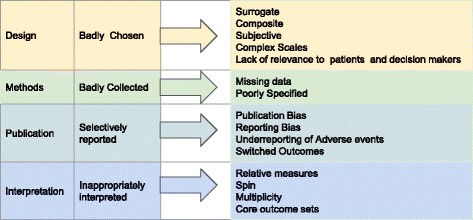
Clinical research should ultimately improve patient care. For this to be possible, trials must evaluate outcomes that genuinely reflect real-world settings and concerns. However, many trials continue to measure and report outcomes that fall short of this clear requirement. We highlight problems with trial outcomes that make evidence difficult or impossible to interpret and that undermine the translation of research into practice and policy. These complex issues include the use of surrogate, composite and subjective endpoints; a failure to take account of patients' perspectives when designing research outcomes; publication and other outcome reporting biases, including the under-reporting of adverse events; the reporting of relative measures at the expense of more informative absolute outcomes; misleading reporting; multiplicity of outcomes; and a lack of core outcome sets. Trial outcomes can be developed with patients in mind, however, and can be reported completely, transparently and competently. Clinicians, patients, researchers and those who pay for health services are entitled to demand reliable evidence demonstrating whether interventions improve patient-relevant clinical outcomes.
Overview
The claims and statistics of this paper haven’t been checked yet.
Free: it reads the open-access text and checks the first 5 claims that cite a source we can check. Create a free account to check every claim.
Integrity signals
Registry
Cites
Statistics
Figures
Verification
Claims the paper makes
The claims and statistics of this paper haven’t been checked yet.
Free: it reads the open-access text and checks the first 5 claims that cite a source we can check. Create a free account to check every claim.
Claims other papers make about this one
Each is checked against this paper’s own text: does it say what the citing paper says it does?
The source backs part of the claim, not all of it — or backs it for a different population, condition or comparison.
In the citing paper
“However, despite increasing attention to the quality of clinical trial reporting [19–21] and generics use in science [15,17,18], it remains unclear to what extent medical researchers produce hasty generalizations, how impactful articles with such generalizations are, and whether the generalizations in primary research articles differ in their scope (e.g., generics use) from those found in research”
From Hasty generalizations and generics in medical research: A systematic review (2024) · cites this paper as [19]
Experimental — accuracy not yet measuredThe source backs part of the claim, not all of it — or backs it for a different population, condition or comparison.
In the citing paper
“An unfortunate consequence of group studies such as the Evans et al. (2017) trial is that mean outcome scores on nomothetic measures obscures both the responsivity (or not) of individuals and also whether the idiosyncratic problems brought by patients to therapy actually change (Heneghan et al., 2017).”
From Effectiveness of cognitive analytic therapy for bipolar affective disorder: A co‐produced single subject cumulative treatment design with extended follow‐up (A 1 /B/A 2 /C‐FU) (2022) · cites this paper as Heneghan et al., 2017
Experimental — accuracy not yet measuredThe check wasn’t confident either way, so it gives no verdict — never disputed.
In the citing paper
“Firstly, in the pursuit of optimal treatment outcomes, clinical exercise trials often invest a level of resources, such as staff time, facilities and other support, that can facilitate patient engagement and overcome key barriers to patient adherence.”
From Identifying the factors affecting ‘patient engagement’ in exercise rehabilitation (2022) · cites this paper as [11]
Experimental — accuracy not yet measuredIn the citing paper
“If medical researchers make claims that are broader than warranted by the evidence or that mask variations, and if articles with such claims are impactful and summarized for practitioners without adjustments in generalization scope, this may contribute to regulatory approval or clinical use of treatments that are ineffective or harmful for people [3,19].”
From Hasty generalizations and generics in medical research: A systematic review (2024) · cites this paper as [19]
In the citing paper
“Secondly, the volunteers for clinical trials are likely to have a vested interest in the exercise activity, a belief in its efficacy, and be positively motivated to engage, as well as the time and resources to commit to the programme/clinical trial—characteristics that are not universal in the wider patient population.”
From Identifying the factors affecting ‘patient engagement’ in exercise rehabilitation (2022) · cites this paper as [11]
1 more claim about this paper
Create a free account to see every claim other papers make about this one.
Self-check
Percentages, sums and reported differences re-computed from the paper’s own numbers.
The self-check needs the paper’s full text.
Citations
Cites
CONSORT 2010 Statement: updated guidelines for reporting parallel group randomised trials
the CONSORT Group, Schulz, K. F., Altman, D. G., & Moher, D. (2010) · BMC Medicine · doi:10.1186/1741-7015-8-18 · Cited by 13,371
CONSORT 2010 Statement: updated guidelines for reporting parallel group randomised trials
Schulz, K. F., Altman, D. G., Moher, D., & for the CONSORT Group (2010) · BMJ · doi:10.1136/bmj.c332 · Cited by 9,329
Wood, L., Egger, M., Gluud, L. L., Schulz, K. F., Jüni, P., Altman, D. G., Gluud, C., Martin, R. M., Wood, A. J. G., & Sterne, J. A. C. (2008) · BMJ · doi:10.1136/bmj.39465.451748.ad · Cited by 2,538 · cited 1×
“, when outcome assessors are not blinded) [17, 18].”
BackgroundThe prevention and handling of the missing data
Kang, H. (2013) · Korean Journal of Anesthesiology · doi:10.4097/kjae.2013.64.5.402 · Cited by 1,728 · cited 1×
“Despite the development of a number of different ways of handling missing data, the only real solution is to prevent it from happening in the first place [36].”
BackgroundDeveloping core outcome sets for clinical trials: issues to consider
Williamson, P. R., Altman, D. G., Blazeby, J. M., Clarke, M., Devane, D., Gargon, E., & Tugwell, P. (2012) · Trials · doi:10.1186/1745-6215-13-132 · Cited by 1,661 · cited 1×
“Standardised core outcome sets take account of patient preferences that should be measured and reported in all trials for a specific therapeutic area [65].”
BackgroundKirkham, J. J., Dwan, K. M., Altman, D. G., Gamble, C., Dodd, S., Smyth, R., & Williamson, P. R. (2010) · BMJ · doi:10.1136/bmj.c365 · Cited by 1,133 · cited 1×
“Authors of a review of 283 Cochrane reviews found that more than half did not include data on the primary outcome [43].”
BackgroundDissemination and publication of research findings: an updated review of related biases
Song, F., Parekh, Hooper, L., Loke, Y., Ryder, J., Sutton, A., Hing, C., Kwok, C., Pang, C., & Harvey, I. (2010) · Health Technology Assessment · doi:10.3310/hta14080 · Cited by 1,039 · cited 1×
“approved trials, half go unpublished [38], and trials with positive outcomes are twice as likely to be published, and published faster, compared with trials with negative outcomes [39, 40].”
BackgroundPublication bias in clinical trials due to statistical significance or direction of trial results
Hopewell, S., Loudon, K., Clarke, M. J., Oxman, A. D., & Dickersin, K. (2009) · Cochrane Database of Systematic Reviews · doi:10.1002/14651858.mr000006.pub3 · Cited by 898 · cited 1×
“approved trials, half go unpublished [38], and trials with positive outcomes are twice as likely to be published, and published faster, compared with trials with negative outcomes [39, 40].”
BackgroundMarshall, M., Lockwood, A., Bradley, C., Adams, C., Joy, C., & Fenton, M. (2000) · British Journal of Psychiatry · doi:10.1192/bjp.176.3.249 · Cited by 870
Cited by
Items 201–300 of 402
Zilundu, P. L. M., Gatsi, A. B., Chapupu, T., & Zhou, L. (2025) · International Journal of Molecular Sciences · doi:10.3390/ijms26146864 · Cited by 4
“Given the limitations of current clinical scales such as the ASIA Impairment Scale, which can be imprecise and often infeasible to use in acute trauma settings, there is an urgent need for objective biomarkers to stratify injury severity and predict outcomes [15,42–44].”
Solebo, A. L., & Braithwaite, T. (2020) · EClinicalMedicine · doi:10.1016/j.eclinm.2020.100536 · Cited by 6
“However, it is worth remembering that even with improved quality of RCT design and reporting [6], few of the 20,000 RCT papers published annually translate into clinical ben-e fi t for the wider target population [7,8].”
BackgroundThe Importance of Real-World Evidence in Understanding Influenza Vaccine Effectiveness
Ferrara, P., & Mantovani, L. G. (2022) · Farmeconomia Health economics and therapeutic pathways · doi:10.7175/fe.v23i1.1522 · Cited by 4
“Additionally, compared with RCTs, RWD generate estimates using relevant patient-oriented outcomes – namely numbers of cases, medical visits, hospitalizations, or deaths prevented by vaccination – the calculation of which reflects real-world health issues and demonstrates whether interventions provide benefits to patie…”
Meade, S. M., Rajan, P. V., Rabah, N. M., Mroz, T. E., Steinmetz, M. P., Benzel, E., Nowacki, A. S., Salas-Vega, S., & Habboub, G. (2023) · Journal of Neurosurgery Spine · doi:10.3171/2023.1.spine22957 · Cited by 4
Lamahewa, K., Griffin, S., Seward, N., Temmerman, M., West, J., de Melo, M. S. I., Raby, E., Alonso, A., Burnside, B., Chissale, F., et al. (2023) · SSM - Mental Health · doi:10.1016/j.ssmmh.2023.100200 · Cited by 7
Alquzi, F. I. Y., Bowers, A. P., Alexander, K. E., & Bradford, N. (2023) · Journal of Pain and Symptom Management · doi:10.1016/j.jpainsymman.2023.02.316 · Cited by 4
Iyngkaran, P., Usmani, W., Hanna, F. S., & de Courten, M. (2023) · Journal of Cardiovascular Development and Disease · doi:10.3390/jcdd10120486 · Cited by 4
“…in accounting for patient perspectives, publication and reporting biases, such as inadequate assessment of adverse events, and the use of relative measures instead of more informative absolute outcomes, misleading reporting, multiplicity of outcomes, and insufficient core outcome sets [3,5].”
BackgroundInfluentialCore Quality and Outcome Measures for Pediatric Health
Webbe, J., Modi, N., & Gale, C. (2018) · Archives of Pediatrics and Adolescent Medicine · doi:10.1001/jamapediatrics.2017.5050 · Cited by 4
Xu, C., Zhang, Y., Chen, L., Li, W., Tang, S., Tang, L., Guo, Y. Q., Liu, Q., Lin, A., Sun, Y. H., et al. (2020) · Radiotherapy and Oncology · doi:10.1016/j.radonc.2020.08.019 · Cited by 6
In the future simulations will replace clinical trials
Ebert, M. A., Gebski, V., & Baldock, C. (2021) · Physical and Engineering Sciences in Medicine · doi:10.1007/s13246-021-01079-y · Cited by 4
“The artificial contexts in which trials must operate and their frequent use of biased outcomes measures have led to substantial translation gaps [17, 18].”
BackgroundPoller, D. N. (2021) · British journal of surgery · doi:10.1093/bjs/znab422 · Cited by 4
Raymond, J., Benomar, A., & Darsaut, T. E. (2022) · Neurochirurgie · doi:10.1016/j.neuchi.2022.04.004 · Cited by 4
Wood, L., Foster, N. E., Lewis, M., Brønfort, G., Groessl, E. J., Hewitt, C. E., Miyamoto, G. C., Rème, S. E., & Bishop, A. (2022) · Archives of Physical Medicine and Rehabilitation · doi:10.1016/j.apmr.2022.07.012 · Cited by 4
Mužný, M., Bradway, M., Blixgård, H., & Årsand, E. (2022) · Linköping electronic conference proceedings · doi:10.3384/ecp187031 · Cited by 3
Trained innate immunity, COVID-19 therapeutic dilemma, and fake science
Belizário, J. E. (2020) · Clinics · doi:10.6061/clinics/2020/e2124 · Cited by 4
“How evidence is transformed into scientific knowledge depends on statistical methods that define whether certain types of interferences (errors, biases, or confounding factors)—that occur either randomly or systematically—are leading to relevant clinical outcomes in patient cohorts (10).”
A tool for assessing the comprehensiveness of outcome reporting within clinical trials in pregnancy
Lim, J. W.-J., Lor, K. Y., & D'Souza, R. D. (2020) · Acta Obstetricia Et Gynecologica Scandinavica · doi:10.1111/aogs.14072 · Cited by 4
“1,17 These outcomes are grouped under five core areas – (1) mortality/survival; (2) systemspecific morbidity (physiological/clinical); (3) functioning or life-impact; (4) resource-use; and (5) adverse events/effects.”
BackgroundMoghaddam, Z. N., Reinhardt, E. K., Thurm, A. E., Potter, B. K., Smith, M., Graham, C., Tiller, B. H., Baker, S. A., Bilder, D. A., Bogar, R., et al. (2025) · Orphanet Journal of Rare Diseases · doi:10.1186/s13023-025-03900-3 · Cited by 5
“A COS supports the generation of patient-centered evidence and its translation into policy and clinical practice, ensuring that researchers are prepared to evaluate therapies effectively when they become available [55, 56].”
Livingston, M. K., Toomey, E. C., & Robinson, K. (2025) · Trials · doi:10.1186/s13063-025-09149-2 · Cited by 3
“Despite the importance of measuring outcomes that are important to all interested parties, clinical trials often fail to achieve this [1].”
InfluentialBanton, A., McIntyre, C., Ellwood, J., MacMillan, A., Hohenschurz‐Schmidt, D., & Vogel, S. (2026) · International journal of osteopathic medicine · doi:10.1016/j.ijosm.2026.100820 · Cited by 3
van der Gang, L. F., Zuithoff, N. P. A., Haeck, I. M., Harbers, V. E. M., Stadhouders‐Keet, S. A. E., Politiek, K., Oosting, A. J., Nes, A. M. T. V. L., Lam, H., van Serooskerken, A.-M. V. T., et al. (2026) · Journal of the European Academy of Dermatology and Venereology · doi:10.1111/jdv.70442 · Cited by 3
Achieving effective patient and public involvement in international clinical trials in neurology
Tallantyre, E. C., Evangelou, N., Bale, C., Chaudhry, B. Z., Gray, E. H., LaRocca, N. G., Pavitt, S. H., Miller, D. M., Planchon, S. M., Ontaneda, D., et al. (2020) · Neurology Clinical Practice · doi:10.1212/cpj.0000000000000739 · Cited by 7
Andersen, C., Presseau, J., Saigle, V., Fitzgerald, E., Lamanna, M., Talbot, P., Delaney, A. P., & English, S. W. (2022) · Frontiers in Neurology · doi:10.3389/fneur.2022.1068499 · Cited by 3
“When this mismatch occurs researchers risk designing studies that overlook key factors and could interpret some interventions to be effective when they are not (and at worst cause harm) (6).”
BackgroundLe paradoxe de la médecine personnalisée
Ngô, C. (2020) · Médecine Palliative · doi:10.1016/j.medpal.2020.08.006 · Cited by 3
Li, Y., Yang, Y., Zhu, S., Cheng, H., Hernández, J., Huang, W., Wang, H., & Li, Y. (2023) · Frontiers in Endocrinology · doi:10.3389/fendo.2023.1112855 · Cited by 5
Zafra‐Tanaka, J. H., Valle, A. D., Bernabé‐Ortiz, A., Miranda, J. J., & Beran, D. (2023) · Diabetic Medicine · doi:10.1111/dme.15223 · Cited by 4
“…to ensure that standardized and agreed outcomes are measured these can also help address what has been called “research waste” by Heneghan et al. 9 According to Heneghan et al., 9 the failure of studies to translate into benefits for patients, research waste, is related to less efficiency…”
BackgroundInfluentialde Barros, V. M., Pacheco, R. L., Martimbianco, A. L. C., Mozetic, V., Castilho, S., & Riera, R. (2023) · Journal of Clinical Epidemiology · doi:10.1016/j.jclinepi.2023.11.002 · Cited by 3
Comment on Topical Dapsone for Folliculitis Decalvans
Trüeb, R. M., Luu, N.-N. C., & Rezende, H. D. (2023) · International Journal of Trichology · doi:10.4103/ijt.ijt_39_22 · Cited by 3
A landscape analysis of clinical trials and infant clinical trials in Kenya, Ethiopia, and Nigeria
Amboka, P., Kurui, D. K., Wamukoya, M., Sindi, J. K., & Vicente-Crespo, M. (2024) · Frontiers in Epidemiology · doi:10.3389/fepid.2024.1417419 · Cited by 7
Restrictive transfusion thresholds: Have we left patient‐centered outcomes behind?
Mo, A., & Higgins, A. M. (2022) · Transfusion · doi:10.1111/trf.17105 · Cited by 3
Absolute Risk Reductions in COVID-19 Antiviral Medication Clinical Trials
Brown, R. B. (2023) · Pharmacoepidemiology · doi:10.3390/pharma2010009 · Cited by 8
Cariology Clinical Trials: What Are We—and What Should We Be—Looking At?
Innes, N. (2018) · Advances in Dental Research · doi:10.1177/0022034517735296 · Cited by 3
“Two key points where decision making is critical are the areas of intervention choice and outcomes or outcome measures’ selection and analyses (Heneghan et al. 2017).”
BackgroundInfluentialNarayan, S. (2021) · Kerala Journal of Ophthalmology · doi:10.4103/kjo.kjo_51_21 · Cited by 3
Identifying The Factors Affecting ‘Patient Engagement’ In Exercise RehabilitationPreprint
Teo, J. L., Zheng, Z., & Bird, S. R. (2021) · Research Square · doi:10.21203/rs.3.rs-753800/v1 · Cited by 3
Lopez-Perez, L. (2022) · UPM Digital Archive (Technical University of Madrid) · doi:10.20868/upm.thesis.70347 · Cited by 6
Reynolds, N., Wei, W., Maroli, K., Bonham, A., Nizam, A., Gilligan, T. D., Wee, C. E., Gupta, S., & Ornstein, M. C. (2024) · Journal of Kidney Cancer and VHL · doi:10.15586/jkcvhl.v11i3.352 · Cited by 2
“However, the restrictive inclusion and exclusion criteria for these trials result in clinical outcomes that may not be reproducible in the real-world setting (6, 7).”
BackgroundSchneider, M., Ferrazza, C. P., da Silva, R. F., Picon, F. A., Rovaris, D. L., Sanches, P. R. S., Pereira, D., Brunoni, A. R., Camprodon, J. A., Caumo, W., et al. (2025) · Journal of Attention Disorders · doi:10.1177/10870547251341595 · Cited by 2
“Indeed, in psychiatry, the translation of changes in symptom rating scales into meaningful impacts on participants’ lives has been questioned (Heneghan et al., 2017; Khan et al., 2018).”
Bakanaitė, R., Bakanienė, I., & Kanyeredzi, A. (2025) · European Psychiatry · doi:10.1177/15305627251358855 · Cited by 5
“20 It is important to mention that the actual cost savings and efficiency gains in real-world settings may vary.”
Fares‐Otero, N. E., Furukawa, Y., Sijbrandij, M., Leucht, S., Vieta, E., Cuijpers, P. J., Harrer, M., & Seedat, S. (2026) · European Neuropsychopharmacology · doi:10.1016/j.euroneuro.2026.112802 · Cited by 2
Vitale, E., Soares, A., Rizzo, A., Maistrello, L., Cauli, O., Brunetti, O., Mollica, V., Albano, A., Güven, D. C., Monteiro, F. S. M., et al. (2026) · Clinical & Translational Oncology · doi:10.1007/s12094-026-04472-9 · Cited by 2
Essop-Adam, A., Houchen‐Wolloff, L., Vaishya, R., & Mangwani, J. (2020) · Journal of Clinical Orthopaedics and Trauma · doi:10.1016/j.jcot.2020.04.001 · Cited by 2
Arora, C., Malhotra, A., Ranjan, P., & Kumar, A. (2021) · Cureus · doi:10.7759/cureus.17036 · Cited by 2
“The outcome measures selected must be ones that can be measured accurately and precisely [21].”
BackgroundPlooij, J., & Delnoij, D. M. J. (2025) · Expert Review of Pharmacoeconomics & Outcomes Research · doi:10.1080/14737167.2025.2467379 · Cited by 2
“For practical reasons, the use of surrogate outcomes is on the rise [4], but such outcomes are not always comprehensive and patient-relevant [5].”
Fernández, M. J., Velez, M. A., Glenn, B. A., Cummings, A. L., Segarra-Vázquez, B., Gorbatov, S. D., Park, S. J., Shen, C., Lind-Lebuffe, J. P., Unger, J. M., et al. (2025) · The Oncologist · doi:10.1093/oncolo/oyaf313 · Cited by 2
Meaningful outcomes for children and their caregivers attending a paediatric brain centre
Kikkert, M. A., Schmidt, A. K., Pangalila, R. F., de Wit, M. Y., van Haren, N. E. M., van Veelen, M. C., & Roebroeck, M. E. (2023) · Developmental Medicine & Child Neurology · doi:10.1111/dmcn.15610 · Cited by 2
“Incorporation of meaningful outcomes in research contributes to improving health care.(3) Involvement of children and their parent- caregivers in developing standard (core) outcome sets is facilitated by the structured methodology of the International Consortium for Health Outcomes Measurement (ICHOM), Core Outcome Me…”
Methods of assessing late radiotherapy effects on bowel function
Nelson, A., Mann, M. K., & Staffurth, J. N. (2019) · Current Opinion in Supportive and Palliative Care · doi:10.1097/spc.0000000000000422 · Cited by 2
“Combined with the use of non validated tools, and limited patient reported outcomes, there is little opportunity to aggregate outcomes and results across trials [13].”
BackgroundBiobusiness in Brief:What Ails Clinical Trials?
Saberwal, G. (2018) · Current Science · doi:10.18520/cs/v115/i9/1648-1652 · Cited by 1
Public Participation in Health Care: Exploring the Co-Production of Knowledge
Green, G., Boaz, A., & Stuttaford, M. C. (2020) · Frontiers research topics · doi:10.3389/978-2-88963-298-5 · Cited by 6
Weeda, E. R., Pilch, N. A., & Annemans, L. (2019) · Elsevier eBooks · doi:10.1016/b978-0-12-814276-9.00020-9 · Cited by 2
O'Donnell, J., Pirret, A. M., Hoare, K., & McDonald, E. M. (2022) · Health Science Reports · doi:10.1002/hsr2.966 · Cited by 1
“Establishing an appropriate target population must align with the study outcomes under consideration.(18) Therefore, the target population is ED patients 18 years or older who need RS.”
BackgroundInfluentialYan, Y., Liang, N., Liang, S.-B., Sun, Y., Robinson, N., & Liu, J. (2019) · Journal of Traditional Chinese Medical Sciences · doi:10.1016/j.jtcms.2019.03.002 · Cited by 2
Mohamed, F. A., & Chaufan, C. (2020) · International Journal of Health Services · doi:10.1177/0020731420902600 · Cited by 3
Wells, B. M., & Lawrence, D. J. (2020) · PubMed Central · Cited by 4
Ooi, C. P., Khan, A. H. K. Y., Manaf, R. A., Mustafa, N., Sukor, N., Williamson, P. R., & Kamaruddin, N. A. (2021) · BMJ Open · doi:10.1136/bmjopen-2021-050231 · Cited by 2
Integrative medicine and primary care: Moving forward or moving backwards?
Wardle, J. (2018) · Advances in Integrative Medicine · doi:10.1016/j.aimed.2018.09.002 · Cited by 2
Vascular ageing and the complex relationship between cognitive decline and cardiovascular disease
Bauer, P., Kraushaar, L. E., & Juenemann, M. B. (2023) · European Journal of Preventive Cardiology · doi:10.1093/eurjpc/zwad027 · Cited by 2
Musallam, I. M. (2023) · Preprints.org · doi:10.20944/preprints202309.2119.v1 · Cited by 1
Ojha, A., Vidwans, H., & Watve, M. (2023) · Qeios · doi:10.32388/ih7kep · Cited by 2
Patient‐centricity: Research's new shibboleth?
Arnold, M. H., & Kerridge, I. (2023) · Journal of Evaluation in Clinical Practice · doi:10.1111/jep.13830 · Cited by 1
Impact of surrogate outcomes in randomized controlled trials for shoulder rotator cuff tears
Miquel, J., Domènech, M. S., Santana, F., & Torrens, C. (2023) · Archives of Orthopaedic and Trauma Surgery · doi:10.1007/s00402-023-04911-0 · Cited by 1
“Surprisingly, few trials significantly contribute to patient care, because of how the trial outcomes are determined, collected, or reported [1].”
BackgroundLaverty, C., Surtees, A. D. R., Sutherland, D., & Richards, C. (2024) · BMJ Open · doi:10.1136/bmjopen-2023-076057 · Cited by 2
“Alongside this, early intervention and surveillance programmes are also targeted towards those born at the earliest gestations, despite the emerging need of those born MLPT.”
BackgroundInfluentialLawand, J. J., Hantouly, A. T., Bouri, F., Muneer, M., & Hagert, E. M. (2024) · Journal of Hand Surgery Global Online · doi:10.1016/j.jhsg.2024.08.007 · Cited by 1
Lozano, F. P., Marcos, A. R., Fernández, R. C., Rodrigo, A. B., Martínez‐Hervás, S., & Ampudia‐Blasco, F. J. (2025) · Endocrinología Diabetes y Nutrición · doi:10.1016/j.endinu.2025.501574 · Cited by 1
Torres, R. V. N. D. A., Lopes, L. W., Ugulino, A. C. D. N. E., Cavalcante, M. E. D. O. B., Marinho, G. K. A. B., Lira, M. L. C. L., Bastos, R. S. D. A., de Melo, E. C. M., & Silva, P. O. C. (2025) · Journal of Voice · doi:10.1016/j.jvoice.2025.07.017 · Cited by 1
Dahmer‐Heath, M., Optenhövel, S., Hechler, T., Konrad, M., & König, J. C. (2025) · Pediatric Nephrology · doi:10.1007/s00467-025-06912-0 · Cited by 1
“Clinical and surrogate parameters often fail to reflect treat-ment benefits that matter most to those living with the disease [41].”
Sevagamoorthy, A., Gavazzi, F., Tashnim, Z., Hong, P., Vaia, Y., Lee‐Kirsch, M. A., Eleftheriou, D., Beerepoot, S., Hully, M., Berry‐Kravis, E., et al. (2026) · Molecular Genetics and Metabolism · doi:10.1016/j.ymgme.2026.109765 · Cited by 1
“[ 29,31,32] In 2022 and 2023, the Food and Drug Administration (FDA) published a four-part guidance series on Patient-Focused Drug Development (PFDD).”
Peterson, C., Anderson, C., Berdine, G. G., & NUGENT, K. M. (2026) · Journal of Electronic Resources in Medical Libraries · doi:10.1080/15424065.2026.2626575 · Cited by 2
“Basic science studies can show results in controlled laboratory environments yet fail to translate to effective pharmaceuticals in the real world (Heneghan et al., 2017; Hwang et al., 2016).”
Severinsen, F., Varsi, C., Andersen, L. F., Henriksen, C., & Paulsen, M. M. (2026) · Current Developments in Nutrition · doi:10.1016/j.cdnut.2026.107677 · Cited by 1
Wang, G., Li, J., Su, X., Fang, Z., Xu, Y., Zheng, J., Wang, N., & Huang, L. (2026) · Frontiers in Immunology · doi:10.3389/fimmu.2026.1695727 · Cited by 1
Rethinking healthcare data interoperability in the age of large language models
von Arnim, G., Kohler, S., Hegselmann, S., Marschollek, M., Eils, R., & Wild, B. (2026) · Med · doi:10.1016/j.medj.2026.101146 · Cited by 4
Four Principles Regarding an Effective Treatment of Aging
Kyriazis, M. (2018) · Current Aging Science · doi:10.2174/1874609811666181025170059 · Cited by 1
“Therapies aimed at established diseases of aging or any other time-dependent loss of function, must not rely only on biomedicine but must take into account non-biomedical factors such as behavioural, social, cognitive, psychological and other environmental influences [9, 10].”
Stability of relative and absolute metrics: empirical evidence from pulmonology
Szigeti, M., Kovács, L., & Ferenci, T. (2019) · IEEE World Symposium on Applied Machine Intelligence and Informatics (SAMI) · doi:10.1109/sami.2019.8782769 · Cited by 1
“”[r]elative measures can exaggerate findings of modest clinical benefit and can often be uninterpretable, such as if control event rates are not reported” [2].”
BackgroundWhen Evidence Goes "Missing in Action": Implications for Patient Management in Cardiac Surgery.
Reynolds, P. S. (2020) · PubMed Central · doi:10.1182/ject-2000020 · Cited by 1
Predicting of patient’s enrollment to multicentral international clinical trials of II–III phase
Milovanov, S. S. (2021) · International Journal of Clinical Trials · doi:10.18203/2349-3259.ijct20210147 · Cited by 1
Perkins, K. A. (2022) · Nicotine & Tobacco Research · doi:10.1093/ntr/ntac139 · Cited by 1
Diet-Related and Gut-Derived Metabolites and Health Outcomes: A Scoping Review
Jia, Y., Yang, X., Wilson, L. M., Mueller, N. T., Sears, C. L., Treisman, G. J., & Robinson, K. A. (2022) · Metabolites · doi:10.3390/metabo12121261 · Cited by 4
Dakopolos, A., Glassman, D., Scott, H. M., Bass, M., & Hessl, D. R. (2023) · Frontiers in Psychology · doi:10.3389/fpsyg.2023.1217821 · Cited by 2
Vaidyanathan, L., Reid, D., Yuan, Y., & Groves, A. M. (2024) · Journal of Perinatology · doi:10.1038/s41372-024-02032-z · Cited by 2
Jent, S., Lüthi, J. J. K., Meichtry, A., Bez, N. S., Bucher, A., Valentini, L., & Rogler, G. (2025) · Clinical Nutrition ESPEN · doi:10.1016/j.clnesp.2025.02.017 · Cited by 1
Incorporating Implementation Science Into Frailty Interventions for Cardiovascular Disease
Teow, K. H., Wong, J. J., Zhao, Y., Wang, L. Y., Choo, S., & Koh, A. S.-M. (2025) · JACC Advances · doi:10.1016/j.jacadv.2025.102278 · Cited by 2
Yu, H., & Hwang, B. (2020) · Korean Journal of Stress Research · doi:10.17547/kjsr.2020.28.1.1 · Cited by 1
“Research studies with negative outcomes occasionally fail to provide full results (Heneghan et al., 2017).”
BackgroundThe Dilemma of Outsourcing Drug Trials
Barat, S. (2020) · ATHENS JOURNAL OF HEALTH & MEDICAL SCIENCES · doi:10.30958/ajhms.7-2-2 · Cited by 1
“In other words, irrespective of the outcome of the trial, the process of conducting the trial does not necessarily seem to in the best interests of the patient (Ahmed et al. 2014, Jacob 2018, Limbu et al. 2018, Heneghan et al. 2017).”
BackgroundIncreasing the impact of Post Authorisation Safety Studies: transparency is key
Kurz, X., Arlett, P. R., Eichler, H., Nolte, A., Straus, S. M. J. M., & Rasi, G. (2020) · European Journal of Internal Medicine · doi:10.1016/j.ejim.2020.11.019 · Cited by 1
Mozetic, V., de Barros, V. M., Denadai, L., da Cruz, M. F. S., da Cruz, N. F. S., & de Moraes, N. S. B. (2021) · Journal of Evidence-Based Healthcare · doi:10.17267/2675-021xevidence.2021.e3415
The Future of Artificial Intelligence Applied to Immunotherapy Trials
Bodalal, Z., Trebeschi, S., Wamelink, I. J. H. G., Lipman, K. B. W. G., Bucho, T. M. T., van Dijk, N., Boellaard, T. N., Waktola, S., & Beets‐Tan, R. G. H. (2022) · Springer eBooks · doi:10.1007/978-3-030-80546-3_20 · Cited by 3
We must ask relevant questions and answer with meaningful outcomes
George, R. B., & McKeen, D. M. (2017) · Canadian Journal of Anesthesia/Journal canadien d anesthésie · doi:10.1007/s12630-017-0913-1 · Cited by 1
Khodake, S. (2020) · Arrow - TU Dublin (Technological University Dublin) · doi:10.21427/69qh-xn75 · Cited by 1
FACE Value of Patient-Reported Outcomes in Dose-Escalated Radiation Therapy for Prostate Cancer
Glicksman, R., & Berlín, A. (2021) · International Journal of Radiation Oncology*Biology*Physics · doi:10.1016/j.ijrobp.2021.08.034 · Cited by 1
Treweek, S. P., Miyakoda, V., Burke, D., & Shiely, F. (2021) · Research Square · doi:10.21203/rs.3.rs-1084868/v1 · Cited by 1
Maharaj, S. (2021) · DUT Open Scholar (Durban University of Technology) · doi:10.51415/10321/4027 · Cited by 2
The Concept of Validity in Psychological Assessment
Teglasi, H., Fleece, H. M., Havewala, M., & Bali, D. (2023) · Oxford University Press eBooks · doi:10.1093/obo/9780199828340-0304 · Cited by 3
Dakopolos, A., Glassman, D., Scott, H. M., Bass, M., & Hessl, D. R. (2023) · Research Square · doi:10.21203/rs.3.rs-2787281/v1 · Cited by 1
Misra, S., Kawamura, Y., Singh, P., Sengupta, S., Nath, M., Rahman, Z., Kumar, P., Kumar, A., Aggarwal, P., Srivastava, A. K., et al. (2023) · medRxiv · doi:10.1101/2023.12.22.23300465 · Cited by 1
Selecting and Appraising Assessments and Outcome Measures
Laver-Fawcett, A. J., & Cox, D. L. (2021) · Wiley eBooks · doi:10.1002/9781119633341.ch10 · Cited by 1
Kyriazis, M. (2018) · Journal of Translational Genetics and Genomics · doi:10.20517/jtgg.2018.04
“In order to improve health outcomes all of these factors need to be taken into account([57]).”
BackgroundSearching for an Optimal Systolic Blood Pressure Target: A Balance of Benefits and Risks
Leung, A. A. C., & Padwal, R. S. (2018) · Canadian Journal of Cardiology · doi:10.1016/j.cjca.2018.08.037
Assessing the Ordinality of Response Bias with Item Response Models: A Case Study Using the PHQ-9
Singhroy, V. (2018) · CUNY Academic Works (City University of New York)
Cultural activities in mental health care : ordinary participation to be in and of the Community
Karpusheff, J. (2019) · Research Explorer (The University of Manchester)
Hammer, H. F. (2020) · Journal of Gastrointestinal and Liver Diseases · doi:10.15403/jgld-2432
“It has been suggested that reliance on these health-care-professionals-determined outcomes (HCPDO) may be a reason why clinical trial outcomes may fail to translate into benefits for patients [13, 14].”
BackgroundImproving knowledge of outcomes in neonatology
Webbe, J. (2019) · doi:10.25560/80620
Metadata
- Authors
- Heneghan, C., Goldacre, B., & Mahtani, K. R.
- Affiliations
- University of Oxford (GB)
- Corresponding author
- Heneghan, Carl
- Venue
- Trials
- Published
- 2017-03-14
- Volume
- 18
- Issue
- 1
- Pages
- 122-122
- ISSN
- 1745-6215 (ISSN-L)
- PMC
- PMC5348914
- OpenAlex
- W2597385103
- Cited by
- 404
- References
- 67
- Citations by year
- 2026: 34 · 2025: 27 · 2024: 59 · 2023: 51 · 2022: 54 · 2021: 50 · 2020: 50 · 2019: 38 · 2018: 27 · 2017: 13
- FWCI
- 24.34
- Type
- journal article
- Language
- en
- Open access
- gold
- doi.org
- Licence
- cc-by
- Locations
- Trials (publishedVersion, cc-by)
- PubMed Central (publishedVersion, cc-by)
- PubMed (publishedVersion)
- Funders
- National Institute for Health and Care Research (CL-2011-13-006)
- Topics
- Physical Sciences › Mathematics › Statistics and Probability › Statistical Methods in Clinical Trials
- Social Sciences › Decision Sciences › Statistics, Probability and Uncertainty › Meta-analysis and systematic reviews
- Social Sciences › Sociology and Political Science › Delphi Technique in Research
- Keywords
- clinical trial results, outcome measurement, clinical translation, surrogate endpoints, composite endpoints, patient perspectives, selective reporting, core outcome set, clinical trial transparency, patient-relevant outcomes
- MeSH terms
- Clinical Trials as Topic, Data Interpretation, Statistical, Humans, Patient Participation, Research Design, Bias, Treatment Outcome, Publication Bias, Endpoint Determination
About these checks
Registry, retraction, Cites and statistics results are computed, not judged, with one exception: a printed reference that no index lists is read once by a model before it counts as a citation error. Claims are extracted by a model and kept only when their quote appears verbatim in the text; each cited source is then checked, with a model’s help, for whether it says what the claim relies on. Those verdicts can be wrong — read the claim’s quote and the cited source before relying on one.
Statistics and arithmetic are recomputed, not judged.
Confidence bands are shown only for fields calibrated on our annotated test set. None is calibrated yet, so no band is shown.
What counts as a claim ›How we measure confidence ›How we check this ›
Are you an author, or do you see a problem with this page? Request a review
Data sources
Bibliographic data: Semantic Scholar, OpenAlex, Crossref.
Contains information from the Semantic Scholar Academic Graph Datasets, made available under the ODC Attribution License (ODC-BY 1.0).
Semantic Scholar’s data is described in: Kinney, R., et al. (2023). The Semantic Scholar Open Data Platform. arXiv:2301.10140.
