

Why clinical trial outcomes fail to translate into benefits for patients
Open accessThe DOI matches its Crossref record; 67 of the 67 references it cites were found in a registry or an index.
Abstract
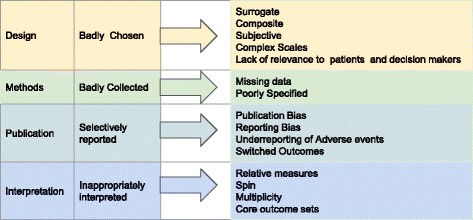
Clinical research should ultimately improve patient care. For this to be possible, trials must evaluate outcomes that genuinely reflect real-world settings and concerns. However, many trials continue to measure and report outcomes that fall short of this clear requirement. We highlight problems with trial outcomes that make evidence difficult or impossible to interpret and that undermine the translation of research into practice and policy. These complex issues include the use of surrogate, composite and subjective endpoints; a failure to take account of patients' perspectives when designing research outcomes; publication and other outcome reporting biases, including the under-reporting of adverse events; the reporting of relative measures at the expense of more informative absolute outcomes; misleading reporting; multiplicity of outcomes; and a lack of core outcome sets. Trial outcomes can be developed with patients in mind, however, and can be reported completely, transparently and competently. Clinicians, patients, researchers and those who pay for health services are entitled to demand reliable evidence demonstrating whether interventions improve patient-relevant clinical outcomes.
Overview
The claims and statistics of this paper haven’t been checked yet.
Free: it reads the open-access text and checks the first 5 claims that cite a source we can check. Create a free account to check every claim.
Integrity signals
Registry
Cites
Statistics
Figures
Verification
Claims the paper makes
The claims and statistics of this paper haven’t been checked yet.
Free: it reads the open-access text and checks the first 5 claims that cite a source we can check. Create a free account to check every claim.
Claims other papers make about this one
Each is checked against this paper’s own text: does it say what the citing paper says it does?
The source backs part of the claim, not all of it — or backs it for a different population, condition or comparison.
In the citing paper
“However, despite increasing attention to the quality of clinical trial reporting [19–21] and generics use in science [15,17,18], it remains unclear to what extent medical researchers produce hasty generalizations, how impactful articles with such generalizations are, and whether the generalizations in primary research articles differ in their scope (e.g., generics use) from those found in research”
From Hasty generalizations and generics in medical research: A systematic review (2024) · cites this paper as [19]
Experimental — accuracy not yet measuredThe source backs part of the claim, not all of it — or backs it for a different population, condition or comparison.
In the citing paper
“An unfortunate consequence of group studies such as the Evans et al. (2017) trial is that mean outcome scores on nomothetic measures obscures both the responsivity (or not) of individuals and also whether the idiosyncratic problems brought by patients to therapy actually change (Heneghan et al., 2017).”
From Effectiveness of cognitive analytic therapy for bipolar affective disorder: A co‐produced single subject cumulative treatment design with extended follow‐up (A 1 /B/A 2 /C‐FU) (2022) · cites this paper as Heneghan et al., 2017
Experimental — accuracy not yet measuredThe check wasn’t confident either way, so it gives no verdict — never disputed.
In the citing paper
“Firstly, in the pursuit of optimal treatment outcomes, clinical exercise trials often invest a level of resources, such as staff time, facilities and other support, that can facilitate patient engagement and overcome key barriers to patient adherence.”
From Identifying the factors affecting ‘patient engagement’ in exercise rehabilitation (2022) · cites this paper as [11]
Experimental — accuracy not yet measuredIn the citing paper
“If medical researchers make claims that are broader than warranted by the evidence or that mask variations, and if articles with such claims are impactful and summarized for practitioners without adjustments in generalization scope, this may contribute to regulatory approval or clinical use of treatments that are ineffective or harmful for people [3,19].”
From Hasty generalizations and generics in medical research: A systematic review (2024) · cites this paper as [19]
In the citing paper
“Secondly, the volunteers for clinical trials are likely to have a vested interest in the exercise activity, a belief in its efficacy, and be positively motivated to engage, as well as the time and resources to commit to the programme/clinical trial—characteristics that are not universal in the wider patient population.”
From Identifying the factors affecting ‘patient engagement’ in exercise rehabilitation (2022) · cites this paper as [11]
1 more claim about this paper
Create a free account to see every claim other papers make about this one.
Self-check
Percentages, sums and reported differences re-computed from the paper’s own numbers.
The self-check needs the paper’s full text.
Citations
Cites
CONSORT 2010 Statement: updated guidelines for reporting parallel group randomised trials
the CONSORT Group, Schulz, K. F., Altman, D. G., & Moher, D. (2010) · BMC Medicine · doi:10.1186/1741-7015-8-18 · Cited by 13,371
CONSORT 2010 Statement: updated guidelines for reporting parallel group randomised trials
Schulz, K. F., Altman, D. G., Moher, D., & for the CONSORT Group (2010) · BMJ · doi:10.1136/bmj.c332 · Cited by 9,329
Wood, L., Egger, M., Gluud, L. L., Schulz, K. F., Jüni, P., Altman, D. G., Gluud, C., Martin, R. M., Wood, A. J. G., & Sterne, J. A. C. (2008) · BMJ · doi:10.1136/bmj.39465.451748.ad · Cited by 2,538 · cited 1×
“, when outcome assessors are not blinded) [17, 18].”
BackgroundThe prevention and handling of the missing data
Kang, H. (2013) · Korean Journal of Anesthesiology · doi:10.4097/kjae.2013.64.5.402 · Cited by 1,728 · cited 1×
“Despite the development of a number of different ways of handling missing data, the only real solution is to prevent it from happening in the first place [36].”
BackgroundDeveloping core outcome sets for clinical trials: issues to consider
Williamson, P. R., Altman, D. G., Blazeby, J. M., Clarke, M., Devane, D., Gargon, E., & Tugwell, P. (2012) · Trials · doi:10.1186/1745-6215-13-132 · Cited by 1,661 · cited 1×
“Standardised core outcome sets take account of patient preferences that should be measured and reported in all trials for a specific therapeutic area [65].”
BackgroundKirkham, J. J., Dwan, K. M., Altman, D. G., Gamble, C., Dodd, S., Smyth, R., & Williamson, P. R. (2010) · BMJ · doi:10.1136/bmj.c365 · Cited by 1,133 · cited 1×
“Authors of a review of 283 Cochrane reviews found that more than half did not include data on the primary outcome [43].”
BackgroundDissemination and publication of research findings: an updated review of related biases
Song, F., Parekh, Hooper, L., Loke, Y., Ryder, J., Sutton, A., Hing, C., Kwok, C., Pang, C., & Harvey, I. (2010) · Health Technology Assessment · doi:10.3310/hta14080 · Cited by 1,039 · cited 1×
“approved trials, half go unpublished [38], and trials with positive outcomes are twice as likely to be published, and published faster, compared with trials with negative outcomes [39, 40].”
BackgroundPublication bias in clinical trials due to statistical significance or direction of trial results
Hopewell, S., Loudon, K., Clarke, M. J., Oxman, A. D., & Dickersin, K. (2009) · Cochrane Database of Systematic Reviews · doi:10.1002/14651858.mr000006.pub3 · Cited by 898 · cited 1×
“approved trials, half go unpublished [38], and trials with positive outcomes are twice as likely to be published, and published faster, compared with trials with negative outcomes [39, 40].”
BackgroundMarshall, M., Lockwood, A., Bradley, C., Adams, C., Joy, C., & Fenton, M. (2000) · British Journal of Psychiatry · doi:10.1192/bjp.176.3.249 · Cited by 870
Cited by
Items 101–200 of 402
Bethel, M. A., Stevens, S. R., Buse, J. B., Choi, J., Gustavson, S. M., Iqbal, N., Lokhnygina, Y. V., Mentz, R. J., Patel, R. A., Öhman, P., et al. (2020) · Circulation · doi:10.1161/circulationaha.119.043353 · Cited by 17
Batterham, P. J., Gulliver, A., Sunderland, M., Farrer, L. M., KAY‐LAMBKIN, F. J., Trias, A., & Calear, A. L. (2023) · Journal of Medical Internet Research · doi:10.2196/41663 · Cited by 17
“An additional limitation of implementing evidence-based interventions, including both digital and in-person therapies, is that outcomes in research trials may not reflect real-world outcomes [9].”
Webbe, J., Allin, B. S. R., Knight, M., Modi, N., & Gale, C. P. (2023) · Trials · doi:10.1186/s13063-023-07285-1 · Cited by 19
“When trial outcomes are not relevant to research users (patients, family members, and clinicians) statistically significant results may be clinically meaningless, and such trials will not necessarily translate into improvements in patient care [2, 3].”
BackgroundThe value of core outcome sets in health psychology
Matvienko‐Sikar, K., Terwee, C. B., Gargon, E., Devane, D., Kearney, P. M., & Byrne, M. (2020) · British Journal of Health Psychology · doi:10.1111/bjhp.12447 · Cited by 16
Copsey, B. J., Buchanan, J. P., Fitzpatrick, R. M., Lamb, S. E., Dutton, S., & Cook, J. A. (2019) · Medical Decision Making · doi:10.1177/0272989x19841877 · Cited by 20
Developments in the Design, Conduct, and Reporting of Child Health Trials
Baba, A., Aregbesola, A., Caldwell, P. H. Y., Elliott, S. A., Elsman, E. B. M., Fernandes, R. M., Hartling, L., Heath, A., Kelly, L. E., Preston, J., et al. (2024) · PEDIATRICS · doi:10.1542/peds.2024-065799 · Cited by 16
Effectiveness of e-cigarettes as a stop smoking intervention in adults: a systematic review
Vyas, N., Bennett, A., Hamel, C., Beck, A., Thuku, M., Hersi, M., Shaver, N., Skidmore, B., Hutton, B., Manuel, D. G., et al. (2024) · Systematic Reviews · doi:10.1186/s13643-024-02572-7 · Cited by 21
“Outcome switching, the failure to report pre-specified outcomes without justification, is commonly observed among academic papers [86, 87] and can present problems in interpreting results.”
Backgroundon behalf of the SCORE-IT study team, Harman, N., Wilding, J. P. H., Curry, D., Harris, J., Logue, J., Pemberton, R. J., Perreault, L., Thompson, G., Tunis, S., et al. (2018) · Trials · doi:10.1186/s13063-018-2805-2 · Cited by 16
Rohwer, A. C., Oladapo, O. T., & Hofmeyr, G. J. (2020) · Cochrane Database of Systematic Reviews · doi:10.1002/14651858.cd013633 · Cited by 18
“There are many ways in which the results of randomised trials may be misleading (Heneghan 2017).”
BackgroundBaddeley, E., Bravington, A., Johnson, M. J., Currow, D. C., Murtagh, F. E., Boland, E. G., Obita, G., Nelson, A., Seddon, K., Oliver, A., et al. (2020) · BMJ Open · doi:10.1136/bmjopen-2020-039154 · Cited by 15
Bliss, N. D., Patel, A. D., Dixon‐Salazar, T., Zhang, L., LoPresti, M. A., Carroll, M., Rosenman, M. B., & Lam, S. K. (2023) · Epilepsy & Behavior · doi:10.1016/j.yebeh.2023.109451 · Cited by 14
Interventions for treating leg ulcers in people with sickle cell disease
Martí-Carvajal, A. J., Knight‐Madden, J., & Martínez‐Zapata, M. J. (2021) · Cochrane Database of Systematic Reviews · doi:10.1002/14651858.cd008394.pub4 · Cited by 17
Dunn, B. D., O’Mahen, H., Wright, K. A., & Brown, G. P. (2019) · Behaviour Research and Therapy · doi:10.1016/j.brat.2019.103417 · Cited by 15
Solebo, A. L., Barry, R. J., Keane, P. A., Rahi, J. S., & Denniston, A. K. (2019) · Orphanet Journal of Rare Diseases · doi:10.1186/s13023-019-1108-3 · Cited by 15
Camellino, D., Dejaco, C., Buttgereit, F., & Matteson, E. L. (2019) · Rheumatic Disease Clinics of North America · doi:10.1016/j.rdc.2019.07.005 · Cited by 17
Misra, S., Kawamura, Y., Singh, P., Sengupta, S., Nath, M., Rahman, Z., Kumar, P., Kumar, A., Aggarwal, P., Srivastava, A. K., et al. (2024) · PLoS ONE · doi:10.1371/journal.pone.0296616 · Cited by 16
Fish, R., Blackwell, S., Knight, S. R., Daniels, S. L., West, M. A., Pearson, I., Moug, S. J., DiSCO Study Group, Keller, D. S., Mutrie, N., et al. (2024) · British journal of surgery · doi:10.1093/bjs/znae056 · Cited by 13
Improving drug repositioning with negative data labeling using large language models
Picard, M., Leclercq, M., Bodein, A., Scott‐Boyer, M., Périn, O., & Droit, A. (2025) · Journal of Cheminformatics · doi:10.1186/s13321-025-00962-0 · Cited by 13
Tucker, S., Edmonds, S. W., Cullen, L., Hanrahan, K., & Laures, E. L. (2023) · Journal of PeriAnesthesia Nursing · doi:10.1016/j.jopan.2023.07.002 · Cited by 14
What is a ‘complex systematic review’? Criteria, definition, and examples
Mahtani, K. R., Jefferson, T., Heneghan, C. J., Nunan, D., & Aronson, J. K. (2018) · BMJ Evidence-Based Medicine · doi:10.1136/bmjebm-2018-110965 · Cited by 14
“Problems with publication bias, particularly in relation to pharmaceuticals, are well documented.(4) These problems have led to calls for inclusion of data from sources other than just the aggregative summaries in the published literature.”
BackgroundSelf-citationDo overly complex reporting guidelines remove the focus from good clinical trials?
Howick, J., Webster, R., Knottnerus, J. A., & Moher, D. (2021) · BMJ · doi:10.1136/bmj.n1793 · Cited by 15
Richardson, E., McEwen, A., Newton-John, T. R. O., Crook, A., & Jacobs, C. (2022) · European Journal of Human Genetics · doi:10.1038/s41431-022-01090-1 · Cited by 13
“Using qualitative methods to explore patient experience can be a valuable tool to identify outcomes that are relevant to patients and ensure that research findings have direct translational impact on clinical practice [45].”
MethodRowhani-Farid, A., Hong, K., Grewal, M., Reynolds, J., Zhang, A. D., Wallach, J. D., & Ross, J. S. (2022) · BMJ Evidence-Based Medicine · doi:10.1136/bmjebm-2022-111989 · Cited by 11
Core outcomes for geographic atrophy trials
Krezel, A., Hogg, R. E., Lohfeld, L. H., Chakravarthy, U., & Azuara‐Blanco, A. (2019) · British Journal of Ophthalmology · doi:10.1136/bjophthalmol-2019-314949 · Cited by 11
“5 (62-94) 77 (62-90) Gender Male 113 (38) 40 (38) 23 (30) 11 (37) Female 183 (61) 64 (61) 53 (70) 19 (63) Unknown 5 (2) 1 (1) 0 (0) 0 (0) AMD type Early 15 (5) 3 (4) GA 105 (35) 105 (100) 30 (40) 30 (100) nAMD 101 (34) 25 (33) Other 77 (26) 18 (24) Eye affected Right 30 (10) 4 (34) Left 28 (9) 8 (8) Both 240 (80) 93 (…”
An analysis of the rates of discontinuation and non-publication of colorectal cancer clinical trials
Traxler, B., Walters, C. G., Adewumi, M. T., Meyer, C. L., Puckett, M., & Vassar, M. B. (2021) · International Journal of Colorectal Disease · doi:10.1007/s00384-021-03972-0 · Cited by 13
Artificial Intelligence in Clinical Trials
Saeed, H., & Naqa, I. E. (2022) · Springer eBooks · doi:10.1007/978-3-030-83047-2_19 · Cited by 23
Gethin, G., Ivory, J. D., Connell, L., McIntosh, C. D., & Weller, C. D. (2019) · Wound Repair and Regeneration · doi:10.1111/wrr.12756 · Cited by 13
“One manifestation of reporting bias is the under-reporting of adverse events, an under-recognized problem that significantly affects the validity of the outcomes.(34) Our results are positive in this respect as 61% reported on adverse events.”
ResultAdvancing ‘real-world’ trials that take account of social context and human volition
Hansen, A. B. G., & Jones, A. (2017) · Trials · doi:10.1186/s13063-017-2286-8 · Cited by 12
Hasty generalizations and generics in medical research: A systematic review
Peters, U., Sherling, H. R., & Chin-Yee, B. (2024) · PLOS ONE · doi:10.1371/journal.pone.0306749 · Cited by 11
Malina, J., Huessler, E., Jöckel, K., Boog-Whiteside, E., Jeschonneck, N., Schröder, B., Schüle, R., Kühl, T., & Klebe, S. (2024) · Orphanet Journal of Rare Diseases · doi:10.1186/s13023-023-03012-w · Cited by 12
“However – due to the character of rare diseases – many therapeutic studies have failed to prove clinical effectiveness or the statistical significance of the observed outcome differences [10].”
BackgroundAdding value to core outcome set development using multimethod systematic reviews
Brunton, G., Webbe, J., Oliver, S. R., & Gale, C. P. (2020) · Research Synthesis Methods · doi:10.1002/jrsm.1391 · Cited by 11
Pearson, I., Blackwell, S., Fish, R., Daniels, S. L., West, M. A., Mutrie, N., Kelly, P., Knight, S. R., Fearnhead, N. S., & Moug, S. J. (2021) · BMJ Open · doi:10.1136/bmjopen-2020-047235 · Cited by 10
Randomized clinical trials in periodontology: focus on outcomes selection
Pannuti, C. M., Costa, F. O., Vilela, N., Retamal‐Valdes, B., Costa, A. A., Susin, C., & Feres, M. (2021) · Brazilian Oral Research · doi:10.1590/1807-3107bor-2021.vol35.0100 · Cited by 11
Made to measure—Selecting outcomes in aneurysmal subarachnoid hemorrhage research
Andersen, C., English, S. W., & Delaney, A. P. (2022) · Frontiers in Neurology · doi:10.3389/fneur.2022.1000454 · Cited by 10
Economical, Clinical, and Humanistic Outcomes and Pharmaceutical Care
Barry, H. E., & Hughes, C. M. (2018) · Springer eBooks · doi:10.1007/978-3-319-92576-9_11 · Cited by 10
Statin associated adverse reactions in Latin America: a scoping review
Urina-Jassir, M., Pacheco-Paez, T., Páez-Canro, C., & Urina‐Triana, M. (2021) · BMJ Open · doi:10.1136/bmjopen-2021-050675 · Cited by 13
A Core Outcome Set for Efficacy of Acute Treatment of Hereditary Angioedema
Petersen, R. S., Fijen, L. M., Apfelbacher, C., Magerl, M. A. K., Weller, K., Aberer, W., Adatia, A., Audhya, P., Bara, N., Betschel, S., et al. (2024) · The Journal of Allergy and Clinical Immunology In Practice · doi:10.1016/j.jaip.2024.04.007 · Cited by 10
“8 Moreover, measuring numerous outcomes in one trial can impose a high burden on participants and potentially lead to selective outcome reporting bias.”
BackgroundSeverinsen, F., Varsi, C., Andersen, L. F., Henriksen, C., & Paulsen, M. M. (2025) · BMC Health Services Research · doi:10.1186/s12913-025-13542-7 · Cited by 9
“One suggested reason for the frequent failure to implement interventions from clinical trials into clinical practice, is that patients do not perceive the outcomes of the interventions as relevant, appropriate, or important [16].”
Farsi, N. J., Farsi, D., Aldajani, M. B., Farsi, N., & El‐Housseiny, A. A. (2021) · Patient Preference and Adherence · doi:10.2147/ppa.s288571 · Cited by 15
Beall, R. F., Leung, A. A. C., Quinn, A. E., Salmon, C., Scory, T. D., Bresee, L. C., & Ronksley, P. E. (2022) · Journal of Clinical Hypertension · doi:10.1111/jch.14567 · Cited by 14
Chai, C.-S., Ng, D.-L.-C., Mos, S. B., Ibrahim, M. A., Tan, S.-B., Pang, Y., & Liam, C. K. (2023) · BMC Pulmonary Medicine · doi:10.1186/s12890-023-02436-1 · Cited by 10
“[17, 18] Therefore, it is essential to look into these clinical endpoints among patients in Asia and real-world setting in order to develop a region-specific evidence-based management policy for COPD .”
BackgroundA patient-centered composite endpoint weighting technique for orthopaedic trauma research
Udogwu, U. N., Howe, A. L., Frey, K. P., Isaac, M., Connelly, D. W., Marinos, D. P., Baker, M., Castillo, R. C., Slobogean, G. P., O’Toole, R. V., et al. (2019) · BMC Medical Research Methodology · doi:10.1186/s12874-019-0885-7 · Cited by 9
Larsen, R. T., Korfitsen, C. B., Juhl, C. B., Andersen, H. B., Christensen, J., & Langberg, H. (2020) · BMC Geriatrics · doi:10.1186/s12877-020-01815-1 · Cited by 11
“Often, surrogate outcomes are used to show an effect if the intervention fails to change the real and clinically relevant outcomes [74].”
BackgroundHort, J., Vališ, M., Zhang, B., Kuča, K., & Angelucci, F. (2021) · Frontiers in Blockchain · doi:10.3389/fbloc.2021.580227 · Cited by 10
Decision making and welfare assessment in canine osteoarthritis
Belshaw, Z. (2017) · Nottingham ePrints (University of Nottingham) · Cited by 14
Beck, A., Hamel, C., Thuku, M., Esmaeilisaraji, L., Bennett, A., Shaver, N., Skidmore, B., Colman, I., Grigoriadis, S., Nicholls, S. G., et al. (2022) · Research Square · doi:10.21203/rs.3.rs-1693696/v1 · Cited by 9
Kellett, S., Alhadeff, L., Gaskell, C., & Simmonds‐Buckley, M. (2022) · Psychology and Psychotherapy Theory Research and Practice · doi:10.1111/papt.12390 · Cited by 8
Vardić, A., Puljak, L., Galić, T., Viskić, J., Kuliš, E., & Peričić, T. P. (2023) · BMC Oral Health · doi:10.1186/s12903-023-03658-9 · Cited by 8
“However, an inadequate trial follow-up period contributes to a lack of reliable evidence for decision-makers [148].”
BackgroundYoung, P. J., Wallsworth, C., Gosal, H., & Mackey, D. C. (2024) · Journal of Aging and Physical Activity · doi:10.1123/japa.2023-0290 · Cited by 9
Matvienko‐Sikar, K., O'Shea, J., Kennedy, S., Thomas, S. D., AVERY, K. N. L., Byrne, M., McHugh, S., Connor, D. B. O., Saldanha, I. J., Smith, V. A., et al. (2024) · Health Psychology Review · doi:10.1080/17437199.2024.2367613 · Cited by 11
“Findings from trials of these interventions inform health research, practice, and policy (Heneghan et al., 2017; Mat-vienko-Sikar et al., 2020).”
AI-Powered Telemedicine for Automatic Scoring of Neuromuscular Examinations
Lesport, Q., Palmie, D., Oztosun, G., Kaminski, H., & Garbey, M. (2024) · Bioengineering · doi:10.3390/bioengineering11090942 · Cited by 6
“There are many reasons for this, including poor assessment of the benefits for patients [23].”
BackgroundReserve antibiotics: overcoming limitations of evidence generated from regulatory approval trials
Moja, L., Abbas, M., de Kraker, M. E. A., Zanichelli, V., Ombajo, L. A., Sharland, M., & Huttner, B. D. (2025) · Globalization and Health · doi:10.1186/s12992-025-01109-4 · Cited by 11
“Several trials used composite endpoints (e.g. clinical cure plus microbiologic eradication) which can often lead to exaggerated estimates of antibiotic efficacy, particularly when microbiologic outcomes are used as part of the outcome combination [39].”
Hjermstad, M. J., Hamfjord, J., Aass, N., Dajani, O. F., Lundeby, T., Wester, T. E., & Kaasa, S. (2021) · Cancers · doi:10.3390/cancers13092194 · Cited by 9
Politics and trust in Ebola vaccine trials
Aggrey, J. K., & Shrum, W. (2020) · Politics and the Life Sciences · doi:10.1017/pls.2020.1 · Cited by 8
“This may cause failure through inappropriate trial populations (Heneghan et al., 2017; Hill et al., 2008).”
BackgroundMultiple outcome interactions in healthcare systems: a participatory outcome mapping approach
Landa-Avila, C., Escobar-Tello, C., Jun, G. T., & Cain, R. L. (2021) · Ergonomics · doi:10.1080/00140139.2021.1961018 · Cited by 10
“However, it has been recognised that outcomes from clinical trials often fail to translate into benefits for patients in a real context (Heneghan, Goldacre, and Mahtani 2017).”
BackgroundTowards a Culture of Care for Societal Wellbeing: A Perspective from the Healthcare Sector
Gibbs, K., Fisher, Z., & Kemp, A. H. (2022) · Springer eBooks · doi:10.1007/978-3-031-18329-4_4 · Cited by 12
Vink, M., & Vink-Niese, A. (2023) · Diseases · doi:10.3390/diseases11010011 · Cited by 9
Kellett, S., Gausden, J., & Gaskell, C. (2021) · Psychology and Psychotherapy: Theory, Research and Practice · doi:10.1111/papt.12278 · Cited by 8
Honda, T., Ishida, Y., Oda, M., Noguchi, K., Chen, S., Sakata, S., Oishi, E., Furuta, Y., Yoshida, D., Hirakawa, Y., et al. (2021) · Journal of Atherosclerosis and Thrombosis · doi:10.5551/jat.59394 · Cited by 10
Green, H. R., Dawson, A., Elfeky, A., Pickles, D. A., Treweek, S. P., & Gillies, K. (2023) · BMC Medical Research Methodology · doi:10.1186/s12874-023-02054-9 · Cited by 9
“The ultimate aim of clinical research is to improve the health of patients [2].”
BackgroundHarvey, K., & Laurie, G. T. (2024) · Journal of Bioethical Inquiry · doi:10.1007/s11673-024-10335-1 · Cited by 8
“As the above example involving consent demonstrates, research is inherently uncertain (Heneghan et al. 2017).”
Benemei, S., Gatto, F., Boni, L., & Pane, M. (2024) · Acta Neurologica Belgica · doi:10.1007/s13760-024-02600-2 · Cited by 11
“Unfortunately, numerous trials fall short in this regard, due to inadequacies in outcome selection, data collection, and reporting practices [13].”
Lessons Learned in Teaching Battlefield (Ear) Acupuncture to Emergency Medicine Clinicians
Jan, A. L. (2020) · Medical Acupuncture · doi:10.1089/acu.2020.1436 · Cited by 7
“Furthermore, many RCTs have outcomes that are short term and exclude long-term quality measures.(27) The natural progression from a successful general acupuncture treatment is for the patient to move on to other healing modalities within the Taoist framework, such as meditation, Tai Chi, Chi Kung, and its associated p…”
BackgroundRamdharry, G. M., Buscemi, V., Boaz, A., Dawes, H., Jaki, T., Jones, F., Marsden, J. F., Paul, L., Playle, R., Randell, E., et al. (2021) · Frontiers in Rehabilitation Sciences · doi:10.3389/fresc.2021.705474 · Cited by 8
Specific recommendations to improve the design and conduct of clinical trials
Kupersmith, M. J., & Jetté, N. (2023) · Trials · doi:10.1186/s13063-023-07276-2 · Cited by 7
“Numerous critiques have detailed a variety of reasons why clinical trials frequently fail and the pitfalls for interpreting and applying the results [23, 24].”
BackgroundHirschwald, J., Duncan, S., Warnecke, T., Boyle, G., Regan, J., & Walshe, M. (2024) · BMJ Open · doi:10.1136/bmjopen-2023-076350 · Cited by 9
Neovascularization: an attractive but tricky target in thyroid cancer
Tasoulas, J., Tsourouflis, G. S., & Theocharis, S. E. (2018) · Expert Opinion on Therapeutic Targets · doi:10.1080/14728222.2018.1513494 · Cited by 7
Rajkumar, R. P. (2024) · Brain Sciences · doi:10.3390/brainsci14060543 · Cited by 9
“The overall level of confidence that one can place in this evidence is low, due to various methodological limitations and sources of bias [136,137].”
BackgroundBleakley, C., Reijgers, J., & Smoliga, J. M. (2020) · Journal of Orthopaedic and Sports Physical Therapy · doi:10.2519/jospt.2020.9264 · Cited by 9
Covert Cerebral Small Vessel Disease: Ready for Clinical Prime Time
Hannawi, Y., Vaishnav, A. G., Coskun, E. P., Gangadhara, S., & Romero, J. R. (2023) · Journal of the American Heart Association · doi:10.1161/jaha.123.029891 · Cited by 7
“13 The clinical targets for vascular risk factors have already been defined by organizations such as the American Heart Association and American Stroke Association, which publish periodically updated guidelines for primary and secondary prevention.”
BackgroundLNDb v4: pulmonary nodule annotation from medical reports
Ferreira, C. A., Sousa, C., Marques, I. D., de Sousa, P. H. P., Ramos, I. M., Coimbra, M. T., & Campilho, A. (2024) · Scientific Data · doi:10.1038/s41597-024-03345-6 · Cited by 12
“As discussed in the background section, published research indicates that medical reports are more objective, whereas manual image annotation in dedicated studies tends to lead to over-annotation including irrelevant findings 19–21 .”
BackgroundResultEvaluating risk of bias using ROBINS-I tool in nonrandomized studies of adjuvanted influenza vaccine
Grabenstein, J. D., Ferrara, P., Mantovani, L. G., & McGovern, I. (2023) · Vaccine · doi:10.1016/j.vaccine.2023.11.005 · Cited by 7
Ghatineh, S., & Vink, M. (2017) · Behavioral Sciences · doi:10.3390/bs7030052 · Cited by 8
“This is a form of outcome reporting bias that endangers the validity of a trial [31].”
BackgroundHeterogeneity of outcomes for intraoperative music interventions: a scoping review and evidence map
Ambler, M., Springs, S., Garcia, D. R., & Born, C. T. (2020) · BMJ Evidence-Based Medicine · doi:10.1136/bmjebm-2020-111382 · Cited by 9
“9 10 Careful attention to selection of outcomes as well as partnering with patients can improve the applicability of study findings and the uptake of evidence.”
Aguiar, M., Laba, T., Munro, S. B., Burch, T., Beckett, J., Kaal, K. J., Bansback, N. J., Hudson, M., & Harrison, M. J. (2021) · Trials · doi:10.1186/s13063-021-05575-0 · Cited by 6
Robson, S. C., McParlin, C., Mossop, H., Lie, M., Fernandez-García, C., Howel, D., Graham, R. H., Ternent, L., Steel, A. J., Goudie, N., et al. (2021) · Health Technology Assessment · doi:10.3310/hta25630 · Cited by 12
Reducing waste in collection of quality-of-life data through better reporting: a case study
McCreanor, V., Lum, E., Graves, N., Luo, N., Parsonage, W. A., & Barnett, A. G. (2022) · Quality of Life Research · doi:10.1007/s11136-022-03079-1 · Cited by 7
“gov) may help identify trials with quality-of-life measures listed as secondary outcomes, additional work is required to find the associated papers, if indeed all trial outcomes have been reported [9].”
BackgroundBrayton, R. P., Price, A. M., Jones, C., Ellis, C. S., Burkhart, S. O., & Knell, G. (2023) · Applied Neuropsychology Child · doi:10.1080/21622965.2023.2181082 · Cited by 8
“…often fail to be relevant, appropriate, and of importance to patients in real-world settings due to their small and unrep-resentative samples (Heneghan et al., 2017), This hinders the translation of gold-standard clinical trial data to a clinical best practices model, and ultimately fails to…”
Schulte, M.-C. (2020) · J.B. Metzler eBooks · doi:10.1007/978-3-476-05703-7 · Cited by 10
Connors, K., Carmichael, N. E., Bichell, T. J., Dies, K. A., & Frazier, Z. J. (2025) · Sage Open Pediatrics · doi:10.1177/30502225251336880 · Cited by 5
Pitt, E., Lowe, A. J., Perrett, K. P., McWilliam, V. L., Tang, M. L. K., Peters, R., & Koplin, J. J. (2026) · The Journal of Allergy and Clinical Immunology In Practice · doi:10.1016/j.jaip.2026.04.004 · Cited by 5
Robinson, J. L., Hunter, J. M., Kern, M., Rodas, M. A., Jowers, J., Robertson, J., & Wanalista, C. (2024) · Nutrients · doi:10.3390/nu16142348 · Cited by 8
“Indeed, there has been recent discussion in the literature related to the deficiencies of traditional clinical models [13–15].”
BackgroundScherrens, A., Jacobs, A., Beernaert, K., Pardon, K., Raemdonck, E., Fallon, M., Cresswell, K. M., Farič, N., Williams, R., Lundeby, T., et al. (2024) · Palliative Care and Social Practice · doi:10.1177/26323524241296143 · Cited by 7
“Together this maximises the chances of successful adoption and implementation, 48,70,71 whilst minimising chances of introducing new risks.”
InfluentialNewman, C., Kgosidialwa, O., Dervan, L., Bogdanet, D., Egan, A. M., Biesty, L., Devane, D., O’Shea, P. M., & Dunne, F. (2022) · Diabetes Research and Clinical Practice · doi:10.1016/j.diabres.2022.109879 · Cited by 7
Korall, A. M. B., Steliga, D., Lamb, S. E., Lord, S. R., Rabbani, R., & Sibley, K. M. (2022) · Trials · doi:10.1186/s13063-022-06642-w · Cited by 7
Zheng, Z., Bird, S. R., Layton, J., Hyde, A. J., Moreland, A., Wan, D. W. L., & Stupans, I. (2022) · Disability and Rehabilitation · doi:10.1080/09638288.2022.2153935 · Cited by 7
“For instance, patient-reported outcomes are less commonly used; the changes that patients require in order to actually make a difference to their lives are much larger than the minimal clinically important difference [11].”
BackgroundGardner, H., Elfeky, A., Pickles, D. A., Dawson, A., Gillies, K., Warwick, V., & Treweek, S. P. (2022) · Trials · doi:10.1186/s13063-022-06973-8 · Cited by 7
“give a catalogue of problems with data collection, including lack of relevance to decision-makers and poorly specified and collected data [8].”
BackgroundRecent developments in pediatric and geriatric dosage forms
Sallam, A. A. N., & Omari, D. M. (2024) · Elsevier eBooks · doi:10.1016/b978-0-323-91816-9.00006-0 · Cited by 8
Jacobsen, P. C., Berry, K., Clarkson, L., Hiscocks, R., Hopkins, I., Morgan, C., Tandon, D., Teale, A., Tyler, N., & Wood, L. (2024) · BMC Psychiatry · doi:10.1186/s12888-024-06294-x · Cited by 6
“However, many trials do not translate into benefits in patient care due to serious limitations in their conduct and reporting [1].”
Vink, M., & Vink-Niese, A. (2018) · Health Psychology Open · doi:10.1177/2055102918792648 · Cited by 5
“Not publishing or ignoring the results of outcomes measured is a form of reporting bias that jeopardizes the validity of a study (Heneghan et al., 2017).”
BackgroundAbsolute effects of statins in the elderly
Heneghan, C. J., & Mahtani, K. R. (2019) · BMJ Evidence-Based Medicine · doi:10.1136/bmjebm-2019-111189 · Cited by 6
“However, the interpretation of relative risks is problematic, as they can often exaggerate findings of modest clinical benefits.(2) To improve interpretation, the Consolidated Standards of Reporting Trials (CONSORT) statement aims to reduce problems arising from inadequate reporting of randomised controlled trials, an…”
BackgroundSelf-citationTong, L., Luo, J., Cisler, R. A., & Cantor, M. N. (2019) · IEEE Annual International Computer Software and Applications Conference (COMPSAC) · doi:10.1109/compsac.2019.10218 · Cited by 5
Ethics of Pharma Clinical Trials in the Era of Precision Oncology
Turner, J. H. (2020) · Cancer Biotherapy and Radiopharmaceuticals · doi:10.1089/cbr.2020.4129 · Cited by 6
Reporting results in manual therapy clinical trials: A need for improvement
Núñez‐Cortés, R., Álvarez, G., Bracchiglione, J., Cabanas‐Valdés, R., Sanz, J. C., Bonfill, X., & Urrútia, G. (2021) · International journal of osteopathic medicine · doi:10.1016/j.ijosm.2021.06.002 · Cited by 7
Qiu, R., Zhong, C., Wan, S., Zhang, Y., Wei, X., Li, M., Hu, J., Chen, S., Zhao, C., Chen, Z., et al. (2022) · Trials · doi:10.1186/s13063-022-06166-3 · Cited by 5
Trüeb, R. M., Rezende, H. D., Dias, M. F. R. G., Polito, D. S., & Salles, S. D. A. N. (2023) · Springer eBooks · doi:10.1007/978-3-031-30754-6_3 · Cited by 5
Strengthening Reporting of Neonatal Trials
Webbe, J., Baba, A., Butcher, N. J., Rodrigues, C., Stallwood, E., Goren, K., Monsour, A., Chang, A. S., Trivedi, A., Manley, B. J., et al. (2023) · PEDIATRICS · doi:10.1542/peds.2022-060765 · Cited by 5
Surgical regenerative treatment of peri-implantitis
Howe, M.-S., & Richards, D. (2017) · Evidence-Based Dentistry · doi:10.1038/sj.ebd.6401256 · Cited by 5
Articulating the “So, What?” in Clinical Research: Insight from the M-CHOIR Group
Kim, Y. J., Mack, S. J., & Chung, K. C. (2020) · Plastic & Reconstructive Surgery Global Open · doi:10.1097/gox.0000000000002848 · Cited by 5
Indispensable but deceptive evidence-based medicine
Funck‐Brentano, C. (2020) · Diabetes & Metabolism · doi:10.1016/j.diabet.2020.09.006 · Cited by 5
Metadata
- Authors
- Heneghan, C., Goldacre, B., & Mahtani, K. R.
- Affiliations
- University of Oxford (GB)
- Corresponding author
- Heneghan, Carl
- Venue
- Trials
- Published
- 2017-03-14
- Volume
- 18
- Issue
- 1
- Pages
- 122-122
- ISSN
- 1745-6215 (ISSN-L)
- PMC
- PMC5348914
- OpenAlex
- W2597385103
- Cited by
- 404
- References
- 67
- Citations by year
- 2026: 34 · 2025: 27 · 2024: 59 · 2023: 51 · 2022: 54 · 2021: 50 · 2020: 50 · 2019: 38 · 2018: 27 · 2017: 13
- FWCI
- 24.34
- Type
- journal article
- Language
- en
- Open access
- gold
- doi.org
- Licence
- cc-by
- Locations
- Trials (publishedVersion, cc-by)
- PubMed Central (publishedVersion, cc-by)
- PubMed (publishedVersion)
- Funders
- National Institute for Health and Care Research (CL-2011-13-006)
- Topics
- Physical Sciences › Mathematics › Statistics and Probability › Statistical Methods in Clinical Trials
- Social Sciences › Decision Sciences › Statistics, Probability and Uncertainty › Meta-analysis and systematic reviews
- Social Sciences › Sociology and Political Science › Delphi Technique in Research
- Keywords
- clinical trial results, outcome measurement, clinical translation, surrogate endpoints, composite endpoints, patient perspectives, selective reporting, core outcome set, clinical trial transparency, patient-relevant outcomes
- MeSH terms
- Clinical Trials as Topic, Data Interpretation, Statistical, Humans, Patient Participation, Research Design, Bias, Treatment Outcome, Publication Bias, Endpoint Determination
About these checks
Registry, retraction, Cites and statistics results are computed, not judged, with one exception: a printed reference that no index lists is read once by a model before it counts as a citation error. Claims are extracted by a model and kept only when their quote appears verbatim in the text; each cited source is then checked, with a model’s help, for whether it says what the claim relies on. Those verdicts can be wrong — read the claim’s quote and the cited source before relying on one.
Statistics and arithmetic are recomputed, not judged.
Confidence bands are shown only for fields calibrated on our annotated test set. None is calibrated yet, so no band is shown.
What counts as a claim ›How we measure confidence ›How we check this ›
Are you an author, or do you see a problem with this page? Request a review
Data sources
Bibliographic data: Semantic Scholar, OpenAlex, Crossref.
Contains information from the Semantic Scholar Academic Graph Datasets, made available under the ODC Attribution License (ODC-BY 1.0).
Semantic Scholar’s data is described in: Kinney, R., et al. (2023). The Semantic Scholar Open Data Platform. arXiv:2301.10140.
