

Why clinical trial outcomes fail to translate into benefits for patients
Open accessThe DOI matches its Crossref record; 67 of the 67 references it cites were found in a registry or an index.
Abstract
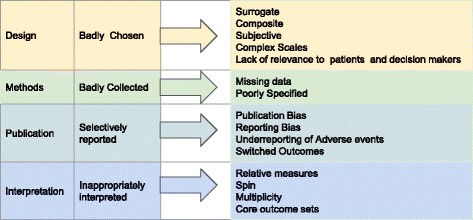
Clinical research should ultimately improve patient care. For this to be possible, trials must evaluate outcomes that genuinely reflect real-world settings and concerns. However, many trials continue to measure and report outcomes that fall short of this clear requirement. We highlight problems with trial outcomes that make evidence difficult or impossible to interpret and that undermine the translation of research into practice and policy. These complex issues include the use of surrogate, composite and subjective endpoints; a failure to take account of patients' perspectives when designing research outcomes; publication and other outcome reporting biases, including the under-reporting of adverse events; the reporting of relative measures at the expense of more informative absolute outcomes; misleading reporting; multiplicity of outcomes; and a lack of core outcome sets. Trial outcomes can be developed with patients in mind, however, and can be reported completely, transparently and competently. Clinicians, patients, researchers and those who pay for health services are entitled to demand reliable evidence demonstrating whether interventions improve patient-relevant clinical outcomes.
Overview
The claims and statistics of this paper haven’t been checked yet.
Free: it reads the open-access text and checks the first 5 claims that cite a source we can check. Create a free account to check every claim.
Integrity signals
Registry
Cites
Statistics
Figures
Verification
Claims the paper makes
The claims and statistics of this paper haven’t been checked yet.
Free: it reads the open-access text and checks the first 5 claims that cite a source we can check. Create a free account to check every claim.
Claims other papers make about this one
Each is checked against this paper’s own text: does it say what the citing paper says it does?
The source backs part of the claim, not all of it — or backs it for a different population, condition or comparison.
In the citing paper
“However, despite increasing attention to the quality of clinical trial reporting [19–21] and generics use in science [15,17,18], it remains unclear to what extent medical researchers produce hasty generalizations, how impactful articles with such generalizations are, and whether the generalizations in primary research articles differ in their scope (e.g., generics use) from those found in research”
From Hasty generalizations and generics in medical research: A systematic review (2024) · cites this paper as [19]
Experimental — accuracy not yet measuredThe source backs part of the claim, not all of it — or backs it for a different population, condition or comparison.
In the citing paper
“An unfortunate consequence of group studies such as the Evans et al. (2017) trial is that mean outcome scores on nomothetic measures obscures both the responsivity (or not) of individuals and also whether the idiosyncratic problems brought by patients to therapy actually change (Heneghan et al., 2017).”
From Effectiveness of cognitive analytic therapy for bipolar affective disorder: A co‐produced single subject cumulative treatment design with extended follow‐up (A 1 /B/A 2 /C‐FU) (2022) · cites this paper as Heneghan et al., 2017
Experimental — accuracy not yet measuredThe check wasn’t confident either way, so it gives no verdict — never disputed.
In the citing paper
“Firstly, in the pursuit of optimal treatment outcomes, clinical exercise trials often invest a level of resources, such as staff time, facilities and other support, that can facilitate patient engagement and overcome key barriers to patient adherence.”
From Identifying the factors affecting ‘patient engagement’ in exercise rehabilitation (2022) · cites this paper as [11]
Experimental — accuracy not yet measuredIn the citing paper
“If medical researchers make claims that are broader than warranted by the evidence or that mask variations, and if articles with such claims are impactful and summarized for practitioners without adjustments in generalization scope, this may contribute to regulatory approval or clinical use of treatments that are ineffective or harmful for people [3,19].”
From Hasty generalizations and generics in medical research: A systematic review (2024) · cites this paper as [19]
In the citing paper
“Secondly, the volunteers for clinical trials are likely to have a vested interest in the exercise activity, a belief in its efficacy, and be positively motivated to engage, as well as the time and resources to commit to the programme/clinical trial—characteristics that are not universal in the wider patient population.”
From Identifying the factors affecting ‘patient engagement’ in exercise rehabilitation (2022) · cites this paper as [11]
1 more claim about this paper
Create a free account to see every claim other papers make about this one.
Self-check
Percentages, sums and reported differences re-computed from the paper’s own numbers.
The self-check needs the paper’s full text.
Citations
Cites
CONSORT 2010 Statement: updated guidelines for reporting parallel group randomised trials
the CONSORT Group, Schulz, K. F., Altman, D. G., & Moher, D. (2010) · BMC Medicine · doi:10.1186/1741-7015-8-18 · Cited by 13,371
CONSORT 2010 Statement: updated guidelines for reporting parallel group randomised trials
Schulz, K. F., Altman, D. G., Moher, D., & for the CONSORT Group (2010) · BMJ · doi:10.1136/bmj.c332 · Cited by 9,329
Wood, L., Egger, M., Gluud, L. L., Schulz, K. F., Jüni, P., Altman, D. G., Gluud, C., Martin, R. M., Wood, A. J. G., & Sterne, J. A. C. (2008) · BMJ · doi:10.1136/bmj.39465.451748.ad · Cited by 2,538 · cited 1×
“, when outcome assessors are not blinded) [17, 18].”
BackgroundThe prevention and handling of the missing data
Kang, H. (2013) · Korean Journal of Anesthesiology · doi:10.4097/kjae.2013.64.5.402 · Cited by 1,728 · cited 1×
“Despite the development of a number of different ways of handling missing data, the only real solution is to prevent it from happening in the first place [36].”
BackgroundDeveloping core outcome sets for clinical trials: issues to consider
Williamson, P. R., Altman, D. G., Blazeby, J. M., Clarke, M., Devane, D., Gargon, E., & Tugwell, P. (2012) · Trials · doi:10.1186/1745-6215-13-132 · Cited by 1,661 · cited 1×
“Standardised core outcome sets take account of patient preferences that should be measured and reported in all trials for a specific therapeutic area [65].”
BackgroundKirkham, J. J., Dwan, K. M., Altman, D. G., Gamble, C., Dodd, S., Smyth, R., & Williamson, P. R. (2010) · BMJ · doi:10.1136/bmj.c365 · Cited by 1,133 · cited 1×
“Authors of a review of 283 Cochrane reviews found that more than half did not include data on the primary outcome [43].”
BackgroundDissemination and publication of research findings: an updated review of related biases
Song, F., Parekh, Hooper, L., Loke, Y., Ryder, J., Sutton, A., Hing, C., Kwok, C., Pang, C., & Harvey, I. (2010) · Health Technology Assessment · doi:10.3310/hta14080 · Cited by 1,039 · cited 1×
“approved trials, half go unpublished [38], and trials with positive outcomes are twice as likely to be published, and published faster, compared with trials with negative outcomes [39, 40].”
BackgroundPublication bias in clinical trials due to statistical significance or direction of trial results
Hopewell, S., Loudon, K., Clarke, M. J., Oxman, A. D., & Dickersin, K. (2009) · Cochrane Database of Systematic Reviews · doi:10.1002/14651858.mr000006.pub3 · Cited by 898 · cited 1×
“approved trials, half go unpublished [38], and trials with positive outcomes are twice as likely to be published, and published faster, compared with trials with negative outcomes [39, 40].”
BackgroundMarshall, M., Lockwood, A., Bradley, C., Adams, C., Joy, C., & Fenton, M. (2000) · British Journal of Psychiatry · doi:10.1192/bjp.176.3.249 · Cited by 870
Cited by
Items 301–400 of 402
Effect of right censoring bias on survival analysisPreprint
Barrajón, E., & Barrajón, L. (2020) · arXiv (Cornell University) · doi:10.48550/arxiv.2012.08649 · Cited by 10
Ethics of Outsourcing Drug Trials
Barat, S. (2021) · International Journal of Applied Research on Public Health Management · doi:10.4018/ijarphm.2021070101
Artificial intelligence for imaging in immunotherapy
Trebeschi, S. (2021) · Research Publications (Maastricht University) · doi:10.26481/dis.20210322st
Knight, R. L. (2021) · theses.fr (ABES) · doi:10.23889/suthesis.59458
Overview of Evaluation of Interventions
(2021) · Wiley eBooks · doi:10.1002/9781119610113.ch10
Ward, F., & Shiely, F. (2022) · Contemporary Clinical Trials Communications · doi:10.1016/j.conctc.2022.100924 · Cited by 1
“Overall, through reduced reporting of “unimportant” outcomes, it will be hoped to avoid the lamentable occurrence of clinical trials that fail to translate into any benefits for patients [53].”
BackgroundUnder-reporting of safety data – cause for concern
Gajbhiye, S. (2022) · Journal of Postgraduate Medicine · doi:10.4103/jpgm.jpgm_326_22
“[4] There are reports on inappropriate reporting of adverse events in literature.”
Toma de decisiones en la práctica clínica: Propuesta de un enfoque basado en evidencia “4E”
Alva‐Díaz, C., Velásquez‐Rimachi, V., Sequeiros, J. M., & Pacheco‐Barrios, K. (2022) · Revista del Cuerpo Médico Hospital Nacional Almanzor Aguinaga Asenjo · doi:10.35434/rcmhnaaa.2022.151.839 · Cited by 2
Farmer, C. (2022) · Autism and child psychopathology series · doi:10.1007/978-3-030-88538-0_48
Exploring the conduct and reporting of qualitative research in trials using mixed methods
Clement, C. (2023) · Cronfa (Swansea University) · doi:10.23889/suthesis.62588
Maissan, F., Pool, J. J. M., Wittink, H. M., de Raaij, E. J., Ostelo, R., Westers, P., Graaf, M. T.-D., & Kroon, G. (2023) · International Journal of Physiotherapy · doi:10.15621/ijphy/2023/v10i2/1316
Ojha, R. P., Lu, Y., Narra, K., Meadows, R. J., Gehr, A. W., Mantilla, E., & Ghabach, B. (2023) · JCO Clinical Cancer Informatics · doi:10.1200/cci.23.00001 · Cited by 2
“11 Some studies of DSTs assessed survival, 12-14 but methodologic limitations of these studies preclude valid inference.”
BackgroundWhen Evidence Goes “Missing in Action”: Implications for Patient Management in Cardiac Surgery
Reynolds, P. S. (2020) · Journal of ExtraCorporeal Technology · doi:10.1051/ject/202052126 · Cited by 1
EVALUATION OF OUTCOMES IN INTERVENTION RANDOMIZED CLINICAL TRIALS - DISTAL RADIUS FRACTURES
Meira, D. A., Moriyama, L. E., Santos, C. C. S., Moreira, F. D., Guedes, A., & de Mattos, E. D. S. R. (2023) · Acta Ortopédica Brasileira · doi:10.1590/1413-785220233103e267872
Malina, J., Huessler, E., Jöckel, K., Boog-Whiteside, E., Jeschonneck, N., Schröder, B., Schüle, R., Kühl, T., & Klebe, S. (2023) · Research Square · doi:10.21203/rs.3.rs-3384596/v1
Field, K. M., Rosenthal, M. A., Gillett, P., & IJzerman, M. J. (2023) · Journal of Clinical Neuroscience · doi:10.1016/j.jocn.2023.07.024
Ethics of Outsourcing Drug Trials
Barat, S. (2023) · IGI Global eBooks · doi:10.4018/979-8-3693-2045-7.ch037
A multidimensional assessment of payback: Evaluating the impact of Breast Cancer Trials
Knight, R., Luke, B., Meuter, R. F. I., Peters, K. V., & Chell, K. (2024) · Asia-Pacific Journal of Clinical Oncology · doi:10.1111/ajco.14043
Design and Analysis of Clinical Trials Concept and Methodology
Ghorpade, A. D., Khairnar, M. A. V., & Shep, S. G. (2024) · International Journal of Advanced Research in Science Communication and Technology · doi:10.48175/ijarsct-15694
Burden from Study Questionnaire on Patient Fatigue in Qualitative Congestive Heart Failure Research
Iyngkaran, P., Usmani, W., Bahmani, Z., & Hanna, F. S. (2024) · Journal of Cardiovascular Development and Disease · doi:10.3390/jcdd11040096
“The strong internal control comes at the expense of reduced generalisability at the population level [23].”
BackgroundContesse, M. G., Woods, R., Leffler, M. G., Prades, S., Greenfield, J., Compton, A., & Carroll, J. B. (2024) · Therapeutic Advances in Rare Disease · doi:10.1177/26330040241252447
Nadanovsky, P., de Oliveira, B. H., Lira‐Junior, R., & dos Santos, A. P. P. (2024) · Brazilian Oral Research · doi:10.1590/1807-3107bor-2024.vol38.0070
“However, the study did not examine whether the conventional RRR format was more effective than natural frequencies in communicating treatment effects, as no participant was provided with the RRR of 24%, that is, [1-(2.5/3.3)].”
InfluentialBetween Rational Beliefs and the Bedside: Breaking the Boundaries and Bridging the Breach
Dhaliwal, H. S. (2024) · Digestive Diseases and Sciences · doi:10.1007/s10620-024-08636-x
“…outcomes (surrogate, composite or subjective outcomes rather than objective, clinically relevant outcomes), improper measurement scales (non-validated scales and complex scales derived from an unreliable and subjective combination of symptoms and signs), flawed randomization and missing data [6].”
Immunotherapy with Checkpoint Inhibitors
Vickers, E. (2024) · Wiley eBooks · doi:10.1002/9781119834090.ch5
Crombie, I. (2021) · Wiley eBooks · doi:10.1002/9781394322183.ch3
Beerman, S., Dean, H., Snider, S., Magee, T., Fitzgerald, K., Ward, S., Modi, J., Magana, K., Jones, G., & Vassar, M. B. (2025) · Trials · doi:10.1186/s13063-025-08765-2
“Enhancing COS adoption in CAD trials could address patient concerns, improve care, and support better-informed clinical decisions by patients and physicians [22].”
Musallam, I. M. (2026) · Journal of Clinical Medicine · doi:10.21203/rs.3.rs-6190348/v1
Lozano, F. P., Marcos, A. R., Fernández, R. C., Rodrigo, A. B., Martínez‐Hervás, S., & Ampudia‐Blasco, F. J. (2025) · Endocrinología Diabetes y Nutrición (English ed ) · doi:10.1016/j.endien.2025.501574 · Cited by 1
Wright, C. L., Case, J., Magee, T., Magana, K., Fitzgerald, K., Jones, G., Modi, J., Ward, S., Hughes, G. K., Ito-Ford, A., et al. (2025) · Urologic Oncology Seminars and Original Investigations · doi:10.1016/j.urolonc.2025.07.008
Priorities towards precision neurotrauma: A methodological perspective
Espin, A. T. (2025) · The Journal of Precision Medicine Health and Disease · doi:10.1016/j.premed.2025.100022 · Cited by 1
The folklore of the “Swift” effect – lessons for medical research and clinical practice
Smoliga, J. M., & Sawyer, K. (2025) · PLoS ONE · doi:10.1371/journal.pone.0315560
Byrne, C. J., Inglis, S. K., Radley, A., Beer, L. J. Z., Pham, M. D., Allardice, K., Palmer, N., Healy, B., Doyle, J., & Dillon, J. F. (2025) · Trials · doi:10.1186/s13063-025-09196-9
de Mattos, E. D. S. R., Guedes, A., Zana, Y., Lessa, P. I. F., Júnior, C. R. A., Barreto, E. S. R., & Baptista, A. F. (2025) · F1000Research · doi:10.12688/f1000research.169801.1 · Cited by 1
Pang, D. C., Royds, J., & Göebel, A. (2025) · European Journal of Pain · doi:10.1002/ejp.70156
“This is consistent with findings in other medical interventions (Heneghan et al. 2017) and may be explained by inherent systemic biases in smaller trials, which positively skew results (Schwab et al. 2021).”
O’Brien, C., Shumard, A., Mitchell, D., Bratten, C., Paul, E., & Vassar, M. B. (2025) · Hand · doi:10.1177/15589447251389662
“11 Similar trends were seen in the trials we analyzed, with many relying on narrow inclusion criteria, single-center designs, blinded assessors, and rigid proto-cols—features that improve internal validity but often compromise external validity and generalizability.”
Vanderhout, S. M., Smith, M., Pallone, N., Tingley, K., Pugliese, M., Chakraborty, P. K., Stöckler, S., Offringa, M., Butcher, N. J., Nicholls, S. G., et al. (2021) · Figshare · doi:10.6084/m9.figshare.16620894
Malina, J., Huessler, E.-M., Jöckel, K.-H., Boog-Whiteside, E., Jeschonneck, N., Schröder, B., Schüle, R., Kühl, T., & Klebe, S. (2024) · Figshare · doi:10.6084/m9.figshare.26659186
Malina, J., Huessler, E.-M., Jöckel, K.-H., Boog-Whiteside, E., Jeschonneck, N., Schröder, B., Schüle, R., Kühl, T., & Klebe, S. (2024) · Figshare · doi:10.6084/m9.figshare.26659183
Korall, A. M. B., Steliga, D., Lamb, S. E., Lord, S. R., Rabbani, R., & Sibley, K. M. (2022) · Figshare · doi:10.6084/m9.figshare.20677991
Vyas, N., Bennett, A., Hamel, C., Beck, A., Thuku, M., Hersi, M., Shaver, N., Skidmore, B., Hutton, B., Manuel, D., et al. (2024) · Figshare · doi:10.6084/m9.figshare.26741315
Treweek, S., Miyakoda, V., Burke, D., & Shiely, F. (2022) · Figshare · doi:10.6084/m9.figshare.20168232
Gardner, H., Elfeky, A., Pickles, D. A., Dawson, A., Gillies, K., Warwick, V., & Treweek, S. (2023) · Figshare · doi:10.6084/m9.figshare.22607285
Treweek, S., Miyakoda, V., Burke, D., & Shiely, F. (2022) · Figshare · doi:10.6084/m9.figshare.20168229
Vyas, N., Bennett, A., Hamel, C., Beck, A., Thuku, M., Hersi, M., Shaver, N., Skidmore, B., Hutton, B., Manuel, D., et al. (2024) · Figshare · doi:10.6084/m9.figshare.26741288
Margaretos, N. M., Bawa, K., Engmann, N. J., & Chambers, J. D. (2022) · Figshare · doi:10.6084/m9.figshare.19128535
Vyas, N., Bennett, A., Hamel, C., Beck, A., Thuku, M., Hersi, M., Shaver, N., Skidmore, B., Hutton, B., Manuel, D., et al. (2024) · Figshare · doi:10.6084/m9.figshare.26741312
Vardić, A., Puljak, L., Galić, T., Viskić, J., Kuliš, E., & Peričić, T. P. (2024) · Figshare · doi:10.6084/m9.figshare.26644009
Korall, A. M. B., Steliga, D., Lamb, S. E., Lord, S. R., Rabbani, R., & Sibley, K. M. (2022) · Figshare · doi:10.6084/m9.figshare.20678000
Malina, J., Huessler, E.-M., Jöckel, K.-H., Boog-Whiteside, E., Jeschonneck, N., Schröder, B., Schüle, R., Kühl, T., & Klebe, S. (2024) · Figshare · doi:10.6084/m9.figshare.26659192
Malina, J., Huessler, E.-M., Jöckel, K.-H., Boog-Whiteside, E., Jeschonneck, N., Schröder, B., Schüle, R., Kühl, T., & Klebe, S. (2024) · Figshare · doi:10.6084/m9.figshare.26659195
Vyas, N., Bennett, A., Hamel, C., Beck, A., Thuku, M., Hersi, M., Shaver, N., Skidmore, B., Hutton, B., Manuel, D., et al. (2024) · Figshare · doi:10.6084/m9.figshare.26741303
Stein, D. J., Kazdin, A. E., Ruscio, A. M., Chiu, W. T., Sampson, N. A., Ziobrowski, H. N., Aguilar‐Gaxiola, S., Al-Hamzawi, A. A., Alonso, J., Altwaijri, Y., et al. (2021) · Figshare · doi:10.6084/m9.figshare.15139469
Green, H. R., Dawson, A., Elfeky, A., Pickles, D. A., Treweek, S., & Gillies, K. (2024) · Figshare · doi:10.6084/m9.figshare.26625907
Chai, C.-S., Ng, D.-L.-C., Bt Mos, S., Ibrahim, M. A., Tan, S.-B., Pang, Y.-K., & Liam, C.-K. (2023) · Figshare · doi:10.6084/m9.figshare.22721488
Teo, J. L., Zheng, Z., & Bird, S. R. (2022) · Figshare · doi:10.6084/m9.figshare.19135984
Vyas, N., Bennett, A., Hamel, C., Beck, A., Thuku, M., Hersi, M., Shaver, N., Skidmore, B., Hutton, B., Manuel, D., et al. (2024) · Figshare · doi:10.6084/m9.figshare.26741300
Vardić, A., Puljak, L., Galić, T., Viskić, J., Kuliš, E., & Peričić, T. P. (2024) · Figshare · doi:10.6084/m9.figshare.26644012
Vyas, N., Bennett, A., Hamel, C., Beck, A., Thuku, M., Hersi, M., Shaver, N., Skidmore, B., Hutton, B., Manuel, D., et al. (2024) · Figshare · doi:10.6084/m9.figshare.26741309
Vyas, N., Bennett, A., Hamel, C., Beck, A., Thuku, M., Hersi, M., Shaver, N., Skidmore, B., Hutton, B., Manuel, D., et al. (2024) · Figshare · doi:10.6084/m9.figshare.26741291
Qiu, R., Zhong, C., Wan, S., Zhang, Y., Wei, X., Li, M., Hu, J., Chen, S., Zhao, C., Chen, Z., et al. (2022) · Figshare · doi:10.6084/m9.figshare.19446044
Malina, J., Huessler, E.-M., Jöckel, K.-H., Boog-Whiteside, E., Jeschonneck, N., Schröder, B., Schüle, R., Kühl, T., & Klebe, S. (2024) · Figshare · doi:10.6084/m9.figshare.24934685
Treweek, S., Miyakoda, V., Burke, D., & Shiely, F. (2022) · Figshare · doi:10.6084/m9.figshare.20168223
Korall, A. M. B., Steliga, D., Lamb, S. E., Lord, S. R., Rabbani, R., & Sibley, K. M. (2022) · Figshare · doi:10.6084/m9.figshare.20677994
Malina, J., Huessler, E.-M., Jöckel, K.-H., Boog-Whiteside, E., Jeschonneck, N., Schröder, B., Schüle, R., Kühl, T., & Klebe, S. (2024) · Figshare · doi:10.6084/m9.figshare.24934036
Vyas, N., Bennett, A., Hamel, C., Beck, A., Thuku, M., Hersi, M., Shaver, N., Skidmore, B., Hutton, B., Manuel, D., et al. (2024) · Figshare · doi:10.6084/m9.figshare.26741297
Vardić, A., Puljak, L., Galić, T., Viskić, J., Kuliš, E., & Peričić, T. P. (2023) · Figshare · doi:10.6084/m9.figshare.24628103
Beck, A., Hamel, C., Thuku, M., Esmaeilisaraji, L., Bennett, A., Shaver, N., Skidmore, B., Colman, I., Grigoriadis, S., Nicholls, S. G., et al. (2022) · Figshare · doi:10.6084/m9.figshare.20552162
Vardić, A., Puljak, L., Galić, T., Viskić, J., Kuliš, E., & Peričić, T. P. (2024) · Figshare · doi:10.6084/m9.figshare.24628192
Webbe, J., Allin, B. S. R., Knight, M., Modi, N., & Gale, C. P. (2024) · Figshare · doi:10.6084/m9.figshare.26590841
Vyas, N., Bennett, A., Hamel, C., Beck, A., Thuku, M., Hersi, M., Shaver, N., Skidmore, B., Hutton, B., Manuel, D., et al. (2024) · Figshare · doi:10.6084/m9.figshare.26741294
Aguiar, M., Laba, T.-L., Munro, S., Burch, T., Beckett, J., Kaal, K. J., Bansback, N. J., Hudson, M., & Harrison, M. J. (2021) · Figshare · doi:10.6084/m9.figshare.16599707
Treweek, S., Miyakoda, V., Burke, D., & Shiely, F. (2022) · Figshare · doi:10.6084/m9.figshare.20168226
Vyas, N., Bennett, A., Hamel, C., Beck, A., Thuku, M., Hersi, M., Shaver, N., Skidmore, B., Hutton, B., Manuel, D., et al. (2024) · Figshare · doi:10.6084/m9.figshare.26741306
Treweek, S., Miyakoda, V., Burke, D., & Shiely, F. (2022) · Figshare · doi:10.6084/m9.figshare.20168220
Green, H. R., Dawson, A., Elfeky, A., Pickles, D. A., Treweek, S., & Gillies, K. (2024) · Figshare · doi:10.6084/m9.figshare.26625904
Malina, J., Huessler, E.-M., Jöckel, K.-H., Boog-Whiteside, E., Jeschonneck, N., Schröder, B., Schüle, R., Kühl, T., & Klebe, S. (2024) · Figshare · doi:10.6084/m9.figshare.26659189
Korall, A. M. B., Steliga, D., Lamb, S. E., Lord, S. R., Rabbani, R., & Sibley, K. M. (2022) · Figshare · doi:10.6084/m9.figshare.20677997
Ray, K., Rowsey, K., Kramer, L., Kee, M. D., Flores, H., Wise, A., Garrett, M., Rucker, B., Newhardt, R., Beaman, J., et al. (2025) · Journal of Psychopharmacology · doi:10.1177/02698811251399554
“Harms are often designated as secondary outcomes in trial protocols, which contributes to inconsistent prespecification and inadequate capture of adverse events (Heneghan et al., 2017).”
Georgopoulou, S., Droney, J., Jaganathan, P. P., Howell, P., Macklin-Doherty, A., Young, K., & Cruickshank, S. (2026) · Supportive Care in Cancer · doi:10.1007/s00520-026-10350-5
de Mattos, E. D. S. R., Guedes, A., Zana, Y., Lessa, P. I. F., Júnior, C. R. A., Barreto, E. S. R., & Baptista, A. F. (2026) · F1000Research · doi:10.12688/f1000research.169801.2
Geraci, J., Qorri, B., Cumbaa, C. A., Tsay, M. J., Leonczyk, P., Gogacz, A., & Pani, L. (2026) · Research Square · doi:10.21203/rs.3.rs-9031851/v1
Vink, M., & Vink-Niese, F. (2026) · Frontiers in Psychiatry · doi:10.3389/fpsyt.2025.1746712 · Cited by 1
“According to the 5 and 20 rule, studies are highly biased if 20% or more drop out or are inadequately treated (12).”
Pivotal studies of pharmacotherapies approved by the US FDA for cancer treatment: a meta-analysis
Chow, R., Im, J. H. B., Zimmermann, C., Richards, G. C., & Heneghan, C. (2026) · The Oncologist · doi:10.1093/oncolo/oyag125
“36 These approaches require careful validation of endpoints, rigorous power calculations, and transparent reporting.”
Self-citationSantos, J. K. D. O., Silvério, K. C. A., & Gama, A. C. C. (2026) · Journal of Voice · doi:10.1016/j.jvoice.2026.02.027
Ademi, M., Saute, J. A. M., Dubec‐Fleury, C., Greenfield, J., Wallis, R., Gobeil, C., Linton, L. R., Nadke, A., Horváth, R., Klebe, S., et al. (2026) · medRxiv · doi:10.64898/2026.04.09.26350392
Tesser, C. D., Dall’Alba, R., & Sato, M. E. (2026) · Interface - Comunicação Saúde Educação · doi:10.1590/interface.250712 · Cited by 1
Hitchman, L. H., Siciliano, M., Lathan, R., Ravindhran, B., Sidapra, M., Long, J., Smith, G., Twiddy, M., Russell, D., Chetter, I. C., et al. (2026) · International Wound Journal · doi:10.1111/iwj.70925
“Outcomes in trials are often reported to be better compared to routinely collected data, for a multitude of reasons [80, 81].”
Sevinc, G., Escoto-Rivera, A., Crespo, K., Nesto, S., Chapman, C. A. T., & Rockwood, K. J. (2026) · Patient Related Outcome Measures · doi:10.2147/prom.s569608
“20,21 Our results indicated that there is a wide variation in how GAS is applied, reinforcing existing literature.”
He, J., Peng, C., Zhang, L., Wang, D.-D., Tan, X., Wen, X.-L., Shen, X., & Wu, X.-P. (2026) · Sports Medicine - Open · doi:10.1186/s40798-026-01095-w
“Even when such information is collected, the apparent “invisibility” or marked attenuation of adverse events in the literature may also reflect conflicts of interest [101].”
The predictive power of first recruits to commercial trial performance
Batty, M. J., Wason, J. M. S., Ward, D. J., & Gkrania-Klotsas, E. (2026) · BMC Medical Research Methodology · doi:10.1186/s12874-026-02907-z
“As with non-commercial trials, clinical benefit is very much dependent on trial design and outcome measures used [11].”
Livingston, M., Toomey, E., & Robinson, K. (2026) · Trials · doi:10.1186/s13063-026-09848-4
“This impedes the conduct of systematic reviews with meta-analyses, contributes to the proliferation of research waste [1], and can lead to the omission of outcome measures that are important to interest-holders who benefit the most from clinical research [2].”
Developing a core outcome set for pharmacist interventions in chronic kidney disease: a Delphi study
Ardavani, A., Curtis, F., HIGHTON, P. J., Khunti, K., & Wilkinson, T. J. (2026) · Journal of Nephrology · doi:10.1093/joneph/aajag005
Cartilage regeneration: clinical progress and future outlook
Thomas-Charles, C. A., Xue, R., Agosto, A. R., Farkash, A. F., Kindblom, P., Lo, Y. L. E., Lo, K. W. ‐., & Li, Y. (2026) · Trends in Molecular Medicine · doi:10.1016/j.molmed.2026.06.017
Luca, F. D., Pozzoni, A., Signorelli, N., & Masella, C. (2026) · Research Involvement and Engagement · doi:10.1186/s40900-026-00947-9
Vink, M., & Vink-Niese, F. (2026) · Journal of Psychosomatic Research · doi:10.1016/j.jpsychores.2026.112957
Kakadia, J. H., Heilmann, R., Barrientos, M., MacNeill, L., Vallee, I., Schultz, S. K., O’Donoghue, P., Moresco, A., Siu, V. M., & Heinemann, I. U. (2026) · FEBS Open Bio · doi:10.1002/2211-5463.70318
Geraci, J., Qorri, B., Cumbaa, C. A., Tsay, M. J., Marrella, C. A., Zappulla, S., Leonczyk, P., Gogacz, A., & Pani, L. (2026) · AI · doi:10.3390/ai7090349 · Cited by 1
“…effect (HTE): clinically meaningful benefit may be concentrated in subsets of patients, while average treatment effects are diluted by biological and clinical diversity, noisy endpoints, and limited sample sizes, conditions especially common in early-phase and precision medicine trials [2,3].”
Zimmerman, S. I., Port, C., Mast, B. T., Haitsma, K. S. V., & Fazio, S. (2026) · Journal of Applied Gerontology · doi:10.1177/07334648261478663 · Cited by 3
“Criterion 6, Systemic Focus, recognizes that the broadest possible relevance of data can accelerate beneficial care and policy change through its ability to inform how resources are allocated (Heneghan, 2017).”
Metadata
- Authors
- Heneghan, C., Goldacre, B., & Mahtani, K. R.
- Affiliations
- University of Oxford (GB)
- Corresponding author
- Heneghan, Carl
- Venue
- Trials
- Published
- 2017-03-14
- Volume
- 18
- Issue
- 1
- Pages
- 122-122
- ISSN
- 1745-6215 (ISSN-L)
- PMC
- PMC5348914
- OpenAlex
- W2597385103
- Cited by
- 404
- References
- 67
- Citations by year
- 2026: 34 · 2025: 27 · 2024: 59 · 2023: 51 · 2022: 54 · 2021: 50 · 2020: 50 · 2019: 38 · 2018: 27 · 2017: 13
- FWCI
- 24.34
- Type
- journal article
- Language
- en
- Open access
- gold
- doi.org
- Licence
- cc-by
- Locations
- Trials (publishedVersion, cc-by)
- PubMed Central (publishedVersion, cc-by)
- PubMed (publishedVersion)
- Funders
- National Institute for Health and Care Research (CL-2011-13-006)
- Topics
- Physical Sciences › Mathematics › Statistics and Probability › Statistical Methods in Clinical Trials
- Social Sciences › Decision Sciences › Statistics, Probability and Uncertainty › Meta-analysis and systematic reviews
- Social Sciences › Sociology and Political Science › Delphi Technique in Research
- Keywords
- clinical trial results, outcome measurement, clinical translation, surrogate endpoints, composite endpoints, patient perspectives, selective reporting, core outcome set, clinical trial transparency, patient-relevant outcomes
- MeSH terms
- Clinical Trials as Topic, Data Interpretation, Statistical, Humans, Patient Participation, Research Design, Bias, Treatment Outcome, Publication Bias, Endpoint Determination
About these checks
Registry, retraction, Cites and statistics results are computed, not judged, with one exception: a printed reference that no index lists is read once by a model before it counts as a citation error. Claims are extracted by a model and kept only when their quote appears verbatim in the text; each cited source is then checked, with a model’s help, for whether it says what the claim relies on. Those verdicts can be wrong — read the claim’s quote and the cited source before relying on one.
Statistics and arithmetic are recomputed, not judged.
Confidence bands are shown only for fields calibrated on our annotated test set. None is calibrated yet, so no band is shown.
What counts as a claim ›How we measure confidence ›How we check this ›
Are you an author, or do you see a problem with this page? Request a review
Data sources
Bibliographic data: Semantic Scholar, OpenAlex, Crossref.
Contains information from the Semantic Scholar Academic Graph Datasets, made available under the ODC Attribution License (ODC-BY 1.0).
Semantic Scholar’s data is described in: Kinney, R., et al. (2023). The Semantic Scholar Open Data Platform. arXiv:2301.10140.
