

Why clinical trial outcomes fail to translate into benefits for patients
Open accessThe DOI matches its Crossref record; 67 of the 67 references it cites were found in a registry or an index.
Abstract
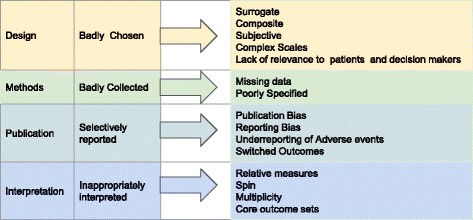
Clinical research should ultimately improve patient care. For this to be possible, trials must evaluate outcomes that genuinely reflect real-world settings and concerns. However, many trials continue to measure and report outcomes that fall short of this clear requirement. We highlight problems with trial outcomes that make evidence difficult or impossible to interpret and that undermine the translation of research into practice and policy. These complex issues include the use of surrogate, composite and subjective endpoints; a failure to take account of patients' perspectives when designing research outcomes; publication and other outcome reporting biases, including the under-reporting of adverse events; the reporting of relative measures at the expense of more informative absolute outcomes; misleading reporting; multiplicity of outcomes; and a lack of core outcome sets. Trial outcomes can be developed with patients in mind, however, and can be reported completely, transparently and competently. Clinicians, patients, researchers and those who pay for health services are entitled to demand reliable evidence demonstrating whether interventions improve patient-relevant clinical outcomes.
Overview
The claims and statistics of this paper haven’t been checked yet.
Free: it reads the open-access text and checks the first 5 claims that cite a source we can check. Create a free account to check every claim.
Integrity signals
Registry
Cites
Statistics
Figures
Verification
Claims the paper makes
The claims and statistics of this paper haven’t been checked yet.
Free: it reads the open-access text and checks the first 5 claims that cite a source we can check. Create a free account to check every claim.
Claims other papers make about this one
Each is checked against this paper’s own text: does it say what the citing paper says it does?
The source backs part of the claim, not all of it — or backs it for a different population, condition or comparison.
In the citing paper
“However, despite increasing attention to the quality of clinical trial reporting [19–21] and generics use in science [15,17,18], it remains unclear to what extent medical researchers produce hasty generalizations, how impactful articles with such generalizations are, and whether the generalizations in primary research articles differ in their scope (e.g., generics use) from those found in research”
From Hasty generalizations and generics in medical research: A systematic review (2024) · cites this paper as [19]
Experimental — accuracy not yet measuredThe source backs part of the claim, not all of it — or backs it for a different population, condition or comparison.
In the citing paper
“An unfortunate consequence of group studies such as the Evans et al. (2017) trial is that mean outcome scores on nomothetic measures obscures both the responsivity (or not) of individuals and also whether the idiosyncratic problems brought by patients to therapy actually change (Heneghan et al., 2017).”
From Effectiveness of cognitive analytic therapy for bipolar affective disorder: A co‐produced single subject cumulative treatment design with extended follow‐up (A 1 /B/A 2 /C‐FU) (2022) · cites this paper as Heneghan et al., 2017
Experimental — accuracy not yet measuredThe check wasn’t confident either way, so it gives no verdict — never disputed.
In the citing paper
“Firstly, in the pursuit of optimal treatment outcomes, clinical exercise trials often invest a level of resources, such as staff time, facilities and other support, that can facilitate patient engagement and overcome key barriers to patient adherence.”
From Identifying the factors affecting ‘patient engagement’ in exercise rehabilitation (2022) · cites this paper as [11]
Experimental — accuracy not yet measuredIn the citing paper
“If medical researchers make claims that are broader than warranted by the evidence or that mask variations, and if articles with such claims are impactful and summarized for practitioners without adjustments in generalization scope, this may contribute to regulatory approval or clinical use of treatments that are ineffective or harmful for people [3,19].”
From Hasty generalizations and generics in medical research: A systematic review (2024) · cites this paper as [19]
In the citing paper
“Secondly, the volunteers for clinical trials are likely to have a vested interest in the exercise activity, a belief in its efficacy, and be positively motivated to engage, as well as the time and resources to commit to the programme/clinical trial—characteristics that are not universal in the wider patient population.”
From Identifying the factors affecting ‘patient engagement’ in exercise rehabilitation (2022) · cites this paper as [11]
1 more claim about this paper
Create a free account to see every claim other papers make about this one.
Self-check
Percentages, sums and reported differences re-computed from the paper’s own numbers.
The self-check needs the paper’s full text.
Citations
Cites
CONSORT 2010 Statement: updated guidelines for reporting parallel group randomised trials
the CONSORT Group, Schulz, K. F., Altman, D. G., & Moher, D. (2010) · BMC Medicine · doi:10.1186/1741-7015-8-18 · Cited by 13,371
CONSORT 2010 Statement: updated guidelines for reporting parallel group randomised trials
Schulz, K. F., Altman, D. G., Moher, D., & for the CONSORT Group (2010) · BMJ · doi:10.1136/bmj.c332 · Cited by 9,329
Wood, L., Egger, M., Gluud, L. L., Schulz, K. F., Jüni, P., Altman, D. G., Gluud, C., Martin, R. M., Wood, A. J. G., & Sterne, J. A. C. (2008) · BMJ · doi:10.1136/bmj.39465.451748.ad · Cited by 2,538 · cited 1×
“, when outcome assessors are not blinded) [17, 18].”
BackgroundThe prevention and handling of the missing data
Kang, H. (2013) · Korean Journal of Anesthesiology · doi:10.4097/kjae.2013.64.5.402 · Cited by 1,728 · cited 1×
“Despite the development of a number of different ways of handling missing data, the only real solution is to prevent it from happening in the first place [36].”
BackgroundDeveloping core outcome sets for clinical trials: issues to consider
Williamson, P. R., Altman, D. G., Blazeby, J. M., Clarke, M., Devane, D., Gargon, E., & Tugwell, P. (2012) · Trials · doi:10.1186/1745-6215-13-132 · Cited by 1,661 · cited 1×
“Standardised core outcome sets take account of patient preferences that should be measured and reported in all trials for a specific therapeutic area [65].”
BackgroundKirkham, J. J., Dwan, K. M., Altman, D. G., Gamble, C., Dodd, S., Smyth, R., & Williamson, P. R. (2010) · BMJ · doi:10.1136/bmj.c365 · Cited by 1,133 · cited 1×
“Authors of a review of 283 Cochrane reviews found that more than half did not include data on the primary outcome [43].”
BackgroundDissemination and publication of research findings: an updated review of related biases
Song, F., Parekh, Hooper, L., Loke, Y., Ryder, J., Sutton, A., Hing, C., Kwok, C., Pang, C., & Harvey, I. (2010) · Health Technology Assessment · doi:10.3310/hta14080 · Cited by 1,039 · cited 1×
“approved trials, half go unpublished [38], and trials with positive outcomes are twice as likely to be published, and published faster, compared with trials with negative outcomes [39, 40].”
BackgroundPublication bias in clinical trials due to statistical significance or direction of trial results
Hopewell, S., Loudon, K., Clarke, M. J., Oxman, A. D., & Dickersin, K. (2009) · Cochrane Database of Systematic Reviews · doi:10.1002/14651858.mr000006.pub3 · Cited by 898 · cited 1×
“approved trials, half go unpublished [38], and trials with positive outcomes are twice as likely to be published, and published faster, compared with trials with negative outcomes [39, 40].”
BackgroundMarshall, M., Lockwood, A., Bradley, C., Adams, C., Joy, C., & Fenton, M. (2000) · British Journal of Psychiatry · doi:10.1192/bjp.176.3.249 · Cited by 870
Boutron, I. (2010) · JAMA · doi:10.1001/jama.2010.651 · Cited by 842 · cited 1×
“secondary outcomes, or subgroup analyses and not the primary outcome, or focussing the reader on another study objective away from the statistically nonsignificant result [59].”
BackgroundPRISMA harms checklist: improving harms reporting in systematic reviews
Zorzela, L., Loke, Y. K., Ioannidis, J. P., Golder, S., Santaguida, P., Altman, D. G., Moher, D., Vohra, S., & PRISMA harms group (2016) · BMJ · doi:10.1136/bmj.i157 · Cited by 557 · cited 1×
“The aim of updates to the Preferred Reporting Items for Systematic Reviews and Meta-Analyses (PRISMA) checklist for systematic reviews is to improve the current situation by ensuring that a minimal set of adverse events items is reported [51].”
BackgroundOMERACT: An international initiative to improve outcome measurement in rheumatology
Tugwell, P., Boers, M., Brooks, P., Simon, L., Strand, V., & Idzerda, L. (2007) · Trials · doi:10.1186/1745-6215-8-38 · Cited by 536 · cited 1×
“Arthritis Clinical Trials (OMERACT) collaboration has advocated the use of core outcome sets [66], and the Core”
MethodHobart, J. C., Cano, S. J., Zajicek, J. P., & Thompson, A. J. (2007) · The Lancet Neurology · doi:10.1016/s1474-4422(07)70290-9 · Cited by 495 · cited 1×
“Clinical trials require rating scales that are rigorous, but this is difficult to achieve [24].”
BackgroundHrobjartsson, A., Thomsen, A. S. S., Emanuelsson, F., Tendal, B., Hilden, J., Boutron, I., Ravaud, P., & Brorson, S. (2012) · BMJ · doi:10.1136/bmj.e1119 · Cited by 483 · cited 1×
“In a systematic review of observer bias, non-blinded outcome assessors exaggerated ORs in RCTs by 36% compared with blinded assessors [19].”
Ferreira-González, I., Permanyer-Miralda, G., Domingo-Salvany, A., Busse, J. W., Heels-Ansdell, D., Montori, V. M., Akl, E. A., Bryant, D. M., Alonso-Coello, P., Alonso, J., et al. (2007) · BMJ · doi:10.1136/bmj.39136.682083.ae · Cited by 473 · cited 1×
“Authors of an analysis of 242 cardiovascular RCTs, published in six high-impact medical journals, found that in 47% of the trials, researchers reported a composite outcome [11].”
Cordoba, G., Schwartz, L., Woloshin, S., Bae, H., & Gotzsche, P. C. (2010) · BMJ · doi:10.1136/bmj.c3920 · Cited by 400 · cited 1×
“Authors of a further review of 40 trials, published in 2008, found that composites often had little justification for their choice [12], were inconsistently defined, and often the outcome combinations did not make clinical sense [13].”
BackgroundCredibility of claims of subgroup effects in randomised controlled trials: systematic review
Sun, X., Briel, M., Busse, J. W., You, J. J., Akl, E. A., Mejza, F., Bala, M. M., Bassler, D., Mertz, D., Diaz-Granados, N., et al. (2012) · BMJ · doi:10.1136/bmj.e1553 · Cited by 395 · cited 2×
“At a minimum, triallists should perform a test of interaction, and journals should ensure it is done, to examine whether treatment effects actually differ amongst subpopulations [64], and decision makers should be very wary of high numbers of outcomes included in a trial report.”
BackgroundMethodFactors That Can Affect the External Validity of Randomised Controlled Trials
Rothwell, P. M. (2006) · PLoS Clinical Trials · doi:10.1371/journal.pctr.0010009 · Cited by 376 · cited 1×
“Use of surrogate, composite and subjective outcomes further undermines relevance to patients [26] and often accompanies problems with reporting and interpretation [25].”
BackgroundBoutron, I., Altman, D. G., Hopewell, S., Vera-Badillo, F., Tannock, I., & Ravaud, P. (2014) · Journal of Clinical Oncology · doi:10.1200/jco.2014.56.7503 · Cited by 368 · cited 1×
“difference in clinicians’ rating of the importance of the study or the need for a further trial [60].”
BackgroundOutcome Reporting in Industry-Sponsored Trials of Gabapentin for Off-Label Use
Vedula, S. S., Bero, L., Scherer, R. W., & Dickersin, K. (2009) · New England Journal of Medicine · doi:10.1056/nejmsa0906126 · Cited by 361 · cited 1×
“gov study reports [48] and reports obtained through litigation [49].”
BackgroundAkl, E. A., Briel, M., You, J. J., Sun, X., Johnston, B. C., Busse, J. W., Mulla, S., Lamontagne, F., Bassler, D., Vera, C., et al. (2012) · BMJ · doi:10.1136/bmj.e2809 · Cited by 350 · cited 1×
“This figure was 58% in a worst-case scenario, where all participants lost to follow-up in the intervention group and none in the control group had the event of interest [35].”
BackgroundGøtzsche, P. C. (1989) · Controlled Clinical Trials · doi:10.1016/0197-2456(89)90017-2 · Cited by 339 · cited 1×
“outcome switching) was one of the possible causes for the high number of results favouring new rheumatoid arthritis drugs [23].”
ResultAtkins, D., Briss, P. A., Eccles, M., Flottorp, S., Guyatt, G. H., Harbour, R. T., Hill, S., Jaeschke, R., Liberati, A., Magrini, N., et al. (2005) · BMC Health Services Research · doi:10.1186/1472-6963-5-25 · Cited by 331 · cited 1×
“Surrogates generally provide less direct relevant evidence than studies using patient-relevant outcomes [5, 7], and over-interpretation runs the risk of incorrect interpretations because changes may not reflect important changes in outcomes [8].”
BackgroundPage, M. J., Higgins, J. P. T., Clayton, G., Sterne, J. A. C., Hróbjartsson, A., & Savović, J. (2016) · PLOS ONE · doi:10.1371/journal.pone.0159267 · Cited by 284 · cited 1×
“In addition, trials with inadequate or unclear sequence generation also biased estimates when outcomes were subjective [20].”
BackgroundGolder, S., Loke, Y. K., Wright, K., & Norman, G. (2016) · PLOS Medicine · doi:10.1371/journal.pmed.1002127 · Cited by 277 · cited 1×
“A further review of 11 studies comparing adverse events in published and unpublished documents reported that 43% to 100% (median 64%) of adverse events (including outcomes such as death or suicide) were missed when journal publications were solely relied on [45].”
BackgroundSchmucker, C., Schell, L. K., Portalupi, S., Oeller, P., Cabrera, L., Bassler, D., Schwarzer, G., Scherer, R. W., Antes, G., von Elm, E., et al. (2014) · PLoS ONE · doi:10.1371/journal.pone.0114023 · Cited by 269 · cited 1×
“approved trials, half go unpublished [38], and trials with positive outcomes are twice as likely to be published, and published faster, compared with trials with negative outcomes [39, 40].”
BackgroundEffect of reporting bias on meta-analyses of drug trials: reanalysis of meta-analyses
Hart, B., Lundh, A., & Bero, L. (2012) · BMJ · doi:10.1136/bmj.d7202 · Cited by 255 · cited 1×
“Researchers in multiple studies have found that journal publications under-report side effects and therefore exaggerate treatment benefits when compared with more complete information presented in clinical study reports [46], FDA reviews [47], ClinicalTrials.”
ResultUse of relative and absolute effect measures in reporting health inequalities: structured review
King, N. B., Harper, S., & Young, M. E. (2012) · BMJ · doi:10.1136/bmj.e5774 · Cited by 247 · cited 1×
“Authors of a 2009 review of 344 journal articles reporting on health inequalities research found that, of the 40% of abstracts reporting an effect measure, 88% reported only the relative measure, 9% an absolute measure and just 2% reported both [56].”
BackgroundYavchitz, A., Ravaud, P., Altman, D. G., Moher, D., Hrobjartsson, A., Lasserson, T., & Boutron, I. (2016) · Journal of Clinical Epidemiology · doi:10.1016/j.jclinepi.2016.01.020 · Cited by 224 · cited 1×
“Of these, the three most serious were recommendations for practice not supported by findings in the conclusion, misleading titles and selective reporting [62].”
BackgroundFrequency and reasons for outcome reporting bias in clinical trials: interviews with trialists
Smyth, R. M. D., Kirkham, J. J., Jacoby, A., Altman, D. G., Gamble, C., & Williamson, P. R. (2011) · BMJ · doi:10.1136/bmj.c7153 · Cited by 220 · cited 1×
“Switched outcomes is the failure to correctly report prespecified outcomes, which remains highly prevalent and presents significant problems in interpreting results [52].”
BackgroundSaini, P., Loke, Y. K., Gamble, C., Altman, D. G., Williamson, P. R., & Kirkham, J. J. (2014) · BMJ · doi:10.1136/bmj.g6501 · Cited by 209 · cited 1×
“included primary studies; in nearly two-thirds of the primary studies, outcome reporting bias was suspected [50].”
BackgroundThe trials methodological research agenda: results from a priority setting exercise
Tudur Smith, C., Hickey, H., Clarke, M., Blazeby, J., & Williamson, P. (2014) · Trials · doi:10.1186/1745-6215-15-32 · Cited by 193 · cited 1×
“clinical trials units found that ‘choosing appropriate outcomes to measure’ as one of the top three priorities for methods research [3].”
BackgroundDwan, K., Altman, D. G., Clarke, M., Gamble, C., Higgins, J. P. T., Sterne, J. A. C., Williamson, P. R., & Kirkham, J. J. (2014) · PLoS Medicine · doi:10.1371/journal.pmed.1001666 · Cited by 187 · cited 1×
“Authors of a systematic review of selective outcome reporting, including 27 analyses, found that the median proportion of trials with a discrepancy between the registered and published primary outcome was 31% [53].”
BackgroundYudkin, J. S., Lipska, K. J., & Montori, V. M. (2011) · BMJ · doi:10.1136/bmj.d7995 · Cited by 185 · cited 2×
“Surrogates generally provide less direct relevant evidence than studies using patient-relevant outcomes [5, 7], and over-interpretation runs the risk of incorrect interpretations because changes may not reflect important changes in outcomes [8].”
BackgroundAbraha, I., Cherubini, A., Cozzolino, F., De Florio, R., Luchetta, M. L., Rimland, J. M., Folletti, I., Marchesi, M., Germani, A., Orso, M., et al. (2015) · BMJ · doi:10.1136/bmj.h2445 · Cited by 165 · cited 1×
“Yet, despite these shortcomings, subjective outcomes are highly prevalent in trials as well as systematic reviews: In a study of 43 systematic reviews of drug interventions, researchers reported the primary outcome was objective in only 38% of the pooled analyses [21].”
BackgroundLinde, K., Kriston, L., Rucker, G., Jamil, S., Schumann, I., Meissner, K., Sigterman, K., & Schneider, A. (2015) · The Annals of Family Medicine · doi:10.1370/afm.1687 · Cited by 151 · cited 1×
“reviews of patients with mild depression have reported that only a handful of trials in primary care provide outcome data on the long-term effectiveness (beyond 12 weeks) of anti-depressant drug treatments [33].”
BackgroundPoints to Consider on Multiplicity Issues in Clinical Trials
Watanabe, H., & Takahashi, K. (2006) · Japanese Journal of Biometrics · doi:10.5691/jjb.27.s73 · Cited by 151
Kelly, S., Lafortune, L., Hart, N. J., Cowan, K., Fenton, M., & Brayne, C. (2015) · Age and Ageing · doi:10.1093/ageing/afv143 · Cited by 131
Wieseler, B., Wolfram, N., McGauran, N., Kerekes, M. F., Vervölgyi, V., Kohlepp, P., Kamphuis, M., & Grouven, U. (2013) · PLoS Medicine · doi:10.1371/journal.pmed.1001526 · Cited by 129 · cited 1×
“Researchers in multiple studies have found that journal publications under-report side effects and therefore exaggerate treatment benefits when compared with more complete information presented in clinical study reports [46], FDA reviews [47], ClinicalTrials.”
ResultRahimi, K., Malhotra, A., Banning, A. P., & Jenkinson, C. (2010) · BMJ · doi:10.1136/bmj.c5707 · Cited by 128 · cited 2×
“Use of surrogate, composite and subjective outcomes further undermines relevance to patients [26] and often accompanies problems with reporting and interpretation [25].”
BackgroundRothwell, P. M., & Warlow, C. P. (1995) · The Lancet · doi:10.1016/s0140-6736(95)91953-8 · Cited by 122 · cited 1×
“differs depending on whether patients are assessed by a neurologist or a surgeon [37].”
BackgroundRosiglitazone: what went wrong?
Cohen, D. (2010) · BMJ · doi:10.1136/bmj.c4848 · Cited by 122 · cited 1×
“As an example, researchers in a well-conducted clinical trial of the diabetes drug rosiglitazone reported that it effectively lowered blood glucose (a surrogate) [9]; however, the drug was subsequently withdrawn in the European Union because of increased cardiovascular events, the patient-relevant outcome [10].”
MethodComposite outcomes in cardiovascular research: a survey of randomized trials.
Lim, E., Brown, A., Helmy, A., Mussa, S., & Altman, D. G. (2008) · Annals of Internal Medicine · doi:10.7326/0003-4819-149-9-200811040-00004 · Cited by 116 · cited 1×
“Individual outcomes within a composite can vary in the severity of their effects, which may be misleading when the most important outcomes, such as death, make relatively little contribution to the overall outcome measure [14].”
BackgroundProblems of stopping trials early
Guyatt, G. H., Briel, M., Glasziou, P., Bassler, D., & Montori, V. M. (2012) · BMJ · doi:10.1136/bmj.e3863 · Cited by 115 · cited 1×
“Furthermore, results of simulation studies show that trials halted too early, with modest effects and few events, will result in large overestimates of the outcome effect [34].”
BackgroundHeneghan, C. J., Onakpoya, I., Jones, M., Doshi, P., Mar, C. D., Hama, R., Thompson, M., Spencer, E. A., Mahtani, K. R., Nunan, D., et al. (2016) · Health Technology Assessment · doi:10.3310/hta20420 · Cited by 110 · cited 1×
“Guidelines, for example, reject the use of antibiotics in sore throat [28] owing to their minimal effects on symptoms; yet, similar guidelines approve the use of antivirals because of their effects on symptoms [29], despite similar limited effects [30].”
BackgroundSelf-citationMolnar, F. J., Man‐Son‐Hing, M., & Fergusson, D. (2009) · Journal of the American Geriatrics Society · doi:10.1111/j.1532-5415.2008.02122.x · Cited by 91 · cited 2×
“Sometimes, however, such interpretation does not happen: In a review of 57 dementia drug trials, researchers found that less than half (46%) discussed the clinical significance of their results [17].”
BackgroundRodgers, M. A., Brown, J. V. E., Heirs, M. K., Higgins, J. P. T., Mannion, R. J., Simmonds, M. C., & Stewart, L. A. (2013) · BMJ · doi:10.1136/bmj.f3981 · Cited by 87 · cited 1×
“A review of recombinant human bone morphogenetic protein 2 used in spinal fusion, however, showed that data from publications substantially underestimated adverse events when compared with individual participant data or internal industry reports [44].”
BackgroundRisk factors and interventions with statistically significant tiny effects
Siontis, G. C., & Ioannidis, J. P. (2011) · International Journal of Epidemiology · doi:10.1093/ije/dyr099 · Cited by 80 · cited 1×
“though, when it comes to assessing minimal effects: Authors of an analysis of 51 trials found small outcome effects were commonly reported and often eliminated by the presence of minimal bias [31].”
BackgroundMoustgaard, H., Bello, S., Miller, F. G., & Hróbjartsson, A. (2014) · Journal of Clinical Epidemiology · doi:10.1016/j.jclinepi.2014.06.020 · Cited by 78 · cited 1×
“Where an observer exercises judgment while assessing an event, or where the outcome is self-reported, the outcome is considered subjective [16].”
BackgroundQuality of Life, Overall Survival, and Costs of Cancer Drugs Approved Based on Surrogate Endpoints
Rupp, T., & Zuckerman, D. M. (2016) · JAMA Internal Medicine · doi:10.1001/jamainternmed.2016.7761 · Cited by 73 · cited 1×
“Food and Drug Administration (FDA) reported a lack of clinically meaningful benefit in many post-marketing studies, owing to the use of surrogates, which undermines the ability of physicians and patients to make informed treatment decisions [1].”
BackgroundWolfe, F., Michaud, K. D., & Strand, V. (2005) · PubMed · Cited by 70
Conflicts of interest and spin in reviews of psychological therapies: a systematic review
Lieb, K., Osten-Sacken, J. V. D., Stoffers-Winterling, J., Reiss, N., & Barth, J. (2016) · BMJ Open · doi:10.1136/bmjopen-2015-010606 · Cited by 69 · cited 1×
“Spin is also often found in systematic reviews; authors of an analysis found that spin was present in 28% of the 95 included reviews of psychological therapies [61].”
BackgroundSchroll, J. B., Penninga, E. I., & Gøtzsche, P. C. (2016) · PLOS Medicine · doi:10.1371/journal.pmed.1002101 · Cited by 69 · cited 1×
“gov study reports [48] and reports obtained through litigation [49].”
BackgroundInconsistent reporting of surrogate outcomes in randomised clinical trials: cohort study
la Cour, J. L., Brok, J., & Gotzsche, P. C. (2010) · BMJ · doi:10.1136/bmj.c3653 · Cited by 60 · cited 1×
“Authors of an analysis of 626 randomised controlled trials (RCTs) reported that 17% of trials used a surrogate primary outcome, but only one-third discussed their validity [6].”
BackgroundHow Can We Assess Outcomes of Clinical Trials: The MCID Approach
Make, B. J. (2007) · COPD Journal of Chronic Obstructive Pulmonary Disease · doi:10.1080/15412550701471231 · Cited by 55 · cited 1×
“Crucially, clinicians and patients can assist in developing MCIDs; however, to date, such joint working is rare, and use of MCIDs has remained limited [27].”
BackgroundClinical Trial Registration: Looking Back and Moving Ahead
Laine, C., De Angelis, C., Delamothe, T., Drazen, J. M., Frizelle, F. A., Haug, C., Hébert, P. C., Horton, R., Kotzin, S., Marusic, A., et al. (2007) · Annals of Internal Medicine · doi:10.7326/0003-4819-147-4-200708210-00166 · Cited by 54
Debate: The slippery slope of surrogate outcomes
D'Agostino, R. B. (2000) · Trials · doi:10.1186/cvm-1-2-076 · Cited by 46 · cited 1×
“Surrogates generally provide less direct relevant evidence than studies using patient-relevant outcomes [5, 7], and over-interpretation runs the risk of incorrect interpretations because changes may not reflect important changes in outcomes [8].”
BackgroundThe COMET initiative database: progress and activities update (2014)
Gargon, E., Williamson, P. R., Altman, D. G., Blazeby, J. M., & Clarke, M. (2015) · Trials · doi:10.1186/s13063-015-1038-x · Cited by 46
Ibrahim, F., Tom, B. D. M., Scott, D. L., & Prevost, A. T. (2016) · Trials · doi:10.1186/s13063-016-1402-5 · Cited by 36 · cited 2×
“Authors of an analysis of 51 rheumatoid arthritis RCTs reported >20% data was missing for the composite primary outcomes in 39% of the trials [15].”
BackgroundMethodInterpreting composite outcomes in trials
Freemantle, N., & Calvert, M. (2010) · BMJ · doi:10.1136/bmj.c3529 · Cited by 29 · cited 1×
“Authors of a further review of 40 trials, published in 2008, found that composites often had little justification for their choice [12], were inconsistently defined, and often the outcome combinations did not make clinical sense [13].”
BackgroundGoldacre, B. M., & Drysdale, H. (2016) · Cited by 26
Self-citationSurrogate outcome markers in research and clinical practice
Twaddell, S. (2009) · Australian Prescriber · doi:10.18773/austprescr.2009.023 · Cited by 23 · cited 1×
“However, for many surrogates, such as glycated haemoglobin, bone mineral density and prostate-specific antigen, there are considerable doubts about their correlation with disease [4].”
Background‘Spin’ in reports of clinical research
Mahtani, K. R. (2016) · BMJ Evidence-Based Medicine · doi:10.1136/ebmed-2016-110570 · Cited by 22
Self-citationWeston, J., Dwan, K., Altman, D., Clarke, M., Gamble, C., Schroter, S., Williamson, P., & Kirkham, J. (2016) · BMJ Open · doi:10.1136/bmjopen-2015-010075 · Cited by 16 · cited 1×
“Researchers in a recent study of 311 manuscripts submitted to The BMJ found that 23% of outcomes pre-specified in the protocol went unreported [54].”
BackgroundZhao, H., Liang, F.-X., Fang, Y., & Liu, B. (2017) · Frontiers of Medicine · doi:10.1007/s11684-017-0537-4 · Cited by 12
Williamson, P. R. (2013) · Trials · doi:10.1186/1745-6215-14-s1-o65 · Cited by 10
Cited by
Fogel, D. B. (2018) · Contemporary Clinical Trials Communications · doi:10.1016/j.conctc.2018.08.001 · Cited by 1,035
Long-term (10-year) dental implant survival: A systematic review and sensitivity meta-analysis
Howe, M.-S., Keys, W., & Richards, D. (2019) · Journal of Dentistry · doi:10.1016/j.jdent.2019.03.008 · Cited by 555
Pound, P., & Ritskes-Hoitinga, M. (2018) · Journal of Translational Medicine · doi:10.1186/s12967-018-1678-1 · Cited by 419
Brennan, N. A., Toubouti, Y. M., Cheng, X., & Bullimore, M. A. (2021) · Progress in Retinal and Eye Research · doi:10.1016/j.preteyeres.2020.100923 · Cited by 355
“Numerous authors in other fields emphasise pitfalls in reporting treatment data as a relative effect (Faraone, 2008; King et al., 2012; Agarwal et al., 2017; Heneghan et al., 2017).”
BackgroundRecent clinical trends in Toll‐like receptor targeting therapeutics
Anwar, M. A., Shah, M., Kim, J., & Choi, S. (2019) · Medicinal Research Reviews · doi:10.1002/med.21553 · Cited by 275
“It is hard to give a single reason for any failure and failures may encompass complex issues, such as the use of subjective, composite, or surrogate endpoints.(165) Moreover, biases in outcome reporting and publications; underreporting of adverse events; failure to select an appropriate patient group; preference for r…”
Background
Metadata
- Authors
- Heneghan, C., Goldacre, B., & Mahtani, K. R.
- Affiliations
- University of Oxford (GB)
- Corresponding author
- Heneghan, Carl
- Venue
- Trials
- Published
- 2017-03-14
- Volume
- 18
- Issue
- 1
- Pages
- 122-122
- ISSN
- 1745-6215 (ISSN-L)
- PMC
- PMC5348914
- OpenAlex
- W2597385103
- Cited by
- 404
- References
- 67
- Citations by year
- 2026: 34 · 2025: 27 · 2024: 59 · 2023: 51 · 2022: 54 · 2021: 50 · 2020: 50 · 2019: 38 · 2018: 27 · 2017: 13
- FWCI
- 24.34
- Type
- journal article
- Language
- en
- Open access
- gold
- doi.org
- Licence
- cc-by
- Locations
- Trials (publishedVersion, cc-by)
- PubMed Central (publishedVersion, cc-by)
- PubMed (publishedVersion)
- Funders
- National Institute for Health and Care Research (CL-2011-13-006)
- Topics
- Physical Sciences › Mathematics › Statistics and Probability › Statistical Methods in Clinical Trials
- Social Sciences › Decision Sciences › Statistics, Probability and Uncertainty › Meta-analysis and systematic reviews
- Social Sciences › Sociology and Political Science › Delphi Technique in Research
- Keywords
- clinical trial results, outcome measurement, clinical translation, surrogate endpoints, composite endpoints, patient perspectives, selective reporting, core outcome set, clinical trial transparency, patient-relevant outcomes
- MeSH terms
- Clinical Trials as Topic, Data Interpretation, Statistical, Humans, Patient Participation, Research Design, Bias, Treatment Outcome, Publication Bias, Endpoint Determination
About these checks
Registry, retraction, Cites and statistics results are computed, not judged, with one exception: a printed reference that no index lists is read once by a model before it counts as a citation error. Claims are extracted by a model and kept only when their quote appears verbatim in the text; each cited source is then checked, with a model’s help, for whether it says what the claim relies on. Those verdicts can be wrong — read the claim’s quote and the cited source before relying on one.
Statistics and arithmetic are recomputed, not judged.
Confidence bands are shown only for fields calibrated on our annotated test set. None is calibrated yet, so no band is shown.
What counts as a claim ›How we measure confidence ›How we check this ›
Are you an author, or do you see a problem with this page? Request a review
Data sources
Bibliographic data: Semantic Scholar, OpenAlex, Crossref.
Contains information from the Semantic Scholar Academic Graph Datasets, made available under the ODC Attribution License (ODC-BY 1.0).
Semantic Scholar’s data is described in: Kinney, R., et al. (2023). The Semantic Scholar Open Data Platform. arXiv:2301.10140.
