

Effectiveness of a transdiagnostic individually tailored Internet-based and mobile-supported intervention for the indicated prevention of depression and anxiety (ICare Prevent) in Dutch college students: study protocol for a randomised controlled trial
Open accessThe DOI matches its Crossref record; 114 of the 114 references it cites were found in a registry or an index.
Abstract
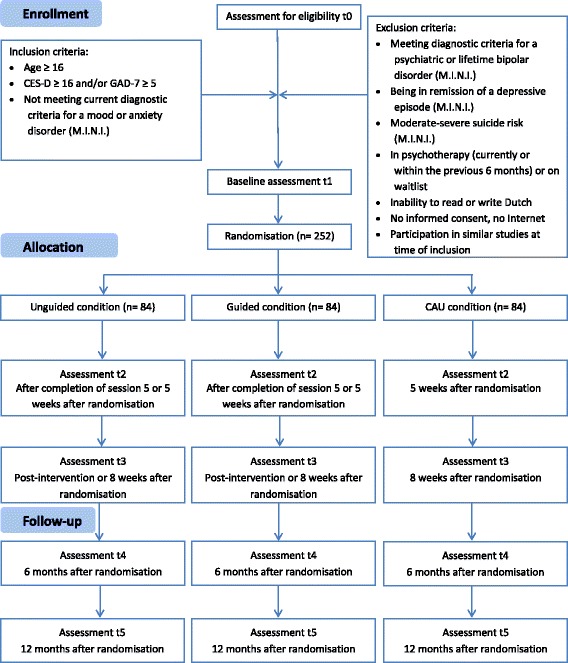
BACKGROUND: Depression and anxiety are common and co-morbid disorders that affect a significant proportion of students. Innovative prevention strategies targeting both conditions are needed to reduce their health burden and costs. ICare Prevent is such an innovative strategy and contains a transdiagnostic individually tailored Internet-based and mobile-supported intervention. It addresses common risk factors of depression and anxiety as part of a large EU-funded multi-country project* (ICare). Little is known about the clinical and cost-effectiveness of this type of intervention compared to care as usual (CAU) for college students. We hypothesize that ICare Prevent will be more (cost-)effective than CAU in the reduction of symptoms of depression and anxiety. METHODS: A three-arm, parallel, randomized controlled superiority trial will be conducted comparing a guided and an unguided version of ICare Prevent with a control group receiving CAU. The trial will be open-label but outcome assessors will be blinded. A total of 252 college students (age ≥ 16 years) with subclinical symptoms of depression defined as a score ≥ 16 on the Center for Epidemiological Studies Depression Scale (CES-D), and/or anxiety, defined as a score ≥ 5 on the Generalized Anxiety Disorder scale (GAD-7), will be included. Those meeting diagnostic criteria for a depressive or anxiety disorder will be excluded. The primary outcome is change in disorder specific symptom severity from baseline to post-intervention. Secondary endpoints include self-reported depression and anxiety symptoms as well as time to onset of a mood or anxiety disorder until 12-month follow-up. Societal costs and quality of life will be assessed to estimate the intervention's cost-effectiveness compared to CAU. DISCUSSION: Transdiagnostic individually tailored Internet-based prevention could be a (cost-)effective approach to tackle the disease burden of depression and anxiety among college students. TRIAL REGISTRATION: Dutch trial register, NTR 6562 . Registered on 6 July 2017.
Overview
The claims and statistics of this paper haven’t been checked yet.
Free: it reads the open-access text and checks the first 5 claims that cite a source we can check. Create a free account to check every claim.
Integrity signals
Registry
Cites
Statistics
Figures
Verification
Claims the paper makes
The claims and statistics of this paper haven’t been checked yet.
Free: it reads the open-access text and checks the first 5 claims that cite a source we can check. Create a free account to check every claim.
Claims other papers make about this one
Each is checked against this paper’s own text: does it say what the citing paper says it does?
The source backs part of the claim, not all of it — or backs it for a different population, condition or comparison.
In the citing paper
“Transdiagnostic interventions for mild to moderate depression and anxiety among university students have been developed and tested in Australia, Canada, Indonesia, the Netherlands, and the UK, [14–20]”
From Transdiagnostic and tailored internet intervention to improve mental health among university students: Research protocol for a randomized controlled trial (2024) · cites this paper as [16]
Experimental — accuracy not yet measuredThe source backs part of the claim, not all of it — or backs it for a different population, condition or comparison.
In the citing paper
“and results have so far shown minor effects.”
From Transdiagnostic and tailored internet intervention to improve mental health among university students: Research protocol for a randomized controlled trial (2024) · cites this paper as [16]
Experimental — accuracy not yet measured
Self-check
Percentages, sums and reported differences re-computed from the paper’s own numbers.
The self-check needs the paper’s full text.
Citations
Cites
The CES-D Scale: A Self-Report Depression Scale for Research in the General Population
Radloff, L. S. (1977) · Applied Psychological Measurement · doi:10.1177/014662167700100306 · Cited by 53,267
The PHQ-9: Validity of a brief depression severity measure
Kroenke, K., Spitzer, R. L., & Williams, J. B. W. (2001) · Journal of General Internal Medicine · doi:10.1046/j.1525-1497.2001.016009606.x · Cited by 44,910 · cited 1×
“The nine-item Patient Health Questionnaire (PHQ-9; [62]) will be used to assess depressive symptoms.”
MethodThe Pittsburgh Sleep Quality Index: a new instrument for psychiatric practice and research
Buysse, D. J., Reynolds, C. F., Monk, T. H., Berman, S. R., & Kupfer, D. J. (1989) · Psychiatry Research · doi:10.1016/0165-1781(89)90047-4 · Cited by 35,234 · cited 1×
“One item on sleep quality from the Pittsburgh Sleep Quality Index (PSQI; [95]) will be administered.”
MethodA Brief Measure for Assessing Generalized Anxiety Disorder: The GAD-7
Spitzer, R. L., Kroenke, K., Williams, J. B. W., & Löwe, B. (2006) · Archives of Internal Medicine · doi:10.1001/archinte.166.10.1092 · Cited by 31,765 · cited 7×
“In addition to screening, the GAD-7 will be used to measure anxiety symptoms throughout the trial.”
BackgroundMethodInfluentialKessler, R. C., Berglund, P., Demler, O., Jin, R., Merikangas, K. R., & Walters, E. E. (2005) · Archives of General Psychiatry · doi:10.1001/archpsyc.62.6.593 · Cited by 20,391 · cited 2×
“Both disorders have their peak onset in early adulthood, including college years [6, 7].”
Background(1998) · The Journal of Clinical Psychiatry · Cited by 19,139
Development of a new resilience scale: The Connor-Davidson Resilience Scale (CD-RISC)
Connor, K. M., & Davidson, J. R. T. (2003) · Depression and Anxiety · doi:10.1002/da.10113 · Cited by 11,793 · cited 1×
“The ten-item version of the Connor-Davidson Resilience Scale (CD-RISC; [91]) measures how good individuals can work under pressure or how strong they think they are.”
Method(1998) · PubMed · Cited by 10,216
Development and preliminary testing of the new five-level version of EQ-5D (EQ-5D-5L)
Herdman, M., Gudex, C., Lloyd, A., Janssen, M., Kind, P., Parkin, D., Bonsel, G., & Badia, X. (2011) · Quality of Life Research · doi:10.1007/s11136-011-9903-x · Cited by 9,795 · cited 1×
“In addition to the Assessment of Quality of Life questionnaire (AQoL-8D; [86, 87]), the EuroQol (EQ-5D-5 L; [88]) will be administered.”
MethodMixed-effects modeling with crossed random effects for subjects and items
Baayen, R. H., Davidson, D. J., & Bates, D. M. (2008) · Journal of Memory and Language · doi:10.1016/j.jml.2007.12.005 · Cited by 8,540 · cited 1×
“Missing data will be handled using either multiple regression imputation techniques if appropriate or full information maximum likelihood estimation [106].”
Method
Research works printed but not linked: 4
- Bouma J Ranchor AV Sanderman R van Sonderen E Het meten van symptomen van depressie met de CES-D: Een handleiding. [Measuring symptoms of depression with the CES-D: a manual] 1995 Groningen Noordelijk Centrum voor Gezondheidsvraagstukken, Rijksuniversiteit Groningen
- Kanter JW, Mulick P, Busch A, Berlin K, Martell C. Behavioral Activation for Depression Scale (BADS) (Long and Short Form). Meas Instrum Datab Soc Sci. 2012;58:113–117.
- Grosse HM Inkongruenzfragebogen (INK) 2014 Bern Hans Huber
- Manos RC, Kanter JW, Luo W. The behavioral activation scale for depression-short form: Development and validation. Behavior Therapy. 2011;42:726–39. 22036000 · DOI · Paper page
Cited by
Liu, X., Guo, Y.-X., Zhang, W., & Gao, W. (2022) · World Journal of Psychiatry · doi:10.5498/wjp.v12.i7.860 · Cited by 210
Spanhel, K., Balci, S., Feldhahn, F., Bengel, J., Baumeister, H., & Sander, L. B. (2021) · npj Digital Medicine · doi:10.1038/s41746-021-00498-1 · Cited by 178
Liu, X., Guo, Y.-X., & Xu, Y. (2023) · World Journal of Clinical Cases · doi:10.12998/wjcc.v11.i7.1442 · Cited by 115
Hasking, P. A., & Claes, L. (2019) · Journal of American College Health · doi:10.1080/07448481.2019.1583661 · Cited by 69
Karyotaki, E., Klein, A. M., Ciharova, M., Bolinski, F., Krijnen, L., de Koning, L., de Wit, L., van der Heijde, C. M., Ebert, D. D., Riper, H., et al. (2022) · Behaviour Research and Therapy · doi:10.1016/j.brat.2021.104028 · Cited by 60
“Previous research has shown that iCBT has moderate effects in reducing symptoms of adult depression and anxiety when delivered with some form of therapeutic support (Karyotaki et al., 2018; Karyotaki et al., 2021; Pauley, Cuijpers, Papola, Miguel, & Karyotaki, 2021).”
Self-citationExploring medical students' views on digital mental health interventions: A qualitative study
Dederichs, M., Weber, J., Pischke, C. R., Angerer, P., & Apolinário-Hagen, J. (2021) · Internet Interventions · doi:10.1016/j.invent.2021.100398 · Cited by 51
“Tailoring an intervention according to the individual users' needs has previously been identified as an essential factor examining IMIs (Batterham and Calear, 2017; Bolinski et al., 2018).”
BackgroundRahmadiana, M., Karyotaki, E., Schulte, M., Ebert, D. D., Passchier, J., Cuijpers, P., Berger, T., van Ballegooijen, W., Wimbarti, S., & Riper, H. (2021) · JMIR Mental Health · doi:10.2196/20036 · Cited by 44
“It was originally developed for the general population in Germany and Switzerland [53] and then adapted to meet the needs of domestic and international university students in The Netherlands [54,55].”
Self-citationVolz, H., Saliger, J., Kasper, S. F., Möller, H., & Seifritz, E. (2021) · International Journal of Psychiatry in Clinical Practice · doi:10.1080/13651501.2021.1941120 · Cited by 41
“…et al. 2013; Bokma et al. 2020), GAI (Rawtaer et al. 2015), DASS (Kanuri et al. 2015), HADS-A (van der Aa et al. 2015), GAD-7 (Jones et al. 2016; Bolinski et al. 2018; Witlox et al. 2018; Weisel et al. 2019), AGECAT (Kang et al. 2016), HAMA (M€oller et al. 2019), and PSWQ (Kanuri et al. 2015;…”
Zhong, Q., Niu, L., Chen, K., Lee, T. M. C., & Zhang, R. (2024) · Journal of Affective Disorders · doi:10.1016/j.jad.2024.09.031 · Cited by 37
Chandeying, N., & Thongseiratch, T. (2021) · Frontiers in Psychiatry · doi:10.3389/fpsyt.2021.784615 · Cited by 38
Karyotaki, E., Klein, A. M., Riper, H., Wit, L. D., Krijnen, L., Bol, E., Bolinski, F., Burger, S., Ebert, D. D., Auerbach, R. P., et al. (2019) · BMJ Open · doi:10.1136/bmjopen-2018-028739 · Cited by 28
“35 Thus, it has been translated into Dutch and English and adapted to college student needs after a series of focus group discussions with college students.(36) The intervention strategies have been based mainly on cognitive behavioural techniques.”
Self-citationDepression intervention using AI chatbots with social cues: a randomized trial of effectiveness
Xu, S., & Ma, T. (2025) · Journal of Affective Disorders · doi:10.1016/j.jad.2025.119760 · Cited by 24
Rahmadiana, M., Karyotaki, E., Passchier, J., Cuijpers, P., van Ballegooijen, W., Wimbarti, S., & Riper, H. (2019) · Internet Interventions · doi:10.1016/j.invent.2018.11.002 · Cited by 25
“A team of translators, local pilot study supervisors, intervention designers and mass communication experts was set up in Indonesia (as adjunct to the team based in the Netherlands).”
MethodInfluentialSelf-citationBolinski, F., Kleiboer, A., Neijenhuijs, K., Karyotaki, E., Wiers, R., de Koning, L., Jacobi, C., Zarski, A.-C., Weisel, K. K., Cuijpers, P., et al. (2022) · Journal of Medical Internet Research · doi:10.2196/40892 · Cited by 24
“35; for the power calculation, see the protocol by Bolinski et al [40]).”
InfluentialSelf-citationVivas-Fernandez, M., Garcia-Lopez, L.-J., Piqueras, J. A., Muela-Martinez, J.-A., Canals-Sans, J., Espinosa-Fernandez, L., Jimenez-Vazquez, D., Diaz-Castela, M. D. M., Morales-Hidalgo, P., Rivera, M., et al. (2023) · Child and Adolescent Psychiatry and Mental Health · doi:10.1186/s13034-023-00616-9 · Cited by 20
“Prevention can be aimed at bolstering resilience in the face of adversity by improving young people’s ability to cope with difficult situations, ultimately preventing the later onset of more severe emotional problems [12, 49, 92, 99].”
BackgroundKoelen, J. A., Klein, A. M., Wolters, N. E., Bol, E., de Koning, L., Roetink, S., Blom, J. V., boutin, B., Schaaf, J. V., Grasman, R. P. P. P., et al. (2024) · JMIR Mental Health · doi:10.2196/50503 · Cited by 20
“A web-based, personalized, and transdiagnostic intervention (iCare Prevent) [29] with human guidance was compared with the same intervention with computer guidance.”
MethodSelf-citationLu, C., Chu, W., Madden, S., Parmanto, B., & Silk, J. S. (2021) · Social Sciences · doi:10.3390/socsci10100397 · Cited by 13
Weiss, E. M., Harder, M., Staggl, S., Holzner, B., Dresen, V., & Canazei, M. (2025) · BMC Public Health · doi:10.1186/s12889-025-23399-4 · Cited by 12
Rademaker, M. M., Ramakers, G. G. J., Smit, A. L., Hooft, L., & Stegeman, I. (2020) · PLoS ONE · doi:10.1371/journal.pone.0235535 · Cited by 11
Klein, A., Wolters, N. E., Bol, E. J. M., Koelen, J., de Koning, L., Roetink, S. S. M., van Blom, J. J., Pronk, T., van der Heijde, C., Salemink, E., et al. (2021) · BMJ Open · doi:10.1136/bmjopen-2021-049554 · Cited by 10
“The online transdiagnostic intervention that is used in this study, ‘ICare Prevent’, was originally developed by Weisel et al 37 for the general German-speaking population and translated and adapted by Bolinski et al 38 and Karyotaki et al 39 for a Dutch undergraduate student population into Dutch and English.”
MethodSelf-citationBerman, A. H., Topooco, N., Lindfors, P., Bendtsen, M., Lindner, P., Molander, O., Kraepelien, M., Sundström, C., Talebizadeh, N., Engström, K., et al. (2024) · Trials · doi:10.1186/s13063-024-07986-1 · Cited by 9
Liu, X., Guo, Y.-X., Zhang, X., Zhang, L.-X., & Zhang, Y. (2023) · World Journal of Psychiatry · doi:10.5498/wjp.v13.i6.397 · Cited by 9
Vivas-Fernández, M., López, L. J. G., Piqueras, J. A., Muela-Martínez, J. A., Canals, J., Fernández, L. E., Jiménez-Vázquez, D., Díaz-Castela, M. D. M., Morales‐Hidalgo, P., Rivera, M., et al. (2023) · Child and Adolescent Psychiatry and Mental Health · doi:10.1186/s13034-022-00550-2 · Cited by 8
RetractedVillemaire-Krajden, R., & Myhr, G. (2019) · Journal of Psychiatric Practice · doi:10.1097/pra.0000000000000396 · Cited by 8
Göktaş, S., Tosun, Y., Gezginci, E., Onuk, E., & Keğin, M. (2021) · Indian Journal of Surgery · doi:10.1007/s12262-021-02983-z · Cited by 7
Hirsig, A., Häfeli, X. A., & Schmidt, S. J. (2024) · Trials · doi:10.1186/s13063-024-08241-3 · Cited by 2
“In line with previous RCTs on Internet interventions [129, 130], participants in the control condition will not receive any intervention or support from the research team.”
ResultAlibudbud, R. C. (2024) · SAGE Open · doi:10.1177/21582440241299925 · Cited by 2
“Bolinski et al. (2018) found that Internet-based prevention could be a promising, cost-effective measure to tackle the burden of anxiety among undergraduate students in Europe.”
Risk Analysis of Dutch Healthcare Company Information System
septian, R., & Pamuji, G. C. (2019) · IOP Conference Series Materials Science and Engineering · doi:10.1088/1757-899x/662/2/022041 · Cited by 2
“Since this healthcare company is operational at the Netherlands market, the NEN 7510-2 should be considered as another standard which should be followed by the company [6-10].”
BackgroundEREN, S. Y., YILDIRIM, Ö., & Şahin, F. (2022) · Uluslararası Anadolu Sosyal Bilimler Dergisi · doi:10.47525/ulasbid.1176721 · Cited by 2
(2024) · doi:10.21203/rs.3.rs-4188992/v1
Mental disorders among Spanish university students: a longitudinal study
Ballester, L. (2021) · DUGiDocs (Universitat de Girona)
Córdoba Cortés, M. N. (2020) · Tesis Doctorals en Xarxa (Consorci de Serveis Universitaris de Catalunya) · Cited by 1
Figura, M., Saurini, M., Bartoli, D., Latina, R., Vellone, E., & Maria, M. D. (2026) · JBI Evidence Synthesis · doi:10.11124/jbies-25-00140
Metadata
- Authors
- Bolinski, F., Kleiboer, A., Karyotaki, E., Bosmans, J. E., Zarski, A.-C., Weisel, K. K., Ebert, D. D., Jacobi, C., Cuijpers, P., & Riper, H.
- Affiliations
- Amsterdam Public Health (NL)
- Vrije Universiteit Amsterdam (NL)
- Friedrich-Alexander-Universität Erlangen-Nürnberg (DE)
- Technische Universität Dresden (DE)
- Corresponding author
- Bolinski, Felix
- ORCID
- Venue
- Trials
- Published
- 2018-02-20
- Volume
- 19
- Issue
- 1
- Pages
- 118-118
- ISSN
- 1745-6215 (ISSN-L)
- PMC
- PMC5819200
- OpenAlex
- W2791399628
- Semantic Scholar
- 8d295728ba0cc0db88445b9045f9936378803d6f
- Cited by
- 31
- References
- 114
- Citations by year
- 2026: 1 · 2025: 2 · 2024: 6 · 2023: 4 · 2022: 4 · 2021: 7 · 2020: 2 · 2019: 4 · 2018: 1
- FWCI
- 4.41
- Type
- journal article
- Language
- en
- Open access
- gold
- doi.org
- Licence
- cc-by
- Locations
- Trials (publishedVersion, cc-by)
- PubMed Central (publishedVersion, cc-by)
- PubMed (publishedVersion)
- Pure Amsterdam UMC (publishedVersion, cc-by)
- Amsterdam UMC (VU Amsterdam) - Institutional Repository (publishedVersion, other-oa)
- VU Research Portal (publishedVersion, other-oa)
- DOAJ (DOAJ: Directory of Open Access Journals) (submittedVersion)
- OPUS FAU (Kooperativer Bibliotheksverbund Berlin-Brandenburg (KOBV), on behalf of the Universitätsbibliothek Erlangen-Nürnberg) (submittedVersion, cc-by)
- Data Archiving and Networked Services (DANS) (submittedVersion, other-oa)
- Funders
- Horizon 2020 (634757)
- Topics
- Social Sciences › Psychology › Applied Psychology › Digital Mental Health Interventions
- Social Sciences › Psychology › Experimental and Cognitive Psychology › Anxiety, Depression, Psychometrics, Treatment, Cognitive Processes
- Social Sciences › Psychology › Experimental and Cognitive Psychology › Mental Health Research Topics
- Keywords
- depression prevention, anxiety prevention, transdiagnostic treatment, online intervention, university students, subthreshold depression, subclinical anxiety, cost-effectiveness, quality of life
- MeSH terms
- Equivalence Trials as Topic, Adult, Anxiety Disorders, Cost-Benefit Analysis, Data Interpretation, Statistical, Depressive Disorder, Humans, Students, Therapy, Computer-Assisted, Randomized Controlled Trials as Topic, Outcome Assessment, Health Care, Internet
About these checks
Registry, retraction, Cites and statistics results are computed, not judged, with one exception: a printed reference that no index lists is read once by a model before it counts as a citation error. Claims are extracted by a model and kept only when their quote appears verbatim in the text; each cited source is then checked, with a model’s help, for whether it says what the claim relies on. Those verdicts can be wrong — read the claim’s quote and the cited source before relying on one.
Statistics and arithmetic are recomputed, not judged.
Confidence bands are shown only for fields calibrated on our annotated test set. None is calibrated yet, so no band is shown.
What counts as a claim ›How we measure confidence ›How we check this ›
Are you an author, or do you see a problem with this page? Request a review
Data sources
Bibliographic data: Semantic Scholar, OpenAlex, Crossref.
Contains information from the Semantic Scholar Academic Graph Datasets, made available under the ODC Attribution License (ODC-BY 1.0).
Semantic Scholar’s data is described in: Kinney, R., et al. (2023). The Semantic Scholar Open Data Platform. arXiv:2301.10140.
