

Effectiveness of a transdiagnostic individually tailored Internet-based and mobile-supported intervention for the indicated prevention of depression and anxiety (ICare Prevent) in Dutch college students: study protocol for a randomised controlled trial
Open accessThe DOI matches its Crossref record; 114 of the 114 references it cites were found in a registry or an index.
Abstract
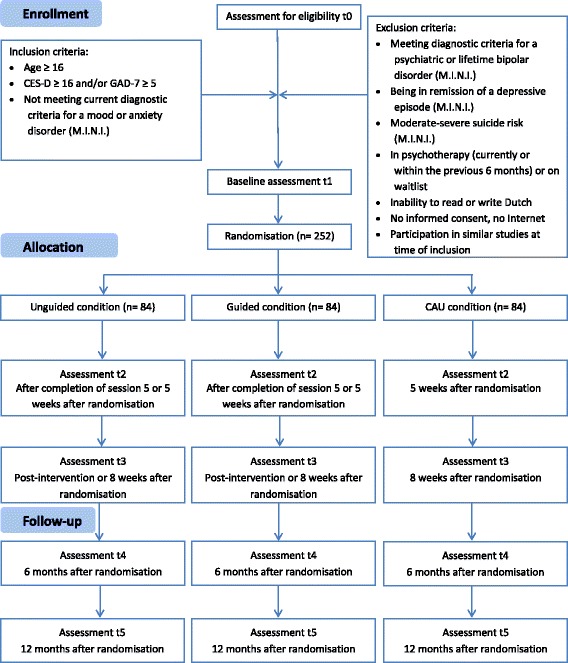
BACKGROUND: Depression and anxiety are common and co-morbid disorders that affect a significant proportion of students. Innovative prevention strategies targeting both conditions are needed to reduce their health burden and costs. ICare Prevent is such an innovative strategy and contains a transdiagnostic individually tailored Internet-based and mobile-supported intervention. It addresses common risk factors of depression and anxiety as part of a large EU-funded multi-country project* (ICare). Little is known about the clinical and cost-effectiveness of this type of intervention compared to care as usual (CAU) for college students. We hypothesize that ICare Prevent will be more (cost-)effective than CAU in the reduction of symptoms of depression and anxiety. METHODS: A three-arm, parallel, randomized controlled superiority trial will be conducted comparing a guided and an unguided version of ICare Prevent with a control group receiving CAU. The trial will be open-label but outcome assessors will be blinded. A total of 252 college students (age ≥ 16 years) with subclinical symptoms of depression defined as a score ≥ 16 on the Center for Epidemiological Studies Depression Scale (CES-D), and/or anxiety, defined as a score ≥ 5 on the Generalized Anxiety Disorder scale (GAD-7), will be included. Those meeting diagnostic criteria for a depressive or anxiety disorder will be excluded. The primary outcome is change in disorder specific symptom severity from baseline to post-intervention. Secondary endpoints include self-reported depression and anxiety symptoms as well as time to onset of a mood or anxiety disorder until 12-month follow-up. Societal costs and quality of life will be assessed to estimate the intervention's cost-effectiveness compared to CAU. DISCUSSION: Transdiagnostic individually tailored Internet-based prevention could be a (cost-)effective approach to tackle the disease burden of depression and anxiety among college students. TRIAL REGISTRATION: Dutch trial register, NTR 6562 . Registered on 6 July 2017.
Overview
The claims and statistics of this paper haven’t been checked yet.
Free: it reads the open-access text and checks the first 5 claims that cite a source we can check. Create a free account to check every claim.
Integrity signals
Registry
Cites
Statistics
Figures
Verification
Claims the paper makes
The claims and statistics of this paper haven’t been checked yet.
Free: it reads the open-access text and checks the first 5 claims that cite a source we can check. Create a free account to check every claim.
Claims other papers make about this one
Each is checked against this paper’s own text: does it say what the citing paper says it does?
The source backs part of the claim, not all of it — or backs it for a different population, condition or comparison.
In the citing paper
“Transdiagnostic interventions for mild to moderate depression and anxiety among university students have been developed and tested in Australia, Canada, Indonesia, the Netherlands, and the UK, [14–20]”
From Transdiagnostic and tailored internet intervention to improve mental health among university students: Research protocol for a randomized controlled trial (2024) · cites this paper as [16]
Experimental — accuracy not yet measuredThe source backs part of the claim, not all of it — or backs it for a different population, condition or comparison.
In the citing paper
“and results have so far shown minor effects.”
From Transdiagnostic and tailored internet intervention to improve mental health among university students: Research protocol for a randomized controlled trial (2024) · cites this paper as [16]
Experimental — accuracy not yet measured
Self-check
Percentages, sums and reported differences re-computed from the paper’s own numbers.
The self-check needs the paper’s full text.
Citations
Cites
The CES-D Scale: A Self-Report Depression Scale for Research in the General Population
Radloff, L. S. (1977) · Applied Psychological Measurement · doi:10.1177/014662167700100306 · Cited by 53,267
The PHQ-9: Validity of a brief depression severity measure
Kroenke, K., Spitzer, R. L., & Williams, J. B. W. (2001) · Journal of General Internal Medicine · doi:10.1046/j.1525-1497.2001.016009606.x · Cited by 44,910 · cited 1×
“The nine-item Patient Health Questionnaire (PHQ-9; [62]) will be used to assess depressive symptoms.”
MethodThe Pittsburgh Sleep Quality Index: a new instrument for psychiatric practice and research
Buysse, D. J., Reynolds, C. F., Monk, T. H., Berman, S. R., & Kupfer, D. J. (1989) · Psychiatry Research · doi:10.1016/0165-1781(89)90047-4 · Cited by 35,234 · cited 1×
“One item on sleep quality from the Pittsburgh Sleep Quality Index (PSQI; [95]) will be administered.”
MethodA Brief Measure for Assessing Generalized Anxiety Disorder: The GAD-7
Spitzer, R. L., Kroenke, K., Williams, J. B. W., & Löwe, B. (2006) · Archives of Internal Medicine · doi:10.1001/archinte.166.10.1092 · Cited by 31,765 · cited 7×
“In addition to screening, the GAD-7 will be used to measure anxiety symptoms throughout the trial.”
BackgroundMethodInfluentialKessler, R. C., Berglund, P., Demler, O., Jin, R., Merikangas, K. R., & Walters, E. E. (2005) · Archives of General Psychiatry · doi:10.1001/archpsyc.62.6.593 · Cited by 20,391 · cited 2×
“Both disorders have their peak onset in early adulthood, including college years [6, 7].”
Background(1998) · The Journal of Clinical Psychiatry · Cited by 19,139
Development of a new resilience scale: The Connor-Davidson Resilience Scale (CD-RISC)
Connor, K. M., & Davidson, J. R. T. (2003) · Depression and Anxiety · doi:10.1002/da.10113 · Cited by 11,793 · cited 1×
“The ten-item version of the Connor-Davidson Resilience Scale (CD-RISC; [91]) measures how good individuals can work under pressure or how strong they think they are.”
Method(1998) · PubMed · Cited by 10,216
Development and preliminary testing of the new five-level version of EQ-5D (EQ-5D-5L)
Herdman, M., Gudex, C., Lloyd, A., Janssen, M., Kind, P., Parkin, D., Bonsel, G., & Badia, X. (2011) · Quality of Life Research · doi:10.1007/s11136-011-9903-x · Cited by 9,795 · cited 1×
“In addition to the Assessment of Quality of Life questionnaire (AQoL-8D; [86, 87]), the EuroQol (EQ-5D-5 L; [88]) will be administered.”
MethodMixed-effects modeling with crossed random effects for subjects and items
Baayen, R. H., Davidson, D. J., & Bates, D. M. (2008) · Journal of Memory and Language · doi:10.1016/j.jml.2007.12.005 · Cited by 8,540 · cited 1×
“Missing data will be handled using either multiple regression imputation techniques if appropriate or full information maximum likelihood estimation [106].”
MethodA very brief measure of the Big-Five personality domains
Gosling, S. D., Rentfrow, P. J., & Swann, W. B. (2003) · Journal of Research in Personality · doi:10.1016/s0092-6566(03)00046-1 · Cited by 8,307 · cited 2×
“The ten-item Big Five Inventory (BFI-10; [81, 82]) will be used as a brief measure of personality.”
BackgroundMethodBush, K. (1998) · Archives of Internal Medicine · doi:10.1001/archinte.158.16.1789 · Cited by 6,196 · cited 1×
“Alcohol use will be monitored by the three consumption questions of the brief Alcohol Use Disorders Identification Test (AUDIT-C; [66]).”
MethodWhiteford, H. A., Degenhardt, L., Rehm, J., Baxter, A. J., Ferrari, A. J., Erskine, H. E., Charlson, F. J., Norman, R. E., Flaxman, A. D., Johns, N., et al. (2013) · The Lancet · doi:10.1016/s0140-6736(13)61611-6 · Cited by 6,006
Löwe, B., Decker, O., Müller, S., Brähler, E., Schellberg, D., Herzog, W., & Herzberg, P. Y. (2008) · Medical Care · doi:10.1097/mlr.0b013e318160d093 · Cited by 4,527 · cited 1×
“It has been tested in students as well as different age groups and showed excellent reliability and validity [57, 58].”
BackgroundRush, A. J., Trivedi, M. H., Ibrahim, H. M., Carmody, T. J., Arnow, B., Klein, D. N., Markowitz, J. C., Ninan, P. T., Kornstein, S., Manber, R., et al. (2003) · Biological Psychiatry · doi:10.1016/s0006-3223(02)01866-8 · Cited by 3,829 · cited 4×
“For depression, this will be assessed using the QIDS-CR [44].”
MethodInfluentialPsychometric properties of the credibility/expectancy questionnaire
Devilly, G. J., & Borkovec, T. D. (2000) · Journal of Behavior Therapy and Experimental Psychiatry · doi:10.1016/s0005-7916(00)00012-4 · Cited by 2,295 · cited 2×
“The Credibility/Expectancy Questionnaire (CEQ; [75]) will be used to assess participants’ expectations of the intervention.”
BackgroundMethodReducing Risks for Mental Disorders: Frontiers for Preventive Intervention Research
(1994) · doi:10.17226/2139 · Cited by 2,073
The use of the Center for Epidemiologic Studies Depression Scale in adolescents and young adults
Radloff, L. S. (1991) · Journal of Youth and Adolescence · doi:10.1007/bf01537606 · Cited by 1,997 · cited 1×
“It has been shown to be reliable and valid in studies across different populations, including students [55, 56].”
BackgroundA systematic review of studies of depression prevalence in university students
Ibrahim, A. K., Kelly, S. J., Adams, C. E., & Glazebrook, C. (2013) · Journal of Psychiatric Research · doi:10.1016/j.jpsychires.2012.11.015 · Cited by 1,988
The client satisfaction questionnaire
Attkisson, C. C., & Zwick, R. (1982) · Evaluation and Program Planning · doi:10.1016/0149-7189(82)90074-x · Cited by 1,743 · cited 1×
“The eight-item Client Satisfaction Questionnaire has been adapted to this online context (CSQ-8; [83, 84]).”
MethodSheehan, D. V., Sheehan, K. H., Shytle, R. D., Janavs, J., Bannon, Y., Rogers, J. E., Milo, K. M., Stock, S. L., & Wilkinson, B. (2010) · The Journal of Clinical Psychiatry · doi:10.4088/jcp.09m05305whi · Cited by 1,730 · cited 1×
“has been established among several populations [59, 60].”
Mental disorders among college students in the World Health Organization World Mental Health Surveys
Auerbach, R. P., Alonso, J., Axinn, W. G., Cuijpers, P., Ebert, D. D., Green, J. G., Hwang, I., Kessler, R. C., Liu, H., Mortier, P., et al. (2016) · Psychological Medicine · doi:10.1017/s0033291716001665 · Cited by 1,587
Self-citationJanssen, M. F., Pickard, A. S., Golicki, D., Gudex, C., Niewada, M., Scalone, L., Swinburn, P., & Busschbach, J. (2013) · Quality of Life Research · doi:10.1007/s11136-012-0322-4 · Cited by 1,582 · cited 1×
“Both instruments have established psychometric properties [86, 90].”
Computer-based psychological treatments for depression: A systematic review and meta-analysis
Richards, D., & Richardson, T. (2012) · Clinical Psychology Review · doi:10.1016/j.cpr.2012.02.004 · Cited by 1,442
Validity of the brief patient health questionnaire mood scale (PHQ-9) in the general population
Martin, A., Rief, W., Klaiberg, A., & Braehler, E. (2006) · General Hospital Psychiatry · doi:10.1016/j.genhosppsych.2005.07.003 · Cited by 1,379
Development and validation of a revised short version of the working alliance inventory
Hatcher, R. L., & Gillaspy, J. A. (2006) · Psychotherapy Research · doi:10.1080/10503300500352500 · Cited by 1,355 · cited 2×
“The original form of the WAI-SR has shown good psychometric properties [70, 71].”
MethodCollege Students: Mental Health Problems and Treatment Considerations
Pedrelli, P., Nyer, M., Yeung, A., Zulauf, C., & Wilens, T. (2015) · Academic Psychiatry · doi:10.1007/s40596-014-0205-9 · Cited by 1,325 · cited 2×
“For example, a younger age of onset of depression and anxiety has been linked to a more severe and chronic disease trajectory, as well as a higher risk for developing co-morbid psychiatric disorders in adulthood [8, 13, 14].”
BackgroundGilbody, S., Richards, D., Brealey, S., & Hewitt, C. (2007) · Journal of General Internal Medicine · doi:10.1007/s11606-007-0333-y · Cited by 1,290
Stigma and Help Seeking for Mental Health Among College Students
Eisenberg, D., Downs, M. F., Golberstein, E., & Zivin, K. (2009) · Medical Care Research and Review · doi:10.1177/1077558709335173 · Cited by 1,193 · cited 2×
“Moreover, it provides a high degree of anonymity and thus tackles the issue of stigma associated with mental health problems, which negatively affects college students’ helpseeking behavior [17, 18].”
BackgroundAmerican College Health Association
(1979) · Journal of American College Health Association · doi:10.1080/01644300.1979.10392892 · Cited by 1,154
Adherence in Internet Interventions for Anxiety and Depression
Christensen, H., Griffiths, K. M., & Farrer, L. (2009) · Journal of Medical Internet Research · doi:10.2196/jmir.1194 · Cited by 1,133 · cited 1×
“Finally, previous research has shown that adherence to Internet interventions is a point of concern, especially in unguided formats [111, 112].”
BackgroundDutch Tariff for the Five-Level Version of EQ-5D
M. Versteegh, M., M. Vermeulen, K., M. A. A. Evers, S., de Wit, G. A., Prenger, R., & A. Stolk, E. (2016) · Value in Health · doi:10.1016/j.jval.2016.01.003 · Cited by 1,113 · cited 1×
“This enables the calculation of quality-adjusted life-years (QALYs) and converting health states into utility scores using the Dutch EQ-5D5 L tariff [89].”
MethodReducing Risks for Mental Disorders: Frontiers for Preventive Intervention Research
Novins, D. K. (1995) · Journal of the American Academy of Child & Adolescent Psychiatry · doi:10.1097/00004583-199503000-00028 · Cited by 1,076
Mental health problems in college freshmen: Prevalence and academic functioning
Bruffaerts, R., Mortier, P., Kiekens, G., Auerbach, R. P., Cuijpers, P., Demyttenaere, K., Green, J. G., Nock, M. K., & Kessler, R. C. (2018) · Journal of Affective Disorders · doi:10.1016/j.jad.2017.07.044 · Cited by 1,047 · cited 1×
“Moreover, it is clear that anxiety and depression negatively influence academic performance and increase the possibility of college dropout [15, 16].”
BackgroundSelf-citationComorbidity of anxiety and depression in children and adolescents: 20 years after
Cummings, C. M., Caporino, N. E., & Kendall, P. C. (2014) · Psychological Bulletin · doi:10.1037/a0034733 · Cited by 1,028
TRIVEDI, M. H., RUSH, A. J., IBRAHIM, H. M., CARMODY, T. J., BIGGS, M. M., SUPPES, T., CRISMON, M. L., SHORES-WILSON, K., TOPRAC, M. G., DENNEHY, E. B., et al. (2004) · Psychological Medicine · doi:10.1017/s0033291703001107 · Cited by 968 · cited 1×
“This interview has been used in different settings and has good psychometric properties [44, 61].”
MethodCost‐effectiveness acceptability curves – facts, fallacies and frequently asked questions
Fenwick, E., O'Brien, B. J., & Briggs, A. (2004) · Health Economics · doi:10.1002/hec.903 · Cited by 943 · cited 1×
“Uncertainty surrounding the ICERs will be presented in cost-effectiveness planes and acceptability curves [108].”
BackgroundMental Health and Academic Success in College
Eisenberg, D., Golberstein, E., & Hunt, J. B. (2009) · The B.E. Journal of Economic Analysis & Policy · doi:10.2202/1935-1682.2191 · Cited by 929
Kessler, R. C. (2012) · Psychiatric Clinics of North America · doi:10.1016/j.psc.2011.11.005 · Cited by 871
Kessler, R. C., Akiskal, H. S., Ames, M., Birnbaum, H., Greenberg, P., .A, R. M., Jin, R., Merikangas, K. R., Simon, G. E., & Wang, P. S. (2006) · American Journal of Psychiatry · doi:10.1176/ajp.2006.163.9.1561 · Cited by 868
Kessler, R. C., Akiskal, H. S., Ames, M., Birnbaum, H., Greenberg, P., .A, R. M., Jin, R., Merikangas, K. R., Simon, G. E., & Wang, P. S. (2006) · American Journal of Psychiatry · doi:10.1176/appi.ajp.163.9.1561 · Cited by 868
Costing psychiatric interventions.
Beecham, J. K., & Knapp, M. R. J. (1992) · Kent Academic Repository (University of Kent) · Cited by 710
Karyotaki, E., Riper, H., Twisk, J., Hoogendoorn, A., Kleiboer, A., Mira, A., Mackinnon, A., Meyer, B., Botella, C., Littlewood, E., et al. (2017) · JAMA Psychiatry · doi:10.1001/jamapsychiatry.2017.0044 · Cited by 691 · cited 1×
“Finally, previous research has shown that adherence to Internet interventions is a point of concern, especially in unguided formats [111, 112].”
BackgroundSelf-citationRyan, R. M., Plant, R. W., & O'Malley, S. (1995) · Addictive Behaviors · doi:10.1016/0306-4603(94)00072-7 · Cited by 651 · cited 1×
“The Treatment Entry Questionnaire (TEQ; [78]) will be used to assess motivation to participate in the study.”
MethodInternet-Delivered Psychological Treatments
Andersson, G. (2016) · Annual Review of Clinical Psychology · doi:10.1146/annurev-clinpsy-021815-093006 · Cited by 595 · cited 1×
“In clinical populations, the effectiveness of such Internet-based interventions for anxiety and depression has already been established [27, 28], especially if they are provided with some form of therapeutic guidance [29].”
BackgroundComorbidity of anxiety and depression in youth: Implications for treatment and prevention.
Garber, J., & Weersing, V. R. (2010) · Clinical Psychology: Science and Practice · doi:10.1111/j.1468-2850.2010.01221.x · Cited by 582 · cited 1×
“Adding transdiagnostic components may address their co-morbidity better, as well as common underlying factors, such as general negative affect and disturbed information processing [32].”
BackgroundEffect of Age at Onset on the Course of Major Depressive Disorder
Zisook, S., Lesser, I., Stewart, J. W., Wisniewski, S. R., Balasubramani, G. K., Fava, M., Gilmer, W. S., Dresselhaus, T. R., Thase, M. E., Nierenberg, A. A., et al. (2007) · American Journal of Psychiatry · doi:10.1176/appi.ajp.2007.06101757 · Cited by 548 · cited 1×
“Both disorders have their peak onset in early adulthood, including college years [6, 7].”
BackgroundMunder, T., Wilmers, F., Leonhart, R., Linster, H. W., & Barth, J. (2010) · Clinical Psychology & Psychotherapy · doi:10.1002/cpp.658 · Cited by 538 · cited 1×
“The original form of the WAI-SR has shown good psychometric properties [70, 71].”
MethodThe WHO (Ten) Well-Being Index: Validation in Diabetes
Bech, P., Gudex, C., & Staehr Johansen, K. (2010) · Psychotherapy and Psychosomatics · doi:10.1159/000289073 · Cited by 528 · cited 1×
“Wellbeing will be measured by the five-item version of the World Health Organization Ten Well-Being Index (WHO-5; [98]).”
MethodReliability and validity of Japanese version of the Mini‐International Neuropsychiatric Interview
OTSUBO, T., TANAKA, K., KODA, R., SHINODA, J., SANO, N., TANAKA, S., AOYAMA, H., MIMURA, M., & KAMIJIMA, K. (2005) · Psychiatry and Clinical Neurosciences · doi:10.1111/j.1440-1819.2005.01408.x · Cited by 507 · cited 1×
“has been established among several populations [59, 60].”
Richardson, J., Iezzi, A., Khan, M. A., & Maxwell, A. (2014) · The Patient - Patient-Centered Outcomes Research · doi:10.1007/s40271-013-0036-x · Cited by 504
Kanter, J. W., Mulick, P. S., Busch, A. M., Berlin, K. S., & Martell, C. R. (2007) · Journal of Psychopathology and Behavioral Assessment · doi:10.1007/s10862-006-9038-5 · Cited by 493 · cited 1×
“The short form of the Behavioral Activation for Depression Scale (BADS-SF; [72, 73]) assesses activation and engagement in pleasant activities.”
MethodMcGorry, P. D., Purcell, R., Goldstone, S., & Amminger, G. P. (2011) · Current Opinion in Psychiatry · doi:10.1097/yco.0b013e3283477a09 · Cited by 490 · cited 1×
“For example, a younger age of onset of depression and anxiety has been linked to a more severe and chronic disease trajectory, as well as a higher risk for developing co-morbid psychiatric disorders in adulthood [8, 13, 14].”
BackgroundShear, M. K., Vander Bilt, J., Rucci, P., Endicott, J., Lydiard, B., Otto, M. W., Pollack, M. H., Chandler, L., Williams, J., Ali, A., et al. (2001) · Depression and Anxiety · doi:10.1002/da.1033 · Cited by 483 · cited 5×
“The SIGH-A [45] will be used for the assessment of anxiety.”
BackgroundMethodInfluentialShear, M. K., Vander Bilt, J., Rucci, P., Endicott, J., Lydiard, B., Otto, M. W., Pollack, M. H., Chandler, L., Williams, J., Ali, A., et al. (2001) · Depression and Anxiety · doi:10.1002/da.1033.abs · Cited by 483
Criterion validity of the Pittsburgh Sleep Quality Index: Investigation in a non-clinical sample
GRANDNER, M. A., KRIPKE, D. F., YOON, I.-Y., & YOUNGSTEDT, S. D. (2006) · Sleep and Biological Rhythms · doi:10.1111/j.1479-8425.2006.00207.x · Cited by 472 · cited 1×
“The PSQI has been used extensively in college samples [96, 97].”
MethodCampus mental health services: Recommendations for change.
Mowbray, C. T., Megivern, D., Mandiberg, J. M., Strauss, S., Stein, C. H., Collins, K., Kopels, S., Curlin, C., & Lett, R. (2006) · American Journal of Orthopsychiatry · doi:10.1037/0002-9432.76.2.226 · Cited by 435 · cited 1×
“Hence, recommendations have been made to implement university-based early detection and prevention programs [19].”
BackgroundBrown, F. C., Buboltz, W. C., & Soper, B. (2002) · Behavioral Medicine · doi:10.1080/08964280209596396 · Cited by 421 · cited 1×
“The PSQI has been used extensively in college samples [96, 97].”
MethodOxford Handbook of Anxiety and Related Disorders
(2008) · doi:10.1093/oxfordhb/9780195307030.001.0001 · Cited by 402 · cited 1×
“Yet, data on selective and indicated university-based prevention approaches are scarce, though their application may be particularly effective because they are targeted at those who need help the most ([22], p.”
BackgroundTherapist-supported Internet cognitive behavioural therapy for anxiety disorders in adults
Olthuis, J. V., Watt, M. C., Bailey, K., Hayden, J. A., & Stewart, S. H. (2016) · Cochrane Database of Systematic Reviews · doi:10.1002/14651858.cd011565.pub2 · Cited by 390
Berger, T., Hämmerli, K., Gubser, N., Andersson, G., & Caspar, F. (2011) · Cognitive Behaviour Therapy · doi:10.1080/16506073.2011.616531 · Cited by 383
Reducing risks for mental disorders frontiers for preventive intervention research
MRAZEK, P. B., Haggerty, R. J., Institute of Medicine (U.S.), & States, U. (1994) · Cited by 364
Josephine, K., Josefine, L., Philipp, D., David, E., & Harald, B. (2017) · Journal of Affective Disorders · doi:10.1016/j.jad.2017.07.021 · Cited by 341 · cited 1×
“In clinical populations, the effectiveness of such Internet-based interventions for anxiety and depression has already been established [27, 28], especially if they are provided with some form of therapeutic guidance [29].”
BackgroundSelf-citationA meta-analysis of universal mental health prevention programs for higher education students
Conley, C. S., Durlak, J. A., & Kirsch, A. C. (2015) · Prevention Science · doi:10.1007/s11121-015-0543-1 · Cited by 340 · cited 1×
“According to previous research, face-to-face college-based universal prevention programs show small to moderate effects in reducing depression or anxiety severity [21].”
MethodValidation of the WHO-5 Well-Being Index in Adolescents With Type 1 Diabetes
de Wit, M., Pouwer, F., Gemke, R. J. B. J., Delemarre-van de Waal, H. A., & Snoek, F. J. (2007) · Diabetes Care · doi:10.2337/dc07-0447 · Cited by 335
Păsărelu, C. R., Andersson, G., Bergman Nordgren, L., & Dobrean, A. (2017) · Cognitive Behaviour Therapy · doi:10.1080/16506073.2016.1231219 · Cited by 335
Homesickness and adjustment in university students
Thurber, C. A., & Walton, E. A. (2012) · Journal of American College Health · doi:10.1080/07448481.2012.673520 · Cited by 330 · cited 1×
“gaining personal and financial independence), which have the potential to trigger or exacerbate symptoms of mental health conditions [8, 9].”
BackgroundHartley, M. T. (2011) · Journal of American College Health · doi:10.1080/07448481.2010.515632 · Cited by 324
Grosser, R. C. (1994) · The Journal of Nervous and Mental Disease · doi:10.1097/00005053-199407000-00029 · Cited by 309
Development and Validation of a Dutch Translation of the Big Five Inventory (BFI)
Denissen, J. J. A., Geenen, R., van Aken, M. A. G., Gosling, S. D., & Potter, J. (2008) · Journal of Personality Assessment · doi:10.1080/00223890701845229 · Cited by 300 · cited 1×
“The ten-item Big Five Inventory (BFI-10; [81, 82]) will be used as a brief measure of personality.”
MethodThe Behavioral Activation for Depression Scale–Short Form: Development and Validation
Manos, R. C., Kanter, J. W., & Luo, W. (2011) · Behavior Therapy · doi:10.1016/j.beth.2011.04.004 · Cited by 276 · cited 1×
“The reliability and validity of the questionnaire has been established in a college student sample [74].”
BackgroundReliability and Validity of Assessing User Satisfaction With Web-Based Health Interventions
Boß, L., Lehr, D., Reis, D., Vis, C., Riper, H., Berking, M., & Ebert, D. D. (2016) · Journal of Medical Internet Research · doi:10.2196/jmir.5952 · Cited by 251 · cited 1×
“The eight-item Client Satisfaction Questionnaire has been adapted to this online context (CSQ-8; [83, 84]).”
MethodSelf-citationEbert, D. D., Cuijpers, P., Muñoz, R. F., & Baumeister, H. (2017) · Frontiers in Psychiatry · doi:10.3389/fpsyt.2017.00116 · Cited by 244
Self-citationOptimizing the use of the AUDIT for alcohol screening in college students.
DeMartini, K. S., & Carey, K. B. (2012) · Psychological Assessment · doi:10.1037/a0028519 · Cited by 242 · cited 1×
“Moreover, it has been used both as a screening as well as outcome instrument [68, 69].”
MethodBuntrock, C., Ebert, D. D., Lehr, D., Smit, F., Riper, H., Berking, M., & Cuijpers, P. (2016) · JAMA · doi:10.1001/jama.2016.4326 · Cited by 232
Self-citationLadwig, I., Rief, W., & Nestoriuc, Y. (2014) · Verhaltenstherapie · doi:10.1159/000367928 · Cited by 227
Psychotherapy for subclinical depression: meta-analysis
Cuijpers, P., Koole, S. L., van Dijke, A., Roca, M., Li, J., & Reynolds, C. F. (2014) · British Journal of Psychiatry · doi:10.1192/bjp.bp.113.138784 · Cited by 193 · cited 1×
“[103] on the effectiveness of psychotherapies for subclinical symptoms of depression, as well as a randomized controlled trial on the effectiveness of an Internetbased intervention for subclinical depression ([24–26], the expected effect size is d = 0.”
BackgroundSelf-citationNobis, S., Lehr, D., Ebert, D. D., Baumeister, H., Snoek, F., Riper, H., & Berking, M. (2015) · Diabetes Care · doi:10.2337/dc14-1728 · Cited by 175
Self-citationPrevention of Late-Life Depression in Primary Care: Do We Know Where to Begin?
Schoevers, R. A., Smit, F., Deeg, D. J. H., Cuijpers, P., Dekker, J., van Tilburg, W., & Beekman, A. T. F. (2006) · American Journal of Psychiatry · doi:10.1176/ajp.2006.163.9.1611 · Cited by 160 · cited 1×
“Specifically, indicated prevention has been described as the preferred approach based on its potential for detecting and efficiently helping those who have a high risk of developing depression [23].”
BackgroundSelf-citationWarmerdam, L., Smit, F., van Straten, A., Riper, H., & Cuijpers, P. (2010) · Journal of Medical Internet Research · doi:10.2196/jmir.1436 · Cited by 158
Self-citationHartley, M. T. (2010) · American Journal of Psychiatric Rehabilitation · doi:10.1080/15487768.2010.523372 · Cited by 141 · cited 1×
“Moreover, it is clear that anxiety and depression negatively influence academic performance and increase the possibility of college dropout [15, 16].”
BackgroundBeintner, I., Jacobi, C., & Taylor, C. B. (2012) · European Eating Disorders Review · doi:10.1002/erv.1130 · Cited by 139 · cited 1×
“So far, research on the effectiveness of Internet-based prevention in college students is largely limited to the field of eating disorders and substance use [109, 110].”
BackgroundSelf-citationGerhards, S. A. H., de Graaf, L. E., Jacobs, L. E., Severens, J. L., Huibers, M. J. H., Arntz, A., Riper, H., Widdershoven, G., Metsemakers, J. F. M., & Evers, S. M. A. A. (2010) · British Journal of Psychiatry · doi:10.1192/bjp.bp.109.065748 · Cited by 135
Self-citationKleiboer, A. M., Donker, T., Seekles, W., van Straten, A., Riper, H. M., & Cuijpers, P. J. (2015) · Behaviour Research and Therapy · doi:10.1016/j.brat.2015.06.013 · Cited by 127 · cited 1×
“A study comparing the effectiveness of Internet-based psychotherapy with different levels of support found effect sizes in a similar range [39].”
BackgroundSelf-citationEvaluating the psychometric properties of the AUDIT-C among college students
Barry, A. E., Chaney, B. H., Stellefson, M. L., & Dodd, V. (2015) · Journal of Substance Use · doi:10.3109/14659891.2013.856479 · Cited by 111 · cited 1×
“The AUDIT-C has shown good psychometric properties in college students [67].”
MethodA cross-national validation of the client satisfaction questionnaire: the Dutch experience
De Brey, H. (1983) · Evaluation and Program Planning · doi:10.1016/0149-7189(83)90018-6 · Cited by 109
Attitudes towards computerized CBT for depression amongst a student population
Mitchell, N., & Gordon, P. K. (2007) · Behavioural and Cognitive Psychotherapy · doi:10.1017/s1352465807003700 · Cited by 106 · cited 1×
“Its reliability and validity has been established and the questionnaire has been used in college student samples [75, 76].”
BackgroundBuntrock, C., Ebert, D., Lehr, D., Riper, H., Smit, F., Cuijpers, P., & Berking, M. (2015) · Psychotherapy and Psychosomatics · doi:10.1159/000438673 · Cited by 102
Self-citationMokkenstorm, J. K., Eikelenboom, M., Huisman, A., Wiebenga, J. X. M., Gilissen, R., Kerkhof, A. J. F. M., & Smit, J. H. (2016) · Suicide and Life-Threatening Behavior · doi:10.1111/sltb.12286 · Cited by 101 · cited 1×
“In addition, they will be informed about the national suicide helpline (113online; [46]).”
BackgroundRamsawh, H. J., Weisberg, R. B., Dyck, I., Stout, R., & Keller, M. B. (2011) · Journal of Affective Disorders · doi:10.1016/j.jad.2011.01.006 · Cited by 93 · cited 1×
“For example, a younger age of onset of depression and anxiety has been linked to a more severe and chronic disease trajectory, as well as a higher risk for developing co-morbid psychiatric disorders in adulthood [8, 13, 14].”
BackgroundHeber, E., Ebert, D. D., Lehr, D., Nobis, S., Berking, M., & Riper, H. (2013) · BMC Public Health · doi:10.1186/1471-2458-13-655 · Cited by 91
Self-citationMuller, K. E., & Stewart, P. W. (2006) · Wiley eBooks · doi:10.1002/0470052147 · Cited by 85
Linear Model Theory: Univariate, Multivariate, and Mixed Models
Muller, K. E., & Stewart, P. W. (2006) · Cited by 82
Evaluation of an Internet-Based Alcohol Misuse Prevention Course for College Freshmen
Paschall, M. J., Antin, T., Ringwalt, C. L., & Saltz, R. F. (2011) · American Journal of Preventive Medicine · doi:10.1016/j.amepre.2011.03.021 · Cited by 81 · cited 1×
“So far, research on the effectiveness of Internet-based prevention in college students is largely limited to the field of eating disorders and substance use [109, 110].”
BackgroundGeneralized anxiety disorder, somatic pain and health care costs
Olfson, M., & Gameroff, M. J. (2007) · General Hospital Psychiatry · doi:10.1016/j.genhosppsych.2007.04.004 · Cited by 80
Buntrock, C., Berking, M., Smit, F., Lehr, D., Nobis, S., Riper, H., Cuijpers, P., & Ebert, D. (2017) · Journal of Medical Internet Research · doi:10.2196/jmir.6587 · Cited by 78 · cited 1×
“[37] shows that such an indicated prevention of depression through the Internet can have a large likelihood to be cost-effective when compared to enhanced usual care.”
Self-citationEbert, D. D., Buntrock, C., Lehr, D., Smit, F., Riper, H., Baumeister, H., Cuijpers, P., & Berking, M. (2018) · Behavior Therapy · doi:10.1016/j.beth.2017.05.004 · Cited by 75
Self-citationChristensen, H., Batterham, P., Mackinnon, A., Griffiths, K. M., Kalia Hehir, K., Kenardy, J., Gosling, J., & Bennett, K. (2014) · Journal of Medical Internet Research · doi:10.2196/jmir.3507 · Cited by 69
Kertz, S. J., Lee, J., & Björgvinsson, T. (2014) · Psychological Assessment · doi:10.1037/a0037251 · Cited by 68 · cited 1×
“The ultra-brief version of the Penn State Worry Questionnaire (PSWQ-3; [101]) has good psychometric properties and will be administered to examine excessive worrying [101, 102].”
BackgroundStatistical tests with accurate size and power for balanced linear mixed models
Muller, K. E., Edwards, L. J., Simpson, S. L., & Taylor, D. J. (2007) · Statistics in Medicine · doi:10.1002/sim.2827 · Cited by 65
Cunningham, J. A., Wild, T. C., Cordingley, J., Van Mierlo, T., & Humphreys, K. (2010) · Alcohol and Alcoholism · doi:10.1093/alcalc/agq009 · Cited by 60 · cited 1×
“Moreover, it has been used both as a screening as well as outcome instrument [68, 69].”
MethodEbert, D. D., Kählke, F., Buntrock, C., Berking, M., Smit, F., Heber, E., Baumeister, H., Funk, B., Riper, H., & Lehr, D. (2017) · Scandinavian Journal of Work, Environment & Health · doi:10.5271/sjweh.3691 · Cited by 56
Self-citationPreventing panic disorder: cost-effectiveness analysis alongside a pragmatic randomised trial
Smit, F., Willemse, G., Meulenbeek, P., Koopmanschap, M., van Balkom, A., Spinhoven, P., & Cuijpers, P. (2009) · Cost Effectiveness and Resource Allocation · doi:10.1186/1478-7547-7-8 · Cited by 48
Self-citationPresenteeism in college students: reliability and validity of the Presenteeism Scale for Students
Matsushita, M., Adachi, H., Arakida, M., Namura, I., Takahashi, Y., Miyata, M., Kumano-go, T., Yamamura, S., Shigedo, Y., Suganuma, N., et al. (2011) · Quality of Life Research · doi:10.1007/s11136-010-9763-9 · Cited by 40 · cited 2×
“Finally, academic performance will be measured by the Presenteeism Scale for Students (PSS; [65]).”
MethodNormative data for the Dutch version of the Penn State Worry Questionnaire
van der Heiden, C., Muris, P., Bos, A. E. R., van der Molen, H., & Oostra, M. (2009) · Netherlands Journal of Psychology · doi:10.1007/bf03080129 · Cited by 37 · cited 1×
“The ultra-brief version of the Penn State Worry Questionnaire (PSWQ-3; [101]) has good psychometric properties and will be administered to examine excessive worrying [101, 102].”
BackgroundThiart, H., Lehr, D., Ebert, D., Sieland, B., Berking, M., & Riper, H. (2013) · Trials · doi:10.1186/1745-6215-14-169 · Cited by 32
Self-citationSpijker, J., Bockting, C., Meeuwissen, J. A. C., van Vliet, I. M., Emmelkamp, P. M. G., Hermens, M. L. M., & van Balkom, A. J. L. M. (2013) · University of Groningen research database (University of Groningen / Centre for Information Technology) · Cited by 31
Jochems, E. C., Mulder, C. L., Duivenvoorden, H. J., Feltz-Cornelis, C. M. V. D., & van Dam, A. (2014) · Assessment · doi:10.1177/1073191113517928 · Cited by 30 · cited 1×
“Research has indicated good psychometric properties for the TEQ in a Dutch psychiatric sample [79].”
BackgroundPsychometric Validity and the AQoL-8D Multi Attribute Utility Instrument
Richardson, J. R. J. (2011) · Cited by 29
Giesbrecht, T., Abidi, K., Smeets, T., Merckelbach, H. L. G. J., van Oorsouw, K. I. M., & Raymaeker, L. (2009) · Netherlands journal of psychology · doi:10.1007/bf03080128 · Cited by 25
Ebenfeld, L., Kleine Stegemann, S., Lehr, D., Ebert, D. D., Jazaieri, H., van Ballegooijen, W., Funk, B., Riper, H., & Berking, M. (2014) · Trials · doi:10.1186/1745-6215-15-427 · Cited by 20
Self-citationMarkovitz, S., & Peters, M. L. (2014) · Research Publications (Maastricht University) · Cited by 6
Monteiro, S. O. M., Bártolo, A., Torres, A., & Pereira, A. (2017) · European Psychiatry · doi:10.1016/j.eurpsy.2017.01.1879 · Cited by 5 · cited 1×
“It has been tested in students as well as different age groups and showed excellent reliability and validity [57, 58].”
BackgroundMultiple imputation of missing blood pressure covariates in survival analysis
van Buuren, S., Boshuizen, H. C., & Knook, D. L. (1999) · Statistics in Medicine · doi:10.1002/(sici)1097-0258(19990330)18:6<681::aid-sim71>3.0.co;2-r · cited 1×
“[107] will be used to impute missing cost and effect data.”
Method
Research works printed but not linked: 4
- Bouma J Ranchor AV Sanderman R van Sonderen E Het meten van symptomen van depressie met de CES-D: Een handleiding. [Measuring symptoms of depression with the CES-D: a manual] 1995 Groningen Noordelijk Centrum voor Gezondheidsvraagstukken, Rijksuniversiteit Groningen
- Kanter JW, Mulick P, Busch A, Berlin K, Martell C. Behavioral Activation for Depression Scale (BADS) (Long and Short Form). Meas Instrum Datab Soc Sci. 2012;58:113–117.
- Grosse HM Inkongruenzfragebogen (INK) 2014 Bern Hans Huber
- Manos RC, Kanter JW, Luo W. The behavioral activation scale for depression-short form: Development and validation. Behavior Therapy. 2011;42:726–39. 22036000 · DOI · Paper page
Cited by
Liu, X., Guo, Y.-X., Zhang, W., & Gao, W. (2022) · World Journal of Psychiatry · doi:10.5498/wjp.v12.i7.860 · Cited by 210
Spanhel, K., Balci, S., Feldhahn, F., Bengel, J., Baumeister, H., & Sander, L. B. (2021) · npj Digital Medicine · doi:10.1038/s41746-021-00498-1 · Cited by 178
Liu, X., Guo, Y.-X., & Xu, Y. (2023) · World Journal of Clinical Cases · doi:10.12998/wjcc.v11.i7.1442 · Cited by 115
Hasking, P. A., & Claes, L. (2019) · Journal of American College Health · doi:10.1080/07448481.2019.1583661 · Cited by 69
Karyotaki, E., Klein, A. M., Ciharova, M., Bolinski, F., Krijnen, L., de Koning, L., de Wit, L., van der Heijde, C. M., Ebert, D. D., Riper, H., et al. (2022) · Behaviour Research and Therapy · doi:10.1016/j.brat.2021.104028 · Cited by 60
“Previous research has shown that iCBT has moderate effects in reducing symptoms of adult depression and anxiety when delivered with some form of therapeutic support (Karyotaki et al., 2018; Karyotaki et al., 2021; Pauley, Cuijpers, Papola, Miguel, & Karyotaki, 2021).”
Self-citation
Metadata
- Authors
- Bolinski, F., Kleiboer, A., Karyotaki, E., Bosmans, J. E., Zarski, A.-C., Weisel, K. K., Ebert, D. D., Jacobi, C., Cuijpers, P., & Riper, H.
- Affiliations
- Amsterdam Public Health (NL)
- Vrije Universiteit Amsterdam (NL)
- Friedrich-Alexander-Universität Erlangen-Nürnberg (DE)
- Technische Universität Dresden (DE)
- Corresponding author
- Bolinski, Felix
- ORCID
- Venue
- Trials
- Published
- 2018-02-20
- Volume
- 19
- Issue
- 1
- Pages
- 118-118
- ISSN
- 1745-6215 (ISSN-L)
- PMC
- PMC5819200
- OpenAlex
- W2791399628
- Cited by
- 31
- References
- 114
- Citations by year
- 2026: 1 · 2025: 2 · 2024: 6 · 2023: 4 · 2022: 4 · 2021: 7 · 2020: 2 · 2019: 4 · 2018: 1
- FWCI
- 4.41
- Type
- journal article
- Language
- en
- Open access
- gold
- doi.org
- Licence
- cc-by
- Locations
- Trials (publishedVersion, cc-by)
- PubMed Central (publishedVersion, cc-by)
- PubMed (publishedVersion)
- Pure Amsterdam UMC (publishedVersion, cc-by)
- Amsterdam UMC (VU Amsterdam) - Institutional Repository (publishedVersion, other-oa)
- VU Research Portal (publishedVersion, other-oa)
- DOAJ (DOAJ: Directory of Open Access Journals) (submittedVersion)
- OPUS FAU (Kooperativer Bibliotheksverbund Berlin-Brandenburg (KOBV), on behalf of the Universitätsbibliothek Erlangen-Nürnberg) (submittedVersion, cc-by)
- Data Archiving and Networked Services (DANS) (submittedVersion, other-oa)
- Funders
- Horizon 2020 (634757)
- Topics
- Social Sciences › Psychology › Applied Psychology › Digital Mental Health Interventions
- Social Sciences › Psychology › Experimental and Cognitive Psychology › Anxiety, Depression, Psychometrics, Treatment, Cognitive Processes
- Social Sciences › Psychology › Experimental and Cognitive Psychology › Mental Health Research Topics
- Keywords
- depression prevention, anxiety prevention, transdiagnostic treatment, online intervention, university students, subthreshold depression, subclinical anxiety, cost-effectiveness, quality of life
- MeSH terms
- Equivalence Trials as Topic, Adult, Anxiety Disorders, Cost-Benefit Analysis, Data Interpretation, Statistical, Depressive Disorder, Humans, Students, Therapy, Computer-Assisted, Randomized Controlled Trials as Topic, Outcome Assessment, Health Care, Internet
About these checks
Registry, retraction, Cites and statistics results are computed, not judged, with one exception: a printed reference that no index lists is read once by a model before it counts as a citation error. Claims are extracted by a model and kept only when their quote appears verbatim in the text; each cited source is then checked, with a model’s help, for whether it says what the claim relies on. Those verdicts can be wrong — read the claim’s quote and the cited source before relying on one.
Statistics and arithmetic are recomputed, not judged.
Confidence bands are shown only for fields calibrated on our annotated test set. None is calibrated yet, so no band is shown.
What counts as a claim ›How we measure confidence ›How we check this ›
Are you an author, or do you see a problem with this page? Request a review
Data sources
Bibliographic data: Semantic Scholar, OpenAlex, Crossref.
Contains information from the Semantic Scholar Academic Graph Datasets, made available under the ODC Attribution License (ODC-BY 1.0).
Semantic Scholar’s data is described in: Kinney, R., et al. (2023). The Semantic Scholar Open Data Platform. arXiv:2301.10140.
