

The effect of the mobile “blood pressure management application” on hypertension self-management enhancement: a randomized controlled trial
Open accessPublished version of a preprint
The DOI matches its Crossref record; 41 of the 41 references it cites were found in a registry or an index; 8 of the 30 sources its claims cite were checked for support.
Abstract
BACKGROUND: Self-management of hypertension is of great significance given its increasing incidence and its associated disabilities. In view of the increased use of mobile health in medicine, the present study evaluated the effect of a self-management application on patient adherence to hypertension treatment. METHODS: This clinical trial was performed on 120 hypertensive patients who were provided with a mobile intervention for 8 weeks and followed up until the 24th week. Data on the primary outcome (adherence to treatment) and secondary outcomes (adherence to the DASH diet, regular monitoring of blood pressure, and physical activity) were collected using a questionnaire and a mobile application, respectively. The inter-group change difference over time was analyzed using repeated measures ANOVA (general linear model). RESULTS: The treatment adherence score increased by an average of 5.9 (95% CI 5.0-6.7) in the intervention group compared to the control group. The scores of "adherence to the low-fat and low-salt diet plans" were 1.7 (95% CI 1.3-2.1) and 1.5 (95% CI 1.2-1.9), respectively. Moreover, moderate physical activity increased to 100.0 min (95% CI 61.7-138.3) per week in the intervention group. CONCLUSION: The treatment and control of blood pressure require a multifaceted approach given its complexity and multifactorial nature. Considering the widespread use of smartphones, mHealth interventions can be effective in self-management and better patient adherence to treatments. Our results showed that this application can be used as a successful tool for hypertension self-management in patients attending public hospitals in developing countries. TRIAL REGISTRATION: Iran Randomized Clinical Trial Center IRCT2015111712211N2 . Registered on 1 January 2016.
Overview
CoChat Summary
TL;DR
This randomized controlled trial evaluated a mobile Blood Pressure Management Application (BPMAP) added to routine care in 120 Iranian adults with primary hypertension. Over 24 weeks, the intervention improved medication adherence, diet adherence, blood pressure, and physical activity compared with usual care.
Key findings
- Medication adherence on the Hill-Bone Scale improved by 5.9 points (95% CI 5.0–6.7) in the intervention group compared with the control group.
- Adherence to low-fat and low-salt diet plans increased by 1.7 points (95% CI 1.3–2.1) and 1.5 points (95% CI 1.2–1.9), respectively.
- Moderate physical activity increased by 100.0 min per week (95% CI 61.7–138.3), and mean arterial pressure decreased by 3.4 mmHg (95% CI 1.6–5.2) in the intervention group compared with control.
- Among app users, 84.7% (50 people) recorded blood pressure more than 25 times over 2 months; mean satisfaction with the app was 18.41 on a 1–20 scale.
Methods
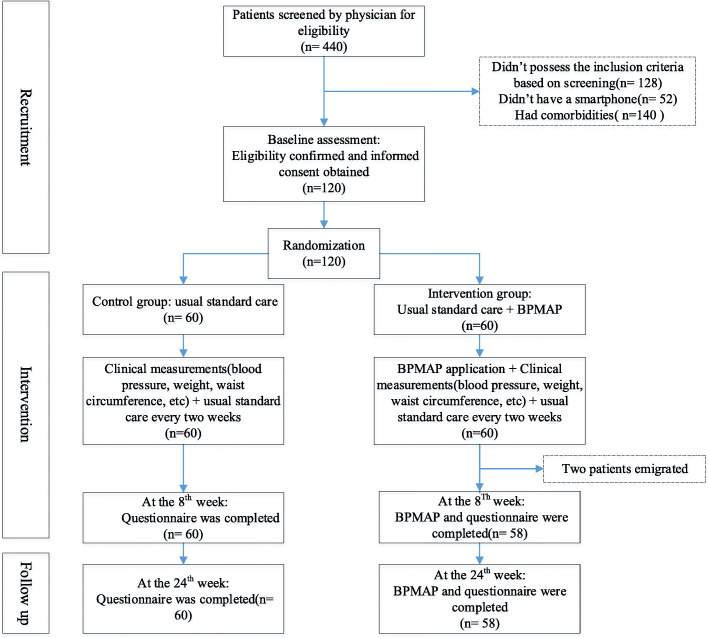
- Randomized, controlled clinical trial with two parallel arms; 120 patients with primary hypertension, aged 30–60, attending Tehran Heart Center in Iran, were allocated 1:1 using permuted block randomization (block size 4).
- Intervention participants received BPMAP plus routine treatment; control participants received usual care. Follow-up included visits at 2-week intervals and final assessment at 24 weeks, with outcomes measured at baseline, 8 weeks, and 24 weeks.
- Primary outcome was antihypertensive medication adherence measured by the 14-item Hill-Bone Scale; secondary outcomes included DASH diet adherence, sodium/fat intake, blood pressure monitoring, physical activity, and PRECEDE factors. Analysis used repeated measures ANOVA/general linear model adjusted for baseline scores in SPSS 20.0.
Limitations
- The authors state the study was not blinded, relied on self-report questionnaires and app-recorded measurements, and required participants to own an Android smartphone.
- The authors also note that positive attitudes among consultant physicians or participants toward the app could have inclined them to detect or express positive results.
- The text makes evident that two intervention participants were lost to follow-up due to emigration and irregular attendance, and baseline characteristics show some between-group differences (e.g., mean arterial pressure 108.0 vs 114.9 mmHg; cholesterol 179.8 vs 196.7 mg/dl).
Model-written summary. Check it against the paper before relying on it.
Integrity signals
Registry
Cites
Statistics
Figures
Verification
Claims the paper makes
6 Valid · 0 Not valid · 11 Not checked · 39 Own results and interpretations
The sources with a verdict support this claim; the rest weren’t checked yet, have no full text we could read, or their verdicts aren’t rated yet.
In the paper
“Evidence suggests that 65% of mHealth studies have increased adherence to drug therapy and in some cases have been able to increase patients’ self-efficacy and self-care by sending encouraging messages [27, 28].”
§ The effect of the mobile “blood pressure management application” on hypertension self-management enhancement: a randomized controlled trial > Discussion
What the sources say
- Supportedcites [27] Anglada-Martinez H Riu-Viladoms G Martin-Conde M Rovira-Illamola M Sotoca-Momblona J Codina-Jane C Does mHealth increase adherence to medication? Results of a systematic review Int J Clin Pract 2015 69 1 9 32 10.1111/ijcp.12582 25472682 source
The Abstract and Conclusion of our copy state that mHealth use 'do seem to have been beneficial, as 65% of the studies found had positive outcomes', and the Discussion (p. ~19) makes the same point in adherence terms: 'the fact that adherence rates significantly improve in 65% of the studies'. This matches the quoted attribution (65% of mHealth studies increasing adherence to drug therapy) in the systematic review's own population of mobile-SMS/app medication-adherence studies. The sentence's trailing self-efficacy/self-care clause is only loosely echoed in our copy ('mHealth can motivate patients and healthy individuals to participate in their own care'; messages carrying 'motivational and reinforcement content'), but the part quoted as attributed to this source is the 65% figure, which is stated verbatim. (LLM, conf=0.90)
- Not checked yetcites [28] Faridi Z Liberti L Shuval K Northrup V Ali A Katz DL Evaluating the impact of mobile telephone technology on type 2 diabetic patients’ self-management: the NICHE pilot study J Eval Clin Pract 2008 14 3 465 469 10.1111/j.1365-2753.2007.00881.x 18373577 source
hedgedstates a cause- Asserted: passes — The authors put it forward as true.
- Checkable: passes — It can be checked against evidence.
- Load-bearing: unclear — It is unclear whether the paper’s conclusions depend on it.
- Based: passes — The paper gives a reason why it holds.
- Supported
The sources with a verdict support this claim; the rest weren’t checked yet, have no full text we could read, or their verdicts aren’t rated yet.
In the paper
“A similar finding was found in studies conducted in the UK [32] and Taiwan [33].”
§ The effect of the mobile “blood pressure management application” on hypertension self-management enhancement: a randomized controlled trial > Discussion
What the sources say
- Supportedcites [32] Prestwich A Perugini M Hurling R Can implementation intentions and text messages promote brisk walking? A randomized trial Health Psychol 2010 29 1 40 49 10.1037/a0016993 20063934 source
The cited work is a UK-based randomized trial (title page: Andrew Prestwich, Institute of Psychological Sciences, University of Leeds, UK; Robert Hurling, Unilever Corporate Research, Bedford, UK; abstract keyword list opens with 'UK'; participants paid £15 and screened against Department of Health UK guidelines, Recruitment section). Its Discussion (p. 1, opening paragraph) and the primary-outcome Results passage state that implementation intentions paired with SMS plan or goal reminders significantly increased the number of days of self-reported brisk/fast walking for 30 minutes relative to control (d = .49 and .45), i.e. a physical activity increase — exactly the identification the citing sentence offers this citation for. The paper frames the evidence as 'preliminary', but the reported increase itself is stated as a significant finding, so the paraphrase is supported. (LLM, conf=0.88)
- Not checked yetcites [33] Liu W Wang C Lin H Lin S Lee K Lo Y Efficacy of a cell phone-based exercise programme for COPD Eur Respir J 2008 32 3 651 659 10.1183/09031936.00104407 18508824 source
plain- Asserted: passes — The authors put it forward as true.
- Checkable: passes — It can be checked against evidence.
- Load-bearing: unclear — It is unclear whether the paper’s conclusions depend on it.
- Based: passes — The paper gives a reason why it holds.
- Supported
The cited sources support only part of this claim — read each source’s verdict below.
In the paper
“Reducing hypertension and maintaining it in the normal range can prevent its irreparable complications [6].”
§ The effect of the mobile “blood pressure management application” on hypertension self-management enhancement: a randomized controlled trial > Background
What the sources say
- Partly supportedcites [6] Lackland DT Roccella EJ Deutsch AF Fornage M George MG Howard G Kissela BM Kittner SJ Lichtman JH Lisabeth LD Schwamm LH Smith EE Towfighi A American Heart Association Stroke Council Council on Cardiovascular and Stroke Nursing Council on Quality of Care and Outcomes Research Council on Functional Genomics and Translational Biology Factors influencing the decline in stroke mortality: a statement from the American Heart Association/American Stroke Association Stroke 2014 45 1 315 353 10.1161/01.str.0000437068.30550.cf 24309587 PMC5995123 sourceExperimental — accuracy not yet measured
The Clinical trials section (page not available) reports that treating hypertension and lowering blood pressure reduce stroke, myocardial infarction, and heart-failure risks. It does not establish that blood pressure must be maintained in the normal range to obtain those benefits, or characterize the complications as irreparable; it says risk improves even when blood-pressure control levels are not achieved. (LLM, conf=0.85)
plainstates a cause- Asserted: passes — The authors put it forward as true.
- Checkable: passes — It can be checked against evidence.
- Load-bearing: passes — The paper’s conclusions depend on it.
- Based: passes — The paper gives a reason why it holds.
- Partly supported
None of the sources cited for this claim have been checked yet.
In the paper
“However, most of these studies have used text messages and notifications only [28, 29].”
§ The effect of the mobile “blood pressure management application” on hypertension self-management enhancement: a randomized controlled trial > Discussion
What the sources say
- Not checked yetcites [28] Faridi Z Liberti L Shuval K Northrup V Ali A Katz DL Evaluating the impact of mobile telephone technology on type 2 diabetic patients’ self-management: the NICHE pilot study J Eval Clin Pract 2008 14 3 465 469 10.1111/j.1365-2753.2007.00881.x 18373577 source
- Could not verifycites [29] Contreras EM Von Wichmann MF Guillen VG Ylla-Catala A Figueras M Balana M Effectiveness of an intervention to provide information to patients with hypertension as short text messages and reminders sent to their mobile phone (HTA-Alert) Aten Primaria 2004 34 8 399 407 10.1016/S0212-6567(04)78922-2 15546536 PMC7668816 sourceExperimental — accuracy not yet measured
Our copy is a single primary RCT (Aten Primaria 2004;34(8):399-407), not a review of mHealth modalities: nowhere does it characterise what technologies 'most' mobile-health studies have used. Its 'Intervención' section describes only its own trial (written HTA information plus a subscription to periodic SMS-type alerts, 2 messages/week for 6 months), and the Introduction/'Mediciones principales' states that SMS had been used as support for young asthma patients (ref 9, Neville et al.) and that 'No existe ningún trabajo publicado que evalúe la efectividad de una intervención sobre el cumplimiento mediante mensajes de alerta en el teléfono móvil' — i.e. it treats alert-message studies as absent/rare rather than surveying the field. Searched: 'most mHealth studies text messages notifications', 'SMS / mensajes cortos / mensajes de alerta', 'discusión estudios previos tecnología móvil', 'Tortajada Raigal estudios antes mencionados'; the discussion compares number-needed-to-treat across adherence studies (Márquez, Tortajada, Raigal) but says nothing about the delivery channels used across mobile-health research. (LLM, conf=0.65)
plain- Asserted: passes — The authors put it forward as true.
- Checkable: passes — It can be checked against evidence.
- Load-bearing: passes — The paper’s conclusions depend on it.
- Based: passes — The paper gives a reason why it holds.
The cited sources support only part of this claim — read each source’s verdict below.
In the paper
“A systematic review by Marshall et al. in 16 countries revealed that the lack of awareness of the causes and symptoms of hypertension, fear of the drugs’ side effects, and their dependency are the major causes of treatment discontinuation and lack of adherence to treatment [35, 36].”
§ The effect of the mobile “blood pressure management application” on hypertension self-management enhancement: a randomized controlled trial > Discussion
What the sources say
- Partly supportedcites [35] Kumar K Greenfield S Raza K Gill P Stack R Understanding adherence-related beliefs about medicine amongst patients of South Asian origin with diabetes and cardiovascular disease patients: a qualitative synthesis BMC Endocr Disord 2016 16 1 1 10.1186/s12902-016-0103-0 27230479 PMC4880880 sourceExperimental — accuracy not yet measured
In the Discussion (p. n/a) our copy does report Marshall et al.'s systematic review (ref [50], Marshall, Wolfe & McKevitt, BMJ 2012, 'Lay perspectives on hypertension and drug adherence') and attributes to it patient views on the need for and efficacy of medicines, intentional non-adherence, toxicity of medicines/polypharmacy and the necessity of traditional remedies — which supports the 'fear of drug side effects' element. However, it never states '16 countries' (it lists nine, 'countries including the USA, UK, Brazil, Sweden, Canada, Finland, Netherlands, South Korea and Spain'), never mentions dependency on medicines as a cause of discontinuation, and frames awareness differently: the review found that hypertensive patients with HIGH adherence had an understanding of hypertension mapping onto the biomedical model, rather than stating lack of awareness of causes/symptoms as a major cause of treatment discontinuation. (LLM, conf=0.68)
- Not checked yetcites [36] Marshall IJ Wolfe CD McKevitt C Lay perspectives on hypertension and drug adherence: systematic review of qualitative research 2012 PMC3392078 22777025
plainstates a cause- Asserted: passes — The authors put it forward as true.
- Checkable: passes — It can be checked against evidence.
- Load-bearing: passes — The paper’s conclusions depend on it.
- Based: passes — The paper gives a reason why it holds.
- Partly supported
23 more claims
Create a free account to see all 56 claims and to verify the 22 references still open.
- It may state two separate claims as one. 12
- The quote only partly states this claim. 2
- Probably not a substantial claim. 20
Self-check
Percentages, sums and reported differences re-computed from the paper’s own numbers.
Each contradiction between two passages listed here was confirmed by an independent check.
Rated major: it would touch a result — a value a result rests on, reported and recomputed p-values on opposite sides of the significance level, two passages that conflict with no sign which is right, or a cited work retracted before this paper was published.
In the paper
§ The effect of the mobile “blood pressure management application” on hypertension self-management enhancement: a randomized controlled trial > Results
“| Characteristics | Adherence to a low-fat diet (mean ± SD) 2* | 12.6 ± 5.1 | 15.8 ± 3.3 |”
§ The effect of the mobile “blood pressure management application” on hypertension self-management enhancement: a randomized controlled trial > Results
“| Adherence to low-fat diet* | Intervention group | 16.0 ± 3.0 | 17.86 ± 1.06 | 18.21 ± 0.78 | 1.7 (1.3–2.1) |”
Rated minor: it would not touch a result — a value no result rests on, a p-value that stays on the same side of the significance level, or a conflict that is clerical, resolved elsewhere in the paper, or outside its own findings.
In the paper
§ The effect of the mobile “blood pressure management application” on hypertension self-management enhancement: a randomized controlled trial > Abstract > Results
“Moreover, moderate physical activity increased to 100.0 min (95% CI 61.7–138.3) per week in the intervention group.”
§ The effect of the mobile “blood pressure management application” on hypertension self-management enhancement: a randomized controlled trial > Results
“The estimated mean of moderate physical activity over the study period was 247.3 (95% CI 223.7–267.5) in the intervention group and 102.7 (95% CI 100.4–176.8) in the control group, indicating an increase of 100.0 min per week (95% CI 61.7–138.3) in the intervention group.”
Rated minor: it would not touch a result — a value no result rests on, a p-value that stays on the same side of the significance level, or a conflict that is clerical, resolved elsewhere in the paper, or outside its own findings.
In the paper
“| Demographic | • Diploma | 33 (56.7) | 26 (43.3) |”
§ The effect of the mobile “blood pressure management application” on hypertension self-management enhancement: a randomized controlled trial > Results
Reported 56.7 · recomputed 55
Rated minor: it would not touch a result — a value no result rests on, a p-value that stays on the same side of the significance level, or a conflict that is clerical, resolved elsewhere in the paper, or outside its own findings.
In the paper
§ The effect of the mobile “blood pressure management application” on hypertension self-management enhancement: a randomized controlled trial > Results
“| Characteristics | Vigorous physical activity (mean ± SD) 4* | 170.0 ± 87.4 | 162.0 ± 100/8 |”
§ The effect of the mobile “blood pressure management application” on hypertension self-management enhancement: a randomized controlled trial > Results
“4* (range 0–150 min/week)”
Citations
Cites
James, P. A., Oparil, S., Carter, B. L., Cushman, W. C., Dennison-Himmelfarb, C., Handler, J., Lackland, D. T., LeFevre, M. L., MacKenzie, T. D., Ogedegbe, O., et al. (2014) · JAMA · doi:10.1001/jama.2013.284427 · Cited by 7,950
Ettehad, D., Emdin, C. A., Kiran, A., Anderson, S. G., Callender, T., Emberson, J., Chalmers, J., Rodgers, A., & Rahimi, K. (2016) · The Lancet · doi:10.1016/s0140-6736(15)01225-8 · Cited by 3,755
Global Burden of Hypertension and Systolic Blood Pressure of at Least 110 to 115 mm Hg, 1990-2015
Forouzanfar, M. H., Liu, P., Roth, G. A., Ng, M., Biryukov, S., Marczak, L., Alexander, L., Estep, K., Hassen Abate, K., Akinyemiju, T. F., et al. (2017) · JAMA · doi:10.1001/jama.2016.19043 · Cited by 2,381
Development of the World Health Organization Global Physical Activity Questionnaire (GPAQ)
Armstrong, T., & Bull, F. (2006) · Journal of Public Health · doi:10.1007/s10389-006-0024-x · Cited by 1,727
Health Program Planning: An Educational and Ecological Approach
Green, L. W., & Kreuter, M. W. (1991) · Cited by 1,332
Mobile Health Technology Evaluation
Kumar, S., Nilsen, W. J., Abernethy, A., Atienza, A., Patrick, K., Pavel, M., Riley, W. T., Shar, A., Spring, B., Spruijt-Metz, D., et al. (2013) · American Journal of Preventive Medicine · doi:10.1016/j.amepre.2013.03.017 · Cited by 900
Lackland, D. T., Roccella, E. J., Deutsch, A. F., Fornage, M., George, M. G., Howard, G., Kissela, B. M., Kittner, S. J., Lichtman, J. H., Lisabeth, L. D., et al. (2014) · Stroke · doi:10.1161/01.str.0000437068.30550.cf · Cited by 815
James, P. A., Oparil, S., Carter, B. L., Cushman, W. C., Himmelfarb, C. D., Handler, J., Lackland, D. T., LeFevre, M. L., MacKenzie, T. D., Ogedegbe, O., et al. (2014) · Carolina Digital Repository (University of North Carolina at Chapel Hill) · Cited by 705
BMC Medical Informatics and Decision Making
McConnell, P. I., Dash, R., Chilukuri, R., Pietrobon, R. S., Johnson, K. S., Annechiarico, R. P., & Cuticchia, A. J. (2008) · Cited by 678
Siervo, M., Lara, J., Chowdhury, S., Ashor, A., Oggioni, C., & Mathers, J. C. (2015) · British Journal of Nutrition · doi:10.1017/s0007114514003341 · Cited by 656
Cited by
Zangger, G., Bricca, A., Liaghat, B., Juhl, C. B., Mortensen, S. R., Andersen, R. M., Damsted, C., Hamborg, T. G., Ried-Larsen, M., Tang, L. H., et al. (2023) · Journal of Medical Internet Research · doi:10.2196/46439 · Cited by 116
Digital Therapeutics in Hypertension: Evidence and Perspectives
Kario, K., Harada, N., & Okura, A. (2022) · Hypertension · doi:10.1161/hypertensionaha.122.19414 · Cited by 110
Boima, V., Doku, A., Agyekum, F., Tuglo, L. S., & Agyemang, C. (2024) · EClinicalMedicine · doi:10.1016/j.eclinm.2024.102432 · Cited by 82
“The meta-analysis of continuous outcome measurements for PA in 2 studies showed signi fi cant differences in the intervention [SMD = 1.30; (95% CI 0.23 – 2.37); p = 0.02; n = 276] compared to the control group, 25,33 (Fig.”
BackgroundResultInfluentialAkinola, S., & Telukdarie, A. (2023) · Sustainability · doi:10.3390/su151310417 · Cited by 70
“[79] 28 Blockchain Technology Provides a secure and tamper-proof platform for the storage and sharing of health information, enhancing privacy and security and supporting interoperability across different health information systems [80]”
BackgroundSeid, A., Fufa, D. D., & Bitew, Z. W. (2024) · Frontiers in Digital Health · doi:10.3389/fdgth.2024.1282570 · Cited by 54
Sun, T., Xu, X., Ding, Z., Xie, H., Ma, L., Zhang, J., Xia, Y., Zhang, G., & Ma, Z. (2024) · JMIR mhealth and uhealth · doi:10.2196/53006 · Cited by 82
“Research involving mHealth or telehealth interventions through smartphones for patients with coronary heart disease or hypertension has also reported their positive effects on exercise compliance [22,59], which were consistent with our results.”
MethodResultInfluentialBiskupiak, Z., Ha, V. V., Rohaj, A., & Bulaj, G. W. (2024) · Journal of Clinical Medicine · doi:10.3390/jcm13020403 · Cited by 55
Digital behaviour change interventions to increase vegetable intake in adults: a systematic review
Livingstone, K. M., Rawstorn, J. C., Partridge, S. R., Godrich, S. L., McNaughton, S. A., Hendrie, G. A., Blekkenhorst, L. C., Maddison, R., Zhang, Y., Barnett, S., et al. (2023) · International Journal of Behavioral Nutrition and Physical Activity · doi:10.1186/s12966-023-01439-9 · Cited by 43
Zhou, Y. J., Li, S., Huang, R.-Q., Ma, H., Wang, A., Tang, X., Pei, R., & Piao, M. (2024) · Journal of Medical Internet Research · doi:10.2196/54978 · Cited by 56
“[34,35], the United Kingdom (1/20, 5”
Yap, H. J., Lim, J. J., Tan, S.-Y. D., & Ang, C. (2024) · Journal of Hypertension · doi:10.1097/hjh.0000000000003793 · Cited by 49
“2.59, P 0.01, I 2 ¼ 28”
InfluentialAlnooh, G., Alessa, T., Hawley, M., & de Witte, L. (2022) · JMIR Cardio · doi:10.2196/35876 · Cited by 31
“Four studies evaluated user engagement [31-33,35]; 2 assessed user satisfaction [33,35]; 1 evaluated acceptance [31]; 1 assessed usability, user knowledge, and user attitudes [35]; and 1 evaluated user self-efficacy [34].”
BackgroundInfluentialHartch, C. E., Dietrich, M. S., Lancaster, B., Stolldorf, D. P., & Mulvaney, S. A. (2023) · Journal of Behavioral Medicine · doi:10.1007/s10865-023-00446-2 · Cited by 36
“An RCT conducted in Iran found the use of a mHealth app designed to manage HTN increased medication adherence through reminders, motivational messages, and access to educational content in patients seeking care in public hospitals (Bozorgi et al., 2021).”
BackgroundLanke, V., Trimm, K., Habib, B., & Tamblyn, R. M. (2025) · Journal of Medical Internet Research · doi:10.2196/60822 · Cited by 44
“…groups received some form of alternative interventions, including different elements from physical examinations to nutrition counseling sessions [24,26-29, 31 , 34-37 34-37 Since there is no standardized way to measure medication adherence [47-49], a range of methods were used by studies included…”
InfluentialSivakumar, B., Lemonde, M., Stein, M., Mak, S. S., Al‐Hesayen, A., & Arcand, J. (2023) · PLoS ONE · doi:10.1371/journal.pone.0285659 · Cited by 23
Alzahrani, S. A., Muammar, M. F. B., Muammar, A. F. B., Alolah, A. A., & Almutawa, M. (2022) · Cureus · doi:10.7759/cureus.31584 · Cited by 21
“[27] 2021 Randomized controlled trial To evaluate the effectiveness of the BPMAP in promoting adherence to medical treatments in patients with primary hypertension in Iran A mobile applicationbased educationalsupportive intervention, along with routine treatment The treatment adherence score increased by an average of…”
MethodExploration of Features of Mobile Applications for Medication Adherence in Asia: Narrative Review
Wang, T., Huang, Y., & Chan, H. (2024) · Journal of Medical Internet Research · doi:10.2196/60787 · Cited by 28
Liu, L., Guo, J., Jiao, X., & You, L. (2024) · Hypertension Research · doi:10.1038/s41440-024-01892-4 · Cited by 23
Lobo, E. H., Karmakar, C. K., Abdelrazek, M., Abawajy, J., Chow, C. K., Zhang, Y., Kabir, M. A., Daryabeygi‐Khotbehsara, R., Maddison, R., & Islam, S. M. S. (2023) · Frontiers in Public Health · doi:10.3389/fpubh.2023.1092755 · Cited by 30
Mobile health technologies in the prevention and management of hypertension: A scoping review
Babatunde, A. O., Ogundijo, D., Afolayan, A.-G. O., Awosiku, O. V., Aderohunmu, Z., Oguntade, M. S., Alao, U. H., Oseni, A. O., Akintola, A. A., & Amusat, O. (2024) · Digital Health · doi:10.1177/20552076241277172 · Cited by 27
“Of the papers reviewed in this study that focused on mobile application technology as a digital health intervention and ful fi lled the inclusion criteria (n = 26), 4, 16 –”
BackgroundThe Recent Advances of Mobile Healthcare in Cardiology Practice
Kulbayeva, S., Tazhibayeva, K. N., Seyduanova, L. B., Smagulova, I., Mussina, A., Tanabayeva, S. B., & Saliev, I. (2022) · Acta Informatica Medica · doi:10.5455/aim.2022.30.236-250 · Cited by 25
“Some studies were carried out to validate the system for urgent care alarm (37), lifestyle changes (43, 45, 53, 62, 65), adherence to treatment (35, 38, 41, 47, 48, 51, 53, 55, 59, 60, 63, 64, 67, 68), and physical activity of the patients (22, 32, 34, 41, 45, 62).”
BackgroundMethodInfluentialMobile Applications and Artificial Intelligence for Nutrition Education: A Narrative Review
Nogueira-Rio, N., Vazquez, L. V., López-Santamarina, A., Mondragón, A. D. C., Karav, S., & Miranda, J. M. (2024) · Dietetics · doi:10.3390/dietetics3040035 · Cited by 23
“[64] There was no evidence that the intervention significantly reduced the salt content of purchased foods, salt intake or blood pressure; however, the intervention was acceptable to both individuals and professionals.”
Thom, S. J. M., Sivakumar, B., Ayodele, T. A., Tan, M. C., Brown, J. M., & Arcand, J. (2023) · Journal of Nutrition Education and Behavior · doi:10.1016/j.jneb.2023.03.004 · Cited by 12
Keskin, A. Y., Şolpan, N. Ö., & Değirmenci, H. (2024) · Public Health Nursing · doi:10.1111/phn.13476 · Cited by 15
Effects of a Digital Intervention to Improve DASH and Blood Pressure Among US Adults
Miller, H., Askew, S., Berger, M. B., Kay, M. C., Palipana, A., Trefney, E., Carr, L. T. B., Barnes, C. N., Tyson, C. C., Svetkey, L. P., et al. (2024) · Hypertension · doi:10.1161/hypertensionaha.124.23887 · Cited by 12
Beger, C., Rüegger, D., Lenz, A., Wagner, S., Haller, H., Schmidt-Ott, K. M., Volland, D., & Limbourg, F. P. (2023) · Frontiers in Cardiovascular Medicine · doi:10.3389/fcvm.2023.1115987 · Cited by 8
Community-based intervention for managing hypertension and diabetes in rural Bangladesh
Kobashi, Y., Haque, S. E., Sakisaka, K., Amir, I., Kaneko, M., Mutahara, M., Mubassara, S., Kashem, A., & Tsubokura, M. (2024) · Tropical Medicine and Health · doi:10.1186/s41182-023-00574-0 · Cited by 16
Park, S., Woo, H. G., Kim, S., Kim, S. Y., Lim, H., Yon, D. K., & Rhee, S. Y. (2023) · JMIR Formative Research · doi:10.2196/48332 · Cited by 11
“[25-27], Canada (n=98) [28], Iceland (n=30) [29], Mexico (n=202) [30], India (n=90) [31], Iran (n=120) [32], China (n=63 to n=480) [33-35], and Japan (n=146 to n=390) [36,37], as well as 2 studies performed in South Korea (n=148 and n=182) [38,39], were included in the comparison with our study.”
Peacock, E., Craig, L. S., & Krousel-Wood, M. A. (2022) · Current Opinion in Cardiology · doi:10.1097/hco.0000000000000971 · Cited by 9
Bandeira, A. C. N., de Melo, P. U. G., Johann, E. B., Ritti‐Dias, R. M., Rech, C. R., & Gerage, A. M. (2024) · Telemedicine Journal and e-Health · doi:10.1089/tmj.2023.0545 · Cited by 14
Kengne, A. P., Brière, J., Gudiña, I. A., Jiang, X., Kodjamanova, P., Bennetts, L. E., & Khan, Z. M. (2024) · Expert Review of Pharmacoeconomics & Outcomes Research · doi:10.1080/14737167.2024.2319598 · Cited by 15
“Five studies from developing countries [100] included a digital application as part of an intervention [37,40,59,86,101].”
Almahmeed, W. A., Al-Abadla, Z., Alawadi, F., Alrohmaihi, D., Alshamiri, M. Q., Elbadawi, H., El‐Tamimi, H., Elzouki, A.-N. Y., Farghaly, M., Hafidh, K., et al. (2025) · Advances in Therapy · doi:10.1007/s12325-024-03103-5 · Cited by 10
“There are several examples within the literature where such tools have been used with success in the Middle East region in patients with cardiometabolic diseases [83–87].”
Dele-Ojo, B. F., Oseni, T. I. A., Duodu, F., Echieh, C. P., Blankson, P., Alabi, B. S., Sarpong, D. F., Tayo, B. O., Boima, V., Amoakoh‐Coleman, M., et al. (2023) · Research Square · doi:10.21203/rs.3.rs-3272069/v1 · Cited by 11
“Mobile health technologies improve hypertension outcomes 7 and they can be effective in self-management of chronic diseases 13,19 .”
BackgroundLee, M., Liu, C., Wang, W., Lin, M., Liao, P., & Chen, M. (2024) · International Journal of Nursing Practice · doi:10.1111/ijn.13312 · Cited by 8
Darabi, Z., Araban, M., Azizi, A., Angali, K. A., & Borazjani, F. (2023) · Jundishapur Journal of Chronic Disease Care · doi:10.5812/jjcdc-138325 · Cited by 13
“A recent study in Iran using mobile application-based-education also showed better adherence to the low-fat and low-salt diet plans among patients with HTN (40).”
BackgroundMotta-Yanac, E., Riley, V., Ellis, N. J., Mankoo, A., & Gidlow, C. J. (2025) · International Journal of Medical Informatics · doi:10.1016/j.ijmedinf.2024.105755 · Cited by 5
Asamoah, K. T., Dei‐Asamoa, R., Akumiah, F. K., & Ekpata, L. A. (2024) · Discover Public Health · doi:10.1186/s12982-024-00346-z · Cited by 6
“These included both general and specific health education messages, reminders for clinic visits and BP checks, reminders to undertake physical activity as needed, and dietary recommendations, among others [47, 56, 70–72].”
Damar, M., Kop, O., Şaylan, Ö. F., Özen, A., Çakmak, Ü. E., & Erenay, F. S. (2024) · Journal of Emerging Computer Technologies · doi:10.57020/ject.1514154 · Cited by 7
Evaluation of the usability of the Quali+ mobile application for people with high blood pressure
da Silva, L. V. F., Santos, J. S., de Sousa, M. M., Gouveia, B. D. L. A., Oliveira, S. H. D. S., Almeida, A. A. M., & Almeida, T. D. C. F. (2024) · Revista gaúcha de enfermagem · doi:10.1590/1983-1447.2023.20230058.en · Cited by 8
Sivakumar, B., Ricupero, M., Mahajan, A., Jefferson, K., Wenger, J., Code, J., Theodorou, A., & Arcand, J. (2025) · BMC Nutrition · doi:10.1186/s40795-025-01117-y · Cited by 6
“Similar findings were reported among individuals with hypertension by Bozorgi et al. [50] who showed that the scores of adherence to a low sodium diet increased by 1.5 points (95% CI 1.2, 1.9) in the intervention group (mobile app) as compared to the control group (routine care).”
InfluentialYulianti, T. E., Widayanti, A. W., Kristina, S. A., & Yasin, N. M. (2025) · Journal of Preventive Medicine and Public Health · doi:10.3961/jpmph.24.651 · Cited by 15
“…employed in the selected articles include the predisposing, reinforcing, and enabling constructs in educa - tional diagnosis and evaluation (PRECEDE) model [29], SCT [27,28,32], the transtheoretical model (TTM) [33,34], MI [30], and information-motivations-behavioral (IMB) skills models [35].”
InfluentialZarei, M., Sarmadi, S., Boozaripour, M., & Sanaie, N. (2025) · BMC Nursing · doi:10.1186/s12912-025-02909-0 · Cited by 7
“The study showed that the application can be used as a successful tool for self-management of hypertension in patients attending public hospitals in developing countries [21].”
Zhang, H., Huo, X., Ren, L., Lu, J., Li, J., Zheng, X., Liu, J., Ma, W., Yuan, J., Diao, X., et al. (2024) · American Heart Journal · doi:10.1016/j.ahj.2024.03.018 · Cited by 5
Abbas, S. M., Salama, H. M., Nour-Eldein, H., & Ahmed, H. A. S. (2024) · Journal of Family and Community Medicine · doi:10.4103/jfcm.jfcm_174_23 · Cited by 11
“[38] Further study on a larger sample is needed to assess the psychometric properties of the Arabic version of the H‑SCALE including evaluation of construct, convergent, and discriminant validity in addition to test–retest reliability.”
BackgroundMaleki, G., Noorian, R., Moeini, B., Barati, M., Maleki, S., & Afshari, M. (2023) · Blood Pressure Monitoring · doi:10.1097/mbp.0000000000000665 · Cited by 8
Heidari, N., Rajati, F., Heidari, P., & Rajati, M. (2025) · Frontiers in Public Health · doi:10.3389/fpubh.2025.1495281 · Cited by 8
Ghavami, M., Abdshah, A., Sadeghian, S., Ahmadi, A., Jolani, M. S., Akbarzadeh, D., & Asgari, F. H. A. (2024) · Archives of Iranian Medicine · doi:10.34172/aim.28501 · Cited by 18
Susanto, Y., Pristianty, L., & Hermansyah, A. (2023) · Pharmacy Education · doi:10.46542/pe.2023.234.208218 · Cited by 5
“Seventeen papers (Bozorgi et al., 2021; Chandler et al., 2019; Frias et al., 2017; Gong et al., 2020; Y. Li et al., 2022; Márquez Contreras et al., 2019; McGillicuddy et al., 2013; Moore et al., 2014; Ni et al., 2018, 2022; Oh et al., 2022; Persell et al., 2020; Sarfo et al., 2018;Sarfo et al., 2019; Schoenthaler et a…”
BackgroundInfluentialSilva, B., Gonçalves, J., Prazeres, F., Santiago, L. M., & Rosendo, I. (2025) · BMC Family Practice · doi:10.1186/s12875-025-02705-4 · Cited by 4
Alnooh, G., ALTAMIMI, J. Z., Williams, E. A., & Hawley, M. (2024) · JMIR Formative Research · doi:10.2196/60037 · Cited by 2
“Bozorgi et al [69] demonstrated that using a mobile app–based XSL • FO RenderX education intervention improved adherence to low-fat and low-salt diets among patients with high blood pressure.”
Key Factors for a Successful Telemedicine Solution for Cardiovascular Diseases: A Systematic Review
Russo, G. F., Basile, I., Ciampi, M., & Silvestri, S. (2024) · Applied Sciences · doi:10.3390/app14177633 · Cited by 3
Health Behavior Change Interventions Using Mobile Phones: A Meta-Analysis
Stee, S. K. V., Yang, Q., & Falcone, M. L. (2024) · Health Communication · doi:10.1080/10410236.2024.2393005 · Cited by 2
Framework for Monitoring Peruvian Patients with Hypertension using a Smartwatch and GPT
Rosales, M., Huacacolque, E., Castillo, J. L., & Wong, L. (2024) · Conference of Open Innovations Association (FRUCT) · doi:10.23919/fruct61870.2024.10516393 · Cited by 4
“Studies such as [22], [19] separated patients into two groups, one that used mobile apps to monitor BP and another with traditional follow-up.”
BackgroundMethodBamidele, F. I., Bello, C. B., Akinwale, O. D., & Falana, M. S. (2024) · Journal of Integrative Nursing · doi:10.4103/jin.jin_151_23 · Cited by 2
Aovare, P., Chilunga, F. P., Hayfron-Benjamin, C. F., Laar, A., Moens, N., van Charante, E. P. M., & Agyemang, C. O. (2026) · Heliyon · doi:10.1016/j.heliyon.2026.e45003 · Cited by 1
Yang, A. (2025) · European Journal of Cardiovascular Nursing · doi:10.1093/eurjcn/zvaf170 · Cited by 1
Development of a Patient-Facing Clinical Decision Support Application for Hypertension
Bobo, M., Canfield, S. M., Shaffer, V. A., Storer, M., Michaels, L. C., Yates, A., Rolbiecki, A. J., Koopman, R. J., & Dorr, D. A. (2025) · Applied Clinical Informatics · doi:10.1055/a-2697-2107 · Cited by 2
Chaiphattharatada, I., Bunthan, W., & Khungtumneam, K. (2024) · Pacific Rim International Journal of Nursing Research · doi:10.60099/prijnr.2025.268827 · Cited by 2
Use of Digital Smartphone Applications for Blood Pressure Monitoring: An Integrative Review
de Sousa, L. B. P., Mororó, I. T., Couto, A. R. M., Costa, G. B. V., & Girão, D. K. F. B. (2024) · Brazilian Journal of Health Aromatherapy and Essential Oil · doi:10.62435/2965-7253.bjhae.2024.bjhae19 · Cited by 1
“E6 [16] Involving participants aged 30-60, this study aimed to evaluate the effectiveness of BP self-management using a mobile app in combination with a low-sodium, low-fat diet.”
MethodMobile Health and Artificial Intelligence as Nutritional Support for the Population: A ReviewPreprint
Nogueira-Rio, N., López-Santamarina, A., Mondragón, A. D. C., & Miranda, J. M. (2024) · Preprints.org · doi:10.20944/preprints202406.0279.v1
张, 世. (2024) · Nursing Science · doi:10.12677/ns.2024.137139 · Cited by 1
PERCEPÇÕES DO USO DE TECNOLOGIA MHEALTH POR PACIENTES EM TRATAMENTO DIALÍTICO
da Silva, M. E. V., Marinho, C. L. A., Schwingel, P. A., et al. (2024) · Texto & Contexto - Enfermagem · doi:10.1590/1980-265x-tce-2023-0321pt · Cited by 1
“A melhor adesão ao tratamento resultou na diminuição da pressão arterial média ao longo do tempo em uma média de 3,4 mmHg no grupo de intervenção em comparação com o grupo de controle 20 .”
Nakrys, M., Valinskas, S., Aleknavičius, K., & Jonusas, J. (2023) · JMIR Cardio · doi:10.2196/48454 · Cited by 1
“Such results may be explained by the fact that mobile apps increase adherence to medication and diet, which was shown in a study by Bozorgi et al [18], who reported that mobile intervention increased treatment adherence by 5.9 points (95% CI 5.03-6.69) based on the Hill-Bone scale.”
BackgroundInfluentialThe Use of mHealth in Promoting Therapeutic Adherence: A Scoping Review
Liquori, G., Posa, V. P., Leo, A. D., Giannetta, N., Simone, E. D., Muzio, M. D., & Dionisi, S. (2024) · CIN Computers Informatics Nursing · doi:10.1097/cin.0000000000001062 · Cited by 10
Shirzad, M., Hajimiri, K., Shakibazadeh, E., & Abedini, M. (2021) · SSRN Electronic Journal · doi:10.2139/ssrn.3897965 · Cited by 1
Doku, A., Kruger, R., Asamoah, K. T., Akumiah, F. K., Auala, T., Beheiry, H., Mutagaywa, R., Isiguzo, G. C., Akintunde, A., Dzudié, A., et al. (2026) · Journal of Hypertension · doi:10.1097/hjh.0000000000004411 · Cited by 2
Salins, P. L., Sabu, K. M., Reshmi, B., Kamath, R., Nair, S., & Kundapur, P. P. (2026) · F1000Research · doi:10.12688/f1000research.181812.1
Application of digital health technologies in hypertension self-management: a narrative review
Zhao, S., Yang, Y., & Lü, N. (2026) · Frontiers in Public Health · doi:10.3389/fpubh.2026.1865773 · Cited by 1
Ma, Y., zhang, X., Shi, J., Guo, C., Tian, C., Wan, Z., Li, Y., Li, Y., Guo, L., Lang, Y., et al. (2026) · doi:10.2196/preprints.102956
Research Progress on Assessment Tools for Self-Efficacy in Hypertension Treatment Adherence
吴, 佳. (2026) · Advances in Clinical Medicine · doi:10.12677/acm.2026.1672643
Ni, X., Xue, H., Fan, L., Li, M., Yang, J., & Du, W. D. (2025) · npj Digital Medicine · doi:10.1038/s41746-025-02064-5 · Cited by 1
Exploring Mobile Health Interventions for Hypertension and Management: A Scoping Review
Baharuddin, M. Z. A. B., & Manaf, R. A. (2025) · Malaysian Journal of Medicine and Health Sciences · doi:10.47836/mjmhs.21.5.25 · Cited by 1
Key determinants and usage patterns of mobile device proficiency in older adults
Choi, H. S., & Song, H.-J. (2025) · Geriatric Nursing · doi:10.1016/j.gerinurse.2025.103645 · Cited by 3
Development of a Mobile Phone Application for Monitoring Cardiovascular Health
Tavares, G. A., Xavier, M. H. C., Moura, I. V. D. S., Souza, V. A., Silva, W. H. D. S., Júnior, R. B. D. S., Cunha, I. T. D. F., de Jesus, E. N. F., da Costa, A. R., & Barreto-Filho, J. A. S. (2025) · Healthcare Informatics Research · doi:10.4258/hir.2025.31.3.310
Lin, P., Tyson, C. C., & Svetkey, L. P. (2025) · Nutrition and health · doi:10.1007/978-3-031-87441-3_1
黄, 美. (2025) · Nursing Science · doi:10.12677/ns.2025.1412331
Softwares para adesão ao tratamento medicamentoso da hipertensão arterial sistêmica
de Carvalho, D. A. C., Araújo, M. A. S., Braga, M. O., Faria, I. C., & de Souza, F. H. B. (2024) · Journal of Health Informatics · doi:10.59681/2175-4411.v16.iespecial.2024.1347
Lanke, V., Trimm, K., Habib, B., & Tamblyn, R. M. (2024) · doi:10.2196/preprints.60822
Wang, T., Huang, Y., & Chan, H. (2024) · doi:10.2196/preprints.60787
Alnooh, G., ALTAMIMI, J. Z., Williams, E. A., et al. (2024) · doi:10.2196/preprints.60037
Telehealth Intervention for Self-management Among Patient with Hypertension: A Scoping Review
Agastiya, I. M. C., & Risnawati, N. E. (2024) · Jurnal Keperawatan Malang (JKM) · doi:10.36916/jkm.v9i01.245 · Cited by 2
Avaliação da usabilidade do aplicativo móvel Quali+ para pessoas com hipertensão arterial
da Silva, L. V. F., Santos, J. S., de Sousa, M. M., Gouveia, B. D. L. A., Oliveira, S. H. D. S., Almeida, A. A. M., & Almeida, T. D. C. F. (2024) · Revista gaúcha de enfermagem · doi:10.1590/1983-1447.2023.20230058.pt · Cited by 9
PERCEPTIONS OF MHEALTH TECHNOLOGY USE BY PATIENTS UNDER DIALYTIC TREATMENT
da Silva, M. E. V., Marinho, C. L. A., Schwingel, P. A., et al. (2024) · Texto & Contexto - Enfermagem · doi:10.1590/1980-265x-tce-2023-0321en
“Better adherence to treatment resulted in a decrease in mean BP over time by an average of 3.4 mmHg in the intervention group compared to the control group 20 .”
ResultInfluentialShirzad, M., Shakibazadeh, E., Sheikhattari, P., Foroushani, A. R., & Poursharifi, H. (2024) · Obstetrics and Gynecology International · doi:10.1155/2024/3071183 · Cited by 1
Botilangi, V. S., Sriyono, S., & Sari, D. W. (2023) · Journal of Telenursing (JOTING) · doi:10.31539/joting.v5i2.5903
“…yang dikaji oleh 7 artikel yaitu pesan teks seluler (Varleta et al., 2017), (Bhandari et al., 2022), (Bobrow et al., 2016) intervensi eHealth dengan simulasi virtual (Hickman et al., 2021), aplikasi DaroYab (Torkabad et al., 2020), aplikasi mHealth (Volpi et al., 2021), (Bozorgi et al., 2021).”
BackgroundSaeidnia, M., Shokri, M., Saeidnia, H. R., Lotfata, A., Ghiasi, N., & Ghaderi, A. (2023) · Research Square · doi:10.21203/rs.3.rs-3424107/v1
Khiavi, F. F., Kalkhajeh, S. G., Gholizadeh, B., & Dindamal, B. (2023) · Health Research Policy and Systems · doi:10.1186/s12961-023-00984-w · Cited by 2
“In Iran, the results of a study showed that smart phones can be used as a successful tool for self-management of blood pressure in patients referring to CHCs or public hospitals [50].”
BackgroundNakrys, M., Valinskas, S., Aleknavičius, K., et al. (2023) · doi:10.2196/preprints.48454
Park, S., Woo, H. G., Kim, S., et al. (2023) · doi:10.2196/preprints.48332
Lobo, E. H., Karmakar, C. K., Abdelrazek, M., Abawajy, J., Chow, C. K., Zhang, Y., Kabir, M. A., Deryabeygi, R., Maddison, R., & Islam, S. M. S. (2022) · doi:10.2196/preprints.43169
Cardiovascular Health Monitoring Mobile Phone Application DevelopmentPreprint
Tavares, G. A., Barreto-Filho, J. A. S., Santos, F. B., Faro, V. A. C., Xavier, M. H. C., Gobatto, F. E., Moura, I. V. D. S., Souza, V. A., Silva, W. H. D. S., Santos, G. D. C., et al. (2022) · SSRN Electronic Journal · doi:10.2139/ssrn.4015032
Cardiovascular Health Monitoring Mobile Phone Application DevelopmentPreprint
Tavares, G. A., Xavier, M. H. C., Gobatto, F. E., Moura, I. V. D. S., Souza, V. A., Silva, W. H. D. S., Santos, G. D. C., de Gaspare, E. F., Santos, F. B., Faro, V. A. C., et al. (2022) · SSRN Electronic Journal · doi:10.2139/ssrn.4122008
Metadata
- Authors
- Bozorgi, A., Hosseini, H., Eftekhar, H., Majdzadeh, R., Yoonessi, A., Ramezankhani, A., Mansouri, M., & Ashoorkhani, M.
- Affiliations
- Tehran Heart Center (IR)
- Tehran University of Medical Sciences (IR)
- Payame Noor University (IR)
- Corresponding author
- Ashoorkhani, Mahnaz
- ORCID
- Venue
- Trials
- Published
- 2021-06-24
- Volume
- 22
- Issue
- 1
- Pages
- 413-413
- ISSN
- 1745-6215 (ISSN-L)
- PMC
- PMC8223338
- OpenAlex
- W3111671800
- Semantic Scholar
- 766fff7afcc55389a90d376cfceb174de6069305
- Cited by
- 94
- References
- 34
- Citations by year
- 2026: 9 · 2025: 15 · 2024: 40 · 2023: 18 · 2022: 11 · 2021: 1
- FWCI
- 19.66
- Type
- journal article
- Language
- en
- Open access
- gold
- doi.org
- Licence
- cc-by
- creativecommons.org/licenses/by/4.0 (tdm)
- creativecommons.org/licenses/by/4.0 (vor)
- Locations
- Trials (publishedVersion, cc-by)
- Research Square (acceptedVersion, cc-by)
- PubMed Central (publishedVersion, cc-by)
- PubMed (publishedVersion)
- Open Access at Essex (University of Essex) (acceptedVersion)
- DOAJ (DOAJ: Directory of Open Access Journals) (submittedVersion, cc-by-sa)
- Funders
- The Global Oper Reserch Support Team (00990476)
- Topics
- Health Sciences › Health Professions › General Health Professions › Mobile Health and mHealth Applications
- Health Sciences › Medicine › Cardiology and Cardiovascular Medicine › Blood Pressure and Hypertension Studies
- Health Sciences › Medicine › Family Practice › Medication Adherence and Compliance
- Keywords
- hypertension, self-management, mobile health, mobile health apps, medication adherence, DASH diet, blood pressure monitoring, physical activity, smartphone-based intervention
- MeSH terms
- Self-Management, Blood Pressure, Humans, Hypertension, Iran, Medication Adherence, Mobile Applications
About these checks
Registry, retraction, Cites and statistics results are computed, not judged, with one exception: a printed reference that no index lists is read once by a model before it counts as a citation error. Claims are extracted by a model and kept only when their quote appears verbatim in the text; each cited source is then checked, with a model’s help, for whether it says what the claim relies on. Those verdicts can be wrong — read the claim’s quote and the cited source before relying on one.
The claim verdicts this report counts are experimental: their accuracy is not yet measured.
A language model drew the claims from the paper on 2026-09-30, under version 3 of the claim definition (model deepseek-v4.1-flash, prompt extract-v3).
A second model labelled each claim on 2026-09-30 (model jev-1.13-20260917, definition revision gold-guideline-v0.2).
Cited sources are checked with a language model’s help (qwen3.8-omni-flash and gpt-6-sol).
Statistics and arithmetic are recomputed, not judged.
Confidence bands are shown only for fields calibrated on our annotated test set. None is calibrated yet, so no band is shown.
What counts as a claim ›How we measure confidence ›How we check this ›
Are you an author, or do you see a problem with this page? Request a review
Data sources
Bibliographic data: Semantic Scholar, OpenAlex, Crossref.
Contains information from the Semantic Scholar Academic Graph Datasets, made available under the ODC Attribution License (ODC-BY 1.0).
Semantic Scholar’s data is described in: Kinney, R., et al. (2023). The Semantic Scholar Open Data Platform. arXiv:2301.10140.
