

Confirmatory Efficacy and Safety Trial of Magnetic Seizure Therapy for Depression (CREST‐MST): study protocol for a randomized non‐inferiority trial of magnetic seizure therapy versus electroconvulsive therapy
Open accessPublished version of a preprint
The DOI matches its Crossref record; 63 of the 63 references it cites were found in a registry or an index.
Abstract
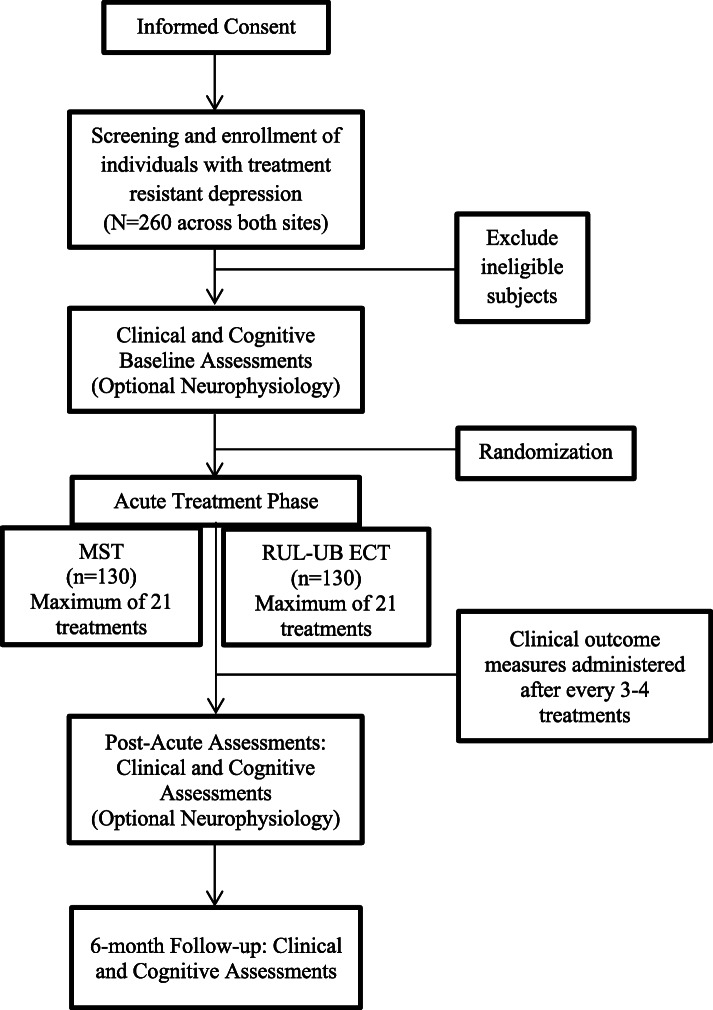
Background: Electroconvulsive therapy (ECT) is well-established and effective for treatment-resistant depression (TRD), but in Canada and the USA, less than 1% of patients with TRD receive ECT mainly due to its cognitive adverse effects (i.e. amnesia). Thus, new treatment alternatives for TRD are urgently needed. One such treatment is magnetic seizure therapy (MST). ECT involves applying a train of high-frequency electrical stimuli to induce a seizure, whereas MST involves applying a train of high-frequency magnetic stimuli to induce a seizure. Methods: In this manuscript, we introduce our international, two-site, double-blinded, randomized, non-inferiority clinical trial to develop MST as an effective and safe treatment for TRD. This trial will compare the efficacy of MST to right unilateral ultra-brief pulse width electroconvulsive therapy (RUL-UB-ECT) with a combined primary endpoint of remission of depression and superior cognitive adverse effects in 260 patients with TRD. Amelioration of suicidal ideation will be assessed as a secondary endpoint. Inpatients or outpatients, over 18 years of age with a MINI International Neuropsychiatric Interview (MINI) diagnosis of non-psychotic major depressive disorder (MDD) can be enrolled in the study provided that they meet illness severity and full eligibility criteria. Participants are randomized to receive MST or RUL-UB ECT, 2-3 days per week over seven weeks, or a maximum of 21 treatments. The study will involve before-, during-, and after-treatment assessments of depression severity, suicidal ideation, subjective side-effects, and cognitive performance consistent with an intent-to-treat study design approach. Discussion: Positive results from this trial could have an immediate and tremendous impact for patients with TRD. If MST demonstrates comparable antidepressant treatment efficacy to ECT, but with greater cognitive safety, it could rapidly be adopted into clinical practice. Indeed, given that the administration of MST is nearly identical to ECT, the majority of ECT facilities in North America could readily adopt MST. Furthermore, the potential for cognitive safety could lead to improved treatment acceptability. Healthcare providers, patients and care partners, and policymakers would therefore demand this form of convulsive therapy. Trial status: Enrollment for this study began on June 26, 2018, and is estimated to complete recruitment by July 2024. At the time of submission, we have enrolled and randomized 117 participants. Trial registration: ClinicalTrials.gov NCT03191058 , Registered on June 19, 2017. Primary sponsor: Daniel Blumberger (DMB), Principal Investigator Daniel.Blumberger@camh.ca, 416-535-8501 x 33662 Contact for public queries: DMB, Daniel.Blumberger@camh.ca Contact for scientific queries: ZJD, Zdaskalakis@health.ucsd.edu
Overview
The claims and statistics of this paper haven’t been checked yet.
Free: it reads the open-access text and checks the first 5 claims that cite a source we can check. Create a free account to check every claim.
Integrity signals
Registry
Cites
Statistics
Figures
Verification
Claims the paper makes
The claims and statistics of this paper haven’t been checked yet.
Free: it reads the open-access text and checks the first 5 claims that cite a source we can check. Create a free account to check every claim.
Claims other papers make about this one
Each is checked against this paper’s own text: does it say what the citing paper says it does?
The source backs part of the claim, not all of it — or backs it for a different population, condition or comparison.
In the citing paper
“In addition, results from RCTs have sup ported the efficacy of magnetic seizure ther apy, with additional evidence demonstrat ing continuation of effect 250,251 .”
From Treatment‐resistant depression: definition, prevalence, detection, management, and investigational interventions (2023) · cites this paper as [250]
Experimental — accuracy not yet measuredThe source backs part of the claim, not all of it — or backs it for a different population, condition or comparison.
In the citing paper
“Across studies, MST shows robust antidepressant effects with shorter reorientation times (≈4–9 min) and fewer cognitive adverse effects [132,133,134,135,136,137,138].”
From The Heart’s Electromagnetic Field in Emotions, Empathy and Human Connection: Biosensor-Derived Insights into Heart–Brain Axis Mechanisms and a Basis for Novel BioMagnetoTherapies (2026) · cites this paper as [138]
Experimental — accuracy not yet measured
Self-check
Percentages, sums and reported differences re-computed from the paper’s own numbers.
The self-check needs the paper’s full text.
Citations
Cites
Development of a Rating Scale for Primary Depressive Illness
HAMILTON, M. (1967) · British Journal of Social and Clinical Psychology · doi:10.1111/j.2044-8260.1967.tb00530.x · Cited by 8,410 · cited 11×
“Participants are discontinued from the treatment if they cannot safely continue the study based on any of the following criteria: (1) experience worsening in depression severity, defined as an increase in the HRSD-24 total score from baseline of more than 30% on two consecutive assessments; (2) experience clinically s…”
InfluentialScoville, W. B. (1949) · Journal of neurosurgery · doi:10.3171/jns.1949.6.1.0065 · Cited by 7,381
SPIRIT 2013 explanation and elaboration: guidance for protocols of clinical trials
Chan, A.-W., Tetzlaff, J. M., Gotzsche, P. C., Altman, D. G., Mann, H., Berlin, J. A., Dickersin, K., Hrobjartsson, A., Schulz, K. F., Parulekar, W. R., et al. (2013) · BMJ · doi:10.1136/bmj.e7586 · Cited by 6,251
Rush, A. J., Trivedi, M. H., Wisniewski, S. R., Nierenberg, A. A., Stewart, J. W., Warden, D., Niederehe, G., Thase, M. E., Lavori, P. W., Lebowitz, B. D., et al. (2006) · American Journal of Psychiatry · doi:10.1176/ajp.2006.163.11.1905 · Cited by 5,643 · cited 1×
“rTMS at about 20% remission [55] and 14% with antidepressants [56]).”
NON-INVASIVE MAGNETIC STIMULATION OF HUMAN MOTOR CORTEX
Barker, A. T., Jalinous, R., & Freeston, I. L. (1985) · The Lancet · doi:10.1016/s0140-6736(85)92413-4 · Cited by 4,460
Assessment of suicidal intention: The Scale for Suicide Ideation.
Beck, A. T., Kovacs, M., & Weissman, A. (1979) · Journal of Consulting and Clinical Psychology · doi:10.1037//0022-006x.47.2.343 · Cited by 3,419 · cited 7×
“Secondary clinical outcome measures include the SSI.”
InfluentialThe Economic Burden of Adults With Major Depressive Disorder in the United States (2005 and 2010)
Greenberg, P. E., Fournier, A.-A., Sisitsky, T., Pike, C. T., & Kessler, R. C. (2015) · The Journal of Clinical Psychiatry · doi:10.4088/jcp.14m09298 · Cited by 1,779
Pocock, S. J., Assmann, S. E., Enos, L. E., & Kasten, L. E. (2002) · Statistics in Medicine · doi:10.1002/sim.1296 · Cited by 1,077
Keller, M. B. (1992) · Archives of General Psychiatry · doi:10.1001/archpsyc.1992.01820100053010 · Cited by 864
Sackeim, H. A., Prudic, J., Devanand, D. P., Nobler, M. S., Lisanby, S. H., Peyser, S., Fitzsimons, L., Moody, B. J., & Clark, J. (2000) · Archives of General Psychiatry · doi:10.1001/archpsyc.57.5.425 · Cited by 804 · cited 4×
“These eligibility criteria are congruent with the criteria that have been used in the major ECT trials conducted during the past decade [6, 44, 45].”
Influential
Cited by
McIntyre, R. S., Alsuwaidan, M., Baune, B. T., Berk, M., Demyttenaere, K., Goldberg, J. F., Gorwood, P., Ho, R., Kasper, S., Kennedy, S. H., et al. (2023) · World Psychiatry · doi:10.1002/wps.21120 · Cited by 836
Deng, Z., Robins, P. L., Regenold, W. T., Rohde, P., Dannhauer, M., & Lisanby, S. H. (2023) · Neuropsychopharmacology · doi:10.1038/s41386-023-01677-2 · Cited by 114
“An adequately powered con fi rmatory ef fi cacy study is currently underway to provide de fi nitive evidence of whether MST is noninferior to ECT in terms of ef fi cacy, while retaining its relatively benign cognitive side effect pro fi le [165].”
BackgroundKaster, T. S., Blumberger, D. M., Gomes, T., Sutradhar, R., Wijeysundera, D. N., & Vigod, S. N. (2021) · The Lancet Psychiatry · doi:10.1016/s2215-0366(22)00077-3 · Cited by 70
Self-citationCellular and Molecular Effects of Magnetic Fields
Tota, M., Jonderko, L., Witek, J., Novickij, V., & Kulbacka, J. (2024) · International Journal of Molecular Sciences · doi:10.3390/ijms25168973 · Cited by 52
“A clinical trial (NCT03191058) is currently being conducted to assess the efficacy, tolerability, and cognitive adverse effects of MST [136].”
Recent advances in electroconvulsive therapy in clinical practice and research
Mukhtar, F., Regenold, W. T., & Lisanby, S. H. (2023) · Faculty Reviews · doi:10.12703/r/12-13 · Cited by 40
Metadata
- Authors
- Daskalakis, Z. J., Tamminga, C., Throop, A., Palmer, L., Dimitrova, J., Farzan, F., Thorpe, K. E., McClintock, S. M., & Blumberger, D. M.
- Affiliations
- University of California San Diego (US)
- The University of Texas Southwestern Medical Center (US)
- University at Buffalo, State University of New York (US)
- Simon Fraser University (CA)
- St. Michael's Hospital (CA)
- Centre for Addiction and Mental Health (CA)
- Corresponding author
- Daskalakis, Zafiris J.
- ORCID
- Venue
- Trials
- Published
- 2021-11-08
- Volume
- 22
- Issue
- 1
- Pages
- 786-786
- ISSN
- 1745-6215 (ISSN-L)
- PMC
- PMC8576983
- OpenAlex
- W3158855046
- Cited by
- 23
- References
- 63
- Citations by year
- 2026: 4 · 2025: 2 · 2024: 8 · 2023: 6 · 2022: 2 · 2021: 1
- FWCI
- 3.05
- Type
- journal article
- Language
- en
- Open access
- gold
- doi.org
- Licence
- cc-by
- creativecommons.org/licenses/by/4.0 (tdm)
- creativecommons.org/licenses/by/4.0 (vor)
- Locations
- Trials (publishedVersion, cc-by)
- Research Square (acceptedVersion, cc-by)
- Europe PMC (PubMed Central) (publishedVersion, other-oa)
- PubMed Central (publishedVersion, cc-by)
- PubMed (publishedVersion)
- TSpace (University of Toronto) (submittedVersion)
- DOAJ (DOAJ: Directory of Open Access Journals) (submittedVersion, cc-by-sa)
- Funders
- National Institute of Mental Health (1R01-MH112815)
- Topics
- Health Sciences › Medicine › Psychiatry and Mental health › Electroconvulsive Therapy Studies
- Life Sciences › Neuroscience › Neurology › Transcranial Magnetic Stimulation Studies
- Health Sciences › Medicine › Pharmacology (medical) › Treatment of Major Depression
- Keywords
- magnetic seizure therapy, electroconvulsive therapy, treatment-resistant depression, cognitive side effects, amnesia, suicidal ideation, major depressive disorder, treatment acceptability, Mini International Neuropsychiatric Interview, treatment efficacy and safety
- MeSH terms
- Equivalence Trials as Topic, Adolescent, Adult, Depression, Major Depressive Disorder, Electroconvulsive Therapy, Humans, Seizures, Treatment Outcome, Depressive Disorder, Treatment-Resistant
About these checks
Registry, retraction, Cites and statistics results are computed, not judged, with one exception: a printed reference that no index lists is read once by a model before it counts as a citation error. Claims are extracted by a model and kept only when their quote appears verbatim in the text; each cited source is then checked, with a model’s help, for whether it says what the claim relies on. Those verdicts can be wrong — read the claim’s quote and the cited source before relying on one.
Statistics and arithmetic are recomputed, not judged.
Confidence bands are shown only for fields calibrated on our annotated test set. None is calibrated yet, so no band is shown.
What counts as a claim ›How we measure confidence ›How we check this ›
Are you an author, or do you see a problem with this page? Request a review
Data sources
Bibliographic data: Semantic Scholar, OpenAlex, Crossref.
Contains information from the Semantic Scholar Academic Graph Datasets, made available under the ODC Attribution License (ODC-BY 1.0).
Semantic Scholar’s data is described in: Kinney, R., et al. (2023). The Semantic Scholar Open Data Platform. arXiv:2301.10140.
