

Confirmatory Efficacy and Safety Trial of Magnetic Seizure Therapy for Depression (CREST‐MST): study protocol for a randomized non‐inferiority trial of magnetic seizure therapy versus electroconvulsive therapy
Open accessPublished version of a preprint
The DOI matches its Crossref record; 63 of the 63 references it cites were found in a registry or an index.
Abstract
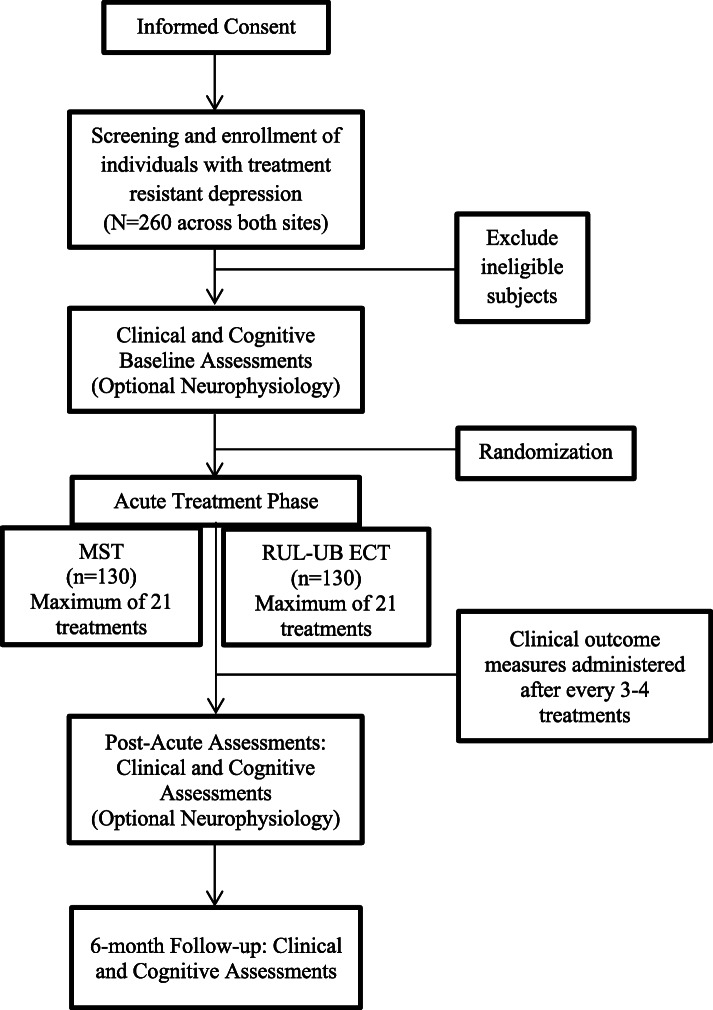
Background: Electroconvulsive therapy (ECT) is well-established and effective for treatment-resistant depression (TRD), but in Canada and the USA, less than 1% of patients with TRD receive ECT mainly due to its cognitive adverse effects (i.e. amnesia). Thus, new treatment alternatives for TRD are urgently needed. One such treatment is magnetic seizure therapy (MST). ECT involves applying a train of high-frequency electrical stimuli to induce a seizure, whereas MST involves applying a train of high-frequency magnetic stimuli to induce a seizure. Methods: In this manuscript, we introduce our international, two-site, double-blinded, randomized, non-inferiority clinical trial to develop MST as an effective and safe treatment for TRD. This trial will compare the efficacy of MST to right unilateral ultra-brief pulse width electroconvulsive therapy (RUL-UB-ECT) with a combined primary endpoint of remission of depression and superior cognitive adverse effects in 260 patients with TRD. Amelioration of suicidal ideation will be assessed as a secondary endpoint. Inpatients or outpatients, over 18 years of age with a MINI International Neuropsychiatric Interview (MINI) diagnosis of non-psychotic major depressive disorder (MDD) can be enrolled in the study provided that they meet illness severity and full eligibility criteria. Participants are randomized to receive MST or RUL-UB ECT, 2-3 days per week over seven weeks, or a maximum of 21 treatments. The study will involve before-, during-, and after-treatment assessments of depression severity, suicidal ideation, subjective side-effects, and cognitive performance consistent with an intent-to-treat study design approach. Discussion: Positive results from this trial could have an immediate and tremendous impact for patients with TRD. If MST demonstrates comparable antidepressant treatment efficacy to ECT, but with greater cognitive safety, it could rapidly be adopted into clinical practice. Indeed, given that the administration of MST is nearly identical to ECT, the majority of ECT facilities in North America could readily adopt MST. Furthermore, the potential for cognitive safety could lead to improved treatment acceptability. Healthcare providers, patients and care partners, and policymakers would therefore demand this form of convulsive therapy. Trial status: Enrollment for this study began on June 26, 2018, and is estimated to complete recruitment by July 2024. At the time of submission, we have enrolled and randomized 117 participants. Trial registration: ClinicalTrials.gov NCT03191058 , Registered on June 19, 2017. Primary sponsor: Daniel Blumberger (DMB), Principal Investigator Daniel.Blumberger@camh.ca, 416-535-8501 x 33662 Contact for public queries: DMB, Daniel.Blumberger@camh.ca Contact for scientific queries: ZJD, Zdaskalakis@health.ucsd.edu
Overview
The claims and statistics of this paper haven’t been checked yet.
Free: it reads the open-access text and checks the first 5 claims that cite a source we can check. Create a free account to check every claim.
Integrity signals
Registry
Cites
Statistics
Figures
Verification
Claims the paper makes
The claims and statistics of this paper haven’t been checked yet.
Free: it reads the open-access text and checks the first 5 claims that cite a source we can check. Create a free account to check every claim.
Claims other papers make about this one
Each is checked against this paper’s own text: does it say what the citing paper says it does?
The source backs part of the claim, not all of it — or backs it for a different population, condition or comparison.
In the citing paper
“In addition, results from RCTs have sup ported the efficacy of magnetic seizure ther apy, with additional evidence demonstrat ing continuation of effect 250,251 .”
From Treatment‐resistant depression: definition, prevalence, detection, management, and investigational interventions (2023) · cites this paper as [250]
Experimental — accuracy not yet measuredThe source backs part of the claim, not all of it — or backs it for a different population, condition or comparison.
In the citing paper
“Across studies, MST shows robust antidepressant effects with shorter reorientation times (≈4–9 min) and fewer cognitive adverse effects [132,133,134,135,136,137,138].”
From The Heart’s Electromagnetic Field in Emotions, Empathy and Human Connection: Biosensor-Derived Insights into Heart–Brain Axis Mechanisms and a Basis for Novel BioMagnetoTherapies (2026) · cites this paper as [138]
Experimental — accuracy not yet measured
Self-check
Percentages, sums and reported differences re-computed from the paper’s own numbers.
The self-check needs the paper’s full text.
Citations
Cites
Development of a Rating Scale for Primary Depressive Illness
HAMILTON, M. (1967) · British Journal of Social and Clinical Psychology · doi:10.1111/j.2044-8260.1967.tb00530.x · Cited by 8,410 · cited 11×
“Participants are discontinued from the treatment if they cannot safely continue the study based on any of the following criteria: (1) experience worsening in depression severity, defined as an increase in the HRSD-24 total score from baseline of more than 30% on two consecutive assessments; (2) experience clinically s…”
InfluentialScoville, W. B. (1949) · Journal of neurosurgery · doi:10.3171/jns.1949.6.1.0065 · Cited by 7,381
SPIRIT 2013 explanation and elaboration: guidance for protocols of clinical trials
Chan, A.-W., Tetzlaff, J. M., Gotzsche, P. C., Altman, D. G., Mann, H., Berlin, J. A., Dickersin, K., Hrobjartsson, A., Schulz, K. F., Parulekar, W. R., et al. (2013) · BMJ · doi:10.1136/bmj.e7586 · Cited by 6,251
Rush, A. J., Trivedi, M. H., Wisniewski, S. R., Nierenberg, A. A., Stewart, J. W., Warden, D., Niederehe, G., Thase, M. E., Lavori, P. W., Lebowitz, B. D., et al. (2006) · American Journal of Psychiatry · doi:10.1176/ajp.2006.163.11.1905 · Cited by 5,643 · cited 1×
“rTMS at about 20% remission [55] and 14% with antidepressants [56]).”
NON-INVASIVE MAGNETIC STIMULATION OF HUMAN MOTOR CORTEX
Barker, A. T., Jalinous, R., & Freeston, I. L. (1985) · The Lancet · doi:10.1016/s0140-6736(85)92413-4 · Cited by 4,460
Assessment of suicidal intention: The Scale for Suicide Ideation.
Beck, A. T., Kovacs, M., & Weissman, A. (1979) · Journal of Consulting and Clinical Psychology · doi:10.1037//0022-006x.47.2.343 · Cited by 3,419 · cited 7×
“Secondary clinical outcome measures include the SSI.”
InfluentialThe Economic Burden of Adults With Major Depressive Disorder in the United States (2005 and 2010)
Greenberg, P. E., Fournier, A.-A., Sisitsky, T., Pike, C. T., & Kessler, R. C. (2015) · The Journal of Clinical Psychiatry · doi:10.4088/jcp.14m09298 · Cited by 1,779
Pocock, S. J., Assmann, S. E., Enos, L. E., & Kasten, L. E. (2002) · Statistics in Medicine · doi:10.1002/sim.1296 · Cited by 1,077
Keller, M. B. (1992) · Archives of General Psychiatry · doi:10.1001/archpsyc.1992.01820100053010 · Cited by 864
Sackeim, H. A., Prudic, J., Devanand, D. P., Nobler, M. S., Lisanby, S. H., Peyser, S., Fitzsimons, L., Moody, B. J., & Clark, J. (2000) · Archives of General Psychiatry · doi:10.1001/archpsyc.57.5.425 · Cited by 804 · cited 4×
“These eligibility criteria are congruent with the criteria that have been used in the major ECT trials conducted during the past decade [6, 44, 45].”
InfluentialA safety screening questionnaire for transcranial magnetic stimulation
Keel, J. C., Smith, M. J., & Wassermann, E. M. (2001) · Clinical Neurophysiology · doi:10.1016/s1388-2457(00)00518-6 · Cited by 612 · cited 1×
“vention schedule; (9) meet the MST safety criteria [43]; and (10) if a woman of child-bearing potential:”
Sackeim, H. A., Prudic, J., Nobler, M. S., Fitzsimons, L., Lisanby, S. H., Payne, N., Berman, R. M., Brakemeier, E.-L., Perera, T., & Devanand, D. P. (2008) · Brain Stimulation · doi:10.1016/j.brs.2008.03.001 · Cited by 542 · cited 4×
“Regardless of treatment delivery, ECT results in significant cognitive impairment including post-ictal disorientation, anterograde and retrograde amnesia, and executive dysfunction [6].”
InfluentialNeuropsychiatric applications of transcranial magnetic stimulation: a meta analysis
Burt, T., Lisanby, S. H., & Sackeim, H. A. (2002) · The International Journal of Neuropsychopharmacology · doi:10.1017/s1461145702002791 · Cited by 503 · cited 1×
“This electrical current is propagated throughout the brain by the corticospinal fluid and ensures the electrical stimulus is non-focal [17, 18].”
Testing for baseline balance in clinical trials
Senn, S. (1994) · Statistics in Medicine · doi:10.1002/sim.4780131703 · Cited by 503
ECT Remission Rates in Psychotic Versus Nonpsychotic Depressed Patients: A Report from CORE
Petrides, G., Fink, M., Husain, M. M., Knapp, R. G., Rush, A. J., Mueller, M., Rummans, T. A., O'Connor, K. M., Rasmussen, K. G., Bernstein, H. J., et al. (2001) · The Journal of ECT · doi:10.1097/00124509-200112000-00003 · Cited by 494 · cited 1×
“Congruent with published criteria, seizures will be considered adequate if they result in generalized tonic-clonic activity > 15 s of motor tonic-clonic activity [45, 50, 51], including the duration of the stimulus [52].”
Bifrontal, bitemporal and right unilateral electrode placement in ECT: randomised trial
Kellner, C. H., Knapp, R., Husain, M. M., Rasmussen, K., Sampson, S., Cullum, M., McClintock, S. M., Tobias, K. G., Martino, C., Mueller, M., et al. (2010) · British Journal of Psychiatry · doi:10.1192/bjp.bp.109.066183 · Cited by 432
Self-citationPredictors of retrograde amnesia following ECT
(1995) · American Journal of Psychiatry · doi:10.1176/ajp.152.7.995 · Cited by 287 · cited 1×
“Disorientation immediately after ECT can last up to 60min, regardless of electrode placement [7], which lengthens and can complicate recovery time after the procedure and causes patient distress and burden [8].”
Lisanby, S. H., Luber, B., Schlaepfer, T. E., & Sackeim, H. A. (2003) · Neuropsychopharmacology · doi:10.1038/sj.npp.1300229 · Cited by 278
Sackeim, H. A., Dillingham, E. M., Prudic, J., Cooper, T., McCall, W. V., Rosenquist, P., Isenberg, K., Garcia, K., Mulsant, B. H., & Haskett, R. F. (2009) · Archives of General Psychiatry · doi:10.1001/archgenpsychiatry.2009.75 · Cited by 269
Right unilateral ultrabrief pulse ECT in geriatric depression: phase 1 of the pride study
Kellner, C. H., Husain, M. M., Knapp, R. G., McCall, W. V., Petrides, G., Rudorfer, M. V., Young, R. C., Sampson, S., McClintock, S. M., Mueller, M., et al. (2016) · American Journal of Psychiatry · doi:10.1176/appi.ajp.2016.15081101 · Cited by 269 · cited 1×
“Congruent with published criteria, seizures will be considered adequate if they result in generalized tonic-clonic activity > 15 s of motor tonic-clonic activity [45, 50, 51], including the duration of the stimulus [52].”
Self-citationLocalizing the site of magnetic brain stimulation in humans
Epstein, C. M., Schwartzberg, D. G., Davey, K. R., & Sudderth, M. (1990) · Neurology · doi:10.1212/wnl.40.4.666 · Cited by 232
Deng, Z.-D., Lisanby, S. H., & Peterchev, A. V. (2011) · Journal of Neural Engineering · doi:10.1088/1741-2560/8/1/016007 · Cited by 216 · cited 2×
“and, therefore, results in focal brain activation [29, 30].”
The Effect of Electroconvulsive Therapy on Autobiographical Memory: A Systematic Review
Fraser, L. M., O'Carroll, R. E., & Ebmeier, K. P. (2008) · The Journal of ECT · doi:10.1097/yct.0b013e3181616c26 · Cited by 215 · cited 1×
“Retrograde amnesia, the inability to recall past personal and impersonal memories, remains one of the most distressing ECT cognitive adverse effects [15].”
Electroconvulsive Therapy Stimulus Parameters: Rethinking Dosage
Peterchev, A. V., Rosa, M. A., Deng, Z.-D., Prudic, J., & Lisanby, S. H. (2010) · The Journal of ECT · doi:10.1097/yct.0b013e3181e48165 · Cited by 213 · cited 1×
“RULUB ECT and MST have been found to achieve remission in approximately 60% of patients with TRD [57, 58].”
Kayser, S., Bewernick, B. H., Grubert, C., Hadrysiewicz, B. L., Axmacher, N., & Schlaepfer, T. E. (2011) · Journal of Psychiatric Research · doi:10.1016/j.jpsychires.2010.09.008 · Cited by 194 · cited 1×
“Comparable antidepressant response and no cognitive side effects were observed in the two groups [26].”
Moscrip, T. D., Terrace, H. S., Sackeim, H. A., & Lisanby, S. H. (2005) · The International Journal of Neuropsychopharmacology · doi:10.1017/s146114570500578x · Cited by 191
Variation in ECT use in the United States
(1995) · American Journal of Psychiatry · doi:10.1176/ajp.152.6.869 · Cited by 178 · cited 10×
“In the USA, the total economic burden of MDD as of 2010 was estimated to be $210.5 billion per year, representing a 21.5% increase from $173.2 billion per year in 2005 [2].”
InfluentialBerlim, M. T., Van den Eynde, F., & Daskalakis, Z. J. (2013) · Psychological Medicine · doi:10.1017/s0033291712002802 · Cited by 158 · cited 1×
“rTMS at about 20% remission [55] and 14% with antidepressants [56]).”
Self-citationMedical Evaluation of Patients Undergoing Electroconvulsive Therapy
Tess, A. V., & Smetana, G. W. (2009) · New England Journal of Medicine · doi:10.1056/nejmra0707755 · Cited by 150 · cited 1×
“RULUB ECT and MST have been found to achieve remission in approximately 60% of patients with TRD [57, 58].”
Multifactorial Determinants of the Neurocognitive Effects of Electroconvulsive Therapy
McClintock, S. M., Choi, J., Deng, Z.-D., Appelbaum, L. G., Krystal, A. D., & Lisanby, S. H. (2014) · The Journal of ECT · doi:10.1097/yct.0000000000000137 · Cited by 141 · cited 2×
“The cognitive battery was designed to comprehensively examine cognitive dimensions that are affected by seizure therapies while minimizing the assessment burden on participants [19].”
Self-citationMagnetic Seizure Therapy Improves Mood in Refractory Major Depression
Kosel, M., Frick, C., Lisanby, S. H., Fisch, H.-U., & Schlaepfer, T. E. (2003) · Neuropsychopharmacology · doi:10.1038/sj.npp.1300293 · Cited by 136
A comparison of RUL ultrabrief pulse (0.3 ms) ECT and standard RUL ECT
Loo, C. K., Sainsbury, K., Sheehan, P., & Lyndon, B. (2008) · The International Journal of Neuropsychopharmacology · doi:10.1017/s1461145708009292 · Cited by 127
Anesthetic Considerations for Magnetic Seizure Therapy: A Novel Therapy for Severe Depression
White, P. F., Amos, Q., Zhang, Y., Stool, L., Husain, M. M., Thornton, L., Downing, M., McClintock, S., & Lisanby, S. H. (2006) · Anesthesia & Analgesia · doi:10.1213/01.ane.0000221182.71648.a3 · Cited by 111 · cited 1×
“The Hamilton Rating Scale for Depression-24 item (HRSD24) total score improved from 32 to 14 in the MST group, while in the ECT group, the total score improved from 30 to 6 [32].”
Self-citationUpdate on Magnetic Seizure Therapy: A Novel Form of Convulsive Therapy
Lisanby, S. H. (2002) · The Journal of ECT · doi:10.1097/00124509-200212000-00003 · Cited by 107 · cited 1×
“This electrical current is propagated throughout the brain by the corticospinal fluid and ensures the electrical stimulus is non-focal [17, 18].”
Physical properties and quantification of the ECT stimulus: I. Basic principles.
Sackeim, H. A., Long, J., Luber, B., Moeller, J. R., Prohovnik, I., Dp, D., & Nobler, M. S. (1994) · PubMed · Cited by 99
LTP-like synaptic efficacy changes following electroconvulsive stimulation
Stewart, C., Jeffery, K., & Reid, I. (1994) · NeuroReport · doi:10.1097/00001756-199405000-00006 · Cited by 98
Sienaert, P., Vansteelandt, K., Demyttenaere, K., & Peuskens, J. (2009) · Journal of Affective Disorders · doi:10.1016/j.jad.2008.11.001 · Cited by 97 · cited 1×
“that receives ECT and that has been used in previous ECT treatment trials [41, 44, 45, 63].”
Kayser, S., Bewernick, B. H., Matusch, A., Hurlemann, R., Soehle, M., & Schlaepfer, T. E. (2015) · Psychological Medicine · doi:10.1017/s0033291714002244 · Cited by 94 · cited 1×
“(FDG-PET) scans (N=12) showed increased bilateral metabolic activity in the frontal cortex and decreased activity in the left striatum [33].”
Magnetic seizure therapy (MST) for major depressive disorder
Daskalakis, Z. J., Dimitrova, J., McClintock, S. M., Sun, Y., Voineskos, D., Rajji, T. K., Goldbloom, D. S., Wong, A. H. C., Knyahnytska, Y., Mulsant, B. H., et al. (2020) · Neuropsychopharmacology · doi:10.1038/s41386-019-0515-4 · Cited by 92 · cited 2×
“Findings from the pilot study also suggested that MST is cognitively safe [35].”
Self-citationFitzgerald, P. B., Hoy, K. E., Herring, S. E., Clinton, A. M., Downey, G., & Daskalakis, Z. J. (2013) · Depression and Anxiety · doi:10.1002/da.22005 · Cited by 88
Self-citationEfficacy and Cognitive Effects of Right Unilateral Electroconvulsive Therapy
Ng, C., Schweitzer, I., Alexopoulos, P., Celi, E., Wong, L., Tuckwell, V., Sergejew, A., & Tiller, J. (2000) · The Journal of ECT · doi:10.1097/00124509-200012000-00007 · Cited by 82
Cost and benefit in the choice of ECT schedule: Twice versus three times weekly ECT
Shapira, B., Tubi, N., Drexler, H., Lidsky, D., Calev, A., & Lerer, B. (1998) · British Journal of Psychiatry · doi:10.1192/bjp.172.1.44 · Cited by 82
Electroconvulsive stimulation and synaptic plasticity in the rat
Stewart, C. A., & Reid, I. (1993) · Brain Research · doi:10.1016/0006-8993(93)90280-z · Cited by 75
A systematic review of the neurocognitive effects of magnetic seizure therapy
McClintock, S. M., Tirmizi, O., Chansard, M., & Husain, M. M. (2011) · International Review of Psychiatry · doi:10.3109/09540261.2011.623687 · Cited by 74
Self-citationEffects of depression and ECT on anterograde memory
Steif, B. L., Sackeim, H. A., Portnoy, S., Decina, P., & Malitz, S. (1986) · Biological Psychiatry · doi:10.1016/0006-3223(86)90266-0 · Cited by 73 · cited 1×
“Anterograde amnesia, the inability to learn and retain new information, can appear at the first ECT treatment [9, 10] and persist for up to several months [11–14].”
Subtypes of Memory Dysfunction Associated with ECT: Characteristics and Neurobiological Bases
Rami-Gonzalez, L., Bernardo, M., Boget, T., Salamero, M., Gil-Verona, J. A., & Junque, C. (2001) · The Journal of ECT · doi:10.1097/00124509-200106000-00008 · Cited by 73
Economic Burden of Treatment-Resistant Depression on the U.S. Health Care System
Sussman, M., O’sullivan, A. K., Shah, A., Olfson, M., & Menzin, J. (2019) · Journal of Managed Care & Specialty Pharmacy · doi:10.18553/jmcp.2019.25.7.823 · Cited by 65
Demographics of Patients Receiving Electroconvulsive Therapy Based on State-Mandated Reporting Data
Luccarelli, J., Henry, M. E., & McCoy, T. H. (2020) · Journal of Ect · doi:10.1097/yct.0000000000000692 · Cited by 64 · cited 1×
“that the acceptability of convulsive therapy as a treatment option is underrepresented in minority populations as opposed to patients who identify as white [60, 61].”
Neurobiological Correlates of the Antidepressant Action of Electroconvulsive Therapy
Mann, J. J. (1998) · Journal of Ect · doi:10.1097/00124509-199809000-00003 · Cited by 63
Distinct memory impairments following electroconvulsive therapy and imipramine
Calev, A., Ben-Tzvi, E., Shapira, B., Drexler, H., Carasso, R., & Lerer, B. (1989) · Psychological Medicine · doi:10.1017/s0033291700011077 · Cited by 61
Quante, A., Luborzewski, A., Brakemeier, E., Merkl, A., Danker‐Hopfe, H., & Bajbouj, M. (2010) · Journal of Psychiatric Research · doi:10.1016/j.jpsychires.2010.08.006 · Cited by 49
DAVEY, K. R., Epstein, C. M., George, M. S., & Bohning, D. E. (2003) · Clinical Neurophysiology · doi:10.1016/s1388-2457(03)00240-2 · Cited by 39 · cited 1×
“neurons based on geometry of the stimulating magnetic coil [27, 28].”
Electroconvulsive Therapy in Older Adults: 13-Year Trends
Rapoport, M. J., Mamdani, M., & Herrmann, N. (2006) · The Canadian Journal of Psychiatry · doi:10.1177/070674370605100910 · Cited by 36 · cited 10×
“In the USA, the total economic burden of MDD as of 2010 was estimated to be $210.5 billion per year, representing a 21.5% increase from $173.2 billion per year in 2005 [2].”
InfluentialDisorientation and Bilateral Moderately Suprathreshold Titrated ECT.
Calev, A., Cohen, R. A., Tubi, N., Nigal, D., Shapira, B., Kugelmass, S., & Lerer, B. (1991) · PubMed · Cited by 35
Magnetic Seizure Therapy for Suicidality in Treatment-Resistant Depression
Weissman, C. R., Blumberger, D. M., Dimitrova, J., Throop, A., Voineskos, D., Downar, J., Mulsant, B. H., Rajji, T. K., Fitzgerald, P. B., & Daskalakis, Z. J. (2020) · JAMA Network Open · doi:10.1001/jamanetworkopen.2020.7434 · Cited by 34 · cited 2×
“…(25Hz) MST supporting further investigation of 100Hz MST. Additionally, an important use of ECT is rapid relief of acute suicidal ideation, and Weissman et al. (2020) found remission of suicidal ideation was achieved in 47.8% of patients who endorsed suicidality at baseline in the MST…”
InfluentialSelf-citationMcClintock, S. M., DeWind, N. K., Husain, M. M., Rowny, S. B., Spellman, T., Terrace, H. S., & Lisanby, S. H. (2013) · The International Journal of Neuropsychopharmacology · doi:10.1017/s1461145711001866 · Cited by 26 · cited 1×
“In all 3 subjects, reaction time was significantly longer in ECS relative to MS and sham [34].”
Self-citationLee, W. H., Lisanby, S. H., Laine, A. F., & Peterchev, A. V. (2014) · Annual International Conference of the IEEE Engineering in Medicine and Biology Society (EMBC) · doi:10.1109/embc.2014.6943615 · Cited by 21 · cited 2×
“The improved focality and lower intensity of MST were suggested as a possible explanation for its favourable cognitive safety profile [31].”
Electroconvulsive Therapy (ECT) and Race
Williams, J., Chiu, L., & Livingston, R. (2016) · Journal of Ect · doi:10.1097/yct.0000000000000379 · Cited by 20 · cited 1×
“that the acceptability of convulsive therapy as a treatment option is underrepresented in minority populations as opposed to patients who identify as white [60, 61].”
Nobler, M. S., & Sackeïm, H. A. (2001) · Springer eBooks · doi:10.1007/978-3-642-59519-6_115 · Cited by 19
Minimizing Therapeutic Differences Between Bilateral and Unilateral Nondominant ECT.
Weiner, R. D., & Coffey, C. E. (1986) · PubMed · Cited by 18
Decreased memory loss associated with right unilateral ultra-brief pulse wave ECT.
Kim, S. W., Grant, J. E., Rittberg, B. R., Simon, J. E., Vine, C. J., & Schulz, S. C. (2007) · PubMed · Cited by 15
ECT-induced postictal delirium and electrode placement
Leechuy, I., Abrams, R., & Kohlhaas, J. (1988) · American Journal of Psychiatry · doi:10.1176/ajp.145.7.880 · Cited by 15 · cited 1×
“Disorientation immediately after ECT can last up to 60min, regardless of electrode placement [7], which lengthens and can complicate recovery time after the procedure and causes patient distress and burden [8].”
Daskalakis, Z. J., McClintock, S. M., Hadas, I., Kallioniemi, E., Zomorrodi, R., Throop, A., Palmer, L., Farzan, F., Thorpe, K. E., Tamminga, C. A., et al. (2021) · Trials · doi:10.1186/s13063-021-05873-7 · Cited by 12 · cited 3×
“In addition to the clinical and neurocognitive measurements, neurophysiological measures for biomarkers are completed both at baseline and upon participant termination of treatment [36].”
InfluentialSelf-citation
Cited by
McIntyre, R. S., Alsuwaidan, M., Baune, B. T., Berk, M., Demyttenaere, K., Goldberg, J. F., Gorwood, P., Ho, R., Kasper, S., Kennedy, S. H., et al. (2023) · World Psychiatry · doi:10.1002/wps.21120 · Cited by 836
Deng, Z., Robins, P. L., Regenold, W. T., Rohde, P., Dannhauer, M., & Lisanby, S. H. (2023) · Neuropsychopharmacology · doi:10.1038/s41386-023-01677-2 · Cited by 114
“An adequately powered con fi rmatory ef fi cacy study is currently underway to provide de fi nitive evidence of whether MST is noninferior to ECT in terms of ef fi cacy, while retaining its relatively benign cognitive side effect pro fi le [165].”
BackgroundKaster, T. S., Blumberger, D. M., Gomes, T., Sutradhar, R., Wijeysundera, D. N., & Vigod, S. N. (2021) · The Lancet Psychiatry · doi:10.1016/s2215-0366(22)00077-3 · Cited by 70
Self-citationCellular and Molecular Effects of Magnetic Fields
Tota, M., Jonderko, L., Witek, J., Novickij, V., & Kulbacka, J. (2024) · International Journal of Molecular Sciences · doi:10.3390/ijms25168973 · Cited by 52
“A clinical trial (NCT03191058) is currently being conducted to assess the efficacy, tolerability, and cognitive adverse effects of MST [136].”
Recent advances in electroconvulsive therapy in clinical practice and research
Mukhtar, F., Regenold, W. T., & Lisanby, S. H. (2023) · Faculty Reviews · doi:10.12703/r/12-13 · Cited by 40
Metadata
- Authors
- Daskalakis, Z. J., Tamminga, C., Throop, A., Palmer, L., Dimitrova, J., Farzan, F., Thorpe, K. E., McClintock, S. M., & Blumberger, D. M.
- Affiliations
- University of California San Diego (US)
- The University of Texas Southwestern Medical Center (US)
- University at Buffalo, State University of New York (US)
- Simon Fraser University (CA)
- St. Michael's Hospital (CA)
- Centre for Addiction and Mental Health (CA)
- Corresponding author
- Daskalakis, Zafiris J.
- ORCID
- Venue
- Trials
- Published
- 2021-11-08
- Volume
- 22
- Issue
- 1
- Pages
- 786-786
- ISSN
- 1745-6215 (ISSN-L)
- PMC
- PMC8576983
- OpenAlex
- W3158855046
- Cited by
- 23
- References
- 63
- Citations by year
- 2026: 4 · 2025: 2 · 2024: 8 · 2023: 6 · 2022: 2 · 2021: 1
- FWCI
- 3.05
- Type
- journal article
- Language
- en
- Open access
- gold
- doi.org
- Licence
- cc-by
- creativecommons.org/licenses/by/4.0 (tdm)
- creativecommons.org/licenses/by/4.0 (vor)
- Locations
- Trials (publishedVersion, cc-by)
- Research Square (acceptedVersion, cc-by)
- Europe PMC (PubMed Central) (publishedVersion, other-oa)
- PubMed Central (publishedVersion, cc-by)
- PubMed (publishedVersion)
- TSpace (University of Toronto) (submittedVersion)
- DOAJ (DOAJ: Directory of Open Access Journals) (submittedVersion, cc-by-sa)
- Funders
- National Institute of Mental Health (1R01-MH112815)
- Topics
- Health Sciences › Medicine › Psychiatry and Mental health › Electroconvulsive Therapy Studies
- Life Sciences › Neuroscience › Neurology › Transcranial Magnetic Stimulation Studies
- Health Sciences › Medicine › Pharmacology (medical) › Treatment of Major Depression
- Keywords
- magnetic seizure therapy, electroconvulsive therapy, treatment-resistant depression, cognitive side effects, amnesia, suicidal ideation, major depressive disorder, treatment acceptability, Mini International Neuropsychiatric Interview, treatment efficacy and safety
- MeSH terms
- Equivalence Trials as Topic, Adolescent, Adult, Depression, Major Depressive Disorder, Electroconvulsive Therapy, Humans, Seizures, Treatment Outcome, Depressive Disorder, Treatment-Resistant
About these checks
Registry, retraction, Cites and statistics results are computed, not judged, with one exception: a printed reference that no index lists is read once by a model before it counts as a citation error. Claims are extracted by a model and kept only when their quote appears verbatim in the text; each cited source is then checked, with a model’s help, for whether it says what the claim relies on. Those verdicts can be wrong — read the claim’s quote and the cited source before relying on one.
Statistics and arithmetic are recomputed, not judged.
Confidence bands are shown only for fields calibrated on our annotated test set. None is calibrated yet, so no band is shown.
What counts as a claim ›How we measure confidence ›How we check this ›
Are you an author, or do you see a problem with this page? Request a review
Data sources
Bibliographic data: Semantic Scholar, OpenAlex, Crossref.
Contains information from the Semantic Scholar Academic Graph Datasets, made available under the ODC Attribution License (ODC-BY 1.0).
Semantic Scholar’s data is described in: Kinney, R., et al. (2023). The Semantic Scholar Open Data Platform. arXiv:2301.10140.
