

Comparison of four outdoor pilot-scale photobioreactors
Open accessThe DOI matches its Crossref record; 30 of the 30 references it cites were found in a registry or an index.
Abstract
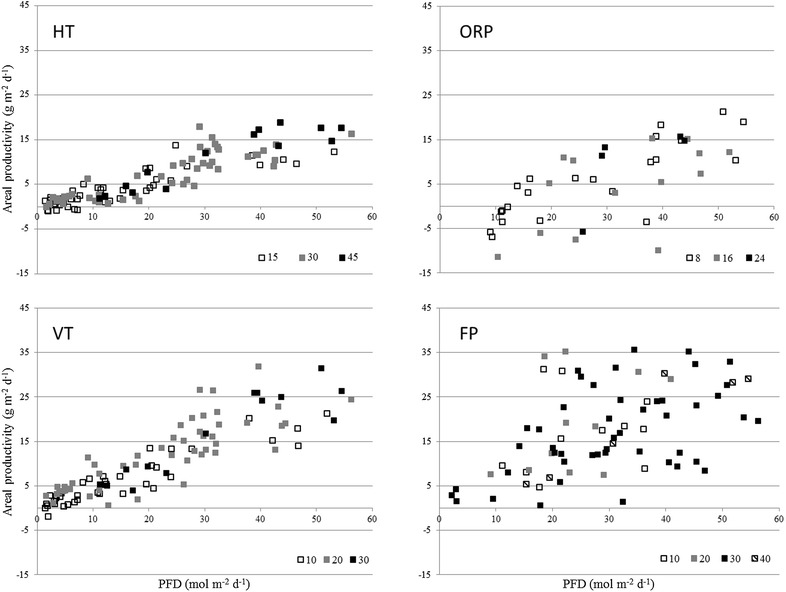
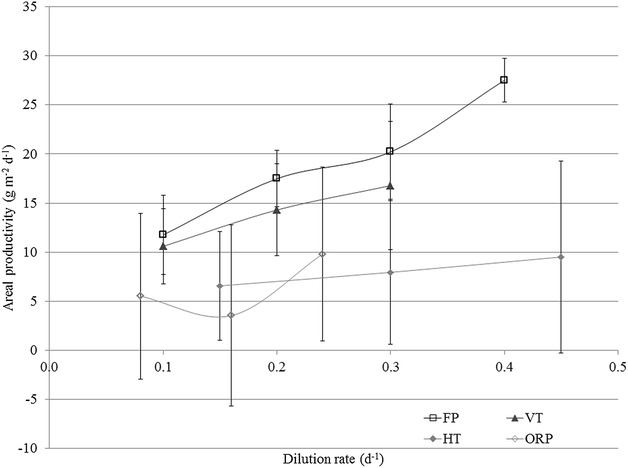
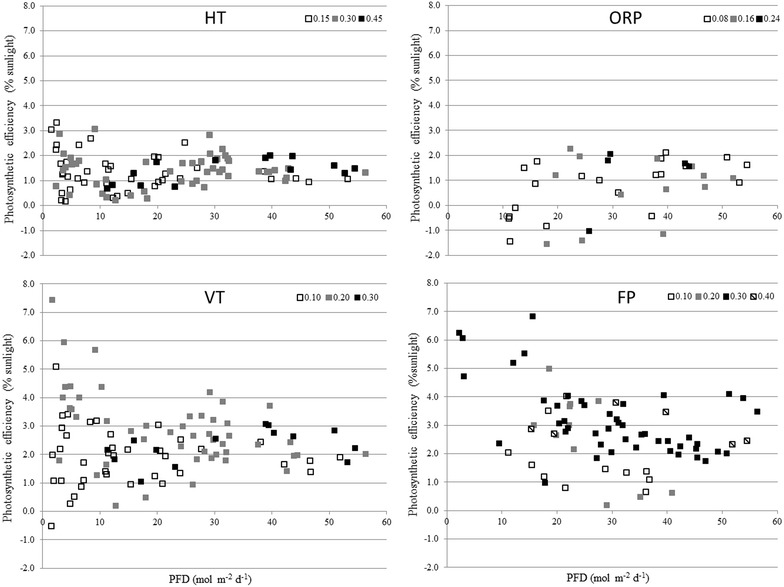
BACKGROUND: Microalgae are a potential source of sustainable commodities of fuels, chemicals and food and feed additives. The current high production costs, as a result of the low areal productivities, limit the application of microalgae in industry. A first step is determining how the different production system designs relate to each other under identical climate conditions. The productivity and photosynthetic efficiency of Nannochloropsis sp. CCAP 211/78 cultivated in four different outdoor continuously operated pilot-scale photobioreactors under the same climatological conditions were compared. The optimal dilution rate was determined for each photobioreactor by operation of the different photobioreactors at different dilution rates. RESULTS: In vertical photobioreactors, higher areal productivities and photosynthetic efficiencies, 19-24 g m(-2) day(-1) and 2.4-4.2 %, respectively, were found in comparison to the horizontal systems; 12-15 g m(-2) day(-1) and 1.5-1.8 %. The higher ground areal productivity in the vertical systems could be explained by light dilution in combination with a higher light capture. In the raceway pond low productivities were obtained, due to the long optical path in this system. Areal productivities in all systems increased with increasing photon flux densities up to a photon flux density of 30 mol m(-2) day(-1). Photosynthetic efficiencies remained constant in all systems with increasing photon flux densities. The highest photosynthetic efficiencies obtained were; 4.2 % for the vertical tubular photobioreactor, 3.8 % for the flat panel reactor, 1.8 % for the horizontal tubular reactor, and 1.5 % for the open raceway pond. CONCLUSIONS: Vertical photobioreactors resulted in higher areal productivities than horizontal photobioreactors because of the lower incident photon flux densities on the reactor surface. The flat panel photobioreactor resulted, among the vertical photobioreactors studied, in the highest average photosynthetic efficiency, areal and volumetric productivities due to the short optical path. Photobioreactor light interception should be further optimized to maximize ground areal productivity and photosynthetic efficiency.
Overview
The claims and statistics of this paper haven’t been checked yet.
Free: it reads the open-access text and checks the first 5 claims that cite a source we can check. Create a free account to check every claim.
Integrity signals
Registry
Cites
Statistics
Figures
Verification
Claims the paper makes
The claims and statistics of this paper haven’t been checked yet.
Free: it reads the open-access text and checks the first 5 claims that cite a source we can check. Create a free account to check every claim.
Claims other papers make about this one
Each is checked against this paper’s own text: does it say what the citing paper says it does?
The cited source says what the claim attributes to it.
In the citing paper
“Comparison of different photobioreactor configurations shows that for the same species (i.e., Nannochloropsis), biomass yield in raceway pond was lower 0.03–0.2 g L−1 d−1 (6.2 to 24.5 g m−2 d−1) compared to 0.12 to 0.85 g L−1 d−1 in horizontal tubes, 0.31 to 1.45 g L−1 d−1 in vertical tubes and 0.15–1.2 g L−1 d−1 in flat panel PBR [52].”
From Overview and Challenges of Large-Scale Cultivation of Photosynthetic Microalgae and Cyanobacteria (2023) · cites this paper as [52]
Self-check
Percentages, sums and reported differences re-computed from the paper’s own numbers.
The self-check needs the paper’s full text.
Citations
Cites
Chisti, Y. (2007) · Biotechnology Advances · doi:10.1016/j.biotechadv.2007.02.001 · Cited by 9,524 · cited 2×
“Diameters of the tubes vary with system orientation, diameters larger than 3 cm and smaller than 10 cm are typically used [4].”
BackgroundRodolfi, L., Chini Zittelli, G., Bassi, N., Padovani, G., Biondi, N., Bonini, G., & Tredici, M. R. (2009) · Biotechnology and Bioengineering · doi:10.1002/bit.22033 · Cited by 2,879 · cited 2×
“96 %) [15, 16].”
An outlook on microalgal biofuels
Wijffels, R. H., & Barbosa, M. J. (2010) · Science · doi:10.1126/science.1189003 · Cited by 1,886 · cited 2×
“Under identical conditions, a higher photosynthetic efficiency means a higher ground areal productivity, and thus a decrease in biomass production costs [1, 2].”
BackgroundSelf-citationDesigner synthetic media for studying microbial-catalyzed biofuel production
Tang, X., da Costa Sousa, L., Jin, M., Chundawat, S., Chambliss, C., Lau, M. W., Xiao, Z., Dale, B. E., & Balan, V. (2015) · Biotechnology for Biofuels · doi:10.1186/s13068-014-0179-6 · Cited by 889
Microalgal production — A close look at the economics
Norsker, N.-H., Barbosa, M. J., Vermuë, M. H., & Wijffels, R. H. (2011) · Biotechnology Advances · doi:10.1016/j.biotechadv.2010.08.005 · Cited by 819 · cited 5×
“5 % for open raceway pond, 3 % for horizontal tubular photobioreactors and 5 % for flat panel photobioreactors [3].”
BackgroundInfluentialSelf-citationMicroalgae for the production of bulk chemicals and biofuels
Wijffels, R. H., Barbosa, M. J., & Eppink, M. H. M. (2010) · Biofuels, Bioproducts and Biorefining · doi:10.1002/bbb.215 · Cited by 522 · cited 1×
“Under identical conditions, a higher photosynthetic efficiency means a higher ground areal productivity, and thus a decrease in biomass production costs [1, 2].”
BackgroundDetermination of biomass dry weight of marine microalgae
Zhu, C. J., & Lee, Y. K. (1997) · Journal of Applied Phycology · doi:10.1023/a:1007914806640 · Cited by 453 · cited 1×
“[25].”
Chini Zittelli, G., Lavista, F., Bastianini, A., Rodolfi, L., Vincenzini, M., & Tredici, M. R. (1999) · Journal of Biotechnology · doi:10.1016/s0168-1656(99)00082-6 · Cited by 254 · cited 2×
“[19].”
Qiang, H., Zarmi, Y., & Richmond, A. (1998) · European Journal of Phycology · doi:10.1080/09670269810001736663 · Cited by 212
Lipid and biomass production by the halotolerant microalga Nannochloropsis salina
Boussiba, S., Vonshak, A., Cohen, Z., Avissar, Y., & Richmond, A. (1987) · Biomass · doi:10.1016/0144-4565(87)90006-0 · Cited by 208 · cited 2×
“under dynamic oxygen concentrations [23].”
BackgroundOptimization of a flat plate glass reactor for mass production of Nannochloropsis sp. outdoors
Richmond, A., & Cheng-Wu, Z. (2001) · Journal of Biotechnology · doi:10.1016/s0168-1656(00)00353-9 · Cited by 199
Arbib, Z., Ruiz, J., Álvarez-Díaz, P., Garrido-Pérez, C., Barragan, J., & Perales, J. A. (2013) · Ecological Engineering · doi:10.1016/j.ecoleng.2012.12.089 · Cited by 193 · cited 3×
“[20, 21].”
A vertical alveolar panel (VAP) for outdoor mass cultivation of microalgae and cyanobacteria
Tredici, M. R., Carlozzi, P., Chini Zittelli, G., & Materassi, R. (1991) · Bioresource Technology · doi:10.1016/0960-8524(91)90147-c · Cited by 177 · cited 1×
“For HT, VT and ORP areal productivities appear to increase linearly with PFD up to 30 mol m−2 day−1, this has been reported previously by [7–10].”
BackgroundNannochloropsis production metrics in a scalable outdoor photobioreactor for commercial applications
Quinn, J. C., Yates, T., Douglas, N. J., Weyer, K. M., Butler, J., Bradley, T. H., & Lammers, P. J. (2012) · Bioresource Technology · doi:10.1016/j.biortech.2012.04.073 · Cited by 169
Cheng-Wu, Z., Zmora, O., Kopel, R., & Richmond, A. (2001) · Aquaculture · doi:10.1016/s0044-8486(00)00533-0 · Cited by 159
Efficiency of light utilization of Chlamydomonas reinhardtii under medium-duration light/dark cycles
Janssen, M., Janssen, M., de Winter, M., TRAMPER, J., Mur, L. R., Snel, J., & Wijffels, R. H. (2000) · Journal of Biotechnology · doi:10.1016/s0168-1656(99)00233-3 · Cited by 154 · cited 3×
“2 m) and long light dark cycles as a result of poor mixing in this system contribute to lower areal productivity [11–13].”
BackgroundOutdoor cultivation of lutein-rich cells of Muriellopsis sp. in open ponds
Blanco, A. M., Moreno, J., Del Campo, J. A., Rivas, J., & Guerrero, M. G. (2007) · Applied Microbiology and Biotechnology · doi:10.1007/s00253-006-0598-9 · Cited by 140 · cited 2×
“[20, 21].”
Scale-up aspects of photobioreactors: effects of mixing-induced light/dark cycles
Janssen, M., de Bresser, L., Baijens, T., TRAMPER, J., Mur, L. R., Snel, J. F. H., & Wijffels, R. H. (2000) · Journal of Applied Phycology · doi:10.1023/a:1008151526680 · Cited by 111
San Pedro, A., González-López, C. V., Acién, F. G., & Molina-Grima, E. (2014) · Bioresource Technology · doi:10.1016/j.biortech.2014.07.052 · Cited by 110 · cited 2×
“4 – [18] Almeria Spain”
Camacho-Rodríguez, J., González, A. M., Cerón-García, M. C., Fernández-Sevilla, J. M., Acién, F. G., & Grima, E. M. (2013) · Applied Microbiology and Biotechnology · doi:10.1007/s00253-013-5413-9 · Cited by 107 · cited 1×
“found similar areal productivities (10–18 g m−2 day−1) as in this study for Nannochloropsis gaditana cultivated in a horizontal tubular photobioreactor [15].”
BackgroundZou, N., & RICHMOND, A. E. (1999) · Journal of Biotechnology · doi:10.1016/s0168-1656(99)00087-5 · Cited by 101
Design and construction of the microalgal pilot facility AlgaePARC
Bosma, R., de Vree, J. H., Slegers, P. M., Janssen, M., Wijffels, R. H., & Barbosa, M. J. (2014) · Algal Research · doi:10.1016/j.algal.2014.10.006 · Cited by 90 · cited 1×
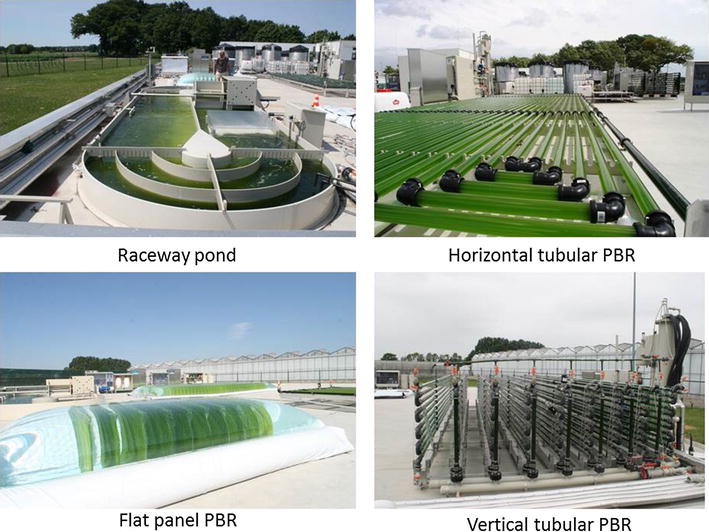
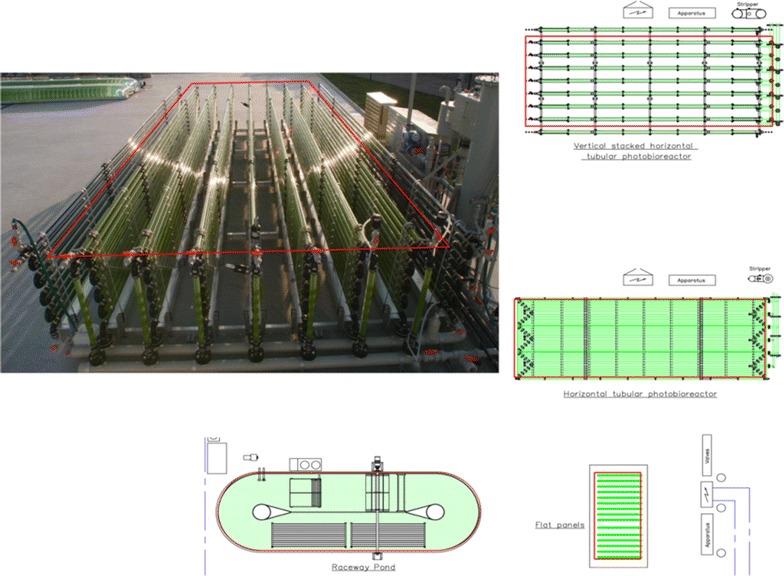
“Four photobioreactors were installed at the AlgaePARC pilot facility; an open raceway pond (OPR), a horizontal tubular photobioreactor (HT), a vertical tubular photobioreactor (VT), and a flat panel photobioreactor (FP) [6].”
BackgroundPrediction of volumetric productivity of an outdoor photobioreactor
Bosma, R., van Zessen, E., Reith, J. H., Tramper, J., & Wijffels, R. H. (2007) · Biotechnology and Bioengineering · doi:10.1002/bit.21319 · Cited by 90 · cited 1×
“For HT, VT and ORP areal productivities appear to increase linearly with PFD up to 30 mol m−2 day−1, this has been reported previously by [7–10].”
BackgroundZittelli, G. C., Pastorelli, R., & Tredici, M. R. (2000) · Journal of Applied Phycology · doi:10.1023/a:1008165606234 · Cited by 87 · cited 1×
“[17] because of a larger optical path; 0.”
BackgroundTakache, H., Pruvost, J., & Marec, H. (2015) · Algal Research · doi:10.1016/j.algal.2015.02.009 · Cited by 79 · cited 2×
“2 m) and long light dark cycles as a result of poor mixing in this system contribute to lower areal productivity [11–13].”
BackgroundSan Pedro, A., González-López, C. V., Acién, F. G., & Molina-Grima, E. (2015) · Algal Research · doi:10.1016/j.algal.2015.02.013 · Cited by 74 · cited 2×
“4 g m−2 day−1) for shallow (11 cm deep) raceway ponds [22]; the lower depth results in a smaller dark zone.”
BackgroundSousa, C., de Winter, L., Janssen, M., Vermuë, M. H., & Wijffels, R. H. (2011) · Bioresource Technology · doi:10.1016/j.biortech.2011.10.048 · Cited by 72 · cited 1×
“Similar dissolved oxygen concentrations were found inhibiting for Neochloris oleoabundans [24].”
BackgroundMichels, M. H. A., Slegers, P. M., Vermuë, M. H., & Wijffels, R. H. (2013) · Algal Research · doi:10.1016/j.algal.2013.11.011 · Cited by 67 · cited 1×
“1) [12, 14].”
Productivity analysis of outdoor chemostat culture in tubular air-lift photobioreactors
Grima, E. M., Pérez, J. A. S., García-Camacho, F., Sevilla, J. M. F., & Acién, F. G. (1996) · Journal of Applied Phycology · doi:10.1007/bf02178580 · Cited by 57 · cited 1×
“For HT, VT and ORP areal productivities appear to increase linearly with PFD up to 30 mol m−2 day−1, this has been reported previously by [7–10].”
BackgroundMicroalgal triacylglycerides production in outdoor batch-operated tubular PBRs
Benvenuti, G., Bosma, R., Klok, A. J., Ji, F., Lamers, P. P., Barbosa, M. J., & Wijffels, R. H. (2015) · Biotechnology for Biofuels · doi:10.1186/s13068-015-0283-2 · Cited by 27 · cited 1×
“[26] (HMSO, 1981; APHA/AWWA/WEF, 4500; USEPA, 19932).”
Cited by
Microalgae-Based Wastewater Treatment for Nutrients Recovery: A Review
Li, K., Liu, Q., Fang, F., Luo, R., Lu, Q., Zhou, W., Huo, S., Cheng, P., Liu, J., Addy, M., et al. (2019) · Bioresource Technology · doi:10.1016/j.biortech.2019.121934 · Cited by 737
Towards industrial products from microalgae
Ruiz, J., Olivieri, G., de Vree, J., Bosma, R., Willems, P., Reith, J. H., Eppink, M. H. M., Kleinegris, D. M. M., Wijffels, R. H., & Barbosa, M. J. (2016) · Energy & Environmental Science · doi:10.1039/c6ee01493c · Cited by 661
Spirulina – From growth to nutritional product: A review
Soni, R. A., Sudhakar, K., & Rana, R. S. (2017) · Trends in Food Science & Technology · doi:10.1016/j.tifs.2017.09.010 · Cited by 528
Design of Photobioreactors for Mass Cultivation of Photosynthetic Organisms
Huang, Q., Jiang, F., Wang, L., & Yang, C. (2017) · Engineering · doi:10.1016/j.eng.2017.03.020 · Cited by 487
“Although tubular PBRs are popular [92], they still have many disadvantages.”
BackgroundFabris, M., Abbriano, R. M., Pernice, M., Sutherland, D. L., Commault, A. S., Hall, C. C., Labeeuw, L., McCauley, J. I., Kuzhiuparambil, U., Ray, P., et al. (2020) · Frontiers in Plant Science · doi:10.3389/fpls.2020.00279 · Cited by 382
Metadata
- Authors
- de Vree, J. H., Bosma, R., Janssen, M., Barbosa, M. J., & Wijffels, R. H.
- Affiliations
- Wageningen University & Research (NL)
- Venue
- Biotechnology for Biofuels
- Published
- 2015-12
- Volume
- 8
- Issue
- 1
- Pages
- 215-215
- ISSN
- 1754-6834 (ISSN-L)
- PMC
- PMC4683866
- OpenAlex
- W2221533135
- Cited by
- 249
- References
- 30
- Citations by year
- 2026: 30 · 2025: 25 · 2024: 20 · 2023: 27 · 2022: 25 · 2021: 30 · 2020: 27 · 2019: 21 · 2018: 18 · 2017: 17 · 2016: 9
- FWCI
- 4.34
- Type
- journal article
- Language
- en
- Open access
- gold
- doi.org
- Licence
- cc-by
- Locations
- Biotechnology for Biofuels (publishedVersion, cc-by)
- PubMed Central (publishedVersion, cc-by)
- PubMed (publishedVersion)
- Socio-Environmental Systems Modeling (acceptedVersion, cc-by)
- NORA - Norwegian Open Research Archives (submittedVersion, cc-by)
- Data Archiving and Networked Services (DANS) (submittedVersion, cc-by)
- Funders
- Exxon Mobil Corporation
- Saudi Basic Industries Corporation
- Ministerie van Economische Zaken, Landbouw en Innovatie
- Topics
- Physical Sciences › Energy › Renewable Energy, Sustainability and the Environment › Algal biology and biofuel production
- Physical Sciences › Environmental Science › Environmental Chemistry › Aquatic Ecosystems and Phytoplankton Dynamics
- Life Sciences › Agricultural and Biological Sciences › Aquatic Science › Innovations in Aquaponics and Hydroponics Systems
- Keywords
- outdoor photobioreactor, microalgae cultivation, Nannochloropsis, areal productivity, photosynthetic efficiency, raceway ponds, tubular photobioreactor, flat panel photobioreactor, dilution rate, photon flux density, light interception, optical path
About these checks
Registry, retraction, Cites and statistics results are computed, not judged, with one exception: a printed reference that no index lists is read once by a model before it counts as a citation error. Claims are extracted by a model and kept only when their quote appears verbatim in the text; each cited source is then checked, with a model’s help, for whether it says what the claim relies on. Those verdicts can be wrong — read the claim’s quote and the cited source before relying on one.
Statistics and arithmetic are recomputed, not judged.
Confidence bands are shown only for fields calibrated on our annotated test set. None is calibrated yet, so no band is shown.
What counts as a claim ›How we measure confidence ›How we check this ›
Are you an author, or do you see a problem with this page? Request a review
Data sources
Bibliographic data: Semantic Scholar, OpenAlex, Crossref.
Contains information from the Semantic Scholar Academic Graph Datasets, made available under the ODC Attribution License (ODC-BY 1.0).
Semantic Scholar’s data is described in: Kinney, R., et al. (2023). The Semantic Scholar Open Data Platform. arXiv:2301.10140.
