

The DOI matches its Crossref record; 107 of the 107 references it cites were found in a registry or an index.
Microbial synthesis of poly-γ-glutamic acid: current progress, challenges, and future perspectives
Open accessAbstract
Poly-γ-glutamic acid (γ-PGA) is a naturally occurring biopolymer made from repeating units of l-glutamic acid, d-glutamic acid, or both. Since some bacteria are capable of vigorous γ-PGA biosynthesis from renewable biomass, γ-PGA is considered a promising bio-based chemical and is already widely used in the food, medical, and wastewater industries due to its biodegradable, non-toxic, and non-immunogenic properties. In this review, we consider the properties, biosynthetic pathway, production strategies, and applications of γ-PGA. Microbial biosynthesis of γ-PGA and the molecular mechanisms regulating production are covered in particular detail. Genetic engineering and optimization of the growth medium, process control, and downstream processing have proved to be effective strategies for lowering the cost of production, as well as manipulating the molecular mass and conformational/enantiomeric properties that facilitate screening of competitive γ-PGA producers. Finally, future prospects of microbial γ-PGA production are discussed in light of recent progress, challenges, and trends in this field.
Overview
The claims and statistics of this paper haven’t been checked yet.
Run the check — free, no account needed. It reads the open-access text and checks the sources it cites.
Integrity signals
Registry
Cites
Statistics
Figures

Verification
Claims the paper makes
The claims and statistics of this paper haven’t been checked yet.
Run the check — free, no account needed. It reads the open-access text and checks the sources it cites.
Claims other papers make about this one
Each is checked against this paper’s own text: does it say what the citing paper says it does?
The cited source says what the claim attributes to it.
In the citing paper
“Gamma-polyglutamic acid (γ-PGA) is a non-toxic and biodegradable biopolymer produced by several species of Bacillus, including B. licheniformis and B. subtilis [12,13].”
From Soy Molasses as Culture Medium for Bacillus Species Aiming at Plant Growth Promotion (2024) · cites this paper as [12]
Self-check
Percentages, sums and reported differences re-computed from the paper’s own numbers.
The self-check needs the paper’s full text.
Citations
Cites
The production of poly-(γ-glutamic acid) from microorganisms and its various applications
Shih, I.-L., & Van, Y.-T. (2001) · Bioresource Technology · doi:10.1016/s0960-8524(01)00074-8 · Cited by 579 · cited 8×
“Animal feed additives Increasing egg-shells strength; decreasing body fat, etc [1]”
BackgroundMethodInfluentialPoly (glutamic acid) – An emerging biopolymer of commercial interest
Bajaj, I., & Singhal, R. (2011) · Bioresource Technology · doi:10.1016/j.biortech.2011.02.047 · Cited by 372 · cited 1×
“Surprisingly, only a small number of mini reviews on the biosynthesis and applications of γ-PGA have been published to date [1, 6–9].”
BackgroundPoly-γ-glutamic acid: production, properties and applications
Ogunleye, A., Bhat, A. R., Irorere, V. U., Hill, D., Williams, C. D., & Radecka, I. (2014) · Microbiology · doi:10.1099/mic.0.081448-0 · Cited by 360
Poly‐gamma‐glutamate in bacteria
Candela, T., & Fouet, A. (2006) · Molecular Microbiology · doi:10.1111/j.1365-2958.2006.05179.x · Cited by 341 · cited 3×
“For example, γ-PGA containing only l or d enantiomers is soluble in ethanol, whereas γ-PGA containing equimolar amounts of l and d precipitates in ethanol [6].”
BackgroundBuescher, J. M., & Margaritis, A. (2007) · Critical Reviews in Biotechnology · doi:10.1080/07388550601166458 · Cited by 275 · cited 8×
“A lot of research has been carried out on the molecular biology (genes, enzymes, pathways) of γ-PGA and its biosynthesis in different organisms, some of which have been applied to improving its production [7, 8, 73].”
BackgroundInfluentialStanley, N. R., & Lazazzera, B. A. (2005) · Molecular Microbiology · doi:10.1111/j.1365-2958.2005.04746.x · Cited by 264
Natural and edible biopolymer poly‐γ‐glutamic acid: synthesis, production, and applications
Sung, M., Park, C., Kim, C., Poo, H., Soda, K., & Ashiuchi, M. (2005) · The Chemical Record · doi:10.1002/tcr.20061 · Cited by 238 · cited 2×
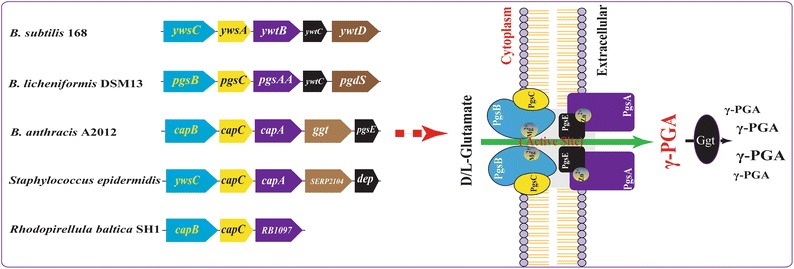
“Recently, pgsBCA was identified as the sole machinery responsible for polymerizing γ-PGA at the active site of the synthase complex (PgsBCA) in an ATP-dependent reaction [25].”
BackgroundKey role of poly-γ-dl-glutamic acid in immune evasion and virulence of Staphylococcus epidermidis
Kocianova, S., Vuong, C., Yao, Y., Voyich, J. M., Fischer, E. R., DeLeo, F. R., & Otto, M. (2005) · Journal of Clinical Investigation · doi:10.1172/jci200523523 · Cited by 230
Paclitaxel poliglumex (XYOTAX™, CT-2103): A macromolecular taxane
Singer, J. W. (2005) · Journal of Controlled Release · doi:10.1016/j.jconrel.2005.09.033 · Cited by 225
Microbial Degradation of Poly(amino acid)s
Obst, M., & Steinbüchel, A. (2004) · Biomacromolecules · doi:10.1021/bm049949u · Cited by 191 · cited 1×
“γ‐PGA degradation There are two enzymes capable of degrading γ-PGA in Bacilli: endo-γ-glutamyl peptidase and exo-γ-glutamyl peptidase [33].”
Background
Research works printed but not linked: 2
- Sanda F, Fujiyama T, Endo T. Chemical synthesis of poly-gamma-glutamic acid by polycondensation of gamma-glutamic acid dimer: synthesis and reaction of poly-gamma-glutamic acid methyl ester. J Polym Sci Polym Chem. 2001;39:732–41. · DOI
- Perez-Camero G, Congregado F, Bou JJ, Munoz-Guerra S. Biosynthesis and ultrasonic degradation of bacterial poly(gamma-glutamic acid). Biotechnol Bioeng. 1999;63:110–5. · DOI
Cited by
Bacterial biopolymers: from pathogenesis to advanced materials
Moradali, M. F., & Rehm, B. H. A. (2020) · Nature Reviews Microbiology · doi:10.1038/s41579-019-0313-3 · Cited by 459
Gu, Y. M., Xu, X., Wu, Y., Niu, T., Liu, Y., Li, J., Du, G., & Liu, L. (2018) · Metabolic Engineering · doi:10.1016/j.ymben.2018.05.006 · Cited by 218
Zhang, S., Wang, J., & Jiang, H. (2020) · Food Chemistry · doi:10.1016/j.foodchem.2020.128860 · Cited by 183
Das, S., Chakraborty, J., Chatterjee, S., & Kumar, H. (2018) · Environmental Science Nano · doi:10.1039/c8en00799c · Cited by 164
Park, S.-B., Sung, M., Uyama, H., & Han, D. K. (2020) · Progress in Polymer Science · doi:10.1016/j.progpolymsci.2020.101341 · Cited by 144
Metadata
- Authors
- Luo, Z., Guo, Y., Liu, J., Qiu, H., Zhao, M., Zou, W., & Li, S.
- Affiliations
- Guangxi University (CN)
- Guangxi Academy of Sciences (CN)
- Sichuan University of Science and Engineering (CN)
- Corresponding author
- Zou, Wei
- Li, Shubo
- Venue
- Biotechnology for Biofuels
- Published
- 2016-06-29
- Volume
- 9
- Issue
- 1
- Pages
- 134-134
- ISSN
- 1754-6834 (ISSN-L)
- PMC
- PMC4928254
- OpenAlex
- W2468943383
- Cited by
- 274
- References
- 107
- Citations by year
- 2026: 16 · 2025: 27 · 2024: 35 · 2023: 33 · 2022: 48 · 2021: 21 · 2020: 23 · 2019: 32 · 2018: 23 · 2017: 14 · 2016: 2
- FWCI
- 2.14
- Type
- journal article
- Language
- en
- Open access
- gold
- doi.org
- Licence
- cc-by
- Locations
- Biotechnology for Biofuels (publishedVersion, cc-by)
- PubMed Central (publishedVersion, cc-by)
- PubMed (publishedVersion)
- Funders
- Fund of Guangxi Academy of Sciences (15YJ22SW05)
- Bagui Scholars Distinguished Professor” Special Project
- the Talents introduction program of Sichuan University of Science and Engineering (No. 2013RC12)
- Topics
- Life Sciences › Immunology and Microbiology › Applied Microbiology and Biotechnology › Biopolymer Synthesis and Applications
- Physical Sciences › Materials Science › Biomaterials › biodegradable polymer synthesis and properties
- Life Sciences › Biochemistry, Genetics and Molecular Biology › Molecular Biology › Microbial Metabolic Engineering and Bioproduction
- Keywords
- poly-γ-glutamic acid, microbial production, biopolymer production, genetic engineering, fermentation medium optimization, downstream processing, biodegradable polymers, bio-based chemicals, production cost reduction
About these checks
Registry, retraction, Cites and statistics results are computed, not judged, with one exception: a printed reference that no index lists is read once by a model before it counts as a citation error. Claims are extracted by a model and kept only when their quote appears verbatim in the text; each cited source is then checked, with a model’s help, for whether it says what the claim relies on. Those verdicts can be wrong — read the claim’s quote and the cited source before relying on one.
Statistics and arithmetic are recomputed, not judged.
Confidence bands are shown only for fields calibrated on our annotated test set. None is calibrated yet, so no band is shown.
What counts as a claim ›How we measure confidence ›How we check this ›
Are you an author, or do you see a problem with this page? Request a review
How to cite
Cite CoChat for the checks on this page, and the paper for its own findings.
- This page
- CoChat. (2026). Citation check: Microbial synthesis of poly-γ-glutamic acid: current progress, challenges, and future perspectives. https://app.cochat.ai/papers/10.1186/s13068-016-0537-7
- The paper
- Luo, Z., Guo, Y., Liu, J., Qiu, H., Zhao, M., Zou, W., & Li, S. (2016). Microbial synthesis of poly-γ-glutamic acid: current progress, challenges, and future perspectives. Biotechnology for Biofuels. https://doi.org/10.1186/s13068-016-0537-7
Data sources
Bibliographic data: Semantic Scholar, OpenAlex, Crossref.
Contains information from the Semantic Scholar Academic Graph Datasets, made available under the ODC Attribution License (ODC-BY 1.0).
Semantic Scholar’s data is described in: Kinney, R., et al. (2023). The Semantic Scholar Open Data Platform. arXiv:2301.10140.
