

A novel Ruminococcus gnavus clade enriched in inflammatory bowel disease patients
Open accessThe DOI matches its Crossref record; 33 of the 33 references it cites were found in a registry or an index.
Abstract
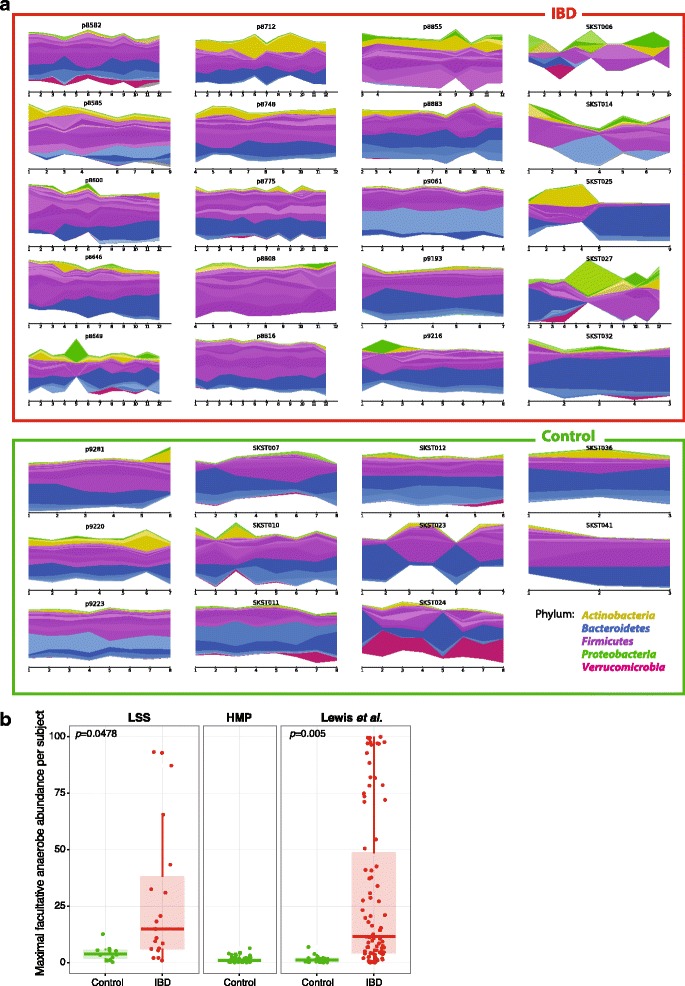
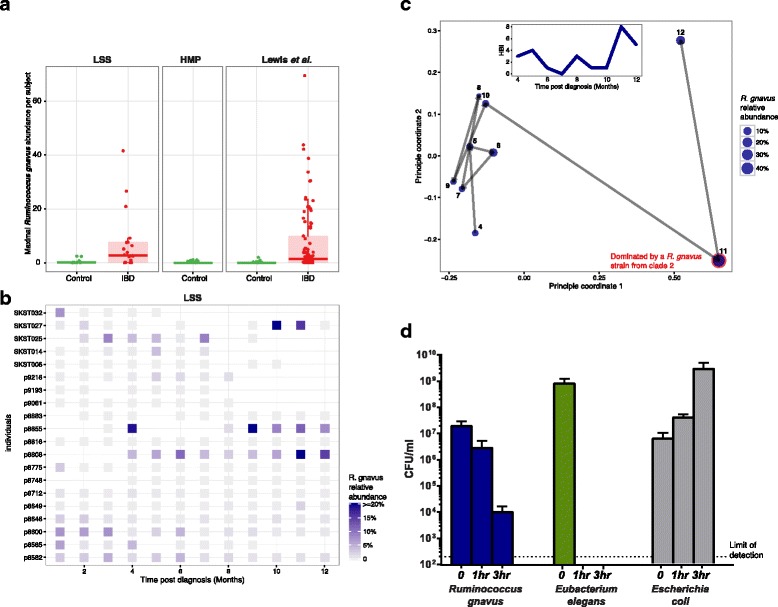
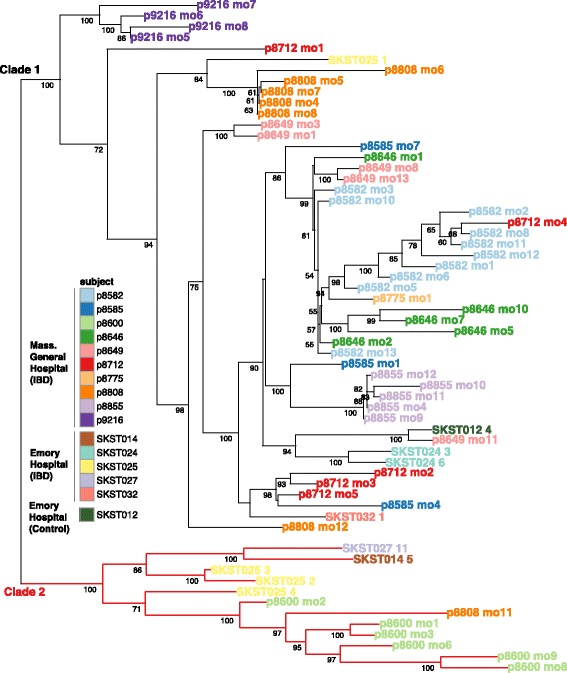
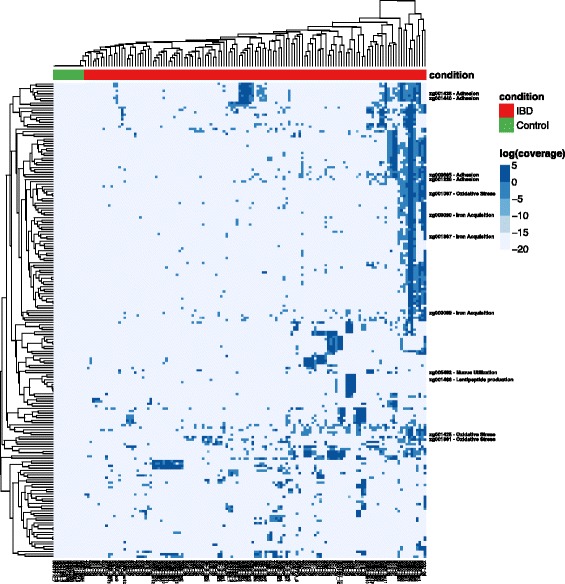
BACKGROUND: Inflammatory bowel disease (IBD) is characterized by chronic inflammation of the gastrointestinal tract that is associated with changes in the gut microbiome. Here, we sought to identify strain-specific functional correlates with IBD outcomes. METHODS: We performed metagenomic sequencing of monthly stool samples from 20 IBD patients and 12 controls (266 total samples). These were taxonomically profiled with MetaPhlAn2 and functionally profiled using HUMAnN2. Differentially abundant species were identified using MaAsLin and strain-specific pangenome haplotypes were analyzed using PanPhlAn. RESULTS: We found a significantly higher abundance in patients of facultative anaerobes that can tolerate the increased oxidative stress of the IBD gut. We also detected dramatic, yet transient, blooms of Ruminococcus gnavus in IBD patients, often co-occurring with increased disease activity. We identified two distinct clades of R. gnavus strains, one of which is enriched in IBD patients. To study functional differences between these two clades, we augmented the R. gnavus pangenome by sequencing nine isolates from IBD patients. We identified 199 IBD-specific, strain-specific genes involved in oxidative stress responses, adhesion, iron-acquisition, and mucus utilization, potentially conferring an adaptive advantage for this R. gnavus clade in the IBD gut. CONCLUSIONS: This study adds further evidence to the hypothesis that increased oxidative stress may be a major factor shaping the dysbiosis of the microbiome observed in IBD and suggests that R. gnavus may be an important member of the altered gut community in IBD.
Overview
The claims and statistics of this paper haven’t been checked yet.
Free: it reads the open-access text and checks the first 5 claims that cite a source we can check. Create a free account to check every claim.
Integrity signals
Registry
Cites
Statistics
Figures
Verification
Claims the paper makes
The claims and statistics of this paper haven’t been checked yet.
Free: it reads the open-access text and checks the first 5 claims that cite a source we can check. Create a free account to check every claim.
Claims other papers make about this one
Each is checked against this paper’s own text: does it say what the citing paper says it does?
The cited source says what the claim attributes to it.
In the citing paper
“whereas the presence of Ruminococcus gnavus as a biomarker of nonresponders in PRIMM-UK is in line with multiple reports of its association with poor cardiometabolic health20 and several diseases24–26.”
From Cross-cohort gut microbiome associations with immune checkpoint inhibitor response in advanced melanoma (2022) · cites this paper as [24]
Self-check
Percentages, sums and reported differences re-computed from the paper’s own numbers.
The self-check needs the paper’s full text.
Citations
Cites
Structure, function and diversity of the healthy human microbiome
The Human Microbiome Project Consortium (2012) · Nature · doi:10.1038/nature11234 · Cited by 11,726
Self-citationThe Treatment-Naive Microbiome in New-Onset Crohn’s Disease
Gevers, D., Kugathasan, S., Denson, L. A., Vázquez-Baeza, Y., Van Treuren, W., Ren, B., Schwager, E., Knights, D., Song, S. J., Yassour, M., et al. (2014) · Cell Host & Microbe · doi:10.1016/j.chom.2014.02.005 · Cited by 3,220 · cited 1×
“[20] cohort may be due to a combination of age (20–66 years here, 3–17 years in Gevers et al.”
BackgroundSelf-citationDysfunction of the intestinal microbiome in inflammatory bowel disease and treatment
Morgan, X. C., Tickle, T. L., Sokol, H., Gevers, D., Devaney, K. L., Ward, D. V., Reyes, J. A., Shah, S. A., LeLeiko, N., Snapper, S. B., et al. (2012) · Genome Biology · doi:10.1186/gb-2012-13-9-r79 · Cited by 2,713 · cited 1×
“Additionally, the gut microbiome in IBD shows dysbiosis characterized by increased abundance of functional pathways involved in the microbial response to oxidative stress [5].”
BackgroundSelf-citationGenetics and pathogenesis of inflammatory bowel disease
Khor, B., Gardet, A., & Xavier, R. J. (2011) · Nature · doi:10.1038/nature10209 · Cited by 2,614
Self-citationMetaPhlAn2 for enhanced metagenomic taxonomic profiling
Truong, D. T., Franzosa, E. A., Tickle, T. L., Scholz, M., Weingart, G., Pasolli, E., Tett, A., Huttenhower, C., & Segata, N. (2015) · Nature Methods · doi:10.1038/nmeth.3589 · Cited by 2,185 · cited 4×
“Community composition was calculated with MetaPhlan2 [16] using the default settings.”
MethodInfluentialSelf-citationThe Long-Term Stability of the Human Gut Microbiota
Faith, J. J., Guruge, J. L., Charbonneau, M., Subramanian, S., Seedorf, H., Goodman, A. L., Clemente, J. C., Knight, R., Heath, A. C., Leibel, R. L., et al. (2013) · Science · doi:10.1126/science.1237439 · Cited by 2,058
Metabolic Reconstruction for Metagenomic Data and Its Application to the Human Microbiome
Abubucker, S., Segata, N., Goll, J., Schubert, A. M., Izard, J., Cantarel, B. L., Rodriguez-Mueller, B., Zucker, J., Thiagarajan, M., Henrissat, B., et al. (2012) · PLoS Computational Biology · doi:10.1371/journal.pcbi.1002358 · Cited by 1,056 · cited 1×
“Functional and pathway composition was calculated with HUMANn2 [17] using the UniRef90 database with default settings.”
MethodSelf-citationYassour, M., Vatanen, T., Siljander, H., Hämäläinen, A.-M., Härkönen, T., Ryhänen, S. J., Franzosa, E. A., Vlamakis, H., Huttenhower, C., Gevers, D., et al. (2016) · Science Translational Medicine · doi:10.1126/scitranslmed.aad0917 · Cited by 1,043 · cited 4×
“(XLSX 9 kb) Additional file 6: Figure S1.”
BackgroundInfluentialSelf-citationCorrelation between intraluminal oxygen gradient and radial partitioning of intestinal microbiota
Albenberg, L., Esipova, T. V., Judge, C. P., Bittinger, K., Chen, J., Laughlin, A., Grunberg, S., Baldassano, R. N., Lewis, J. D., Li, H., et al. (2014) · Gastroenterology · doi:10.1053/j.gastro.2014.07.020 · Cited by 886 · cited 1×
“[18] and expanded for abundant genera in our samples (Additional file 2: Table S2).”
BackgroundMicrobial strain-level population structure and genetic diversity from metagenomes
Truong, D. T., Tett, A., Pasolli, E., Huttenhower, C., & Segata, N. (2017) · Genome Research · doi:10.1101/gr.216242.116 · Cited by 839 · cited 6×
“While strain-level profiling using StrainPhlAn was carried out for 72 species of the gut microbiome with sufficient coverage, R. gnavus was the only species detected to have an IBD-specific strain.”
MethodInfluentialSelf-citationLewis, J. D., Chen, E. Z., Baldassano, R. N., Otley, A. R., Griffiths, A. M., Lee, D., Bittinger, K., Bailey, A., Friedman, E. S., Hoffmann, C., et al. (2015) · Cell Host & Microbe · doi:10.1016/j.chom.2015.09.008 · Cited by 823 · cited 5×
“(n = 368) [13], and HMP (n = 80) [15] cohorts.”
BackgroundMethodInfluentialMining the Human Gut Microbiota for Immunomodulatory Organisms
Geva-Zatorsky, N., Sefik, E., Kua, L., Pasman, L., Tan, T. G., Ortiz-Lopez, A., Yanortsang, T. B., Yang, L., Jupp, R., Mathis, D., et al. (2017) · Cell · doi:10.1016/j.cell.2017.01.022 · Cited by 762 · cited 2×
“For example, different strains of the same species can provoke different host immune responses [8], and in the context of IBD, analysis of Escheri-”
BackgroundIdentifying personal microbiomes using metagenomic codes
Franzosa, E. A., Huang, K., Meadow, J. F., Gevers, D., Lemon, K. P., Bohannan, B. J. M., & Huttenhower, C. (2015) · Proceedings of the National Academy of Sciences · doi:10.1073/pnas.1423854112 · Cited by 497
Self-citationThe Many Faces of Glutathione in Bacteria
Masip, L., Veeravalli, K., & Georgiou, G. (2006) · Antioxidants & Redox Signaling · doi:10.1089/ars.2006.8.753 · Cited by 477
Seril, D. N. (2003) · Carcinogenesis · doi:10.1093/carcin/24.3.353 · Cited by 467
Dysbiosis in inflammatory bowel diseases: the oxygen hypothesis
Rigottier-Gois, L. (2013) · The ISME Journal · doi:10.1038/ismej.2013.80 · Cited by 439 · cited 1×
“The results presented here are concordant with the hypothesis that a major feature of the dysbiosis of the gut microbiome in IBD is a shift towards organisms that can cope with increased oxidative stress [27].”
ResultStrain-level microbial epidemiology and population genomics from shotgun metagenomics
Scholz, M., Ward, D. V., Pasolli, E., Tolio, T., Zolfo, M., Asnicar, F., Truong, D. T., Tett, A., Morrow, A. L., & Segata, N. (2016) · Nature Methods · doi:10.1038/nmeth.3802 · Cited by 376 · cited 5×
“Strain-level analysis was performed using StrainPhlAn [7] with the default parameters and PanPhlAn [6] with (–min_coverage 1 –left_max 1.”
MethodInfluentialLiu, C., Finegold, S. M., Song, Y., & Lawson, P. A. (2008) · INTERNATIONAL JOURNAL OF SYSTEMATIC AND EVOLUTIONARY MICROBIOLOGY · doi:10.1099/ijs.0.65208-0 · Cited by 358 · cited 1×
“[21], it has been recently transferred to the Blautia genus based on 16S rRNA gene sequencing [32, 33].”
MethodCiobica, A., Balmus, I., Trifan, A., & Stanciu, C. (2016) · Saudi Journal of Gastroenterology · doi:10.4103/1319-3767.173753 · Cited by 292
Shaw, K. A., Bertha, M., Hofmekler, T., Chopra, P., Vatanen, T., Srivatsa, A., Prince, J., Kumar, A., Sauer, C., Zwick, M. E., et al. (2016) · Genome Medicine · doi:10.1186/s13073-016-0331-y · Cited by 277 · cited 2×
“All selected UC cases were categorized as non-responders to treatment [14].”
BackgroundMethodSelf-citationMOORE, W. E. C., JOHNSON, J. L., & HOLDEMAN, L. V. (1976) · International Journal of Systematic Bacteriology · doi:10.1099/00207713-26-2-238 · Cited by 234 · cited 2×
“[21], it has been recently transferred to the Blautia genus based on 16S rRNA gene sequencing [32, 33].”
BackgroundMethodMartinez-Medina, M., & Garcia-Gil, L. J. (2014) · World Journal of Gastrointestinal Pathophysiology · doi:10.4291/wjgp.v5.i3.213 · Cited by 223
Fuentes, S., Rossen, N. G., van der Spek, M. J., Hartman, J. H. A., Huuskonen, L., Korpela, K., Salojärvi, J., Aalvink, S., de Vos, W. M., D’Haens, G. R., et al. (2017) · The ISME Journal · doi:10.1038/ismej.2017.44 · Cited by 223 · cited 1×
“gnavus were more likely to relapse [31], suggesting a causal role in disease.”
BackgroundTailford, L. E., Owen, C. D., Walshaw, J., Crost, E. H., Hardy-Goddard, J., Le Gall, G., de Vos, W. M., Taylor, G. L., & Juge, N. (2015) · Nature Communications · doi:10.1038/ncomms8624 · Cited by 183
Dabard, J., Bridonneau, C., Phillipe, C., Anglade, P., Molle, D., Nardi, M., Ladiré, M., Girardin, H., Marcille, F., Gomez, A., et al. (2001) · Applied and Environmental Microbiology · doi:10.1128/aem.67.9.4111-4118.2001 · Cited by 178 · cited 1×
“gnavus are known to produce the lantipeptide ruminococcin A, which inhibits the colonization of Clostridium species [26].”
BackgroundIron deficiency anemia in inflammatory bowel disease
Kaitha, S., Bashir, M., & Ali, T. (2015) · World Journal of Gastrointestinal Pathophysiology · doi:10.4291/wjgp.v6.i3.62 · Cited by 161 · cited 1×
“Additional genes involved in iron acquisition could be adaptive for colonization of the IBD gut because anemia is common in patients with IBD [24].”
BackgroundHigh-throughput automated microfluidic sample preparation for accurate microbial genomics
Kim, S., Jonghe, J. D., Kulesa, A. B., Feldman, D., Vatanen, T., Bhattacharyya, R. P., Berdy, B. M., Gomez, J. E., Nolan, J., Epstein, S. S., et al. (2017) · Nature Communications · doi:10.1038/ncomms13919 · Cited by 121 · cited 1×
“gnavus strains using a previously described automated microfluidic sample preparation device [19].”
MethodSelf-citationReclassification of Ruminococcus obeum as Blautia obeum comb. nov.
Lawson, P. A., & Finegold, S. M. (2015) · International Journal of Systematic and Evolutionary Microbiology · doi:10.1099/ijs.0.000015 · Cited by 61 · cited 1×
“[21], it has been recently transferred to the Blautia genus based on 16S rRNA gene sequencing [32, 33].”
Two Cases of Ruminococcus gnavus Bacteremia Associated with Diverticulitis
Hansen, S. G. K., Skov, M. N., & Justesen, U. S. (2013) · Journal of Clinical Microbiology · doi:10.1128/jcm.03382-12 · Cited by 58
Poulsen, N. A., Andersen, V., Møller, J. C., Møller, H. S., Jessen, F., Purup, S., & Larsen, L. B. (2012) · BMC Gastroenterology · doi:10.1186/1471-230x-12-76 · Cited by 53
Nishiyama, Y., Massey, V., Takeda, K., Kawasaki, S., Sato, J., Watanabe, T., & Niimura, Y. (2001) · Journal of Bacteriology · doi:10.1128/jb.183.8.2431-2438.2001 · Cited by 47 · cited 1×
“extra protection against oxidative stress in the IBD gut [22].”
BackgroundRuminococcus gnavus Total Hip Arthroplasty Infection in a 62-Year-Old Man with Ulcerative Colitis
Roux, A., Sayed, F. E., Duffiet, P., Bauer, T. W., Heym, B., Herrmann, J., Herrmann, J., & Rottman, M. (2015) · Journal of Clinical Microbiology · doi:10.1128/jcm.03040-14 · Cited by 28
A bloodstream infection by Ruminococcus gnavus in a patient with a gall bladder perforation
Kim, Y. J., Kang, H. Y., Han, Y., Lee, M. S., & Lee, H. J. (2017) · Anaerobe · doi:10.1016/j.anaerobe.2017.05.007 · Cited by 26
Cited by
Multi-omics of the gut microbial ecosystem in inflammatory bowel diseases
Lloyd-Price, J., Arze, C., Ananthakrishnan, A. N., Schirmer, M., Avila-Pacheco, J., Poon, T. W., Andrews, E., Ajami, N. J., Bonham, K. S., Brislawn, C. J., et al. (2019) · Nature · doi:10.1038/s41586-019-1237-9 · Cited by 3,143
Self-citationGut microbiota-derived metabolites as key actors in inflammatory bowel disease
Lavelle, A., & Sokol, H. (2020) · Nature Reviews Gastroenterology & Hepatology · doi:10.1038/s41575-019-0258-z · Cited by 2,015
Role of gut microbiota in type 2 diabetes pathophysiology
Gurung, M., Li, Z., You, H., Rodrigues, R., Jump, D. B., Morgun, A., & Shulzhenko, N. (2020) · EBioMedicine · doi:10.1016/j.ebiom.2019.11.051 · Cited by 1,708
“Potentially detrimental microbes in T2D (pathobionts), like Fusobacterium nucleatum and Ruminococcus gnavus can increase several inflammatory cytokines, albeit in other inflammatory diseases [103,104].”
BackgroundBlanco-Míguez, A., Beghini, F., Cumbo, F., McIver, L. J., Thompson, K. N., Zolfo, M., Manghi, P., Dubois, L., Huang, K. D., Thomas, A. M., et al. (2023) · Nature Biotechnology · doi:10.1038/s41587-023-01688-w · Cited by 1,442
Self-citationThe Integrative Human Microbiome Project
The Integrative HMP (iHMP) Research Network Consortium, Proctor, L. M., Creasy, H. H., Fettweis, J. M., Lloyd-Price, J., Mahurkar, A., Zhou, W., Buck, G. A., Snyder, M. P., Strauss, J. F., et al. (2019) · Nature · doi:10.1038/s41586-019-1238-8 · Cited by 1,381
Self-citation
Metadata
- Authors
- Hall, A. B., Yassour, M., Sauk, J., Garner, A., Jiang, X., Arthur, T., Lagoudas, G. K., Vatanen, T., Fornelos, N., Wilson, R., Bertha, M., Cohen, M., Garber, J., Khalili, H., Gevers, D., Ananthakrishnan, A. N., Kugathasan, S., Lander, E. S., Blainey, P., Vlamakis, H., Xavier, R. J., & Huttenhower, C.
- Affiliations
- Broad Institute (US)
- Harvard University (US)
- Emory University (US)
- Corresponding author
- Xavier, Ramnik J.
- Huttenhower, Curtis
- ORCID
- Venue
- Genome Medicine
- Published
- 2017-11-28
- Volume
- 9
- Issue
- 1
- Pages
- 103-103
- ISSN
- 1756-994X (ISSN-L)
- PMC
- PMC5704459
- OpenAlex
- W2769664962
- Cited by
- 777
- References
- 33
- Citations by year
- 2026: 74 · 2025: 115 · 2024: 134 · 2023: 110 · 2022: 106 · 2021: 96 · 2020: 69 · 2019: 55 · 2018: 16
- FWCI
- 15.64
- Type
- journal article
- Language
- en
- Open access
- gold
- doi.org
- Licence
- cc-by
- creativecommons.org/licenses/by/4.0/ (tdm)
- creativecommons.org/licenses/by/4.0/ (vor)
- Locations
- Genome Medicine (publishedVersion, cc-by)
- Europe PMC (PubMed Central) (publishedVersion, cc-by)
- PubMed Central (publishedVersion, cc-by)
- PubMed (publishedVersion)
- Digital Access to Scholarship at Harvard (DASH) (Harvard University) (submittedVersion, cc-by)
- DOAJ (DOAJ: Directory of Open Access Journals) (submittedVersion)
- ResearchSpace (University of Auckland) (submittedVersion, cc-by)
- Funders
- National Institutes of Health (U54DE023798)
- National Science Foundation (MCB-1453942)
- Crohn's and Colitis Foundation of America
- Helen Hay Whitney Foundation
- Charles A. King Trust
- Klarman Family Foundation
- National Institute of Diabetes and Digestive and Kidney Diseases (R01DK92405, P30DK43351)
- Topics
- Life Sciences › Biochemistry, Genetics and Molecular Biology › Molecular Biology › Gut microbiota and health
- Health Sciences › Medicine › Gastroenterology › Inflammatory Bowel Disease
- Health Sciences › Medicine › Infectious Diseases › Clostridium difficile and Clostridium perfringens research
- Keywords
- Ruminococcus gnavus, inflammatory bowel disease, gut microbiota, strain-specific genes, pan-genome, oxidative stress response, facultative anaerobes, iron acquisition, adhesion genes, dysbiosis, disease activity
- MeSH terms
- Gastrointestinal Microbiome, Adult, Aged, Feces, Humans, Middle Aged, Phylogeny, Species Specificity, Inflammatory Bowel Diseases, Genome, Bacterial, Oxidative Stress, Ruminococcus, Young Adult
About these checks
Registry, retraction, Cites and statistics results are computed, not judged, with one exception: a printed reference that no index lists is read once by a model before it counts as a citation error. Claims are extracted by a model and kept only when their quote appears verbatim in the text; each cited source is then checked, with a model’s help, for whether it says what the claim relies on. Those verdicts can be wrong — read the claim’s quote and the cited source before relying on one.
Statistics and arithmetic are recomputed, not judged.
Confidence bands are shown only for fields calibrated on our annotated test set. None is calibrated yet, so no band is shown.
What counts as a claim ›How we measure confidence ›How we check this ›
Are you an author, or do you see a problem with this page? Request a review
Data sources
Bibliographic data: Semantic Scholar, OpenAlex, Crossref.
Contains information from the Semantic Scholar Academic Graph Datasets, made available under the ODC Attribution License (ODC-BY 1.0).
Semantic Scholar’s data is described in: Kinney, R., et al. (2023). The Semantic Scholar Open Data Platform. arXiv:2301.10140.
