

Deep learning in cancer diagnosis, prognosis and treatment selection
Open accessThe DOI matches its Crossref record; 174 of the 175 references it cites were found in a registry or an index, and 1 are not checked yet.
Abstract
Deep learning is a subdiscipline of artificial intelligence that uses a machine learning technique called artificial neural networks to extract patterns and make predictions from large data sets. The increasing adoption of deep learning across healthcare domains together with the availability of highly characterised cancer datasets has accelerated research into the utility of deep learning in the analysis of the complex biology of cancer. While early results are promising, this is a rapidly evolving field with new knowledge emerging in both cancer biology and deep learning. In this review, we provide an overview of emerging deep learning techniques and how they are being applied to oncology. We focus on the deep learning applications for omics data types, including genomic, methylation and transcriptomic data, as well as histopathology-based genomic inference, and provide perspectives on how the different data types can be integrated to develop decision support tools. We provide specific examples of how deep learning may be applied in cancer diagnosis, prognosis and treatment management. We also assess the current limitations and challenges for the application of deep learning in precision oncology, including the lack of phenotypically rich data and the need for more explainable deep learning models. Finally, we conclude with a discussion of how current obstacles can be overcome to enable future clinical utilisation of deep learning.
Overview
The claims and statistics of this paper haven’t been checked yet.
Free: it reads the open-access text and checks the first 5 claims that cite a source we can check. Create a free account to check every claim.
Integrity signals
Registry
Cites
Statistics
Figures
Verification
Claims the paper makes
The claims and statistics of this paper haven’t been checked yet.
Free: it reads the open-access text and checks the first 5 claims that cite a source we can check. Create a free account to check every claim.
Claims other papers make about this one
Each is checked against this paper’s own text: does it say what the citing paper says it does?
The source backs part of the claim, not all of it — or backs it for a different population, condition or comparison.
In the citing paper
“These technologies contribute to the emergence of new hypotheses, discoveries, and task optimization in healthcare, aiming for a safer and more efficient approach(5-8).”
From Artificial intelligence in the diagnosis and management of dysphagia: a scoping review (2025) · cites this paper as [6]
Experimental — accuracy not yet measuredThe source backs part of the claim, not all of it — or backs it for a different population, condition or comparison.
In the citing paper
“With the significant development of computer technology, many DL algorithms, such as Convolutional Neural Networks (CNN), Recurrent Neural Networks (RNN), MultiLayer Perceptron (MLP), Generative Adversarial Networks (GAN), and Deep Belief Networks (DBN), have been widely used in the field of oncology (Figure 3) 85-87.”
From Artificial intelligence in pancreatic cancer (2022) · cites this paper as [85]
Experimental — accuracy not yet measuredThe cited source says what the claim attributes to it.
In the citing paper
“These techniques have been applied to predict cancer prognosis and estimate treatment response based on genomic and clinical data [8–14].”
From Integrating machine learning and artificial intelligence in life-course epidemiology: pathways to innovative public health solutions (2024) · cites this paper as [8]
Self-check
Percentages, sums and reported differences re-computed from the paper’s own numbers.
The self-check needs the paper’s full text.
Citations
Cites
LeCun, Y., Bengio, Y., & Hinton, G. (2015) · Nature · doi:10.1038/nature14539 · Cited by 84,126
Going deeper with convolutions
Szegedy, C., Liu, W., Jia, Y., Sermanet, P., Reed, S., Anguelov, D., Erhan, D., Vanhoucke, V., & Rabinovich, A. (2015) · 2015 IEEE Conference on Computer Vision and Pattern Recognition (CVPR) · doi:10.1109/cvpr.2015.7298594 · Cited by 48,562
Robinson, M. D., McCarthy, D. J., & Smyth, G. K. (2010) · Bioinformatics · doi:10.1093/bioinformatics/btp616 · Cited by 41,364 · cited 1×
“In genomics, this entails validating DL-identified relevant genetic features against those identified by conventional bioinformatics methods, for example confirming that the most discriminatory genes in predicting tissue types, as identified by SHAP, were also identified by pairwise differential expression analysis us…”
MethodWGCNA: an R package for weighted correlation network analysis
Langfelder, P., & Horvath, S. (2008) · BMC Bioinformatics · doi:10.1186/1471-2105-9-559 · Cited by 27,252
Regression Models and Life-Tables
Cox, D. R. (1992) · Springer Series in Statistics · doi:10.1007/978-1-4612-4380-9_37 · Cited by 26,297
A Unified Approach to Interpreting Model Predictions
Lundberg, S., & Lee, S.-I. (2017) · arXiv · doi:10.48550/arxiv.1705.07874 · Cited by 23,707
Generative adversarial networks
Goodfellow, I., Pouget-Abadie, J., Mirza, M., Xu, B., Warde-Farley, D., Ozair, S., Courville, A., & Bengio, Y. (2020) · Communications of the ACM · doi:10.1145/3422622 · Cited by 18,384
"Why Should I Trust You?": Explaining the Predictions of Any Classifier
Ribeiro, M. T., Singh, S., & Guestrin, C. (2016) · Proceedings of the 22nd ACM SIGKDD International Conference on Knowledge Discovery and Data Mining · doi:10.1145/2939672.2939778 · Cited by 17,555
Gene Expression Omnibus: NCBI gene expression and hybridization array data repository
Edgar, R. (2002) · Nucleic Acids Research · doi:10.1093/nar/30.1.207 · Cited by 13,288 · cited 2×
“Large curated ‘ground-truth’ datasets of matched genomic, histopathological and clinical outcome data are scarce beyond the publicly available datasets, such as The Cancer Genome Atlas (TCGA) [34], International Cancer Genome Consortium (ICGC) [35], Gene Expression Omnibus (GEO) [36], European Genome-Phenome Archive (…”
BackgroundRobust enumeration of cell subsets from tissue expression profiles
Newman, A. M., Liu, C. L., Green, M. R., Gentles, A. J., Feng, W., Xu, Y., Hoang, C. D., Diehn, M., & Alizadeh, A. A. (2015) · Nature Methods · doi:10.1038/nmeth.3337 · Cited by 13,224 · cited 2×
“using transcriptomic [141, 142] or methylation data [143].”
Method
Research works printed but not linked: 1
- Maggiori E, Tarabalka Y, Charpiat G, Alliez P. High-resolution image classification with convolutional networks. 2017 IEEE Int Geosci Remote Sens Symp IGARSS [Internet]. Fort Worth: IEEE; 2017. p. 5157-60. [cited 2020 Dec 8]. Available from: http://ieeexplore.ieee.org/document/8128163/
Cited by
Items 801–900 of 984
Wen, Y., & Zeng, S. (2025) · Oral Oncology · doi:10.1016/j.oraloncology.2025.107635
Application of ResNet-18 and VGG-16 Algorithms in the Diagnosis of Breast Cancer
Alsajer, H., Philippovich, Y. N., Pukhova, E. A., & Beketova, T. V. (2025) · Lecture notes in networks and systems · doi:10.1007/978-3-031-96798-6_35
Machine Learning Architecture for Detection of Cancer from DNA
Jerry, J. M., Mathew, J. L., Gopika, P. S., Parakkal, A., & Anoop, V. (2025) · International Conference on Advances in Computing, Communication, Embedded and Secure Systems (ACCESS) · doi:10.1109/access65134.2025.11135659
“[4 ] The paper, Screening Dys-Methylation Genes and Rules for Cancer Diagnosis Using the Pan-Cancer Study, explores how DNA methylation, an epigenetic modification, can serve as a powerful diagnostic marker for cancer.”
Pérez‐Baena, M. J., Blanco‐Gómez, A., Jiménez‐Navas, A., González, M. R., Abad‐Hernández, M. D. M., Taylor, M. A., Mendiburu‐Eliçabe, M., García‐Sancha, N., Corchado‐Cobos, R., Rodríguez‐Sánchez, C. A., et al. (2025) · medRxiv · doi:10.1101/2025.09.15.25335730
Chin, L. C., Tang, G. K., Hussain, F. A., Oung, Q. W., Yajid, A. I., Chong, Y. F., & Redwan, S. N. S. M. (2025) · Biomedical Physics & Engineering Express · doi:10.1088/2057-1976/ae06ab
Application of Machine Learning for Early Disease Diagnosis in Healthcare
Asad, S. M., Hussain, M., Monim, R. M., & Islam, K. (2022) · Cuestiones de Fisioterapia · doi:10.48047/bp9aw408 · Cited by 8
“For example, convolutional neural networks (CNNs) have demonstrated impressive performance in image-based diagnostics, while recurrent neural networks (RNNs) and other designs are being explored for time-series data and natural language processing applications in the healthcare industry [16].”
Lv, J., Zhang, B., Cao, C., Jiang, G., Zhang, T., & Li, J. (2025) · Lecture notes in networks and systems · doi:10.1007/978-981-96-6124-4_47
Machine Learning Prediction of Carotid Intraplaque Hemorrhage: Fusing CT Radiomics and Clinical DataPreprint
Zhang, M., Li, J., Wang, Y., Zhao, Y., Xie, W., Zhang, F., & Du, H. (2025) · Research Square · doi:10.21203/rs.3.rs-7592769/v1
Zinsou, K. M. S., Mahamoud, H. A., Gaye, A. M., Diop, I., Ndiaye, M., Sow, D., Diop, C. T., & Korkin, D. (2025) · bioRxiv (Cold Spring Harbor Laboratory) · doi:10.1101/2025.10.17.682660
Khan, S. A., Faerber, D., Kirkey, D. C., Stirewalt, D. L., Raffel, S., Hadland, B., Deininger, M. W., Buettner, F., & Zhao, H. (2025) · bioRxiv (Cold Spring Harbor Laboratory) · doi:10.1101/2025.10.20.682949
FARKLI KANSER TÜRLERİNDE DERİN ÖĞRENMEYE DAYALI GÖRÜNTÜ ANALİZİ: BİR LİTERATÜR TARAMASI
Ertürkmen, E., Çam, H., & Öter, A. (2025) · Uluslararası Stratejik Boyut Dergisi · doi:10.63742/ustbd.1744186
Acil Serviste Yapay Zekâ Destekli Karar Destek Sistemleri
Can, F. E. (2025) · Akademisyen Kitabevi eBooks · doi:10.37609/akya.63.c669
JUNGHARE, M., JUNGHARE, P., & SONEWANE, Y. (2025) · International Journal For Multidisciplinary Research · doi:10.36948/ijfmr.2025.v07i06.60453
“The absence of robust interpretability can lead to significant disagreements between AI models and human experts, thereby undermining confidence in AI systems and limiting their adoption in clinical practice [39].”
In-Depth Analysis of Deep Learning Approaches for Acute Lymphoblastic Leukemia on Blood Smear Images
Ratna, A., Solanki, A., & Kumari, R. (2025) · Smart innovation, systems and technologies · doi:10.1007/978-981-96-6250-0_31
HOVG-Net: A Hybrid Model for the Early Detection of Lung Cancer in Computed Tomography
Ahammed, S. Z., Baskar, R., & NalliniPriya, G. (2025) · Lecture notes in electrical engineering · doi:10.1007/978-981-95-0269-1_113
Key Account Managers (KAMS) Journey Management and Performance Prediction Using Machine Learning
Fabriansyah, A., Sofwan, A., Batu, K. L., Murti, N. P., Nuraya, S. N., & Adifa, S. R. (2025) · International Conference on Information Technology, Computer, and Electrical Engineering · doi:10.1109/icitacee66165.2025.11232816
An efficient dermatological lesion diagnosis method based on U-shape architecture
Hien, L. T., Hiếu, P. T., & Toàn, Đ. N. (2025) · Pattern Analysis and Applications · doi:10.1007/s10044-025-01571-1
“Deep learning models–especially those trained on large-scale datasets–have demonstrated remarkable capabilities in identifying pathological features from medical images, notably in the detection of cancers such as skin cancer, breast cancer, and lung cancer [11, 12].”
InfluentialChen, Y., Xie, J., Lin, Y., Song, Y., Yang, W., & Yu, R. (2025) · IEEE Journal of Biomedical and Health Informatics · doi:10.1109/jbhi.2025.3638707
“P RECISION medicine, crucial for providing personalized treatment with improved outcomes and reduced costs [1], has increasingly focused on cancer subtyping and prognostic assessment to advance precision oncology [2].”
Keller, S. A., Schuessler, M., Naderalvojoud, B., Seto, T., Tian, L., Roy, M., & Hernandez‐Boussard, T. (2025) · JMIR Medical Informatics · doi:10.2196/77891
Deep learning-based approach for quality control scoring of digital pathological sections
Luo, Q., Chen, Y., Zhao, N., Zhang, X., Cui, H., Wen, X., Ren, F., Zhao, Z., Li, X., Zeng, H., et al. (2026) · European journal of medical research · doi:10.1186/s40001-026-04393-x
Vm, M., Беркут, М. В., Носов, А. К., Artemyeva, A. S., Mamontova, A. S., & Багненко, С. С. (2025) · Cancer Urology · doi:10.17650/1726-9776-2025-21-3-99-112 · Cited by 1
xML-workFlow: an end-to-end explainable scikit-learn workflow for rapid biomedical experimentationPreprint
Tran, K. A., Pearson, J. V., & Waddell, N. (2025) · arXiv (Cornell University) · doi:10.48550/arxiv.2504.01356
Self-citationLi, C., Liu, M., Zhang, Y., Wang, Y., Li, J., Sun, S., Liu, X., Wu, H., Feng, C., Yao, P., et al. (2024) · Figshare · doi:10.6084/m9.figshare.26598863
Zhang, X., Yang, L., Zhang, D., Wang, X., Bu, X., Zhang, X., & Cui, L. (2023) · Figshare · doi:10.6084/m9.figshare.22623062
Li, C., Liu, M., Zhang, Y., Wang, Y., Li, J., Sun, S., Liu, X., Wu, H., Feng, C., Yao, P., et al. (2024) · Figshare · doi:10.6084/m9.figshare.26598860
Wang, Y., Yang, Z., Guo, X., Jin, W., Lin, D., Chen, A., & Zhou, M. (2024) · Figshare · doi:10.6084/m9.figshare.26743181
Wang, Y., Yang, Z., Guo, X., Jin, W., Lin, D., Chen, A., & Zhou, M. (2024) · Figshare · doi:10.6084/m9.figshare.26420507
Wang, F.-A., Zhuang, Z., Gao, F., He, R., Zhang, S., Wang, L., Liu, J., & Li, Y. (2024) · Figshare · doi:10.6084/m9.figshare.26730532
Wang, Y., Yang, Z., Guo, X., Jin, W., Lin, D., Chen, A., & Zhou, M. (2024) · Figshare · doi:10.6084/m9.figshare.26743178
Wysocka, M., Wysocki, O., Zufferey, M., Landers, D., & Freitas, A. (2024) · Figshare · doi:10.6084/m9.figshare.26589750
Wang, F.-A., Zhuang, Z., Gao, F., He, R., Zhang, S., Wang, L., Liu, J., & Li, Y. (2024) · Figshare · doi:10.6084/m9.figshare.25989234
Phage Therapy For People With Cystic Fibrosis Pseudomonas aeruginosa Lung Infection
Ng, R. N. Y. W. (2023) · UWA Profiles and Research Repository (University of Western Australia) · doi:10.26182/4x5f-2740
Wang, S., Han, J., Huang, J., Islam, K., Shi, Y., Zhou, Y., Kim, D., Zhou, J. H., Lian, Z., Liu, Y., et al. (2024) · Figshare · doi:10.6084/m9.figshare.25397517
Dong, B., Zhang, H., Duan, Y., Yao, S., Chen, Y., & Zhang, C. (2024) · Figshare · doi:10.6084/m9.figshare.25815140
Carrillo‐Pérez, F., Ortuno, F. M., Börjesson, A., Rojas, I., & Herrera, L. J. (2023) · Figshare · doi:10.6084/m9.figshare.23583552
Wysocka, M., Wysocki, O., Zufferey, M., Landers, D., & Freitas, A. (2024) · Figshare · doi:10.6084/m9.figshare.26589753
Zhang, X., Yang, L., Zhang, D., Wang, X., Bu, X., Zhang, X., & Cui, L. (2023) · Figshare · doi:10.6084/m9.figshare.22623068
Wang, Y., Yang, Z., Guo, X., Jin, W., Lin, D., Chen, A., & Zhou, M. (2024) · Figshare · doi:10.6084/m9.figshare.26743175
Wu, M., Yang, X., Liu, Y., Han, F., Li, X., Wang, J., Guo, D., Tang, X., Lin, L., & Liu, C. Y. (2024) · Figshare · doi:10.6084/m9.figshare.26689670
Wang, Y., Yang, Z., Guo, X., Jin, W., Lin, D., Chen, A., & Zhou, M. (2024) · Figshare · doi:10.6084/m9.figshare.26420343
Wang, S., Han, J., Huang, J., Islam, K., Shi, Y., Zhou, Y., Kim, D., Zhou, J. H., Lian, Z., Liu, Y., et al. (2024) · Figshare · doi:10.6084/m9.figshare.25397740
Zhang, X., Yang, L., Zhang, D., Wang, X., Bu, X., Zhang, X., & Cui, L. (2023) · Figshare · doi:10.6084/m9.figshare.22623065
Sanjaya, P., Maljanen, K., Katainen, R., Waszak, S. M., Aaltonen, L. A., Stegle, O., Korbel, J. O., & Pitkänen, E. (2023) · Figshare · doi:10.6084/m9.figshare.23647585
Wang, F.-A., Zhuang, Z., Gao, F., He, R., Zhang, S., Wang, L., Liu, J., & Li, Y. (2024) · Figshare · doi:10.6084/m9.figshare.25989345
Sanjaya, P., Maljanen, K., Katainen, R., Waszak, S. M., Aaltonen, L. A., Stegle, O., Korbel, J. O., & Pitkänen, E. (2023) · Figshare · doi:10.6084/m9.figshare.23647582
Assistência mediada por tecnologia : uma abordagem possível em tempos de pandemia?
da Silva, H. E. C. (2023) · RIUnB Institutional Repository (University of Brasília)
Nery, S. B. M. (2024) · Portuguese National Funding Agency for Science, Research and Technology (RCAAP Project by FCT)
Deep learning for microbiome-based disease prediction and rheumatoid arthritis hand joint detection
Fung, D. L. X. (2022) · Mspace (University of Manitoba)
Development of skeletal muscle models to study ageing and associated conditions
Tarum, J. (2023) · Nottingham Trent University's Institutional Repository (Nottingham Trent Repository)
정원철 (2023) · Seoul National University Open Repository (Seoul National University)
Classification of medical images with convolutional networks
Li, S. (2024) · UPCommons institutional repository (Universitat Politècnica de Catalunya)
SenSeqNet : A Deep Learning Framework for Cellular Senescence Detection From Protein Sequences
Jiang, H., Deng, D., Yuan, Y. L., Ren, J., Yang, X., Liu, S., Tan, B., Lin, L., & Lubin, L. I. U. (2025) · Aging Cell · doi:10.1111/acel.70344 · Cited by 1
“…with their ability to automatically learn hierarchical representations from raw data, have demonstrated remarkable success in various biomedical applications, including protein structure prediction, drug discovery, and disease diagnosis (Tran et al. 2021; Zhou et al. 2022; Crampon et al. 2022).”
Ji, X., Wang, C. H., Zhang, H., Gong, X., Zhu, C., Zhao, Y., Liu, Y., Han, Z., & Hang, H. E. (2025) · Theoretical and Applied Genetics · doi:10.1007/s00122-025-05109-1
“…neural networks (CNNs), in particular, have demonstrated remarkable success in modeling genomic features, such as transcription factor binding sites, chromatin accessibility, and gene expression levels, directly from DNA sequences (Hu et al. 2019; Tran et al. 2021; Niehues et al. 2023).”
REINFORCEMENT LEARNING IN CREATIVE SKILL DEVELOPMENT
Taneja, M., Tomer, H., Khan, A. K., Thakur, S., Nagpal, M., Walia, A., & Kulkarni, S. (2025) · ShodhKosh Journal of Visual and Performing Arts · doi:10.29121/shodhkosh.v6.i3s.2025.6791
GUDR-Net-Based MMF Wavemeters for High-Resolution Wavelength Prediction Across the Full C-Band
Hu, J., Liu, Z., Lu, W., & Shieh, W. (2025) · IEEE Photonics Technology Letters · doi:10.1109/lpt.2025.3648451
“Deep learning has recently attracted significant attention as a powerful technique driving major advancements across various scientific fields [7], [8], [9].”
A low-cost breast cancer prognosis tool using machine learning
Espinoza, I. R. G., Castro-Ponce, A., Castelló-Pons, M., Jiménez-Monferrer, S., Cardona-Ferrer, E. E., Juárez-Salazar, G., Juárez-Salazar, D. A., Chiquillo-Domínguez, M., Cruz, E. M., & González-Lozada, L. E. (2024) · Breast Disease · doi:10.1177/15581551241289699
Generative AI and medical oncologists: Be curious, but cautious!
Quaglini, S., Sacchi, L., Sottotetti, F., Premoli, A., & Locati, L. D. (2026) · Tumori Journal · doi:10.1177/03008916251388549 · Cited by 1
“Highly successful DL-based systems have been developed, particularly in the fields of omics 16 and biomedical image interpretation.”
Feizyab, S., Bonetti, G., Macchia, A., Donato, K., Luca, I. D., Miertuš, J., Abidin, A. J., Chiurazzi, P., Gordani, O., Dhamo, X., et al. (2026) · La Clinica Terapeutica · doi:10.7417/ct.2026.2102
Kwatra, C. V., & Kaur, H. (2026) · Journal of The Institution of Engineers (India) Series B · doi:10.1007/s40031-025-01285-2
“The improvised cancer diagnosis by constituting deep learning techniques, prognosis prediction, and treatment selection was conducted by Tran et al. [12].”
Yang, C., Cheung, T. H., Chen, Y.-L., Moi, S., & Chuang, L.-Y. (2026) · Machine Learning with Applications · doi:10.1016/j.mlwa.2026.100846
Wang, Y., Zhou, W., & Huang, Y. (2026) · Journal of Visualized Experiments · doi:10.3791/69658
(2026) · Frontiers research topics · doi:10.3389/978-2-8325-7369-3
Manukyan, M. S., Pavlova, V. I., Abdulaeva, R. S., Gevorkyan, T. G., & Gordeev, S. S. (2026) · Malignant tumours · doi:10.18027/2224-5057-2025-064
Predicting breast cancer prognosis using γδ T cell gene signatures
Weng, J. F., Weng, J., Kam, A., Loo, S., Zhou, L., Fan, R., Guan, R., Li, S., & Chen, K. (2026) · Artificial Intelligence in Health · doi:10.36922/aih025470105
Research Progress of Contrast-Enhanced CT in the Differential Diagnosis of Thymoma
杨, 童. (2026) · Advances in Clinical Medicine · doi:10.12677/acm.2026.162523
Diagnosis approaches for bladder cancer
Sharma, S. K., Choudhary, D., Trivedi, N. D., & Kapoor, D. U. (2026) · Elsevier eBooks · doi:10.1016/b978-0-443-36632-1.00002-x
Targeting the treatment of bladder cancer employing aptamer conjugates
Yashaswini, C., Kiran, N. S., Chatterjee, A., Ali, N., & Prajapati, B. G. (2026) · Elsevier eBooks · doi:10.1016/b978-0-443-36632-1.00010-9
汤, 臻. (2026) · Advances in Clinical Medicine · doi:10.12677/acm.2026.162574
Gopisairam, T., Thota, S., & Bikku, T. (2026) · Scientific Reports · doi:10.1038/s41598-026-39283-z
Predicting Surgical Outcomes in Breast Reconstruction With Machine Learning: A Systematic Review
Rosenbloom, A., Gasbeck, T., Mamoun, L., Shah, N. D., Nanda, A., & Lee, G. (2026) · Annals of Plastic Surgery · doi:10.1097/sap.0000000000004667
Sekhri, R., Boufenara, M. N., & Boufaïda, Z. (2025) · International Conference on Research in Computing at Feminine (RIF) · doi:10.1109/rif68108.2025.11406767
“These data consist of general medical history, physical exam data, laboratory test results (lab reports), and pathology reports [10], [11].”
Jiang, X., Chai, J., Li, X., Li, Y., Fu, S., Liu, F., & Li, Y. (2026) · Clinical Chemistry and Laboratory Medicine (CCLM) · doi:10.1515/cclm-2026-0088 · Cited by 1
Deep Learning for Medical Diagnosis and Prognosis
Deshmukh, P., & Carter, B. (2025) · International Journal on Advanced Electrical and Computer Engineering · doi:10.65521/ijaece.v12i1.124
Hierarchical Tissue-Specific Modeling of Pathology Images Predicts Response in HER2+ Breast Cancer
Cui, W., Tan, T., Fan, M., & Li, L. (2026) · Cyborg and Bionic Systems · doi:10.34133/cbsystems.0554
Machine Learning and Emerging Technologies in Cancer Care
Rafique, M. A., & Ilyas, Q. M. (2026) · Advances in computational intelligence and robotics book series · doi:10.4018/979-8-3373-4312-9.ch009
Técnicas de machine learning aplicadas a predição de dados biomoleculares
Pedroso, Y. V. D. S., da Cunha, J. K., Santos, J. N., & Bandiera‐Paiva, P. (2026) · Research Society and Development · doi:10.33448/rsd-v15i3.50648
Long, L., Peng, X., Cui, J., Liu, B., Wu, X., Zhang, D., & Wang, Y. (2026) · IEEE Transactions on Circuits and Systems for Video Technology · doi:10.1109/tcsvt.2026.3672108
“In oncology, it has become increasingly important in cancer analysis and prognosis, as it helps evaluate patients’ mortality and enhances the clinical decision-making process related to diagnosis and treatment planning [1].”
Alwahaishi, S. S., & Nisar, H. (2026) · Journal of King Saud University - Science · doi:10.25259/jksus_1217_2025
Lu, W., He, Z., & Huang, X. (2026) · Leukemia Research · doi:10.1016/j.leukres.2026.108201
30113 Optimizing Machine Learning and Robotics for Precision in Cancer Prediction and Treatment
Usharani, S., Bala, P. M., Balachandar, A., Rajkumar, K., & Coker, M. E. (2026) · De Gruyter eBooks · doi:10.1515/9783112214374-013
徐, 月. (2026) · Advances in Clinical Medicine · doi:10.12677/acm.2026.1631187
Artificial Intelligence for treatment outcomes in Pancreatic Cancer: a Scoping ReviewPreprint
Gevorkyan, T., Belenkaya, Y., Pavlova, V. I., Abdulaeva, R., Manukyan, M., Mandrina, M., Makiev, G. G., & Gordeyev, S. S. (2026) · Research Square · doi:10.21203/rs.3.rs-8940110/v1
Wang, Z., Kong, L., Jiang, T., Zhang, Q., Chen, L., Zhao, J., & Fuchun, W. (2026) · Frontiers in Oncology · doi:10.3389/fonc.2026.1795575
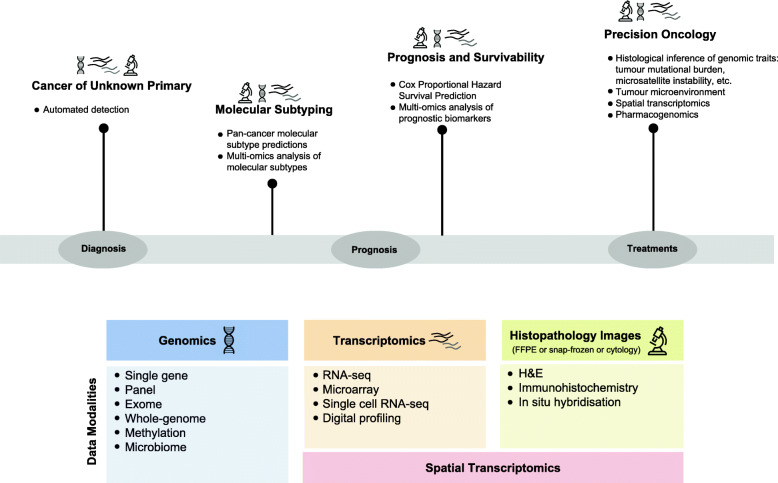
“…of deep learning in oncology include cancer origin detection, molecular subtype identi fi cation, prognosis and survival prediction, histological inference of genomic traits, tumor microenvironment analysis, and future applications in spatial transcriptomics, metagenomics, and pharmacogenomics (45).”
Wang, X., Fu, S., Ren, J., Tan, P., Wei, T., Liu, Y., & Ling, H. H. (2026) · BMC Oral Health · doi:10.1186/s12903-026-08165-1
“It facilitates personalized planning by automatically extracting high-dimensional features beyond visual assessment [53, 57–59].”
Sikkander, A. R. M. (2026) · World Journal of Applied Medical Sciences · doi:10.65336/wjams.2026.3105 · Cited by 6
Lei, X., Qian, G., Sun, Z.-G., Tang, Z.-Q., Liu, Y.-C., Du, R., & Li, Y. (2026) · World Journal of Gastrointestinal Oncology · doi:10.4251/wjgo.v18.i4.115635 · Cited by 1
Ogunleye, A. Z. (2022) · theses.fr (ABES) · doi:10.70675/d4b968d2z957cz4c8ez813fz6ff9e5102ade
Data-Driven AI Techniques in Raman Spectroscopy for Biomedical Applications: A Comprehensive Review
Ahmed, S., Raza, M. R., & Varol, A. (2026) · International Symposium on Digital Forensics and Security (ISDFS) · doi:10.1109/isdfs69419.2026.11458934
“In addition to the widely utilized algorithms, various other supervised learning techniques are gaining traction in enhancing cancer discrimination, such as PLSR, PLS-DA, and its orthogonal counterpart OPLS DA [20–25].”
Ma, Y., Zhao, L., & Zhao, Q. (2026) · Journal of Hepatocellular Carcinoma · doi:10.2147/jhc.s602760
“19 Nevertheless, most existing ML models function as “black boxes”, providing limited insight into how individual predictors contribute to model outputs.”
Li, F., Fang, C., Qiao, A., Hao, Y., Yao, X., Yang, S., Jiang, Z., He, S., & Qiao, Y. (2026) · Frontiers in Oncology · doi:10.3389/fonc.2026.1703790
“Likewise, DL algorithms can automatically identify deep features in images, facilitating the “ mining ” of more discriminative information (9, 10).”
Tang, G. K., Lim, C. C., Hussain, F. A., Oung, Q. W., Yajid, A. I., AZMI, S. M., Chong, Y. F., & Redwan, S. N. S. M. (2025) · International Conference on Biomedical Engineering and Technology (ICBET) · doi:10.1109/icbet66094.2025.11470285
“Deep learning has demonstrated superior performance in medical image analysis, often surpassing human accuracy [5].”
Guo, J., Sun, W., Wang, T., Miao, J., Nie, P., Huang, Y., & Xu, W. (2026) · Academic Radiology · doi:10.1016/j.acra.2026.03.046
Respiratory diseases: Innovations in early diagnosis
Kumari, S. (2026) · Elsevier eBooks · doi:10.1016/b978-0-443-33263-0.00008-5
Data Science at the Interface of Air Pollution and Lung Health: Toward Precision Health
Ofori-Amanfo, K., Dustin, M., & Lim, E. L. (2026) · Annual Review of Biomedical Data Science · doi:10.1146/annurev-biodatasci-092724-061536
Artificial intelligence-driven personalized medicine
Meddeb, K., Boussarsar, M., Ennouri, E., & Toumi, R. (2026) · Elsevier eBooks · doi:10.1016/b978-0-443-36554-6.00008-8
Gu, S., Kang, J., Niu, J., & Xu, G. (2026) · Research Square · doi:10.21203/rs.3.rs-9176722/v1
Artificial intelligence for personalized oncology: Tailoring treatments to individual patients
Kumar, V., Akhter, N., Krishnia, L., & Kashyap, M. K. (2026) · Elsevier eBooks · doi:10.1016/b978-0-443-45004-4.00009-8
Sun, H., Yu, M., Zhou, Y., An, Z., Guo, X., Zhang, S., Lei, L., Liu, Y., Liang, F., Sun, B., et al. (2026) · European Journal of Radiology · doi:10.1016/j.ejrad.2026.112902
Metadata
- Authors
- Tran, K. A., Kondrashova, O., Bradley, A., Williams, E. D., Pearson, J. V., & Waddell, N.
- Affiliations
- Queensland University of Technology (AU)
- QIMR Berghofer Medical Research Institute (AU)
- Corresponding author
- Waddell, Nicola
- ORCID
- Venue
- Genome Medicine
- Published
- 2021-09-27
- Volume
- 13
- Issue
- 1
- Pages
- 152-152
- ISSN
- 1756-994X (ISSN-L)
- PMC
- PMC8477474
- OpenAlex
- W3204312334
- Cited by
- 932
- References
- 170
- Citations by year
- 2026: 158 · 2025: 246 · 2024: 258 · 2023: 191 · 2022: 79
- FWCI
- 9.60
- Type
- journal article
- Language
- en
- Open access
- gold
- doi.org
- Licence
- cc-by
- creativecommons.org/licenses/by/4.0 (tdm)
- creativecommons.org/licenses/by/4.0 (vor)
- Locations
- Genome Medicine (publishedVersion, cc-by)
- Europe PMC (PubMed Central) (publishedVersion, other-oa)
- PubMed Central (publishedVersion, cc-by)
- PubMed (publishedVersion)
- QUT ePrints (Queensland University of Technology) (submittedVersion, cc-by)
- DOAJ (DOAJ: Directory of Open Access Journals) (submittedVersion, cc-by-sa)
- Figshare (submittedVersion, cc-by)
- Minerva Access (University of Melbourne) (submittedVersion, cc-by)
- Funders
- National Health and Medical Research Council (APP1139071)
- Topics
- Physical Sciences › Computer Science › Artificial Intelligence › AI in cancer detection
- Health Sciences › Medicine › Health Informatics › Artificial Intelligence in Healthcare and Education
- Health Sciences › Medicine › Radiology, Nuclear Medicine and Imaging › Radiomics and Machine Learning in Medical Imaging
- Keywords
- deep learning, cancer diagnosis, cancer prognosis, treatment selection, precision oncology, multi-omics integration, genomic data, DNA methylation, transcriptomic data, decision support system, explainable deep learning
- MeSH terms
- Machine Learning, Deep Learning, Artificial Intelligence, Humans, Medical Oncology, Neoplasms, Pharmacogenetics, Prognosis, Neural Networks, Computer, Genomics, Precision Medicine, Tumor Microenvironment
About these checks
Registry, retraction, Cites and statistics results are computed, not judged, with one exception: a printed reference that no index lists is read once by a model before it counts as a citation error. Claims are extracted by a model and kept only when their quote appears verbatim in the text; each cited source is then checked, with a model’s help, for whether it says what the claim relies on. Those verdicts can be wrong — read the claim’s quote and the cited source before relying on one.
Statistics and arithmetic are recomputed, not judged.
Confidence bands are shown only for fields calibrated on our annotated test set. None is calibrated yet, so no band is shown.
What counts as a claim ›How we measure confidence ›How we check this ›
Are you an author, or do you see a problem with this page? Request a review
Data sources
Bibliographic data: Semantic Scholar, OpenAlex, Crossref.
Contains information from the Semantic Scholar Academic Graph Datasets, made available under the ODC Attribution License (ODC-BY 1.0).
Semantic Scholar’s data is described in: Kinney, R., et al. (2023). The Semantic Scholar Open Data Platform. arXiv:2301.10140.
