

The DOI matches its Crossref record; 39 of the 40 references it cites were found in a registry or an index; none of the 46 sources its claims cite is checked for support yet.
Assessing the feasibility of eHealth and mHealth: a systematic review and analysis of initiatives implemented in Kenya
Open accessAbstract
BACKGROUND: The growth of Information and Communication Technology in Kenya has facilitated implementation of a large number of eHealth projects in a bid to cost-effectively address health and health system challenges. This systematic review aims to provide a situational analysis of eHealth initiatives being implemented in Kenya, including an assessment of the areas of focus and geographic distribution of the health projects. The search strategy involved peer and non-peer reviewed sources of relevant information relating to projects under implementation in Kenya. The projects were examined based on strategic area of implementation, health purpose and focus, geographic location, evaluation status and thematic area. RESULTS: A total of 114 citations comprising 69 eHealth projects fulfilled the inclusion criteria. The eHealth projects included 47 mHealth projects, 9 health information system projects, 8 eLearning projects and 5 telemedicine projects. In terms of projects geographical distribution, 24 were executed in Nairobi whilst 15 were designed to have a national coverage but only 3 were scaled up. In terms of health focus, 19 projects were mainly on primary care, 17 on HIV/AIDS and 11 on maternal and child health (MNCH). Only 8 projects were rigorously evaluated under randomized control trials. CONCLUSION: This review discovered that there is a myriad of eHealth projects being implemented in Kenya, mainly in the mHealth strategic area and focusing mostly on primary care and HIV/AIDs. Based on our analysis, most of the projects were rarely evaluated. In addition, few projects are implemented in marginalised areas and least urbanized counties with more health care needs, notwithstanding the fact that adoption of information and communication technology should aim to improve health equity (i.e. improve access to health care particularly in remote parts of the country in order to reduce geographical inequities) and contribute to overall health systems strengthening.
Overview
AI snapshot
Written from the paper’s full text.
TL;DR
This systematic review inventories 69 eHealth projects implemented in Kenya, finding that most were mHealth initiatives concentrated in urban counties and rarely rigorously evaluated. It concludes that eHealth activity is poorly aligned with marginalized areas and Ministry of Health priorities, limiting scale-up and equity impact.
Key findings
- Of 69 eHealth projects, 47 (69%) were mHealth, 9 (13%) health information systems, 8 (11%) eLearning, and 5 (7%) telemedicine.
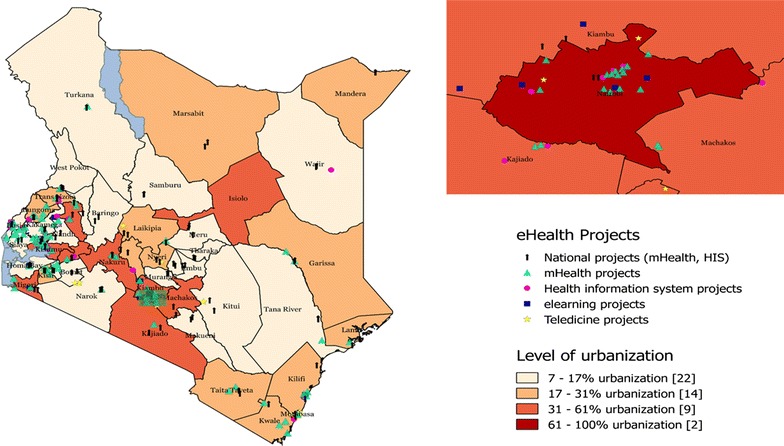
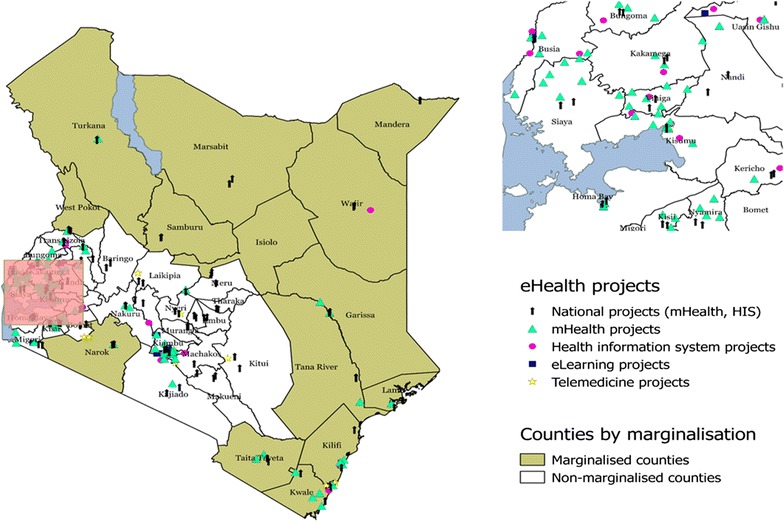
- Geographic distribution was skewed: Nairobi had 24 mapped projects, while least urbanized counties such as Turkana, Wajir, and Garissa had 1, 1, and 2 projects respectively; Samburu, Marsabit, and Mandera had none. Of 14 marginalized counties, 10 had at least one project, with Kilifi highest at 5 and Kwale at 4.
- Health focus was mainly primary care (19; 28%), HIV/AIDS (17; 25%), and maternal and child health (11; 16%).
- Evaluation was limited: only 28 of 69 projects (41%) reported any evaluation, and only 8 (12%) were randomized controlled trials; 41 projects (59%) had no reported evaluation.
Methods
- Systematic review of peer-reviewed and non-peer-reviewed sources, including PubMed, Embase, Web of Science, Econlit, SocIndex, Cochrane, Google Scholar, organizational websites, blogs, personal communication with implementers, and hand searches; no time period was specified.
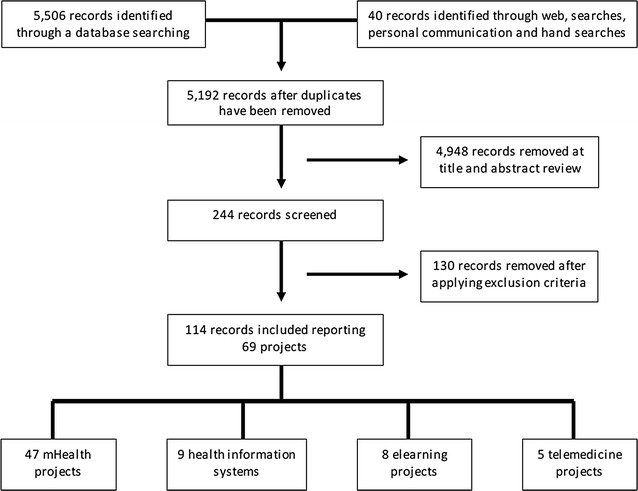
- The search identified 5,506 citations plus 40 hand-searched publications; after removing 354 duplicates and excluding records, 114 citations reporting 69 eHealth projects met inclusion criteria.
- Projects were categorized by strategic area, thematic area, health focus, geographic location, and evaluation status; geo-coded maps were layered by urbanization and marginalisation using Commission on Revenue Allocation classifications.
Limitations
- Stated by the paper: some projects may have lacked documentation or externally shared reports because they were profit-driven, aid-funded, or proprietary, and some projects may have been implemented after data collection concluded, so the inventory may not be exhaustive.
- Evident from the text: reliance on non-peer-reviewed sources, organizational websites, blogs, and personal communication may introduce selection or reporting bias.
- Evident from the text: because 41 of 69 projects (59%) had no reported evaluation, the review cannot assess effectiveness or cost-effectiveness for most included projects.
Model-written summary. Check it against the paper before relying on it.
Integrity signals
Registry
Cites
Statistics
Figures
Verification
Claims the paper makes
47 Own result · 19 Not checked yet · 16 Own interpretation · 9 No basis given · 6 Own method
A result the paper reports from its own data — it cites no other source for it, so there is none to check. The quote shows it is in the paper.
In the paper
“Projects implemented in Kenya covered all eHealth strategic areas with majority (47; 69%) of them delivered through mHealth, less commonly focusing on health information systems (9; 13%), eLearning (8; 11%) and telemedicine (5; 7%) as shown in Table 2.”
- Also stated in: § Results · plain
“The eHealth projects included 47 mHealth projects, 9 health information system projects, 8 eLearning projects and 5 telemedicine projects.”
§ Assessing the feasibility of eHealth and mHealth: a systematic review and analysis of initiatives implemented in Kenya > Characteristics of the projects > Strategic area of implementation
plain- Asserted: passes — The authors put it forward as true.
- Checkable: passes — It can be checked against evidence.
- Load-bearing: unclear — It is unclear whether the paper’s conclusions depend on it.
- Based: passes — The paper gives a reason why it holds.
- Also stated in: § Results · plain
None of the sources cited for this claim have been checked yet.
In the paper
“In terms of projects geographical distribution, 24 were executed in Nairobi whilst 15 were designed to have a national coverage but only 3 were scaled up.”
- Also stated in: § Geographic location of the projects by urbanization and marginalisation · plain
“However, only three projects were scaled up to national level [27–31].”
§ Assessing the feasibility of eHealth and mHealth: a systematic review and analysis of initiatives implemented in Kenya > Abstract > Results
What the sources say
- Not checked yetcites [27] Maurer B. Mobile money: communication, consumption and change in the payments space. J Dev Stud. 2012;48(5):589–604. source
- Not checked yetcites [28] Sahay S, Sæbø J, Braa JR. Scaling of HIS in a global context: same, same, but different. Inf Organ. 2013;23(4):294–323. source
- Not checked yetcites [29] Suri T, Jack W, Stoker TM. Documenting the birth of a financial economy. Proc Natl Acad Sci. 2012;109(26):10257–62. source
- Not checked yetcites [30] Afyainfo. The AfyaInfo Project. 2014. http://www.afyainfo.org/index.php/features/the-afyainfo-project . Accessed 20 May 2014.
- Not checked yetcites [31] KEMSA. KEMSA E-mobile. 2015. http://kemsa.co.ke/index.php?option=com_content&view=article&id=66&Itemid=153 . Accessed 10 Mar 2015.
plainn = 15- Asserted: passes — The authors put it forward as true.
- Checkable: passes — It can be checked against evidence.
- Load-bearing: unclear — It is unclear whether the paper’s conclusions depend on it.
- Based: passes — The paper gives a reason why it holds.
- Also stated in: § Geographic location of the projects by urbanization and marginalisation · plain
None of the sources cited for this claim have been checked yet.
In the paper
“Another noteworthy finding is that the first eHealth project was implemented in 2001 [40–43] in Kenya while most of the projects (n = 42) were initiated in 2010 and onwards.”
§ Assessing the feasibility of eHealth and mHealth: a systematic review and analysis of initiatives implemented in Kenya > Characteristics of the projects > Evaluation of the projects
What the sources say
- Not checked yetcites [40] Vanderbilt University. The Moi Schools of Medicine & Public Health, Kenya. Eldoret. 2001. http://www.vecd.org/trainee-sites/the-moi-schools-of-medicine-public-health-kenya/ . Accessed 20 May 2014.
- Not checked yetcites [41] Diero L, Rotich JK, Bii J, Mamlin BW, Einterz RM, Kalamai IZ, et al. A computer-based medical record system and personal digital assistants to assess and follow patients with respiratory tract infections visiting a rural Kenyan health centre. BMC Med Inform Decis Mak. 2006;6(1):21. source
- Not checked yetcites [42] Fazen LE, Chemwolo BT, Songok JJ, Ruhl LJ, Kipkoech C, Green JM, et al. AccessMRS: integrating OpenMRS with smart forms on android. Stud Health Technol Inform. 2012;192:866–70.
- Not checked yetcites [43] Rajput ZA, Mbugua S, Amadi D, Chepnǵeno V, Saleem JJ, Anokwa Y, et al. Evaluation of an android-based mHealth system for population surveillance in developing countries. J Am Med Inform Assoc. 2012;19(4):655–9. source
plain- Asserted: passes — The authors put it forward as true.
- Checkable: passes — It can be checked against evidence.
- Load-bearing: unclear — It is unclear whether the paper’s conclusions depend on it.
- Based: passes — The paper gives a reason why it holds.
A result the paper reports from its own data — it cites no other source for it, so there is none to check. The quote shows it is in the paper.
In the paper
“In total there were a total of eleven projects being executed in the least urbanized counties as demonstrated by Fig. 2.”
§ Assessing the feasibility of eHealth and mHealth: a systematic review and analysis of initiatives implemented in Kenya > Results > Geographic location of the projects by urbanization and marginalisation
boosted- Asserted: passes — The authors put it forward as true.
- Checkable: passes — It can be checked against evidence.
- Load-bearing: unclear — It is unclear whether the paper’s conclusions depend on it.
- Based: passes — The paper gives a reason why it holds.
A result the paper reports from its own data — it cites no other source for it, so there is none to check. The quote shows it is in the paper.
In the paper
“The search concluded with 114 citations reporting 69 eHealth projects (Fig. 1).”
- Also stated in: § Results · plain
“A total of 114 citations comprising 69 eHealth projects fulfilled the inclusion criteria.”
§ Assessing the feasibility of eHealth and mHealth: a systematic review and analysis of initiatives implemented in Kenya > Results
plain- Asserted: passes — The authors put it forward as true.
- Checkable: passes — It can be checked against evidence.
- Load-bearing: passes — The paper’s conclusions depend on it.
- Based: passes — The paper gives a reason why it holds.
- Also stated in: § Results · plain
A result the paper reports from its own data — it cites no other source for it, so there is none to check. The quote shows it is in the paper.
In the paper
“Notably, at least one project was under implementation in each of the twelve thematic areas (Table 2).”
§ Assessing the feasibility of eHealth and mHealth: a systematic review and analysis of initiatives implemented in Kenya > Characteristics of the projects > Thematic area
plain- Asserted: passes — The authors put it forward as true.
- Checkable: passes — It can be checked against evidence.
- Load-bearing: unclear — It is unclear whether the paper’s conclusions depend on it.
- Based: passes — The paper gives a reason why it holds.
A result the paper reports from its own data — it cites no other source for it, so there is none to check. The quote shows it is in the paper.
In the paper
“According to the Commission on Revenue Allocation (CRA), fourteen counties are classified as marginalised [26]. Of these, ten counties had at least one eHealth initiative under implementation whilst Kilifi had the highest number of projects (n = 5) with Kwale having four projects.”
§ Assessing the feasibility of eHealth and mHealth: a systematic review and analysis of initiatives implemented in Kenya > Results > Geographic location of the projects by urbanization and marginalisation
plain- Asserted: passes — The authors put it forward as true.
- Checkable: passes — It can be checked against evidence.
- Load-bearing: unclear — It is unclear whether the paper’s conclusions depend on it.
- Based: passes — The paper gives a reason why it holds.
A result the paper reports from its own data — it cites no other source for it, so there is none to check. The quote shows it is in the paper.
In the paper
“The remaining two projects were designed to address both HIV/AIDS and maternal and child health (Table 2).”
§ Assessing the feasibility of eHealth and mHealth: a systematic review and analysis of initiatives implemented in Kenya > Characteristics of the projects > Health focus
plain- Asserted: passes — The authors put it forward as true.
- Checkable: passes — It can be checked against evidence.
- Load-bearing: unclear — It is unclear whether the paper’s conclusions depend on it.
- Based: passes — The paper gives a reason why it holds.
A result the paper reports from its own data — it cites no other source for it, so there is none to check. The quote shows it is in the paper.
In the paper
“Twenty-three projects were designed to target multiple conditions and diseases.”
§ Assessing the feasibility of eHealth and mHealth: a systematic review and analysis of initiatives implemented in Kenya > Characteristics of the projects > Health focus
plain- Asserted: passes — The authors put it forward as true.
- Checkable: passes — It can be checked against evidence.
- Load-bearing: unclear — It is unclear whether the paper’s conclusions depend on it.
- Based: passes — The paper gives a reason why it holds.
A result the paper reports from its own data — it cites no other source for it, so there is none to check. The quote shows it is in the paper.
In the paper
“Indeed, only 8 out of the 69 projects underwent rigorous effectiveness evaluation utilising randomized controlled trials.”
- Also stated in: § Discussion · plain
“As shown by this study, about 69 eHealth projects were implemented in Kenya with only 8 showing evidence of rigorous evaluation.”
§ Assessing the feasibility of eHealth and mHealth: a systematic review and analysis of initiatives implemented in Kenya > Characteristics of the projects > Evaluation of the projects
plain- Asserted: passes — The authors put it forward as true.
- Checkable: passes — It can be checked against evidence.
- Load-bearing: passes — The paper’s conclusions depend on it.
- Based: passes — The paper gives a reason why it holds.
- Also stated in: § Discussion · plain
- It may state two separate claims as one. 24
- Probably not a substantial claim. 18
A result the paper reports from its own data — it cites no other source for it, so there is none to check. The quote shows it is in the paper.
In the paper
“Of the remaining 21 projects, one was non-randomized intervention studies (1%), 7 cross-sectional studies (10%), and 1 cohort study (1%), 9 were feasibility and acceptability studies (13%) while 3 (4%) were qualitative studies (Table 2).”
§ Assessing the feasibility of eHealth and mHealth: a systematic review and analysis of initiatives implemented in Kenya > Characteristics of the projects > Evaluation of the projects
plain- Asserted: passes — The authors put it forward as true.
- Checkable: passes — It can be checked against evidence.
- Load-bearing: unclear — It is unclear whether the paper’s conclusions depend on it.
- Based: passes — The paper gives a reason why it holds.
It may state two separate claims as one.
A result the paper reports from its own data — it cites no other source for it, so there is none to check. The quote shows it is in the paper.
In the paper
“Health financing | 4 (5%)”
§ Assessing the feasibility of eHealth and mHealth: a systematic review and analysis of initiatives implemented in Kenya > Characteristics of the projects > Strategic area of implementation
plainn = 69- Asserted: passes — The authors put it forward as true.
- Checkable: passes — It can be checked against evidence.
- Load-bearing: fails — The paper’s conclusions may not depend on it.
- Based: passes — The paper gives a reason why it holds.
Probably not a substantial claim. The paper’s conclusions may not depend on it.
A result the paper reports from its own data — it cites no other source for it, so there is none to check. The quote shows it is in the paper.
In the paper
“Supply chain management | 4 (5%)”
§ Assessing the feasibility of eHealth and mHealth: a systematic review and analysis of initiatives implemented in Kenya > Characteristics of the projects > Strategic area of implementation
plainn = 69- Asserted: passes — The authors put it forward as true.
- Checkable: passes — It can be checked against evidence.
- Load-bearing: fails — The paper’s conclusions may not depend on it.
- Based: passes — The paper gives a reason why it holds.
Probably not a substantial claim. The paper’s conclusions may not depend on it.
A result the paper reports from its own data — it cites no other source for it, so there is none to check. The quote shows it is in the paper.
In the paper
“The other thematic areas involved provider training and education, and financial transactions and incentives. These thematic areas were represented by six (9%) projects in each of the respective domains.”
§ Assessing the feasibility of eHealth and mHealth: a systematic review and analysis of initiatives implemented in Kenya > Characteristics of the projects > Thematic area
plain- Asserted: passes — The authors put it forward as true.
- Checkable: passes — It can be checked against evidence.
- Load-bearing: unclear — It is unclear whether the paper’s conclusions depend on it.
- Based: passes — The paper gives a reason why it holds.
It may state two separate claims as one.
A result the paper reports from its own data — it cites no other source for it, so there is none to check. The quote shows it is in the paper.
In the paper
“However, the other least urbanised counties such as Samburu, Marsabit and Mandera had no eHealth project being implemented.”
§ Assessing the feasibility of eHealth and mHealth: a systematic review and analysis of initiatives implemented in Kenya > Results > Geographic location of the projects by urbanization and marginalisation
plain- Asserted: passes — The authors put it forward as true.
- Checkable: passes — It can be checked against evidence.
- Load-bearing: unclear — It is unclear whether the paper’s conclusions depend on it.
- Based: passes — The paper gives a reason why it holds.
It may state two separate claims as one.
A result the paper reports from its own data — it cites no other source for it, so there is none to check. The quote shows it is in the paper.
In the paper
“Finally, three thematic areas applying sensors and point-of-care diagnostics, registries and vital events tracking, and electronic decision support were each represented by two innovations.”
§ Assessing the feasibility of eHealth and mHealth: a systematic review and analysis of initiatives implemented in Kenya > Characteristics of the projects > Thematic area
plain- Asserted: passes — The authors put it forward as true.
- Checkable: passes — It can be checked against evidence.
- Load-bearing: unclear — It is unclear whether the paper’s conclusions depend on it.
- Based: passes — The paper gives a reason why it holds.
It may state two separate claims as one.
A result the paper reports from its own data — it cites no other source for it, so there is none to check. The quote shows it is in the paper.
In the paper
“Drug supply | 4 (5%)”
§ Assessing the feasibility of eHealth and mHealth: a systematic review and analysis of initiatives implemented in Kenya > Characteristics of the projects > Strategic area of implementation
plainn = 69- Asserted: passes — The authors put it forward as true.
- Checkable: passes — It can be checked against evidence.
- Load-bearing: fails — The paper’s conclusions may not depend on it.
- Based: passes — The paper gives a reason why it holds.
Probably not a substantial claim. The paper’s conclusions may not depend on it.
The paper states this without a source or data behind it here, so there is nothing to check it against. The quote shows it is in the paper.
In the paper
“Additionally, most of the projects (n = 41) were implemented in multiple counties thus the total number of mapped projects excluding national projects (n = 148) were greater than the number of actual projects (n = 69).”
§ Assessing the feasibility of eHealth and mHealth: a systematic review and analysis of initiatives implemented in Kenya > Results > Geographic location of the projects by urbanization and marginalisation
plainn = 41- Asserted: passes — The authors put it forward as true.
- Checkable: passes — It can be checked against evidence.
- Load-bearing: unclear — It is unclear whether the paper’s conclusions depend on it.
- Based: passes — The paper gives a reason why it holds.
It may state two separate claims as one.
A result the paper reports from its own data — it cites no other source for it, so there is none to check. The quote shows it is in the paper.
In the paper
“In terms of health focus, this study found that nineteen (28%) projects focused on primary care followed by HIV/AIDS (17; 25%), then maternal and child health (11; 16%) and malaria (8; 11%).”
§ Assessing the feasibility of eHealth and mHealth: a systematic review and analysis of initiatives implemented in Kenya > Characteristics of the projects > Health focus
plain- Asserted: passes — The authors put it forward as true.
- Checkable: passes — It can be checked against evidence.
- Load-bearing: fails — The paper’s conclusions may not depend on it.
- Based: passes — The paper gives a reason why it holds.
Probably not a substantial claim. The paper’s conclusions may not depend on it.
None of the sources cited for this claim have been checked yet.
In the paper
“One of these projects relied on the innovative use of mobile money [27, 29] to provide health care and therefore it was not mapped.”
§ Assessing the feasibility of eHealth and mHealth: a systematic review and analysis of initiatives implemented in Kenya > Results > Geographic location of the projects by urbanization and marginalisation
What the sources say
plaindirect- Asserted: passes — The authors put it forward as true.
- Checkable: passes — It can be checked against evidence.
- Load-bearing: unclear — It is unclear whether the paper’s conclusions depend on it.
- Based: passes — The paper gives a reason why it holds.
It may state two separate claims as one.
The paper states this without a source or data behind it here, so there is nothing to check it against. The quote shows it is in the paper.
In the paper
“Most eHealth projects were designed to be implemented in specific geographical locations with a few projects implemented nationally.”
§ Assessing the feasibility of eHealth and mHealth: a systematic review and analysis of initiatives implemented in Kenya > Methods > Categorization of eHealth projects in Kenya
plain- Asserted: passes — The authors put it forward as true.
- Checkable: passes — It can be checked against evidence.
- Load-bearing: fails — The paper’s conclusions may not depend on it.
- Based: passes — The paper gives a reason why it holds.
Probably not a substantial claim. The paper’s conclusions may not depend on it. It may state two separate claims as one.
A result the paper reports from its own data — it cites no other source for it, so there is none to check. The quote shows it is in the paper.
In the paper
“Other purposesb | 7 (10%)”
§ Assessing the feasibility of eHealth and mHealth: a systematic review and analysis of initiatives implemented in Kenya > Characteristics of the projects > Strategic area of implementation
plainn = 69- Asserted: passes — The authors put it forward as true.
- Checkable: passes — It can be checked against evidence.
- Load-bearing: fails — The paper’s conclusions may not depend on it.
- Based: passes — The paper gives a reason why it holds.
Probably not a substantial claim. The paper’s conclusions may not depend on it.
The paper states this without a source or data behind it here, so there is nothing to check it against. The quote shows it is in the paper.
In the paper
“Most of the eHealth projects were used to influence client education and behaviour change and to collect patient data.”
§ Assessing the feasibility of eHealth and mHealth: a systematic review and analysis of initiatives implemented in Kenya > Discussion
plain- Asserted: passes — The authors put it forward as true.
- Checkable: passes — It can be checked against evidence.
- Load-bearing: passes — The paper’s conclusions depend on it.
- Based: passes — The paper gives a reason why it holds.
It may state two separate claims as one.
In the paper
“These types of interventions have been proven to be effective as evidenced by the small sample of evaluated mHealth interventions [16, 20, 32, 33, 45], that showed that SMS communications had positive effect on patient behaviour and health outcomes and was also cost-effective and reliable [50].”
§ Assessing the feasibility of eHealth and mHealth: a systematic review and analysis of initiatives implemented in Kenya > Discussion
What the sources say
- Not checked yetcites [50] Zurovac D, Larson BA, Sudoi RK, Snow RW. Costs and cost-effectiveness of a mobile phone text-message reminder programmes to improve health workers’ adherence to malaria guidelines in Kenya. PLoS ONE. 2012;7(12):e52045. source
boosted- Asserted: passes — The authors put it forward as true.
- Checkable: passes — It can be checked against evidence.
- Load-bearing: unclear — It is unclear whether the paper’s conclusions depend on it.
- Based: passes — The paper gives a reason why it holds.
It may state two separate claims as one.
The paper states this without a source or data behind it here, so there is nothing to check it against. The quote shows it is in the paper.
In the paper
“According to this study, mHealth and eHealth projects are on the rise, which could be explained by the increasing growth of ICT sector in Kenya and the political willingness to advance investment in this important industry.”
§ Assessing the feasibility of eHealth and mHealth: a systematic review and analysis of initiatives implemented in Kenya > Discussion
plain- Asserted: passes — The authors put it forward as true.
- Checkable: passes — It can be checked against evidence.
- Load-bearing: fails — The paper’s conclusions may not depend on it.
- Based: passes — The paper gives a reason why it holds.
Probably not a substantial claim. The paper’s conclusions may not depend on it.
None of the sources cited for this claim have been checked yet.
In the paper
“Of the 15 national projects, only two reported some form of evaluation, one being a cross-sectional survey [27, 29] while the other was a qualitative study [51, 52].”
§ Assessing the feasibility of eHealth and mHealth: a systematic review and analysis of initiatives implemented in Kenya > Characteristics of the projects > Evaluation of the projects
What the sources say
- Not checked yetcites [27] Maurer B. Mobile money: communication, consumption and change in the payments space. J Dev Stud. 2012;48(5):589–604. source
- Not checked yetcites [29] Suri T, Jack W, Stoker TM. Documenting the birth of a financial economy. Proc Natl Acad Sci. 2012;109(26):10257–62. source
- Not checked yetcites [51] IntraHealth International. Capacity Kenya. 2009. http://www.intrahealth.org/page/capacity-kenya . Accessed 19 May 2014.
- Not checked yetcites [52] IntraHealth International. Kenya. Nairobi. 2014. http://www.intrahealth.org/files/media/kenya/Country_Brief_Kenya_web%20ready.pdf .
plain- Asserted: passes — The authors put it forward as true.
- Checkable: passes — It can be checked against evidence.
- Load-bearing: unclear — It is unclear whether the paper’s conclusions depend on it.
- Based: passes — The paper gives a reason why it holds.
It may state two separate claims as one.
A result the paper reports from its own data — it cites no other source for it, so there is none to check. The quote shows it is in the paper.
In the paper
“As illustrated by this study, projects implemented were not aligned to the MoH health needs and priorities and instead majority of projects focused on specific diseases and population groups such as HIV/AIDS and maternal and child health at primary care.”
§ Assessing the feasibility of eHealth and mHealth: a systematic review and analysis of initiatives implemented in Kenya > Discussion
plain- Asserted: passes — The authors put it forward as true.
- Checkable: passes — It can be checked against evidence.
- Load-bearing: passes — The paper’s conclusions depend on it.
- Based: passes — The paper gives a reason why it holds.
It may state two separate claims as one.
The paper states this without a source or data behind it here, so there is nothing to check it against. The quote shows it is in the paper.
In the paper
“For example, based on this analysis, majority of the eHealth initiatives under implementation are fragmented and not integrated with the national health information system creating interoperability challenges.”
§ Assessing the feasibility of eHealth and mHealth: a systematic review and analysis of initiatives implemented in Kenya > Discussion
plaindirect- Asserted: passes — The authors put it forward as true.
- Checkable: passes — It can be checked against evidence.
- Load-bearing: passes — The paper’s conclusions depend on it.
- Based: passes — The paper gives a reason why it holds.
It may state two separate claims as one.
A result the paper reports from its own data — it cites no other source for it, so there is none to check. The quote shows it is in the paper.
In the paper
“Another important finding in this study is that majority of the eHealth initiatives implemented in the country are funded by development agencies and international non-governmental organisations raising the issue of ownership by the Ministry of Health.”
§ Assessing the feasibility of eHealth and mHealth: a systematic review and analysis of initiatives implemented in Kenya > Discussion
plaindirect- Asserted: passes — The authors put it forward as true.
- Checkable: passes — It can be checked against evidence.
- Load-bearing: passes — The paper’s conclusions depend on it.
- Based: passes — The paper gives a reason why it holds.
It may state two separate claims as one.
None of the sources cited for this claim have been checked yet.
In the paper
“These types of interventions have been proven to be effective as evidenced by the small sample of evaluated mHealth interventions [16, 20, 32, 33, 45], that showed that SMS communications had positive effect on patient behaviour and health outcomes and was also cost-effective and reliable [50].”
§ Assessing the feasibility of eHealth and mHealth: a systematic review and analysis of initiatives implemented in Kenya > Discussion
What the sources say
- Not checked yetcites [16] Curran K, Mugo NR, Kurth A, Ngure K, Heffron R, Donnell D, et al. Daily short message service surveys to measure sexual behavior and pre-exposure prophylaxis use among kenyan men and women. AIDS and Behav. 2013;17(9):2977–85. source
- Not checked yetcites [20] Lester RT, Mills EJ, Kariri A, Ritvo P, Chung M, Jack W, et al. The HAART cell phone adherence trial (WelTel Kenya1): a randomized controlled trial protocol. Trials. 2009;10(1):87. source
- Not checked yetcites [32] Lester RT, Ritvo P, Mills EJ, Kariri A, Karanja S, Chung MH, et al. Effects of a mobile phone short message service on antiretroviral treatment adherence in Kenya (WelTel Kenya1): a randomised trial. Lancet. 2010;376(9755):1838–45. source
- Not checked yetcites [33] Pop-Eleches C, Thirumurthy H, Habyarimana J, Graff Zivin J, Goldstein M, De Walque D, et al. Mobile phone technologies improve adherence to antiretroviral treatment in resource-limited settings: a randomized controlled trial of text message reminders. Aids. 2011;25:825–34. source
- Not checked yetcites [45] Odeny TA, Bailey RC, Bukusi EA, Simoni JM, Tapia KA, Yuhas K, et al. Text messaging to improve attendance at post-operative clinic visits after adult male circumcision for HIV prevention: a randomized controlled trial. PLoS ONE. 2012;7(9):e43832. source
- Not checked yetcites [50] Zurovac D, Larson BA, Sudoi RK, Snow RW. Costs and cost-effectiveness of a mobile phone text-message reminder programmes to improve health workers’ adherence to malaria guidelines in Kenya. PLoS ONE. 2012;7(12):e52045. source
boosteddirect- Asserted: passes — The authors put it forward as true.
- Checkable: passes — It can be checked against evidence.
- Load-bearing: passes — The paper’s conclusions depend on it.
- Based: passes — The paper gives a reason why it holds.
It may state two separate claims as one.
A conclusion the paper draws from its own results — it cites no other source for it, so there is none to check. The quote shows it is in the paper.
In the paper
“This review discovered that there is a myriad of eHealth projects being implemented in Kenya, mainly in the mHealth strategic area and focusing mostly on primary care and HIV/AIDs.”
§ Assessing the feasibility of eHealth and mHealth: a systematic review and analysis of initiatives implemented in Kenya > Abstract > Conclusion
plain- Asserted: passes — The authors put it forward as true.
- Checkable: passes — It can be checked against evidence.
- Load-bearing: passes — The paper’s conclusions depend on it.
- Based: passes — The paper gives a reason why it holds.
It may state two separate claims as one.
In the paper
“The national eHealth strategy outlined five specific strategic areas of focus to aid eHealth project implementation in the country. These include telemedicine, health information systems (including electronic health records), mHealth (health through the use of mobile devices), eLearning (including distance education or learning) and health information for citizens (health information provision to”
§ Assessing the feasibility of eHealth and mHealth: a systematic review and analysis of initiatives implemented in Kenya > Background
What the sources say
- Not checked yetcites [14] Republic of Kenya. Kenya National e-Health Strategy 2011–2017. In: Ministry of Medical Services, Ministry of Public Health and Sanitation, editors. Nairobi. 2011.
plain- Asserted: passes — The authors put it forward as true.
- Checkable: passes — It can be checked against evidence.
- Load-bearing: fails — The paper’s conclusions may not depend on it.
- Based: passes — The paper gives a reason why it holds.
Probably not a substantial claim. The paper’s conclusions may not depend on it.
What the paper did — it cites no source for this, so there is none to check. The quote shows it is in the paper.
In the paper
“However, due to the sensitive nature of this information, most private projects were not prepared to disclose the information deemed as delicate.”
§ Assessing the feasibility of eHealth and mHealth: a systematic review and analysis of initiatives implemented in Kenya > Methods > Data extraction
plain- Asserted: passes — The authors put it forward as true.
- Checkable: passes — It can be checked against evidence.
- Load-bearing: fails — The paper’s conclusions may not depend on it.
- Based: passes — The paper gives a reason why it holds.
Probably not a substantial claim. The paper’s conclusions may not depend on it.
What the paper did — it cites no source for this, so there is none to check. The quote shows it is in the paper.
In the paper
“Conflicting opinions were resolved through discussion amongst the authors.”
§ Assessing the feasibility of eHealth and mHealth: a systematic review and analysis of initiatives implemented in Kenya > Methods > Search strategy
plaindirect- Asserted: passes — The authors put it forward as true.
- Checkable: passes — It can be checked against evidence.
- Load-bearing: fails — The paper’s conclusions may not depend on it.
- Based: passes — The paper gives a reason why it holds.
Probably not a substantial claim. The paper’s conclusions may not depend on it.
What the paper did — it cites no source for this, so there is none to check. The quote shows it is in the paper.
In the paper
“Due to overlap with other areas, the strategic area referring to health information for citizens was not analysed separately but included in other project implementation areas.”
§ Assessing the feasibility of eHealth and mHealth: a systematic review and analysis of initiatives implemented in Kenya > Methods > Categorization of eHealth projects in Kenya
plain- Asserted: passes — The authors put it forward as true.
- Checkable: passes — It can be checked against evidence.
- Load-bearing: fails — The paper’s conclusions may not depend on it.
- Based: passes — The paper gives a reason why it holds.
Probably not a substantial claim. The paper’s conclusions may not depend on it.
None of the sources cited for this claim have been checked yet.
In the paper
“One of the major eHealth public health objectives is to improve access to health services through strengthening health system [3, 55] by ensuring hard-to-reach communities receive effective and quality health care.”
§ Assessing the feasibility of eHealth and mHealth: a systematic review and analysis of initiatives implemented in Kenya > Discussion
What the sources say
- Not checked yetcites [3] Kirigia JM, Seddoh A, Gatwiri D, Muthuri LH, Seddoh J. E-health: determinants, opportunities, challenges and the way forward for countries in the WHO African Region. BMC Public Health. 2005;5:137. doi: 10.1186/1471-2458-5-137 . source
- Not checked yetcites [55] Alvarez RC. The promise of e-Health—a Canadian perspective. eHealth Int. 2002;1(1):4. source
plaindirect- Asserted: passes — The authors put it forward as true.
- Checkable: passes — It can be checked against evidence.
- Load-bearing: fails — The paper’s conclusions may not depend on it.
- Based: passes — The paper gives a reason why it holds.
Probably not a substantial claim. The paper’s conclusions may not depend on it.
In the paper
“In a few instances, the ICT sector has experienced successful public private partnerships for example business mobile products such as M-Pesa [58] shows that the scaling up of eHealth projects can be executed in Kenya with proper planning and sufficient funding.”
§ Assessing the feasibility of eHealth and mHealth: a systematic review and analysis of initiatives implemented in Kenya > Discussion
What the sources say
- Not checked yetcites [58] Jack W, Suri T, Townsend RM. Monetary theory and electronic money: reflections on the Kenyan experience. FRB Richmond Econ Q. 2010;96(1):83–122.
plaindirect- Asserted: passes — The authors put it forward as true.
- Checkable: passes — It can be checked against evidence.
- Load-bearing: unclear — It is unclear whether the paper’s conclusions depend on it.
- Based: passes — The paper gives a reason why it holds.
It may state two separate claims as one.
What the paper did — it cites no source for this, so there is none to check. The quote shows it is in the paper.
In the paper
“Even though it was a challenge gathering information relating to innovations being implemented in the country, the researchers combined different methods to ensure all projects were documented and inventoried.”
§ Assessing the feasibility of eHealth and mHealth: a systematic review and analysis of initiatives implemented in Kenya > Discussion
plaindirect- Asserted: passes — The authors put it forward as true.
- Checkable: passes — It can be checked against evidence.
- Load-bearing: passes — The paper’s conclusions depend on it.
- Based: passes — The paper gives a reason why it holds.
Probably not a substantial claim.
What the paper did — it cites no source for this, so there is none to check. The quote shows it is in the paper.
In the paper
“First, some projects may have lacked documentation or externally shared reports, probably due to the profit driven or aid funded nature of the eHealth projects whilst some projects were proprietary in nature and thus business ventures.”
§ Assessing the feasibility of eHealth and mHealth: a systematic review and analysis of initiatives implemented in Kenya > Discussion > Limitations
hedgedconditional- Asserted: passes — The authors put it forward as true.
- Checkable: passes — It can be checked against evidence.
- Load-bearing: fails — The paper’s conclusions may not depend on it.
- Based: fails — The paper may give no reason why it holds.
Probably not a substantial claim. The paper’s conclusions may not depend on it. The paper may give no reason why it holds. It may state two separate claims as one.
A conclusion the paper draws from its own results — it cites no other source for it, so there is none to check. The quote shows it is in the paper.
In the paper
“According to this study, mHealth and eHealth projects are on the rise, which could be explained by the increasing growth of ICT sector in Kenya and the political willingness to advance investment in this important industry.”
§ Assessing the feasibility of eHealth and mHealth: a systematic review and analysis of initiatives implemented in Kenya > Discussion
hedgedconditional- Asserted: passes — The authors put it forward as true.
- Checkable: passes — It can be checked against evidence.
- Load-bearing: fails — The paper’s conclusions may not depend on it.
- Based: fails — The paper may give no reason why it holds.
Probably not a substantial claim. The paper’s conclusions may not depend on it. The paper may give no reason why it holds.
In the paper
“As noted by Kirigia et al., ICT treats geographically displaced resources as if they were centralized thus promoting economies of scale [3].”
§ Assessing the feasibility of eHealth and mHealth: a systematic review and analysis of initiatives implemented in Kenya > Discussion
What the sources say
- Not checked yetcites [3] Kirigia JM, Seddoh A, Gatwiri D, Muthuri LH, Seddoh J. E-health: determinants, opportunities, challenges and the way forward for countries in the WHO African Region. BMC Public Health. 2005;5:137. doi: 10.1186/1471-2458-5-137 . source
plaindirect- Asserted: passes — The authors put it forward as true.
- Checkable: passes — It can be checked against evidence.
- Load-bearing: passes — The paper’s conclusions depend on it.
- Based: passes — The paper gives a reason why it holds.
Probably not a substantial claim. It may state two separate claims as one.
A conclusion the paper draws from its own results — it cites no other source for it, so there is none to check. The quote shows it is in the paper.
In the paper
“This review concludes that there is a myriad of eHealth projects being implemented in urban centres rather than marginalised areas where geographical inequalities and inequities in access to health care exist in Kenya.”
§ Assessing the feasibility of eHealth and mHealth: a systematic review and analysis of initiatives implemented in Kenya > Conclusions
plaincorrelational- Asserted: passes — The authors put it forward as true.
- Checkable: passes — It can be checked against evidence.
- Load-bearing: passes — The paper’s conclusions depend on it.
- Based: passes — The paper gives a reason why it holds.
It may state two separate claims as one.
A conclusion the paper draws from its own results — it cites no other source for it, so there is none to check. The quote shows it is in the paper.
In the paper
“Generally, if eHealth projects are implemented and evaluated effectively they would contribute to improving access to and quality of health care hence strengthening the overall health system in an effort to achieve good health outcomes.”
§ Assessing the feasibility of eHealth and mHealth: a systematic review and analysis of initiatives implemented in Kenya > Discussion
hedgedconditional- Asserted: passes — The authors put it forward as true.
- Checkable: fails — It may be too vague to check against evidence.
- Load-bearing: passes — The paper’s conclusions depend on it.
- Based: fails — The paper may give no reason why it holds.
Probably not a substantial claim. It may be too vague to check against evidence. The paper may give no reason why it holds. It may state two separate claims as one.
What the paper did — it cites no source for this, so there is none to check. The quote shows it is in the paper.
In the paper
“Therefore, information from some of these types of innovations could not be shared with the authors and there might be projects that have since been implemented once the data collection had been concluded implying that this study may not be an exhaustive inventory of all eHealth innovations implemented in Kenya.”
§ Assessing the feasibility of eHealth and mHealth: a systematic review and analysis of initiatives implemented in Kenya > Discussion > Limitations
hedgedconditional- Asserted: passes — The authors put it forward as true.
- Checkable: passes — It can be checked against evidence.
- Load-bearing: unclear — It is unclear whether the paper’s conclusions depend on it.
- Based: passes — The paper gives a reason why it holds.
It may state two separate claims as one.
A conclusion the paper draws from its own results — it cites no other source for it, so there is none to check. The quote shows it is in the paper.
In the paper
“Due to lack of government stewardship and leadership, eHealth initiatives are not aligned to the Ministry of Health priorities hence projects location is often determined by implementers.”
§ Assessing the feasibility of eHealth and mHealth: a systematic review and analysis of initiatives implemented in Kenya > Conclusions
plaindirect- Asserted: passes — The authors put it forward as true.
- Checkable: passes — It can be checked against evidence.
- Load-bearing: passes — The paper’s conclusions depend on it.
- Based: passes — The paper gives a reason why it holds.
It may state two separate claims as one.
A conclusion the paper draws from its own results — it cites no other source for it, so there is none to check. The quote shows it is in the paper.
In the paper
“The implication being that the benefits arising from eHealth adoption are often not passed on to patients or beneficiaries.”
§ Assessing the feasibility of eHealth and mHealth: a systematic review and analysis of initiatives implemented in Kenya > Conclusions
plain- Asserted: passes — The authors put it forward as true.
- Checkable: passes — It can be checked against evidence.
- Load-bearing: passes — The paper’s conclusions depend on it.
- Based: passes — The paper gives a reason why it holds.
Probably not a substantial claim.
In the paper
“The marginalised areas have limited access to health care services yet they bear the highest burden of disease [54].”
§ Assessing the feasibility of eHealth and mHealth: a systematic review and analysis of initiatives implemented in Kenya > Discussion
What the sources say
- Not checked yetcites [54] Vision K. 2030 (2007). A globally competitive and prosperous Kenya: https://www.opendatagoke/download/jih3-amby/application/pdf .
plaincorrelational- Asserted: passes — The authors put it forward as true.
- Checkable: passes — It can be checked against evidence.
- Load-bearing: passes — The paper’s conclusions depend on it.
- Based: passes — The paper gives a reason why it holds.
It may state two separate claims as one.
In the paper
“This analysis showed that the use of text-message reminders is inexpensive and effective way to improve health workers adherence to malaria treatment guidelines.”
§ Assessing the feasibility of eHealth and mHealth: a systematic review and analysis of initiatives implemented in Kenya > Characteristics of the projects > Evaluation of the projects
What the sources say
- Not checked yetcites [50] Zurovac D, Larson BA, Sudoi RK, Snow RW. Costs and cost-effectiveness of a mobile phone text-message reminder programmes to improve health workers’ adherence to malaria guidelines in Kenya. PLoS ONE. 2012;7(12):e52045. source
plaindirect- Asserted: passes — The authors put it forward as true.
- Checkable: passes — It can be checked against evidence.
- Load-bearing: unclear — It is unclear whether the paper’s conclusions depend on it.
- Based: passes — The paper gives a reason why it holds.
It may state two separate claims as one.
The paper relies on this without support.
There is a dearth of evidence of eHealth initiatives being implemented in Kenya, specifically a lack of a registry of all projects under implementation and documentation of their characteristics.
“However, there is dearth of evidence of initiatives being implemented in the country. Specifically, there is lack of a registry of all projects under implementation and documentation of their specific characteristics including contributions to strengthening the Kenyan health system.”
The paper relies on this without support.
A large number of eHealth projects in Kenya were not reported in peer reviewed literature.
“This however was not sufficient as there were large number of eHealth projects in Kenya that were not reported in peer reviewed literature.”
The paper relies on this without support.
The cost of setting up mobile health systems is considerably low compared to other ICT systems.
“The cost of setting up mobile health systems is considerably low compared to other ICT systems.”
The paper relies on this without support.
Mobile Health driven initiatives provide easy accessibility to interventions effectively at any setting.
“Mobile Health driven initiatives provide easy accessibility to interventions effectively at any setting.”
The paper relies on this without support.
In the developing and building up phase, eHealth initiatives are majorly driven by the need to improve access and quality of health care.
“In this phase, the eHealth initiatives are majorly driven by the need to improve access and quality of health care.”
The paper relies on this without support.
The major pressing health priorities in marginalised regions are maternal and child health challenges and communicable diseases such as malaria, tuberculosis, and HIV/AIDS.
“The major pressing health priorities in these regions are maternal and child health challenges and communicable diseases such malaria, tuberculosis, and HIV/AIDS.”
The paper relies on this without support.
Health systems are interconnected.
“Since health systems are interconnected, it is necessary that eHealth projects be able to integrate to the overall health system.”
The paper relies on this without support.
Development agencies focus on their countries' development assistance strategic direction while international non-governmental organisations focus on the most popular diseases in an effort to attract funding.
“This is because development agencies focuses on their countries’ development assistance strategic direction while international non-governmental organisations would focus on the most popular diseases in an effort to attract funding.”
Claims other papers make about this one
Each is checked against this paper’s own text: does it say what the citing paper says it does?
In the citing paper
“Lack of political commitment, including regulations, standardization, monitoring, and evaluation, could be important barriers to digital health uptake.”
From Digital health interventions for non-communicable disease management in primary health care in low-and middle-income countries (2023) · cites this paper as [49]
Self-check
Percentages, sums and reported differences re-computed from the paper’s own numbers.
Each contradiction between two passages listed here was confirmed by an independent check.
Rated minor: it would not touch a result — a value no result rests on, a p-value that stays on the same side of the significance level, or a conflict that is clerical, resolved elsewhere in the paper, or outside its own findings.
In the paper
“Of the remaining 21 projects, one was non-randomized intervention studies”
§ Assessing the feasibility of eHealth and mHealth: a systematic review and analysis of initiatives implemented in Kenya > Characteristics of the projects > Evaluation of the projects
Reported 21 · recomputed 20
Rated minor: it would not touch a result — a value no result rests on, a p-value that stays on the same side of the significance level, or a conflict that is clerical, resolved elsewhere in the paper, or outside its own findings.
In the paper
“primary care (19; 27%)”
§ Assessing the feasibility of eHealth and mHealth: a systematic review and analysis of initiatives implemented in Kenya > Characteristics of the projects > Health focus
Reported 27 · recomputed 27.536232
Rated minor: it would not touch a result — a value no result rests on, a p-value that stays on the same side of the significance level, or a conflict that is clerical, resolved elsewhere in the paper, or outside its own findings.
In the paper
§ Assessing the feasibility of eHealth and mHealth: a systematic review and analysis of initiatives implemented in Kenya > Characteristics of the projects > Strategic area of implementation
“| Malaria | 7 (10%) |”
§ Assessing the feasibility of eHealth and mHealth: a systematic review and analysis of initiatives implemented in Kenya > Characteristics of the projects > Health focus
“and malaria (8; 11%).”
Rated minor: it would not touch a result — a value no result rests on, a p-value that stays on the same side of the significance level, or a conflict that is clerical, resolved elsewhere in the paper, or outside its own findings.
In the paper
“eLearning (8; 11%)”
§ Assessing the feasibility of eHealth and mHealth: a systematic review and analysis of initiatives implemented in Kenya > Characteristics of the projects > Strategic area of implementation
Reported 11 · recomputed 11.594203
Rated minor: it would not touch a result — a value no result rests on, a p-value that stays on the same side of the significance level, or a conflict that is clerical, resolved elsewhere in the paper, or outside its own findings.
In the paper
“| Supply chain management | 4 (5%) |”
§ Assessing the feasibility of eHealth and mHealth: a systematic review and analysis of initiatives implemented in Kenya > Characteristics of the projects > Strategic area of implementation
Reported 5 · recomputed 5.797101
Rated minor: it would not touch a result — a value no result rests on, a p-value that stays on the same side of the significance level, or a conflict that is clerical, resolved elsewhere in the paper, or outside its own findings.
In the paper
§ Assessing the feasibility of eHealth and mHealth: a systematic review and analysis of initiatives implemented in Kenya > Characteristics of the projects > Strategic area of implementation
“| Cross-sectional study | 6 (9%) |”
§ Assessing the feasibility of eHealth and mHealth: a systematic review and analysis of initiatives implemented in Kenya > Characteristics of the projects > Evaluation of the projects
“7 cross-sectional studies (10%)”
Citations
Cites
Eysenbach, G. (2001) · Journal of Medical Internet Research · doi:10.2196/jmir.3.2.e20 · Cited by 2,449
Lester, R. T., Ritvo, P., Mills, E. J., Kariri, A., Karanja, S., Chung, M. H., Jack, W., Habyarimana, J., Sadatsafavi, M., Najafzadeh, M., et al. (2010) · The Lancet · doi:10.1016/s0140-6736(10)61997-6 · Cited by 1,278
Free, C., Phillips, G., Watson, L., Galli, L., Felix, L., Edwards, P., Patel, V., & Haines, A. (2013) · PLoS Medicine · doi:10.1371/journal.pmed.1001363 · Cited by 1,187
Pop-Eleches, C., Thirumurthy, H., Habyarimana, J. P., Zivin, J. G., Goldstein, M. P., de Walque, D., MacKeen, L., Haberer, J., Kimaiyo, S., Sidle, J., et al. (2011) · AIDS · doi:10.1097/qad.0b013e32834380c1 · Cited by 982
Scaling Up mHealth: Where Is the Evidence?
Tomlinson, M., Rotheram-Borus, M. J., Swartz, L., & Tsai, A. C. (2013) · PLoS Medicine · doi:10.1371/journal.pmed.1001382 · Cited by 673
Källander, K., Tibenderana, J. K., Akpogheneta, O. J., Strachan, D. L., Hill, Z., ten Asbroek, A. H. A., Conteh, L., Kirkwood, B. R., & Meek, S. R. (2013) · Journal of Medical Internet Research · doi:10.2196/jmir.2130 · Cited by 653
Labrique, A. B., Vasudevan, L., Kochi, E., Fabricant, R., & Mehl, G. (2013) · Global Health: Science and Practice · doi:10.9745/ghsp-d-13-00031 · Cited by 601
Zurovac, D., Sudoi, R. K., Akhwale, W. S., Ndiritu, M., Hamer, D. H., Rowe, A. K., & Snow, R. W. (2011) · The Lancet · doi:10.1016/s0140-6736(11)60783-6 · Cited by 403
Self-citationMobile Money: Communication, Consumption and Change in the Payments Space
Maurer, B. (2012) · Journal of Development Studies · doi:10.1080/00220388.2011.621944 · Cited by 338
Evaluating eHealth Interventions: The Need for Continuous Systemic Evaluation
Catwell, L., & Sheikh, A. (2009) · PLoS Medicine · doi:10.1371/journal.pmed.1000126 · Cited by 307
Research works printed but not linked: 4
- Talbot D. Kenya’s mobile prescription: local programmers and homegrown business models are helping to realize the vast promise of using phones to improve health care and save lives. Technol Rev (Camb, Mass). 2012;115:52.
- Kenya National Bureau of Statistics. Economic survey 2014. Nairobi: Kenya National Bureau of Statistics; 2014.
- Hoibak S, Schilperoord M. Android phones for mosquito net surveys. Forced Migr Rev. 2011;1(38):32.
- Constitution K. Government Printer. Kenya: Nairobi; 2010.
Cited by
Sorted by citations
Items 101–101 of 101
Tetteh, D. A., & Dai, Z. (2026) · Behaviour and Information Technology · doi:10.1080/0144929x.2026.2740080
Metadata
- Authors
- Njoroge, M., Zurovac, D., Ogara, E. A. A., Chuma, J., & Kirigia, D.
- Affiliations
- Kenya Medical Research Institute (KE)
- Boston University (US)
- Ministry of Health (KE)
- Corresponding author
- Njoroge, Martin
- Venue
- BMC Research Notes
- Published
- 2017-02-10
- Volume
- 10
- Issue
- 1
- Pages
- 90-90
- ISSN
- 1756-0500 (ISSN-L)
- PMC
- PMC5301342
- OpenAlex
- W2586626150
- Semantic Scholar
- 1be9f4e520c591a227e4dfc1fd5972cc4bcb6db7
- Cited by
- 100
- References
- 40
- Citations by year
- 2026: 4 · 2025: 9 · 2024: 9 · 2023: 17 · 2022: 10 · 2021: 16 · 2020: 14 · 2019: 10 · 2018: 5 · 2017: 6
- FWCI
- 1.68
- Type
- journal article
- Language
- en
- Open access
- gold
- doi.org
- Licence
- cc-by
- Locations
- BMC Research Notes (publishedVersion, cc-by)
- PubMed Central (publishedVersion, cc-by)
- PubMed (publishedVersion)
- Funders
- International Development Research Centre (CA) (grant number 106229-011)
- Wellcome Trust (GB) (092654)
- Topics
- Health Sciences › Health Professions › General Health Professions › Mobile Health and mHealth Applications
- Health Sciences › Medicine › Public Health, Environmental and Occupational Health › Telemedicine and Telehealth Implementation
- Physical Sciences › Computer Science › Information Systems › ICT in Developing Communities
- Keywords
- e-health, mobile health, Kenya, health information systems, telemedicine, online learning, HIV/AIDS, maternal and child health, primary care, health equity, health system strengthening, project evaluation
- MeSH terms
- Acquired Immunodeficiency Syndrome, Community Health Services, Developing Countries, Humans, Kenya, Primary Health Care, Public Health, Randomized Controlled Trials as Topic, Telemedicine, Healthcare Disparities, Health Information Systems
About these checks
Registry, retraction, Cites and statistics results are computed, not judged, with one exception: a printed reference that no index lists is read once by a model before it counts as a citation error. Claims are extracted by a model and kept only when their quote appears verbatim in the text; each cited source is then checked, with a model’s help, for whether it says what the claim relies on. Those verdicts can be wrong — read the claim’s quote and the cited source before relying on one.
A language model drew the claims from the paper on 2026-10-09, under version 3 of the claim definition (model deepseek-v4.1-flash, prompt extract-v3).
A second model labelled each claim on 2026-10-09 (model jev-1.13-20260917, definition revision gold-guideline-v0.2).
Statistics and arithmetic are recomputed, not judged.
Confidence bands are shown only for fields calibrated on our annotated test set. None is calibrated yet, so no band is shown.
What counts as a claim ›How we measure confidence ›How we check this ›
Are you an author, or do you see a problem with this page? Request a review
