

Analyzing the genes related to Alzheimer’s disease via a network and pathway-based approach
Open accessThe DOI matches its Crossref record; 82 of the 82 references it cites were found in a registry or an index; none of the 74 sources its claims cite is checked for support yet.
Abstract
BACKGROUND: Our understanding of the molecular mechanisms underlying Alzheimer's disease (AD) remains incomplete. Previous studies have revealed that genetic factors provide a significant contribution to the pathogenesis and development of AD. In the past years, numerous genes implicated in this disease have been identified via genetic association studies on candidate genes or at the genome-wide level. However, in many cases, the roles of these genes and their interactions in AD are still unclear. A comprehensive and systematic analysis focusing on the biological function and interactions of these genes in the context of AD will therefore provide valuable insights to understand the molecular features of the disease. METHOD: In this study, we collected genes potentially associated with AD by screening publications on genetic association studies deposited in PubMed. The major biological themes linked with these genes were then revealed by function and biochemical pathway enrichment analysis, and the relation between the pathways was explored by pathway crosstalk analysis. Furthermore, the network features of these AD-related genes were analyzed in the context of human interactome and an AD-specific network was inferred using the Steiner minimal tree algorithm. RESULTS: We compiled 430 human genes reported to be associated with AD from 823 publications. Biological theme analysis indicated that the biological processes and biochemical pathways related to neurodevelopment, metabolism, cell growth and/or survival, and immunology were enriched in these genes. Pathway crosstalk analysis then revealed that the significantly enriched pathways could be grouped into three interlinked modules-neuronal and metabolic module, cell growth/survival and neuroendocrine pathway module, and immune response-related module-indicating an AD-specific immune-endocrine-neuronal regulatory network. Furthermore, an AD-specific protein network was inferred and novel genes potentially associated with AD were identified. CONCLUSION: By means of network and pathway-based methodology, we explored the pathogenetic mechanism underlying AD at a systems biology level. Results from our work could provide valuable clues for understanding the molecular mechanism underlying AD. In addition, the framework proposed in this study could be used to investigate the pathological molecular network and genes relevant to other complex diseases or phenotypes.
Overview
CoChat Summary
TL;DR
This study curated 430 AD-associated genes from 823 publications and used enrichment, pathway crosstalk, and network analyses to identify three interconnected modules—neuronal/metabolic, cell growth/survival/neuroendocrine, and immune—and an AD-specific protein network of 496 nodes and 1521 edges. It predicts 103 additional network genes as potential AD candidates and proposes an immune-endocrine-neuronal regulatory network for AD.
Key findings
- The curated AD gene set (Alzgset) contained 430 human genes from 823 publications; enrichment analysis identified 68 significantly enriched pathways (FDR < 0.05), including cytokines and inflammatory response (p = 1.03 × 10⁻⁹), cytokine network (p = 9.89 × 10⁻⁹), neurotrophin signaling (p = 1.08 × 10⁻⁵), and PI3K-Akt signaling (p = 3.80 × 10⁻⁵).
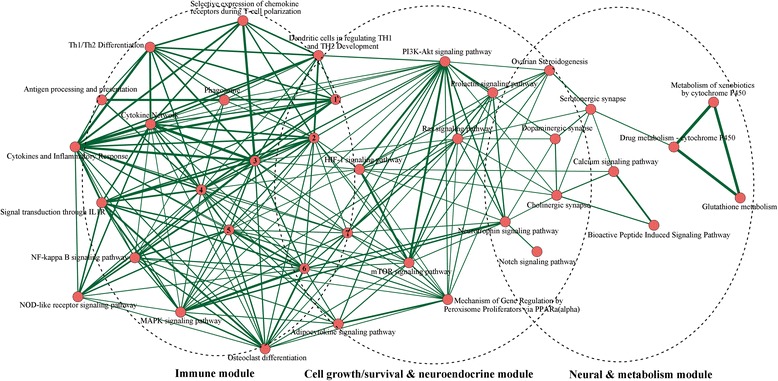
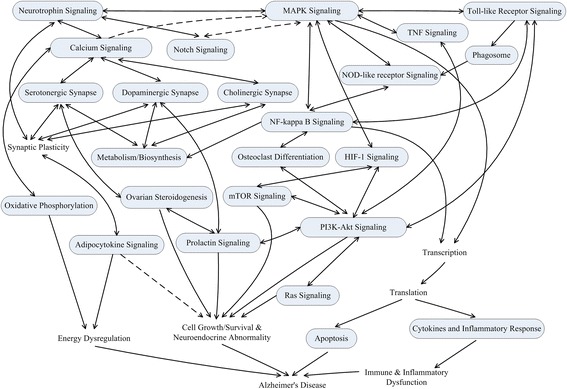
- Pathway crosstalk analysis found 207 crosstalks among 37 pathways, which grouped into three interlinked modules: neuronal and metabolic, cell growth/survival and neuroendocrine, and immune response-related, suggesting an AD-specific immune-endocrine-neuronal regulatory network.
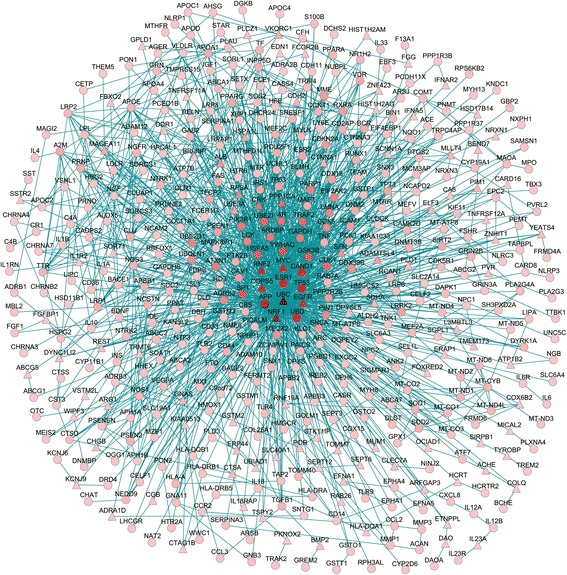
- The inferred AD-specific protein network comprised 496 nodes and 1521 edges; 393 of 430 Alzgset genes were included, accounting for 79.2% of the network and 91.4% of Alzgset.
- There were 103 genes in the AD-specific network outside Alzgset, including EGFR, NRF1, SSTR2, SORT1, TYROBP, CDH2, FBXO2, and VSTM2L, proposed as potentially associated with AD.
Methods
- AD-related genes were collected by searching PubMed for genetic association studies using the term “(Alzheimer’s Disease [MeSH]) AND (Polymorphism [MeSH] OR Genotype [MeSH] OR Alleles [MeSH]) NOT (Neoplasms [MeSH])”; by July 7, 2015, 5298 reports were retrieved, and studies reporting significant gene associations were retained, while insignificant or negative reports were excluded.
- Functional enrichment used WebGestalt and ToppGene for GO biological processes and pathways with FDR < 0.05; pathway crosstalk used overlap coefficient and Jaccard coefficient, keeping pathways with FDR < 0.05 and more than five candidate genes, removing pathway pairs with fewer than two overlapping genes, and visualizing with Cytoscape.
- A human protein–protein interaction network was compiled from PINA (May 21, 2014) and another human interactome, yielding 16,022 genes/proteins and 228,122 interactions; an AD-specific subnetwork was inferred with the Steiner minimal tree algorithm via GenRev, and non-randomness was assessed with 1000 random Erdos-Renyi networks.
Limitations
- The paper states that results depend on genes reported in publications, that AD risk-gene identification is ongoing, that original authors’ conclusions were adopted with possible bias or insufficiency, and that excluding insignificant/negative reports may omit genes actually associated with AD.
- The paper also states that GO is biased toward cancer biology and underrepresents neurology concepts, and that the human interactome remains incomplete and may include false-positive interactions.
- Evident from the text: the 103 additional network genes are computational predictions described as potentially involved or targets for further exploration, and the study does not report experimental validation of these novel candidates.
Model-written summary. Check it against the paper before relying on it.
Integrity signals
Registry
Cites
Statistics
Figures
Verification
Claims the paper makes
0 Valid · 0 Not valid · 41 Not checked · 74 Own results and interpretations
A result the paper states — it cites no source for it, so there is none to check. The quote shows it is in the paper.
In the paper
“Given that these intermediate genes interacted closely with those known to be related to AD, they might also be involved in the pathological process of the disease phenotype.”
§ Analyzing the genes related to Alzheimer’s disease via a network and pathway-based approach > Results > AD-specific protein network
hedgedstates an association- Asserted: passes — The authors put it forward as true.
- Checkable: passes — It can be checked against evidence.
- Load-bearing: passes — The paper’s conclusions depend on it.
- Based: passes — The paper gives a reason why it holds.
A result the paper reports from its own data — it cites no other source for it, so there is none to check. The quote shows it is in the paper.
In the paper
“What is more, the pathway of the intestinal immune network for IgA production was enriched, which might suggest a connection between AD and the intestinal microbiota [29, 30].”
§ Analyzing the genes related to Alzheimer’s disease via a network and pathway-based approach > Results > Biochemical pathway enriched in Alzgset
plainstates an association- Asserted: passes — The authors put it forward as true.
- Checkable: passes — It can be checked against evidence.
- Load-bearing: passes — The paper’s conclusions depend on it.
- Based: passes — The paper gives a reason why it holds.
A result the paper reports from its own data — it cites no other source for it, so there is none to check. The quote shows it is in the paper.
In the paper
“Biological theme analysis indicated that the biological processes and biochemical pathways related to neurodevelopment, metabolism, cell growth and/or survival, and immunology were enriched in these genes.”
§ Analyzing the genes related to Alzheimer’s disease via a network and pathway-based approach > Abstract > Results
hedgedstates an association- Asserted: passes — The authors put it forward as true.
- Checkable: passes — It can be checked against evidence.
- Load-bearing: passes — The paper’s conclusions depend on it.
- Based: passes — The paper gives a reason why it holds.
A result the paper reports from its own data — it cites no other source for it, so there is none to check. The quote shows it is in the paper.
In the paper
“Finally, we compiled a relatively comprehensive human physical interactome, which comprised 16,022 genes/proteins and 228,122 interactions (see Additional file 1).”
§ Analyzing the genes related to Alzheimer’s disease via a network and pathway-based approach > Methods > Compilation of the human protein–protein interaction network
plain- Asserted: passes — The authors put it forward as true.
- Checkable: passes — It can be checked against evidence.
- Load-bearing: passes — The paper’s conclusions depend on it.
- Based: passes — The paper gives a reason why it holds.
A result the paper reports from its own data — it cites no other source for it, so there is none to check. The quote shows it is in the paper.
In the paper
“Additionally, in the Alzgset enriched pathway list, there were some pathways related to cell growth and/or survival, including neurotrophin signaling, PI3K-Akt signaling, mTOR signaling, Notch signaling, and so forth, which are vital for cell growth/survival state of neurons in the process of AD [27, 28].”
§ Analyzing the genes related to Alzheimer’s disease via a network and pathway-based approach > Results > Biochemical pathway enriched in Alzgset
plain- Asserted: passes — The authors put it forward as true.
- Checkable: passes — It can be checked against evidence.
- Load-bearing: unclear — It is unclear whether the paper’s conclusions depend on it.
- Based: passes — The paper gives a reason why it holds.
56 more claims
Create a free account to see all 115 claims and to verify the 74 references still open.
- It may state two separate claims as one. 32
- Probably not a substantial claim. 29
Self-check
Percentages, sums and reported differences re-computed from the paper’s own numbers.
Each contradiction between two passages listed here was confirmed by an independent check.
Rated minor: it would not touch a result — a value no result rests on, a p-value that stays on the same side of the significance level, or a conflict that is clerical, resolved elsewhere in the paper, or outside its own findings.
In the paper
§ Analyzing the genes related to Alzheimer’s disease via a network and pathway-based approach > Results > Crosstalks among significantly enriched pathways
“The major theme of the second module was cell growth/survival and neuroendocrine-related pathways (e.g., PI3K-Akt signaling, mTOR signaling, notch signaling, prolactin signaling, etc.). The third module included immune response-related pathways (e.g., toll-like receptor signaling, Fc epsilon RI signaling pathway).”
§ Analyzing the genes related to Alzheimer’s disease via a network and pathway-based approach > Discussion
“In the second module, pathways were largely dominated by immune response or related functions, and by cell growth/survival and neuroendocrine pathways for the third group.”
Citations
Cites
Cytoscape: A software Environment for integrated models of biomolecular interaction networks
Shannon, P., Markiel, A., Ozier, O., Baliga, N. S., Wang, J. T., Ramage, D., Amin, N., Schwikowski, B., & Ideker, T. (2003) · Genome Research · doi:10.1101/gr.1239303 · Cited by 51,888
Self-citationLozano, R., Naghavi, M., Foreman, K., Lim, S., Shibuya, K., Aboyans, V., Abraham, J., Adair, T., Aggarwal, R., Ahn, S. Y., et al. (2012) · The Lancet · doi:10.1016/s0140-6736(12)61728-0 · Cited by 14,070
Network medicine: a network-based approach to human disease
Barabási, A.-L., Gulbahce, N., & Loscalzo, J. (2011) · Nature Reviews Genetics · doi:10.1038/nrg2918 · Cited by 5,034 · cited 1×
“A network parsimony principle has been demonstrated in the context of biological processes [19]; that is, the molecular networks/pathways often follow the shortest molecular paths between known disease-associated components (disease-related genes or proteins in our case).”
BackgroundHearing loss and cognitive decline in older adults
Lin, F. R., Yaffe, K., Xia, J., Xue, Q.-L., Harris, T. B., Purchase-Helzner, E., Satterfield, S., Ayonayon, H. N., Ferrucci, L., Simonsick, E. M., et al. (2013) · JAMA Internal Medicine · doi:10.1001/jamainternmed.2013.1868 · Cited by 4,017
Clinical and biomarker changes in dominantly inherited Alzheimer's disease
Bateman, R. J., Xiong, C., Benzinger, T. L. S., Fagan, A. M., Goate, A., Fox, N. C., Marcus, D. S., Cairns, N. J., Xie, X., Blazey, T. M., et al. (2012) · New England Journal of Medicine · doi:10.1056/nejmoa1202753 · Cited by 3,814 · cited 1×
“, amyloid deposition, accumulation of neurofibrillary tangles, as well as function and structure changes of brain regions involved in memory) often appear many years prior to clinical manifestations [6, 7].”
BackgroundToppGene Suite for gene list enrichment analysis and candidate gene prioritization
Chen, J., Bardes, E. E., Aronow, B. J., & Jegga, A. G. (2009) · Nucleic Acids Research · doi:10.1093/nar/gkp427 · Cited by 2,952
Ballard, C., Gauthier, S., Corbett, A., Brayne, C., Aarsland, D., & Jones, E. (2011) · The Lancet · doi:10.1016/s0140-6736(10)61349-9 · Cited by 2,336
Systematic meta-analyses of Alzheimer disease genetic association studies: the AlzGene database
Bertram, L., McQueen, M. B., Mullin, K., Blacker, D., & Tanzi, R. E. (2007) · Nature Genetics · doi:10.1038/ng1934 · Cited by 1,857
Role of Genes and Environments for Explaining Alzheimer Disease
Gatz, M., Reynolds, C. A., Fratiglioni, L., Johansson, B., Mortimer, J. A., Berg, S., Fiske, A., & Pedersen, N. L. (2006) · Archives of General Psychiatry · doi:10.1001/archpsyc.63.2.168 · Cited by 1,798 · cited 1×
“Among these factors, it is estimated that about 70% of the risk for AD is attributable to genetics [1, 12].”
BackgroundWebGestalt: an integrated system for exploring gene sets in various biological contexts
Zhang, B., Kirov, S., & Snoddy, J. (2005) · Nucleic Acids Research · doi:10.1093/nar/gki475 · Cited by 1,796
Research works printed but not linked: 1
- Erdos P Rényi A On the evolution of random graphs Publ Math Inst Hungar Acad Sci 1960 5 17 61
Cited by
A multiomics approach to heterogeneity in Alzheimer’s disease: focused review and roadmap
Badhwar, A., McFall, G. P., Sapkota, S., Black, S. E., Chertkow, H., Duchesne, S., Masellis, M., Li, L., Dixon, R. A., & Bellec, P. (2020) · Brain · doi:10.1093/brain/awz384 · Cited by 165
Single-cell genomics and regulatory networks for 388 human brains
Emani, P. S., Liu, J. J., Clarke, D., Jensen, M., Warrell, J., Gupta, C., Meng, R., Lee, C. Y., Xu, S., Dursun, C., et al. (2024) · Science · doi:10.1126/science.adi5199 · Cited by 163
The foundation and architecture of precision medicine in neurology and psychiatry
Hampel, H., Gao, P., Cummings, J., Toschi, N., Thompson, P. M., Hu, Y., Cho, M., & Vergallo, A. (2023) · Trends in Neurosciences · doi:10.1016/j.tins.2022.12.004 · Cited by 143
Self-citationZhao, M.-Y., Wang, G.-Q., Wang, N.-N., Yu, Q.-Y., Liu, R.-L., & Shi, W.-Q. (2019) · Neurological Research · doi:10.1080/01616412.2018.1548747 · Cited by 118
The Alzheimer's Disease Exposome
Finch, C. E., & Kulminski, A. M. (2019) · Alzheimer's & Dementia · doi:10.1016/j.jalz.2019.06.3914 · Cited by 109
Computational Drug Repurposing: Current Trends
Karaman, B., & Sippl, W. (2018) · Current Medicinal Chemistry · doi:10.2174/0929867325666180530100332 · Cited by 95
Comparison of Methods for Differential Co-expression Analysis for Disease Biomarker Prediction
Kakati, T., Bhattacharyya, D. K., Barah, P., & Kalita, J. K. (2019) · Computers in Biology and Medicine · doi:10.1016/j.compbiomed.2019.103380 · Cited by 93
Patir, A., Shih, B., McColl, B. W., & Freeman, T. C. (2019) · Glia · doi:10.1002/glia.23572 · Cited by 90
“…by cell activation and cell numbers, certain genes found differentially upregulated in both Alzheimer’s and aging, such as TSPO, MS4A6A, and MHC class 2 genes, are known features of microglial activation (Bergen, Kaing, Jacoline, Gorgels, & Janssen, 2015; Hamelin et al., 2016; Hu et al., 2017).”
BackgroundAdvances in protein-protein interaction network analysis for Parkinson's disease
Tomkins, J. E., & Manzoni, C. (2021) · Neurobiology of Disease · doi:10.1016/j.nbd.2021.105395 · Cited by 84
Genetic variation within endolysosomal system is associated with late-onset Alzheimer’s disease
Gao, S., Casey, A. E., Sargeant, T. J., & Mäkinen, V.-P. (2018) · Brain · doi:10.1093/brain/awy197 · Cited by 78
Network Medicine for Alzheimer’s Disease and Traditional Chinese Medicine
Jarrell, J. T., Gao, L., Cohen, D. S., & Huang, X. (2018) · Molecules · doi:10.3390/molecules23051143 · Cited by 71
Mendonça, C. F., Kuras, M., Nogueira, F. C. S., Plá, I., Hortobágyi, T., Csiba, L., Palkovits, M., Renner, É., Döme, P., Marko-Varga, G., et al. (2019) · Neurobiology of Disease · doi:10.1016/j.nbd.2019.104509 · Cited by 70
Cheng, Y., Pereira, M. G., Raukar, N. P., Reagan, J. L., Queseneberry, M., Goldberg, L. R., Borgovan, T., LaFrance, W. C., Jr., Dooner, M. S., Deregibus, M. C., et al. (2019) · Journal of Cellular Physiology · doi:10.1002/jcp.28139 · Cited by 69
Analyzing the genes and pathways related to major depressive disorder via a systems biology approach
Fan, T., Hu, Y. C., Xin, J., Zhao, M., & Wang, J. (2019) · Brain and Behavior · doi:10.1002/brb3.1502 · Cited by 65
Self-citationPeng, Y., Yuan, M., Xin, J., Liu, X., & Wang, J. (2020) · Bioinformatics · doi:10.1093/bioinformatics/btaa563 · Cited by 64
Self-citationHassan, M., Raza, H., Abbasi, M. A., Moustafa, A. A., & Seo, S.-Y. (2019) · Biomedicine & Pharmacotherapy · doi:10.1016/j.biopha.2018.11.115 · Cited by 61
Pathway-based classification of genetic diseases
Iourov, I. Y., Vorsanova, S. G., & Yurov, Y. B. (2019) · Molecular Cytogenetics · doi:10.1186/s13039-019-0418-4 · Cited by 51
MENDA: a comprehensive curated resource of metabolic characterization in depression
Pu, J., Yu, Y., Liu, Y., Tian, L., Gui, S., Zhong, X., Fan, C., Xu, S., Song, X., Liu, L., et al. (2019) · Briefings in Bioinformatics · doi:10.1093/bib/bbz055 · Cited by 49
Zhu, M., Jia, L., Li, F., & Jia, J. (2020) · Frontiers in Genetics · doi:10.3389/fgene.2020.00981 · Cited by 48
Vasunilashorn, S. M., Ngo, L. H., Inouye, S. K., Fong, T. G., Jones, R. N., Dillon, S. T., Libermann, T. A., O’Connor, M. G., Arnold, S. E., Xie, Z., et al. (2020) · Alzheimer s & Dementia · doi:10.1016/j.jalz.2019.09.080 · Cited by 48
Fani, L., Georgakis, M. K., Ikram, M. A., Ikram, M. K., Malik, R., & Dichgans, M. (2021) · Translational Psychiatry · doi:10.1038/s41398-021-01400-z · Cited by 47
Alonso-Garrido, M., Frangiamone, M., Font, G., Cimbalo, A., & Manyes, L. (2021) · Food and Chemical Toxicology · doi:10.1016/j.fct.2021.112261 · Cited by 43
François, M., Karpe, A. V., Liu, J., Beale, D. J., Hor, M., Hecker, J. R., Faunt, J., Maddison, J., Johns, S., Doecke, J. D., et al. (2021) · Journal of Alzheimer s Disease · doi:10.3233/jad-210283 · Cited by 39
Baker, E. A., Sims, R., Leonenko, G., Frizzati, A., Harwood, J. C., Grozeva, D., GERAD/PERADES, CHARGE, ADGC, EADI, et al. (2019) · PLoS ONE · doi:10.1371/journal.pone.0218111 · Cited by 35
Re-thinking Alzheimer's disease therapeutic targets using gene-based tests
Kwok, M. K., Lin, S. L., & Schooling, C. M. (2018) · EBioMedicine · doi:10.1016/j.ebiom.2018.10.001 · Cited by 35
Chen, H., He, Y., Ji, J., & Shi, Y. (2019) · Frontiers in Neurology · doi:10.3389/fneur.2019.01162 · Cited by 34
der Auwera, S. V., Ameling, S., Wittfeld, K., Rowold, E. D., Nauck, M. A., Völzke, H., Suhre, K., Najafi-Shoushtari, S. H., Methew, J., Ramachandran, V., et al. (2019) · Neuropsychopharmacology · doi:10.1038/s41386-019-0460-2 · Cited by 33
Mullane, K., & Williams, M. (2018) · Biochemical Pharmacology · doi:10.1016/j.bcp.2018.09.027 · Cited by 32
Wu, A. T. H., Lawal, B., Wei, L., Wen, Y.-T., Tzeng, D. T. W., & Lo, W. (2021) · Pharmaceutics · doi:10.3390/pharmaceutics13101555 · Cited by 32
Baker, E., Sims, R., Leonenko, G., Frizzati, A., Harwood, J., Grozeva, D., GERAD/PERADES, consortia, I., Morgan, K., Passmore, P., et al. (2018) · doi:10.1101/374876 · Cited by 31
“involved in a variety of functions, circadian rhythm, cholesterol metabolism, inflammation, etc (Jetten et al. [2009]).”
BackgroundData science in neurodegenerative disease: its capabilities, limitations, and perspectives
Khatami, S. G., Mubeen, S., & Hofmann‐Apitius, M. (2020) · Current Opinion in Neurology · doi:10.1097/wco.0000000000000795 · Cited by 30
Mihelčić, M., Šimić, G., Leko, M. B., Lavrač, N., Džeroski, S., Šmuc, T., & Initiative, A. D. N. (2017) · PLoS ONE · doi:10.1371/journal.pone.0187364 · Cited by 29
Battaglia, C., Venturin, M., Šojić, A., Jesuthasan, N., Orro, A., Spinelli, R., Musicco, M., Bellis, G. D., & Adorni, F. (2019) · Frontiers in Genetics · doi:10.3389/fgene.2019.00846 · Cited by 26
Pauls, E., Bayod, S., Mateo, L., Alcalde, V., Juan-Blanco, T., Sánchez‐Soto, M., Saido, T. C., Saito, T., Berenguer, A., Attolini, C. S., et al. (2021) · Genome Medicine · doi:10.1186/s13073-021-00983-y · Cited by 25
Dolci, G., Cruciani, F., Rahaman, M. A., Abrol, A., Chen, J., Fu, Z., Galazzo, I. B., Menegaz, G., Calhoun, V. D., & Initiative, A. D. N. (2025) · Journal of Neural Engineering · doi:10.1088/1741-2552/ae087d · Cited by 24
Network Analysis for Complex Neurodegenerative Diseases
Manzoni, C., Lewis, P. A., & Ferrari, R. (2020) · Current Genetic Medicine Reports · doi:10.1007/s40142-020-00181-z · Cited by 23
Drug Repurposing for Alzheimer’s Disease Based on Protein‐Protein Interaction Network
Zakeri, N. S. S., Pashazadeh, S., & MotieGhader, H. (2021) · BioMed Research International · doi:10.1155/2021/1280237 · Cited by 23
Initiative, A. D. N., Maxwell, T. J., Corcoran, C., Del‐Aguila, J. L., Budde, J., Deming, Y. K., Cruchaga, C., Goate, A., & Kauwe, J. S. K. (2018) · Alzheimer s Research & Therapy · doi:10.1186/s13195-018-0410-y · Cited by 23
Systems biology and gene networks in Alzheimer’s disease
Wang, Z.-T., Tan, C., Tan, L., & Yu, J. (2018) · Neuroscience & Biobehavioral Reviews · doi:10.1016/j.neubiorev.2018.11.007 · Cited by 21
Sapkota, S., & Dixon, R. A. (2018) · Journal of Alzheimer s Disease · doi:10.3233/jad-170909 · Cited by 21
Lee, C.-Y., Riffle, D., Xiong, Y., Momtaz, N., Lei, Y., Pariser, J. M., Sikdar, D., Hwang, A., Duan, Z., & Zhang, J. (2024) · BMC Neuroscience · doi:10.1186/s12868-024-00867-y · Cited by 20
Petracci, I., Bellini, S., Goljanek‐Whysall, K., Quinlan, L. R., Fiszer, A., Cakmak, A., Njume, C. M., Borroni, B., & Ghidoni, R. (2025) · International Journal of Molecular Sciences · doi:10.3390/ijms26073399 · Cited by 20
Hoogstraten, C. A., Lyon, J. J., Smeitink, J. A. M., Rüssel, F. G. M., & Schirris, T. J. J. (2023) · Pharmacological Reviews · doi:10.1124/pharmrev.122.000568 · Cited by 20
Park, C., Kim, J., Kim, J., & Park, S. (2018) · PLoS ONE · doi:10.1371/journal.pone.0201056 · Cited by 20
Network Medicine Approach for Analysis of Alzheimer’s Disease Gene Expression Data
Cohen, D., Pilozzi, A. R., & Huang, X. (2020) · International Journal of Molecular Sciences · doi:10.3390/ijms21010332 · Cited by 18
Updating functional brain units: Insights far beyond Luria
Peña‐Casanova, J., Sánchez‐Benavides, G., & Sigg-Alonso, J. (2024) · Cortex · doi:10.1016/j.cortex.2024.02.004 · Cited by 17
Honda, K., Saito, Y., Saito, H., Toyoda, M., Abe, R., Saito, T., Saido, T. C., Michikawa, M., Taru, H., Sobu, Y., et al. (2022) · SSRN Electronic Journal · doi:10.1016/j.neurobiolaging.2022.12.003 · Cited by 17
Multi-scale modeling for systematically understanding the key roles of microglia in AD development
Ji, Z., Liu, C., Zhao, W., Soto, C. A., & Zhou, X. (2021) · Computers in Biology and Medicine · doi:10.1016/j.compbiomed.2021.104374 · Cited by 16
Guo, P., Chen, S., Wang, H., Wang, Y., & Wang, J. (2022) · Frontiers in Aging Neuroscience · doi:10.3389/fnagi.2021.789698 · Cited by 16
Self-citationModulatory Effects of Nicotine on neuroHIV/neuroAIDS
Han, H., Yang, Z., Chang, S. L., & Li, M. D. (2018) · Journal of Neuroimmune Pharmacology · doi:10.1007/s11481-018-9806-5 · Cited by 16
Metabolomic analysis of animal models of depression
Tian, L., Pu, J., Liu, Y., Gui, S., Zhong, X., Song, X., Xu, S., Zhang, H., Wang, H., Zhou, W., et al. (2020) · Metabolic Brain Disease · doi:10.1007/s11011-020-00574-7 · Cited by 16
Huang, Y.-H., Chen, Y., Ho, W.-M., Lee, R.-G., Chung, R., Liu, Y., Chang, P.-Y., Chang, S., Wang, C.-W., Chung, W., et al. (2023) · Journal of the Formosan Medical Association · doi:10.1016/j.jfma.2023.10.021 · Cited by 15
Salivary Proteomics Identifies Transthyretin as a Biomarker of Early Dementia Conversion
Eldem, E., Barve, A., Sallin, O., Foucras, S., Annoni, J., Schmid, A. W., & Alberi, L. A. (2022) · Journal of Alzheimer s Disease Reports · doi:10.3233/adr-210056 · Cited by 15
Patel, D., Zhang, X., Farrell, J. J., Lunetta, K. L., & Farrer, L. A. (2021) · Genes · doi:10.3390/genes12030419 · Cited by 14
Analyzing the disease module associated with osteosarcoma via a network‑ and pathway‑based approach
Zhang, Y., & Yang, F. (2018) · Experimental and Therapeutic Medicine · doi:10.3892/etm.2018.6506 · Cited by 14
Benefits and Challenges of Rare Genetic Variation in Alzheimer’s Disease
Grozeva, D., Saad, S., Menzies, G. E., & Sims, R. (2019) · Current Genetic Medicine Reports · doi:10.1007/s40142-019-0161-5 · Cited by 13
Mei, T., Li, Y., Dolado, A. O., Li, Z., Andersson, R., Berliocchi, L., & Rasmussen, L. J. (2023) · Frontiers in Aging Neuroscience · doi:10.3389/fnagi.2023.1101216 · Cited by 13
Zhou, M., Jiao, Q., Wu, Z., Li, W., Liu, G., Wang, R., & Tang, Y. (2023) · Journal of Alzheimer s Disease · doi:10.3233/jad-220727 · Cited by 12
Aplysia Neurons as a Model of Alzheimer’s Disease: Shared Genes and Differential Expression
Kron, N. S., & Fieber, L. A. (2021) · Journal of Molecular Neuroscience · doi:10.1007/s12031-021-01918-3 · Cited by 10
Chan, G. G., Koch, C. M., & Connors, L. H. (2017) · Journal of Proteome Research · doi:10.1021/acs.jproteome.7b00479 · Cited by 10
GWAS and Beyond: Using Omics Approaches to Interpret SNP Associations
Chen, H., Petty, L. E., Bush, W. S., Naj, A. C., & Below, J. E. (2019) · Current Genetic Medicine Reports · doi:10.1007/s40142-019-0159-z · Cited by 9
Pathway and network analysis of genes related to osteoporosis
Guo, L., Han, J. G., Guo, H., Lv, D.-M., & Wang, Y. (2019) · Molecular Medicine Reports · doi:10.3892/mmr.2019.10353 · Cited by 9
Yesudas, C., Neethu, P., & Devaraj, I. (2024) · Brain Disorders · doi:10.1016/j.dscb.2024.100178 · Cited by 6
Oczkowicz, M., Szmatoła, T., & Świątkiewicz, M. (2019) · Genes · doi:10.3390/genes10120948 · Cited by 6
Hosseini-Gerami, L., Ficulle, E., Humphryes-Kirilov, N., Airey, D. C., Scherschel, J., Kananathan, S., Eastwood, B. J., Bose, S., Collier, D. A., Laing, E., et al. (2023) · Alzheimer s Research & Therapy · doi:10.1186/s13195-023-01182-0 · Cited by 6
Picón-Pagès, P., Bosch-Morató, M., Subirana, L., Rubio-Moscardó, F., Guivernau, B., Fanlo-Ucar, H., Zeylan, M. E., Senyuz, S., Herrera-Fernández, V., Vicente, R., et al. (2023) · International Journal of Molecular Sciences · doi:10.3390/ijms24021278 · Cited by 6
Padmanabhan, K., Shpanskaya, K. S., Bello, G. A., Doraiswamy, P. M., & Samatova, N. F. (2017) · Frontiers in Aging Neuroscience · doi:10.3389/fnagi.2017.00315 · Cited by 6
Yuan, X., Gao, L., Peng, Y., She, T., & Wang, J. (2025) · Artificial Intelligence in Medicine · doi:10.1016/j.artmed.2025.103301 · Cited by 5
Self-citationCeylan, B., Düz, E., & Çakır, T. (2023) · Molecular Neurobiology · doi:10.1007/s12035-023-03690-4 · Cited by 5
Ma, Y., Cao, C., Zhao, M., Liu, X., Cheng, F., & Wang, J. (2021) · Journal of Molecular Neuroscience · doi:10.1007/s12031-021-01874-y · Cited by 5
Self-citationHe, S., Lv, X., He, X., Guo, J., Pan, R., Jin, Y., Tian, Z., Pan, L., & Zhang, S. (2024) · Human Gene Therapy · doi:10.1089/hum.2021.222 · Cited by 5
Aligning Cross-Species Interactomes for Studying Complex and Chronic Diseases
Milano, M., Cinaglia, P., Guzzi, P. H., & Cannataro, M. (2023) · Life · doi:10.3390/life13071520 · Cited by 5
A Novel Pathway Network Analytics Method Based on Graph Theory
Saha, S., Soliman, A. T., & Rajasekaran, S. (2021) · Journal of Computational Biology · doi:10.1089/cmb.2021.0257 · Cited by 5
Lüleci, H. B., Jones, A., & Çakır, T. (2024) · European Journal of Neuroscience · doi:10.1111/ejn.16482 · Cited by 4
Multimorbidity in neurodegenerative diseases: a network analysis
Amini, M., Bagheri, A., Paulus, M. P., & Delen, D. (2024) · Informatics for Health and Social Care · doi:10.1080/17538157.2024.2405869 · Cited by 4
Development and use of a Cytoscape app for GRNCOP2
Díaz–Montaña, J. J., Díaz–Díaz, N., Barranco, C. D., & Ponzoni, I. (2019) · Computer Methods and Programs in Biomedicine · doi:10.1016/j.cmpb.2019.05.030 · Cited by 4
Ma, T., Liu, J., Liang, D., Ebelt, S., Steenland, K., Levey, A. I., Lah, J. J., Wingo, A. P., Wingo, T. S., & Hüls, A. (2026) · Molecular Psychiatry · doi:10.1038/s41380-026-03662-9 · Cited by 3
Trifonova, E. A., Pashchenko, A. A., Ivanov, R. A., Kochetov, A. V., & Lashin, S. A. (2025) · International Journal of Molecular Sciences · doi:10.3390/ijms262010066 · Cited by 3
Armañanzas, R. (2018) · BMC Genomics · doi:10.1186/s12864-018-5025-y · Cited by 3
Natural Products Targeting Alzheimer’s Disease via NF-κB Pathway: A Review
Hasan, F., Thippamma, K., Kumar, V., Baiseitova, A., Ikram, M. A., & Shah, A. B. (2025) · CNS & Neurological Disorders - Drug Targets · doi:10.2174/0118715273397045250922054643 · Cited by 2
Hu, Y., She, B., Yin, Z., Yu, X., Wu, W., & Chen, M. (2025) · medRxiv · doi:10.1101/2025.10.01.25337087 · Cited by 2
Self-citationA Network and Pathway Analysis of Genes Associated With Atrial Fibrillation
Zeng, M., Yang, X., Chen, Y., Fan, J., Cao, L., Wang, M., Xiao, P., Ling, Z., Yin, Y., & Chen, Y.-W. (2024) · Cardiovascular Therapeutics · doi:10.1155/2024/7054039 · Cited by 2
Rahmanto, I., Cahyono, M. B. A., Khatimah, H., Nugraningrum, R., Putri, P. S. G., Sahiruddin, N. Z., Rahmaniah, N., & Romadhon, P. Z. (2024) · Qanun Medika - Medical Journal Faculty of Medicine Muhammadiyah Surabaya · doi:10.30651/jqm.v8i01.16054 · Cited by 2
Düz, E., İlgün, A., Bozkurt, F. B., & Çakır, T. (2024) · European Journal of Neuroscience · doi:10.1111/ejn.16600 · Cited by 2
Thorat, D. S., Uddin, M. J., Ibrahim, R. I. H., Oladosu, T. A., Sahu, K. K., Chidrawar, V. R., Singh, S. A., Nagime, P. V., Basu, B., & Shafi, S. (2026) · CNS & Neurological Disorders - Drug Targets · doi:10.2174/0118715273388245251113054232 · Cited by 2
Wang, Q., Fu, M., Gao, L., Yuan, X., & Wang, J. (2024) · Journal of Alzheimer s Disease · doi:10.3233/jad-240235 · Cited by 1
Self-citationWard, K. M., Pickett, B. D., Ebbert, M., Kauwe, J. S. K., & Miller, J. B. (2022) · Genes · doi:10.3390/genes13081346 · Cited by 1
Khan, S., Prinsa, Bano, N., Fazal, F., Ahamad, S., Saha, S., Dar, N. J., & Bhat, S. A. (2026) · Network Modeling Analysis in Health Informatics and Bioinformatics · doi:10.1007/s13721-026-00776-6 · Cited by 1
Aksu, R., Lüleci, H. B., & Çakır, T. (2026) · Cellular and Molecular Neurobiology · doi:10.1007/s10571-026-01700-2 · Cited by 1
Chasovskikh, N. Y., Grechishnikova, A. Y., & Smirnov, D. V. (2020) · Bulletin of Siberian Medicine · doi:10.20538/1682-0363-2020-1-108-113 · Cited by 1
Functional biological paths altered in Alzheimer’s disease: from genes to bile acidsPreprint
Gorijala, P., Nho, K. T., Risacher, S. L., Kaddurah‐Daouk, R., Saykin, A. J., & Yan, J. (2020) · bioRxiv (Cold Spring Harbor Laboratory) · doi:10.1101/2020.01.31.929554 · Cited by 1
Sui, X., Yu, J., Wu, J., Guo, L., & Shi, X. (2018) · CYTOLOGIA · doi:10.1508/cytologia.83.251 · Cited by 1
Wickstead, E. S. (2019) · WestminsterResearch (University of Westminster) · doi:10.34737/qy292 · Cited by 1
Ensemble graphs to reveal post-transcriptional regulatory networks in Alzheimer's disease
Armañanzas, R. (2017) · IEEE International Conference on Bioinformatics and Biomedicine (BIBM) · doi:10.1109/bibm.2017.8217667 · Cited by 1
Ontology-driven pathway data integration
Wang, L. L. (2019) · ResearchWorks at the University of Washington (University of Washington) · Cited by 1
Saha, S., Soliman, A. T., & Rajasekaran, S. (2021) · bioRxiv (Cold Spring Harbor Laboratory) · doi:10.1101/2021.10.19.465019
Ma, Y., Cao, C., Zhao, M., Liu, X., Cheng, F., & Wang, J. (2021) · Research Square · doi:10.21203/rs.3.rs-295165/v1
Self-citationIdentification of the modulators of and the molecular pathways involved in the BIN1-Tau interaction
Mendes, T. (2018) · theses.fr (ABES) · doi:10.70675/7f8b5d9cz1433z4dd0za940zdc3273d248b0
A Novel Pathway Network Analytics Method Based on Graph Theory
Saha, S., Soliman, A. T., & Rajasekaran, S. (2021) · Lecture notes in computer science · doi:10.1007/978-3-030-79290-9_5
Investigating genetic variation in Alzheimer’s disease
Patel, T. (2018) · Nottingham ePrints (University of Nottingham)
Metadata
- Authors
- Hu, Y.-S., Xin, J., Hu, Y., Zhang, L., & Wang, J.
- Affiliations
- Tianjin Medical University (CN)
- Tianjin University (CN)
- Corresponding author
- Zhang, Lei
- Wang, Ju
- Venue
- Alzheimer's Research & Therapy
- Published
- 2017-04-27
- Volume
- 9
- Issue
- 1
- Pages
- 29-29
- ISSN
- 1758-9193 (ISSN-L)
- PMC
- PMC5406904
- OpenAlex
- W2608472446
- Semantic Scholar
- 5ea98996ad39e26b133a61e64bef2491691d2198
- Cited by
- 123
- References
- 81
- Citations by year
- 2026: 10 · 2025: 10 · 2024: 17 · 2023: 13 · 2022: 6 · 2021: 16 · 2020: 9 · 2019: 21 · 2018: 16 · 2017: 4
- FWCI
- 5.08
- Type
- journal article
- Language
- en
- Open access
- gold
- doi.org
- Licence
- cc-by
- Locations
- Alzheimer s Research & Therapy (publishedVersion, cc-by)
- PubMed Central (publishedVersion, cc-by)
- PubMed (publishedVersion)
- DOAJ (DOAJ: Directory of Open Access Journals) (submittedVersion)
- Funders
- National Natural Science Foundation of China (31271411, 61202379)
- Topics
- Life Sciences › Neuroscience › Cellular and Molecular Neuroscience › Alzheimer's disease research and treatments
- Life Sciences › Biochemistry, Genetics and Molecular Biology › Molecular Biology › Bioinformatics and Genomic Networks
- Health Sciences › Medicine › Psychiatry and Mental health › Dementia and Cognitive Impairment Research
- Keywords
- Alzheimer's disease, genetic association studies, gene interaction networks, pathway crosstalk, pathway enrichment, minimum Steiner tree, human interactome, immune response, neuroendocrine pathways, metabolic pathways, brain development, cell growth and survival, pathogenesis
- MeSH terms
- Alzheimer Disease, Brain, Computer Simulation, Humans, Models, Genetic, Nerve Tissue Proteins, Signal Transduction, Genetic Predisposition to Disease, Gene Expression Profiling, Gene Regulatory Networks, Metabolic Networks and Pathways, Genetic Association Studies, Metabolic Flux Analysis
About these checks
Registry, retraction, Cites and statistics results are computed, not judged, with one exception: a printed reference that no index lists is read once by a model before it counts as a citation error. Claims are extracted by a model and kept only when their quote appears verbatim in the text; each cited source is then checked, with a model’s help, for whether it says what the claim relies on. Those verdicts can be wrong — read the claim’s quote and the cited source before relying on one.
A language model drew the claims from the paper on 2026-11-26, under version 3 of the claim definition (model deepseek-v4.1-flash, prompt extract-v3).
A second model labelled each claim on 2026-11-26 (model jev-1.13-20260917, definition revision gold-guideline-v0.2).
Statistics and arithmetic are recomputed, not judged.
Confidence bands are shown only for fields calibrated on our annotated test set. None is calibrated yet, so no band is shown.
What counts as a claim ›How we measure confidence ›How we check this ›
Are you an author, or do you see a problem with this page? Request a review
Data sources
Bibliographic data: Semantic Scholar, OpenAlex, Crossref.
Contains information from the Semantic Scholar Academic Graph Datasets, made available under the ODC Attribution License (ODC-BY 1.0).
Semantic Scholar’s data is described in: Kinney, R., et al. (2023). The Semantic Scholar Open Data Platform. arXiv:2301.10140.
