

The DOI matches its Crossref record; 157 of the 157 references it cites were found in a registry or an index.
Stem cell models of Alzheimer’s disease: progress and challenges
Open accessAbstract
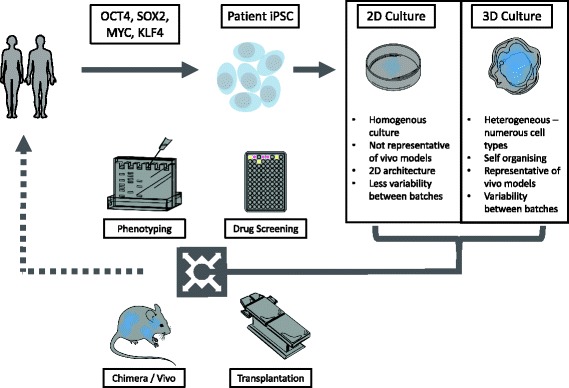
A major challenge to our understanding of the molecular mechanisms of Alzheimer's disease (AD) has been the lack of physiologically relevant in vitro models which capture the precise patient genome, in the cell type of interest, with physiological expression levels of the gene(s) of interest. Induced pluripotent stem cell (iPSC) technology, together with advances in 2D and 3D neuronal differentiation, offers a unique opportunity to overcome this challenge and generate a limitless supply of human neurons for in vitro studies. iPSC-neuron models have been widely employed to model AD and we discuss in this review the progress that has been made to date using patient-derived neurons to recapitulate key aspects of AD pathology and how these models have contributed to a deeper understanding of AD molecular mechanisms, as well as addressing the key challenges posed by using this technology and what progress is being made to overcome these. Finally, we highlight future directions for the use of iPSC-neurons in AD research and highlight the potential value of this technology to neurodegenerative research in the coming years.
Overview
The claims and statistics of this paper haven’t been checked yet.
Run the check — free, no account needed. It reads the open-access text and checks the sources it cites.
Integrity signals
Registry
Cites
Statistics
Figures
Verification
Claims the paper makes
The claims and statistics of this paper haven’t been checked yet.
Run the check — free, no account needed. It reads the open-access text and checks the sources it cites.
Claims other papers make about this one
Each is checked against this paper’s own text: does it say what the citing paper says it does?
The check wasn’t confident either way, so it gives no verdict — never disputed.
In the citing paper
“For example, monolayer cultures of microglia have been widely used to study the basic functions of microglia, such as migration and phagocytosis.16”
From Acoustofluidic assembly of 3D neurospheroids to model Alzheimer's disease (2020) · cites this paper as [16]
Experimental — accuracy not yet measured
Self-check
Percentages, sums and reported differences re-computed from the paper’s own numbers.
The self-check needs the paper’s full text.
Citations
Cites
2 retracted
Crews, L. A., Spencer, B. J., Desplats, P., Patrick, C., Paulino, A., Rockenstein, E. M., Hansen, L. A., Adame, A., Galasko, D. R., & Masliah, E. (2010) · PLoS ONE · doi:10.1371/journal.pone.0009313 · Cited by 379
RetractedYamamizu, K., Iwasaki, M., Takakubo, H., Sakamoto, T., Ikuno, T., Miyoshi, M., Kondo, T., Nakao, Y., Nakagawa, M., Inoue, H., et al. (2017) · Stem Cell Reports · doi:10.1016/j.stemcr.2017.01.023 · Cited by 51
RetractedInduction of Pluripotent Stem Cells from Adult Human Fibroblasts by Defined Factors
Takahashi, K., Tanabe, K., Ohnuki, M., Narita, M., Ichisaka, T., Tomoda, K., & Yamanaka, S. (2007) · Cell · doi:10.1016/j.cell.2007.11.019 · Cited by 20,221
Neuropathological stageing of Alzheimer-related changes.
Braak, H., & Braak, E. (1991) · Acta Neuropathologica · doi:10.1007/bf00308809 · Cited by 16,123
Multiplex Genome Engineering Using CRISPR/Cas Systems
Cong, L., Ran, F. A., Cox, D., Lin, S., Barretto, R., Habib, N., Hsu, P. D., Wu, X., Jiang, W., Marraffini, L. A., et al. (2013) · Science · doi:10.1126/science.1231143 · Cited by 15,339
Amyloid oligomers exacerbate tau pathology in a mouse model of tauopathy
Selenica, M.-L. B., Brownlow, M., Jimenez, J. P., Lee, D. C., Pena, G., Dickey, C. A., Gordon, M. N., & Morgan, D. (2013) · Neurodegenerative Diseases · doi:10.1159/000337230 · Cited by 10,359
Induced Pluripotent Stem Cell Lines Derived from Human Somatic Cells
Yu, J., Vodyanik, M. A., Smuga-Otto, K., Antosiewicz-Bourget, J., Frane, J. L., Tian, S., Nie, J., Jonsdottir, G. A., Ruotti, V., Stewart, R., et al. (2007) · Science · doi:10.1126/science.1151526 · Cited by 10,310
Corder, E. H., Saunders, A. M., Strittmatter, W. J., Schmechel, D. E., Gaskell, P. C., Small, G. W., Roses, A. D., Haines, J. L., & Pericak-Vance, M. A. (1993) · Science · doi:10.1126/science.8346443 · Cited by 9,429
RNA-Guided Human Genome Engineering via Cas9
Mali, P., Yang, L., Esvelt, K. M., Aach, J., Guell, M., DiCarlo, J. E., Norville, J. E., & Church, G. M. (2013) · Science · doi:10.1126/science.1232033 · Cited by 9,210
Cerebral organoids model human brain development and microcephaly
Lancaster, M. A., Renner, M., Martin, C.-A., Wenzel, D., Bicknell, L. S., Hurles, M. E., Homfray, T., Penninger, J. M., Jackson, A. P., & Knoblich, J. A. (2013) · Nature · doi:10.1038/nature12517 · Cited by 5,372
Research works printed but not linked: 1
- Huang Y-WA, Zhou B, Wernig M, Südhof TCTC. ApoE2, ApoE3, and ApoE4 differentially stimulate APP transcription and Aβ secretion. Cell. 2017;168(3):427–41.e21. · DOI · Paper page
Cited by
Sorted by citations
Ageing as a risk factor for neurodegenerative disease
Hou, Y., Dan, X., Babbar, M., Wei, Y., Hasselbalch, S. G., Croteau, D. L., & Bohr, V. A. (2019) · Nature Reviews Neurology · doi:10.1038/s41582-019-0244-7 · Cited by 3,310
Brain organoids: advances, applications and challenges
Qian, X., Song, H., & Ming, G.-L. (2019) · Development · doi:10.1242/dev.166074 · Cited by 724
The multiplex model of the genetics of Alzheimer's disease
Sims, R., Hill, M., & Williams, J. (2020) · Nature Neuroscience · doi:10.1038/s41593-020-0599-5 · Cited by 466
The complexity of Alzheimer’s disease: an evolving puzzle
Ferrari, C., & Sorbi, S. (2021) · Physiological Reviews · doi:10.1152/physrev.00015.2020 · Cited by 341
The amyloid cascade hypothesis: an updated critical review
Kepp, K. P., Robakis, N. K. R. K., Høilund‐Carlsen, P. F., Sensi, S. L., & Vissel, B. (2023) · Brain · doi:10.1093/brain/awad159 · Cited by 315
Metadata
- Authors
- Arber, C., Lovejoy, C., & Wray, S.
- Affiliations
- UCL Queen Square Institute of Neurology (GB)
- Corresponding author
- Wray, Selina
- Venue
- Alzheimer's Research & Therapy
- Published
- 2017-06-13
- Volume
- 9
- Issue
- 1
- Pages
- 42-42
- ISSN
- 1758-9193 (ISSN-L)
- PMC
- PMC5470327
- OpenAlex
- W2624768339
- Cited by
- 143
- References
- 157
- Citations by year
- 2026: 7 · 2025: 8 · 2024: 13 · 2023: 10 · 2022: 14 · 2021: 19 · 2020: 26 · 2019: 26 · 2018: 19
- FWCI
- 2.38
- Type
- journal article
- Language
- en
- Open access
- gold
- doi.org
- Licence
- cc-by
- Locations
- Alzheimer s Research & Therapy (publishedVersion, cc-by)
- Europe PMC (PubMed Central) (publishedVersion, cc-by)
- PubMed Central (publishedVersion, cc-by)
- PubMed (publishedVersion)
- DOAJ (DOAJ: Directory of Open Access Journals) (submittedVersion, cc-by-sa)
- UCL Discovery (University College London) (submittedVersion)
- Funders
- Alzheimer’s Research UK
- National Centre for the Replacement, Refinement and Reduction of Animals in Research
- National Institute for Health Research
- Topics
- Life Sciences › Neuroscience › Cellular and Molecular Neuroscience › Alzheimer's disease research and treatments
- Life Sciences › Biochemistry, Genetics and Molecular Biology › Molecular Biology › Pluripotent Stem Cells Research
- Health Sciences › Medicine › Psychiatry and Mental health › Dementia and Cognitive Impairment Research
- Keywords
- Alzheimer's disease, induced pluripotent stem cells, iPSC-derived neurons, patient-derived neurons, neuronal differentiation, in vitro disease model, neurodegeneration
- MeSH terms
- Alzheimer Disease, Animals, Cells, Cultured, Disease Models, Animal, Humans, Organoids, Tissue Engineering, Induced Pluripotent Stem Cells, Neural Stem Cells, Batch Cell Culture Techniques
About these checks
Registry, retraction, Cites and statistics results are computed, not judged, with one exception: a printed reference that no index lists is read once by a model before it counts as a citation error. Claims are extracted by a model and kept only when their quote appears verbatim in the text; each cited source is then checked, with a model’s help, for whether it says what the claim relies on. Those verdicts can be wrong — read the claim’s quote and the cited source before relying on one.
Statistics and arithmetic are recomputed, not judged.
Confidence bands are shown only for fields calibrated on our annotated test set. None is calibrated yet, so no band is shown.
What counts as a claim ›How we measure confidence ›How we check this ›
Are you an author, or do you see a problem with this page? Request a review
