

The DOI matches its Crossref record; 104 of the 104 references it cites were found in a registry or an index.
Neurons derived from sporadic Alzheimer’s disease iPSCs reveal elevated TAU hyperphosphorylation, increased amyloid levels, and GSK3B activation
Open accessAbstract
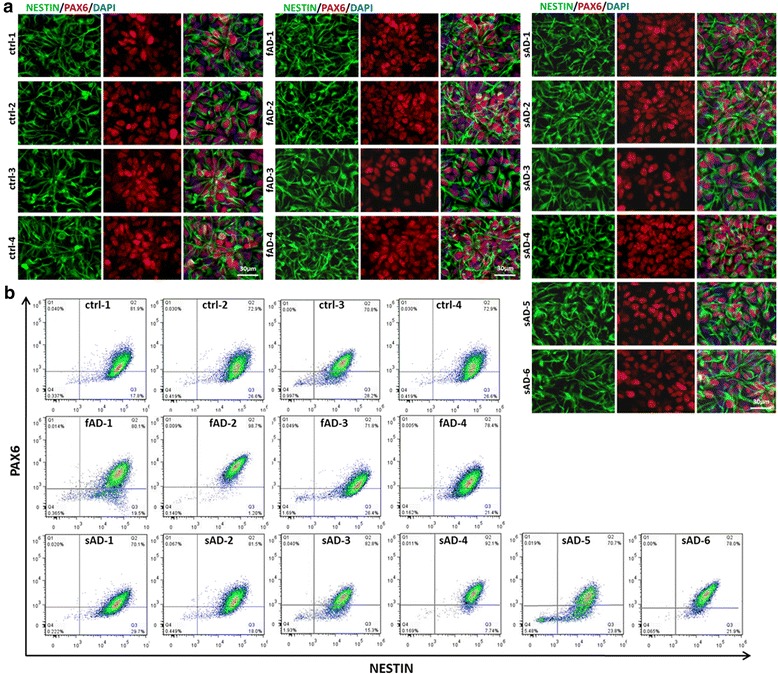
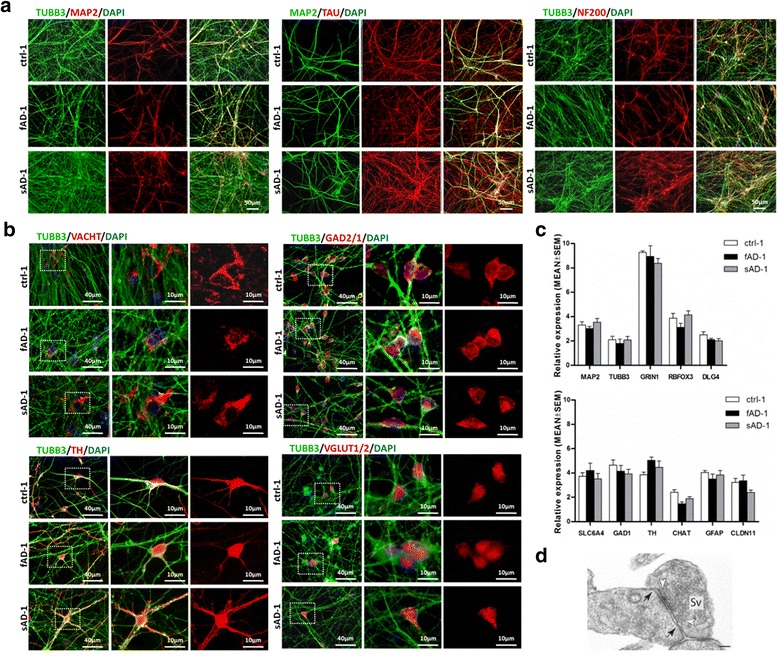
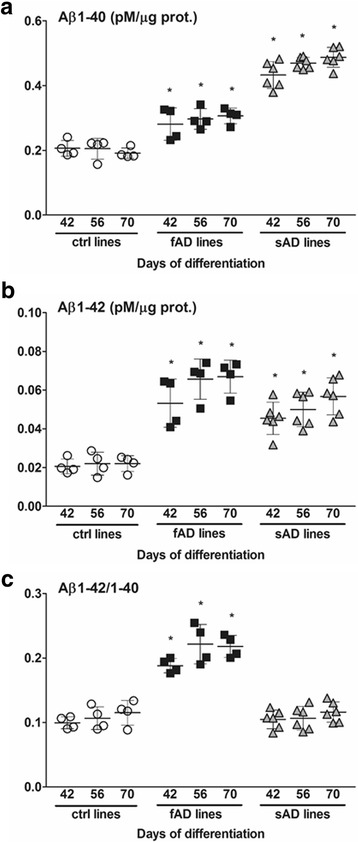
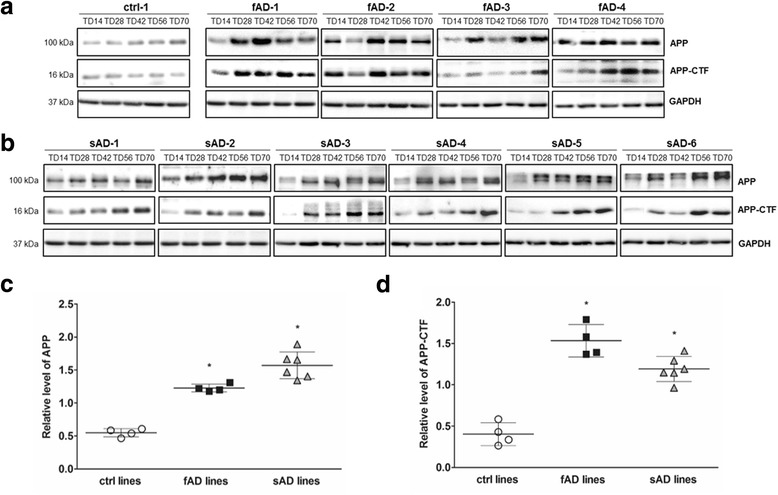
Alzheimer’s disease (AD) is the most common type of dementia, affecting one in eight adults over 65 years of age. The majority of AD cases are sporadic, with unknown etiology, and only 5% of all patients with AD present the familial monogenic form of the disease. In the present study, our aim was to establish an in vitro cell model based on patient-specific human neurons to study the pathomechanism of sporadic AD. We compared neurons derived from induced pluripotent stem cell (iPSC) lines of patients with early-onset familial Alzheimer’s disease (fAD), all caused by mutations in the PSEN1 gene; patients with late-onset sporadic Alzheimer’s disease (sAD); and three control individuals without dementia. The iPSC lines were differentiated toward mature cortical neurons, and AD pathological hallmarks were analyzed by RT-qPCR, enzyme-linked immunosorbent assay, and Western blotting methods. Neurons from patients with fAD and patients with sAD showed increased phosphorylation of TAU protein at all investigated phosphorylation sites. Relative to the control neurons, neurons derived from patients with fAD and patients with sAD exhibited higher levels of extracellular amyloid-β 1–40 (Aβ 1–40 ) and amyloid-β 1–42 (Aβ 1–42 ). However, significantly increased Aβ 1–42 /Aβ 1–40 ratios, which is one of the pathological markers of fAD, were observed only in samples of patients with fAD. Additionally, we detected increased levels of active glycogen synthase kinase 3 β, a physiological kinase of TAU, in neurons derived from AD iPSCs, as well as significant upregulation of amyloid precursor protein (APP) synthesis and APP carboxy-terminal fragment cleavage. Moreover, elevated sensitivity to oxidative stress, as induced by amyloid oligomers or peroxide, was detected in both fAD- and sAD-derived neurons. On the basis of the experiments we performed, we can conclude there is no evident difference except secreted Aβ 1–40 levels in phenotype between fAD and sAD samples. To our knowledge, this is the first study in which the hyperphosphorylation of TAU protein has been compared in fAD and sAD iPSC-derived neurons. Our findings demonstrate that iPSC technology is suitable to model both fAD and sAD and may provide a platform for developing new treatment strategies for these conditions.
Overview
The claims and statistics of this paper haven’t been checked yet.
Run the check — free, no account needed. It reads the open-access text and checks the sources it cites.
Integrity signals
Registry
Cites
Statistics
Figures
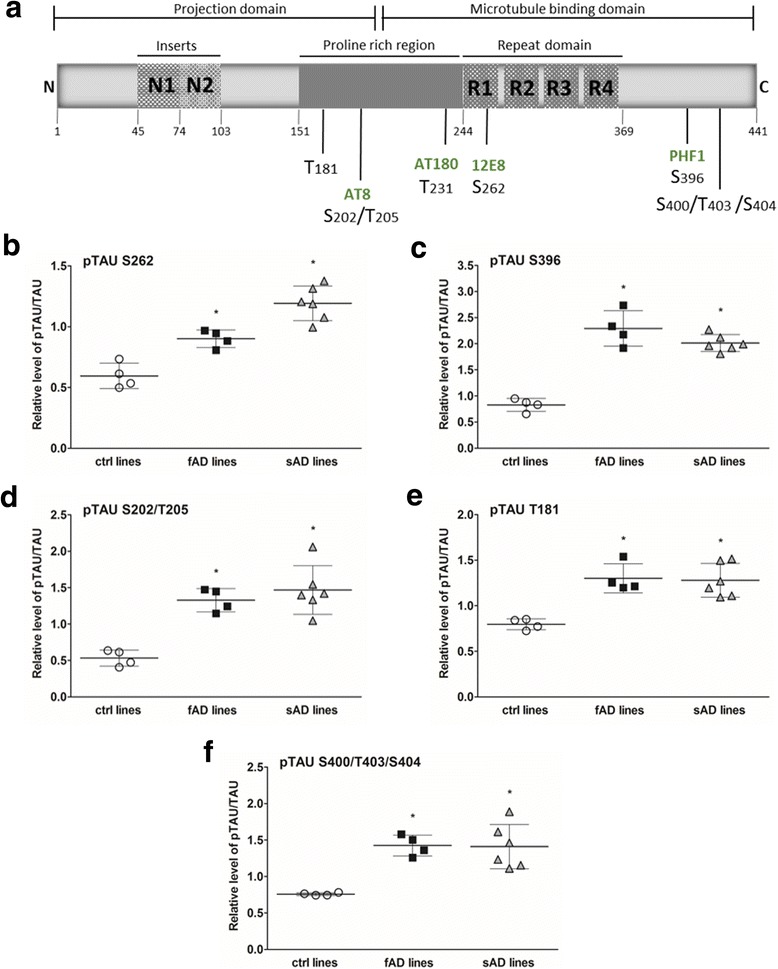
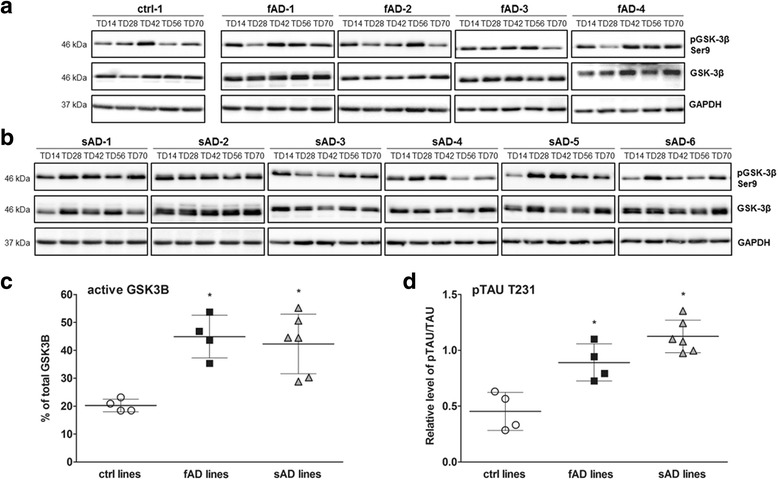
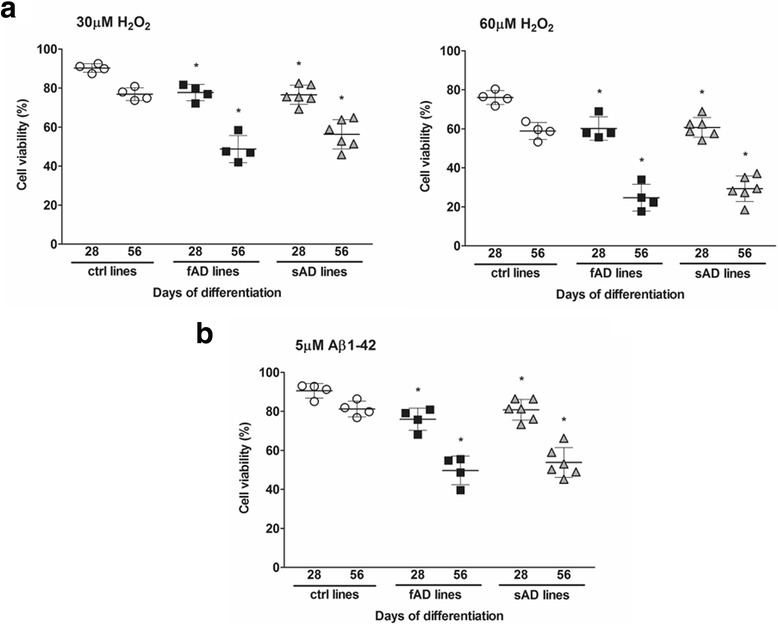
Verification
Claims the paper makes
The claims and statistics of this paper haven’t been checked yet.
Run the check — free, no account needed. It reads the open-access text and checks the sources it cites.
Claims other papers make about this one
Each is checked against this paper’s own text: does it say what the citing paper says it does?
The source backs part of the claim, not all of it — or backs it for a different population, condition or comparison.
In the citing paper
“iPSC-derived neurons from individuals with AD exhibit increased production of Aβ42, active GSK-3β, phosphorylated tau, endosomal abnormalities, and oxidative stress (12–17)”
From Modeling late-onset Alzheimer’s disease neuropathology via direct neuronal reprogramming (2024) · cites this paper as [15]
Experimental — accuracy not yet measuredThe cited source says what the claim attributes to it.
In the citing paper
“neurons derived from iPSCs obtained from sporadic AD cases also show elevated Tau hyperphosphorylation, increased Aβ levels and GSK3β activation44.”
From PLCG2 downregulation impairs synaptic function and increases Alzheimer’s disease hallmarks in neuronal cultures (2026) · cites this paper as [44]
The check wasn’t confident either way, so it gives no verdict — never disputed.
In the citing paper
“but late-stage neuropathological features, such as formation of insoluble tau and neurodegeneration have not been reported.”
From Modeling late-onset Alzheimer’s disease neuropathology via direct neuronal reprogramming (2024) · cites this paper as [15]
Experimental — accuracy not yet measured
Self-check
Percentages, sums and reported differences re-computed from the paper’s own numbers.
The self-check needs the paper’s full text.
Citations
Cites
Fast and accurate short read alignment with Burrows-Wheeler transform
Li, H., & Durbin, R. (2009) · Bioinformatics · doi:10.1093/bioinformatics/btp324 · Cited by 58,607
Richards, S., Aziz, N., Bale, S., Bick, D., Das, S., Gastier-Foster, J., Grody, W. W., Hegde, M., Lyon, E., Spector, E., et al. (2015) · Genetics in Medicine · doi:10.1038/gim.2015.30 · Cited by 32,594
The Genome Analysis Toolkit: A MapReduce framework for analyzing next-generation DNA sequencing data
McKenna, A., Hanna, M., Banks, E., Sivachenko, A., Cibulskis, K., Kernytsky, A., Garimella, K., Altshuler, D., Gabriel, S., Daly, M., et al. (2010) · Genome Research · doi:10.1101/gr.107524.110 · Cited by 27,895
Amyloid oligomers exacerbate tau pathology in a mouse model of tauopathy
Selenica, M.-L. B., Brownlow, M., Jimenez, J. P., Lee, D. C., Pena, G., Dickey, C. A., Gordon, M. N., & Morgan, D. (2013) · Neurodegenerative Diseases · doi:10.1159/000337230 · Cited by 10,359
The amyloid hypothesis of Alzheimer's disease at 25 years
Selkoe, D. J., & Hardy, J. (2016) · EMBO Molecular Medicine · doi:10.15252/emmm.201606210 · Cited by 6,164
Walsh, D. M., Klyubin, I., Fadeeva, J. V., Cullen, W. K., Anwyl, R., Wolfe, M. S., Rowan, M. J., & Selkoe, D. J. (2002) · Nature · doi:10.1038/416535a · Cited by 4,291
Grundke-Iqbal, I., Iqbal, K., Tung, Y. C., Quinlan, M., Wisniewski, H. M., & Binder, L. I. (1986) · Proceedings of the National Academy of Sciences · doi:10.1073/pnas.83.13.4913 · Cited by 3,676
Highly efficient neural conversion of human ES and iPS cells by dual inhibition of SMAD signaling
Chambers, S. M., Fasano, C. A., Papapetrou, E. P., Tomishima, M., Sadelain, M., & Studer, L. (2009) · Nature Biotechnology · doi:10.1038/nbt.1529 · Cited by 3,620
Apolipoprotein E and Alzheimer disease: risk, mechanisms and therapy
Liu, C.-C., Kanekiyo, T., Xu, H., & Bu, G. (2013) · Nature Reviews Neurology · doi:10.1038/nrneurol.2012.263 · Cited by 3,459
Uttara, B., Singh, A., Zamboni, P., & Mahajan, R. (2009) · Current Neuropharmacology · doi:10.2174/157015909787602823 · Cited by 3,378
Research works printed but not linked: 1
- Ferreira ST, Lourenco MV, Oliveira MM, De Felice FG. Soluble amyloid-β oligomers as synaptotoxins leading to cognitive impairment in Alzheimer’s disease. Front Cell Neurosci. 2015;9:191.
Cited by
Sorted by citations
Items 201–226 of 226
Chan, D., Spires‐Jones, T. L., Provenzano, F. A., Glennon, E. B. C., & Duff, K. (2025) · Oxford University Press eBooks · doi:10.1093/med/9780190065324.003.0020
Buckley, N., & Rowland, H. (2025) · Stem Cells · doi:10.1093/stmcls/sxaf031
AHA1 regulates Aβ production via modulation of APP expression and γ-secretase assemblyPreprint
Noorani, A. A., Islam, S., Catalfano, K. C., Wilkins, H., Blagg, B. S. J., Zou, K., & Wolfe, M. S. (2025) · bioRxiv (Cold Spring Harbor Laboratory) · doi:10.1101/2025.11.03.686106
Supakul, S., Murakami, R., Oyama, C., Shindo, T., Hatakeyama, Y., Itsuno, M., Bannai, H., Shibata, S., Maeda, S., & Okano, H. (2024) · Figshare · doi:10.6084/m9.figshare.26686686
Supakul, S., Murakami, R., Oyama, C., Shindo, T., Hatakeyama, Y., Itsuno, M., Bannai, H., Shibata, S., Maeda, S., & Okano, H. (2024) · Figshare · doi:10.6084/m9.figshare.26686680
Chong, C.-M., Tan, Y., Tong, J., Ke, M., Zhang, K., Yan, L., Cen, X., Lu, J., Chen, G., Su, H., et al. (2022) · Figshare · doi:10.6084/m9.figshare.20488689
Supakul, S., Murakami, R., Oyama, C., Shindo, T., Hatakeyama, Y., Itsuno, M., Bannai, H., Shibata, S., Maeda, S., & Okano, H. (2024) · Figshare · doi:10.6084/m9.figshare.26686683
Supakul, S., Murakami, R., Oyama, C., Shindo, T., Hatakeyama, Y., Itsuno, M., Bannai, H., Shibata, S., Maeda, S., & Okano, H. (2024) · Figshare · doi:10.6084/m9.figshare.26686677
Induced Pluripotent Stem Cells: A Unique Model for Studying the Human Brain in Health and Disease
Novosadova, E. V., & Grivennikov, I. A. (2025) · Neurochemical Journal · doi:10.1134/s1819712425700692
Modeling Late-Onset Sporadic Alzheimer’s Disease Using Patient-Derived Cells: A Review
Katbe, A., Diagne, I., & Bernier, G. (2026) · Neurology International · doi:10.3390/neurolint18010017
Cross-Species Aging Knowledge Integration into Agentic AI Platform Uncovers Conserved MechanismsPreprint
Ahuja, G., Sharma, A., Singh, A., Kedia, S., Sharma, A., Gautam, V., Sharma, P. B., Khandelwal, A., Ramakrishna, S., Muddashetty, R. S., et al. (2026) · Research Square · doi:10.21203/rs.3.rs-9060414/v1
Self-citationÉtude biophysique de l'interaction protéine tau - zinc
Rocca, R. L. (2020) · theses.fr (ABES) · doi:10.70675/c975b708z273cz4f8ez9703zc6efc7ce3b5c
Studying the role of human Amyloid Precursor Protein (APP) during human cortical neurogenesis
Shabani, K. (2021) · theses.fr (ABES) · doi:10.70675/2deeb337z2d8ez4a8dzaf55z268de3428ac9
Yatoui, D. (2022) · theses.fr (ABES) · doi:10.70675/e3620ccez2ea7z43f2za0dcz257a72021b17
Aladeokin, A. C., Jeltsch, M., Davtyan, H., Blurton-Jones, M. M., & Koıstınaho, J. (2026) · bioRxiv (Cold Spring Harbor Laboratory) · doi:10.64898/2026.06.23.734021
Thumu, S. C. R., Gonzales, J. P. M., Munir, S., Tuck, C., Dominguez, O., & Singh, S. S. (2026) · bioRxiv (Cold Spring Harbor Laboratory) · doi:10.64898/2026.06.25.734569
Ono, R. M. D. S., Lima, J. E. B. D. F., de Lira, J. A. S. P., Sanches, F. C., Piassi, L. D. O., Coelho, L. B. V., Moreira, N. C. D. S., & Sakamoto‐Hojo, E. T. (2026) · Genetics and Molecular Biology · doi:10.1590/1678-4685-gmb-2025-0233
AHA1 Regulates Aβ Production via Modulation of APP Abundance and γ‐Secretase Assembly
Noorani, A. A., Islam, S., Filip, E., Catalfano, K. C., Paswan, S. K., Nagarajan, V., Wilkins, H., Blagg, B. S. J., Zou, K., & Wolfe, M. S. (2026) · Journal of Neurochemistry · doi:10.1111/jnc.70544
Burdman, G., Hanna, M., Yndart, A., Vashist, A., & Lakshmana, M. K. (2026) · Cells · doi:10.3390/cells15191768
Matta, C., Cheon, Y.-H., Vágó, J., Mészár, Z., Kim, E. H., Jiang, S., Balogh, A., Zana, M., Dinnyés, A., & Jin, E. (2026) · Materials Today Bio · doi:10.1016/j.mtbio.2026.103752
Self-citationBody-on-chip systems and clinical biomarkers discovery
Härtung, T., & Smirnova, L. (2026) · Elsevier eBooks · doi:10.1016/b978-0-443-16110-0.00008-x
Xu, T.-Y., Er-Deng, E., Zhang, T., & Xiao-Qin, Z. (2026) · Ageing Research Reviews · doi:10.1016/j.arr.2026.103430
Metadata
- Authors
- Ochalek, A., Mihalik, B., Avci, H. X., Chandrasekaran, A., Téglási, A., Bock, I., Giudice, M. L., Táncos, Z., Molnár, K., László, L., Nielsen, J. E., Holst, B., Freude, K., Hyttel, P., Kobolák, J., & Dinnyés, A.
- Affiliations
- BioTalentum (Hungary) (HU)
- University of Szeged (HU)
- Eötvös Loránd University (HU)
- University of Copenhagen (DK)
- Bioneer (Denmark) (DK)
- Magyar Agrár- és Élettudományi Egyetem (HU)
- Corresponding author
- Dinnyés, András
- ORCID
- Venue
- Alzheimer's Research & Therapy
- Published
- 2017-12
- Volume
- 9
- Issue
- 1
- Pages
- 90-90
- ISSN
- 1758-9193 (ISSN-L)
- PMC
- PMC5709977
- OpenAlex
- W2769598455
- Cited by
- 225
- References
- 104
- Citations by year
- 2026: 16 · 2025: 27 · 2024: 28 · 2023: 19 · 2022: 29 · 2021: 25 · 2020: 38 · 2019: 29 · 2018: 13
- FWCI
- 16.19
- Type
- journal article
- Language
- en
- Open access
- gold
- doi.org
- Licence
- cc-by
- Locations
- Alzheimer s Research & Therapy (publishedVersion, cc-by)
- Europe PMC (PubMed Central) (publishedVersion, cc-by)
- PubMed Central (publishedVersion, cc-by)
- PubMed (publishedVersion)
- Research at the University of Copenhagen (University of Copenhagen) (publishedVersion, cc-by)
- DOAJ (DOAJ: Directory of Open Access Journals) (submittedVersion)
- ELTE Digital Institutional Repository (EDIT) (Eötvös Loránd University) (submittedVersion, other-oa)
- Funders
- EU FP7, STEMMAD (PIAPP-GA-2012-324451)
- EU FP7, EpiHealth (HEALTH-2012-F2-278418)
- EU FP7, EpiHealthNet (PITN-GA-2012-317146)
- Richter Gedeon Research Grant (RG-IPI-2013_TP7/026)
- Innovation Fund Denmark (BrainStem 4108-00008B, NeuroStem 4096-00001B)
- Topics
- Life Sciences › Neuroscience › Cellular and Molecular Neuroscience › Alzheimer's disease research and treatments
- Life Sciences › Biochemistry, Genetics and Molecular Biology › Molecular Biology › Pluripotent Stem Cells Research
- Health Sciences › Medicine › Psychiatry and Mental health › Dementia and Cognitive Impairment Research
- Keywords
- sporadic Alzheimer's disease, familial Alzheimer's disease, iPSC-derived neurons, tau hyperphosphorylation, amyloid-beta, amyloid precursor protein, oxidative stress, amyloid oligomers
- MeSH terms
- Glycogen Synthase Kinase 3 beta, Alzheimer Disease, Animals, Cell Differentiation, Cell Line, Transformed, Gene Expression Regulation, Humans, Hydrogen Peroxide, Mutation, Nerve Tissue Proteins, Neurons, Phosphorylation, RNA, Messenger, Time Factors, Amyloid beta-Peptides, Amyloid beta-Protein Precursor, tau Proteins, Oxidative Stress, Presenilin-1, Induced Pluripotent Stem Cells
About these checks
Registry, retraction, Cites and statistics results are computed, not judged, with one exception: a printed reference that no index lists is read once by a model before it counts as a citation error. Claims are extracted by a model and kept only when their quote appears verbatim in the text; each cited source is then checked, with a model’s help, for whether it says what the claim relies on. Those verdicts can be wrong — read the claim’s quote and the cited source before relying on one.
Statistics and arithmetic are recomputed, not judged.
Confidence bands are shown only for fields calibrated on our annotated test set. None is calibrated yet, so no band is shown.
What counts as a claim ›How we measure confidence ›How we check this ›
Are you an author, or do you see a problem with this page? Request a review
