

A 36-week multicenter, randomized, double-blind, placebo-controlled, parallel-group, phase 3 clinical trial of sodium oligomannate for mild-to-moderate Alzheimer’s dementia
Open accessPublished version of a preprint
The DOI matches its Crossref record; 45 of the 46 references it cites were found in a registry or an index.
Abstract
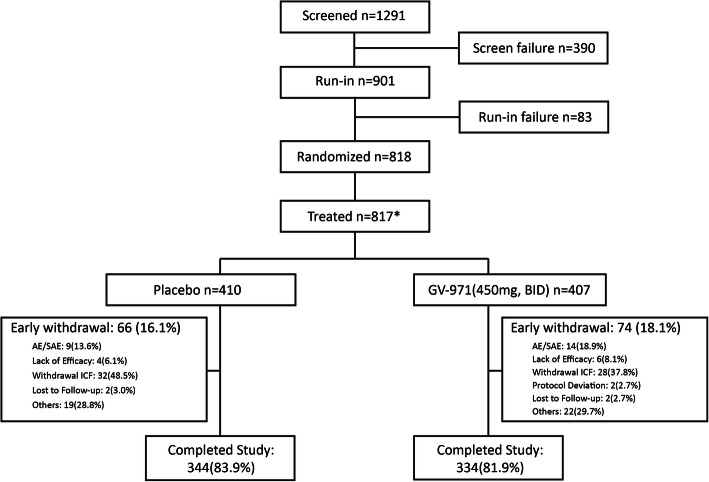
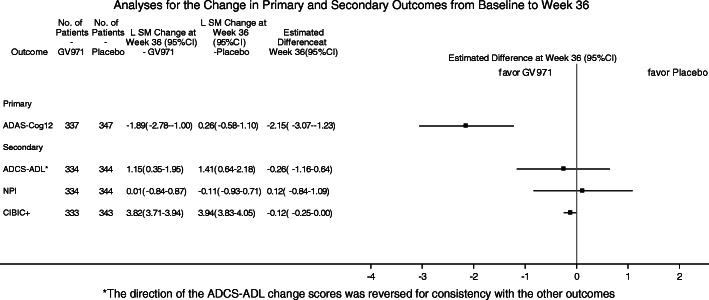
Background: New therapies are urgently needed for Alzheimer’s disease (AD). Sodium oligomannate (GV-971) is a marine-derived oligosaccharide with a novel proposed mechanism of action. The first phase 3 clinical trial of GV-971 has been completed in China. Methods: We conducted a phase 3, double-blind, placebo-controlled trial in participants with mild-to-moderate AD to assess GV-971 efficacy and safety. Participants were randomized to placebo or GV-971 (900 mg) for 36 weeks. The primary outcome was the drug-placebo difference in change from baseline on the 12-item cognitive subscale of the Alzheimer’s Disease Assessment Scale (ADAS-cog12). Secondary endpoints were drug-placebo differences on the Clinician’s Interview-Based Impression of Change with caregiver input (CIBIC+), Alzheimer’s Disease Cooperative Study-Activities of Daily Living (ADCS-ADL) scale, and Neuropsychiatric Inventory (NPI). Safety and tolerability were monitored. Results: A total of 818 participants were randomized: 408 to GV-971 and 410 to placebo. A significant drug-placebo difference on the ADAS-Cog12 favoring GV-971 was present at each measurement time point, measurable at the week 4 visit and continuing throughout the trial. The difference between the groups in change from baseline was − 2.15 points (95% confidence interval, − 3.07 to − 1.23; p < 0.0001; effect size 0.531) after 36 weeks of treatment. Treatment-emergent adverse event incidence was comparable between active treatment and placebo (73.9%, 75.4%). Two deaths determined to be unrelated to drug effects occurred in the GV-971 group. Conclusions: GV-971 demonstrated significant efficacy in improving cognition with sustained improvement across all observation periods of a 36-week trial. GV-971 was safe and well-tolerated. Trial registration: ClinicalTrials.gov, NCT0229391 5. Registered on November 19, 2014
Overview
The claims and statistics of this paper haven’t been checked yet.
Free: it reads the open-access text and checks the first 5 claims that cite a source we can check. Create a free account to check every claim.
Integrity signals
Registry
Cites
Statistics
Figures


Verification
Claims the paper makes
The claims and statistics of this paper haven’t been checked yet.
Free: it reads the open-access text and checks the first 5 claims that cite a source we can check. Create a free account to check every claim.
Claims other papers make about this one
Each is checked against this paper’s own text: does it say what the citing paper says it does?
The cited source says what the claim attributes to it.
In the citing paper
“New drugs, including sodium oligomannate (9, GV-971),54–56 aducanumab (1),57–59 lecanemab (2),60–62 and donanemab (10, currently under review for market approval),63 which aim to offer disease-modifying therapies that intervene in the progression of AD.”
From Recent advances in Alzheimer's disease: Mechanisms, clinical trials and new drug development strategies. (2024) · cites this paper as [56]
The cited source says what the claim attributes to it.
In the citing paper
“Sodium oligomannate (9, GV-971) was postulated to counteract AD by inhibiting neuroinflammation triggered by gut dysbiosis and disrupting the formation of Aβ fibrils.56,414”
From Recent advances in Alzheimer's disease: Mechanisms, clinical trials and new drug development strategies. (2024) · cites this paper as [56]
In the citing paper
“GV-971 has also been demonstrated to reverse cognitive deficits in patients with mild to moderate AD in the phase 2/3 clinical trial in China (NCT02293915) [262].”
From Tau and neuroinflammation in Alzheimer’s disease: interplay mechanisms and clinical translation (2023) · cites this paper as [262]
Self-check
Percentages, sums and reported differences re-computed from the paper’s own numbers.
The self-check needs the paper’s full text.
Citations
Cites
Folstein, M. F., Folstein, S. E., & McHugh, P. R. (1975) · Journal of Psychiatric Research · doi:10.1016/0022-3956(75)90026-6 · Cited by 88,282 · cited 17×
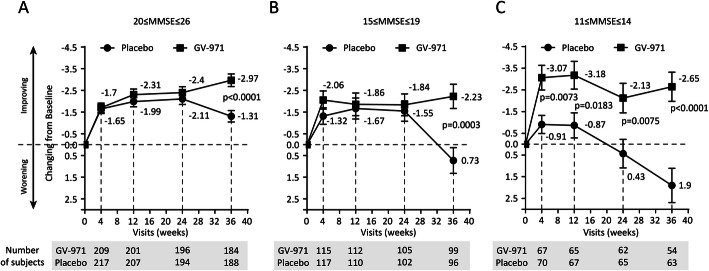
“In preplanned exploratory analyses, we assessed the treatment effect of GV-971 in participant groups of MMSE 11-14, 15-19, and 20-26 (Figure 4).”
BackgroundMethodInfluentialHamilton, M. (1960) · Journal of Neurology, Neurosurgery & Psychiatry · doi:10.1136/jnnp.23.1.56 · Cited by 32,817 · cited 1×
“A total Hachinski Ischemia Scale[20] score of ≤ 4 was required, and the Hamilton Hamilton Depression Scale 17[21] score had to be ≤ 10.”
MethodMcKhann, G., Drachman, D., Folstein, M., Katzman, R., Price, D., & Stadlan, E. M. (1984) · Neurology · doi:10.1212/wnl.34.7.939 · Cited by 27,915
Hirono, N., Mori, E., Ikejiri, Y., Imamura, T., Shimomura, T., Hashimoto, M., Yamashita, H., & Ikeda, M. (1997) · Brain and nerve · Cited by 21,038
Kok, J. S., Berg, I. J., & Scherder, E. J. A. (2013) · Dementia and Geriatric Cognitive Disorders Extra · doi:10.1159/000353441 · Cited by 20,589
Older Adults' Reasons for Using Technology while Aging in Place
Peek, S. T. M., Luijkx, K. G., Rijnaard, M. D., Nieboer, M. E., van der Voort, C. S., Aarts, S., van Hoof, J., Vrijhoef, H. J. M., & Wouters, E. J. M. (2016) · Gerontology · doi:10.1159/000430949 · Cited by 19,690
Sensitivity and False Alarm Rate of a Fall Sensor in Long-Term Fall Detection in the Elderly
Kangas, M., Korpelainen, R., Vikman, I., Nyberg, L., & Jämsä, T. (2015) · Gerontology · doi:10.1159/000362720 · Cited by 18,909
The Neuropsychiatric Inventory: Comprehensive assessment of psychopathology in dementia
Cummings, J. L., Mega, M., Gray, K., Rosenberg-Thompson, S., Carusi, D. A., & Gornbein, J. (1994) · Neurology · doi:10.1212/wnl.44.12.2308 · Cited by 7,568
Self-citationA new rating scale for Alzheimer's disease
(1984) · American Journal of Psychiatry · doi:10.1176/ajp.141.11.1356 · Cited by 4,175 · cited 1×
“The primary e cacy endpoint was the drug–placebo difference in the change from baseline on the ADAS-Cog12 (score range, 0-75, with higher scores indicating greater cognitive impairment) at week36[29].”
Method. Cerebral blood flow in dementia.
Hachinski, V. C., Iliff, L. D., Zilhka, E., Du Boulay, G. H., McAllister, V. L., Marshall, J., Russell, R. W. R., & Symon, L. (1975) · Archives of Neurology · doi:10.1001/archneur.1975.00490510088009 · Cited by 3,186
Research works printed but not linked: 1
- Reisberg B. FS: Clinician’s interview-based impression of change-plus; in Kelly C, Newton-Howes G (eds): guide to assessment scales in dementia. London: Science Press; 1994.
Cited by
Zhang, J., Zhang, Y., Wang, J., Xia, Y., Zhang, J., & Chen, L. (2024) · Signal Transduction and Targeted Therapy · doi:10.1038/s41392-024-01911-3 · Cited by 1,138
“554 and 56, 555 require further in vitro and in vivo studies to evaluate their pharmacokinetic properties and allosteric modulation effects.”
BackgroundSelf-citationNeuroinflammation in Alzheimer’s Disease: Current Progress in Molecular Signaling and Therapeutics
Thakur, S., Dhapola, R., Sarma, P., Medhi, B., & Reddy, D. H. (2023) · Inflammation · doi:10.1007/s10753-022-01721-1 · Cited by 557
Synaptic degeneration in Alzheimer disease
Tzioras, M., McGeachan, R. I., Durrant, C. S., & Spires-Jones, T. L. (2023) · Nature Reviews Neurology · doi:10.1038/s41582-022-00749-z · Cited by 504
Tau and neuroinflammation in Alzheimer’s disease: interplay mechanisms and clinical translation
Chen, Y., & Yu, Y. (2023) · Journal of Neuroinflammation · doi:10.1186/s12974-023-02853-3 · Cited by 516
“GV-971 has also been demonstrated to reverse cognitive deficits in patients with mild to moderate AD in the phase 2/3 clinical trial in China (NCT02293915) [262].”
BackgroundThe China Alzheimer Report 2022
Ren, R., Qi, J., Lin, S., Liu, X., Yin, P., Wang, Z., Tang, R., Wang, J., Huang, Q., Li, J., et al. (2022) · General Psychiatry · doi:10.1136/gpsych-2022-100751 · Cited by 353
Self-citation
Metadata
- Authors
- Xiao, S., Chan, P., Wang, T., Hong, Z., Wang, S., Kuang, W., He, J., Pan, X., Zhou, Y., Ji, Y., Wang, L., Cheng, Y., Peng, Y., Ye, Q., Wang, X., Wu, Y., Qu, Q., Chen, S., Li, S., Chen, W., Xu, J., Peng, D., Zhao, Z., Li, Y., Zhang, J., Du, Y., Chen, W., Fan, D., Yan, Y., Liu, X., Zhang, W., Luo, B., Wu, W., Shen, L., Liu, C., Mao, P., Wang, Q., Zhao, Q., Guo, Q., Zhou, Y., Li, Y., Jiang, L., Ren, W., Ouyang, Y., Wang, Y., Liu, S., Jia, J., Zhang, N., Liu, Z., He, R., Feng, T., Lu, W., Tang, H., Gao, P., Zhang, Y., Chen, L., Wang, L., Yin, Y., Xu, Q., Xiao, J., Cong, L., Cheng, X., Zhang, H., Gao, D., Xia, M., Lian, T., Peng, G., Zhang, X., Jiao, B., Hu, H., Chen, X., Guan, Y., Cui, R., Huang, Q., Xin, X., Chen, H., Ding, Y., Zhang, J., Feng, T., Cantillon, M., Chen, K., Cummings, J. L., Ding, J., Geng, M., & Zhang, Z.
- Affiliations
- Shanghai Jiao Tong University (CN)
- Capital Medical University (CN)
- Fudan University (CN)
- Qilu Hospital of Shandong University (CN)
- West China Hospital of Sichuan University (CN)
- First Affiliated Hospital of Wenzhou Medical University (CN)
- Guangzhou First People's Hospital (CN)
- Nankai University (CN)
- Tianjin Medical University General Hospital (CN)
- Sun Yat-sen University (CN)
- Union Hospital (CN)
- First Affiliated Hospital of Xi'an Jiaotong University (CN)
- Beijing Hospital (CN)
- Sir Run Run Shaw Hospital (CN)
- Northern Jiangsu People's Hospital (CN)
- China-Japan Friendship Hospital (CN)
- Shanghai Changzheng Hospital (CN)
- Zhongnan Hospital of Wuhan University (CN)
- Shandong University (CN)
- Peking University Third Hospital (CN)
- The Affiliated Yongchuan Hospital of Chongqing Medical University (CN)
- First Affiliated Hospital Zhejiang University (CN)
- Tongji University (CN)
- Xiangya Hospital Central South University (CN)
- Peking Union Medical College Hospital (CN)
- Chinese PLA General Hospital (CN)
- Second Affiliated Hospital of Soochow University (CN)
- Banner Alzheimer’s Institute (US)
- University of Nevada, Las Vegas (US)
- Chinese Academy of Sciences (CN)
- Corresponding author
- Xiao, Shifu
- Geng, Meiyu
- Zhang, Zhenxin
- ORCID
- Xiao, Shifu
- Chan, Piu
- Wang, Tao
- Hong, Zhen
- Wang, Shuzhen
- Kuang, Weihong
- He, Jincai
- Pan, Xiaoping
- Zhou, Yuying
- Ji, Yong
- Cheng, Yan
- Peng, Ying
- Ye, Qinyong
- Wang, Xiaoping
- Qu, Qiumin
- Chen, Shengdi
- Chen, Wei
- Xu, Jun
- Peng, Dantao
- Li, Yansheng
- Zhang, Junjian
- Du, Yifeng
- Chen, Weixian
- Fan, Dongsheng
- Yan, Yong
- Liu, Xiaowei
- Zhang, Wei
- Luo, Benyan
- Wu, Wenyuan
- Wang, Qiumei
- Zhao, Qianhua
- Guo, Qihao
- Zhou, Yongtao
- Li, Yi
- Ren, Wenwei
- Ouyang, Yingjun
- Wang, Yan
- Liu, Shuai
- Jia, Jianjun
- Zhang, Nan
- Liu, Zhonglin
- Lu, Wenhui
- Tang, Huidong
- Gao, Ping
- Zhang, Yingchun
- Chen, Lanlan
- Wang, Lei
- Yin, You
- Xu, Qun
- Cong, Lin
- Cheng, Xi
- Zhang, Hui
- Gao, Dan
- Peng, Guoping
- Zhang, Xu
- Jiao, Bin
- Hu, Hua
- Chen, Xueyan
- Guan, Yihui
- Cui, Ruixue
- Huang, Qiu
- Ding, Yu
- Zhang, Jing
- Feng, Teng
- Chen, Kewei
- Cummings, Jeffrey L.
- Ding, Jian
- Geng, Meiyu
- Zhang, Zhenxin
- Venue
- Alzheimer's Research & Therapy
- Published
- 2021-03-17
- Volume
- 13
- Issue
- 1
- Pages
- 62-62
- ISSN
- 1758-9193 (ISSN-L)
- PMC
- PMC7967962
- OpenAlex
- W3159386017
- Cited by
- 224
- References
- 46
- Citations by year
- 2026: 41 · 2025: 32 · 2024: 39 · 2023: 48 · 2022: 39 · 2021: 25
- FWCI
- 23.93
- Type
- journal article
- Language
- en
- Open access
- gold
- doi.org
- Licence
- cc-by
- creativecommons.org/licenses/by/4.0/ (tdm)
- creativecommons.org/licenses/by/4.0/ (vor)
- Locations
- Alzheimer s Research & Therapy (publishedVersion, cc-by)
- Research Square (acceptedVersion, cc-by)
- PubMed Central (publishedVersion, cc-by)
- PubMed (publishedVersion)
- DOAJ (DOAJ: Directory of Open Access Journals) (submittedVersion, cc-by-sa)
- Funders
- National Science and Technology Major Project for Investigational New Drugs (2011ZX09101-003-01, 2015ZX09101003, 2018ZX09711002-015)
- Topics
- Life Sciences › Neuroscience › Cellular and Molecular Neuroscience › Alzheimer's disease research and treatments
- Health Sciences › Medicine › Psychiatry and Mental health › Dementia and Cognitive Impairment Research
- Health Sciences › Medicine › Pharmacology (medical) › Cholinesterase and Neurodegenerative Diseases
- Keywords
- Alzheimer's disease, mild to moderate dementia, cognitive function, activities of daily living, neuropsychiatric symptoms, drug safety and tolerability
- MeSH terms
- Activities of Daily Living, Alzheimer Disease, China, Cholinesterase Inhibitors, Double-Blind Method, Pharmaceutical Preparations, Humans, Mannose, Oligosaccharides, Sodium, Treatment Outcome
About these checks
Registry, retraction, Cites and statistics results are computed, not judged, with one exception: a printed reference that no index lists is read once by a model before it counts as a citation error. Claims are extracted by a model and kept only when their quote appears verbatim in the text; each cited source is then checked, with a model’s help, for whether it says what the claim relies on. Those verdicts can be wrong — read the claim’s quote and the cited source before relying on one.
Statistics and arithmetic are recomputed, not judged.
Confidence bands are shown only for fields calibrated on our annotated test set. None is calibrated yet, so no band is shown.
What counts as a claim ›How we measure confidence ›How we check this ›
Are you an author, or do you see a problem with this page? Request a review
How to cite
Cite CoChat for the checks on this page, and the paper for its own findings.
- This page
- CoChat. (2026). Citation check: A 36-week multicenter, randomized, double-blind, placebo-controlled, parallel-group, phase 3 clinical trial of sodium oligomannate for mild-to-moderate Alzheimer’s dementia. https://app.cochat.ai/papers/10.1186/s13195-021-00795-7
- The paper
- Xiao, S., Chan, P., Wang, T., Hong, Z., Wang, S., Kuang, W., He, J., Pan, X., Zhou, Y., Ji, Y., Wang, L., Cheng, Y., Peng, Y., Ye, Q., Wang, X., Wu, Y., Qu, Q., Chen, S., Li, S., . . . Zhang, Z. (2021). A 36-week multicenter, randomized, double-blind, placebo-controlled, parallel-group, phase 3 clinical trial of sodium oligomannate for mild-to-moderate Alzheimer’s dementia. Alzheimer's Research & Therapy. https://doi.org/10.1186/s13195-021-00795-7
Data sources
Bibliographic data: Semantic Scholar, OpenAlex, Crossref.
Contains information from the Semantic Scholar Academic Graph Datasets, made available under the ODC Attribution License (ODC-BY 1.0).
Semantic Scholar’s data is described in: Kinney, R., et al. (2023). The Semantic Scholar Open Data Platform. arXiv:2301.10140.
