

A 36-week multicenter, randomized, double-blind, placebo-controlled, parallel-group, phase 3 clinical trial of sodium oligomannate for mild-to-moderate Alzheimer’s dementia
Open accessPublished version of a preprint
The DOI matches its Crossref record; 46 of the 46 references it cites were found in a registry or an index.
Abstract
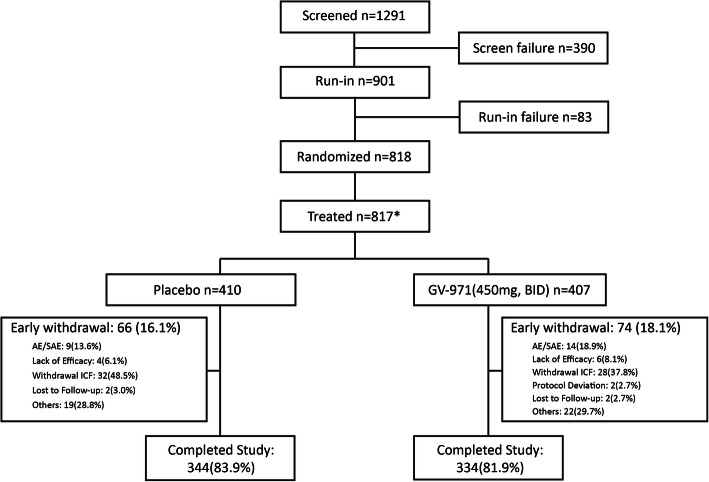
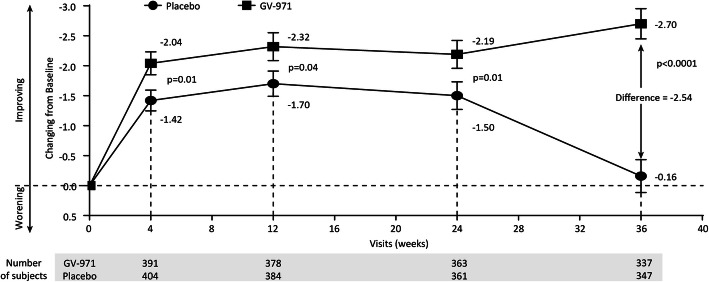
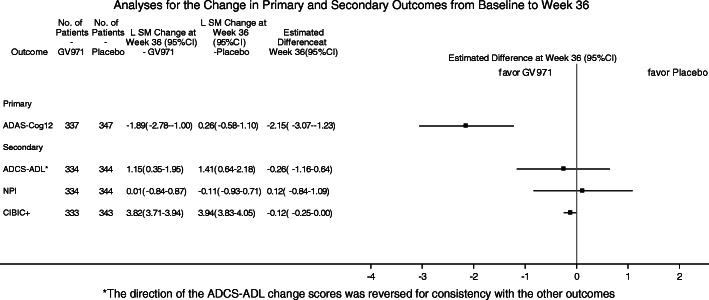
Background: New therapies are urgently needed for Alzheimer’s disease (AD). Sodium oligomannate (GV-971) is a marine-derived oligosaccharide with a novel proposed mechanism of action. The first phase 3 clinical trial of GV-971 has been completed in China. Methods: We conducted a phase 3, double-blind, placebo-controlled trial in participants with mild-to-moderate AD to assess GV-971 efficacy and safety. Participants were randomized to placebo or GV-971 (900 mg) for 36 weeks. The primary outcome was the drug-placebo difference in change from baseline on the 12-item cognitive subscale of the Alzheimer’s Disease Assessment Scale (ADAS-cog12). Secondary endpoints were drug-placebo differences on the Clinician’s Interview-Based Impression of Change with caregiver input (CIBIC+), Alzheimer’s Disease Cooperative Study-Activities of Daily Living (ADCS-ADL) scale, and Neuropsychiatric Inventory (NPI). Safety and tolerability were monitored. Results: A total of 818 participants were randomized: 408 to GV-971 and 410 to placebo. A significant drug-placebo difference on the ADAS-Cog12 favoring GV-971 was present at each measurement time point, measurable at the week 4 visit and continuing throughout the trial. The difference between the groups in change from baseline was − 2.15 points (95% confidence interval, − 3.07 to − 1.23; p < 0.0001; effect size 0.531) after 36 weeks of treatment. Treatment-emergent adverse event incidence was comparable between active treatment and placebo (73.9%, 75.4%). Two deaths determined to be unrelated to drug effects occurred in the GV-971 group. Conclusions: GV-971 demonstrated significant efficacy in improving cognition with sustained improvement across all observation periods of a 36-week trial. GV-971 was safe and well-tolerated. Trial registration: ClinicalTrials.gov, NCT0229391 5. Registered on November 19, 2014
Overview
The claims and statistics of this paper haven’t been checked yet.
Free: it reads the open-access text and checks the first 5 claims that cite a source we can check. Create a free account to check every claim.
Integrity signals
Registry
Cites
Statistics
Figures
Verification
Claims the paper makes
The claims and statistics of this paper haven’t been checked yet.
Free: it reads the open-access text and checks the first 5 claims that cite a source we can check. Create a free account to check every claim.
Claims other papers make about this one
Each is checked against this paper’s own text: does it say what the citing paper says it does?
The cited source says what the claim attributes to it.
In the citing paper
“New drugs, including sodium oligomannate (9, GV-971),54–56 aducanumab (1),57–59 lecanemab (2),60–62 and donanemab (10, currently under review for market approval),63 which aim to offer disease-modifying therapies that intervene in the progression of AD.”
From Recent advances in Alzheimer's disease: Mechanisms, clinical trials and new drug development strategies. (2024) · cites this paper as [56]
The cited source says what the claim attributes to it.
In the citing paper
“Sodium oligomannate (9, GV-971) was postulated to counteract AD by inhibiting neuroinflammation triggered by gut dysbiosis and disrupting the formation of Aβ fibrils.56,414”
From Recent advances in Alzheimer's disease: Mechanisms, clinical trials and new drug development strategies. (2024) · cites this paper as [56]
In the citing paper
“GV-971 has also been demonstrated to reverse cognitive deficits in patients with mild to moderate AD in the phase 2/3 clinical trial in China (NCT02293915) [262].”
From Tau and neuroinflammation in Alzheimer’s disease: interplay mechanisms and clinical translation (2023) · cites this paper as [262]
Self-check
Percentages, sums and reported differences re-computed from the paper’s own numbers.
The self-check needs the paper’s full text.
Citations
Cites
Folstein, M. F., Folstein, S. E., & McHugh, P. R. (1975) · Journal of Psychiatric Research · doi:10.1016/0022-3956(75)90026-6 · Cited by 88,282 · cited 17×
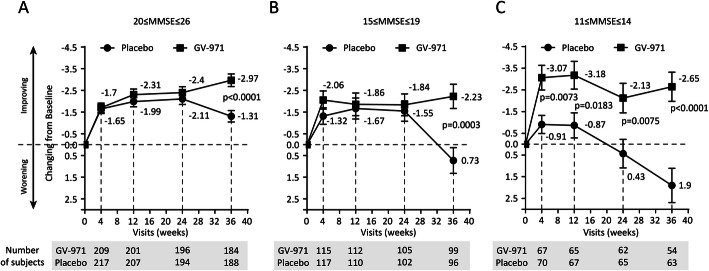
“In preplanned exploratory analyses, we assessed the treatment effect of GV-971 in participant groups of MMSE 11-14, 15-19, and 20-26 (Figure 4).”
BackgroundMethodInfluentialHamilton, M. (1960) · Journal of Neurology, Neurosurgery & Psychiatry · doi:10.1136/jnnp.23.1.56 · Cited by 32,817 · cited 1×
“A total Hachinski Ischemia Scale[20] score of ≤ 4 was required, and the Hamilton Hamilton Depression Scale 17[21] score had to be ≤ 10.”
MethodMcKhann, G., Drachman, D., Folstein, M., Katzman, R., Price, D., & Stadlan, E. M. (1984) · Neurology · doi:10.1212/wnl.34.7.939 · Cited by 27,915
Hirono, N., Mori, E., Ikejiri, Y., Imamura, T., Shimomura, T., Hashimoto, M., Yamashita, H., & Ikeda, M. (1997) · Brain and nerve · Cited by 21,039
Kok, J. S., Berg, I. J., & Scherder, E. J. A. (2013) · Dementia and Geriatric Cognitive Disorders Extra · doi:10.1159/000353441 · Cited by 20,589
Older Adults' Reasons for Using Technology while Aging in Place
Peek, S. T. M., Luijkx, K. G., Rijnaard, M. D., Nieboer, M. E., van der Voort, C. S., Aarts, S., van Hoof, J., Vrijhoef, H. J. M., & Wouters, E. J. M. (2016) · Gerontology · doi:10.1159/000430949 · Cited by 19,690
Sensitivity and False Alarm Rate of a Fall Sensor in Long-Term Fall Detection in the Elderly
Kangas, M., Korpelainen, R., Vikman, I., Nyberg, L., & Jämsä, T. (2015) · Gerontology · doi:10.1159/000362720 · Cited by 18,909
The Neuropsychiatric Inventory: Comprehensive assessment of psychopathology in dementia
Cummings, J. L., Mega, M., Gray, K., Rosenberg-Thompson, S., Carusi, D. A., & Gornbein, J. (1994) · Neurology · doi:10.1212/wnl.44.12.2308 · Cited by 7,568
Self-citationA new rating scale for Alzheimer's disease
(1984) · American Journal of Psychiatry · doi:10.1176/ajp.141.11.1356 · Cited by 4,175 · cited 1×
“The primary efficacy endpoint was the drug–placebo difference in the change from baseline on the ADASCog12 (score range, 0–75, with higher scores indicating greater cognitive impairment) at week 36 [29].”
Background. Cerebral blood flow in dementia.
Hachinski, V. C., Iliff, L. D., Zilhka, E., Du Boulay, G. H., McAllister, V. L., Marshall, J., Russell, R. W. R., & Symon, L. (1975) · Archives of Neurology · doi:10.1001/archneur.1975.00490510088009 · Cited by 3,186
Two Phase 3 Trials of Bapineuzumab in Mild-to-Moderate Alzheimer's Disease
Salloway, S., Sperling, R., Fox, N. C., Blennow, K., Klunk, W., Raskind, M., Sabbagh, M., Honig, L. S., Porsteinsson, A. P., Ferris, S., et al. (2014) · New England Journal of Medicine · doi:10.1056/nejmoa1304839 · Cited by 1,960 · cited 1×
“Although repeated failures of phase 3 clinical trials in the last decade have been reported[7, 8], much effort continues to be invested in developing treatments for this disease[9].”
BackgroundAlzheimer’s disease drug-development pipeline: Few candidates, frequent failures
Cummings, J. L., Morstorf, T., & Zhong, K. (2014) · Alzheimer's Research & Therapy · doi:10.1186/alzrt269 · Cited by 1,744 · cited 1×
“Approximately 50% of the participants in the trial were carriers of the APOE4 gene and therefore had a higher likelihood of amyloid-related disease than noncarriers[5, 32].”
BackgroundSelf-citationPhase 3 Trials of Solanezumab for Mild-to-Moderate Alzheimer's Disease
Doody, R. S., Thomas, R. G., Farlow, M., Iwatsubo, T., Vellas, B., Joffe, S., Kieburtz, K., Raman, R., Sun, X., Aisen, P. S., et al. (2014) · New England Journal of Medicine · doi:10.1056/nejmoa1312889 · Cited by 1,668 · cited 1×
“Although repeated failures of phase 3 clinical trials in the last decade have been reported[7, 8], much effort continues to be invested in developing treatments for this disease[9].”
BackgroundA 24-week, double-blind, placebo-controlled trial of donepezil in patients with Alzheimer's disease
Rogers, S. L., Farlow, M. R., Doody, R. S., Mohs, R., Friedhoff, L. T., & Donepezil Study Group* (1998) · Neurology · doi:10.1212/wnl.50.1.136 · Cited by 1,618
The gut microbiome in neurological disorders
Cryan, J. F., O'Riordan, K. J., Sandhu, K., Peterson, V., & Dinan, T. G. (2020) · The Lancet Neurology · doi:10.1016/s1474-4422(19)30356-4 · Cited by 1,336
International Journal of Geriatric Psychiatry
(2006) · International Journal of Geriatric Psychiatry · doi:10.1002/(issn)1099-1166 · Cited by 1,301
An Inventory to Assess Activities of Daily Living for Clinical Trials in Alzheimerʼs Disease
Galasko, D., Bennett, D., Sano, M., Ernesto, C., Thomas, R., Grundman, M., & Ferris, S. (1997) · Alzheimer Disease & Associated Disorders · doi:10.1097/00002093-199700112-00005 · Cited by 1,194 · cited 2×
“Secondary endpoints were intergroup differences in changes from baseline in the CIBIC+[24, 25], ADCS-ADL scale (score range, 0-78, with lower scores indicating worse functioning)[26] and NPI[27, 28].”
BackgroundMethodWang, X., Sun, G., Feng, T., Zhang, J., Huang, X., Wang, T., Xie, Z., Chu, X., Yang, J., Wang, H., et al. (2019) · Cell Research · doi:10.1038/s41422-019-0216-x · Cited by 1,144 · cited 2×
“GV-971 is an oligosaccharide which, in non-clinical studies, reconstitutes the dysbiosis of gut microbiota, reduces metabolite-driven peripheral in ltration of immune cells into the brain, and inhibits neuroin ammation[15].”
BackgroundSelf-citationKatzman, R., Zhang, M., Ouang-Ya-Qu, Wang, Z., Liu, W. T., Yu, E., Wong, S.-C., Salmon, D. P., & Grant, I. (1988) · Journal of Clinical Epidemiology · doi:10.1016/0895-4356(88)90034-0 · Cited by 1,040 · cited 1×
“Participants had mild-to-moderate AD, with a MMSE score from 11 to 22 inclusive for participants with only a primary-school education, and from 11 to 26 inclusive for those with an education beyond primary school, in line with representative China national sample of age-, gender-, education- reference norms [17, 19].”
MethodRosler, M., Anand, R., Cicin-Sain, A., Gauthier, S., Agid, Y., Dal-Bianco, P., Stahelin, H. B., Hartman, R., Gharabawi, M., & Bayer, T. (1999) · BMJ · doi:10.1136/bmj.318.7184.633 · Cited by 943
Galasko, D. R., Bennett, D., Sano, M., Ernesto, C., Thomas, R., Grundman, M., & Ferris, S. H. (1997) · PubMed · Cited by 767
Alzheimer's disease drug development pipeline: 2019
Cummings, J., Lee, G., Ritter, A., Sabbagh, M., & Zhong, K. (2019) · Alzheimer's & Dementia: Translational Research & Clinical Interventions · doi:10.1016/j.trci.2019.05.008 · Cited by 762
Self-citationChan, K. Y., Wang, W., Wu, J. J., Liu, L., Theodoratou, E., Car, J., Middleton, L., Russ, T. C., Deary, I. J., Campbell, H., et al. (2013) · The Lancet · doi:10.1016/s0140-6736(13)60221-4 · Cited by 711 · cited 1×
“China has more than 6 million AD patients, and this number is expected to exceed 10 million by 2050[1, 2].”
BackgroundAlzheimer's disease drug development pipeline: 2018
Cummings, J., Lee, G., Ritter, A., & Zhong, K. (2018) · Alzheimer's & Dementia: Translational Research & Clinical Interventions · doi:10.1016/j.trci.2018.03.009 · Cited by 697 · cited 1×
“Although repeated failures of phase 3 clinical trials in the last decade have been reported[7, 8], much effort continues to be invested in developing treatments for this disease[9].”
BackgroundSelf-citationWilcock, G. K., Lilienfeld, S., & Gaens, E. (2000) · BMJ · doi:10.1136/bmj.321.7274.1445 · Cited by 626
Kim, M.-S., Kim, Y., Choi, H., Kim, W., Park, S., Lee, D., Kim, D. K., Kim, H. J., Choi, H., Hyun, D.-W., et al. (2020) · Gut · doi:10.1136/gutjnl-2018-317431 · Cited by 614
Inzitari, D. (2007) · Archives of Internal Medicine · doi:10.1001/archinte.167.1.81 · Cited by 211 · cited 1×
“A Fazekas scale[23] for whitematter lesions of grade ≥ 3 (moderate-to-severe) or > 2 lacunar-infarction lesions of diameter 1.”
BackgroundChen, C., Ahn, E. H., Kang, S. S., Liu, X., Alam, A., & Ye, K. (2020) · Science Advances · doi:10.1126/sciadv.aba0466 · Cited by 205
Self-citationFan, Y., Hu, J., Li, J., Yang, Z., Xin, X., Wang, J., Ding, J., & Geng, M. (2005) · Neuroscience Letters · doi:10.1016/j.neulet.2004.10.063 · Cited by 190
Self-citationvan Dyck, C. H., Tariot, P. N., Meyers, B., & Malca Resnick, E. (2007) · Alzheimer Disease & Associated Disorders · doi:10.1097/wad.0b013e318065c495 · Cited by 181
Chen, K., Langbaum, J. B. S., Fleisher, A. S., Ayutyanont, N., Reschke, C., Lee, W., Liu, X., Bandy, D., Alexander, G. E., Thompson, P. M., et al. (2010) · NeuroImage · doi:10.1016/j.neuroimage.2010.02.064 · Cited by 169
Self-citationThe Cognitive Neuroscience of Placebo Effects: Concepts, Predictions, and Physiology
Geuter, S., Koban, L., & Wager, T. D. (2017) · Annual Review of Neuroscience · doi:10.1146/annurev-neuro-072116-031132 · Cited by 160
Effect of AZD0530 on Cerebral Metabolic Decline in Alzheimer Disease: A Randomized Clinical Trial
van Dyck, C. H., Nygaard, H. B., Chen, K., Donohue, M. C., Raman, R., Rissman, R. A., Brewer, J. B., Koeppe, R. A., Chow, T. W., Rafii, M. S., et al. (2019) · JAMA Neurology · doi:10.1001/jamaneurol.2019.2050 · Cited by 142 · cited 1×
“sROI was introduced based cross-validation and ADNI data, and was used in a recent clinical trial[31].”
MethodSelf-citationZhang, Y., Xu, Y., Nie, H., Lei, T., Wu, Y., Zhang, L., & Zhang, M. (2012) · Journal of Clinical Neuroscience · doi:10.1016/j.jocn.2012.01.029 · Cited by 122 · cited 1×
“China has more than 6 million AD patients, and this number is expected to exceed 10 million by 2050[1, 2].”
BackgroundSelf-citationSeo, D.-O., & Holtzman, D. M. (2020) · The Journals of Gerontology: Series A · doi:10.1093/gerona/glz262 · Cited by 106
A phase II randomized trial of sodium oligomannate in Alzheimer’s dementia
Wang, T., Kuang, W., Chen, W., Xu, W., Zhang, L., Li, Y., Li, H., Peng, Y., Chen, Y., Wang, B., et al. (2020) · Alzheimer's Research & Therapy · doi:10.1186/s13195-020-00678-3 · Cited by 103 · cited 2×
“Therefore, it is necessary to increase the treatment duration in phase 3 trials of GV-971[16].”
BackgroundSelf-citationHu, J., Geng, M., Li, J., Xin, X., Wang, J., Tang, M., Zhang, J., Zhang, X., & Ding, J. (2004) · Journal of Pharmacological Sciences · doi:10.1254/jphs.fpj04004x · Cited by 86 · cited 1×
“GV-971 also inhibits β-amyloid (Aβ) aggregation by binding directly to multiple sites on the Aβ protein and antagonizes Aβ-triggered microglial activation [11, 13].”
BackgroundSelf-citationReliability and validity of the Chinese version of the neuropsychiatric inventory in mainland China
Wang, T., Xiao, S., Li, X., Wang, H., Liu, Y., Su, N., & Fang, Y. (2012) · International Journal of Geriatric Psychiatry · doi:10.1002/gps.2757 · Cited by 69 · cited 12×
“Secondary endpoints were drug-placebo differences on the Clinician’s Interview-Based Impression of Change with caregiver input (CIBIC+), Alzheimer’s Disease Cooperative Study-Activities of Daily Living (ADCS-ADL) scale, and Neuropsychiatric Inventory (NPI).”
BackgroundMethodInfluentialSelf-citationPlacebo effects and racial and ethnic health disparities: an unjust and underexplored connection
Friesen, P., & Blease, C. R. (2018) · Journal of Medical Ethics · doi:10.1136/medethics-2018-104811 · Cited by 66
Synthesis and bioassay of β-(1,4)-D-mannans as potential agents against Alzheimer's disease
Jiang, R.-W., Du, X.-G., Zhang, X., Wang, X., Hu, D.-Y., Meng, T., Chen, Y.-L., Geng, M.-Y., & Shen, J.-K. (2013) · Acta Pharmacologica Sinica · doi:10.1038/aps.2013.104 · Cited by 37
Self-citationRelevance of outcome measures in different cultural groups - does one size fit all?
Chiu, H. F. K., & Lam, L. C. W. (2007) · International Psychogeriatrics · doi:10.1017/s1041610207004838 · Cited by 29
Factors determining interrater agreement with rating global change in dementia: The cibic‐plus
Boothby, H., Mann, A. H., & Barker, A. (1995) · International Journal of Geriatric Psychiatry · doi:10.1002/gps.930101208 · Cited by 28 · cited 8×
“Secondary endpoints were drug-placebo differences on the Clinician’s Interview-Based Impression of Change with caregiver input (CIBIC+), Alzheimer’s Disease Cooperative Study-Activities of Daily Living (ADCS-ADL) scale, and Neuropsychiatric Inventory (NPI).”
BackgroundMethodInfluentialMedial temporal lobe atrophy in vascular dementia: Visual temporal lobe rating scale
Cho, H., Kwon, J., & Seo, H. (2008) · Archives of Gerontology and Geriatrics · doi:10.1016/j.archger.2008.03.014 · Cited by 18 · cited 1×
“During screening, brain magnetic resonance imaging (MRI) with oblique coronal hippocampus images was undertaken; a medial temporal lobe atrophy visual rating scale score ≥ 2 was required[22].”
MethodTachibana, Y., & Narukawa, M. (2013) · Clinical Drug Investigation · doi:10.1007/s40261-013-0077-x · Cited by 15
Kong, L.-N., Geng, M., Mu, L., Xin, X., Yang, N., & Zuo, P.-P. (2005) · PubMed · Cited by 9
Self-citationNew Drug Research and Development for Alzheimer's Pathology: Present and Prospect.
Wang, T. (2017) · PubMed Central · doi:10.11919/j.issn.1002-0829.217045 · Cited by 7
Self-citation
Research works printed but not linked: 1
- Reisberg B. FS: Clinician's interview-based impression of change-plus; in Kelly C, Newton-Howes G (eds): guide to assessment scales in dementia. London: Science Press; 1994.
Cited by
Zhang, J., Zhang, Y., Wang, J., Xia, Y., Zhang, J., & Chen, L. (2024) · Signal Transduction and Targeted Therapy · doi:10.1038/s41392-024-01911-3 · Cited by 1,138
“554 and 56, 555 require further in vitro and in vivo studies to evaluate their pharmacokinetic properties and allosteric modulation effects.”
BackgroundSelf-citationNeuroinflammation in Alzheimer’s Disease: Current Progress in Molecular Signaling and Therapeutics
Thakur, S., Dhapola, R., Sarma, P., Medhi, B., & Reddy, D. H. (2023) · Inflammation · doi:10.1007/s10753-022-01721-1 · Cited by 557
Synaptic degeneration in Alzheimer disease
Tzioras, M., McGeachan, R. I., Durrant, C. S., & Spires-Jones, T. L. (2023) · Nature Reviews Neurology · doi:10.1038/s41582-022-00749-z · Cited by 504
Tau and neuroinflammation in Alzheimer’s disease: interplay mechanisms and clinical translation
Chen, Y., & Yu, Y. (2023) · Journal of Neuroinflammation · doi:10.1186/s12974-023-02853-3 · Cited by 516
“GV-971 has also been demonstrated to reverse cognitive deficits in patients with mild to moderate AD in the phase 2/3 clinical trial in China (NCT02293915) [262].”
BackgroundThe China Alzheimer Report 2022
Ren, R., Qi, J., Lin, S., Liu, X., Yin, P., Wang, Z., Tang, R., Wang, J., Huang, Q., Li, J., et al. (2022) · General Psychiatry · doi:10.1136/gpsych-2022-100751 · Cited by 353
Self-citation
Metadata
- Authors
- Xiao, S., Chan, P., Wang, T., Hong, Z., Wang, S., Kuang, W., He, J., Pan, X., Zhou, Y., Ji, Y., Wang, L., Cheng, Y., Peng, Y., Ye, Q., Wang, X., Wu, Y., Qu, Q., Chen, S., Li, S., Chen, W., Xu, J., Peng, D., Zhao, Z., Li, Y., Zhang, J., Du, Y., Chen, W., Fan, D., Yan, Y., Liu, X., Zhang, W., Luo, B., Wu, W., Shen, L., Liu, C., Mao, P., Wang, Q., Zhao, Q., Guo, Q., Zhou, Y., Li, Y., Jiang, L., Ren, W., Ouyang, Y., Wang, Y., Liu, S., Jia, J., Zhang, N., Liu, Z., He, R., Feng, T., Lu, W., Tang, H., Gao, P., Zhang, Y., Chen, L., Wang, L., Yin, Y., Xu, Q., Xiao, J., Cong, L., Cheng, X., Zhang, H., Gao, D., Xia, M., Lian, T., Peng, G., Zhang, X., Jiao, B., Hu, H., Chen, X., Guan, Y., Cui, R., Huang, Q., Xin, X., Chen, H., Ding, Y., Zhang, J., Feng, T., Cantillon, M., Chen, K., Cummings, J. L., Ding, J., Geng, M., & Zhang, Z.
- Affiliations
- Shanghai Jiao Tong University (CN)
- Capital Medical University (CN)
- Fudan University (CN)
- Qilu Hospital of Shandong University (CN)
- West China Hospital of Sichuan University (CN)
- First Affiliated Hospital of Wenzhou Medical University (CN)
- Guangzhou First People's Hospital (CN)
- Nankai University (CN)
- Tianjin Medical University General Hospital (CN)
- Sun Yat-sen University (CN)
- Union Hospital (CN)
- First Affiliated Hospital of Xi'an Jiaotong University (CN)
- Beijing Hospital (CN)
- Sir Run Run Shaw Hospital (CN)
- Northern Jiangsu People's Hospital (CN)
- China-Japan Friendship Hospital (CN)
- Shanghai Changzheng Hospital (CN)
- Zhongnan Hospital of Wuhan University (CN)
- Shandong University (CN)
- Peking University Third Hospital (CN)
- The Affiliated Yongchuan Hospital of Chongqing Medical University (CN)
- First Affiliated Hospital Zhejiang University (CN)
- Tongji University (CN)
- Xiangya Hospital Central South University (CN)
- Peking Union Medical College Hospital (CN)
- Chinese PLA General Hospital (CN)
- Second Affiliated Hospital of Soochow University (CN)
- Banner Alzheimer’s Institute (US)
- University of Nevada, Las Vegas (US)
- Chinese Academy of Sciences (CN)
- Corresponding author
- Xiao, Shifu
- Geng, Meiyu
- Zhang, Zhenxin
- ORCID
- Xiao, Shifu
- Chan, Piu
- Wang, Tao
- Hong, Zhen
- Wang, Shuzhen
- Kuang, Weihong
- He, Jincai
- Pan, Xiaoping
- Zhou, Yuying
- Ji, Yong
- Cheng, Yan
- Peng, Ying
- Ye, Qinyong
- Wang, Xiaoping
- Qu, Qiumin
- Chen, Shengdi
- Chen, Wei
- Xu, Jun
- Peng, Dantao
- Li, Yansheng
- Zhang, Junjian
- Du, Yifeng
- Chen, Weixian
- Fan, Dongsheng
- Yan, Yong
- Liu, Xiaowei
- Zhang, Wei
- Luo, Benyan
- Wu, Wenyuan
- Wang, Qiumei
- Zhao, Qianhua
- Guo, Qihao
- Zhou, Yongtao
- Li, Yi
- Ren, Wenwei
- Ouyang, Yingjun
- Wang, Yan
- Liu, Shuai
- Jia, Jianjun
- Zhang, Nan
- Liu, Zhonglin
- Lu, Wenhui
- Tang, Huidong
- Gao, Ping
- Zhang, Yingchun
- Chen, Lanlan
- Wang, Lei
- Yin, You
- Xu, Qun
- Cong, Lin
- Cheng, Xi
- Zhang, Hui
- Gao, Dan
- Peng, Guoping
- Zhang, Xu
- Jiao, Bin
- Hu, Hua
- Chen, Xueyan
- Guan, Yihui
- Cui, Ruixue
- Huang, Qiu
- Ding, Yu
- Zhang, Jing
- Feng, Teng
- Chen, Kewei
- Cummings, Jeffrey L.
- Ding, Jian
- Geng, Meiyu
- Zhang, Zhenxin
- Venue
- Alzheimer's Research & Therapy
- Published
- 2021-03-17
- Volume
- 13
- Issue
- 1
- Pages
- 62-62
- ISSN
- 1758-9193 (ISSN-L)
- PMC
- PMC7967962
- OpenAlex
- W3159386017
- Cited by
- 224
- References
- 46
- Citations by year
- 2026: 41 · 2025: 32 · 2024: 39 · 2023: 48 · 2022: 39 · 2021: 25
- FWCI
- 23.93
- Type
- journal article
- Language
- en
- Open access
- gold
- doi.org
- Licence
- cc-by
- creativecommons.org/licenses/by/4.0/ (tdm)
- creativecommons.org/licenses/by/4.0/ (vor)
- Locations
- Alzheimer s Research & Therapy (publishedVersion, cc-by)
- Research Square (acceptedVersion, cc-by)
- PubMed Central (publishedVersion, cc-by)
- PubMed (publishedVersion)
- DOAJ (DOAJ: Directory of Open Access Journals) (submittedVersion, cc-by-sa)
- Funders
- National Science and Technology Major Project for Investigational New Drugs (2011ZX09101-003-01, 2015ZX09101003, 2018ZX09711002-015)
- Topics
- Life Sciences › Neuroscience › Cellular and Molecular Neuroscience › Alzheimer's disease research and treatments
- Health Sciences › Medicine › Psychiatry and Mental health › Dementia and Cognitive Impairment Research
- Health Sciences › Medicine › Pharmacology (medical) › Cholinesterase and Neurodegenerative Diseases
- Keywords
- Alzheimer's disease, mild to moderate dementia, cognitive function, activities of daily living, neuropsychiatric symptoms, drug safety and tolerability
- MeSH terms
- Activities of Daily Living, Alzheimer Disease, China, Cholinesterase Inhibitors, Double-Blind Method, Pharmaceutical Preparations, Humans, Mannose, Oligosaccharides, Sodium, Treatment Outcome
About these checks
Registry, retraction, Cites and statistics results are computed, not judged, with one exception: a printed reference that no index lists is read once by a model before it counts as a citation error. Claims are extracted by a model and kept only when their quote appears verbatim in the text; each cited source is then checked, with a model’s help, for whether it says what the claim relies on. Those verdicts can be wrong — read the claim’s quote and the cited source before relying on one.
Statistics and arithmetic are recomputed, not judged.
Confidence bands are shown only for fields calibrated on our annotated test set. None is calibrated yet, so no band is shown.
What counts as a claim ›How we measure confidence ›How we check this ›
Are you an author, or do you see a problem with this page? Request a review
Data sources
Bibliographic data: Semantic Scholar, OpenAlex, Crossref.
Contains information from the Semantic Scholar Academic Graph Datasets, made available under the ODC Attribution License (ODC-BY 1.0).
Semantic Scholar’s data is described in: Kinney, R., et al. (2023). The Semantic Scholar Open Data Platform. arXiv:2301.10140.
