

A 36-week multicenter, randomized, double-blind, placebo-controlled, parallel-group, phase 3 clinical trial of sodium oligomannate for mild-to-moderate Alzheimer’s dementia
Open accessPublished version of a preprint
The DOI matches its Crossref record; 46 of the 46 references it cites were found in a registry or an index.
Abstract
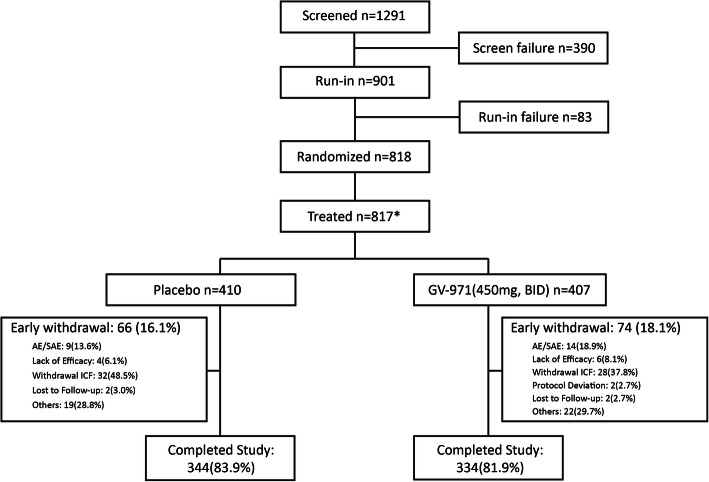
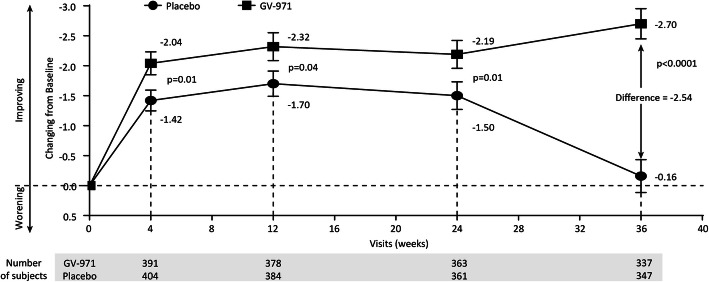
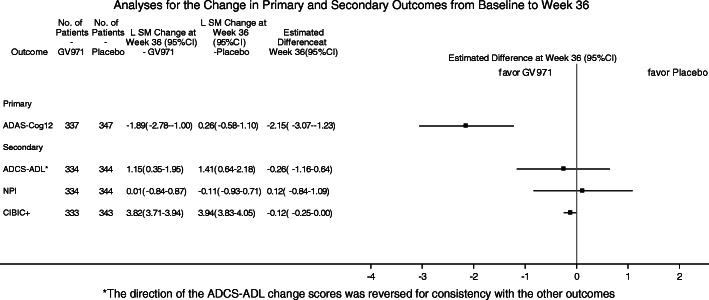
Background: New therapies are urgently needed for Alzheimer’s disease (AD). Sodium oligomannate (GV-971) is a marine-derived oligosaccharide with a novel proposed mechanism of action. The first phase 3 clinical trial of GV-971 has been completed in China. Methods: We conducted a phase 3, double-blind, placebo-controlled trial in participants with mild-to-moderate AD to assess GV-971 efficacy and safety. Participants were randomized to placebo or GV-971 (900 mg) for 36 weeks. The primary outcome was the drug-placebo difference in change from baseline on the 12-item cognitive subscale of the Alzheimer’s Disease Assessment Scale (ADAS-cog12). Secondary endpoints were drug-placebo differences on the Clinician’s Interview-Based Impression of Change with caregiver input (CIBIC+), Alzheimer’s Disease Cooperative Study-Activities of Daily Living (ADCS-ADL) scale, and Neuropsychiatric Inventory (NPI). Safety and tolerability were monitored. Results: A total of 818 participants were randomized: 408 to GV-971 and 410 to placebo. A significant drug-placebo difference on the ADAS-Cog12 favoring GV-971 was present at each measurement time point, measurable at the week 4 visit and continuing throughout the trial. The difference between the groups in change from baseline was − 2.15 points (95% confidence interval, − 3.07 to − 1.23; p < 0.0001; effect size 0.531) after 36 weeks of treatment. Treatment-emergent adverse event incidence was comparable between active treatment and placebo (73.9%, 75.4%). Two deaths determined to be unrelated to drug effects occurred in the GV-971 group. Conclusions: GV-971 demonstrated significant efficacy in improving cognition with sustained improvement across all observation periods of a 36-week trial. GV-971 was safe and well-tolerated. Trial registration: ClinicalTrials.gov, NCT0229391 5. Registered on November 19, 2014
Overview
The claims and statistics of this paper haven’t been checked yet.
Free: it reads the open-access text and checks the first 5 claims that cite a source we can check. Create a free account to check every claim.
Integrity signals
Registry
Cites
Statistics
Figures
Verification
Claims the paper makes
The claims and statistics of this paper haven’t been checked yet.
Free: it reads the open-access text and checks the first 5 claims that cite a source we can check. Create a free account to check every claim.
Claims other papers make about this one
Each is checked against this paper’s own text: does it say what the citing paper says it does?
The cited source says what the claim attributes to it.
In the citing paper
“New drugs, including sodium oligomannate (9, GV-971),54–56 aducanumab (1),57–59 lecanemab (2),60–62 and donanemab (10, currently under review for market approval),63 which aim to offer disease-modifying therapies that intervene in the progression of AD.”
From Recent advances in Alzheimer's disease: Mechanisms, clinical trials and new drug development strategies. (2024) · cites this paper as [56]
The cited source says what the claim attributes to it.
In the citing paper
“Sodium oligomannate (9, GV-971) was postulated to counteract AD by inhibiting neuroinflammation triggered by gut dysbiosis and disrupting the formation of Aβ fibrils.56,414”
From Recent advances in Alzheimer's disease: Mechanisms, clinical trials and new drug development strategies. (2024) · cites this paper as [56]
In the citing paper
“GV-971 has also been demonstrated to reverse cognitive deficits in patients with mild to moderate AD in the phase 2/3 clinical trial in China (NCT02293915) [262].”
From Tau and neuroinflammation in Alzheimer’s disease: interplay mechanisms and clinical translation (2023) · cites this paper as [262]
Self-check
Percentages, sums and reported differences re-computed from the paper’s own numbers.
The self-check needs the paper’s full text.
Citations
Cites
Folstein, M. F., Folstein, S. E., & McHugh, P. R. (1975) · Journal of Psychiatric Research · doi:10.1016/0022-3956(75)90026-6 · Cited by 88,282 · cited 17×
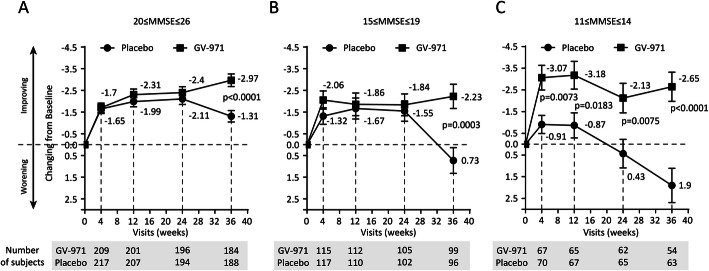
“In preplanned exploratory analyses, we assessed the treatment effect of GV-971 in participant groups of MMSE 11-14, 15-19, and 20-26 (Figure 4).”
BackgroundMethodInfluentialHamilton, M. (1960) · Journal of Neurology, Neurosurgery & Psychiatry · doi:10.1136/jnnp.23.1.56 · Cited by 32,817 · cited 1×
“A total Hachinski Ischemia Scale[20] score of ≤ 4 was required, and the Hamilton Hamilton Depression Scale 17[21] score had to be ≤ 10.”
MethodMcKhann, G., Drachman, D., Folstein, M., Katzman, R., Price, D., & Stadlan, E. M. (1984) · Neurology · doi:10.1212/wnl.34.7.939 · Cited by 27,915
Hirono, N., Mori, E., Ikejiri, Y., Imamura, T., Shimomura, T., Hashimoto, M., Yamashita, H., & Ikeda, M. (1997) · Brain and nerve · Cited by 21,039
Kok, J. S., Berg, I. J., & Scherder, E. J. A. (2013) · Dementia and Geriatric Cognitive Disorders Extra · doi:10.1159/000353441 · Cited by 20,589
Older Adults' Reasons for Using Technology while Aging in Place
Peek, S. T. M., Luijkx, K. G., Rijnaard, M. D., Nieboer, M. E., van der Voort, C. S., Aarts, S., van Hoof, J., Vrijhoef, H. J. M., & Wouters, E. J. M. (2016) · Gerontology · doi:10.1159/000430949 · Cited by 19,690
Sensitivity and False Alarm Rate of a Fall Sensor in Long-Term Fall Detection in the Elderly
Kangas, M., Korpelainen, R., Vikman, I., Nyberg, L., & Jämsä, T. (2015) · Gerontology · doi:10.1159/000362720 · Cited by 18,909
The Neuropsychiatric Inventory: Comprehensive assessment of psychopathology in dementia
Cummings, J. L., Mega, M., Gray, K., Rosenberg-Thompson, S., Carusi, D. A., & Gornbein, J. (1994) · Neurology · doi:10.1212/wnl.44.12.2308 · Cited by 7,568
Self-citationA new rating scale for Alzheimer's disease
(1984) · American Journal of Psychiatry · doi:10.1176/ajp.141.11.1356 · Cited by 4,175 · cited 1×
“The primary efficacy endpoint was the drug–placebo difference in the change from baseline on the ADASCog12 (score range, 0–75, with higher scores indicating greater cognitive impairment) at week 36 [29].”
Background. Cerebral blood flow in dementia.
Hachinski, V. C., Iliff, L. D., Zilhka, E., Du Boulay, G. H., McAllister, V. L., Marshall, J., Russell, R. W. R., & Symon, L. (1975) · Archives of Neurology · doi:10.1001/archneur.1975.00490510088009 · Cited by 3,186
Research works printed but not linked: 1
- Reisberg B. FS: Clinician's interview-based impression of change-plus; in Kelly C, Newton-Howes G (eds): guide to assessment scales in dementia. London: Science Press; 1994.
Cited by
Zhang, J., Zhang, Y., Wang, J., Xia, Y., Zhang, J., & Chen, L. (2024) · Signal Transduction and Targeted Therapy · doi:10.1038/s41392-024-01911-3 · Cited by 1,138
“554 and 56, 555 require further in vitro and in vivo studies to evaluate their pharmacokinetic properties and allosteric modulation effects.”
BackgroundSelf-citationNeuroinflammation in Alzheimer’s Disease: Current Progress in Molecular Signaling and Therapeutics
Thakur, S., Dhapola, R., Sarma, P., Medhi, B., & Reddy, D. H. (2023) · Inflammation · doi:10.1007/s10753-022-01721-1 · Cited by 557
Synaptic degeneration in Alzheimer disease
Tzioras, M., McGeachan, R. I., Durrant, C. S., & Spires-Jones, T. L. (2023) · Nature Reviews Neurology · doi:10.1038/s41582-022-00749-z · Cited by 504
Tau and neuroinflammation in Alzheimer’s disease: interplay mechanisms and clinical translation
Chen, Y., & Yu, Y. (2023) · Journal of Neuroinflammation · doi:10.1186/s12974-023-02853-3 · Cited by 516
“GV-971 has also been demonstrated to reverse cognitive deficits in patients with mild to moderate AD in the phase 2/3 clinical trial in China (NCT02293915) [262].”
BackgroundThe China Alzheimer Report 2022
Ren, R., Qi, J., Lin, S., Liu, X., Yin, P., Wang, Z., Tang, R., Wang, J., Huang, Q., Li, J., et al. (2022) · General Psychiatry · doi:10.1136/gpsych-2022-100751 · Cited by 353
Self-citationTauopathies: new perspectives and challenges
Zhang, Y., Wu, K.-M., Yang, L., Dong, Q., & Yu, J.-T. (2022) · Molecular Neurodegeneration · doi:10.1186/s13024-022-00533-z · Cited by 323
Self-citationTwo phase 3 trials of gantenerumab in early Alzheimer's disease
Bateman, R. J., Smith, J., Donohue, M. C., Delmar, P., Abbas, R., Salloway, S., Wojtowicz, J., Blennow, K., Bittner, T., Black, S. E., et al. (2023) · New England Journal of Medicine · doi:10.1056/nejmoa2304430 · Cited by 314
Self-citationGut liver brain axis in diseases: the implications for therapeutic interventions
Yan, M., Man, S., Sun, B., Ma, L., Guo, L., Huang, L., & Gao, W. (2023) · Signal Transduction and Targeted Therapy · doi:10.1038/s41392-023-01673-4 · Cited by 287
The gut microbiome in Alzheimer’s disease: what we know and what remains to be explored
Chandra, S., Sisodia, S. S., & Vassar, R. J. (2023) · Molecular Neurodegeneration · doi:10.1186/s13024-023-00595-7 · Cited by 278
“Furthermore, in a 36-week, multicenter, randomized phase 3 clinical trial in China (N = 818), GV-971 met its primary endpoint [108].”
BackgroundCarbohydrate-based drugs launched during 2000−2021
Cao, X., Du, X., Jiao, H., An, Q., Chen, R., Fang, P., Wang, J., & Yu, B. (2022) · Acta Pharmaceutica Sinica B · doi:10.1016/j.apsb.2022.05.020 · Cited by 267
Clinical trials of new drugs for Alzheimer disease: a 2020–2023 update
Huang, L.-K., Kuan, Y.-C., Lin, H.-W., & Hu, C.-J. (2023) · Journal of Biomedical Science · doi:10.1186/s12929-023-00976-6 · Cited by 252
Updates in Alzheimer's disease: from basic research to diagnosis and therapies
Liu, E., Zhang, Y., & Wang, J.-Z. (2024) · Translational Neurodegeneration · doi:10.1186/s40035-024-00432-x · Cited by 199
Self-citationThe State of The Art on Acetylcholinesterase Inhibitors in the Treatment of Alzheimer’s Disease
Vecchio, I., Sorrentino, L., Paoletti, A., Marra, R., & Arbitrio, M. (2021) · Journal of Central Nervous System Disease · doi:10.1177/11795735211029113 · Cited by 178
Gut Microbiota: A Novel Therapeutic Target for Parkinson’s Disease
Zhu, M., Liu, X., Ye, Y., Yan, X., Cheng, Y., Zhao, L., Chen, F., & Ling, Z. (2022) · Frontiers in Immunology · doi:10.3389/fimmu.2022.937555 · Cited by 177
Self-citationNovel Therapeutic Approaches for Alzheimer’s Disease: An Updated Review
Yu, T.-W., Lane, H.-Y., & Lin, C.-H. (2021) · International Journal of Molecular Sciences · doi:10.3390/ijms22158208 · Cited by 176
Xie, X., Song, Q., Dai, C., Cui, S., Tang, R., Li, S., Chang, J., Li, P., Wang, J., Li, J., et al. (2023) · General Psychiatry · doi:10.1136/gpsych-2023-101143 · Cited by 166
Self-citationMicroRNAs in Alzheimer's disease: Potential diagnostic markers and therapeutic targets
Liu, S., Fan, M., Zheng, Q., Hao, S., Yang, L., Xia, Q., Qi, C., & Ge, J. (2022) · Biomedicine & Pharmacotherapy · doi:10.1016/j.biopha.2022.112681 · Cited by 156
Self-citationShort-chain fatty acids-producing probiotics: A novel source of psychobiotics
Cheng, Y., Liu, J., & Ling, Z. (2021) · Critical Reviews in Food Science and Nutrition · doi:10.1080/10408398.2021.1920884 · Cited by 169
Self-citationExercise suppresses neuroinflammation for alleviating Alzheimer’s disease
Wang, M., Zhang, H., Liang, J., Huang, J., & Chen, N. (2023) · Journal of Neuroinflammation · doi:10.1186/s12974-023-02753-6 · Cited by 162
“Moreover, the drug has successfully passed the phase III clinical trial [15].”
BackgroundSelf-citationItzhaki, R. F. (2021) · Vaccines · doi:10.3390/vaccines9060679 · Cited by 123
The role of the immune system in Alzheimer’s disease
Wu, K., Zhang, Y.-R., Huang, Y., Dong, Q., Tan, L., & Yu, J. (2021) · Ageing Research Reviews · doi:10.1016/j.arr.2021.101409 · Cited by 127
Self-citationMulti-Targets: An Unconventional Drug Development Strategy for Alzheimer’s Disease
Gong, C.-X., Dai, C.-L., Liu, F., & Iqbal, K. (2022) · Frontiers in Aging Neuroscience · doi:10.3389/fnagi.2022.837649 · Cited by 106
Advances in Alzheimer’s disease’s pharmacological treatment
Filho, C. E. C., Loss, L. B., Pereira, C. M., Rossoni, J. V., Barcelos, R. M., Chiarelli-Neto, O., da Silva, B. S., Ambrósio, R. P., Castro, F. C. D. A. Q., Teixeira, S. F., et al. (2023) · Frontiers in Pharmacology · doi:10.3389/fphar.2023.1101452 · Cited by 123
Neuroinflammation, Its Role in Alzheimer's Disease and Therapeutic Strategies
Király, M., Foss, J. F., & Giordano, T. (2023) · The Journal of Prevention of Alzheimer s Disease · doi:10.14283/jpad.2023.109 · Cited by 122
Austad, S. N., Ballinger, S. W., Buford, T. W., Carter, C. S., Smith, D. L., Darley-Usmar, V. M., & Zhang, J. (2021) · Acta Pharmaceutica Sinica B · doi:10.1016/j.apsb.2021.06.014 · Cited by 100
Self-citationNeuroinflammation as a Potential Therapeutic Target in Alzheimer’s Disease
Liu, P., Wang, Y., Sun, Y., & Peng, G. (2022) · Clinical Interventions in Aging · doi:10.2147/cia.s357558 · Cited by 89
Self-citationAnthocyanins in Chronic Diseases: The Power of Purple
Panchal, S. K., John, O. D., Mathai, M. L., & Brown, L. (2022) · Nutrients · doi:10.3390/nu14102161 · Cited by 107
Alzheimer’s disease and its treatment–yesterday, today, and tomorrow
Kim, A. Y., Jerdi, S. A., MacDonald, R., & Triggle, C. R. (2024) · Frontiers in Pharmacology · doi:10.3389/fphar.2024.1399121 · Cited by 118
Li, H., Yi, Y.-L., Guo, S., Zhang, F., Yan, H., Zhan, Z.-L., Zhu, K. Y., & Duan, J. (2021) · Food Chemistry · doi:10.1016/j.foodchem.2021.131010 · Cited by 91
Cognitive Impairment in Heart Failure: Landscape, Challenges, and Future Directions
Yang, M., Sun, D., Wang, Y., Yan, M., Zheng, J., & Ren, J. (2022) · Frontiers in Cardiovascular Medicine · doi:10.3389/fcvm.2021.831734 · Cited by 102
Self-citationLiu, X., Liu, Y., Liu, J., Zhang, H., Shan, C., Guo, Y., Gong, X., Cui, M., Li, X., & Tang, M. (2023) · Neural Regeneration Research · doi:10.4103/1673-5374.382223 · Cited by 84
“A Phase III clinical study demonstrated that the sodium oligomannate reliably and successfully reduced AD patients’ cognitive symptoms (Wang et al., 2019, 2020a; Syed, 2020; Xiao et al., 2021).”
BackgroundSelf-citationLogan, R., Williams, B. G., Ferreira da Silva, M., Indani, A., Schcolnicov, N., Ganguly, A., & Miller, S. J. (2021) · Frontiers in Aging Neuroscience · doi:10.3389/fnagi.2021.720226 · Cited by 67
Bosch, M. E., Dodiya, H. B., Michalkiewicz, J., Lee, C., Shaik, S. M., Weigle, I. Q., Zhang, C., Osborn, J., Nambiar, A., Patel, P., et al. (2024) · Molecular Neurodegeneration · doi:10.1186/s13024-023-00700-w · Cited by 70
“However, GV-971, a marine-derived oligosaccharide that was developed and extensively studied [17, 24] by the company Shanghai Green Valley Pharmaceuticals (GV), was shown to improve spatial learning and memory in mouse models of AD, inhibited neuroinflammation by markedly altering the composition…”
BackgroundSelf-citationGiovannini, M. G., Lana, D., Traini, C., & Vannucchi, M. G. (2021) · Journal of Clinical Medicine · doi:10.3390/jcm10112358 · Cited by 61
Monroy-García, I. N., Torres-Romero, S., Castro-Ochoa, D., Mendoza-Acosta, A., Viveros‐Valdez, E., & Ayala-Zavala, J. F. (2025) · Stresses · doi:10.3390/stresses5010022 · Cited by 70
“…such as equipment cost, the need for precise temperature control, and the risk of degrading heat-sensitive compounds, MAE shows promise for large-scale algae processing—especially if paired with other extraction methods or alternative green solvents that further reduce environmental impact.”
Physiological Roles of Monomeric Amyloid-β and Implications for Alzheimer’s Disease Therapeutics
Jeong, H., Shin, H., Hong, S., & Kim, Y. S. (2022) · Experimental Neurobiology · doi:10.5607/en22004 · Cited by 66
Recent Advances in Drug Development for Alzheimer’s Disease: A Comprehensive Review
Xing, H., Yue, S., Qin, R., Du, X., Wu, Y., Zhangsun, D., & Luo, S. (2025) · International Journal of Molecular Sciences · doi:10.3390/ijms26083905 · Cited by 73
“Confirmatory Phase III trial data from a 36-week, double-blind study revealed clinically meaningful differences in ADAS-cog12 scores between GV-971 (900 mg/day) and placebo cohorts, with sustained cognitive benefits and ≤ 3% incidence of gastrointestinal adverse events [175].”
Self-citationDai, R., Sun, Y., Su, R., & Gao, H. (2022) · Biomedicine & Pharmacotherapy · doi:10.1016/j.biopha.2022.113576 · Cited by 63
Phenotyping and phenomics in aquaculture breeding
Fu, G., & Yuna, Y. (2021) · Aquaculture and Fisheries · doi:10.1016/j.aaf.2021.07.001 · Cited by 55
Martins, B., Vieira, M., Delerue-Matos, C. M., Grosso, C., & Soares, C. M. D. (2022) · Marine Drugs · doi:10.3390/md20060362 · Cited by 66
Morató, X., Pytel, V., Jofresa, S., Ruiz, A., & Boada, M. (2022) · International Journal of Molecular Sciences · doi:10.3390/ijms23169305 · Cited by 53
Modifying the diet and gut microbiota to prevent and manage neurodegenerative diseases
Gates, E. J., Bernath, A. K., & Klegeris, A. (2022) · Reviews in the Neurosciences · doi:10.1515/revneuro-2021-0146 · Cited by 66
“…the GV-971 mechanisms of action, this trial demonstrates improvement in clinical scores, whereas nonclinical studies provide evidence of disease-modifyingmechanistic actions of GV-971 illustrating the potential of this drug to ameliorate symptoms and slow the progression of AD (Xiao et al. 2021).”
ResultZhong, S.-R., Kuang, Q., Zhang, F., Chen, B., & Zhong, Z.-G. (2021) · Translational Neuroscience · doi:10.1515/tnsci-2020-0206 · Cited by 59
Li, L., Yan, S., Liu, S., Wang, P., Li, W., Yi, Y., & Qin, S. (2023) · Food Research International · doi:10.1016/j.foodres.2023.113133 · Cited by 52
Self-citationApplication of Marine Natural Products against Alzheimer’s Disease: Past, Present and Future
Hu, D., Jin, Y., Hou, X., Zhu, Y., Chen, D., Tai, J., Chen, Q., Shi, C., Ye, J., Wu, M., et al. (2023) · Marine Drugs · doi:10.3390/md21010043 · Cited by 53
“Sodium Oligomanne Capsules (GV-971) is a low molecular acid oligosaccharide compound prepared from the extract of marine brown algae [50].”
BackgroundSelf-citationThe gut microbiota‐astrocyte axis: Implications for type 2 diabetic cognitive dysfunction
Li, Z.-H., Jiang, Y., Long, C., Peng, Q., & Yue, R. (2023) · CNS Neuroscience & Therapeutics · doi:10.1111/cns.14077 · Cited by 43
Bajaj, S., Jain, S., Vyas, P., Bawa, S., & Vohora, D. (2021) · Brain Research Bulletin · doi:10.1016/j.brainresbull.2021.06.022 · Cited by 44
Ma, L., Jiang, X., Huang, Q.-Y., Chen, W., Zhang, H., Pei, H., Cao, Y., Wang, H., & Li, H. (2023) · Biomedicine & Pharmacotherapy · doi:10.1016/j.biopha.2023.115244 · Cited by 45
Self-citationCatumbela, C. S. G., Giridharan, V. V., Barichello, T., & Morales, R. (2023) · Translational Neurodegeneration · doi:10.1186/s40035-023-00369-7 · Cited by 37
“A randomized, double-blind, placebo-controlled, multicenter phase III trial revealed that, relative to the placebo group, twice daily administration of GV-971 for 36 weeks resulted in significant improvement of the ADAS-cog12 score in patients with mild to moderate AD from 4 weeks and onwards [34].”
Puranik, N., & Song, M. (2024) · Molecules · doi:10.3390/molecules29235744 · Cited by 55
“This series of events emphasizes how important GLU transmission is for brain function and how detrimental its dysregulation is to the development of AD [129].”
Zhang, S., Wu, Z., Zhang, S., Ru, Y., Wang, Q., Tong, H., Qin, Q., Yan, Q., Li, Z., & Wu, G. (2025) · Food & Function · doi:10.1039/d5fo03139g · Cited by 43
Self-citationThe mechanisms, hallmarks, and therapies for brain aging and age-related dementia
Jin, S., Lü, W., Zhang, J., Zhang, L., Tao, F., Zhang, Y., Hu, X., & Liu, Q. (2024) · 中国科学通报:英文版 · doi:10.1016/j.scib.2024.09.005 · Cited by 44
Self-citationOumata, N., Lu, K., Teng, Y., Cavé, C., Yu, P., Galons, H., & Roques, B. P. (2022) · European Journal of Medicinal Chemistry · doi:10.1016/j.ejmech.2022.114578 · Cited by 38
Modulation of gut microbiome in the treatment of neurodegenerative diseases: A systematic review
Mincic, A. M., Antal, M., Filip, L. A., & Miere, D. (2024) · Clinical Nutrition · doi:10.1016/j.clnu.2024.05.036 · Cited by 46
Pan, Z., Wu, N., & Jin, C. (2023) · Canadian Journal of Infectious Diseases and Medical Microbiology · doi:10.1155/2023/3080969 · Cited by 43
“Sodium oligomannate (GV-971) has been reported as a promising drug to treat AD by reshaping the gut microbiome, thereby reducing peripheral and neuro-infammation [142, 143].”
Viral Infections, Are They a Trigger and Risk Factor of Alzheimer’s Disease?
Rippee‐Brooks, M. D., Wu, W., Dong, J., Pappolla, M. A., Fang, X., & Bao, X. (2024) · Pathogens · doi:10.3390/pathogens13030240 · Cited by 32
“…mechanism linking HSV-1 to the development of AD through the virus directly damaging neural tissue [38], triggering an inflammatory response [42], or interacting with genetic and environmental factors to increase the risk of developing AD [43], there are also two other potential mechanisms…”
BackgroundSelf-citationChen, Y., Lai, M., & Tao, M. (2024) · Medicine · doi:10.1097/md.0000000000037799 · Cited by 53
“Of these, 8 donepezil trials, [20–26] Clinicaltrials.gov: NCT00708552; 5 galantamine trials, [27–30] Clinicaltrials.gov: NCT00814801; 3 rivastigmine trials [31–33] ; 2 memantine trials, [34,35] and 2 GV-971 trials [36,37] were included in this study.”
BackgroundInfluentialA Review of Recent Advances in the Management of Alzheimer’s Disease
Skylynn, T., Lee, C. S., Metchikoff, E., Razdan, V., Suliman, G., Rivera, D., Pinto, A., & Pemminati, S. (2024) · Cureus · doi:10.7759/cureus.58416 · Cited by 64
“…of Materia Medica demonstrated that there was a significant and sustained improvement over 36 weeks in cognition in patients who had administration of GV-971 as compared to those with placebo administration (difference: - 2.15 [CI 95%: -3.07 to -1.23; P < 0.0001; effect size: 0.531]) [31].”
BackgroundInfluentialThe 2021 yearbook of Neurorestoratology
Sharma, H. S., Chopp, M., Chen, L., Sarnowska, A., Xue, M., Ao, Q., Siniscalco, D., Chen, L., Hawamdeh, Z. M., & Huang, H. (2022) · Journal of Neurorestoratology · doi:10.1016/j.jnrt.2022.100008 · Cited by 34
Self-citationLu, J., Pan, Q., Zhou, J., Weng, Y., Chen, K., Shi, L., Zhu, G., Chen, C., Li, L., Geng, M., et al. (2022) · Journal of Pharmaceutical Analysis · doi:10.1016/j.jpha.2021.06.001 · Cited by 30
Self-citationZhan, Y., Al‐Nusaif, M., Ding, C., Zhao, L., & Dong, C. (2023) · Frontiers in Neuroscience · doi:10.3389/fnins.2023.1130730 · Cited by 34
Masitinib for the Treatment of Alzheimer’s Disease
Ettcheto, M., Cano, A., Sanchez-López, E., Verdaguer, E., Folch, J., Auladell, C., & Camins, A. (2021) · Neurodegenerative Disease Management · doi:10.2217/nmt-2021-0019 · Cited by 28
Yeo-Teh, N. S. L., & Tang, B. L. (2023) · Science and Engineering Ethics · doi:10.1007/s11948-022-00422-0 · Cited by 28
“However, none of the secondary endpoints, global function (assessed by CIBIC +), activities of daily living (assessed by ADCS-ADL) scale or behavioural symptoms (assessed by NPI), showed any significant drug-placebo differences (Xiao et al., 2021).”
BackgroundInfluentialInterplay between microglia and environmental risk factors in Alzheimer's disease
Zhang, M., Liang, C., Chen, X., Cai, Y., & Cui, L. (2023) · Neural Regeneration Research · doi:10.4103/1673-5374.389745 · Cited by 32
Self-citationAlfei, S., & Zuccari, G. (2025) · International Journal of Molecular Sciences · doi:10.3390/ijms26020844 · Cited by 29
The Breakthroughs and Caveats of Using Human Pluripotent Stem Cells in Modeling Alzheimer’s Disease
Bendtsen, K. M., & Hall, V. J. (2023) · Cells · doi:10.3390/cells12030420 · Cited by 33
“Previous studies, have shown GV-971 acts primarily in the gut, altering the microbiome of patients, and by doing so, reducing both infiltration of immune cells into the brain and neuroinflammation [27].”
Beyond the amyloid cascade: An update of Alzheimer's disease pathophysiology
Gouilly, D., Rafiq, M., Nogueira, L., Salabert, A., Payoux, P., Péran, P., & Pariente, J. (2023) · Revue Neurologique · doi:10.1016/j.neurol.2022.12.006 · Cited by 35
Cao, Y., Yu, F., Lyu, Y., & Lu, X. (2022) · Frontiers in Neurology · doi:10.3389/fneur.2022.1034243 · Cited by 26
“The results of a 36-week experiment revealed that GV-971 displayed high efficacy in improving cognition, with persistent improvement throughout all observation periods (55).”
BackgroundRen, B., Guo, C., Liu, R., Bian, Z.-Y., Liu, R.-C., Huang, L.-F., & Tang, J. (2021) · European Journal of Medicinal Chemistry · doi:10.1016/j.ejmech.2021.114031 · Cited by 27
Gutti, G., Leifeld, J., Ramakrishna, K., Bajad, N. G., Ganeshpurkar, A., Kumar, A., Krishnamurthy, S., Klein-Schmidt, C., Tapken, D., Hollmann, M., et al. (2023) · European Journal of Medicinal Chemistry · doi:10.1016/j.ejmech.2023.115670 · Cited by 27
Alzheimer’s Disease: Models and Molecular Mechanisms Informing Disease and Treatments
Nystuen, K., McNamee, S. M., Akula, M., Holton, K. M., DeAngelis, M. M., & Haider, N. B. (2024) · Bioengineering · doi:10.3390/bioengineering11010045 · Cited by 30
Jy, L., Wong, C.-Y., Koh, R. Y., Lim, C. L., Kok, Y.-Y., & Chye, S. M. (2024) · The Yale Journal of Biology and Medicine · doi:10.59249/jnkb9714 · Cited by 29
“…trial with mild-to-moderate AD patients, GV-971 significantly improved cognitive functions compared to the placebo group after 4 weeks of treatment, as assessed by ADAS-cog12, and also benefited secondary end - points like CIBIC+ scores and activities of daily living (ADCS-ADL) scores [108].”
BackgroundMethodWang, L., Lu, Y., Liu, J., Wang, S., Fei, Z., Zhang, K., Zhang, D., & Jin, X. (2024) · Phytomedicine · doi:10.1016/j.phymed.2024.155394 · Cited by 28
Self-citationNatural Products from Plants and Algae for Treatment of Alzheimer’s Disease: A Review
Klose, J., Griehl, C., Roßner, S., & Schilling, S. (2022) · Biomolecules · doi:10.3390/biom12050694 · Cited by 23
The emerging role of the microbiome in Alzheimer's disease
Wasén, C., Simonsen, E., Ekwudo, M. N., Profant, M. R., & Cox, L. M. (2022) · International review of neurobiology · doi:10.1016/bs.irn.2022.09.001 · Cited by 25
The Neuropharmacological Evaluation of Seaweed: A Potential Therapeutic Source
Jannat, K., Balakrishnan, R., Han, J., Yu, Y.-J., Kim, G.-W., & Choi, D. (2023) · Cells · doi:10.3390/cells12222652 · Cited by 23
Jia, C., Chai, J., Zhang, S., Sun, Y., He, L., Sang, Z., Chen, D., & Zheng, X. (2025) · Marine Drugs · doi:10.3390/md23030091 · Cited by 24
The chemical basis of seawater therapies: a review
Costanzo, M., Giglio, M. A. R. D., Gilhen-Baker, M., & Roviello, G. N. (2024) · Environmental Chemistry Letters · doi:10.1007/s10311-024-01720-8 · Cited by 23
“…sodium oli-gomannate (GV-971) passed phase 3 clinical trials showing promising results in the therapeutic approaches against Alzheimer’s disease (Xiao et al. 2021) with this compound demonstrating to attenuate the accumulation and aggregation of α-synuclein in mice and related pathology,…”
Research Progress on the Pathogenesis, Diagnosis, and Drug Therapy of Alzheimer’s Disease
Yang, Y., & Qiu, L. (2024) · Brain Sciences · doi:10.3390/brainsci14060590 · Cited by 23
“Sodium Oligomannate (GV-971): Sodium Oligomannate is extracted from seaweed and is usually taken orally in capsules [167]. and was approved for marketing in China [168].”
BackgroundNutrition in Alzheimer’s disease: a review of an underappreciated pathophysiological mechanism
Jiang, J., Shi, H., Jiang, S., Wang, A., Zou, X., Wang, Y., Li, W., Zhang, Y., Sun, M., Ren, Q., et al. (2023) · Science China Life Sciences · doi:10.1007/s11427-022-2276-6 · Cited by 22
“A 36-week multicenter, randomized, double-blind, phase 3 clinical trial demonstrated that sodium oligomannate offered good safety and tolerability in addition to significant efficacy in improving cognition in patients with mild-to-moderate AD (Xiao et al., 2021).”
BackgroundSelf-citationImpact of New Drugs for Therapeutic Intervention in Alzheimer’s Disease
Olloquequi, J., Ettcheto, M., Cano, A. C., Sánchez‐López, E., Carrasco, M., Espinosa-Jiménez, T., Beas‐Zárate, C., Gudiño‐Cabrera, G., Ureña‐Guerrero, M. E., Verdaguer, E., et al. (2022) · Frontiers in Bioscience-Landmark · doi:10.31083/j.fbl2705146 · Cited by 27
“GV-971 also demonstrated significant and sustained efficacy in enhancing cognition in his first phase III trial [29].”
BackgroundResultPathogenesis, Animal Models, and Drug Discovery of Alzheimer’s Disease
Xia, Z.-D., Ma, R.-X., Wen, J.-F., Zhai, Y.-F., Wang, Y.-Q., Wang, F.-Y., Liu, D., Zhao, X.-L., Sun, B., Jia, P., et al. (2023) · Journal of Alzheimer's Disease · doi:10.3233/jad-230326 · Cited by 19
Self-citationTargeting tau in Alzheimer’s and beyond: Insights into pathology and therapeutic strategies
Singh, S., Khan, S., Shahid, M., Sardar, M., Hassan, M. I., & Islam, A. (2024) · Ageing Research Reviews · doi:10.1016/j.arr.2024.102639 · Cited by 23
Saiyasit, N., Butlig, E.-A. R., Chaney, S. D., Traylor, M. K., Hawley, N. A., Randall, R. B., Bobinger, H. V., Frizell, C. A., Trimm, F., Crook, E. D., et al. (2022) · Frontiers in Neuroscience · doi:10.3389/fnins.2022.915405 · Cited by 22
“Sodium oligomannate (GV-971) effectively remodels gut microbiota and reduces Th1-related inflammation in the brain (Wang et al., 2020; Xiao et al., 2021).”
BackgroundInfluentialZeng, H., Zhou, K., Zhuang, Y., Li, A., Luo, B., & Zhang, Y. (2023) · Frontiers in Aging Neuroscience · doi:10.3389/fnagi.2023.1273104 · Cited by 20
Self-citationMicrobiota-Gut-Brain Axis in Age-Related Neurodegenerative Diseases
Nie, T., Li, Y., Tang, F., Duan, Y., Nepovimová, E., Kuča, K., Wu, Q., & Wei, W. (2024) · Current Neuropharmacology · doi:10.2174/1570159x23666241101093436 · Cited by 25
Self-citationJiménez-García, A., Villarino, M., & Arias, N. (2024) · Alzheimer s & Dementia Diagnosis Assessment & Disease Monitoring · doi:10.1002/dad2.70057 · Cited by 36
“For instance, a recent phase-3 clinical trial 13 highlighted the efficacy of GV-971, a sodium oligomannate capable of reshaping gut microbiota, in alleviating gut dysbiosis and mitigating phenylalanine/isoleucine accumulation.”
Tilki, E. K., & Dikmen, M. (2021) · PLoS ONE · doi:10.1371/journal.pone.0260633 · Cited by 16
Effects of Qi-Fu-Yin on aging of APP/PS1 transgenic mice by regulating the intestinal microbiome
Xiao, Q., Ye, T., Wang, X., Qi, D., & Cheng, X. (2023) · Frontiers in Cellular and Infection Microbiology · doi:10.3389/fcimb.2022.1048513 · Cited by 18
Self-citationZhu, L., Wang, Y., Wu, Y., Wilson, A., Zhou, H., Li, N., & Wang, Y. Y. (2024) · Frontiers in Public Health · doi:10.3389/fpubh.2024.1352433 · Cited by 19
Self-citationThe role of brain–liver–gut Axis in neurological disorders
Li, P., Xie, L., Yang, W., Feng, S., Mao, W., Ye, L., Cheng, H., Wu, X., & Mao, X. (2025) · Burns & Trauma · doi:10.1093/burnst/tkaf011 · Cited by 18
“The drug sodium oligomannate, which regulates the gut microbiota, has entered phase III clinical trials, and its ability to improve cognitive function in AD patients has been demonstrated [88].”
Yang, X., Zhangyi, Z., Yu, A., Zhou, Q., Xia, A., Qiu, J., Cai, M., Chu, X., Li, L., Feng, Z., et al. (2024) · CNS Neuroscience & Therapeutics · doi:10.1111/cns.14847 · Cited by 15
Self-citationHuang, J., Huang, N., Cui, D., Shi, J., & Qiu, Y. (2023) · Frontiers in Aging Neuroscience · doi:10.3389/fnagi.2023.1122300 · Cited by 16
“Learning cognitive dysfunction, neuronal loss, etc., appear in T2DM patients (Noreen et al., 2018; Li et al., 2021).”
BackgroundZhou, J., Tang, M., Li, W., Fang, R., Tang, C., & Wang, Q. (2023) · Food Science and Human Wellness · doi:10.26599/fshw.2022.9250049 · Cited by 18
Self-citationKim, J., Jeon, H., Kim, H. Y., & Kim, Y. S. (2023) · ChemBioChem · doi:10.1002/cbic.202300328 · Cited by 17
Let food be your medicine – dietary fiber
Liu, M., Li, S., Cao, S., Liu, C., Han, Y., Cheng, J., Zhang, S., Zhao, J., & Shi, Y. (2024) · Food & Function · doi:10.1039/d3fo05641d · Cited by 17
Self-citationAlshammari, F. F., Al-Kuraishy, H. M., Shokr, M. M., Papadakis, M., Alexiou, A. T., & Batiha, G. E. (2025) · Inflammopharmacology · doi:10.1007/s10787-025-01940-6 · Cited by 15
“A Multicenter, randomized, double-blind phase 3 clinical trial also demonstrated significant efficacy of GV-971 in improving cognition across all observation periods of a 36-week trial (Xiao et al. 2021).”
Wang, Q., Gao, F., Dai, L., Zhang, J., Bi, D., & Shen, Y. (2022) · The Journal of Prevention of Alzheimer s Disease · doi:10.14283/jpad.2022.46 · Cited by 18
Self-citationNeurorestoratology: New Advances in Clinical Therapy
Huang, H., Sharma, H. S., Chen, L., & Chen, D. (2022) · CNS & Neurological Disorders - Drug Targets · doi:10.2174/1871527321666220827093805 · Cited by 15
Self-citationGao, M., Duan, X., Liu, X.-R., Luo, S., Tang, S., Nie, H., Yan, J., Zou, Z., Chen, C., Yin, Q., et al. (2022) · Frontiers in Pharmacology · doi:10.3389/fphar.2022.841990 · Cited by 15
Self-citation
Metadata
- Authors
- Xiao, S., Chan, P., Wang, T., Hong, Z., Wang, S., Kuang, W., He, J., Pan, X., Zhou, Y., Ji, Y., Wang, L., Cheng, Y., Peng, Y., Ye, Q., Wang, X., Wu, Y., Qu, Q., Chen, S., Li, S., Chen, W., Xu, J., Peng, D., Zhao, Z., Li, Y., Zhang, J., Du, Y., Chen, W., Fan, D., Yan, Y., Liu, X., Zhang, W., Luo, B., Wu, W., Shen, L., Liu, C., Mao, P., Wang, Q., Zhao, Q., Guo, Q., Zhou, Y., Li, Y., Jiang, L., Ren, W., Ouyang, Y., Wang, Y., Liu, S., Jia, J., Zhang, N., Liu, Z., He, R., Feng, T., Lu, W., Tang, H., Gao, P., Zhang, Y., Chen, L., Wang, L., Yin, Y., Xu, Q., Xiao, J., Cong, L., Cheng, X., Zhang, H., Gao, D., Xia, M., Lian, T., Peng, G., Zhang, X., Jiao, B., Hu, H., Chen, X., Guan, Y., Cui, R., Huang, Q., Xin, X., Chen, H., Ding, Y., Zhang, J., Feng, T., Cantillon, M., Chen, K., Cummings, J. L., Ding, J., Geng, M., & Zhang, Z.
- Affiliations
- Shanghai Jiao Tong University (CN)
- Capital Medical University (CN)
- Fudan University (CN)
- Qilu Hospital of Shandong University (CN)
- West China Hospital of Sichuan University (CN)
- First Affiliated Hospital of Wenzhou Medical University (CN)
- Guangzhou First People's Hospital (CN)
- Nankai University (CN)
- Tianjin Medical University General Hospital (CN)
- Sun Yat-sen University (CN)
- Union Hospital (CN)
- First Affiliated Hospital of Xi'an Jiaotong University (CN)
- Beijing Hospital (CN)
- Sir Run Run Shaw Hospital (CN)
- Northern Jiangsu People's Hospital (CN)
- China-Japan Friendship Hospital (CN)
- Shanghai Changzheng Hospital (CN)
- Zhongnan Hospital of Wuhan University (CN)
- Shandong University (CN)
- Peking University Third Hospital (CN)
- The Affiliated Yongchuan Hospital of Chongqing Medical University (CN)
- First Affiliated Hospital Zhejiang University (CN)
- Tongji University (CN)
- Xiangya Hospital Central South University (CN)
- Peking Union Medical College Hospital (CN)
- Chinese PLA General Hospital (CN)
- Second Affiliated Hospital of Soochow University (CN)
- Banner Alzheimer’s Institute (US)
- University of Nevada, Las Vegas (US)
- Chinese Academy of Sciences (CN)
- Corresponding author
- Xiao, Shifu
- Geng, Meiyu
- Zhang, Zhenxin
- ORCID
- Xiao, Shifu
- Chan, Piu
- Wang, Tao
- Hong, Zhen
- Wang, Shuzhen
- Kuang, Weihong
- He, Jincai
- Pan, Xiaoping
- Zhou, Yuying
- Ji, Yong
- Cheng, Yan
- Peng, Ying
- Ye, Qinyong
- Wang, Xiaoping
- Qu, Qiumin
- Chen, Shengdi
- Chen, Wei
- Xu, Jun
- Peng, Dantao
- Li, Yansheng
- Zhang, Junjian
- Du, Yifeng
- Chen, Weixian
- Fan, Dongsheng
- Yan, Yong
- Liu, Xiaowei
- Zhang, Wei
- Luo, Benyan
- Wu, Wenyuan
- Wang, Qiumei
- Zhao, Qianhua
- Guo, Qihao
- Zhou, Yongtao
- Li, Yi
- Ren, Wenwei
- Ouyang, Yingjun
- Wang, Yan
- Liu, Shuai
- Jia, Jianjun
- Zhang, Nan
- Liu, Zhonglin
- Lu, Wenhui
- Tang, Huidong
- Gao, Ping
- Zhang, Yingchun
- Chen, Lanlan
- Wang, Lei
- Yin, You
- Xu, Qun
- Cong, Lin
- Cheng, Xi
- Zhang, Hui
- Gao, Dan
- Peng, Guoping
- Zhang, Xu
- Jiao, Bin
- Hu, Hua
- Chen, Xueyan
- Guan, Yihui
- Cui, Ruixue
- Huang, Qiu
- Ding, Yu
- Zhang, Jing
- Feng, Teng
- Chen, Kewei
- Cummings, Jeffrey L.
- Ding, Jian
- Geng, Meiyu
- Zhang, Zhenxin
- Venue
- Alzheimer's Research & Therapy
- Published
- 2021-03-17
- Volume
- 13
- Issue
- 1
- Pages
- 62-62
- ISSN
- 1758-9193 (ISSN-L)
- PMC
- PMC7967962
- OpenAlex
- W3159386017
- Cited by
- 224
- References
- 46
- Citations by year
- 2026: 41 · 2025: 32 · 2024: 39 · 2023: 48 · 2022: 39 · 2021: 25
- FWCI
- 23.93
- Type
- journal article
- Language
- en
- Open access
- gold
- doi.org
- Licence
- cc-by
- creativecommons.org/licenses/by/4.0/ (tdm)
- creativecommons.org/licenses/by/4.0/ (vor)
- Locations
- Alzheimer s Research & Therapy (publishedVersion, cc-by)
- Research Square (acceptedVersion, cc-by)
- PubMed Central (publishedVersion, cc-by)
- PubMed (publishedVersion)
- DOAJ (DOAJ: Directory of Open Access Journals) (submittedVersion, cc-by-sa)
- Funders
- National Science and Technology Major Project for Investigational New Drugs (2011ZX09101-003-01, 2015ZX09101003, 2018ZX09711002-015)
- Topics
- Life Sciences › Neuroscience › Cellular and Molecular Neuroscience › Alzheimer's disease research and treatments
- Health Sciences › Medicine › Psychiatry and Mental health › Dementia and Cognitive Impairment Research
- Health Sciences › Medicine › Pharmacology (medical) › Cholinesterase and Neurodegenerative Diseases
- Keywords
- Alzheimer's disease, mild to moderate dementia, cognitive function, activities of daily living, neuropsychiatric symptoms, drug safety and tolerability
- MeSH terms
- Activities of Daily Living, Alzheimer Disease, China, Cholinesterase Inhibitors, Double-Blind Method, Pharmaceutical Preparations, Humans, Mannose, Oligosaccharides, Sodium, Treatment Outcome
About these checks
Registry, retraction, Cites and statistics results are computed, not judged, with one exception: a printed reference that no index lists is read once by a model before it counts as a citation error. Claims are extracted by a model and kept only when their quote appears verbatim in the text; each cited source is then checked, with a model’s help, for whether it says what the claim relies on. Those verdicts can be wrong — read the claim’s quote and the cited source before relying on one.
Statistics and arithmetic are recomputed, not judged.
Confidence bands are shown only for fields calibrated on our annotated test set. None is calibrated yet, so no band is shown.
What counts as a claim ›How we measure confidence ›How we check this ›
Are you an author, or do you see a problem with this page? Request a review
Data sources
Bibliographic data: Semantic Scholar, OpenAlex, Crossref.
Contains information from the Semantic Scholar Academic Graph Datasets, made available under the ODC Attribution License (ODC-BY 1.0).
Semantic Scholar’s data is described in: Kinney, R., et al. (2023). The Semantic Scholar Open Data Platform. arXiv:2301.10140.
