

A 36-week multicenter, randomized, double-blind, placebo-controlled, parallel-group, phase 3 clinical trial of sodium oligomannate for mild-to-moderate Alzheimer’s dementia
Open accessPublished version of a preprint
The DOI matches its Crossref record; 46 of the 46 references it cites were found in a registry or an index.
Abstract
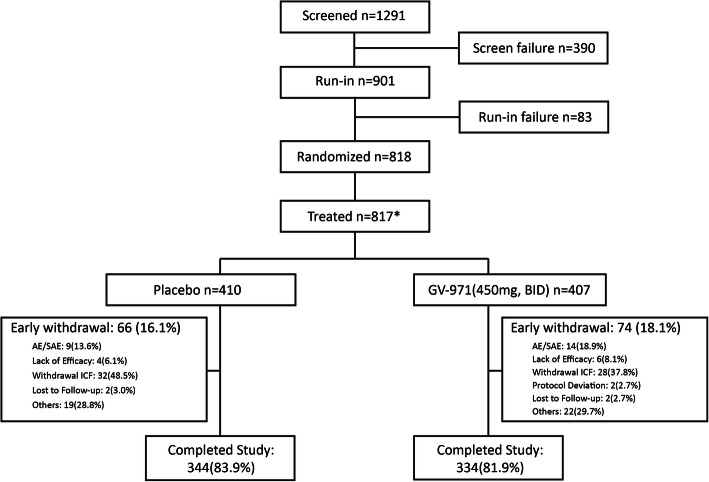
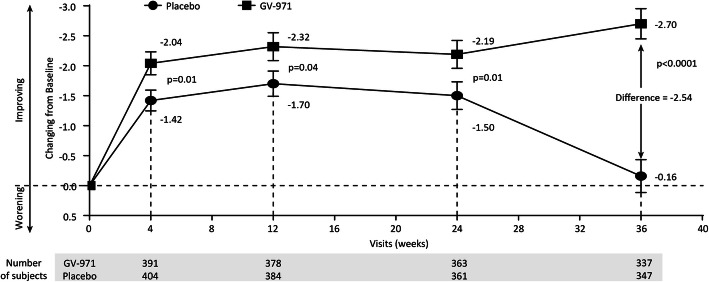
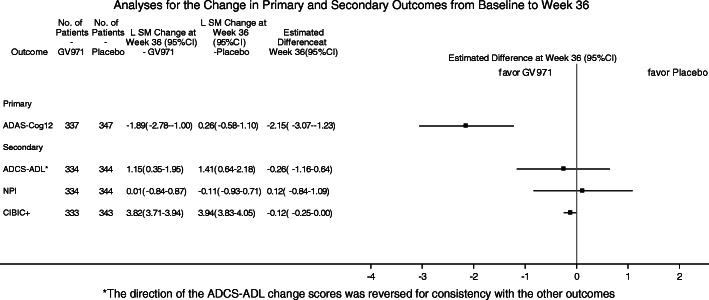
Background: New therapies are urgently needed for Alzheimer’s disease (AD). Sodium oligomannate (GV-971) is a marine-derived oligosaccharide with a novel proposed mechanism of action. The first phase 3 clinical trial of GV-971 has been completed in China. Methods: We conducted a phase 3, double-blind, placebo-controlled trial in participants with mild-to-moderate AD to assess GV-971 efficacy and safety. Participants were randomized to placebo or GV-971 (900 mg) for 36 weeks. The primary outcome was the drug-placebo difference in change from baseline on the 12-item cognitive subscale of the Alzheimer’s Disease Assessment Scale (ADAS-cog12). Secondary endpoints were drug-placebo differences on the Clinician’s Interview-Based Impression of Change with caregiver input (CIBIC+), Alzheimer’s Disease Cooperative Study-Activities of Daily Living (ADCS-ADL) scale, and Neuropsychiatric Inventory (NPI). Safety and tolerability were monitored. Results: A total of 818 participants were randomized: 408 to GV-971 and 410 to placebo. A significant drug-placebo difference on the ADAS-Cog12 favoring GV-971 was present at each measurement time point, measurable at the week 4 visit and continuing throughout the trial. The difference between the groups in change from baseline was − 2.15 points (95% confidence interval, − 3.07 to − 1.23; p < 0.0001; effect size 0.531) after 36 weeks of treatment. Treatment-emergent adverse event incidence was comparable between active treatment and placebo (73.9%, 75.4%). Two deaths determined to be unrelated to drug effects occurred in the GV-971 group. Conclusions: GV-971 demonstrated significant efficacy in improving cognition with sustained improvement across all observation periods of a 36-week trial. GV-971 was safe and well-tolerated. Trial registration: ClinicalTrials.gov, NCT0229391 5. Registered on November 19, 2014
Overview
The claims and statistics of this paper haven’t been checked yet.
Free: it reads the open-access text and checks the first 5 claims that cite a source we can check. Create a free account to check every claim.
Integrity signals
Registry
Cites
Statistics
Figures
Verification
Claims the paper makes
The claims and statistics of this paper haven’t been checked yet.
Free: it reads the open-access text and checks the first 5 claims that cite a source we can check. Create a free account to check every claim.
Claims other papers make about this one
Each is checked against this paper’s own text: does it say what the citing paper says it does?
The cited source says what the claim attributes to it.
In the citing paper
“New drugs, including sodium oligomannate (9, GV-971),54–56 aducanumab (1),57–59 lecanemab (2),60–62 and donanemab (10, currently under review for market approval),63 which aim to offer disease-modifying therapies that intervene in the progression of AD.”
From Recent advances in Alzheimer's disease: Mechanisms, clinical trials and new drug development strategies. (2024) · cites this paper as [56]
The cited source says what the claim attributes to it.
In the citing paper
“Sodium oligomannate (9, GV-971) was postulated to counteract AD by inhibiting neuroinflammation triggered by gut dysbiosis and disrupting the formation of Aβ fibrils.56,414”
From Recent advances in Alzheimer's disease: Mechanisms, clinical trials and new drug development strategies. (2024) · cites this paper as [56]
In the citing paper
“GV-971 has also been demonstrated to reverse cognitive deficits in patients with mild to moderate AD in the phase 2/3 clinical trial in China (NCT02293915) [262].”
From Tau and neuroinflammation in Alzheimer’s disease: interplay mechanisms and clinical translation (2023) · cites this paper as [262]
Self-check
Percentages, sums and reported differences re-computed from the paper’s own numbers.
The self-check needs the paper’s full text.
Citations
Cites
Folstein, M. F., Folstein, S. E., & McHugh, P. R. (1975) · Journal of Psychiatric Research · doi:10.1016/0022-3956(75)90026-6 · Cited by 88,282 · cited 17×
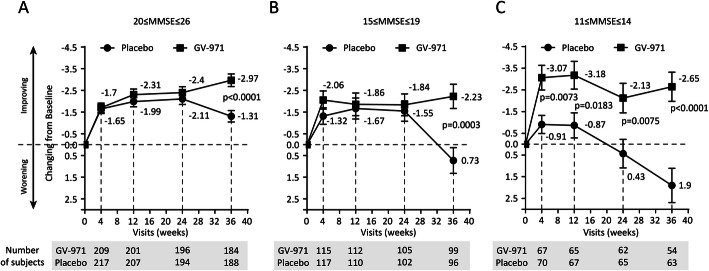
“In preplanned exploratory analyses, we assessed the treatment effect of GV-971 in participant groups of MMSE 11-14, 15-19, and 20-26 (Figure 4).”
BackgroundMethodInfluentialHamilton, M. (1960) · Journal of Neurology, Neurosurgery & Psychiatry · doi:10.1136/jnnp.23.1.56 · Cited by 32,817 · cited 1×
“A total Hachinski Ischemia Scale[20] score of ≤ 4 was required, and the Hamilton Hamilton Depression Scale 17[21] score had to be ≤ 10.”
MethodMcKhann, G., Drachman, D., Folstein, M., Katzman, R., Price, D., & Stadlan, E. M. (1984) · Neurology · doi:10.1212/wnl.34.7.939 · Cited by 27,915
Kok, J. S., Berg, I. J., & Scherder, E. J. A. (2013) · Dementia and Geriatric Cognitive Disorders Extra · doi:10.1159/000353441 · Cited by 20,589
Older Adults' Reasons for Using Technology while Aging in Place
Peek, S. T. M., Luijkx, K. G., Rijnaard, M. D., Nieboer, M. E., van der Voort, C. S., Aarts, S., van Hoof, J., Vrijhoef, H. J. M., & Wouters, E. J. M. (2016) · Gerontology · doi:10.1159/000430949 · Cited by 19,690
Sensitivity and False Alarm Rate of a Fall Sensor in Long-Term Fall Detection in the Elderly
Kangas, M., Korpelainen, R., Vikman, I., Nyberg, L., & Jämsä, T. (2015) · Gerontology · doi:10.1159/000362720 · Cited by 18,909
The Neuropsychiatric Inventory: Comprehensive assessment of psychopathology in dementia
Cummings, J. L., Mega, M., Gray, K., Rosenberg-Thompson, S., Carusi, D. A., & Gornbein, J. (1994) · Neurology · doi:10.1212/wnl.44.12.2308 · Cited by 7,568
Self-citationA new rating scale for Alzheimer's disease
(1984) · American Journal of Psychiatry · doi:10.1176/ajp.141.11.1356 · Cited by 4,175 · cited 1×
“The primary efficacy endpoint was the drug–placebo difference in the change from baseline on the ADASCog12 (score range, 0–75, with higher scores indicating greater cognitive impairment) at week 36 [29].”
Background. Cerebral blood flow in dementia.
Hachinski, V. C., Iliff, L. D., Zilhka, E., Du Boulay, G. H., McAllister, V. L., Marshall, J., Russell, R. W. R., & Symon, L. (1975) · Archives of Neurology · doi:10.1001/archneur.1975.00490510088009 · Cited by 3,186
Two Phase 3 Trials of Bapineuzumab in Mild-to-Moderate Alzheimer's Disease
Salloway, S., Sperling, R., Fox, N. C., Blennow, K., Klunk, W., Raskind, M., Sabbagh, M., Honig, L. S., Porsteinsson, A. P., Ferris, S., et al. (2014) · New England Journal of Medicine · doi:10.1056/nejmoa1304839 · Cited by 1,960 · cited 1×
“Although repeated failures of phase 3 clinical trials in the last decade have been reported[7, 8], much effort continues to be invested in developing treatments for this disease[9].”
Background
Research works printed but not linked: 1
- Reisberg B. FS: Clinician's interview-based impression of change-plus; in Kelly C, Newton-Howes G (eds): guide to assessment scales in dementia. London: Science Press; 1994.
Cited by
Items 101–200 of 226
Lou, I. X., Chen, J., Ali, K., Shaikh, A. L., & Chen, Q. (2023) · Frontiers in Pharmacology · doi:10.3389/fphar.2023.1190604 · Cited by 17
Multi-target regulatory mechanism of Yang Xin Tang − a traditional Chinese medicine against dementia
Lo, T. Y., Chan, A. S. L., Cheung, S. T., Yung, L. Y., Leung, M. M. H., & Wong, Y. H. (2023) · Chinese Medicine · doi:10.1186/s13020-023-00813-w · Cited by 18
Helgudóttir, S. S., Mørkholt, A. S., Lichota, J., Bruun-Nyzell, P., Andersen, M. C., Kristensen, N. M. J., Johansen, A. K., Zinn, M. R., Jensdóttir, H. M., & Nieland, J. D. (2023) · Neural Regeneration Research · doi:10.4103/1673-5374.387965 · Cited by 17
“The efficacy of targeting the microbiota-brain axis in improving cognition in individuals with mild to moderate AD has been established through the use of GV-971, as demonstrated in a Phase 3 trial (Xiao et al., 2021).”
MethodMir, P. A., Kumar, N. G., Bhutia, G. T., Chaudhary, P., Kaur, G., & Gupta, S. K. (2026) · GeroScience · doi:10.1007/s11357-025-02062-1 · Cited by 15
Advances in Neurorestoratology—Current status and future developments
Huang, H., Ramón‐Cueto, A., Masri, W. E., Moviglia, G. A., Saberi, H., Sharma, H. S., Otom, A. H., Chen, L., Siniscalco, D., & Sarnowska, A. (2023) · International review of neurobiology · doi:10.1016/bs.irn.2023.04.003 · Cited by 12
Self-citationThe Gut Microbiota-Brain Axis: A New Frontier in Alzheimer's Disease Pathology
Dhanawat, M., Garima, G., Wilson, K., Gupta, S., Gupta, N., & Sardana, S. (2024) · CNS & Neurological Disorders - Drug Targets · doi:10.2174/0118715273302508240613114103 · Cited by 13
Arif, S., Qazi, T. J., Quan, Z., Ni, J., Li, Z., Qiu, Y., & Qing, H. (2024) · Ageing Research Reviews · doi:10.1016/j.arr.2024.102614 · Cited by 13
Pharmacotherapeutic combinations for the treatment of Alzheimer’s disease.
Nagata, T., Shinagawa, S., Nakajima, S., Noda, Y., & Mimura, M. (2022) · Expert Opinion on Pharmacotherapy · doi:10.1080/14656566.2022.2042514 · Cited by 11
“ing degradation or destabilization of the protein to nontoxic monomers and reduction of Aβ deposition [31,34].”
BackgroundSong, M., & Fan, X. (2023) · International Journal of Molecular Sciences · doi:10.3390/ijms24098398 · Cited by 11
Advances in prodrug design for Alzheimer’s disease: the state of the art
Travers--Lesage, V., Mignani, S. M., Dallemagne, P., & Rochais, C. (2022) · Expert Opinion on Drug Discovery · doi:10.1080/17460441.2022.2031972 · Cited by 13
Still grasping at straws: donanemab in Alzheimer’s disease
Doggrell, S. A. (2021) · Expert Opinion on Investigational Drugs · doi:10.1080/13543784.2021.1948010 · Cited by 12
Liu, S. J., Li, X., Fan, P., Gu, Y., Yang, A., Wang, W., Zhou, L., Chen, H., Zheng, F., Lin, J., et al. (2024) · Biomedicine & Pharmacotherapy · doi:10.1016/j.biopha.2024.117575 · Cited by 13
Self-citationCao, W., Zhu, B., Liu, Z., Jia, X.-T., Zhao, H., Gu, N., Chang, H., Xi, J., Li, R., Guo, K., et al. (2024) · Neuroscience · doi:10.1016/j.neuroscience.2024.11.029 · Cited by 14
Self-citationLiu, S., Min, Z., Liu, Y., Yang, X., Yan, H., Xu, H. E., Wu, Y., & Xu, Y. (2025) · Frontiers in Neuroscience · doi:10.3389/fnins.2025.1656906 · Cited by 15
Self-citationJalali, D., Guevarra, J. A., Martinez, L., Hung, L., & Vonhoff, F. (2021) · International Journal of Molecular Sciences · doi:10.3390/ijms22137022 · Cited by 12
Potential Role of Marine Species-Derived Bioactive Agents in the Management of SARS-CoV-2 Infection
Asif, M., Saleem, M., Yaseen, H. S., Yehya, A. H. S., Saadullah, M., Zubair, H. M., Oon, C. E., Khaniabadi, P. M., Khalid, S. H., Khan, I. U., et al. (2021) · Future Microbiology · doi:10.2217/fmb-2021-0024 · Cited by 10
Blivet, G., Roman, F. J., Lelouvier, B., Ribière, C., & Touchon, J. (2024) · Journal of Integrative Neuroscience · doi:10.31083/j.jin2305092 · Cited by 11
“A recent clinical phase-3 trial [32] has shown that GV-971, a sodium oligomannate that is able to remodel gut microbiota, suppressing gut dysbiosis and the associated phenylalanine/isoleucine accumulation, reverses cognition impairment in patients with mild cognitive impairment due to AD [33].”
BackgroundWu, W., Meng, T., Han, L., Jin, F., Han, P., & Zhou, Y. (2025) · Frontiers in Pharmacology · doi:10.3389/fphar.2025.1630205 · Cited by 14
Self-citationXiong, R., Liu, H., Zhang, S., Wang, L., Zhang, P., Wang, Y., Ou, X., Wu, A., & Lai, X. (2025) · Journal of Ethnopharmacology · doi:10.1016/j.jep.2025.120829 · Cited by 10
Self-citationThe potential role of the brain–gut axis in the development and progression of Alzheimer's disease
Zhou, G., Yin, Y., Huan, X.-Y., Zhuang, Y., Xu, S., Liu, J., Liu, S., & Duan, J. (2022) · Journal of Translational Internal Medicine · doi:10.2478/jtim-2022-0016 · Cited by 12
Self-citationZheng, X., Tang, Y., Yang, Q., Wang, S., Chen, R., Tao, C., Zhang, P., Fan, B., Zhan, J., Tang, C., et al. (2022) · Journal of the American Geriatrics Society · doi:10.1111/jgs.18025 · Cited by 10
Self-citationDeep brain stimulation of the nucleus basalis of Meynert in severe Alzheimer’s disease
Xu, J., Liu, B., Shang, G., Liu, S., Feng, Z., Yang, H., Liu, D., Chang, Q., Chen, Y., Yu, X., et al. (2024) · Journal of Alzheimer s Disease Reports · doi:10.1177/25424823241296780 · Cited by 9
Self-citationReview on pathogenesis and treatment of Alzheimer's disease
Cai, J., Liu, Y., & Fan, H. (2024) · Developmental Dynamics · doi:10.1002/dvdy.762 · Cited by 11
“96 A meta-analysis of 6547 subjects indicates that low-dose lithium may be a safer alternative to adu-canumab, lecanemab, and donanemab.”
Ren, Y., Liang, J., Xie, J., Hu, W., Lai, M., Li, X., Zhang, J., Zheng, Y., Wu, Q., Zhou, H., et al. (2025) · Microbiome · doi:10.1186/s40168-025-02257-w · Cited by 12
“Given its clinical potential, we selected sodium oli-gomannate (GV-971), an oligosaccharide drug commonly used in clinical practice to improve Alzheimer’s disease (AD) by modulating gut microbiota [28–30].”
Self-citationPapiri, G., Luzzi, S., Marcucci, M., & Vignini, A. (2021) · Journal of Integrative Neuroscience · doi:10.31083/j.jin2004107 · Cited by 9
Multi-Target-Directed Ligand Approach in Anti-Alzheimer’s Drug Discovery
Patil, V. M., Masand, N., Gautam, V., Kaushik, S., & Wu, D. H. (2023) · Springer eBooks · doi:10.1007/978-981-99-2657-2_13 · Cited by 10
Bian, Z.-Y., Li, P., Feng, X.-Y., Zhou, Y., Cheng, F.-Y., Dong, W.-X., Xiang, P., & Tang, J. (2024) · European Journal of Medicinal Chemistry · doi:10.1016/j.ejmech.2024.116794 · Cited by 8
Self-citationNourelden, A. Z., Kamal, I., Tawfik, A. G., Hagrass, A. I., Fathallah, A. H., & Zaazouee, M. S. (2023) · The Egyptian Journal of Neurology Psychiatry and Neurosurgery · doi:10.1186/s41983-023-00682-y · Cited by 7
“Change in ADAS cog score At 12 weeks Two studies [21, 22] reported this outcome with a total population of 840 participants.”
BackgroundNon-Drug and Non-Invasive Therapeutic Options in Alzheimer’s Disease
Şovrea, A. S., Boşca, A. B., Dronca, E., Constantin, A.-M., Crintea, A., Suflețel, R. T., Lupean, R.-A., Ștefan, P.-A., Onofrei, M. M., Tschall, C., et al. (2025) · Biomedicines · doi:10.3390/biomedicines13010084 · Cited by 10
“Sodium oligomannate GV-971 was safe and well tolerated [66].”
Navigating the treatment landscape of Alzheimer's disease: Current strategies and future directions
Mohapatra, T. K., Nayak, R. R., Ganeshpurkar, A., Tiwari, P. K., & Kumar, D. (2025) · Ibrain · doi:10.1002/ibra.12197 · Cited by 9
Shen, H., Wang, S. Y., Zhao, Y., Zhou, J. L., Zhao, J., & Zhu, W. K. (2026) · Frontiers in Microbiology · doi:10.3389/fmicb.2026.1768891 · Cited by 13
Self-citationAdvances in the drug treatment of Alzheimer’s disease: pathophysiology and mechanisms of action
Nowell, J., Crook, H., de Leon, M. J., & Edison, P. (2026) · BMJ · doi:10.1136/bmj-2023-078881 · Cited by 8
Deciphering the microbial map and its implications in the therapeutics of neurodegenerative disorder
Vashishth, S., Ambasta, R. K., & Kumar, P. (2024) · Ageing Research Reviews · doi:10.1016/j.arr.2024.102466 · Cited by 9
Xu, J., Liu, B., Feng, Z., Yu, X., Shang, G., Liu, Y., Sun, Y., Yang, H., Chen, Y., Zhang, Y., et al. (2024) · Journal of Alzheimer s Disease Reports · doi:10.1177/25424823241297852 · Cited by 7
Self-citationAlzheimer’s Disease: Perspective on Therapeutic Options and Recent Hallmarks in Clinical Research
MOLLY, B. A., Seethamraju, S. M., & Nori, L. P. (2021) · International Journal Of Pharmaceutical Research And Allied Sciences · doi:10.51847/vic6sagcyq · Cited by 7
Wang, Y., Zhang, Y., & Xu, J. L. (2022) · Frontiers in Oncology · doi:10.3389/fonc.2022.902301 · Cited by 6
Self-citationTikhonova, M. A., Chang, H., Singh, S. K., & Vieau, D. (2022) · Frontiers in Neuroscience · doi:10.3389/fnins.2022.910020 · Cited by 7
The role for artificial intelligence in identifying combination therapies for Alzheimer’s disease
Cheng, F., Sha, Z., Zhou, Y., Hou, Y., Zhang, P., Pieper, A. A., & Cummings, J. L. (2025) · The Journal of Prevention of Alzheimer s Disease · doi:10.1016/j.tjpad.2025.100366 · Cited by 6
Self-citationLiang, P., Wang, C. Y. Y., Liu, J., Huang, H., Li, Y., Kang, J., Li, G., & Wu, H. (2025) · Immunity Inflammation and Disease · doi:10.1002/iid3.70166 · Cited by 6
“Although Phase 3 clinical trials have confirmed that it has a certain effect on improving cognition [18], due to the epidemic and financial reasons, the study was terminated early in 2022.”
Self-citationPolymers for the treatment of Alzheimer’s disease
Zhu, Y., Xu, H., Yu, C., Jiang, W., Hou, X., Ma, M., & Wu, J. (2025) · Frontiers in Pharmacology · doi:10.3389/fphar.2025.1512941 · Cited by 5
The Janus face of CaMKII: from memory consolidation to neurotoxic switch in Alzheimer’s disease
Tang, L., Liu, F., Sun, X., Yang, J., Liu, Y., Pan, X., Hao, L., Lou, F., & Su, J. (2025) · Archives of Toxicology · doi:10.1007/s00204-025-04160-7 · Cited by 6
“Sodium (GV-971) is a novel prebiotic agent that mitigates neuroinflammation by inhibiting gut microbiota dysbiosis and disrupts the stability of Aβ aggregates (Wang et al. 2019b; Xiao et al. 2021; Yu et al. 2021).”
Self-citation2′-Fucosyllactose Ameliorates Cognitive Impairment and Neuroinflammation in AD Mice
Ma, Y., Zhang, M., Jin, Y., Wang, Y., Ji, T., Wu, F., Li, Y., Wang, R., Guo, H., Ren, F., et al. (2025) · Journal of Agricultural and Food Chemistry · doi:10.1021/acs.jafc.5c06137 · Cited by 4
Self-citationFu, G., Pan, M., Sun, Q., Yue, G., & Lei, T. (2025) · Journal of Pharmaceutical Analysis · doi:10.1016/j.jpha.2025.101535 · Cited by 6
El-Sheekh, M. M., Ramadan, N. E., Elshikh, F. M., R.Youssef, F., Salem, J. W., Sharaf, M., Elmor, S. H., & Ali, S. S. (2026) · International Journal of Biological Macromolecules · doi:10.1016/j.ijbiomac.2026.150688 · Cited by 6
Annamalai, A., & Kolandhasamy, P. (2026) · Discover Biotechnology · doi:10.1007/s44340-025-00047-6 · Cited by 10
Anisomycin alleviates cognitive impairments and pathological features in 3xTg-AD mice
Jiao, J., Hu, Y., Cui, Y., Tuo, C.-M., Wang, Y.-X., Li, X., Zhang, Y., & Wu, M. (2024) · Neuropharmacology · doi:10.1016/j.neuropharm.2024.110159 · Cited by 4
Self-citationCui, T., Yu, P., Feng, X., Song, Q., Yang, D., Li, M., & Feng, L. (2024) · Metabolic Brain Disease · doi:10.1007/s11011-024-01444-2 · Cited by 4
Guo, X., Gao, L., Liu, J., Lu, W., Wang, J., & Qu, Q. (2023) · PubMed Central · Cited by 7
Self-citationLeal, M. F. C., Duarte, R. J. G., Cardoso, I. L., Catarino, R. I. L., Pimenta, A. M., & Souto, M. R. S. (2023) · Neurophysiology · doi:10.1007/s11062-025-09953-1 · Cited by 4
Lei, J., Li, J., Wu, W. D., Xiong, R., Liu, Y., & Tang, Y. (2025) · Metabolic Brain Disease · doi:10.1007/s11011-025-01688-6 · Cited by 3
“…years, the means to deal with it are very limited, mainly including some drugs to control symptoms such as cholinesterase inhibitors and N-methyl-D-aspartate (NMDA) receptor antagonists, and the new drug GV971, which targets the brain-gut axis, has been launched in recent years (Xiao et al. 2021).”
Self-citationZhou, J., Zheng, L., Zheng, Z., Ding, K., Fu, Z., & Ni, Y. (2026) · The Journal of Nutritional Biochemistry · doi:10.1016/j.jnutbio.2026.110351 · Cited by 4
Luo, S., Guo, J., Xu, J., Song, J., Dai, Y., & Xu, S. (2026) · Phytomedicine · doi:10.1016/j.phymed.2026.158585 · Cited by 3
Self-citationThe Gut microbiota and Alzheimer's disease
Morales, M., Cuervo-Zanatta, D., Hernández-Acosta, J., Chacón, M., Sánchez-Valle, V., & Perez‐Cruz, C. (2023) · Elsevier eBooks · doi:10.1016/b978-0-323-89834-8.00050-7 · Cited by 4
Niazi, S. K. (2024) · International Journal of Molecular Sciences · doi:10.3390/ijms251810211 · Cited by 3
“Oligomannate [130] A marine-derived oligosaccharide aimed at reducing neuroinflammation.”
BackgroundWang, J., Huang, L., Wei, L., & Chen, W. (2021) · Journal of Zhejiang University (Medical Sciences) · doi:10.3724/zdxbyxb-2021-0184 · Cited by 6
“的认知功能,但还需要进行更多的相关研究以证 实其疗效[6]。截至目前,AD的新型药物开发几乎”
Self-citationPrinciple and Application of Novel Negative Air (Oxygen) Ion Storage and Release Products
Li, A., Wang, J., Zhu, W., Liu, M., & Liu, S. (2025) · Molecular Pharmaceutics · doi:10.1021/acs.molpharmaceut.5c00361 · Cited by 2
Self-citationWang, Y., Xie, X., Xu, J. L., Lei, P., Wang, K., Zhang, J., Yu, J., Cui, M., & Dong, Q. (2025) · Stroke and Vascular Neurology · doi:10.1136/svn-2024-003929 · Cited by 2
“Regular reports will be submitted to the committee chair following each DSMB meeting, detailing the study’s progress, safety data and any recommendations for modifications or continuation of the trial.”
Self-citationTargeting neurodegenerative diseases with bioactive oligosaccharides: Mechanisms and prospects
Ni, Q., Zhang, S., Jia, G., Wang, Y., Guo, Y., & Liu, Y. (2025) · International Immunopharmacology · doi:10.1016/j.intimp.2025.115560 · Cited by 2
Self-citationMulti-objective optimization formulation for Alzheimer’s disease trial patient selection
Moayedikia, A., Fin, S., & Wiil, U. K. (2025) · Journal of Biomedical Informatics · doi:10.1016/j.jbi.2025.104955 · Cited by 5
The mechanisms and strategies for Alzheimer’s disease prevention: An update
Han, M., Wang, N., Song, M., Liu, C., Wu, Y., Yin, J., Jin, L., Jin, W., & Gao, Z. (2026) · Acta Pharmaceutica Sinica B · doi:10.1016/j.apsb.2026.04.007 · Cited by 3
Self-citationLiu, C., Zhu, Z., Lin, H., Bush, W. S., Jenq, R. R., Cominelli, F., Pillai, J. A., Haines, J. L., Zhu, X., Xu, R., et al. (2026) · Frontiers in Molecular Biosciences · doi:10.3389/fmolb.2026.1735332 · Cited by 2
“…mainly in relatively controlled AD settings rather than in populations with substantial multimorbidity or medication burden, limiting direct translation to real-world older adults (Yajing et al., 2024; Bosch et al., 2024; Yang et al., 2024; Wang et al., 2024; Xiao et al., 2021; Wang et al., 2020).”
Self-citationADVANCEMENT IN THE TREATMENT OF ALZHEIMER'S DISEASE, 2023
Safdar, A., Ghani, M. U., Sabar, M. F., Khan, M. U., Hussain, M., aziz, K., & Hussain, T. (2024) · International Journal of Pharmacy & Integrated Health Sciences · doi:10.56536/ijpihs.v5i1.114 · Cited by 3
Zheng, Q., Wang, S., Wang, T., & Zhang, G. (2025) · Current Stem Cell Research & Therapy · doi:10.2174/011574888x352270250407170235 · Cited by 3
Self-citationGut-Brain Axis and a Systematic Approach to Alzheimer’s Disease Therapies
Li, J., Mou, H., & Yao, R. (2025) · Brain Science Advances · doi:10.26599/bsa.2024.9050031 · Cited by 2
“A β monoclonal antibodies because it indicates that GV ‐ 971 consistently provides cognitive benefits above baseline levels [17, 19, 33–36].”
Pharmacotherapy for Alzheimer’s disease: what’s new on the horizon?
Khoury, R., Gallop, A., Roberts, K., Grysman, N., Lu, J., & Grossberg, G. T. (2022) · Expert Opinion on Pharmacotherapy · doi:10.1080/14656566.2022.2097868 · Cited by 2
Shi, H., & Xu, J. (2021) · Scientia Sinica Vitae · doi:10.1360/ssv-2021-0196 · Cited by 6
Self-citationZhang, Z., Yang, X. H., Zhang, L., Zhu, H., Huang, B., Chen, Q., Wang, Y., Chen, Y., Bi, L., Geng, M., et al. (2023) · Bioanalysis · doi:10.4155/bio-2023-0026 · Cited by 1
Self-citationGreen drug repurposing using seaweed bioactives beyond a sustainable future
Kang, B.-S., Ali, M. S., Jeon, S.-B., Lee, H.-J., Kim, C. W., & Lee, E. (2025) · Aquaculture International · doi:10.1007/s10499-025-02270-8 · Cited by 1
Memory-enhancing food-derived peptides: action and transportability
Cheng, L., & Matsui, T. (2026) · Food Science and Technology Research · doi:10.3136/fstr.fstr-d-25-00171 · Cited by 1
Huang, S., & Guo, Y. (2026) · Journal of Alzheimer s Disease Reports · doi:10.1177/25424823261422205 · Cited by 1
Zhao, Y., Luo, G., Huang, C., Chen, Z., Wei, Y., Chen, Q., Wang, F., Gan, Y., & Yin, X. (2026) · The Journal of Prevention of Alzheimer s Disease · doi:10.1016/j.tjpad.2026.100564 · Cited by 1
“However, concerns regarding adverse effects — such as bradycardia, gastrointestinal symptoms, and altered mental states — have prompted increasing interest in safer, more tolerable alternatives [7 – 13].”
Zhang, H., Yu, J., Sheng, R., Zhang, S., Chen, L., & Wang, H. Y. (2026) · Frontiers in Marine Science · doi:10.3389/fmars.2026.1832655 · Cited by 1
Self-citationLi, E., Zhang, P., & Feng, W. (2026) · Frontiers in Immunology · doi:10.3389/fimmu.2026.1783786 · Cited by 6
Lv, Y., Shao, M., Fu, Z., Lv, D., Shang, Q., Yang, Y., Wang, C. P., Guo, P., Lin, S., Zhang, X., et al. (2026) · Food & Function · doi:10.1039/d6fo01790h · Cited by 1
Self-citationTherapieentwicklungen bei der Alzheimer-Krankheit
Grimmer, T. (2022) · Fortschritte der Neurologie · Psychiatrie · doi:10.1055/a-1802-4837 · Cited by 2
“…III ausgewählten Dosis [37] In der Phase III-Studie an 818 Patienten mit leicht-bis mittel-gradiger Alzheimer-Demenz in China, zeigte sich auf dem primä-ren Endpunkt Kognition, gemessen mit der ADAS-Cog12, ein sig-nifikanter Effekt ab Woche 4 durchgehend bis zum Ende der Studie nach 36 Wochen [38].”
BackgroundZusammenhänge zwischen Mikrobiom und Neurodegeneration
Bang, C., & Heinzel, S. (2023) · Der Nervenarzt · doi:10.1007/s00115-023-01537-w · Cited by 3
“Für Präbiotika bei AD in Form von Natriumoligomannat [28] wurden sogar krankheitsmodifizierende Effekte auf kognitive Symptome über 36 Monate in einer placebokontrollierten, randomisierten Studie gezeigt.”
BackgroundSystemic Literature Review Study on the Efficacy and Safety of Novel Alzheimer’s Disease Treatments
Park, S., Chang, H., Sohn, H., & Shim, M. (2023) · Korean Journal of Clinical Pharmacy · doi:10.24304/kjcp.2023.33.4.290 · Cited by 1
Management of Cognitive Dysfunction
Morley, J. E. (2021) · The journal of nutrition health & aging · doi:10.1007/s12603-021-1654-y · Cited by 2
Bosch, M. E., Dodiya, H. B., Michalkiewicz, J., Lee, C., Shaik, S. M., Weigle, I. Q., Zhang, C. M., Osborn, J., Nambiar, A., Patel, P. A., et al. (2023) · Research Square · doi:10.21203/rs.3.rs-3394003/v1 · Cited by 1
Self-citationGlobalization of Alzheimer’s Disease Clinical Trials
Wang, H., Wang, T., Xiao, S., & Yu, X. (2022) · Cambridge University Press eBooks · doi:10.1017/9781108975759.024
Self-citationAlzheimer-Erkrankung – welche Substanzen befinden sich derzeit in Phase-III-Studien?
Häger, K. (2022) · Der Nervenarzt · doi:10.1007/s00115-022-01275-5
Intertwined relationship among ROS, mitochondria and APOE4 during the onset of Alzheimer's disease
Wang, S. (2022) · AIP conference proceedings · doi:10.1063/5.0111737
Self-citationA Potential New Alzheimer’s Treatment That May Function by Modulating the Gut Microbiota
Wakelin, S. (2022) · touchREVIEWS in Neurology · doi:10.17925/usn.2022.18.suppl.1.4
The Potential Role of Inflammation in Alzheimer’s Disease
Cummings, J. L. (2022) · touchREVIEWS in Neurology · doi:10.17925/usn.2022.18.suppl.1.2
Self-citationEditorial: Case reports in hematological malignancies: 2022
Antar, A. I., SZALLASI, A., & Imataki, O. (2023) · Frontiers in Oncology · doi:10.3389/fonc.2023.1272547
Research progress in relationship between gut microbiota and Alzheimer’s disease
Li, D., Li, Y., & Zhang, Z. (2023) · International Conference on Modern Medicine and Global Health (ICMMGH) · doi:10.1117/12.2691850
“In test, it can steadily enhance AD patients' ability to care for themselves and their cognitive function, while also decreasing their symptoms and delaying the disease's progression [21].”
BackgroundSelf-citationDas Streben nach „Ikigai“ und dessen Herausforderungen in Memories of Tomorrow
Selamet, S. (2023) · Springer eBooks · doi:10.1007/978-3-662-66389-9_12
Alzheimer's disease - a review of medicinal substances and their derivatives
Więcek, M., Piotrowska, D. G., Kołodziejczyk, M. K., & Głowacka, I. E. (2024) · Farmacja Polska · doi:10.32383/farmpol/185732
Exploring the Interplay Between Gut Microflora and Parkinson’s
Swathi, M., Hazra, A., Dhanu, A. S., & Basalingappa, K. M. (2024) · Springer eBooks · doi:10.1007/978-981-99-8803-7_15
Searching for new drugs to treat Alzheimer’s disease dementia through multiple pathways
Bai, H., & Feng, X.-F. (2025) · World Journal of Clinical Cases · doi:10.12998/wjcc.v13.i1.100833
Popp, J., Kressig, R. W., Bieler-Aeschlimann, M., Rabl, M., Ienca, M., Monsch, A. U., Pihan, H., Klöppel, S., Meyer-Heim, T., & Becker, S. (2025) · Swiss Medical Weekly · doi:10.57187/s.4017
Long Noncoding RNAs: Emerging Players in Neurodegenerative Diseases
Guha, P., Rishi, A., Bhat, N., & Mandal, S. S. (2025) · RNA technologies · doi:10.1007/978-3-031-91072-2_11 · Cited by 1
Influence of gut microbiota on axonal cells of the brain
Suresh, G., Srivastava, S., & Singh, A. (2025) · Elsevier eBooks · doi:10.1016/b978-0-443-29932-2.00004-9 · Cited by 1
Anti-inflammatory and immunomodulating agents
Britten, J. L. (2025) · Elsevier eBooks · doi:10.1016/b978-0-443-30008-0.00014-4
Nourelden, A. Z., Kamal, I., Tawfik, A. G., Hagrass, A. I., Fathallah, A. H., & Zaazouee, M. S. (2023) · Figshare · doi:10.6084/m9.figshare.23558024
Lo, T. Y., Chan, A. S. L., Cheung, S. T., Yung, L. Y., Leung, M. M. H., & Wong, Y. H. (2024) · Figshare · doi:10.6084/m9.figshare.26610666
Bosch, M. E., Dodiya, H. B., Michalkiewicz, J., Lee, C., Shaik, S. M., Weigle, I. Q., Zhang, C., Osborn, J., Nambiar, A., Patel, P., et al. (2024) · Figshare · doi:10.6084/m9.figshare.25237292
Self-citationA dive into the untapped potential of marine compounds in counteracting neurodegeneration
Costa, I., Barbosa, D. J., Remião, F., Sousa, M. E., & Silva, R. (2026) · Pharmacology & Therapeutics · doi:10.1016/j.pharmthera.2026.108982
Pharmacological Precision Medicine to Treat Dementia
Lee, K., Lin, P., Wu, M.-J., & Sung, P. (2026) · Springer eBooks · doi:10.1007/978-981-95-5222-1_9 · Cited by 1
Ismeurt, C. (2021) · theses.fr (ABES) · doi:10.70675/159d4638zb5f8z4580zb26fzd0419dba4d37 · Cited by 1
Metadata
- Authors
- Xiao, S., Chan, P., Wang, T., Hong, Z., Wang, S., Kuang, W., He, J., Pan, X., Zhou, Y., Ji, Y., Wang, L., Cheng, Y., Peng, Y., Ye, Q., Wang, X., Wu, Y., Qu, Q., Chen, S., Li, S., Chen, W., Xu, J., Peng, D., Zhao, Z., Li, Y., Zhang, J., Du, Y., Chen, W., Fan, D., Yan, Y., Liu, X., Zhang, W., Luo, B., Wu, W., Shen, L., Liu, C., Mao, P., Wang, Q., Zhao, Q., Guo, Q., Zhou, Y., Li, Y., Jiang, L., Ren, W., Ouyang, Y., Wang, Y., Liu, S., Jia, J., Zhang, N., Liu, Z., He, R., Feng, T., Lu, W., Tang, H., Gao, P., Zhang, Y., Chen, L., Wang, L., Yin, Y., Xu, Q., Xiao, J., Cong, L., Cheng, X., Zhang, H., Gao, D., Xia, M., Lian, T., Peng, G., Zhang, X., Jiao, B., Hu, H., Chen, X., Guan, Y., Cui, R., Huang, Q., Xin, X., Chen, H., Ding, Y., Zhang, J., Feng, T., Cantillon, M., Chen, K., Cummings, J. L., Ding, J., Geng, M., & Zhang, Z.
- Affiliations
- Shanghai Jiao Tong University (CN)
- Capital Medical University (CN)
- Fudan University (CN)
- Qilu Hospital of Shandong University (CN)
- West China Hospital of Sichuan University (CN)
- First Affiliated Hospital of Wenzhou Medical University (CN)
- Guangzhou First People's Hospital (CN)
- Nankai University (CN)
- Tianjin Medical University General Hospital (CN)
- Sun Yat-sen University (CN)
- Union Hospital (CN)
- First Affiliated Hospital of Xi'an Jiaotong University (CN)
- Beijing Hospital (CN)
- Sir Run Run Shaw Hospital (CN)
- Northern Jiangsu People's Hospital (CN)
- China-Japan Friendship Hospital (CN)
- Shanghai Changzheng Hospital (CN)
- Zhongnan Hospital of Wuhan University (CN)
- Shandong University (CN)
- Peking University Third Hospital (CN)
- The Affiliated Yongchuan Hospital of Chongqing Medical University (CN)
- First Affiliated Hospital Zhejiang University (CN)
- Tongji University (CN)
- Xiangya Hospital Central South University (CN)
- Peking Union Medical College Hospital (CN)
- Chinese PLA General Hospital (CN)
- Second Affiliated Hospital of Soochow University (CN)
- Banner Alzheimer’s Institute (US)
- University of Nevada, Las Vegas (US)
- Chinese Academy of Sciences (CN)
- Corresponding author
- Xiao, Shifu
- Geng, Meiyu
- Zhang, Zhenxin
- ORCID
- Xiao, Shifu
- Chan, Piu
- Wang, Tao
- Hong, Zhen
- Wang, Shuzhen
- Kuang, Weihong
- He, Jincai
- Pan, Xiaoping
- Zhou, Yuying
- Ji, Yong
- Cheng, Yan
- Peng, Ying
- Ye, Qinyong
- Wang, Xiaoping
- Qu, Qiumin
- Chen, Shengdi
- Chen, Wei
- Xu, Jun
- Peng, Dantao
- Li, Yansheng
- Zhang, Junjian
- Du, Yifeng
- Chen, Weixian
- Fan, Dongsheng
- Yan, Yong
- Liu, Xiaowei
- Zhang, Wei
- Luo, Benyan
- Wu, Wenyuan
- Wang, Qiumei
- Zhao, Qianhua
- Guo, Qihao
- Zhou, Yongtao
- Li, Yi
- Ren, Wenwei
- Ouyang, Yingjun
- Wang, Yan
- Liu, Shuai
- Jia, Jianjun
- Zhang, Nan
- Liu, Zhonglin
- Lu, Wenhui
- Tang, Huidong
- Gao, Ping
- Zhang, Yingchun
- Chen, Lanlan
- Wang, Lei
- Yin, You
- Xu, Qun
- Cong, Lin
- Cheng, Xi
- Zhang, Hui
- Gao, Dan
- Peng, Guoping
- Zhang, Xu
- Jiao, Bin
- Hu, Hua
- Chen, Xueyan
- Guan, Yihui
- Cui, Ruixue
- Huang, Qiu
- Ding, Yu
- Zhang, Jing
- Feng, Teng
- Chen, Kewei
- Cummings, Jeffrey L.
- Ding, Jian
- Geng, Meiyu
- Zhang, Zhenxin
- Venue
- Alzheimer's Research & Therapy
- Published
- 2021-03-17
- Volume
- 13
- Issue
- 1
- Pages
- 62-62
- ISSN
- 1758-9193 (ISSN-L)
- PMC
- PMC7967962
- OpenAlex
- W3159386017
- Cited by
- 224
- References
- 46
- Citations by year
- 2026: 41 · 2025: 32 · 2024: 39 · 2023: 48 · 2022: 39 · 2021: 25
- FWCI
- 23.93
- Type
- journal article
- Language
- en
- Open access
- gold
- doi.org
- Licence
- cc-by
- creativecommons.org/licenses/by/4.0/ (tdm)
- creativecommons.org/licenses/by/4.0/ (vor)
- Locations
- Alzheimer s Research & Therapy (publishedVersion, cc-by)
- Research Square (acceptedVersion, cc-by)
- PubMed Central (publishedVersion, cc-by)
- PubMed (publishedVersion)
- DOAJ (DOAJ: Directory of Open Access Journals) (submittedVersion, cc-by-sa)
- Funders
- National Science and Technology Major Project for Investigational New Drugs (2011ZX09101-003-01, 2015ZX09101003, 2018ZX09711002-015)
- Topics
- Life Sciences › Neuroscience › Cellular and Molecular Neuroscience › Alzheimer's disease research and treatments
- Health Sciences › Medicine › Psychiatry and Mental health › Dementia and Cognitive Impairment Research
- Health Sciences › Medicine › Pharmacology (medical) › Cholinesterase and Neurodegenerative Diseases
- Keywords
- Alzheimer's disease, mild to moderate dementia, cognitive function, activities of daily living, neuropsychiatric symptoms, drug safety and tolerability
- MeSH terms
- Activities of Daily Living, Alzheimer Disease, China, Cholinesterase Inhibitors, Double-Blind Method, Pharmaceutical Preparations, Humans, Mannose, Oligosaccharides, Sodium, Treatment Outcome
About these checks
Registry, retraction, Cites and statistics results are computed, not judged, with one exception: a printed reference that no index lists is read once by a model before it counts as a citation error. Claims are extracted by a model and kept only when their quote appears verbatim in the text; each cited source is then checked, with a model’s help, for whether it says what the claim relies on. Those verdicts can be wrong — read the claim’s quote and the cited source before relying on one.
Statistics and arithmetic are recomputed, not judged.
Confidence bands are shown only for fields calibrated on our annotated test set. None is calibrated yet, so no band is shown.
What counts as a claim ›How we measure confidence ›How we check this ›
Are you an author, or do you see a problem with this page? Request a review
Data sources
Bibliographic data: Semantic Scholar, OpenAlex, Crossref.
Contains information from the Semantic Scholar Academic Graph Datasets, made available under the ODC Attribution License (ODC-BY 1.0).
Semantic Scholar’s data is described in: Kinney, R., et al. (2023). The Semantic Scholar Open Data Platform. arXiv:2301.10140.
