

A 36-week multicenter, randomized, double-blind, placebo-controlled, parallel-group, phase 3 clinical trial of sodium oligomannate for mild-to-moderate Alzheimer’s dementia
Open accessPublished version of a preprint
The DOI matches its Crossref record; 46 of the 46 references it cites were found in a registry or an index.
Abstract
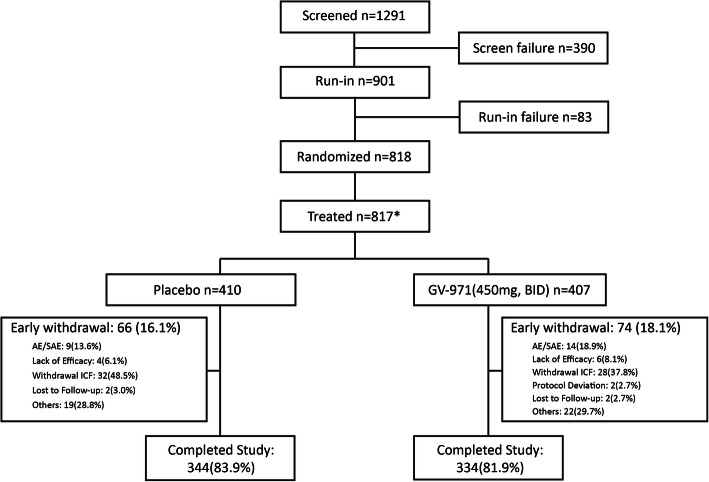
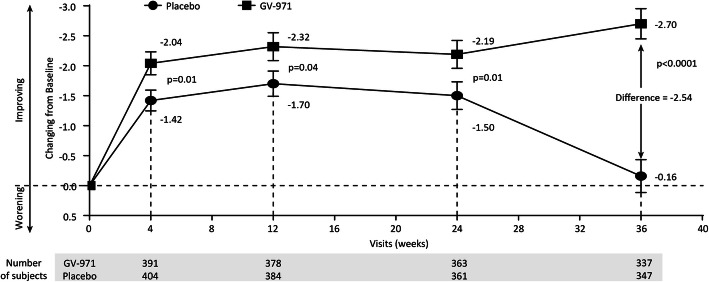
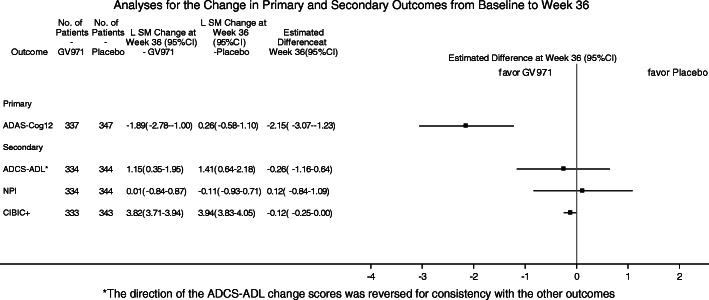
Background: New therapies are urgently needed for Alzheimer’s disease (AD). Sodium oligomannate (GV-971) is a marine-derived oligosaccharide with a novel proposed mechanism of action. The first phase 3 clinical trial of GV-971 has been completed in China. Methods: We conducted a phase 3, double-blind, placebo-controlled trial in participants with mild-to-moderate AD to assess GV-971 efficacy and safety. Participants were randomized to placebo or GV-971 (900 mg) for 36 weeks. The primary outcome was the drug-placebo difference in change from baseline on the 12-item cognitive subscale of the Alzheimer’s Disease Assessment Scale (ADAS-cog12). Secondary endpoints were drug-placebo differences on the Clinician’s Interview-Based Impression of Change with caregiver input (CIBIC+), Alzheimer’s Disease Cooperative Study-Activities of Daily Living (ADCS-ADL) scale, and Neuropsychiatric Inventory (NPI). Safety and tolerability were monitored. Results: A total of 818 participants were randomized: 408 to GV-971 and 410 to placebo. A significant drug-placebo difference on the ADAS-Cog12 favoring GV-971 was present at each measurement time point, measurable at the week 4 visit and continuing throughout the trial. The difference between the groups in change from baseline was − 2.15 points (95% confidence interval, − 3.07 to − 1.23; p < 0.0001; effect size 0.531) after 36 weeks of treatment. Treatment-emergent adverse event incidence was comparable between active treatment and placebo (73.9%, 75.4%). Two deaths determined to be unrelated to drug effects occurred in the GV-971 group. Conclusions: GV-971 demonstrated significant efficacy in improving cognition with sustained improvement across all observation periods of a 36-week trial. GV-971 was safe and well-tolerated. Trial registration: ClinicalTrials.gov, NCT0229391 5. Registered on November 19, 2014
Overview
The claims and statistics of this paper haven’t been checked yet.
Free: it reads the open-access text and checks the first 5 claims that cite a source we can check. Create a free account to check every claim.
Integrity signals
Registry
Cites
Statistics
Figures
Verification
Claims the paper makes
The claims and statistics of this paper haven’t been checked yet.
Free: it reads the open-access text and checks the first 5 claims that cite a source we can check. Create a free account to check every claim.
Claims other papers make about this one
Each is checked against this paper’s own text: does it say what the citing paper says it does?
The cited source says what the claim attributes to it.
In the citing paper
“New drugs, including sodium oligomannate (9, GV-971),54–56 aducanumab (1),57–59 lecanemab (2),60–62 and donanemab (10, currently under review for market approval),63 which aim to offer disease-modifying therapies that intervene in the progression of AD.”
From Recent advances in Alzheimer's disease: Mechanisms, clinical trials and new drug development strategies. (2024) · cites this paper as [56]
The cited source says what the claim attributes to it.
In the citing paper
“Sodium oligomannate (9, GV-971) was postulated to counteract AD by inhibiting neuroinflammation triggered by gut dysbiosis and disrupting the formation of Aβ fibrils.56,414”
From Recent advances in Alzheimer's disease: Mechanisms, clinical trials and new drug development strategies. (2024) · cites this paper as [56]
In the citing paper
“GV-971 has also been demonstrated to reverse cognitive deficits in patients with mild to moderate AD in the phase 2/3 clinical trial in China (NCT02293915) [262].”
From Tau and neuroinflammation in Alzheimer’s disease: interplay mechanisms and clinical translation (2023) · cites this paper as [262]
Self-check
Percentages, sums and reported differences re-computed from the paper’s own numbers.
The self-check needs the paper’s full text.
Citations
Cites
Folstein, M. F., Folstein, S. E., & McHugh, P. R. (1975) · Journal of Psychiatric Research · doi:10.1016/0022-3956(75)90026-6 · Cited by 88,282 · cited 17×
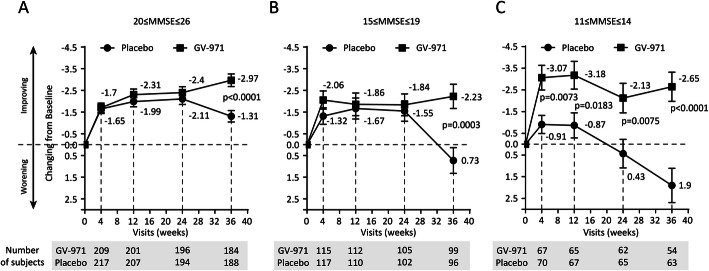
“In preplanned exploratory analyses, we assessed the treatment effect of GV-971 in participant groups of MMSE 11-14, 15-19, and 20-26 (Figure 4).”
BackgroundMethodInfluentialHamilton, M. (1960) · Journal of Neurology, Neurosurgery & Psychiatry · doi:10.1136/jnnp.23.1.56 · Cited by 32,817 · cited 1×
“A total Hachinski Ischemia Scale[20] score of ≤ 4 was required, and the Hamilton Hamilton Depression Scale 17[21] score had to be ≤ 10.”
MethodMcKhann, G., Drachman, D., Folstein, M., Katzman, R., Price, D., & Stadlan, E. M. (1984) · Neurology · doi:10.1212/wnl.34.7.939 · Cited by 27,915
Kok, J. S., Berg, I. J., & Scherder, E. J. A. (2013) · Dementia and Geriatric Cognitive Disorders Extra · doi:10.1159/000353441 · Cited by 20,589
Older Adults' Reasons for Using Technology while Aging in Place
Peek, S. T. M., Luijkx, K. G., Rijnaard, M. D., Nieboer, M. E., van der Voort, C. S., Aarts, S., van Hoof, J., Vrijhoef, H. J. M., & Wouters, E. J. M. (2016) · Gerontology · doi:10.1159/000430949 · Cited by 19,690
Sensitivity and False Alarm Rate of a Fall Sensor in Long-Term Fall Detection in the Elderly
Kangas, M., Korpelainen, R., Vikman, I., Nyberg, L., & Jämsä, T. (2015) · Gerontology · doi:10.1159/000362720 · Cited by 18,909
The Neuropsychiatric Inventory: Comprehensive assessment of psychopathology in dementia
Cummings, J. L., Mega, M., Gray, K., Rosenberg-Thompson, S., Carusi, D. A., & Gornbein, J. (1994) · Neurology · doi:10.1212/wnl.44.12.2308 · Cited by 7,568
Self-citationA new rating scale for Alzheimer's disease
(1984) · American Journal of Psychiatry · doi:10.1176/ajp.141.11.1356 · Cited by 4,175 · cited 1×
“The primary efficacy endpoint was the drug–placebo difference in the change from baseline on the ADASCog12 (score range, 0–75, with higher scores indicating greater cognitive impairment) at week 36 [29].”
Background. Cerebral blood flow in dementia.
Hachinski, V. C., Iliff, L. D., Zilhka, E., Du Boulay, G. H., McAllister, V. L., Marshall, J., Russell, R. W. R., & Symon, L. (1975) · Archives of Neurology · doi:10.1001/archneur.1975.00490510088009 · Cited by 3,186
Two Phase 3 Trials of Bapineuzumab in Mild-to-Moderate Alzheimer's Disease
Salloway, S., Sperling, R., Fox, N. C., Blennow, K., Klunk, W., Raskind, M., Sabbagh, M., Honig, L. S., Porsteinsson, A. P., Ferris, S., et al. (2014) · New England Journal of Medicine · doi:10.1056/nejmoa1304839 · Cited by 1,960 · cited 1×
“Although repeated failures of phase 3 clinical trials in the last decade have been reported[7, 8], much effort continues to be invested in developing treatments for this disease[9].”
Background
Research works printed but not linked: 1
- Reisberg B. FS: Clinician's interview-based impression of change-plus; in Kelly C, Newton-Howes G (eds): guide to assessment scales in dementia. London: Science Press; 1994.
Cited by
Items 201–226 of 226
Brain-gut communication and potential applications of microecological treatments in stroke
Gao, M., Zhou, Y., Zhang, K., Ye, Y., Han, Z., Chen, Q., Shi, W., & Lu, X. (2026) · Frontiers in Neuroscience · doi:10.3389/fnins.2026.1799890
“It is suggested that bile acids exert natural antibacterial activity through their “cleansing” capabilities via disruption of the cell membranes of bacteria (Xiao et al., 2021).”
Self-citationAChE inhibitors from marine resources
Kim, C. (2026) · Elsevier eBooks · doi:10.1016/b978-0-443-45844-6.00018-4
He, Z., Nie, Y., Li, C., Sun, G., Zheng, W., Liu, H., Geng, M., Tian, J., & Zhang, Y. (2026) · Marine Drugs · doi:10.3390/md24060189
“…III clinical trial (NCT02293915) has further demonstrated that GV-971, at a dose of 900 mg/day for up to 36 weeks, is safe and well tolerated in patients with AD [19], providing a solid rationale for the dosing regimen adopted in the present study and supporting its future translational potential.”
Self-citationNanoparticles that target nonamyloid and nontau pathways in Alzheimer’s disease
Alavian, F., & Hajimohammadi, A. (2026) · Discover Nano · doi:10.1186/s11671-026-04747-8 · Cited by 1
“…has been shown to suppress gut dysbiosis, reduce the peripheral accumulation of phenyl-alanine and isoleucine, inhibit neuroinflammation driven by Th1 cell infiltration and M1 microglial activation, and ultimately improve cognitive function in both transgenic AD models and human patients [169].”
Wu, Y., Di, Y., Wang, H. W., Wang, L., Zhang, J., Zhang, Y., & Lyu, D. (2026) · Ageing Research Reviews · doi:10.1016/j.arr.2026.103216
Self-citationPal, T., Mukherjee, S., Karati, D., Pahari, N., Hossain, C. M., & Naskar, S. (2026) · BENTHAM SCIENCE PUBLISHERS eBooks · doi:10.2174/9798898815646126010017
Systematic review of cellular senescence as a therapeutic target in Alzheimer’s disease
Lopez-Samayoa, D. M., Rodríguez, K. C. M., Rubio, L. M. S., Morales, D. A. M., Reyes, T. M. R., Montano, N. D. V., Serrato, Á. R. M., & Méndez‐Domínguez, N. (2026) · European journal of medical research · doi:10.1186/s40001-026-04718-w
“…demonstrated that selective elimination of p16INK4a-positive senescent cells reduces tau pathology, attenuates neuroinflammation, and preserves cognitive function, while senolytics have shown safety in human trials for other age-related conditions, establishing a translational precedent [42–44].”
Manzine, P. R., Carrasco, M., Fernandes, T. A. A., Alves, S. S., Guzman, L., Driouech, L., Millet, M., Cairasco, N. G., Olloquequi, J., Juan, M. E., et al. (2026) · Expert Opinion on Investigational Drugs · doi:10.1080/13543784.2026.2710112
“The primary outcome was the change in cognitive performance assessed by the ADAS-Cog12 scale, while secondary outcomes included CIBIC+, ADCS-ADL, and NPI scores [224].”
Peng, C., Chen, L., Wu, Z., Danzeng, C., & Cheng, X. (2026) · Metabolic Brain Disease · doi:10.1007/s11011-026-01946-1 · Cited by 1
“Its Phase 3 trial reported a modest cognitive benefit over 36 weeks (ADAS-Cog12 difference − 0.95, p = 0.002) that fell below the minimal clinically important difference of 1.5– 2.5 points, with no active comparator or long-term extension data (Xiao et al. 2021).”
InfluentialSelf-citationMuhammad, N., Ai, R., Yang, L., Cui, Y., Wang, L., Weng, S., Wang, Y., Kakar, M. U., Khan, S., Ahmad, S., et al. (2026) · Frontiers in Aging Neuroscience · doi:10.3389/fnagi.2026.1877358 · Cited by 2
Self-citationLi, Y., Li, W., Qin, H., Zhou, X., & Cui, Y. (2026) · Sustainability · doi:10.3390/su18168081
Self-citationSong, Z., Xie, Y., Zhu, H., Li, J., Yang, C., Guo, Y., Nong, X., Zhu, Z., Chen, Z., & Wang, Z. (2026) · Therapeutic Advances in Neurological Disorders · doi:10.1177/17562864261476868
“34,62,69 70–72 Tramiprosate, a small-molecule amino acid analog, may also trigger nausea and diarrhea by irritating the gastrointestinal mucosa or altering intestinal osmotic pressure.”
Parveen, N., Ansari, J. A., Singh, M., & Verma, V. (2026) · The Egyptian Journal of Neurology Psychiatry and Neurosurgery · doi:10.1186/s41983-026-01211-3
“Although conceptually promising, these agents face substantial challenges in demonstrating consistent clinical efficacy and acceptable safety profiles across diverse patient populations [81, 82].”
Metabolic shifts driven by host‐microbial interactions
Nair, T., Stuhr, N. L., Weathers, B. A., & Curran, S. P. (2026) · FEBS Journal · doi:10.1111/febs.70704
Targeting protein aggregate co-pathologies in neurodegeneration: a viable therapeutic strategy?
Buck, S. A., Madhavan, S. S., & Sanders, L. H. (2026) · Molecular Neurodegeneration Advances · doi:10.1186/s44477-026-00047-8
“GV-971 is approved in the People’s Republic of China for the treatment of AD, was found to be safe and tolerable in Phase 2 and Phase 3 and had significant improvements to cognition in Phase 3 [268, 269].”
Targeting the peripheral immune system for treatment of Alzheimer’s disease
Almasarani, E., Fog, M. H., Vorup‐Jensen, T., & Juul‐Madsen, K. (2026) · Molecular Neurodegeneration Advances · doi:10.1186/s44477-026-00054-9
Huang, D., Lu, R., Sheng, C., Zheng, J., Wang, Y., & Sang, Z. (2026) · Marine Drugs · doi:10.3390/md24100356
“Developed by Geng’s team at the Shanghai Institute of Materia Medica, Chinese Academy of Sciences, sodium oligomannate (GV-971, Jiuqi-1) (Figure 11A) is the world’s first anti-AD drug targeting the gut–brain axis [65].”
Self-citationResearch Advances and Perspectives on Gut Microbiota Regulating Alzheimer’s Disease
Zhu, F., & Shao, X. (2026) · Biology · doi:10.3390/biology15201893
“The phase-III trial was conducted only in China, and mechanistic observations from preclinical animal studies still await further https://doi.org/10.3390/biology15201893 corroboration in human cohorts [12,34].”
InfluentialSharma, R., Kumar, G., & Thakur, A. (2026) · Inflammopharmacology · doi:10.1007/s10787-026-02433-w
Poonam, Rana, R., Thakur, M., Sharma, A., Pannu, S., Sharma, S., Naman, S., Rani, S., Devi, D., Kumar, V., et al. (2026) · Frontiers in Oncology · doi:10.3389/fonc.2026.1908830
“Nevertheless, this gut microbiota – neuroin fl ammation axis remains a proposed mechanism and continues to be actively debated (151, 152).”
Zhang, D., Chu, H., Zhang, Y., Wang, Y., Zhang, Y., Guo, Y., Wan, P., Yue, H., Sun, G., Chao, Y., et al. (2026) · Gut · doi:10.1136/gutjnl-2026-339603
Self-citationLiu, X., Wang, S., Long, W., Tan, X., Li, W., & Gao, L. (2026) · Frontiers in Aging Neuroscience · doi:10.3389/fnagi.2026.1926883
Self-citationHuang, X., Zhang, X., & Qi, Z. (2026) · Frontiers in Microbiology · doi:10.3389/fmicb.2026.1828118
Self-citationLuo, Z., Manavis, J., Yu, W., & 孙宝飞 (2026) · Human Brain · doi:10.15302/hb.2026.0009
Metadata
- Authors
- Xiao, S., Chan, P., Wang, T., Hong, Z., Wang, S., Kuang, W., He, J., Pan, X., Zhou, Y., Ji, Y., Wang, L., Cheng, Y., Peng, Y., Ye, Q., Wang, X., Wu, Y., Qu, Q., Chen, S., Li, S., Chen, W., Xu, J., Peng, D., Zhao, Z., Li, Y., Zhang, J., Du, Y., Chen, W., Fan, D., Yan, Y., Liu, X., Zhang, W., Luo, B., Wu, W., Shen, L., Liu, C., Mao, P., Wang, Q., Zhao, Q., Guo, Q., Zhou, Y., Li, Y., Jiang, L., Ren, W., Ouyang, Y., Wang, Y., Liu, S., Jia, J., Zhang, N., Liu, Z., He, R., Feng, T., Lu, W., Tang, H., Gao, P., Zhang, Y., Chen, L., Wang, L., Yin, Y., Xu, Q., Xiao, J., Cong, L., Cheng, X., Zhang, H., Gao, D., Xia, M., Lian, T., Peng, G., Zhang, X., Jiao, B., Hu, H., Chen, X., Guan, Y., Cui, R., Huang, Q., Xin, X., Chen, H., Ding, Y., Zhang, J., Feng, T., Cantillon, M., Chen, K., Cummings, J. L., Ding, J., Geng, M., & Zhang, Z.
- Affiliations
- Shanghai Jiao Tong University (CN)
- Capital Medical University (CN)
- Fudan University (CN)
- Qilu Hospital of Shandong University (CN)
- West China Hospital of Sichuan University (CN)
- First Affiliated Hospital of Wenzhou Medical University (CN)
- Guangzhou First People's Hospital (CN)
- Nankai University (CN)
- Tianjin Medical University General Hospital (CN)
- Sun Yat-sen University (CN)
- Union Hospital (CN)
- First Affiliated Hospital of Xi'an Jiaotong University (CN)
- Beijing Hospital (CN)
- Sir Run Run Shaw Hospital (CN)
- Northern Jiangsu People's Hospital (CN)
- China-Japan Friendship Hospital (CN)
- Shanghai Changzheng Hospital (CN)
- Zhongnan Hospital of Wuhan University (CN)
- Shandong University (CN)
- Peking University Third Hospital (CN)
- The Affiliated Yongchuan Hospital of Chongqing Medical University (CN)
- First Affiliated Hospital Zhejiang University (CN)
- Tongji University (CN)
- Xiangya Hospital Central South University (CN)
- Peking Union Medical College Hospital (CN)
- Chinese PLA General Hospital (CN)
- Second Affiliated Hospital of Soochow University (CN)
- Banner Alzheimer’s Institute (US)
- University of Nevada, Las Vegas (US)
- Chinese Academy of Sciences (CN)
- Corresponding author
- Xiao, Shifu
- Geng, Meiyu
- Zhang, Zhenxin
- ORCID
- Xiao, Shifu
- Chan, Piu
- Wang, Tao
- Hong, Zhen
- Wang, Shuzhen
- Kuang, Weihong
- He, Jincai
- Pan, Xiaoping
- Zhou, Yuying
- Ji, Yong
- Cheng, Yan
- Peng, Ying
- Ye, Qinyong
- Wang, Xiaoping
- Qu, Qiumin
- Chen, Shengdi
- Chen, Wei
- Xu, Jun
- Peng, Dantao
- Li, Yansheng
- Zhang, Junjian
- Du, Yifeng
- Chen, Weixian
- Fan, Dongsheng
- Yan, Yong
- Liu, Xiaowei
- Zhang, Wei
- Luo, Benyan
- Wu, Wenyuan
- Wang, Qiumei
- Zhao, Qianhua
- Guo, Qihao
- Zhou, Yongtao
- Li, Yi
- Ren, Wenwei
- Ouyang, Yingjun
- Wang, Yan
- Liu, Shuai
- Jia, Jianjun
- Zhang, Nan
- Liu, Zhonglin
- Lu, Wenhui
- Tang, Huidong
- Gao, Ping
- Zhang, Yingchun
- Chen, Lanlan
- Wang, Lei
- Yin, You
- Xu, Qun
- Cong, Lin
- Cheng, Xi
- Zhang, Hui
- Gao, Dan
- Peng, Guoping
- Zhang, Xu
- Jiao, Bin
- Hu, Hua
- Chen, Xueyan
- Guan, Yihui
- Cui, Ruixue
- Huang, Qiu
- Ding, Yu
- Zhang, Jing
- Feng, Teng
- Chen, Kewei
- Cummings, Jeffrey L.
- Ding, Jian
- Geng, Meiyu
- Zhang, Zhenxin
- Venue
- Alzheimer's Research & Therapy
- Published
- 2021-03-17
- Volume
- 13
- Issue
- 1
- Pages
- 62-62
- ISSN
- 1758-9193 (ISSN-L)
- PMC
- PMC7967962
- OpenAlex
- W3159386017
- Cited by
- 224
- References
- 46
- Citations by year
- 2026: 41 · 2025: 32 · 2024: 39 · 2023: 48 · 2022: 39 · 2021: 25
- FWCI
- 23.93
- Type
- journal article
- Language
- en
- Open access
- gold
- doi.org
- Licence
- cc-by
- creativecommons.org/licenses/by/4.0/ (tdm)
- creativecommons.org/licenses/by/4.0/ (vor)
- Locations
- Alzheimer s Research & Therapy (publishedVersion, cc-by)
- Research Square (acceptedVersion, cc-by)
- PubMed Central (publishedVersion, cc-by)
- PubMed (publishedVersion)
- DOAJ (DOAJ: Directory of Open Access Journals) (submittedVersion, cc-by-sa)
- Funders
- National Science and Technology Major Project for Investigational New Drugs (2011ZX09101-003-01, 2015ZX09101003, 2018ZX09711002-015)
- Topics
- Life Sciences › Neuroscience › Cellular and Molecular Neuroscience › Alzheimer's disease research and treatments
- Health Sciences › Medicine › Psychiatry and Mental health › Dementia and Cognitive Impairment Research
- Health Sciences › Medicine › Pharmacology (medical) › Cholinesterase and Neurodegenerative Diseases
- Keywords
- Alzheimer's disease, mild to moderate dementia, cognitive function, activities of daily living, neuropsychiatric symptoms, drug safety and tolerability
- MeSH terms
- Activities of Daily Living, Alzheimer Disease, China, Cholinesterase Inhibitors, Double-Blind Method, Pharmaceutical Preparations, Humans, Mannose, Oligosaccharides, Sodium, Treatment Outcome
About these checks
Registry, retraction, Cites and statistics results are computed, not judged, with one exception: a printed reference that no index lists is read once by a model before it counts as a citation error. Claims are extracted by a model and kept only when their quote appears verbatim in the text; each cited source is then checked, with a model’s help, for whether it says what the claim relies on. Those verdicts can be wrong — read the claim’s quote and the cited source before relying on one.
Statistics and arithmetic are recomputed, not judged.
Confidence bands are shown only for fields calibrated on our annotated test set. None is calibrated yet, so no band is shown.
What counts as a claim ›How we measure confidence ›How we check this ›
Are you an author, or do you see a problem with this page? Request a review
Data sources
Bibliographic data: Semantic Scholar, OpenAlex, Crossref.
Contains information from the Semantic Scholar Academic Graph Datasets, made available under the ODC Attribution License (ODC-BY 1.0).
Semantic Scholar’s data is described in: Kinney, R., et al. (2023). The Semantic Scholar Open Data Platform. arXiv:2301.10140.
