

The bidirectional association between sleep problems and autism spectrum disorder: a population-based cohort study
Open accessThe DOI matches its Crossref record; 72 of the 72 references it cites were found in a registry or an index.
Abstract
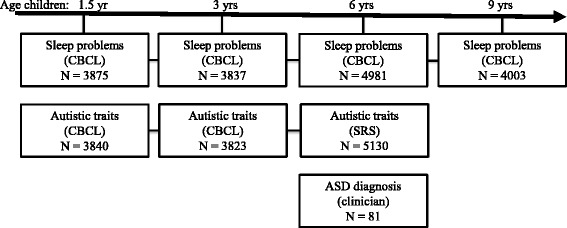
Background: Sleep difficulties are prevalent in children with autism spectrum disorder (ASD). The temporal nature of the association between sleep problems and ASD is unclear because longitudinal studies are lacking. Our aim is to clarify whether sleep problems precede and worsen autistic traits and ASD or occur as a consequence of the disorder. Methods: Repeated sleep measures were available at 1.5, 3, 6, and 9 years of age in 5151 children participating in the Generation R Study, a large prospective birth cohort in the Netherlands. Autistic traits were determined with the Pervasive Developmental Problems score (PDP) of the Child Behavior Checklist (CBCL) at 1.5 and 3 years and the Social Responsiveness Scale (SRS) at 6 years. This cohort included 81 children diagnosed with ASD. Results: Sleep problems in early childhood were prospectively associated with a higher SRS score, but not when correcting for baseline PDP score. By contrast, a higher SRS score and an ASD diagnosis were associated with more sleep problems at later ages, even when adjusting for baseline sleep problems. Likewise, a trajectory of increasing sleep problems was associated with ASD. Conclusions: Sleep problems and ASD are not bidirectionally associated. Sleep problems do not precede and worsen autistic behavior but rather co-occur with autistic traits in early childhood. Over time, children with ASD have an increase in sleep problems, whereas typically developing children have a decrease in sleep problems. Our findings suggest that sleep problems are part of the construct ASD.
Overview
The claims and statistics of this paper haven’t been checked yet.
Free: it reads the open-access text and checks the first 5 claims that cite a source we can check. Create a free account to check every claim.
Integrity signals
Registry
Cites
Statistics
Figures
Verification
Claims the paper makes
The claims and statistics of this paper haven’t been checked yet.
Free: it reads the open-access text and checks the first 5 claims that cite a source we can check. Create a free account to check every claim.
Claims other papers make about this one
Each is checked against this paper’s own text: does it say what the citing paper says it does?
The cited source says what the claim attributes to it.
In the citing paper
“Children with ASD frequently suffer from difficulties falling asleep or nightmares (85, 86).”
From Autism Spectrum Disorder in Children Is Not Associated With Abnormal Autonomic Nervous System Function: Hypothesis and Theory (2022) · cites this paper as [85]
Self-check
Percentages, sums and reported differences re-computed from the paper’s own numbers.
The self-check needs the paper’s full text.
Citations
Cites
1 retracted
Adams, H. L., Matson, J. L., Cervantes, P. E., & Goldin, R. L. (2014) · Research in Autism · doi:10.1016/j.rasd.2013.11.008 · Cited by 102 · cited 1×
“Thus, it is difficult to properly asses the course of sleep problems in children with ASD [28, 30, 31].”
BackgroundRetractedSimonoff, E., Pickles, A., Charman, T., Chandler, S., Loucas, T., & Baird, G. (2008) · Journal of the American Academy of Child & Adolescent Psychiatry · doi:10.1097/chi.0b013e318179964f · Cited by 3,399
An Introduction to Latent Class Growth Analysis and Growth Mixture Modeling
Jung, T., & Wickrama, K. A. S. (2008) · Social and Personality Psychology Compass · doi:10.1111/j.1751-9004.2007.00054.x · Cited by 3,181 · cited 1×
“Trajectories of sleep disturbance up to 6 years of age were defined using Latent Class Trajectory Models [46], as previously applied to this data in Generation R [47].”
MethodExecutive functions and developmental psychopathology.
Pennington, B. F., & Ozonoff, S. (1996) · Journal of Child Psychology and Psychiatry · doi:10.1111/j.1469-7610.1996.tb01380.x · Cited by 3,150
Social Jetlag: Misalignment of Biological and Social Time
Wittmann, M., Dinich, J., Merrow, M., & Roenneberg, T. (2006) · Chronobiology International · doi:10.1080/07420520500545979 · Cited by 2,625
Neurocognitive consequences of sleep deprivation
Goel, N., Rao, H., Durmer, J., & Dinges, D. (2009) · Seminars in Neurology · doi:10.1055/s-0029-1237117 · Cited by 2,154
Baird, G., Simonoff, E., Pickles, A., Chandler, S., Loucas, T., Meldrum, D., & Charman, T. (2006) · The Lancet · doi:10.1016/s0140-6736(06)69041-7 · Cited by 2,104
Structural Variation of Chromosomes in Autism Spectrum Disorder
Marshall, C. R., Noor, A., Vincent, J. B., Lionel, A. C., Feuk, L., Skaug, J., Shago, M., Moessner, R., Pinto, D., Ren, Y., et al. (2008) · The American Journal of Human Genetics · doi:10.1016/j.ajhg.2007.12.009 · Cited by 1,815
Constantino, J. N., Davis, S. A., Todd, R. D., Schindler, M. K., Gross, M. M., Brophy, S. L., Metzger, L. M., Shoushtari, C. S., Splinter, R., & Reich, W. (2003) · Journal of Autism and Developmental Disorders · doi:10.1023/a:1025014929212 · Cited by 1,611 · cited 1×
“The SRS provides a valid quantitative measure of subclinical and clinical autistic traits [41].”
BackgroundNeurocognitive Consequences of Sleep Deprivation
Durmer, J. S., & Dinges, D. F. (2005) · Seminars in Neurology · doi:10.1055/s-2005-867080 · Cited by 1,473
Research works printed but not linked: 2
- Verhulst FC, Van der Ende J. Handleiding ASEBA Vragenlijsten voor leeftijden 6 tot met 18 jaar. ASEBA Nederland: Rotterdam; 2013.
- Corbett B, Medoza SP, Levine S. Cortisol dysregulation in children with autism. Int J Neuropsychopharmacol. 2004;7:S298-S9.
Cited by
Items 101–146 of 146
Cunha, L., Paschalidis, M., Moysés‐Oliveira, M., Marquezini, B. P., Deconto, T. B., Guerreiro, P., Kloster, A. K., Mosini, A. C., Adami, L. N. G., Andersen, M. L., et al. (2023) · Sleep Medicine · doi:10.1016/j.sleep.2023.09.031 · Cited by 2
Miike, T., Toyoura, M., Oniki, K., Tonooka, S., & Tajima, S. (2023) · Springer eBooks · doi:10.1007/978-3-031-42383-3_10 · Cited by 3
Shuffrey, L. C., Rennie, B. J., Li, X., Galai, N., Pini, N., Akbaryan, A., Alshawabkeh, A. N., Aschner, J. L., Vargas, J. C., Costello, L., et al. (2024) · Pediatric Research · doi:10.1038/s41390-024-03306-0 · Cited by 2
“14,16 For example, Krakowiak and colleagues found that 53% of children (2 – 5 years of age) with ASD had experienced sleep problems at least once compared with 46% of children with non-ASD developmental delays and 32% of children without developmental concerns.”
Black, B. (2021) · Sleep · doi:10.1093/sleep/zsab178 · Cited by 2
Ezedinma, U., Burgess, S., Jones, E. B. G., Fjaagesund, S., Metse, A. P., Downer, T., & Oprescu, F. (2026) · Current Sleep Medicine Reports · doi:10.1007/s40675-026-00354-2 · Cited by 1
Zhang, B. (2020) · International Conference on Humanities Science and Society Development (ICHSSD) · doi:10.2991/assehr.k.200727.052 · Cited by 1
“Social difficulties associated with ASD may also play a critical role in the development of sleep problems [20,21].”
BackgroundCONSUMO DE CÁLCIO EM ESTUDANTES UNIVERSITÁRIOS COM INTOLERÂNCIA À LACTOSE
de Oliveira, L. S., Casaril, K. B. P. B., & Treco, F. R. (2022) · doi:10.22533/at.ed.5922224039 · Cited by 1
Sleep in Children with Neurodevelopmental Disorders
Richdale, A. L., Baker, E. K., & Sciberras, E. (2022) · Springer eBooks · doi:10.1007/978-981-19-5791-8_20 · Cited by 1
Genomic dissection of sleep archetypes in a large autism cohortPreprint
Brueggeman, L., Pottschmidt, N. R., Koomar, T., Thomas, T., & Michaelson, J. J. (2025) · medRxiv · doi:10.1101/2025.04.04.25325272 · Cited by 1
“It has been suggested that sleep problems in infancy precede autism development later in childhood [5], but other studies have found that sleep problems arise simultaneously with ASD and then are consistent or worse as the child grows older [6][2].”
Sleep Problems in Children With Autism Spectrum Disorder
Alba, L. A. (2020) · eScholarship (California Digital Library) · Cited by 1
Bedtime Studies: Sleep and Mental Health in Child Development
Koopman‐Verhoeff, M. E. (2020) · EUR Research Repository (Erasmus University Rotterdam)
POST COVID-19 ENCEPHALITIS PRESENTING WITH CEREBELLAR SYNDROME
Neto, A. S. D. A., da Nóbrega, A. W., Queiroz, L. P., Neto, Y. C., Leal, E. M., Vieira, G. D. D., Marquardt, M., Cavagnollo, M. T., Freitas, R. G., & de Oliveira, A. D. (2022) · doi:10.22533/at.ed.5922224031
ACOLHIMENTO DE REFUGIADOS: UM RELATO DE EXPERIÊNCIA
Scandiuzzi, S. D. M., & Sanfelice, F. A. N. (2022) · doi:10.22533/at.ed.5922224035
Sistema para Coleta de Dados Comportamentais de Pacientes com Transtorno do Espectro Autista
Chernicharo, L., Bezerra, E., & Henriques, F. D. R. (2022) · Anais de XXXV Simpósio Brasileiro de Telecomunicações e Processamento de Sinais · doi:10.14209/sbrt.2022.1570821412
Sex hormone receptor expression in children with autism spectrum disorderPreprint
Sun, R., Guo, P., Sun, T., Yu, H. Y., Liao, Y., Xie, J., Zeng, J., Xie, X., & Huang, S. (2023) · Research Square · doi:10.21203/rs.3.rs-2345028/v1
Nijhof, D., Melville, C. A., Rydzewska, E., Meehan, L., & Gardani, M. (2024) · Research Square · doi:10.21203/rs.3.rs-3934649/v1
Nijhof, D., Melville, C. A., Rydzewska, E., Pavlopoulou, G., Meehan, L., & Gardani, M. (2024) · Research Square · doi:10.21203/rs.3.rs-3934649/v2
Grigg-Damberger, M. M., & Wolfe, K. M. (2024) · Elsevier eBooks · doi:10.1016/b978-0-323-82759-1.00019-9
النمري, ن., صالح, ع. ع., & الشهراني, م. ب. م. (2024) · Mağallaẗ Al-Buḥūṯ Al-Tarbawiyyaẗ wa Al-Nawʿiyyaẗ · doi:10.21608/jeor.2024.386249
Lord, J. S., Gay, S. M., Harper, K. M., Nikolova, V. D., Smith, K. M., Moy, S. S., & Diering, G. H. (2022) · Figshare · doi:10.6084/m9.figshare.20727811
Lord, J. S., Gay, S. M., Harper, K. M., Nikolova, V. D., Smith, K. M., Moy, S. S., & Diering, G. H. (2022) · Figshare · doi:10.6084/m9.figshare.20727817
Mechanisms underpinning sleep problems and links to mental ill health in autism
Zahir, R. (2025) · ERA · doi:10.7488/era/6059 · Cited by 1
Lord, J. S., Gay, S. M., Harper, K. M., Nikolova, V. D., Smith, K. M., Moy, S. S., & Diering, G. H. (2022) · Figshare · doi:10.6084/m9.figshare.20727814
Lord, J. S., Gay, S. M., Harper, K. M., Nikolova, V. D., Smith, K. M., Moy, S. S., & Diering, G. H. (2022) · Figshare · doi:10.6084/m9.figshare.20727808
O’Hora, K., Lin, A., Kushan, L., & Bearden, C. E. (2022) · Figshare · doi:10.6084/m9.figshare.20295732
Sleep and Sensory Processing in Infants at Elevated and Typical Likelihood for Autism
Laet, A. D. (2024) · UEA Digital Repository (University of East Anglia)
de Courville, M. (2024) · Archipel (Université du Québec à Montréal)
Kucharová, P. (2021) · Jyväskylä University Digital Archive (University of Jyväskylä)
The interplay between sleep, cognition, and copy number variations in Autism Spectrum Disorder (ASD)
Tesfaye, R. (2023) · eScholarship@McGill (McGill) · doi:10.82308/27967
Sound asleep: sensory decoupling during sleep depends on an infant’s sensory profile
Laet, A. D., Whitworth, M., Fincham, H., Lázár, A. S., Bedford, R., & Gliga, T. (2026) · SLEEP · doi:10.1093/sleep/zsag010
Zahir, R., Moody, S. C., Morales‐Muñoz, I., Murray, A. L., Fletcher‐Watson, S., Kwong, A. S. F., & Smith, D. J. (2026) · medRxiv · doi:10.64898/2026.03.10.26348028
自閉スペクトラム症児の睡眠問題に対する養育者の認識と対応 ―児童発達支援専門職者へのインタビュー調査から―
Takei, Y., 池内, 由., 水子, 学., & 岡野, 維. (2024) · Kawasaki University of Medical Welfare Institutional Repository (Kawasaki University of Medical Welfare) · doi:10.15112/0002000201
Applying multidimensional approaches to disentangle autism spectrum disorder heterogeneity
Mihailov, A. (2021) · theses.fr (ABES) · doi:10.70675/b9bfc6a7za998z4d56z9380z5ec7781bc4ac · Cited by 1
Wyse, C., de Vasconcelos, M., Phyo, A. M., Nordon, E. A., & Lopez, L. M. (2026) · medRxiv · doi:10.64898/2026.06.20.26356092
Çocukluk Çağında Otizm Spektrum Bozukluğu: Multidisipliner Yaklaşım
Kırık, S., Sargın, F., Ferahkaya, H., Güven, A. S., ŞAHİN, M., Demirci, E., Şener, E. F., Oney, C., Yıldız, E. P., Yılmaz, E. A., et al. (2026) · Akademisyen Kitabevi eBooks · doi:10.37609/akya.3934
Sleep in Young Children With Autism, ADHD and Combined Presentations
Kurz, E., Bölte, S., & Falck‐Ytter, T. (2026) · Autism Research · doi:10.1002/aur.70326
“…et al. 2018) and 2–17 years (Sadikova et al. 2023), respectively, found that baseline sleep problems did not affect later autism symptom/ trait expression but baseline autism phenotypic expression was associated with more sleep problems later on (Sadikova et al. 2023; Verhoeff et al. 2018).”
InfluentialWei, W., Zhang, J., & Wang, H. (2026) · JCPP Advances · doi:10.1002/jcv2.70155
“For social functioning and autistic traits, early sleep problems and infant sleep quality have been associated with later autism spectrum disorder (ASD) related outcomes (Kikuchi et al., 2023; Verhoeff et al., 2018).”
Chang, C.-S., & Lin, C.-J. (2026) · Autism · doi:10.1177/13623613261477806
“Descriptive and bivariate analyses were conducted in the full analytic sample to characterize patterns of sleep–wake regularity across sociodemographic and psychosocial factors previously identified in the literature (Verhoeff et al., 2018; Wenzell et al., 2025).”
Behavioral interventions for sleep problems in autistic children: A systematic review
Mazurek, M. O., Smith, J. V., Kiernan, B., Howard, M., Baker, E., Pappagianopoulos, J. E., Menezes, M., & Ballif, S. (2026) · Sleep Medicine · doi:10.1016/j.sleep.2026.109242
Wu, Y., Wu, D., Zhong, W., & Ma, J. (2026) · ALPHA PSYCHIATRY · doi:10.31083/ap52264
“In contrast, earlier autistic traits appear to predict later sleep problems more consistently [38,39].”
Gohary, M. M., Reda, E., Saleh, S. H. A., Ismail, M. M. M., Awad, M. T., & Amer, M. (2024) · Cuestiones de Fisioterapia · doi:10.48047/m235ax39
Breil, F., Rappaport, C., Virlet, L., Quercia, P., & Rosikon, A. (2026) · Neuropsychiatrie de l Enfance et de l Adolescence · doi:10.1016/j.neurenf.2026.09.006
Ajanya, A. K., Malhotra, S., Arya, A. K., & Deb, D. (2026) · Indian Journal of Psychological Medicine · doi:10.1177/02537176261491880
Adamou, M., & Petrou, C. (2026) · Frontiers in Psychiatry · doi:10.3389/fpsyt.2026.1969750
Metadata
- Authors
- Verhoeff, M. E., Blanken, L. M. E., Kocevska, D., Mileva-Seitz, V. R., Jaddoe, V. W. V., White, T., Verhulst, F., Luijk, M. P. C. M., & Tiemeier, H.
- Affiliations
- Erasmus MC (NL)
- Corresponding author
- Tiemeier, Henning
- ORCID
- Venue
- Molecular Autism
- Published
- 2018-01-30
- Volume
- 9
- Issue
- 1
- Pages
- 8-8
- ISSN
- 2040-2392 (ISSN-L)
- PMC
- PMC5791216
- OpenAlex
- W2788020653
- Cited by
- 126
- References
- 72
- Citations by year
- 2026: 10 · 2025: 7 · 2024: 15 · 2023: 15 · 2022: 31 · 2021: 17 · 2020: 11 · 2019: 17 · 2018: 2
- FWCI
- 7.00
- Type
- journal article
- Language
- en
- Open access
- gold
- doi.org
- Licence
- cc-by
- Locations
- Molecular Autism (publishedVersion, cc-by)
- PubMed Central (publishedVersion, cc-by)
- PubMed (publishedVersion)
- EUR Research Repository (Erasmus University Rotterdam) (acceptedVersion, other-oa)
- EUR Research Repository (Erasmus University Rotterdam) (submittedVersion, other-oa)
- RePub (Erasmus University Rotterdam) (submittedVersion, other-oa)
- DOAJ (DOAJ: Directory of Open Access Journals) (submittedVersion, cc-by-sa)
- Funders
- Nederlandse Organisatie voor Wetenschappelijk Onderzoek (016.VICI.170.200)
- Erasmus Medisch Centrum (Mrace)
- European Commission (2013-2548/001-001-EMA-2)
- Simons Foundation (SFARI - 307280)
- Topics
- Life Sciences › Neuroscience › Cognitive Neuroscience › Autism Spectrum Disorder Research
- Social Sciences › Psychology › Experimental and Cognitive Psychology › Sleep and related disorders
- Health Sciences › Medicine › Psychiatry and Mental health › Child Nutrition and Feeding Issues
- Keywords
- autism spectrum disorder, sleep disorders, bidirectional relationship, autistic traits, social responsiveness, early childhood, sleep trajectories, temporal association, Generation R Study
- MeSH terms
- Autism Spectrum Disorder, Child, Child, Preschool, Female, Humans, Infant, Male, Sleep Wake Disorders, Cohort Studies
About these checks
Registry, retraction, Cites and statistics results are computed, not judged, with one exception: a printed reference that no index lists is read once by a model before it counts as a citation error. Claims are extracted by a model and kept only when their quote appears verbatim in the text; each cited source is then checked, with a model’s help, for whether it says what the claim relies on. Those verdicts can be wrong — read the claim’s quote and the cited source before relying on one.
Statistics and arithmetic are recomputed, not judged.
Confidence bands are shown only for fields calibrated on our annotated test set. None is calibrated yet, so no band is shown.
What counts as a claim ›How we measure confidence ›How we check this ›
Are you an author, or do you see a problem with this page? Request a review
Data sources
Bibliographic data: Semantic Scholar, OpenAlex, Crossref.
Contains information from the Semantic Scholar Academic Graph Datasets, made available under the ODC Attribution License (ODC-BY 1.0).
Semantic Scholar’s data is described in: Kinney, R., et al. (2023). The Semantic Scholar Open Data Platform. arXiv:2301.10140.
