

The bidirectional association between sleep problems and autism spectrum disorder: a population-based cohort study
Open accessThe DOI matches its Crossref record; 72 of the 72 references it cites were found in a registry or an index.
Abstract
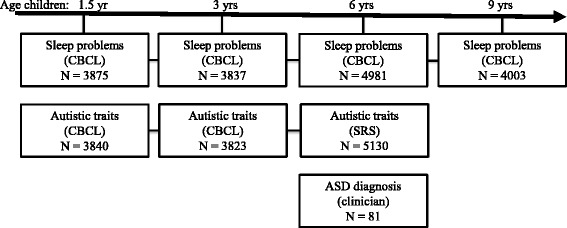
Background: Sleep difficulties are prevalent in children with autism spectrum disorder (ASD). The temporal nature of the association between sleep problems and ASD is unclear because longitudinal studies are lacking. Our aim is to clarify whether sleep problems precede and worsen autistic traits and ASD or occur as a consequence of the disorder. Methods: Repeated sleep measures were available at 1.5, 3, 6, and 9 years of age in 5151 children participating in the Generation R Study, a large prospective birth cohort in the Netherlands. Autistic traits were determined with the Pervasive Developmental Problems score (PDP) of the Child Behavior Checklist (CBCL) at 1.5 and 3 years and the Social Responsiveness Scale (SRS) at 6 years. This cohort included 81 children diagnosed with ASD. Results: Sleep problems in early childhood were prospectively associated with a higher SRS score, but not when correcting for baseline PDP score. By contrast, a higher SRS score and an ASD diagnosis were associated with more sleep problems at later ages, even when adjusting for baseline sleep problems. Likewise, a trajectory of increasing sleep problems was associated with ASD. Conclusions: Sleep problems and ASD are not bidirectionally associated. Sleep problems do not precede and worsen autistic behavior but rather co-occur with autistic traits in early childhood. Over time, children with ASD have an increase in sleep problems, whereas typically developing children have a decrease in sleep problems. Our findings suggest that sleep problems are part of the construct ASD.
Overview
The claims and statistics of this paper haven’t been checked yet.
Free: it reads the open-access text and checks the first 5 claims that cite a source we can check. Create a free account to check every claim.
Integrity signals
Registry
Cites
Statistics
Figures
Verification
Claims the paper makes
The claims and statistics of this paper haven’t been checked yet.
Free: it reads the open-access text and checks the first 5 claims that cite a source we can check. Create a free account to check every claim.
Claims other papers make about this one
Each is checked against this paper’s own text: does it say what the citing paper says it does?
The cited source says what the claim attributes to it.
In the citing paper
“Children with ASD frequently suffer from difficulties falling asleep or nightmares (85, 86).”
From Autism Spectrum Disorder in Children Is Not Associated With Abnormal Autonomic Nervous System Function: Hypothesis and Theory (2022) · cites this paper as [85]
Self-check
Percentages, sums and reported differences re-computed from the paper’s own numbers.
The self-check needs the paper’s full text.
Citations
Cites
1 retracted
Adams, H. L., Matson, J. L., Cervantes, P. E., & Goldin, R. L. (2014) · Research in Autism · doi:10.1016/j.rasd.2013.11.008 · Cited by 102 · cited 1×
“Thus, it is difficult to properly asses the course of sleep problems in children with ASD [28, 30, 31].”
BackgroundRetractedSimonoff, E., Pickles, A., Charman, T., Chandler, S., Loucas, T., & Baird, G. (2008) · Journal of the American Academy of Child & Adolescent Psychiatry · doi:10.1097/chi.0b013e318179964f · Cited by 3,399
An Introduction to Latent Class Growth Analysis and Growth Mixture Modeling
Jung, T., & Wickrama, K. A. S. (2008) · Social and Personality Psychology Compass · doi:10.1111/j.1751-9004.2007.00054.x · Cited by 3,181 · cited 1×
“Trajectories of sleep disturbance up to 6 years of age were defined using Latent Class Trajectory Models [46], as previously applied to this data in Generation R [47].”
MethodExecutive functions and developmental psychopathology.
Pennington, B. F., & Ozonoff, S. (1996) · Journal of Child Psychology and Psychiatry · doi:10.1111/j.1469-7610.1996.tb01380.x · Cited by 3,150
Social Jetlag: Misalignment of Biological and Social Time
Wittmann, M., Dinich, J., Merrow, M., & Roenneberg, T. (2006) · Chronobiology International · doi:10.1080/07420520500545979 · Cited by 2,625
Neurocognitive consequences of sleep deprivation
Goel, N., Rao, H., Durmer, J., & Dinges, D. (2009) · Seminars in Neurology · doi:10.1055/s-0029-1237117 · Cited by 2,154
Baird, G., Simonoff, E., Pickles, A., Chandler, S., Loucas, T., Meldrum, D., & Charman, T. (2006) · The Lancet · doi:10.1016/s0140-6736(06)69041-7 · Cited by 2,104
Structural Variation of Chromosomes in Autism Spectrum Disorder
Marshall, C. R., Noor, A., Vincent, J. B., Lionel, A. C., Feuk, L., Skaug, J., Shago, M., Moessner, R., Pinto, D., Ren, Y., et al. (2008) · The American Journal of Human Genetics · doi:10.1016/j.ajhg.2007.12.009 · Cited by 1,815
Constantino, J. N., Davis, S. A., Todd, R. D., Schindler, M. K., Gross, M. M., Brophy, S. L., Metzger, L. M., Shoushtari, C. S., Splinter, R., & Reich, W. (2003) · Journal of Autism and Developmental Disorders · doi:10.1023/a:1025014929212 · Cited by 1,611 · cited 1×
“The SRS provides a valid quantitative measure of subclinical and clinical autistic traits [41].”
BackgroundNeurocognitive Consequences of Sleep Deprivation
Durmer, J. S., & Dinges, D. F. (2005) · Seminars in Neurology · doi:10.1055/s-2005-867080 · Cited by 1,473
Executive dysfunction in autism☆
Hill, E. L. (2004) · Trends in Cognitive Sciences · doi:10.1016/j.tics.2003.11.003 · Cited by 1,468
Autism screening questionnaire: diagnostic validity
Berument, S. K., Rutter, M., Lord, C., Pickles, A., & Bailey, A. (1999) · British Journal of Psychiatry · doi:10.1192/bjp.175.5.444 · Cited by 1,464 · cited 1×
“5–5 total score or those in the top 2nd percentile on the PDP subscale, were screened with the Social Communication Questionnaire (SCQ), a 40item parent-reported screening instrument for ASD [42].”
MethodAutism genome-wide copy number variation reveals ubiquitin and neuronal genes
Glessner, J. T., Wang, K., Cai, G., Korvatska, O., Kim, C. E., Wood, S., Zhang, H., Estes, A., Brune, C. W., Bradfield, J. P., et al. (2009) · Nature · doi:10.1038/nature07953 · Cited by 1,421
Achenbach, T. M., & Ruffle, T. M. (2000) · Pediatrics in Review · doi:10.1542/pir.21-8-265 · Cited by 1,285 · cited 1×
“Children’s sleep problems were quantified using the Sleep Problem Scale, which is a pre-defined Problem Scale of the Child Behavior Checklist (CBCL), a reliable and valid measure for behavioral problems [33, 34].”
MethodThe Epidemiology of Autism Spectrum Disorders
Newschaffer, C. J., Croen, L. A., Daniels, J., Giarelli, E., Grether, J. K., Levy, S. E., Mandell, D. S., Miller, L. A., Pinto-Martin, J., Reaven, J., et al. (2007) · Annual Review of Public Health · doi:10.1146/annurev.publhealth.28.021406.144007 · Cited by 1,228
The Generation R Study: design and cohort update 2017
Kooijman, M. N., Kruithof, C. J., van Duijn, C. M., Duijts, L., Franco, O. H., van IJzendoorn, M. H., de Jongste, J. C., Klaver, C. C. W., van der Lugt, A., Mackenbach, J. P., et al. (2016) · European Journal of Epidemiology · doi:10.1007/s10654-016-0224-9 · Cited by 1,214 · cited 1×
“This study was embedded in Generation R, a prospective population-based cohort from fetal life onward [32].”
MethodSelf-citationThe Generation R Study: design and cohort update 2010
Jaddoe, V. W. V., van Duijn, C. M., van der Heijden, A. J., Mackenbach, J. P., Moll, H. A., Steegers, E. A. P., Tiemeier, H., Uitterlinden, A. G., Verhulst, F. C., & Hofman, A. (2010) · European Journal of Epidemiology · doi:10.1007/s10654-010-9516-7 · Cited by 1,027
Self-citationDerogatis, L. R. (2011) · PsycTESTS Dataset · doi:10.1037/t00789-000 · Cited by 852
Behavioral treatment of bedtime problems and night wakings in infants and young children
(2006) · Sleep · doi:10.1093/sleep/29.10.1263 · Cited by 849
The genetics of autism spectrum disorders and related neuropsychiatric disorders in childhood
Lichtenstein, P., Carlström, E., Råstam, M., Gillberg, C., & Anckarsäter, H. (2010) · American Journal of Psychiatry · doi:10.1176/appi.ajp.2010.10020223 · Cited by 738
Richdale, A. L., & Schreck, K. A. (2009) · Sleep Medicine Reviews · doi:10.1016/j.smrv.2009.02.003 · Cited by 708 · cited 4×
“Among those, sleep problems, defined as difficulties falling asleep or nightmares, are common [10] occurring in 40–80% of cases across all ages [11–17] in comparison to 25–50% in normally developing children [16, 18, 19].”
BackgroundInfluentialEhlers, C. L. (1988) · Archives of General Psychiatry · doi:10.1001/archpsyc.1988.01800340076012 · Cited by 707
Wolff, J. J., Gu, H., Gerig, G., Elison, J. T., Styner, M., Gouttard, S., Botteron, K. N., Dager, S. R., Dawson, G., Estes, A. M., et al. (2012) · American Journal of Psychiatry · doi:10.1176/appi.ajp.2011.11091447 · Cited by 671
GREGORY, A. M., & O'CONNOR, T. G. (2002) · Journal of the American Academy of Child & Adolescent Psychiatry · doi:10.1097/00004583-200208000-00015 · Cited by 631
Heritability of Autism Spectrum Disorder in a UK Population-Based Twin Sample
Colvert, E., Tick, B., McEwen, F., Stewart, C., Curran, S. R., Woodhouse, E., Gillan, N., Hallett, V., Lietz, S., Garnett, T., et al. (2015) · JAMA Psychiatry · doi:10.1001/jamapsychiatry.2014.3028 · Cited by 560
Margari, L., Craig, F., Margari, F., Legrottaglie, A., Palumbi, R., & De Giambattista, C. (2016) · Neuropsychiatric Disease and Treatment · doi:10.2147/ndt.s104620 · Cited by 557
Sleep in adolescence: Physiology, cognition and mental health
Tarokh, L., Saletin, J. M., & Carskadon, M. A. (2016) · Neuroscience & Biobehavioral Reviews · doi:10.1016/j.neubiorev.2016.08.008 · Cited by 552
Genetic architecture in autism spectrum disorder
Devlin, B., & Scherer, S. W. (2012) · Current Opinion in Genetics & Development · doi:10.1016/j.gde.2012.03.002 · Cited by 545
Early Identification of Autism Spectrum Disorder: Recommendations for Practice and Research
Zwaigenbaum, L., Bauman, M. L., Stone, W. L., Yirmiya, N., Estes, A., Hansen, R. L., McPartland, J. C., Natowicz, M. R., Choueiri, R., Fein, D., et al. (2015) · Pediatrics · doi:10.1542/peds.2014-3667c · Cited by 487
Sleep Problems in Early Childhood: Continuities, Predictive Factors, and Behavioral Correlates
Zuckerman, B., Stevenson, J., & Bailey, V. (1987) · Pediatrics · doi:10.1542/peds.80.5.664 · Cited by 472 · cited 3×
“Risk factors or correlates of early childhood sleep problems are, for example, maternal psychopathology, parenting practices, child temperament, difficulties setting bedtime, and feeding patterns [19, 24, 25].”
BackgroundSleep problems as possible predictors of intensified symptoms of autism*1
SCHRECK, K. (2004) · Research in Developmental Disabilities · doi:10.1016/j.ridd.2003.04.007 · Cited by 418 · cited 3×
“Autistic traits and ASD were associated with more sleep problems in accordance with previous studies [28, 49, 50].”
BackgroundResultThe relationship between sleep and behavior in autism spectrum disorder (ASD): a review
Cohen, S., Conduit, R., Lockley, S. W., Rajaratnam, S. M., & Cornish, K. M. (2014) · Journal of Neurodevelopmental Disorders · doi:10.1186/1866-1955-6-44 · Cited by 389 · cited 4×
“Our finding that sleep problems are associated with more autistic traits is in line with previous studies [21, 28, 31].”
BackgroundResultInfluentialSleep Disturbances and Correlates of Children with Autism Spectrum Disorders
Liu, X., Hubbard, J. A., Fabes, R. A., & Adam, J. B. (2006) · Child Psychiatry and Human Development · doi:10.1007/s10578-006-0028-3 · Cited by 358
Sleep in children with autistic spectrum disorder
Cortesi, F., Giannotti, F., Ivanenko, A., & Johnson, K. (2010) · Sleep Medicine · doi:10.1016/j.sleep.2010.01.010 · Cited by 355
Dyssomnias and Parasomnias in Early Childhood
Petit, D., Touchette, E., Tremblay, R. E., Boivin, M., & Montplaisir, J. (2007) · Pediatrics · doi:10.1542/peds.2006-2132 · Cited by 355
Sleep problems in autism: prevalence, cause, and intervention
Richdale, A. L. (1999) · Developmental Medicine & Child Neurology · doi:10.1017/s0012162299000122 · Cited by 346
Sleep problems in children with autism
Gail Williams, P., Sears, L. L., & Allard, A. (2004) · Journal of Sleep Research · doi:10.1111/j.1365-2869.2004.00405.x · Cited by 335
A nightly bedtime routine: impact on sleep in young children and maternal mood
Mindell, J. A., Telofski, L. S., Wiegand, B., & Kurtz, E. S. (2009) · Sleep · doi:10.1093/sleep/32.5.599 · Cited by 328
Parental sleep concerns in autism spectrum disorders: Variations from childhood to adolescence
Goldman, S. E., Richdale, A. L., Clemons, T., & Malow, B. A. (2012) · Journal of Autism and Developmental Disorders · doi:10.1007/s10803-011-1270-5 · Cited by 304
An investigation into sleep characteristics of children with autism and Asperger’s Disorder
PATZOLD, L., RICHDALE, A., & TONGE, B. (1998) · Journal of Paediatrics and Child Health · doi:10.1046/j.1440-1754.1998.00291.x · Cited by 288 · cited 1×
“Among those, sleep problems, defined as difficulties falling asleep or nightmares, are common [10] occurring in 40–80% of cases across all ages [11–17] in comparison to 25–50% in normally developing children [16, 18, 19].”
BackgroundThe sleep/wake rhythm in children with autism
Richdale, A. L., & Prior, M. R. (1995) · European Child & Adolescent Psychiatry · doi:10.1007/bf01980456 · Cited by 283 · cited 1×
“Another mechanism could be that social problems associated with ASD may worsen the day-night rhythm in these children [14] and play a crucial role in the development of sleep problems.”
BackgroundGoldman, S. E., McGrew, S., Johnson, K. P., Richdale, A. L., Clemons, T., & Malow, B. A. (2011) · Research in Autism Spectrum Disorders · doi:10.1016/j.rasd.2011.01.010 · Cited by 281 · cited 1×
“walking, sleep talking, and nightmares), whereas older children mainly exhibit insomnia symptoms (defined as the difficulty falling asleep or staying asleep) [16, 20].”
BackgroundIvanova, M. Y., Achenbach, T. M., Rescorla, L. A., Harder, V. S., Ang, R. P., Bilenberg, N., Bjarnadottir, G., Capron, C., De Pauw, S. S. W., Dias, P., et al. (2010) · Journal of the American Academy of Child & Adolescent Psychiatry · doi:10.1016/j.jaac.2010.08.019 · Cited by 278 · cited 1×
“The CBCL is widely used internationally and has been found to be generalizable across 23 societies [35].”
BackgroundSelf-citationA survey of sleep problems in autism, Asperger's disorder and typically developing children
Polimeni, M. A., Richdale, A. L., & Francis, A. J. P. (2005) · Journal of Intellectual Disability Research · doi:10.1111/j.1365-2788.2005.00642.x · Cited by 278 · cited 1×
“Sleep problems are common in early childhood with prevalence estimates of up to 50% [18]; prevalence decline in typically developing children but not in children with ASD [23].”
BackgroundGregory, A. M., & Sadeh, A. (2016) · Journal of Child Psychology and Psychiatry · doi:10.1111/jcpp.12469 · Cited by 259 · cited 1×
“Sleep problems in young children are relatively common and can be considered part of normative development in the general population [26, 51].”
BackgroundThe definition and prevalence of autism: A review
Wing, L. (1993) · European Child & Adolescent Psychiatry · doi:10.1007/bf02098832 · Cited by 255 · cited 1×
“These trajectories are a further indication that the longitudinal course of sleep problems is a symptom and consequence of ASD, rather than worsen ASD symptomatology [9].”
BackgroundFactors Associated With Fragmented Sleep at Night Across Early Childhood
Touchette, É., Petit, D., Paquet, J., Boivin, M., Japel, C., Tremblay, R. E., & Montplaisir, J. Y. (2005) · Archives of Pediatrics & Adolescent Medicine · doi:10.1001/archpedi.159.3.242 · Cited by 238 · cited 2×
“Risk factors or correlates of early childhood sleep problems are, for example, maternal psychopathology, parenting practices, child temperament, difficulties setting bedtime, and feeding patterns [19, 24, 25].”
BackgroundUse of Multiple Imputation in the Epidemiologic Literature
Klebanoff, M. A., & Cole, S. R. (2008) · American Journal of Epidemiology · doi:10.1093/aje/kwn071 · Cited by 237 · cited 1×
“Ten imputed datasets were created and analyzed separately after which the results were pooled [48].”
MethodVariables related to sleep problems in children with autism
Mayes, S. D., & Calhoun, S. L. (2009) · Research in Autism Spectrum Disorders · doi:10.1016/j.rasd.2009.04.002 · Cited by 229 · cited 1×
“Autistic traits and ASD were associated with more sleep problems in accordance with previous studies [28, 49, 50].”
ResultBehavioral sleep problems and their potential impact on developing executive function in children
Turnbull, K., Reid, G. J., & Morton, J. B. (2013) · Sleep · doi:10.5665/sleep.2814 · Cited by 218
Gregory, A. M., Van der Ende, J., Willis, T. A., & Verhulst, F. C. (2008) · Archives of Pediatrics & Adolescent Medicine · doi:10.1001/archpedi.162.4.330 · Cited by 207
Self-citationChildren With Autism: Sleep Problems and Symptom Severity
Tudor, M. E., Hoffman, C. D., & Sweeney, D. P. (2012) · Focus on Autism and Other Developmental Disabilities · doi:10.1177/1088357612457989 · Cited by 199 · cited 2×
“Our finding that sleep problems are associated with more autistic traits is in line with previous studies [21, 28, 31].”
ResultSleep patterns in children with autistic spectrum disorders: a prospective cohort study
Humphreys, J. S., Gringras, P., Blair, P. S., Scott, N., Henderson, J., Fleming, P. J., & Emond, A. M. (2014) · Archives of Disease in Childhood · doi:10.1136/archdischild-2013-304083 · Cited by 197 · cited 2×
“A British cohort study showed that children with and without ASD have similar sleep durations in infancy, but from 30 months onwards, their sleep is characterized by a shorter duration than typically developing children [26].”
BackgroundBolton, P. F., Golding, J., Emond, A., & Steer, C. D. (2012) · Journal of the American Academy of Child & Adolescent Psychiatry · doi:10.1016/j.jaac.2011.12.009 · Cited by 193 · cited 1×
“Although measuring autistic traits in the general population in younger children is not very reliable [73], mostly retrospective studies documented that many children who develop ASD will have had symptoms prior to age 1.”
BackgroundSleep problems in children with autism spectrum problems: a longitudinal population-based study
Sivertsen, B., Posserud, M.-B., Gillberg, C., Lundervold, A. J., & Hysing, M. (2012) · Autism · doi:10.1177/1362361311404255 · Cited by 184 · cited 1×
“Another study showed that children with autistic traits developed more sleep problems in pre-adolescence [27].”
BackgroundSleep Patterns of School-Age Children with Asperger Syndrome or High-Functioning Autism
Allik, H., Larsson, J.-O., & Smedje, H. (2006) · Journal of Autism and Developmental Disorders · doi:10.1007/s10803-006-0099-9 · Cited by 179 · cited 1×
“Autistic traits and ASD were associated with more sleep problems in accordance with previous studies [28, 49, 50].”
ResultCircadian rhythms and sleep in children with autism
Glickman, G. (2010) · Neuroscience & Biobehavioral Reviews · doi:10.1016/j.neubiorev.2009.11.017 · Cited by 171 · cited 2×
“Children with ASD have difficulty to adequately respond to the social zeitgebers and therefore struggle to develop a healthy sleep pattern [56].”
BackgroundShort Nighttime Sleep-Duration and Hyperactivity Trajectories in Early Childhood
Touchette, E., Côté, S. M., Petit, D., Liu, X., Boivin, M., Falissard, B., Tremblay, R. E., & Montplaisir, J. Y. (2009) · Pediatrics · doi:10.1542/peds.2008-2005 · Cited by 144 · cited 1×
“The following variables were considered possible confounders in the association between sleep problems and autistic traits and ASD [24, 43].”
BackgroundSleep’s effects on cognition and learning in adolescence
Carskadon, M. A. (2011) · Progress in brain research · doi:10.1016/b978-0-444-53817-8.00008-6 · Cited by 131 · cited 1×
“However, mothers are known to be reliable reporters of children’s sleep at younger ages [72].”
BackgroundTordjman, S., Anderson, G. M., Bellissant, E., Botbol, M., Charbuy, H., Camus, F., Graignic, R., Kermarrec, S., Fougerou, C., Cohen, D., et al. (2012) · Psychoneuroendocrinology · doi:10.1016/j.psyneuen.2012.04.013 · Cited by 129 · cited 1×
“Some studies point to underlying deficits in endogenous melatonin secretion [52], others to alterations in hypothalamic-pituitary adrenal-axis function and cortisol secretion [53, 54], alterations in neurodevelopmental pathways [55], and some to polygenetic variations in circadian rhythm and clock genes related to ASD…”
BackgroundAssessment and treatment of common pediatric sleep disorders.
Moturi, S., & Avis, K. T. (2010) · PubMed Central · Cited by 126
Sleep Problems Across Development: A Pathway to Adolescent Risk Taking Through Working Memory
Thomas, A. G., Monahan, K. C., Lukowski, A. F., & Cauffman, E. (2015) · Journal of Youth and Adolescence · doi:10.1007/s10964-014-0179-7 · Cited by 116 · cited 1×
“This sleep problem scale has previously been used in the same format as a measure of sleep problems [40].”
MethodPsychiatric comorbidities in autism spectrum disorders: findings from a Danish Historic Birth Cohort
Abdallah, M. W., Greaves-Lord, K., Grove, J., Nørgaard-Pedersen, B., Hougaard, D. M., & Mortensen, E. L. (2011) · European Child & Adolescent Psychiatry · doi:10.1007/s00787-011-0220-2 · Cited by 108
Baker, E., Richdale, A., Short, M., & Gradisar, M. (2013) · Developmental Neurorehabilitation · doi:10.3109/17518423.2013.765518 · Cited by 95
Jansen, P. W., Saridjan, N. S., Hofman, A., Jaddoe, V. W. V., Verhulst, F. C., & Tiemeier, H. (2011) · Psychosomatic Medicine · doi:10.1097/psy.0b013e31820a4abb · Cited by 91
Self-citationSleep Problems in Children with Developmental Disorders
Wiggs, L. (2001) · Journal of the Royal Society of Medicine · doi:10.1177/014107680109400406 · Cited by 86
(2016) · Sleep · doi:10.1093/sleep/zsw022 · Cited by 84
Self-citationExploring Behavioral Sleep Problems in Children With ADHD and Comorbid Autism Spectrum Disorder
Thomas, S., Lycett, K., Papadopoulos, N. V., Sciberras, E., & Rinehart, N. (2015) · Journal of Attention Disorders · doi:10.1177/1087054715613439 · Cited by 53
Tomarken, A. J., Han, G. T., & Corbett, B. A. (2015) · Psychoneuroendocrinology · doi:10.1016/j.psyneuen.2015.08.016 · Cited by 50 · cited 1×
“Some studies point to underlying deficits in endogenous melatonin secretion [52], others to alterations in hypothalamic-pituitary adrenal-axis function and cortisol secretion [53, 54], alterations in neurodevelopmental pathways [55], and some to polygenetic variations in circadian rhythm and clock genes related to ASD…”
BackgroundEarly Childhood Sleep Patterns and Cognitive Development at Age 6 Years: The Generation R Study
Kocevska, D., Rijlaarsdam, J., Ghassabian, A., Jaddoe, V. W., Franco, O. H., Verhulst, F. C., & Tiemeier, H. (2016) · Journal of Pediatric Psychology · doi:10.1093/jpepsy/jsv168 · Cited by 44
Self-citationKohyama, J. (2016) · Medical Hypotheses · doi:10.1016/j.mehy.2016.11.001 · Cited by 25 · cited 1×
“Some studies point to underlying deficits in endogenous melatonin secretion [52], others to alterations in hypothalamic-pituitary adrenal-axis function and cortisol secretion [53, 54], alterations in neurodevelopmental pathways [55], and some to polygenetic variations in circadian rhythm and clock genes related to ASD…”
BackgroundFrom Attention to Interaction: The Emergence of Autism During Infancy
Hutman, T. (2013) · Biological Psychiatry · doi:10.1016/j.biopsych.2013.05.018 · Cited by 8
Research works printed but not linked: 2
- Verhulst FC, Van der Ende J. Handleiding ASEBA Vragenlijsten voor leeftijden 6 tot met 18 jaar. ASEBA Nederland: Rotterdam; 2013.
- Corbett B, Medoza SP, Levine S. Cortisol dysregulation in children with autism. Int J Neuropsychopharmacol. 2004;7:S298-S9.
Cited by
Carmassi, C., Palagini, L., Caruso, D., Masci, I., Nobili, L., Vita, A., & Dell’Osso, L. (2019) · Frontiers in Psychiatry · doi:10.3389/fpsyt.2019.00366 · Cited by 220
Gastrointestinal Symptoms in Autism Spectrum Disorder: A Systematic Review
Leader, G., Abberton, C., Cunningham, S., Gilmartin, K., Grudzien, M., Higgins, E., Joshi, L., Whelan, S., & Mannion, A. (2022) · Nutrients · doi:10.3390/nu14071471 · Cited by 156
“However, the relationship between ASD and sleep problems is unclear as there is a lack of longitudinal studies on this topic [75].”
BackgroundGao, X., Meng, L.-X., Ma, K.-L., Liang, J., Wang, H., Gao, Q., & Wang, T. (2019) · European Psychiatry · doi:10.1016/j.eurpsy.2019.05.004 · Cited by 94
Shank3 modulates sleep and expression of circadian transcription factors
Ingiosi, A. M., Schoch, H., Wintler, T., Singletary, K. G., Righelli, D., Roser, L. G., Medina, E., Risso, D., Frank, M. G., & Peixoto, L. (2019) · eLife · doi:10.7554/elife.42819 · Cited by 95
Otterman, D. L., Koopman‐Verhoeff, M. E., White, T. J. H., Tiemeier, H. W., Bolhuis, K., & Jansen, P. W. (2019) · Child and Adolescent Psychiatry and Mental Health · doi:10.1186/s13034-019-0299-7 · Cited by 91
Self-citation
Metadata
- Authors
- Verhoeff, M. E., Blanken, L. M. E., Kocevska, D., Mileva-Seitz, V. R., Jaddoe, V. W. V., White, T., Verhulst, F., Luijk, M. P. C. M., & Tiemeier, H.
- Affiliations
- Erasmus MC (NL)
- Corresponding author
- Tiemeier, Henning
- ORCID
- Venue
- Molecular Autism
- Published
- 2018-01-30
- Volume
- 9
- Issue
- 1
- Pages
- 8-8
- ISSN
- 2040-2392 (ISSN-L)
- PMC
- PMC5791216
- OpenAlex
- W2788020653
- Cited by
- 126
- References
- 72
- Citations by year
- 2026: 10 · 2025: 7 · 2024: 15 · 2023: 15 · 2022: 31 · 2021: 17 · 2020: 11 · 2019: 17 · 2018: 2
- FWCI
- 7.00
- Type
- journal article
- Language
- en
- Open access
- gold
- doi.org
- Licence
- cc-by
- Locations
- Molecular Autism (publishedVersion, cc-by)
- PubMed Central (publishedVersion, cc-by)
- PubMed (publishedVersion)
- EUR Research Repository (Erasmus University Rotterdam) (acceptedVersion, other-oa)
- EUR Research Repository (Erasmus University Rotterdam) (submittedVersion, other-oa)
- RePub (Erasmus University Rotterdam) (submittedVersion, other-oa)
- DOAJ (DOAJ: Directory of Open Access Journals) (submittedVersion, cc-by-sa)
- Funders
- Nederlandse Organisatie voor Wetenschappelijk Onderzoek (016.VICI.170.200)
- Erasmus Medisch Centrum (Mrace)
- European Commission (2013-2548/001-001-EMA-2)
- Simons Foundation (SFARI - 307280)
- Topics
- Life Sciences › Neuroscience › Cognitive Neuroscience › Autism Spectrum Disorder Research
- Social Sciences › Psychology › Experimental and Cognitive Psychology › Sleep and related disorders
- Health Sciences › Medicine › Psychiatry and Mental health › Child Nutrition and Feeding Issues
- Keywords
- autism spectrum disorder, sleep disorders, bidirectional relationship, autistic traits, social responsiveness, early childhood, sleep trajectories, temporal association, Generation R Study
- MeSH terms
- Autism Spectrum Disorder, Child, Child, Preschool, Female, Humans, Infant, Male, Sleep Wake Disorders, Cohort Studies
About these checks
Registry, retraction, Cites and statistics results are computed, not judged, with one exception: a printed reference that no index lists is read once by a model before it counts as a citation error. Claims are extracted by a model and kept only when their quote appears verbatim in the text; each cited source is then checked, with a model’s help, for whether it says what the claim relies on. Those verdicts can be wrong — read the claim’s quote and the cited source before relying on one.
Statistics and arithmetic are recomputed, not judged.
Confidence bands are shown only for fields calibrated on our annotated test set. None is calibrated yet, so no band is shown.
What counts as a claim ›How we measure confidence ›How we check this ›
Are you an author, or do you see a problem with this page? Request a review
Data sources
Bibliographic data: Semantic Scholar, OpenAlex, Crossref.
Contains information from the Semantic Scholar Academic Graph Datasets, made available under the ODC Attribution License (ODC-BY 1.0).
Semantic Scholar’s data is described in: Kinney, R., et al. (2023). The Semantic Scholar Open Data Platform. arXiv:2301.10140.
