

Physical health of autistic girls and women: a scoping review
Open accessPublished version of a preprint
The DOI matches its Crossref record; 97 of the 98 references it cites were found in a registry or an index.
Abstract
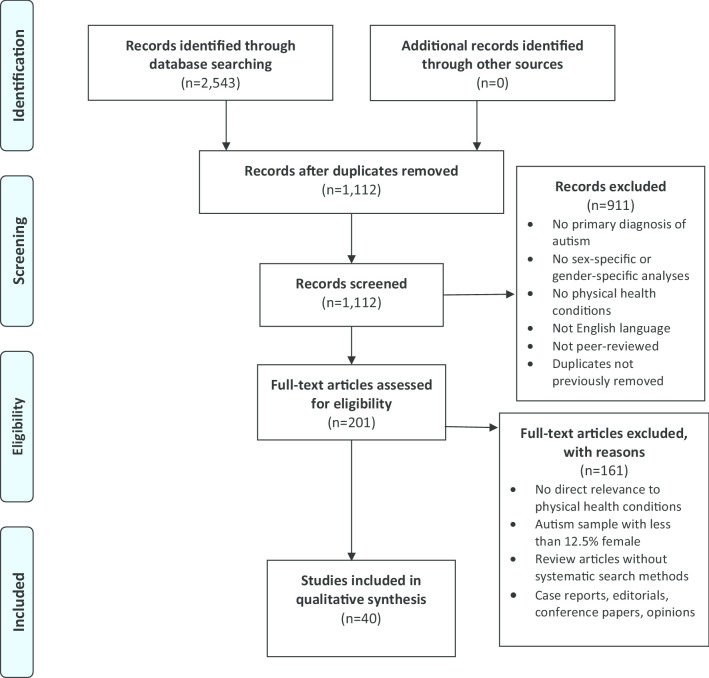
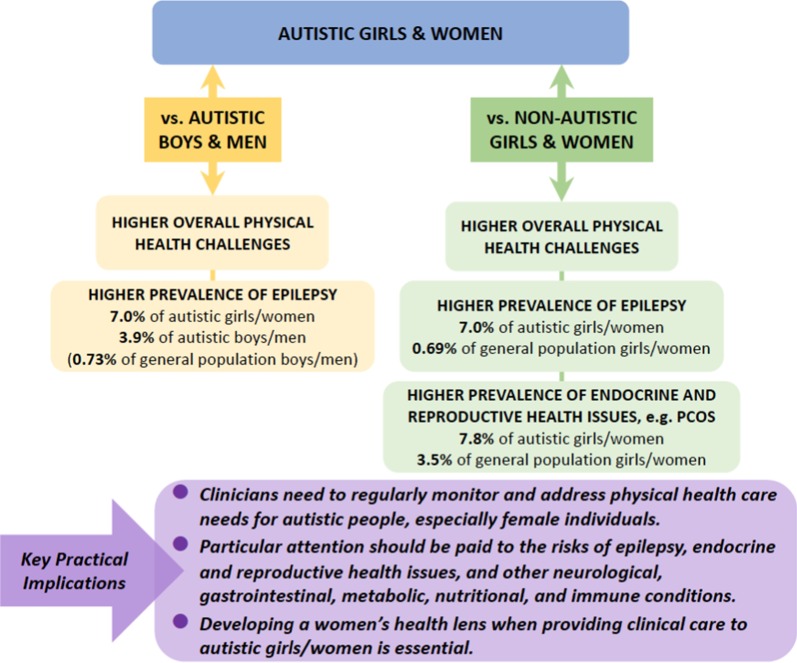
Background: There is a growing recognition of sex and gender influences in autism. Increasingly, studies include comparisons between sexes or genders, but few have focused on clarifying the characteristics of autistic girls’/women’s physical health. Methods: A scoping review was conducted to determine what is currently known about the physical health of autistic girls/women. We screened 1112 unique articles, with 40 studies meeting the inclusion criteria. We used a convergent iterative process to synthesize this content into broad thematic areas. Results: Autistic girls/women experience more overall physical health challenges compared to non-autistic girls/women and to autistic boys/men. Emerging evidence suggests increased prevalence of epilepsy in autistic girls/women compared to non-autistic girls/women and to autistic boys/men. The literature also suggests increased endocrine and reproductive health conditions in autistic girls/women compared to non-autistic girls/women. Findings regarding gastrointestinal, metabolic, nutritional, and immune-related conditions are preliminary and inconsistent. Limitations: The literature has substantial heterogeneity in how physical health conditions were assessed and reported. Further, our explicit focus on physical health may have constrained the ability to examine interactions between mental and physical health. The widely differing research aims and methodologies make it difficult to reach definitive conclusions. Nevertheless, in keeping with the goals of a scoping review, we were able to identify key themes to guide future research. Conclusions: The emerging literature suggests that autistic girls/women have heightened rates of physical health challenges compared to non-autistic girls/women and to autistic boys/men. Clinicians should seek to provide holistic care that includes a focus on physical health and develop a women’s health lens when providing clinical care to autistic girls/women.
Overview
The claims and statistics of this paper haven’t been checked yet.
Free: it reads the open-access text and checks the first 5 claims that cite a source we can check. Create a free account to check every claim.
Integrity signals
Registry
Cites
Statistics
Figures
Verification
Claims the paper makes
The claims and statistics of this paper haven’t been checked yet.
Free: it reads the open-access text and checks the first 5 claims that cite a source we can check. Create a free account to check every claim.
Claims other papers make about this one
Each is checked against this paper’s own text: does it say what the citing paper says it does?
The source backs part of the claim, not all of it — or backs it for a different population, condition or comparison.
In the citing paper
“Co-occurrence of neurodevelopmental conditions with psychiatric and medical conditions is high74–79.”
From Sex and gender in neurodevelopmental conditions (2023) · cites this paper as [79]
Experimental — accuracy not yet measuredIn the citing paper
“In terms of health conditions, autistic females are more likely to have epilepsy and endocrine–reproductive problems79,125, depressive disorders78, and disordered eating and sleep126–128, whereas autistic males are more likely to exhibit hyperactivity in childhood124.”
From Sex and gender in neurodevelopmental conditions (2023) · cites this paper as [79]
Self-check
Percentages, sums and reported differences re-computed from the paper’s own numbers.
The self-check needs the paper’s full text.
Citations
Cites
Preferred Reporting Items for Systematic Reviews and Meta-Analyses: the PRISMA statement
Moher, D., Liberati, A., Tetzlaff, J., Altman, D. G., & for the PRISMA Group (2009) · BMJ · doi:10.1136/bmj.b2535 · Cited by 83,823
Preferred Reporting Items for Systematic Reviews and Meta-Analyses: The PRISMA Statement
Moher, D., Liberati, A., Tetzlaff, J., Altman, D. G., & The PRISMA Group (2009) · PLoS Medicine · doi:10.1371/journal.pmed.1000097 · Cited by 64,042 · cited 1×
“We systematically searched the following databases according to PRISMA standards [17]:”
Preferred reporting items for systematic reviews and meta-analyses: the PRISMA Statement.
(2009) · PubMed Central · Cited by 44,859
PRISMA Extension for Scoping Reviews (PRISMA-ScR): Checklist and Explanation
Tricco, A. C., Lillie, E., Zarin, W., O'Brien, K. K., Colquhoun, H., Levac, D., Moher, D., Peters, M. D. J., Horsley, T., Weeks, L., et al. (2018) · Annals of Internal Medicine · doi:10.7326/m18-0850 · Cited by 43,565
Preferred reporting items for systematic reviews and meta-analyses: The PRISMA statement
Moher, D., Liberati, A., Tetzlaff, J., Altman, D. G., & the PRISMA Group* (2009) · Annals of Internal Medicine · doi:10.7326/0003-4819-151-4-200908180-00135 · Cited by 37,554
Scoping studies: towards a methodological framework
Arksey, H., & O'Malley, L. (2005) · International Journal of Social Research Methodology · doi:10.1080/1364557032000119616 · Cited by 36,742 · cited 4×
“Arksey H, O’Malley L. Scoping studies: towards a methodological frame‑ work.”
BackgroundInfluentialWhat Is the Male-to-Female Ratio in Autism Spectrum Disorder? A Systematic Review and Meta-Analysis
Loomes, R., Hull, L., & Mandy, W. P. L. (2017) · Journal of the American Academy of Child & Adolescent Psychiatry · doi:10.1016/j.jaac.2017.03.013 · Cited by 2,804
Lai, M.-C., Lombardo, M. V., & Baron-Cohen, S. (2014) · The Lancet · doi:10.1016/s0140-6736(13)61539-1 · Cited by 2,371
Self-citationSatterstrom, F. K., Kosmicki, J. A., Wang, J., Breen, M. S., De Rubeis, S., An, J.-Y., Peng, M., Collins, R., Grove, J., Klei, L., et al. (2020) · Cell · doi:10.1016/j.cell.2019.12.036 · Cited by 2,321 · cited 1×
“At a group level, autistic girls/women tend to carry more de novo protein-truncating genetic variants likely causal to autism compared to autistic boys/men [67].”
BackgroundPrevalence and incidence of epilepsy: A systematic review and meta-analysis of international studies
Fiest, K. M., Sauro, K. M., Wiebe, S., Patten, S. B., Kwon, C.-S., Dykeman, J., Pringsheim, T., Lorenzetti, D. L., & Jetté, N. (2017) · Neurology · doi:10.1212/wnl.0000000000003509 · Cited by 1,902
Cited by
Sex and gender in neurodevelopmental conditions
Bölte, S., Neufeld, J., Marschik, P. B., Williams, Z. J., Gallagher, L., & Lai, M.-C. (2023) · Nature Reviews Neurology · doi:10.1038/s41582-023-00774-6 · Cited by 249
Self-citationA capabilities approach to understanding and supporting autistic adulthood
Pellicano, E., Fatima, U., Hall, G., Heyworth, M., Lawson, W., Lilley, R., Mahony, J., & Stears, M. (2022) · Nature Reviews Psychology · doi:10.1038/s44159-022-00099-z · Cited by 237
Mental health challenges faced by autistic people
Lai, M. (2023) · Nature Human Behaviour · doi:10.1038/s41562-023-01718-2 · Cited by 100
“This pattern is more prominent in those assigned female than male at birth 257,258 , particularly for endocrinological and metabolic problems 258,259 .”
BackgroundSelf-citationLai, M.-C., Lin, H.-Y., & Ameis, S. H. (2022) · Current Opinion in Psychiatry · doi:10.1097/yco.0000000000000770 · Cited by 86
Self-citationOchoa‐Lubinoff, C., Makol, B. A., & Dillon, E. F. (2023) · Neurologic Clinics · doi:10.1016/j.ncl.2022.10.006 · Cited by 75
Lai, M., Amestoy, A., Bishop, S. L., Brown, H. M., Onaiwu, M. G., Halladay, A. K., Harrop, C., Hotez, E., Huerta, M., Kelly, A. M., et al. (2023) · The Lancet Child & Adolescent Health · doi:10.1016/s2352-4642(23)00221-3 · Cited by 64
Self-citationCurrent and lifetime somatic symptom burden among transition‐aged autistic young adults
Williams, Z. J., & Gotham, K. O. (2022) · Autism Research · doi:10.1002/aur.2671 · Cited by 57
Mo, K., Sadoway, T., Bonato, S., Ameis, S. H., Anagnostou, E., Lerch, J. P., Taylor, M. J., & Lai, M.-C. (2021) · NeuroImage: Clinical · doi:10.1016/j.nicl.2021.102811 · Cited by 53
Self-citationGrove, R., Clapham, H., Moodie, T., Gurrin, S., & Hall, G. (2023) · Women s Health · doi:10.1177/17455057231189542 · Cited by 49
Grove, R., Clapham, H., Moodie, T., Gurrin, S., & Hall, G. (2024) · Journal of Autism and Developmental Disorders · doi:10.1007/s10803-024-06330-5 · Cited by 38
“Autistic girls and women experience higher rates of mental and physi - cal health conditions (Kassee et al., 2020 ; Tint et al., 2023), sexual violence (Cazalis et al., 2022) and have specific sex - ual and reproductive health needs (Graham Holmes et al., 2022).”
Dubreucq, J., Coutelle, R., Lajnef, M., Godin, O., Amestoy, A., Atzori, P., Baleyte, J., Bonnot, O., Bouvard, M. P., Coulon, N., et al. (2022) · Psychological Medicine · doi:10.1017/s0033291722002902 · Cited by 38
“This pattern of outcome concurs with previous findings (Hull et al., 2020; Kassee et al., 2020; Kõlves, Fitzgerald, Nordentoft, Wood, & Erlangsen, 2021; Weir et al., 2021).”
Weiner, L., Costache, M. E., Bemmouna, D., Rabot, J., Weibel, S., Dubreucq, M., Dubreucq, J., & Coutelle, R. (2023) · Women s Health · doi:10.1177/17455057231174763 · Cited by 37
Special considerations for assessing and caring for autism in girls and women
Rynkiewicz, A., Zheng, S., & Lacroix, A. (2023) · Current Opinion in Psychiatry · doi:10.1097/yco.0000000000000913 · Cited by 33
Tint, A., Brown, H. K., Chen, S. D. M., Lai, M., Tarasoff, L. A., Vigod, S. N., Parish, S. L., Havercamp, S. M., & Lunsky, Y. (2021) · Autism · doi:10.1177/1362361320982819 · Cited by 30
“primary care physicians, obstetricians, and gynecologists) of the care needs of their autistic patients (Kassee et al., 2020).”
BackgroundInfluentialSelf-citationPremature mortality in a population‐based cohort of autistic adults in Canada
Lunsky, Y., Lai, M., Balogh, R., Chung, H., Durbin, A., Jachyra, P., Tint, A., Weiss, J., & Lin, E. (2022) · Autism Research · doi:10.1002/aur.2741 · Cited by 26
“Given the increasing recognition of sex- and genderdifferential health burden in autistic people (Kassee et al., 2020) and individuals with developmental disabilities more broadly (O’Leary et al., 2018), sex-stratified analysis is important in mortality research (Robertson et al., 2020).”
Self-citationAutistic and transgender/gender diverse people’s experiences of health and healthcare
Green, K., Weir, E. M., Wright, L., Allison, C. L., & Baron‐Cohen, S. (2025) · Molecular Autism · doi:10.1186/s13229-024-00634-0 · Cited by 28
Tint, A., Chung, H., Lai, M., Balogh, R. S., Lin, E. H. B., Durbin, A., & Lunsky, Y. (2023) · Autism · doi:10.1177/13623613221144353 · Cited by 25
“…pronounced for certain physical health (e.g. epilepsy, diabetes, stroke, endocrinological conditions) and psychiatric conditions (e.g. psychotic disorders, obsessive-compulsive disorder, depressive disorders; Kassee et al., 2020; Simantov et al., 2021; Smith DaWalt et al., 2021; Tint et al., 2021).”
BackgroundSelf-citationDubreucq, M., & Dubreucq, J. (2021) · Frontiers in Psychiatry · doi:10.3389/fpsyt.2021.630029 · Cited by 22
Williams, Z. J., Cascio, C. J., & Woynaroski, T. G. (2022) · Autism · doi:10.1177/13623613221085364 · Cited by 23
“…current study, but we suspect that known group differences in both physical and mental health conditions (DaWalt et al., 2021; Grant et al., 2022; Kassee et al., 2020; Lai et al., 2019; Murphy et al., 2020; Simantov et al., 2022; Strauss et al., 2021; Weir, Allison, & Baron-Cohen, 2021; Weir,…”
BackgroundMiot, S., Chancel, R., Périés, M., Crepiat, S., Couderc, S., Pernon, É., Picot, M., Gonnier, V., Jeandel, C., Blain, H., et al. (2022) · Autism · doi:10.1177/13623613221121623 · Cited by 19
“Moreover, autistic women have more chronic health conditions than autistic men and women from general population, primarily due to endocrine disorders (Kassee et al., 2020), of which prevalence was significantly higher in our third cluster.”
BackgroundMoseley, R. L., Marsden, S. J. E., Allison, C. L., Parsons, T. A., Cassidy, S., Procyshyn, T. L., Pelton, M., Weir, E. M., Chikaura, T., Mosse, D., et al. (2026) · Autism in Adulthood · doi:10.1177/25739581251371393 · Cited by 14
Does the M-Chat-R Give Important Information for the Diagnosis of the Autism Spectrum Disorder?
Pop-Jordanova, N. D., & Zorčec, T. (2021) · PRILOZI · doi:10.2478/prilozi-2021-0005 · Cited by 14
The Autism Intervention Research Network on Physical Health Autistic Researcher Review Board
Brown, H. M., Dwyer, P. S. R., Gassner, D. L., Onaiwu, M. G., Kapp, S. K., Ne'eman, A., Ryan, J. G., Waisman, T., & Williams, Z. J. (2022) · PEDIATRICS · doi:10.1542/peds.2020-049437f · Cited by 12
Self-citationGrzeszak, A., & Pisula, E. (2025) · Frontiers in Psychiatry · doi:10.3389/fpsyt.2025.1578963 · Cited by 11
“Additionally, evidence suggests that autistic females experience poorer physical health (18).”
Lacroix, A., Tzang, C.-C., Yu, J., Jacob, B. K., Alexandrovsky, M., Winge-Breen, A., Rodak, T., & Lai, M. (2025) · Frontiers in Neuroendocrinology · doi:10.1016/j.yfrne.2025.101229 · Cited by 11
Self-citationMaternal Autistic Traits and Adverse Birth Outcomes
Hosozawa, M., Cable, N., Ikehara, S., Aochi, Y., Tanigawa, K., Baba, S., Hirokawa, K., Kimura, T., Sobue, T., Iso, H., et al. (2024) · JAMA Network Open · doi:10.1001/jamanetworkopen.2023.52809 · Cited by 10
The healthcare experiences of middle and older age autistic women in the United Kingdom
Gillions, A., O’Nions, E., Mansour, H., Hoare, S., Mandy, W., & Stott, J. C. H. (2025) · Autism · doi:10.1177/13623613251362265 · Cited by 9
“Additionally, for adult women with multiple chronic physical health conditions and ongoing mental health difficulties, services could consider screening for autism as part of routine healthcare (Kassee et al., 2020).”
Association Between Neighborhood Support and Family Resilience in Households with Autistic Children
Menezes, M., Soland, J., & Mazurek, M. O. (2023) · Journal of Autism and Developmental Disorders · doi:10.1007/s10803-023-05951-6 · Cited by 9
Dangmann, R. (2023) · Medical Hypotheses · doi:10.1016/j.mehy.2023.111136 · Cited by 6
Petreca, V. G., Barros, J. T., & Harding, S. (2025) · Journal of the American Psychiatric Nurses Association · doi:10.1177/10783903251404481 · Cited by 3
“For example, it is now well established that autism may manifest more subtly in women, gender-diverse individuals, and people of color, leading to patterns of underrecognition and misdiagnosis (Kassee et al., 2020; Lai et al., 2015; Russell et al., 2020).”
TRANSTORNO DO ESPECTRO AUTISTA: RELATO DE CASO FEMININO
David, R. S. (2024) · Revista Eletrônica Multidisciplinar de Investigação Científica · doi:10.56166/remici.2023.5.v2n4.2.34 · Cited by 7
Barón-Mendoza, I., Martínez‐Marcial, M., García‐Juárez, M., Mejía-Hernández, M., Cortés-Sánchez, Y., Zamora-Sánchez, C. J., Rebollar, J. O. G., Chavira‐Ramírez, R., Ordaz‐Rosado, D., Camacho‐Arroyo, I., et al. (2024) · Hormones and Behavior · doi:10.1016/j.yhbeh.2024.105593 · Cited by 3
“Notably, girls and women on the autism spectrum exhibit a higher prevalence of endocrine, menstrual, and reproductive health conditions compared to neurotypical individuals (Kassee et al., 2020).”
Case series of autistic people diagnosed in adulthood: Factors leading to late diagnoses
Porthukaran, A., Man, L., Fernandes, N., Matsuba, E. S. M., & Lunsky, Y. (2026) · Research in Autism · doi:10.1016/j.reia.2026.202868 · Cited by 3
Self-citationVoulgarakis, H. M., Saulnier, C. A., Bendell, D., Bush, J. P., & Field, T. M. (2021) · Children s Health Care · doi:10.1080/02739615.2021.1925117 · Cited by 4
“9% of children and adolescents with ASD, and notably more often in girls than in boys (Kassee et al., 2020).”
BackgroundInfluentialChuang, Y., Huang, Y., Lai, M., Su, S., & Kuo, C. (2025) · Autism Research · doi:10.1002/aur.70109 · Cited by 2
“Autistic females are particularly more likely to experience epilepsy than autistic males (Kassee et al. 2020).”
Self-citationCharalampopoulou, Μ., Beauchamp, A., Anagnostou, E. A., & Jachyra, P. (2026) · Journal of Autism and Developmental Disorders · doi:10.1007/s10803-026-07334-z · Cited by 2
Advances in supporting development in autistic children and youth
Penner, M., Zwaigenbaum, L., Piroddi, N., Park, S., Minhas, R. S., & Singal, D. (2026) · BMJ · doi:10.1136/bmj-2025-086562 · Cited by 2
Auditory brainstem response findings in autism spectrum disorder speech delay population
Blue, C. M., Wong, S. J., & Dodson, K. M. (2024) · American Journal of Otolaryngology · doi:10.1016/j.amjoto.2024.104417 · Cited by 2
Rynkiewicz, A., Centrum Diagnozy, T. I. E. S. A.-M., Łucka, I., Grylowska, G., Szura, M., Centrum Medyczne w Łańcucie, Ł., & Plata‐Nazar, K. (2022) · Psychiatria i Psychologia Kliniczna · doi:10.15557/pipk.2022.0014 · Cited by 3
“Leczenie chorób współistniejących z ASD wymaga zaangażowania różnych specjalistów: pediatrów, internistów, ginekologów i innych (Casanova et al. , 2020; Kassee et al. , 2020).”
FEEDING BEHAVIORS IN CHILDREN WITH AUTISM SPECTRUM DISORDER: A CROSS-SECTIONAL STUDY
Önal, S., & Uçar, A. (2024) · Eskişehir Türk Dünyası Uygulama ve Araştırma Merkezi Halk Sağlığı Dergisi · doi:10.35232/estudamhsd.1465378 · Cited by 2
Couture, M. M., Courteau, J., Brodeur, S., Chiu, Y. M., Courteau, M., Dubé, E., Thomas, N., LESAGE, A. D., Fombonne, E. J., & Dufour, I. (2025) · Autism Research · doi:10.1002/aur.70072 · Cited by 2
“Autistic girls and women experience more phys‑ ical health challenges than both non‑ autistic females and au‑ tistic males, with higher rates of epilepsy, diabetes, stroke, endocrinological, and psychiatric conditions (Kassee et al. 2020; Steinhausen et al. 2024; Tint et al. 2023, 2017).”
Transtorno do Espectro Autista: relato de caso feminino
Leal, S. S. R., Romano, P. V. N., Bini, J. A. P., Juda, L. H. B., & Silva, M. F. P. T. B. D. (2022) · Brazilian Journal of Health Review · doi:10.34119/bjhrv5n6-012 · Cited by 1
Preparation of people with autism for thyroid scintigraphy
Glumbić, N., Đorđević Mirjana, V., Brojčin, B., & Matovic, M. D. (2022) · Specijalna edukacija i rehabilitacija · doi:10.5937/specedreh21-39140 · Cited by 1
Guidance for Medical Issues in Female Puberty, Gender Identity, Pregnancy, Parenting and Menopause
Gabrielsen, T. P., Begay, K. K., Campbell, K. M., Hahn, K., & Harrington, L. T. (2023) · Springer eBooks · doi:10.1007/978-3-031-33969-1_9 · Cited by 2
Invisible disabilities and health among U.S. postsecondary students
McLeod, J. D., Cho, Y., Myers, A., Halpern-Manners, A., & Knight, S. (2025) · Journal of American College Health · doi:10.1080/07448481.2025.2476654 · Cited by 1
“35,36 Similarly, girls and women with ADHD have a higher risk of physical health problems, including migraines and asthma, and they are more likely to smoke.”
Neal, A. J., McFayden, T. C., Goldblum, J., Bristol, S. K., & Harrop, C. (2025) · Research in Autism · doi:10.1016/j.reia.2025.202576 · Cited by 1
Transtorno do espectro autista: relato de caso feminino
Leal, S. S. R., Romano, P. V. N., Bini, J. A. P., Juda, L. H. B., & da Silva, M. F. P. T. B. (2022) · Brazilian Journal of Health Review · doi:10.34119/bjhrv5n5-308
Coexistence of type 1 diabetes mellitus, autism and blindness – narrative review and case report
CYRANKA, K. M., Dudek, D., Pilecki, M. W., Matejko, B., Krzyżowska, S., Malecki, M. T., & Klupa, T. (2022) · Archives of Psychiatry and Psychotherapy · doi:10.12740/app/154752
“The higher rates of autism among males reflect sex and gender differences in the likelihood of developing autism and potential gender biases in clinical assessment and diagnoses [4-6].”
Lacroix, A. (2023) · UGA Éditions eBooks · doi:10.4000/books.ugaeditions.29935
Sex Differences in Epilepsy and Other Medical Comorbidities
Brenner, L. A., Axeen, E. T., & Frazier, K. F. (2024) · Springer eBooks · doi:10.1007/978-3-031-62072-0_8
Quality of Life Impairment in Bullied Students: A Case Report
Muna, N., & Yandri, H. (2024) · JURNAL BIMBINGAN DAN KONSELING AR-RAHMAN · doi:10.31602/jbkr.v10i2.16127
Barber, C. (2025) · Wiley eBooks · doi:10.1002/9781394266135.ch9
(2025) · Wiley eBooks · doi:10.1002/9781394266135.ch4
Servant, S. (2024) · eScholarship@McGill (McGill) · doi:10.82308/43838
The Healthcare Experiences of Middle and Older Age Autistic Women: A Thematic Analysis
Gillions, A. (2023) · UCL Discovery (University College London) · Cited by 1
Trauma: The Artist Formerly Known as Hysteria
Galbraith, E. (2026) · Springer eBooks · doi:10.1007/978-3-032-05946-8_5
Chuang, Y., Huang, Y., Lai, M., Chen, W. J., Pan, C., Su, S., & Kuo, C. (2026) · JCPP Advances · doi:10.1002/jcv2.70108 · Cited by 1
“Previous studies have conducted sex - stratified analyses of co - occurring physical illnesses, with the majority focusing on autistic adults (Dizitzer et al., 2020; Dubreucq et al., 2023; Kassee et al., 2020; Liu et al., 2023; Ward et al., 2023).”
InfluentialSelf-citationEmotion dysregulation in autistic adults : an ecological, self-report, and physiological approach
Costache, M. E. (2024) · theses.fr (ABES) · doi:10.70675/575e0a4az1174z4c91z976cz320b40c5304a
Psychometric Analysis of the German Version of the Barriers to Healthcare Checklist—Short Form
Peth, J., David, N., Dückert, S., Gewohn, P., Schöttle, D., Rahlff, P., Konnopka, A., König, H., Vogeley, K. T., Nicolaidis, C., et al. (2026) · Autism in Adulthood · doi:10.1177/25739581261441229
Lusi, B., Bastoni, S., Toso, F., & Zaga, C. (2026) · ACM Interactive Health Conference · doi:10.1145/3786579.3804961
“They often present co-morbidities which can act as confunding factors to their diagnosis [40], and suffer more often from, among other, reproductive and endocrine issues [32].”
Subtle and unseen: Understanding the nuanced autism profiles in female individuals
Lacroix, A., & Lai, M. (2026) · Annales Médico-psychologiques revue psychiatrique · doi:10.1016/j.amp.2026.07.014
Self-citationMenhenett, T., Evans, S., Seymour, M., & Pecora, L. A. (2026) · Research in Neurodiversity · doi:10.1016/j.rin.2026.100077
Vidriales-Fernández, R., Benito-Ruiz, G., & Plaza-Sanz, M. (2026) · Research in Autism · doi:10.1016/j.reia.2026.203049
Servant, S. C., Koch, J., & da Costa, B. (2026) · Review Journal of Autism and Developmental Disorders · doi:10.1007/s40489-026-00592-8
Brown, H. K., Lunsky, Y., Berndl, A., Patrikar, A., Hamdani, Y., Lai, M., Saunders, N. R., Tint, A., Weiss, J. A., Vigod, S. N., et al. (2026) · Autism · doi:10.1177/13623613261500520
Self-citation
Metadata
- Authors
- Kassee, C., Babinski, S., Tint, A., Lunsky, Y., Brown, H. K., Ameis, S. H., Szatmari, P., Lai, M.-C., & Einstein, G.
- Affiliations
- Centre for Addiction and Mental Health (CA)
- University of Toronto (CA)
- Linköping University (SE)
- Corresponding author
- Lai, Meng-Chuan
- ORCID
- Venue
- Molecular Autism
- Published
- 2020-10-27
- Volume
- 11
- Issue
- 1
- Pages
- 84-84
- ISSN
- 2040-2392 (ISSN-L)
- PMC
- PMC7590704
- OpenAlex
- W3094995723
- Semantic Scholar
- b4a32f6e4bbc199256b5cfb851564a7fe9520917
- Cited by
- 60
- References
- 98
- Citations by year
- 2026: 10 · 2025: 11 · 2024: 8 · 2023: 13 · 2022: 12 · 2021: 6
- FWCI
- 1.05
- Type
- journal article
- Language
- en
- Open access
- gold
- doi.org
- Licence
- cc-by
- creativecommons.org/licenses/by/4.0 (tdm)
- creativecommons.org/licenses/by/4.0 (vor)
- Locations
- Molecular Autism (publishedVersion, cc-by)
- medRxiv (acceptedVersion, cc-by-nc-nd)
- PubMed Central (publishedVersion, cc-by)
- PubMed (publishedVersion)
- TSpace (University of Toronto) (submittedVersion, other-oa)
- KTH Publication Database DiVA (KTH Royal Institute of Technology) (submittedVersion, other-oa)
- DiVA (Linkoping University) (submittedVersion, other-oa)
- DOAJ (DOAJ: Directory of Open Access Journals) (submittedVersion, cc-by-sa)
- Apollo (University of Cambridge) (submittedVersion, cc-by)
- Apollo (cc-by)
- Funders
- Institute of Gender and Health (GSB-171373)
- Centre for Addiction and Mental Health (CAM-18-004)
- Topics
- Life Sciences › Neuroscience › Cognitive Neuroscience › Autism Spectrum Disorder Research
- Health Sciences › Medicine › Psychiatry and Mental health › Child Nutrition and Feeding Issues
- Health Sciences › Medicine › Public Health, Environmental and Occupational Health › Down syndrome and intellectual disability research
- Keywords
- autism spectrum disorder, autistic women, autistic girls, physical health, sex differences, gender differences, epilepsy, reproductive health, endocrine health, gastrointestinal diseases, metabolic disorders, nutritional status, women's health
- MeSH terms
- Autistic Disorder, Female, Health Status, Humans, Women's Health
About these checks
Registry, retraction, Cites and statistics results are computed, not judged, with one exception: a printed reference that no index lists is read once by a model before it counts as a citation error. Claims are extracted by a model and kept only when their quote appears verbatim in the text; each cited source is then checked, with a model’s help, for whether it says what the claim relies on. Those verdicts can be wrong — read the claim’s quote and the cited source before relying on one.
Statistics and arithmetic are recomputed, not judged.
Confidence bands are shown only for fields calibrated on our annotated test set. None is calibrated yet, so no band is shown.
What counts as a claim ›How we measure confidence ›How we check this ›
Are you an author, or do you see a problem with this page? Request a review
Data sources
Bibliographic data: Semantic Scholar, OpenAlex, Crossref.
Contains information from the Semantic Scholar Academic Graph Datasets, made available under the ODC Attribution License (ODC-BY 1.0).
Semantic Scholar’s data is described in: Kinney, R., et al. (2023). The Semantic Scholar Open Data Platform. arXiv:2301.10140.
