

Physical health of autistic girls and women: a scoping review
Open accessPublished version of a preprint
The DOI matches its Crossref record; 97 of the 98 references it cites were found in a registry or an index.
Abstract
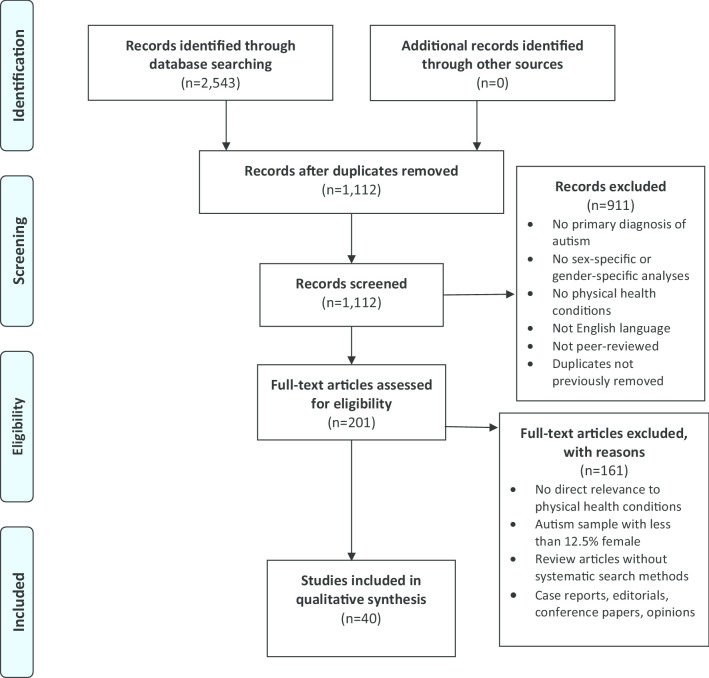
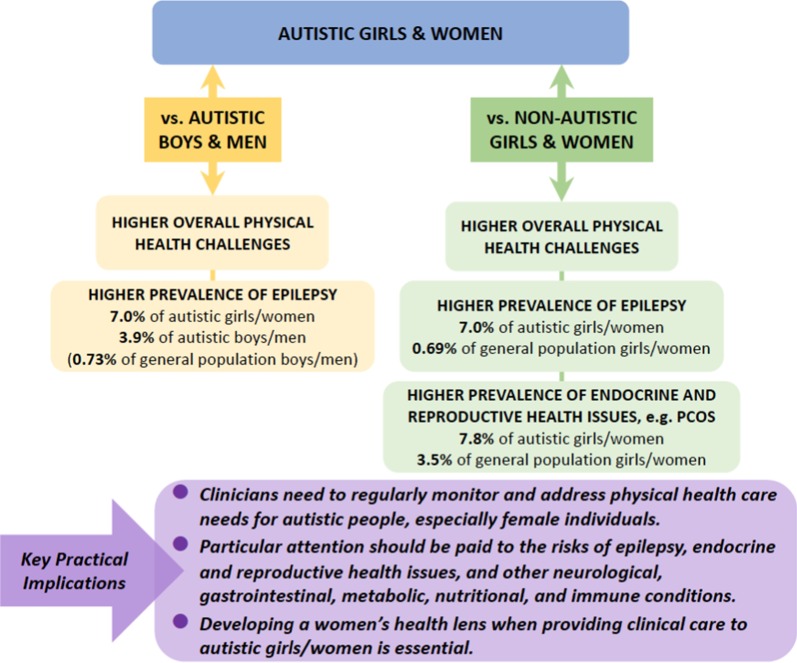
Background: There is a growing recognition of sex and gender influences in autism. Increasingly, studies include comparisons between sexes or genders, but few have focused on clarifying the characteristics of autistic girls’/women’s physical health. Methods: A scoping review was conducted to determine what is currently known about the physical health of autistic girls/women. We screened 1112 unique articles, with 40 studies meeting the inclusion criteria. We used a convergent iterative process to synthesize this content into broad thematic areas. Results: Autistic girls/women experience more overall physical health challenges compared to non-autistic girls/women and to autistic boys/men. Emerging evidence suggests increased prevalence of epilepsy in autistic girls/women compared to non-autistic girls/women and to autistic boys/men. The literature also suggests increased endocrine and reproductive health conditions in autistic girls/women compared to non-autistic girls/women. Findings regarding gastrointestinal, metabolic, nutritional, and immune-related conditions are preliminary and inconsistent. Limitations: The literature has substantial heterogeneity in how physical health conditions were assessed and reported. Further, our explicit focus on physical health may have constrained the ability to examine interactions between mental and physical health. The widely differing research aims and methodologies make it difficult to reach definitive conclusions. Nevertheless, in keeping with the goals of a scoping review, we were able to identify key themes to guide future research. Conclusions: The emerging literature suggests that autistic girls/women have heightened rates of physical health challenges compared to non-autistic girls/women and to autistic boys/men. Clinicians should seek to provide holistic care that includes a focus on physical health and develop a women’s health lens when providing clinical care to autistic girls/women.
Overview
The claims and statistics of this paper haven’t been checked yet.
Free: it reads the open-access text and checks the first 5 claims that cite a source we can check. Create a free account to check every claim.
Integrity signals
Registry
Cites
Statistics
Figures
Verification
Claims the paper makes
The claims and statistics of this paper haven’t been checked yet.
Free: it reads the open-access text and checks the first 5 claims that cite a source we can check. Create a free account to check every claim.
Claims other papers make about this one
Each is checked against this paper’s own text: does it say what the citing paper says it does?
The source backs part of the claim, not all of it — or backs it for a different population, condition or comparison.
In the citing paper
“Co-occurrence of neurodevelopmental conditions with psychiatric and medical conditions is high74–79.”
From Sex and gender in neurodevelopmental conditions (2023) · cites this paper as [79]
Experimental — accuracy not yet measuredIn the citing paper
“In terms of health conditions, autistic females are more likely to have epilepsy and endocrine–reproductive problems79,125, depressive disorders78, and disordered eating and sleep126–128, whereas autistic males are more likely to exhibit hyperactivity in childhood124.”
From Sex and gender in neurodevelopmental conditions (2023) · cites this paper as [79]
Self-check
Percentages, sums and reported differences re-computed from the paper’s own numbers.
The self-check needs the paper’s full text.
Citations
Cites
Preferred Reporting Items for Systematic Reviews and Meta-Analyses: the PRISMA statement
Moher, D., Liberati, A., Tetzlaff, J., Altman, D. G., & for the PRISMA Group (2009) · BMJ · doi:10.1136/bmj.b2535 · Cited by 83,823
Preferred Reporting Items for Systematic Reviews and Meta-Analyses: The PRISMA Statement
Moher, D., Liberati, A., Tetzlaff, J., Altman, D. G., & The PRISMA Group (2009) · PLoS Medicine · doi:10.1371/journal.pmed.1000097 · Cited by 64,042 · cited 1×
“We systematically searched the following databases according to PRISMA standards [17]:”
Preferred reporting items for systematic reviews and meta-analyses: the PRISMA Statement.
(2009) · PubMed Central · Cited by 44,859
PRISMA Extension for Scoping Reviews (PRISMA-ScR): Checklist and Explanation
Tricco, A. C., Lillie, E., Zarin, W., O'Brien, K. K., Colquhoun, H., Levac, D., Moher, D., Peters, M. D. J., Horsley, T., Weeks, L., et al. (2018) · Annals of Internal Medicine · doi:10.7326/m18-0850 · Cited by 43,565
Preferred reporting items for systematic reviews and meta-analyses: The PRISMA statement
Moher, D., Liberati, A., Tetzlaff, J., Altman, D. G., & the PRISMA Group* (2009) · Annals of Internal Medicine · doi:10.7326/0003-4819-151-4-200908180-00135 · Cited by 37,554
Scoping studies: towards a methodological framework
Arksey, H., & O'Malley, L. (2005) · International Journal of Social Research Methodology · doi:10.1080/1364557032000119616 · Cited by 36,742 · cited 4×
“Arksey H, O’Malley L. Scoping studies: towards a methodological frame‑ work.”
BackgroundInfluentialWhat Is the Male-to-Female Ratio in Autism Spectrum Disorder? A Systematic Review and Meta-Analysis
Loomes, R., Hull, L., & Mandy, W. P. L. (2017) · Journal of the American Academy of Child & Adolescent Psychiatry · doi:10.1016/j.jaac.2017.03.013 · Cited by 2,804
Lai, M.-C., Lombardo, M. V., & Baron-Cohen, S. (2014) · The Lancet · doi:10.1016/s0140-6736(13)61539-1 · Cited by 2,371
Self-citationSatterstrom, F. K., Kosmicki, J. A., Wang, J., Breen, M. S., De Rubeis, S., An, J.-Y., Peng, M., Collins, R., Grove, J., Klei, L., et al. (2020) · Cell · doi:10.1016/j.cell.2019.12.036 · Cited by 2,321 · cited 1×
“At a group level, autistic girls/women tend to carry more de novo protein-truncating genetic variants likely causal to autism compared to autistic boys/men [67].”
BackgroundPrevalence and incidence of epilepsy: A systematic review and meta-analysis of international studies
Fiest, K. M., Sauro, K. M., Wiebe, S., Patten, S. B., Kwon, C.-S., Dykeman, J., Pringsheim, T., Lorenzetti, D. L., & Jetté, N. (2017) · Neurology · doi:10.1212/wnl.0000000000003509 · Cited by 1,902
Lai, M.-C., Kassee, C., Besney, R., Bonato, S., Hull, L., Mandy, W., Szatmari, P., & Ameis, S. H. (2019) · The Lancet Psychiatry · doi:10.1016/s2215-0366(19)30289-5 · Cited by 1,892
Self-citationRosenfield, R. L., & Ehrmann, D. A. (2016) · Endocrine Reviews · doi:10.1210/er.2015-1104 · Cited by 1,603
Sex differences in autism spectrum disorders
Werling, D. M., & Geschwind, D. H. (2013) · Current Opinion in Neurology · doi:10.1097/wco.0b013e32835ee548 · Cited by 1,245
Sex/Gender Differences and Autism: Setting the Scene for Future Research
Lai, M.-C., Lombardo, M. V., Auyeung, B., Chakrabarti, B., & Baron-Cohen, S. (2015) · Journal of the American Academy of Child & Adolescent Psychiatry · doi:10.1016/j.jaac.2014.10.003 · Cited by 1,120
Self-citationThe health status of adults on the autism spectrum
Croen, L. A., Zerbo, O., Qian, Y., Massolo, M. L., Rich, S., Sidney, S., & Kripke, C. (2015) · Autism · doi:10.1177/1362361315577517 · Cited by 1,110
Bargiela, S., Steward, R., & Mandy, W. (2016) · Journal of Autism and Developmental Disorders · doi:10.1007/s10803-016-2872-8 · Cited by 1,087
The Changing Epidemiology of Autism Spectrum Disorders
Lyall, K., Croen, L., Daniels, J., Fallin, M. D., Ladd-Acosta, C., Lee, B. K., Park, B. Y., Snyder, N. W., Schendel, D., Volk, H., et al. (2017) · Annual Review of Public Health · doi:10.1146/annurev-publhealth-031816-044318 · Cited by 1,011
Mitochondrial dysfunction in autism spectrum disorders: a systematic review and meta-analysis
Rossignol, D. A., & Frye, R. E. (2012) · Molecular Psychiatry · doi:10.1038/mp.2010.136 · Cited by 907
Identifying the lost generation of adults with autism spectrum conditions
Lai, M.-C., & Baron-Cohen, S. (2015) · The Lancet Psychiatry · doi:10.1016/s2215-0366(15)00277-1 · Cited by 756
Self-citationWhy are autism spectrum conditions more prevalent in males?
Baron-Cohen, S., Lombardo, M. V., Auyeung, B., Ashwin, E., Chakrabarti, B., & Knickmeyer, R. (2011) · PLoS Biology · doi:10.1371/journal.pbio.1001081 · Cited by 754
Big data approaches to decomposing heterogeneity across the autism spectrum
Lombardo, M. V., Lai, M.-C., & Baron-Cohen, S. (2019) · Molecular Psychiatry · doi:10.1038/s41380-018-0321-0 · Cited by 537
Self-citationThe Role of the Immune System in Autism Spectrum Disorder
Meltzer, A., & Van de Water, J. (2017) · Neuropsychopharmacology · doi:10.1038/npp.2016.158 · Cited by 533
Amiet, C., Gourfinkel-An, I., Bouzamondo, A., Tordjman, S., Baulac, M., Lechat, P., Mottron, L., & Cohen, D. (2008) · Biological Psychiatry · doi:10.1016/j.biopsych.2008.04.030 · Cited by 499
Elevated fetal steroidogenic activity in autism
Baron-Cohen, S., Auyeung, B., Nørgaard-Pedersen, B., Hougaard, D. M., Abdallah, M. W., Melgaard, L., Cohen, A. S., Chakrabarti, B., Ruta, L., & Lombardo, M. V. (2015) · Molecular Psychiatry · doi:10.1038/mp.2014.48 · Cited by 471
Autism genetics: opportunities and challenges for clinical translation
Vorstman, J. A. S., Parr, J. R., Moreno-De-Luca, D., Anney, R. J. L., Nurnberger Jr, J. I., & Hallmayer, J. F. (2017) · Nature Reviews Genetics · doi:10.1038/nrg.2017.4 · Cited by 463
Frazier, T. W., Georgiades, S., Bishop, S. L., & Hardan, A. Y. (2014) · Journal of the American Academy of Child & Adolescent Psychiatry · doi:10.1016/j.jaac.2013.12.004 · Cited by 409 · cited 1×
“Indeed, for a long time, girls/women who were clinically diagnosed with autism, and hence included in the registry and hospital-based datasets in the reviewed studies, tended to be those with lower IQ, early-recognized and more “classic” symptoms of autism [63]—those who tend to carry heightened etiological risk facto…”
BackgroundPredictors of quality of life for autistic adults
Mason, D., McConachie, H., Garland, D., Petrou, A., Rodgers, J., & Parr, J. R. (2018) · Autism Research · doi:10.1002/aur.1965 · Cited by 327
Szatmari, P., Georgiades, S., Duku, E., Bennett, T. A., Bryson, S., Fombonne, E., Mirenda, P., Roberts, W., Smith, I. M., Vaillancourt, T., et al. (2015) · JAMA Psychiatry · doi:10.1001/jamapsychiatry.2014.2463 · Cited by 322
Cukier, H. N., Dueker, N. D., Slifer, S. H., Lee, J. M., Whitehead, P. L., Lalanne, E., Leyva, N., Konidari, I., Gentry, R. C., Hulme, W. F., et al. (2014) · Molecular Autism · doi:10.1186/2040-2392-5-1 · Cited by 316
Holtmann, M., Bölte, S., & Poustka, F. (2007) · Developmental Medicine & Child Neurology · doi:10.1111/j.1469-8749.2007.00361.x · Cited by 308
Mason, D., Ingham, B., Urbanowicz, A., Michael, C., Birtles, H., Woodbury-Smith, M., Brown, T., James, I., Scarlett, C., Nicolaidis, C., et al. (2019) · Journal of Autism and Developmental Disorders · doi:10.1007/s10803-019-04049-2 · Cited by 291
Gastrointestinal Conditions in Children With Autism Spectrum Disorder: Developing a Research Agenda
Coury, D. L., Ashwood, P., Fasano, A., Fuchs, G., Geraghty, M., Kaul, A., Mawe, G., Patterson, P., & Jones, N. E. (2012) · Pediatrics · doi:10.1542/peds.2012-0900n · Cited by 264
Elevated rates of testosterone-related disorders in women with autism spectrum conditions
Ingudomnukul, E., Baron-Cohen, S., Wheelwright, S., & Knickmeyer, R. (2007) · Hormones and Behavior · doi:10.1016/j.yhbeh.2007.02.001 · Cited by 259
Lai, M.-C., Anagnostou, E., Wiznitzer, M., Allison, C., & Baron-Cohen, S. (2020) · The Lancet Neurology · doi:10.1016/s1474-4422(20)30034-x · Cited by 250
Self-citationSex and gender impacts on the behavioural presentation and recognition of autism
Lai, M.-C., & Szatmari, P. (2020) · Current Opinion in Psychiatry · doi:10.1097/yco.0000000000000575 · Cited by 237
Self-citationClinical characteristics of children with autism spectrum disorder and co-occurring epilepsy.
Viscidi, E. W., Triche, E. W., Pescosolido, M. F., McLean, R. L., Joseph, R. M., Spence, S. J., & Morrow, E. M. (2013) · PLoS ONE · doi:10.1371/journal.pone.0067797 · Cited by 235
Saghazadeh, A., Ataeinia, B., Keynejad, K., Abdolalizadeh, A., Hirbod-Mobarakeh, A., & Rezaei, N. (2019) · Journal of Psychiatric Research · doi:10.1016/j.jpsychires.2019.05.019 · Cited by 235
Prevalence of physical and mental health conditions in Medicare-enrolled, autistic older adults
Hand, B. N., Angell, A. M., Harris, L., & Carpenter, L. A. (2020) · Autism · doi:10.1177/1362361319890793 · Cited by 235
Muskens, J. B., Velders, F. P., & Staal, W. G. (2017) · European Child & Adolescent Psychiatry · doi:10.1007/s00787-017-1020-0 · Cited by 232
Prenatal and postnatal hormone effects on the human brain and cognition
Auyeung, B., Lombardo, M. V., & Baron-Cohen, S. (2013) · Pflügers Archiv - European Journal of Physiology · doi:10.1007/s00424-013-1268-2 · Cited by 216
Baron-Cohen, S., Tsompanidis, A., Auyeung, B., Nørgaard-Pedersen, B., Hougaard, D. M., Abdallah, M., Cohen, A., & Pohl, A. (2020) · Molecular Psychiatry · doi:10.1038/s41380-019-0454-9 · Cited by 200 · cited 1×
“endocrine dysregulation and autism-related neurodevelopmental and behavioural characteristics [62–64], with some emerging empirical support published recently [65–69].”
BackgroundDevelopmental trajectories as autism phenotypes
Lord, C., Bishop, S., & Anderson, D. (2015) · American Journal of Medical Genetics Part C: Seminars in Medical Genetics · doi:10.1002/ajmg.c.31440 · Cited by 197
Prevalence of Overweight and Obesity in a Large Clinical Sample of Children With Autism
Broder-Fingert, S., Brazauskas, K., Lindgren, K., Iannuzzi, D., & Van Cleave, J. (2014) · Academic Pediatrics · doi:10.1016/j.acap.2014.04.004 · Cited by 182
Nutritional Status of Individuals with Autism Spectrum Disorders: Do We Know Enough?
Ranjan, S., & Nasser, J. A. (2015) · Advances in Nutrition · doi:10.3945/an.114.007914 · Cited by 173
Health Conditions and Functional Status in Adults with Autism: A Cross-Sectional Evaluation
Fortuna, R. J., Robinson, L., Smith, T. H., Meccarello, J., Bullen, B., Nobis, K., & Davidson, P. W. (2016) · Journal of General Internal Medicine · doi:10.1007/s11606-015-3509-x · Cited by 169
Implications of Prenatal Steroid Perturbations for Neurodevelopment, Behavior, and Autism
Gore, A. C., Martien, K. M., Gagnidze, K., & Pfaff, D. (2014) · Endocrine Reviews · doi:10.1210/er.2013-1122 · Cited by 160
Convergence of Sex Differences and the Neuroimmune System in Autism Spectrum Disorder
McCarthy, M. M., & Wright, C. L. (2017) · Biological Psychiatry · doi:10.1016/j.biopsych.2016.10.004 · Cited by 158
Psychiatric and Medical Conditions in Transition-Aged Individuals With ASD
Davignon, M. N., Qian, Y., Massolo, M., & Croen, L. A. (2018) · Pediatrics · doi:10.1542/peds.2016-4300k · Cited by 155
Nicolaidis, C., Raymaker, D., McDonald, K., Kapp, S., Weiner, M., Ashkenazy, E., Gerrity, M., Kripke, C., Platt, L., & Baggs, A. (2016) · Journal of General Internal Medicine · doi:10.1007/s11606-016-3763-6 · Cited by 150
A scoping review of what is known of the physical health of adults with autism spectrum disorder
Cashin, A., Buckley, T., Trollor, J. N., & Lennox, N. (2018) · Journal of Intellectual Disabilities · doi:10.1177/1744629516665242 · Cited by 146
A qualitative study of the service experiences of women with autism spectrum disorder
Tint, A., & Weiss, J. A. (2018) · Autism · doi:10.1177/1362361317702561 · Cited by 146
Self-citationKosidou, K., Dalman, C., Widman, L., Arver, S., Lee, B. K., Magnusson, C., & Gardner, R. M. (2016) · Molecular Psychiatry · doi:10.1038/mp.2015.183 · Cited by 145
Epilepsy and autism: Is there a special relationship?
Berg, A. T., & Plioplys, S. (2012) · Epilepsy & Behavior · doi:10.1016/j.yebeh.2012.01.015 · Cited by 144
Nardone, S., & Elliott, E. (2016) · Frontiers in Neuroscience · doi:10.3389/fnins.2016.00329 · Cited by 125
Rydzewska, E., Hughes-McCormack, L. A., Gillberg, C., Henderson, A., MacIntyre, C., Rintoul, J., & Cooper, S.-A. (2018) · BMJ Open · doi:10.1136/bmjopen-2018-023945 · Cited by 122
Karpur, A., Lello, A., Frazier, T., Dixon, P. J., & Shih, A. J. (2019) · Journal of Autism and Developmental Disorders · doi:10.1007/s10803-018-3862-9 · Cited by 121
Both sex- and gender-related factors should be considered in autism research and clinical practice
Strang, J. F., van der Miesen, A. I., Caplan, R., Hughes, C., daVanport, S., & Lai, M.-C. (2020) · Autism · doi:10.1177/1362361320913192 · Cited by 121
Self-citationTowards sex- and gender-informed autism research
Mandy, W., & Lai, M. (2017) · Autism · doi:10.1177/1362361317706904 · Cited by 118
Self-citationMedications for Adolescents and Young Adults With Autism Spectrum Disorders: A Systematic Review
Dove, D., Warren, Z., McPheeters, M. L., Taylor, J. L., Sathe, N. A., & Veenstra-VanderWeele, J. (2012) · Pediatrics · doi:10.1542/peds.2012-0683 · Cited by 115
Polycystic ovary syndrome and autism: A test of the prenatal sex steroid theory
Cherskov, A., Pohl, A., Allison, C., Zhang, H., Payne, R. A., & Baron-Cohen, S. (2018) · Translational Psychiatry · doi:10.1038/s41398-018-0186-7 · Cited by 114
Masi, A., Breen, E. J., Alvares, G. A., Glozier, N., Hickie, I. B., Hunt, A., Hui, J., Beilby, J., Ravine, D., Wray, J., et al. (2017) · Molecular Autism · doi:10.1186/s13229-017-0176-2 · Cited by 111
Autism Spectrum Disorders and Metabolic Complications of Obesity
Shedlock, K. E., Susi, A., Gorman, G. H., Hisle-Gorman, E. J., Erdie-Lalena, C. R., & Nylund, C. M. (2016) · The Journal of Pediatrics · doi:10.1016/j.jpeds.2016.07.055 · Cited by 109
Recognition of Girls on the Autism Spectrum by Primary School Educators: An Experimental Study
Whitlock, A., Fulton, K., Lai, M., Pellicano, E., & Mandy, W. (2020) · Autism Research · doi:10.1002/aur.2316 · Cited by 109
Self-citationUncovering steroidopathy in women with autism: a latent class analysis
Pohl, A., Cassidy, S., Auyeung, B., & Baron-Cohen, S. (2014) · Molecular Autism · doi:10.1186/2040-2392-5-27 · Cited by 97
Vitamin A and vitamin D deficiencies exacerbate symptoms in children with autism spectrum disorders
Guo, M., Zhu, J., Yang, T., Lai, X., Lei, Y., Chen, J., & Li, T. (2018) · Nutritional Neuroscience · doi:10.1080/1028415x.2017.1423268 · Cited by 92
The influence of sex and age on prevalence rates of comorbid conditions in autism
Supekar, K., Iyer, T., & Menon, V. (2017) · Autism Research · doi:10.1002/aur.1741 · Cited by 90
Rydzewska, E., Hughes-McCormack, L. A., Gillberg, C., Henderson, A., MacIntyre, C., Rintoul, J., & Cooper, S.-A. (2019) · Autism · doi:10.1177/1362361318791279 · Cited by 90
“Life is Much More Difficult to Manage During Periods”: Autistic Experiences of Menstruation
Steward, R., Crane, L., Mairi Roy, E., Remington, A., & Pellicano, E. (2018) · Journal of Autism and Developmental Disorders · doi:10.1007/s10803-018-3664-0 · Cited by 88
Jones, K. B., Cottle, K., Bakian, A., Farley, M., Bilder, D., Coon, H., & McMahon, W. M. (2016) · Autism · doi:10.1177/1362361315594798 · Cited by 87
Rubenstein, E., Wiggins, L. D., & Lee, L.-C. (2015) · Journal of Developmental and Physical Disabilities · doi:10.1007/s10882-014-9397-x · Cited by 84 · cited 3×
“reviewed sex differences in developmental, medical and psychiatric conditions for autistic people of all ages, with samples ranging from n=28 to n=337,000 from 69 studies, with 20 studies reporting specifically on the physical health domain [31].”
BackgroundStress and Androgen Activity During Fetal Development
Barrett, E. S., & Swan, S. H. (2015) · Endocrinology · doi:10.1210/en.2015-1335 · Cited by 82
García‐Pastor, T., Salinero, J. J., Theirs, C., & Ruiz-Vicente, D. (2018) · Journal of Autism and Developmental Disorders · doi:10.1007/s10803-018-3692-9 · Cited by 78
Yang, X.-L., Liang, S., Zou, M.-Y., Sun, C.-H., Han, P.-P., Jiang, X.-T., Xia, W., & Wu, L.-J. (2018) · Psychiatry Research · doi:10.1016/j.psychres.2017.10.040 · Cited by 76
Alterations in plasma cytokine levels in chinese children with autism spectrum disorder
Hu, C., Xu, X., Xiong, G., Xu, Q., Zhou, B., Li, C., Qin, Q., Liu, C., Li, H., Sun, Y., et al. (2018) · Autism Research · doi:10.1002/aur.1940 · Cited by 70
Autism Spectrum Disorders and Menstruation
Hamilton, A. M., Marshal, M. P., & Murray, P. J. (2011) · Journal of Adolescent Health · doi:10.1016/j.jadohealth.2011.01.015 · Cited by 68
Systematic review and guide to management of core and psychiatric symptoms in youth with autism
Ameis, S. H., Kassee, C., Corbett‐Dick, P., Cole, L., Dadhwal, S., Lai, M. ‐., Veenstra‐VanderWeele, J., & Correll, C. U. (2018) · Acta Psychiatrica Scandinavica · doi:10.1111/acps.12918 · Cited by 64
Self-citationRisk of Cancer in Children, Adolescents, and Young Adults with Autistic Disorder
Chiang, H., Liu, C., Hu, Y., Chen, S., Hu, L., Shen, C.-C., Yeh, C., Chen, T., & Gau, S. S. (2014) · The Journal of Pediatrics · doi:10.1016/j.jpeds.2014.10.029 · Cited by 58
ASD Traits and Co-occurring Psychopathology: The Moderating Role of Gender
Kreiser, N. L., & White, S. W. (2015) · Journal of Autism and Developmental Disorders · doi:10.1007/s10803-015-2580-9 · Cited by 58
Self-reported sex differences in high-functioning adults with autism: a meta-analysis
Moseley, R. L., Hitchiner, R., & Kirkby, J. A. (2018) · Molecular Autism · doi:10.1186/s13229-018-0216-6 · Cited by 56
Epilepsy and autism severity: a study of 6,975 children
Ewen, J. B., Marvin, A. R., Law, K., & Lipkin, P. H. (2019) · Autism Research · doi:10.1002/aur.2132 · Cited by 56
Tseng, P., Cheng, Y., Chen, Y., Stubbs, B., Whiteley, P., Carvalho, A. F., Li, D., Chen, T., Yang, W., Tang, C.-H., et al. (2017) · Nutrition Research · doi:10.1016/j.nutres.2017.11.004 · Cited by 55
Tsakanikos, E., Underwood, L., Kravariti, E., Bouras, N., & McCarthy, J. M. (2010) · Research in Autism · doi:10.1016/j.rasd.2010.09.009 · Cited by 52
Rydzewska, E., Hughes-McCormack, L. A., Gillberg, C., Henderson, A., MacIntyre, C., Rintoul, J., & Cooper, S.-A. (2019) · Research in Autism Spectrum Disorders · doi:10.1016/j.rasd.2019.01.004 · Cited by 52
Pregnancy outcomes in women with autism: a nationwide population-based cohort study
Sundelin, H. E., Stephansson, O., Hultman, C. M., & Ludvigsson, J. F. (2018) · Clinical Epidemiology · doi:10.2147/clep.s176910 · Cited by 49
Tint, A., Weiss, J. A., & Lunsky, Y. (2017) · Autism Research · doi:10.1002/aur.1806 · Cited by 48
Self-citationSpecific Neurological Phenotypes in Autism Spectrum Disorders Are Associated with Sex Representation
Ben‐Itzchak, E., Ben‐Shachar, S., & Zachor, D. A. (2013) · Autism Research · doi:10.1002/aur.1319 · Cited by 47
Investigation of Autism Comorbidities and Associations in a School‐Based Community Sample
Memari, A., Ziaee, V., Mirfazeli, F., & Kordi, R. (2012) · Journal of Child and Adolescent Psychiatric Nursing · doi:10.1111/j.1744-6171.2012.00325.x · Cited by 40
Comprehensive Description of Comorbidity for Autism Spectrum Disorder in a General Population
Cawthorpe, D. (2016) · The Permanente Journal · doi:10.7812/tpp/16-088 · Cited by 40 · cited 6×
“[32] and Croen et al.”
BackgroundResultInfluentialCongenital Abnormalities of the Male Reproductive System and Risk of Autism Spectrum Disorders
Rotem, R. S., Chodick, G., Davidovitch, M., Hauser, R. B., Coull, B. A., & Weisskopf, M. G. (2018) · American Journal of Epidemiology · doi:10.1093/aje/kwx367 · Cited by 36
Bowers, K. A., Wink, L. K., Pottenger, A., McDougle, C. J., & Erickson, C. A. (2014) · Autism · doi:10.1177/1362361314547366 · Cited by 33
Trends in documented co-occurring conditions in children with autism spectrum disorder, 2002–2010
Rubenstein, E., Schieve, L., Wiggins, L., Rice, C., Van Naarden Braun, K., Christensen, D., Durkin, M., Daniels, J., & Lee, L.-C. (2018) · Research in Developmental Disabilities · doi:10.1016/j.ridd.2018.08.015 · Cited by 28
Sex differences in co-occurring conditions of children with autism spectrum disorders
Stacy, M. E., Zablotsky, B., Yarger, H. A., Zimmerman, A., Makia, B., & Lee, L.-C. (2014) · Autism · doi:10.1177/1362361313505719 · Cited by 27
Maternal hirsutism and autism spectrum disorders in offspring
Lee, B. K., Arver, S., Widman, L., Gardner, R. M., Magnusson, C., Dalman, C., & Kosidou, K. (2017) · Autism Research · doi:10.1002/aur.1797 · Cited by 21
Wellness Efforts for Autistic Women
Tint, A., Hamdani, Y., Sawyer, A., Desarkar, P., Ameis, S. H., Bardikoff, N., & Lai, M. (2018) · Current Developmental Disorders Reports · doi:10.1007/s40474-018-0148-z · Cited by 19
Self-citationAutistic traits in epilepsy models: Why, when and how?
Velíšková, J., Silverman, J. L., Benson, M. J., & Lenck‐Santini, P. (2018) · Epilepsy Research · doi:10.1016/j.eplepsyres.2018.05.009 · Cited by 16 · cited 1×
“With regard to ascertainment bias, some have suggested that the observed association between autism and epilepsy is largely driven by co-occurring intellectual disability [60], which is in turn confounded by the greater proportion of autistic girls/ women with lower cognitive abilities [61] and shared neurobiological…”
BackgroundThe Effects of Menarche upon the Sensory Features of Girls with Autism Spectrum Disorder
Bitsika, V., & Sharpley, C. F. (2018) · Journal of Developmental and Physical Disabilities · doi:10.1007/s10882-018-9617-x · Cited by 7
Rich, B., Isager, T., & Mouridsen, S. E. (2015) · Journal of Pediatric Neurology · doi:10.3233/jpn-120594 · Cited by 3 · cited 1×
“examined prevalence of cerebral palsy in a nation-wide cohort of n=4,180 autistic individuals with ICD-10 Asperger’s syndrome (4-31 years) [40].”
Background
Cited by
Sex and gender in neurodevelopmental conditions
Bölte, S., Neufeld, J., Marschik, P. B., Williams, Z. J., Gallagher, L., & Lai, M.-C. (2023) · Nature Reviews Neurology · doi:10.1038/s41582-023-00774-6 · Cited by 249
Self-citationA capabilities approach to understanding and supporting autistic adulthood
Pellicano, E., Fatima, U., Hall, G., Heyworth, M., Lawson, W., Lilley, R., Mahony, J., & Stears, M. (2022) · Nature Reviews Psychology · doi:10.1038/s44159-022-00099-z · Cited by 237
Mental health challenges faced by autistic people
Lai, M. (2023) · Nature Human Behaviour · doi:10.1038/s41562-023-01718-2 · Cited by 100
“This pattern is more prominent in those assigned female than male at birth 257,258 , particularly for endocrinological and metabolic problems 258,259 .”
BackgroundSelf-citationLai, M.-C., Lin, H.-Y., & Ameis, S. H. (2022) · Current Opinion in Psychiatry · doi:10.1097/yco.0000000000000770 · Cited by 86
Self-citationOchoa‐Lubinoff, C., Makol, B. A., & Dillon, E. F. (2023) · Neurologic Clinics · doi:10.1016/j.ncl.2022.10.006 · Cited by 75
Metadata
- Authors
- Kassee, C., Babinski, S., Tint, A., Lunsky, Y., Brown, H. K., Ameis, S. H., Szatmari, P., Lai, M.-C., & Einstein, G.
- Affiliations
- Centre for Addiction and Mental Health (CA)
- University of Toronto (CA)
- Linköping University (SE)
- Corresponding author
- Lai, Meng-Chuan
- ORCID
- Venue
- Molecular Autism
- Published
- 2020-10-27
- Volume
- 11
- Issue
- 1
- Pages
- 84-84
- ISSN
- 2040-2392 (ISSN-L)
- PMC
- PMC7590704
- OpenAlex
- W3094995723
- Semantic Scholar
- b4a32f6e4bbc199256b5cfb851564a7fe9520917
- Cited by
- 60
- References
- 98
- Citations by year
- 2026: 10 · 2025: 11 · 2024: 8 · 2023: 13 · 2022: 12 · 2021: 6
- FWCI
- 1.05
- Type
- journal article
- Language
- en
- Open access
- gold
- doi.org
- Licence
- cc-by
- creativecommons.org/licenses/by/4.0 (tdm)
- creativecommons.org/licenses/by/4.0 (vor)
- Locations
- Molecular Autism (publishedVersion, cc-by)
- medRxiv (acceptedVersion, cc-by-nc-nd)
- PubMed Central (publishedVersion, cc-by)
- PubMed (publishedVersion)
- TSpace (University of Toronto) (submittedVersion, other-oa)
- KTH Publication Database DiVA (KTH Royal Institute of Technology) (submittedVersion, other-oa)
- DiVA (Linkoping University) (submittedVersion, other-oa)
- DOAJ (DOAJ: Directory of Open Access Journals) (submittedVersion, cc-by-sa)
- Apollo (University of Cambridge) (submittedVersion, cc-by)
- Apollo (cc-by)
- Funders
- Institute of Gender and Health (GSB-171373)
- Centre for Addiction and Mental Health (CAM-18-004)
- Topics
- Life Sciences › Neuroscience › Cognitive Neuroscience › Autism Spectrum Disorder Research
- Health Sciences › Medicine › Psychiatry and Mental health › Child Nutrition and Feeding Issues
- Health Sciences › Medicine › Public Health, Environmental and Occupational Health › Down syndrome and intellectual disability research
- Keywords
- autism spectrum disorder, autistic women, autistic girls, physical health, sex differences, gender differences, epilepsy, reproductive health, endocrine health, gastrointestinal diseases, metabolic disorders, nutritional status, women's health
- MeSH terms
- Autistic Disorder, Female, Health Status, Humans, Women's Health
About these checks
Registry, retraction, Cites and statistics results are computed, not judged, with one exception: a printed reference that no index lists is read once by a model before it counts as a citation error. Claims are extracted by a model and kept only when their quote appears verbatim in the text; each cited source is then checked, with a model’s help, for whether it says what the claim relies on. Those verdicts can be wrong — read the claim’s quote and the cited source before relying on one.
Statistics and arithmetic are recomputed, not judged.
Confidence bands are shown only for fields calibrated on our annotated test set. None is calibrated yet, so no band is shown.
What counts as a claim ›How we measure confidence ›How we check this ›
Are you an author, or do you see a problem with this page? Request a review
Data sources
Bibliographic data: Semantic Scholar, OpenAlex, Crossref.
Contains information from the Semantic Scholar Academic Graph Datasets, made available under the ODC Attribution License (ODC-BY 1.0).
Semantic Scholar’s data is described in: Kinney, R., et al. (2023). The Semantic Scholar Open Data Platform. arXiv:2301.10140.
