

The DOI matches its Crossref record; 125 of the 126 references it cites were found in a registry or an index.
Mesenchymal stem cell-derived exosomes: a new therapeutic approach to osteoarthritis?
Open accessAbstract
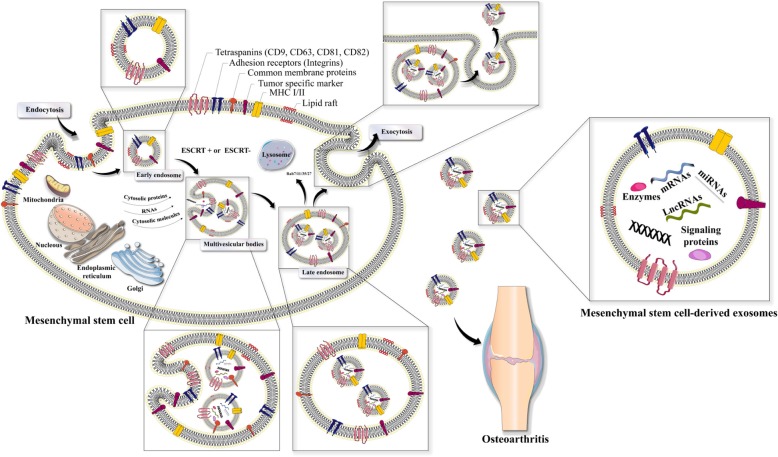
Degenerative disorders of joints, especially osteoarthritis (OA), result in persistent pain and disability and high costs to society. Nevertheless, the molecular mechanisms of OA have not yet been fully explained. OA is characterized by destruction of cartilage and loss of extracellular matrix (ECM). It is generally agreed that there is an association between pro-inflammatory cytokines and the development of OA. There is increased expression of matrix metalloproteinase (MMP) and “a disintegrin and metalloproteinase with thrombospondin motifs” (ADAMTS). Mesenchymal stem cells (MSCs) have been explored as a new treatment for OA during the last decade. It has been suggested that paracrine secretion of trophic factors, in which exosomes have a crucial role, contributes to the mechanism of MSC-based treatment of OA. The paracrine secretion of exosomes may play a role in the repair of joint tissue as well as MSC-based treatments for other disorders. Exosomes isolated from various stem cells may contribute to tissue regeneration in the heart, limbs, skin, and other tissues. Recent studies have indicated that exosomes (or similar particles) derived from MSCs may suppress OA development. Herein, for first time, we summarize the recent findings of studies on various exosomes derived from MSCs and their effectiveness in the treatment of OA. Moreover, we highlight the likely mechanisms of actions of exosomes in OA.
Overview
The claims and statistics of this paper haven’t been checked yet.
Run the check — free, no account needed. It reads the open-access text and checks the sources it cites.
Integrity signals
Registry
Cites
Statistics
Figures
Verification
Claims the paper makes
The claims and statistics of this paper haven’t been checked yet.
Run the check — free, no account needed. It reads the open-access text and checks the sources it cites.
Claims other papers make about this one
Each is checked against this paper’s own text: does it say what the citing paper says it does?
The source backs part of the claim, not all of it — or backs it for a different population, condition or comparison.
In the citing paper
“Furthermore, variability in MSC sources, such as bone marrow-derived (BM-MSCs), adipose-derived (AD-MSCs), and umbilical cord-derived MSCs (UC-MSCs), contributes to discrepancies in reported outcomes.”
From Advancements in Regenerative Therapies for Orthopedics: A Comprehensive Review of Platelet-Rich Plasma, Mesenchymal Stem Cells, Peptide Therapies, and Biomimetic Applications (2025) · cites this paper as [112]
Experimental — accuracy not yet measuredThe source backs part of the claim, not all of it — or backs it for a different population, condition or comparison.
In the citing paper
“While some trials have demonstrated substantial cartilage repair and functional improvement, others have reported minimal to no long-term benefit, particularly in advanced osteoarthritis patients [112].”
From Advancements in Regenerative Therapies for Orthopedics: A Comprehensive Review of Platelet-Rich Plasma, Mesenchymal Stem Cells, Peptide Therapies, and Biomimetic Applications (2025) · cites this paper as [112]
Experimental — accuracy not yet measured
Self-check
Percentages, sums and reported differences re-computed from the paper’s own numbers.
The self-check needs the paper’s full text.
Citations
Cites
2 retracted
RETRACTED: Exosome‐encapsulated miR‐6089 regulates inflammatory response via targeting TLR4
Xu, D., Song, M., Chai, C., Wang, J., Jin, C., Wang, X., Cheng, M., & Yan, S. (2018) · Journal of Cellular Physiology · doi:10.1002/jcp.27014 · Cited by 74
Retracted[Differential expression of exosomal miRNAs in osteoblasts in osteoarthritis].
Liu, B., Wu, P., Mei, L., Luo, Y., Li, H., & Mao, X. (2018) · PubMed · doi:10.11817/j.issn.1672-7347.2018.12.003 · Cited by 6
RetractedKEGG: Kyoto Encyclopedia of Genes and Genomes
Kanehisa, M. (2000) · Nucleic Acids Research · doi:10.1093/nar/28.1.27 · Cited by 37,077
KEGG: Kyoto Encyclopedia of Genes and Genomes
Ogata, H., Goto, S., Sato, K., Fujibuchi, W., Bono, H., & Kanehisa, M. (1999) · Nucleic Acids Research · doi:10.1093/nar/27.1.29 · Cited by 31,232
Extracellular vesicles: Exosomes, microvesicles, and friends
Raposo, G., & Stoorvogel, W. (2013) · Journal of Cell Biology · doi:10.1083/jcb.201211138 · Cited by 8,099
Biological properties of extracellular vesicles and their physiological functions
Yáñez‐Mó, M., Siljander, P. R. ‐., Andreu, Z., Bedina Zavec, A., Borràs, F. E., Buzas, E. I., Buzas, K., Casal, E., Cappello, F., Carvalho, J., et al. (2015) · Journal of Extracellular Vesicles · doi:10.3402/jev.v4.27066 · Cited by 5,926
Ceramide Triggers Budding of Exosome Vesicles into Multivesicular Endosomes
Trajković, K., Hsu, C., Chiantia, S., Rajendran, L., Wenzel, D., Wieland, F., Schwille, P., Brügger, B., & Simons, M. (2008) · Science · doi:10.1126/science.1153124 · Cited by 3,760
Extracellular vesicles: biology and emerging therapeutic opportunities
EL Andaloussi, S., Mäger, I., Breakefield, X. O., & Wood, M. J. A. (2013) · Nature Reviews Drug Discovery · doi:10.1038/nrd3978 · Cited by 3,571
Communication by Extracellular Vesicles: Where We Are and Where We Need to Go
Tkach, M., & Théry, C. (2016) · Cell · doi:10.1016/j.cell.2016.01.043 · Cited by 3,444
Silverstein, F. E., Faich, G. A., Goldstein, J. L., Simon, L. S., Pincus, T., Whelton, A., Makuch, R., Eisen, G. M., Agrawal, N. M., Stenson, W. F., et al. (2000) · JAMA · doi:10.1001/jama.284.10.1247 · Cited by 3,144
Cited by
Sorted by citations
Recent Updates of Diagnosis, Pathophysiology, and Treatment on Osteoarthritis of the Knee
Jang, S., Lee, K.-J., & Ju, J. H. (2021) · International Journal of Molecular Sciences · doi:10.3390/ijms22052619 · Cited by 879
Giorgino, R., Albano, D., Fusco, S., Peretti, G. M., Mangiavini, L., & Messina, C. (2023) · International Journal of Molecular Sciences · doi:10.3390/ijms24076405 · Cited by 476
Shao, J., Zaro, J., & Shen, Y. (2020) · International Journal of Nanomedicine · doi:10.2147/ijn.s281890 · Cited by 295
Exosomes: roles and therapeutic potential in osteoarthritis
Ni, Z., Zhou, S., Li, S., Kuang, L., Chen, H., Luo, X., Ouyang, J., He, M., Du, X., & Chen, L. (2020) · Bone Research · doi:10.1038/s41413-020-0100-9 · Cited by 302
A Review of the Effects of Collagen Treatment in Clinical Studies
Wang, H. (2021) · Polymers · doi:10.3390/polym13223868 · Cited by 263
Metadata
- Authors
- Mianehsaz, E., Mirzaei, H. R., Mahjoubin-Tehran, M., Rezaee, A., Sahebnasagh, R., Pourhanifeh, M. H., Mirzaei, H., & Hamblin, M. R.
- Affiliations
- Kashan University of Medical Sciences (IR)
- Tehran University of Medical Sciences (IR)
- Harvard University (US)
- Corresponding author
- Mirzaei, Hamid Reza
- Mirzaei, Hamed
- Hamblin, Michael R.
- ORCID
- Venue
- Stem Cell Research & Therapy
- Published
- 2019-11-21
- Volume
- 10
- Issue
- 1
- Pages
- 340-340
- ISSN
- 1757-6512 (ISSN-L)
- PMC
- PMC6873475
- OpenAlex
- W2990542915
- Cited by
- 274
- References
- 126
- Citations by year
- 2026: 15 · 2025: 28 · 2024: 35 · 2023: 44 · 2022: 45 · 2021: 74 · 2020: 33
- FWCI
- 6.22
- Type
- journal article
- Language
- en
- Open access
- gold
- doi.org
- Locations
- Stem Cell Research & Therapy (publishedVersion, cc-by)
- PubMed Central (publishedVersion, cc-by)
- PubMed (publishedVersion)
- DOAJ (DOAJ: Directory of Open Access Journals) (submittedVersion)
- Funders
- National Institutes of Health
- National Institute of Allergy and Infectious Diseases (R01AI050875, R21AI121700)
- Topics
- Health Sciences › Medicine › Rheumatology › Osteoarthritis Treatment and Mechanisms
- Life Sciences › Biochemistry, Genetics and Molecular Biology › Molecular Biology › Extracellular vesicles in disease
- Life Sciences › Biochemistry, Genetics and Molecular Biology › Cell Biology › Mesenchymal stem cell research
- Keywords
- mesenchymal stem cells, exosomes, osteoarthritis, cartilage degeneration, extracellular matrix, paracrine signaling, matrix metalloproteinases, ADAMTS, inflammatory cytokines, tissue regeneration, stem cell therapy
- MeSH terms
- Animals, Humans, Osteoarthritis, Exosomes, Mesenchymal Stem Cells
About these checks
Registry, retraction, Cites and statistics results are computed, not judged, with one exception: a printed reference that no index lists is read once by a model before it counts as a citation error. Claims are extracted by a model and kept only when their quote appears verbatim in the text; each cited source is then checked, with a model’s help, for whether it says what the claim relies on. Those verdicts can be wrong — read the claim’s quote and the cited source before relying on one.
Statistics and arithmetic are recomputed, not judged.
Confidence bands are shown only for fields calibrated on our annotated test set. None is calibrated yet, so no band is shown.
What counts as a claim ›How we measure confidence ›How we check this ›
Are you an author, or do you see a problem with this page? Request a review
