

Genome engineering of induced pluripotent stem cells to manufacture natural killer cell therapies
Open accessThe DOI matches its Crossref record; 149 of the 149 references it cites were found in a registry or an index.
Abstract
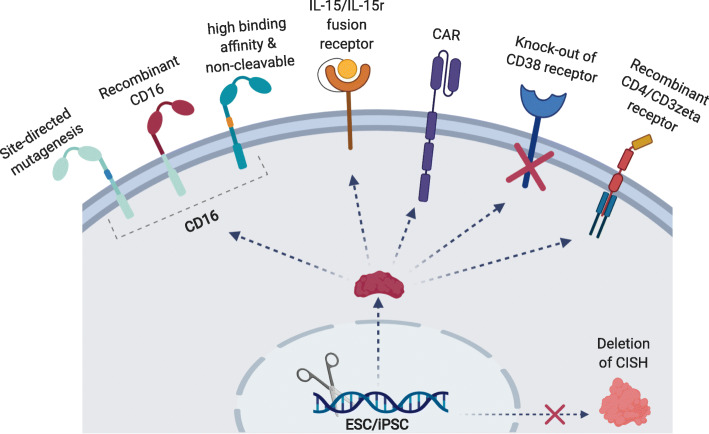
Natural killer (NK) cells play a crucial role in host immunity by detecting cells that downregulate MHC class I presentation and upregulate stress ligands, as commonly seen in cancers. Current NK therapies using primary NK cells are prone to manufacturing issues related to expansion and storage. Alternative cell sources utilizing immortalized NK cell lines require irradiation and are dependent on systemic IL-2 administration, which has been associated with adverse effects. In contrast, NK cells differentiated from induced pluripotent stem cells (iPSC-NK cells) offer an off-the-shelf alternative that may overcome these bottlenecks. The development of a serum-free and feeder-free differentiation protocol allows for the manufacturing of clinically adaptable iPSC-NK cells that are equally as effective as primary NK cells and the NK-92 cell line for many indications. Moreover, genetic modifications targeting NK-mediated antibody-dependent cellular cytotoxicity capabilities, cytotoxicity, and checkpoint inhibitors may increase the therapeutic potential of iPSC-NK products. This review will highlight the current sources for NK therapies and their respective constraints, discuss recent developments in the manufacturing and genetic engineering of iPSC-NK cells, and provide an overview of ongoing clinical trials using NK cells.
Overview
The claims and statistics of this paper haven’t been checked yet.
Free: it reads the open-access text and checks the first 5 claims that cite a source we can check. Create a free account to check every claim.
Integrity signals
Registry
Cites
Statistics
Figures
Verification
Claims the paper makes
The claims and statistics of this paper haven’t been checked yet.
Free: it reads the open-access text and checks the first 5 claims that cite a source we can check. Create a free account to check every claim.
Claims other papers make about this one
Each is checked against this paper’s own text: does it say what the citing paper says it does?
The cited source says what the claim attributes to it.
In the citing paper
“Moreover, antigen priming is not required for NK cells, therefore, it is not necessary to transplant with HLA matched NK cells [85].”
From Utility of iPSC-Derived Cells for Disease Modeling, Drug Development, and Cell Therapy (2022) · cites this paper as [85]
Self-check
Percentages, sums and reported differences re-computed from the paper’s own numbers.
The self-check needs the paper’s full text.
Citations
Cites
Siegel, R. L., Miller, K. D., & Jemal, A. (2019) · CA: A Cancer Journal for Clinicians · doi:10.3322/caac.21551 · Cited by 20,160
Axicabtagene Ciloleucel CAR T-Cell Therapy in Refractory Large B-Cell Lymphoma
Neelapu, S. S., Locke, F. L., Bartlett, N. L., Lekakis, L. J., Miklos, D. B., Jacobson, C. A., Braunschweig, I., Oluwole, O. O., Siddiqi, T., Lin, Y., et al. (2017) · New England Journal of Medicine · doi:10.1056/nejmoa1707447 · Cited by 6,030
Tisagenlecleucel in children and young adults with B-cell lymphoblastic leukemia
Maude, S. L., Laetsch, T. W., Buechner, J., Rives, S., Boyer, M., Bittencourt, H., Bader, P., Verneris, M. R., Stefanski, H. E., Myers, G. D., et al. (2018) · New England Journal of Medicine · doi:10.1056/nejmoa1709866 · Cited by 5,735
Tisagenlecleucel in Adult Relapsed or Refractory Diffuse Large B-Cell Lymphoma
Schuster, S. J., Bishop, M. R., Tam, C. S., Waller, E. K., Borchmann, P., McGuirk, J. P., Jäger, U., Jaglowski, S., Andreadis, C., Westin, J. R., et al. (2019) · New England Journal of Medicine · doi:10.1056/nejmoa1804980 · Cited by 4,112
Effectiveness of donor natural killer cell alloreactivity in mismatched hematopoietic transplants
Ruggeri, L., Capanni, M., Urbani, E., Perruccio, K., Shlomchik, W. D., Tosti, A., Posati, S., Rogaia, D., Frassoni, F., Aversa, F., et al. (2002) · Science · doi:10.1126/science.1068440 · Cited by 3,380
Activation of NK Cells and T Cells by NKG2D, a Receptor for Stress-Inducible MICA
Bauer, S., Groh, V., Wu, J., Steinle, A., Phillips, J. H., Lanier, L. L., & Spies, T. (1999) · Science · doi:10.1126/science.285.5428.727 · Cited by 2,999
Locke, F. L., Ghobadi, A., Jacobson, C. A., Miklos, D. B., Lekakis, L. J., Oluwole, O. O., Lin, Y., Braunschweig, I., Hill, B. T., Timmerman, J. M., et al. (2019) · The Lancet Oncology · doi:10.1016/s1470-2045(18)30864-7 · Cited by 2,286
Use of CAR-Transduced Natural Killer Cells in CD19-Positive Lymphoid Tumors
Liu, E., Marin, D., Banerjee, P., Macapinlac, H. A., Thompson, P., Basar, R., Nassif Kerbauy, L., Overman, B., Thall, P., Kaplan, M., et al. (2020) · New England Journal of Medicine · doi:10.1056/nejmoa1910607 · Cited by 2,217
A more efficient method to generate integration-free human iPS cells
Okita, K., Matsumura, Y., Sato, Y., Okada, A., Morizane, A., Okamoto, S., Hong, H., Nakagawa, M., Tanabe, K., Tezuka, K.-I., et al. (2011) · Nature Methods · doi:10.1038/nmeth.1591 · Cited by 2,061
Miller, J. S., Soignier, Y., Panoskaltsis-Mortari, A., McNearney, S. A., Yun, G. H., Fautsch, S. K., McKenna, D., Le, C., Defor, T. E., Burns, L. J., et al. (2005) · Blood · doi:10.1182/blood-2004-07-2974 · Cited by 1,903
Cited by
Current Perspectives on “Off-The-Shelf” Allogeneic NK and CAR-NK Cell Therapies
Heipertz, E. L., Zynda, E. R., Stav-Noraas, T. E., Hungler, A. D., Boucher, S. E., Kaur, N., & Vemuri, M. C. (2021) · Frontiers in Immunology · doi:10.3389/fimmu.2021.732135 · Cited by 211
“Further, cryopreservation of PB NK cells lowers the cytotoxic ability (35, 37).”
BackgroundAllogeneic CAR Cell Therapy—More Than a Pipe Dream
Caldwell, K. J., Gottschalk, S. M., & Talleur, A. C. (2021) · Frontiers in Immunology · doi:10.3389/fimmu.2020.618427 · Cited by 151
Advances in NK cell production
Fang, F., Xie, S., Chen, M., Li, Y., Yue, J., Ma, J., Shu, X., He, Y., Xiao, W., & Tian, Z. (2022) · Cellular and Molecular Immunology · doi:10.1038/s41423-021-00808-3 · Cited by 140
“Studies have shown that PSC-derived NK cells not only have the advantages of primary NK cells and NK cell lines but also lack their problems [176].”
BackgroundNatural killer cell-based immunotherapy for acute myeloid leukemia
Xu, J., & Niu, T. (2020) · Journal of Hematology & Oncology · doi:10.1186/s13045-020-00996-x · Cited by 125
Engineering Anti-Tumor Monoclonal Antibodies and Fc Receptors to Enhance ADCC by Human NK Cells
Dixon, K. J., Wu, J., & Walcheck, B. K. (2021) · Cancers · doi:10.3390/cancers13020312 · Cited by 101
An iPSC-derived CD19/BCMA CAR-NK therapy in a patient with systemic sclerosis
Wang, X., Zhang, Y., Jin, Y., Dai, L., Yue, Y., Hu, J., Liu, X., Pang, K., Ye, S., Chen, Y., et al. (2025) · Cell · doi:10.1016/j.cell.2025.05.038 · Cited by 103
IPSC-derived CAR-NK cells for cancer immunotherapy
Lin, X., Sun, Y., Dong, X., Liu, Z., Sugimura, R., & Xie, G. (2023) · Biomedicine & Pharmacotherapy · doi:10.1016/j.biopha.2023.115123 · Cited by 93
Harnessing CD16-Mediated NK Cell Functions to Enhance Therapeutic Efficacy of Tumor-Targeting mAbs
Capuano, C., Pighi, C., Battella, S., Federicis, D. D., Galandrini, R., & Palmieri, G. (2021) · Cancers · doi:10.3390/cancers13102500 · Cited by 90
“Among the various sources employed for adoptive therapy, induced pluripotent stem cells (iPSC)-derived NK cells are particularly promising since they are able to mediate both natural and ADCC cytotoxic activities, and the potential for expansion and persistence in vivo [212]; in this context, iPSC-derived NK cells, tr…”
BackgroundPinto, S., Pahl, J. H. W., Schottelius, A. J. G., Carter, P. J., & Koch, J. (2022) · Trends in Immunology · doi:10.1016/j.it.2022.09.007 · Cited by 88
Generating natural killer cells for adoptive transfer: expanding horizons
Kundu, S., Gurney, M. E., & O'Dwyer, M. E. (2021) · Cytotherapy · doi:10.1016/j.jcyt.2020.12.002 · Cited by 81
Zhang, C., Hu, Y., Xiao, W., & Tian, Z. (2021) · Cellular and Molecular Immunology · doi:10.1038/s41423-021-00732-6 · Cited by 84
iPSC-Derived Natural Killer Cells for Cancer Immunotherapy
Karagiannis, P., & Kim, S. (2021) · Molecules and Cells · doi:10.14348/molcells.2021.0078 · Cited by 74
“While initial research on NK cell-based ACT has used primary NK cells from peripheral blood (PB-NK), NK cells in cord blood (CB-NK) and immortalized lines such as NK-92 are respectively more abundant (10% vs 30%) and easier to genetically modify (Myers and Miller, 2021; Shankar et al., 2020).”
BackgroundUtility of iPSC-Derived Cells for Disease Modeling, Drug Development, and Cell Therapy
Nicholson, M. W., Ting, C.-Y., Chan, D. Z. H., Cheng, Y.-C., Lee, Y.-C., Hsu, C.-C., Huang, C.-Y., & Hsieh, P. C. H. (2022) · Cells · doi:10.3390/cells11111853 · Cited by 65
“Moreover, antigen priming is not required for NK cells, therefore, it is not necessary to transplant with HLA matched NK cells [85].”
BackgroundKim, D., Jo, S., Lee, D., Kim, S., Seok, J. M., Yeo, S. J., Lee, J. H., Lee, J., Lee, K., Kim, T., et al. (2023) · Biomaterials Research · doi:10.1186/s40824-023-00403-9 · Cited by 60
“The two main obstacles are the high expansion rate of immune cells with suitable viability and targeting effect, homing to the tumor site, and activity in the TME that results in the loss of long-term anti-tumor efficiency [4, 6, 13, 17, 18].”
BackgroundCAR-NK Cells from Engineered Pluripotent Stem Cells: Off-the-shelf Therapeutics for all Patients
Lu, S., & Feng, Q. (2021) · Stem Cells Translational Medicine · doi:10.1002/sctm.21-0135 · Cited by 47
“These advantages offer new solutions for obstacles associated with conventional NK therapies.(46)”
BackgroundDevelopment of Stem Cell-Derived Immune Cells for Off-the-Shelf Cancer Immunotherapies
Li, Y.-R., Dunn, Z. S., Zhou, Y., Lee, D. P. H., & Yang, L. (2021) · Cells · doi:10.3390/cells10123497 · Cited by 45
“The same group also developed a novel platform to produce NK cells from iPSCs [80,145,146].”
BackgroundMethodRealizing Innate Potential: CAR-NK Cell Therapies for Acute Myeloid Leukemia
Gurney, M. E., & O'Dwyer, M. E. (2021) · Cancers · doi:10.3390/cancers13071568 · Cited by 42
“Human induced pluripotent stem cells (iPSCs) can be stably gene modified and subsequently differentiated into CAR-NK cells, creating a platform with several advantages [131].”
BackgroundDelivery technologies to engineer natural killer cells for cancer immunotherapy
El-Mayta, R. D., Zhang, Z., Hamilton, A. G., & Mitchell, M. J. (2021) · Cancer Gene Therapy · doi:10.1038/s41417-021-00336-2 · Cited by 43
“These cells also demonstrate enhanced transfection efficiency [61, 62].”
BackgroundApproaches to Enhance Natural Killer Cell-Based Immunotherapy for Pediatric Solid Tumors
Quamine, A. E., Olsen, M. R., Cho, M. M., & Capitini, C. M. (2021) · Cancers · doi:10.3390/cancers13112796 · Cited by 39
“iPSC-CAR NK cells performed and NK-92s but possess the advantage of not requiring irradiation [153].”
BackgroundSelf-citationTang, S. Y., Zha, S., Du, Z., Zeng, J., Zhu, D., Luo, Y., & Wang, S. (2021) · Stem Cell Research & Therapy · doi:10.1186/s13287-021-02648-4 · Cited by 34
Design of transfections: Implementation of design of experiments for cell transfection fine tuning
Mancinelli, S., Turcato, A., Kisslinger, A., Bongiovanni, A., Zazzu, V., Lanati, A., & Liguori, G. L. (2021) · Biotechnology and Bioengineering · doi:10.1002/bit.27918 · Cited by 33
“…of the induced pluripotent stem (iPS) cells to be used as models of disease and/or in patient ‐ specific cell therapy (Nishikawa et al., 2008; Shankar et al., 2020; Takahashi & Yamanaka, 2006) as well as in many bioprocesses for the production of clinical ‐ grade recombinant bio-logics…”
Liu, E., Karpf, L., & Bohl, D. (2021) · Frontiers in Molecular Neuroscience · doi:10.3389/fnmol.2021.767041 · Cited by 34
“For NK cells, a recent review summarizes protocols to obtain these cells from human iPSC (Shankar et al., 2020). iPS-derived NK cells were shown to be phenotypically similar to primary NK cells as well as regarding their effector function.”
BackgroundChen, Y., Zhu, Y., Kramer, A. B., Fang, Y., Wilson, M., Li, Y.-R., & Yang, L. (2023) · Frontiers in Medicine · doi:10.3389/fmed.2023.1135468 · Cited by 33
“iPSC-dervied NK cells have demonstrated the capability to produce a hyperinflammatory environment, inducing cytokine release syndrome (CRS) in recipients (21).”
BackgroundAdvances in manufacturing chimeric antigen receptor immune cell therapies
Ramamurthy, A., Tommasi, A. M., & Saha, K. (2024) · Seminars in Immunopathology · doi:10.1007/s00281-024-01019-4 · Cited by 32
“This attribute renders them less likely to induce Graft vs. Host Disease (GvHD) due to HLA mismatch, providing an unmatched allogeneic source of immune cells amenable to engineering and infusion [57, 58].”
Self-citationEmerging Approaches for Solid Tumor Treatment Using CAR-T Cell Therapy
Chung, H., Jung, H., & Noh, J. (2021) · International Journal of Molecular Sciences · doi:10.3390/ijms222212126 · Cited by 28
“CB-NK and iPSC-derived NK cells could provide “off-the-shelf” therapy, as CB-NK cells could recover after cryopreservation, while iPSCs can be expanded to larger scale, reviewed in [175].”
BackgroundShankar, K., Zingler-Hoslet, I., Tabima, D. M., Zima, S. R. T., Shi, L., Gimse, K., Forsberg, M. H., Katta, V., Davis, S. Z., Maldonado, D., et al. (2025) · Molecular Therapy · doi:10.1016/j.ymthe.2025.01.024 · Cited by 26
Self-citationThepmalee, C., Jenkham, P., Ramwarungkura, B., Suwannasom, N., Khoothiam, K., Thephinlap, C., Sawasdee, N., Panya, A., & Yenchitsomanus, P. (2024) · Scientific Reports · doi:10.1038/s41598-024-72833-x · Cited by 23
“The upregulated expression of NKG2D ligand on cancer cells can be influenced by various stressors, including DNA damage, heat shock, and oxidative stress 32 .”
Addressing Natural Killer Cell Dysfunction and Plasticity in Cell-Based Cancer Therapeutics
Coyle, K. M., Hawke, L. G., & Ormiston, M. L. (2023) · Cancers · doi:10.3390/cancers15061743 · Cited by 24
“Ability to generate multiple doses from a single healthy donor [31,71] Safety concerns regarding toxicity”
BackgroundBeyond CAR-T: The rise of CAR-NK cell therapy in asthma immunotherapy
Taheri, M. M., Javan, F., Poudineh, M., & Athari, S. S. (2024) · Journal of Translational Medicine · doi:10.1186/s12967-024-05534-8 · Cited by 21
“Moreover, The NK-92 cell line exhibits remarkable cryo-preservation tolerance, demonstrating high post-thaw viability and functional retention [83].”
BackgroundAdoptive Cell Therapy for T-Cell Malignancies
Fang, K., Lee, J. B., & Li, Z. (2022) · Cancers · doi:10.3390/cancers15010094 · Cited by 23
“While more robust protocols for iPSCs are being developed [103], the process of manufacturing iPSCs remains complex and lengthy.”
BackgroundImmune cell-based therapies for solid tumors, current challenges and therapeutic advances
Torabi, S., Yekzaman, E., Taherkhani, S., Talachi, N., Khoshravesh, R., Khosravi, A., Salehi, M., Zarrabi, A., & Vosough, M. (2025) · Cell Communication and Signaling · doi:10.1186/s12964-025-02632-y · Cited by 22
“Another approach is to engineer NK cells to resist immune suppression by expressing immune checkpoint inhibitors, such as PD-1 or CTLA-4, which can block the inhibitory signals from the TME [123].”
Hsu, L.-J., Liu, C., Kuo, M., Shen, C., & Shen, C. (2021) · Biomedicines · doi:10.3390/biomedicines9101323 · Cited by 19
Humanized Mouse Models for the Advancement of Innate Lymphoid Cell-Based Cancer Immunotherapies
Horowitz, N. B., Mohammad, I., Moreno‐Nieves, U. Y., Koliesnik, I. O., Tran, Q., & Sunwoo, J. B. (2021) · Frontiers in Immunology · doi:10.3389/fimmu.2021.648580 · Cited by 21
iPSCs in NK Cell Manufacturing and NKEV Development
Boyd-Gibbins, N., Karagiannis, P., Hwang, D. W., & Kim, S. (2022) · Frontiers in Immunology · doi:10.3389/fimmu.2022.890894 · Cited by 19
“NK-92 cells possess anti-cancer potential (23, 24), and have shown efficacy in human clinical trials (25).”
BackgroundNK cell therapy in relapsed refractory multiple myeloma
Roshandel, E., Nazari, H. G., Mohammadian, M., Salimi, M., Abroun, S., Mirfakhraie, R., & Hajifathali, A. (2022) · Clinical Immunology · doi:10.1016/j.clim.2022.109168 · Cited by 18
Chimeric antigen receptor natural killer cells: a promising antitumor immunotherapy
Wang, Y., Jin, S., Zhuang, Q., Liu, N., Chen, R., Adam, S. A., Jin, J., & Sun, J. (2023) · MedComm · doi:10.1002/mco2.422 · Cited by 17
“86 Repeated infusions may improve the persistence of NK-92 cells in vivo, but this may trigger the immune response to antigens expressed in NK-92 cells.”
BackgroundA novel endogenous CD16-Expressing Natural Killer Cell for cancer immunotherapy
Cheng, Z.-F., Li, H.-K., Yang, H., Lee, C.-Y., Tang, S.-W., Lin, Y., & Hsiao, S.-C. (2021) · Biochemistry and Biophysics Reports · doi:10.1016/j.bbrep.2021.100935 · Cited by 21
“Human NK cell lines as well as cord blood-, peripheral blood- and iPSC-derived NK cells have been reported as successful sources of allogeneic applications [5,12,44].”
BackgroundSun, J. Q. J., Elliott, M. R., & Souza-Fonseca-Guimarães, F. (2025) · Clinical & Translational Immunology · doi:10.1002/cti2.70045 · Cited by 17
“56 A novel haplobanking approach for iPSCs can be utilised, in which cells are separated and stored according to different HLA haplotypes, enabling the production of disease-specific, patient-specific and immune-matched allogeneic cell therapies.”
NK cells as powerful therapeutic tool in cancer immunotherapy
Huang, M., Liu, Y., Yan, Q., Miao, P., Ge, J., Mo, Y., Wang, Y., Wang, F., Zeng, Z., Li, Y., et al. (2024) · Cellular Oncology · doi:10.1007/s13402-023-00909-3 · Cited by 15
“These iPSC-derived NK cells were as effective as pri - mary NK cells and NK-92 cells for many indications [ 154].”
Programmed cell death protein 1 on natural killer cells: fact or fiction?
Cho, M. M., Quamine, A. E., Olsen, M. R., & Capitini, C. M. (2020) · Journal of Clinical Investigation · doi:10.1172/jci137051 · Cited by 13
Self-citationJung, J., Chang, Y., Jin, G., Lian, X. L., & Bao, X. (2022) · ACS Synthetic Biology · doi:10.1021/acssynbio.2c00017 · Cited by 12
Thongsin, N., Suwanpitak, S., Augsornworawat, P., Srisantitham, J., Saiprayong, K., Jenjaroenpun, P., & Wattanapanitch, M. (2024) · Stem Cell Research & Therapy · doi:10.1186/s13287-024-04029-z · Cited by 13
Yang, S., Kim, S., Intisar, A., Shin, H. Y., Kang, H. G., Kim, M. Y., Kim, J. M., Roh, H. R., Oh, S. Y., Kong, S., et al. (2023) · Analytical Chemistry · doi:10.1021/acs.analchem.3c01075 · Cited by 11
Quality criteria for in vitro human pluripotent stem cell-derived models of tissue-based cells
Pistollato, F., Bal-Price, A., Coecke, S., Parvatam, S., Pamies, D., Czysz, K., Hao, J., Kee, K., Teo, A. K. K., Niu, S., et al. (2022) · Reproductive Toxicology · doi:10.1016/j.reprotox.2022.06.003 · Cited by 10
Current status and future perspective of natural killer cell therapy for cancer
Zhao, X., Lin, M., & Huang, X. (2023) · Medical Review · doi:10.1515/mr-2023-0031 · Cited by 10
“More importantly, the e ffi ciency of transduction or transfection for iPSC-NK cells is high, allowing them to be better genetically engineered through viral vectors, transposons, and CRISPR-Cas9 to create more lethal NK cells [108 – 110].”
BackgroundBakhtiyaridovvombaygi, M., Yazdanparast, S., Kheyrandish, S., Safdari, S. M., Samani, F. A., Sohani, M., Jaafarian, A. S., Damirchiloo, F., Izadpanah, A., Parkhideh, S., et al. (2024) · Biomarker Research · doi:10.1186/s40364-024-00610-z · Cited by 10
“Currently, this product, designated high-affinity NK (haNK), is being investigated in several clinical trials for solid tumors [170, 171].”
BackgroundHarnessing the Power of NK Cell Receptor Engineering as a New Prospect in Cancer Immunotherapy
Douka, S., Papamoschou, V., Raimo, M., Mastrobattista, E., & Caiazzo, M. (2024) · Pharmaceutics · doi:10.3390/pharmaceutics16091143 · Cited by 11
“The immortalized NK-92 cell line, deriving from a large granular lymphocyte (LGL) lymphoma patient, is currently used in clinical trials due to its indefinite proliferation, resulting in cell abundancy and easier manipulation for therapeutic purposes [23,25].”
BackgroundMethodInfluentialZhang, Q., Xia, C., Weng, Q., Zhang, L., Wang, Y., Liu, Y., Zheng, X., Lin, Y., Chen, Y., Shen, Y., et al. (2024) · Frontiers in Immunology · doi:10.3389/fimmu.2024.1504459 · Cited by 10
New Orders to an Old Soldier: Optimizing NK Cells for Adoptive Immunotherapy in Hematology
Gündüz, M., Atilla, P. A., & Atilla, E. (2021) · Biomedicines · doi:10.3390/biomedicines9091201 · Cited by 10
Ren, T., Wang, F., Liu, X., Guo, J., & Xie, S. (2026) · Frontiers in Oncology · doi:10.3389/fonc.2025.1759796 · Cited by 11
Jiang, J., Ren, R., Cheng, Y.-J., Li, X., & Zhang, G. (2024) · Frontiers in Cell and Developmental Biology · doi:10.3389/fcell.2023.1327466 · Cited by 10
“The umbilical cord blood (CB) is a rich source of NK cells and has been found to have a higher blood supply compared to PB (Shankar et al., 2020; Myers and Miller, 2021).”
BackgroundBoyiadzis, M. M., Aksentijevich, I., Arber, D. A., Barrett, J. A., Brentjens, R. J., Brufsky, J. W., Cortes, J. E., Lima, M. J. G. D., Forman, S. J., Fuchs, E. J., et al. (2020) · Journal for ImmunoTherapy of Cancer · doi:10.1136/jitc-2020-000810 · Cited by 11
Repellin, C. E., Ssemadaali, M. A., Newmyer, S. L., Radhakrishnan, H., Javitz, H. S., & Bhatnagar, P. (2021) · Advanced Biology · doi:10.1002/adbi.202000298 · Cited by 9
Targeted Treatment of Follicular Lymphoma
Nath, K., & Gandhi, M. K. (2021) · Journal of Personalized Medicine · doi:10.3390/jpm11020152 · Cited by 8
Chaudhry, K., Dowlati, E. P., Long, M. D., Geiger, A. E., Lang, H., Gomez, E. C., Muniraj, N., Sanchez, C. E., Singh, P. K., Liu, S., et al. (2022) · Cytotherapy · doi:10.1016/j.jcyt.2022.04.001 · Cited by 8
“…cells from PB by apheresis or from bone marrow can be invasive, with potential risks to healthy donors [15 (cid:1) 17], and NK cell differentiation from human embryonic stem cells or induced pluripotent stem cells is largely experimental [18,19], with a few therapies entering clinical trials [20].”
BackgroundDemel, I., Kořístek, Z., Motais, B., Hájek, R., & Jelínek, T. (2022) · American Journal of Hematology · doi:10.1002/ajh.26529 · Cited by 7
Non-clinical safety considerations on genome editing using the CRISPR/Cas system
Toofan, P., Singh, M., Brööks, A. G., & McLuckie, K. (2025) · Genes & Diseases · doi:10.1016/j.gendis.2025.101785 · Cited by 11
Induced Pluripotent Stem Cell-Based Cancer Immunotherapy: Strategies and Perspectives
Xun, X., Hao, J., Cheng, Q., & Gao, P. (2025) · Biomedicines · doi:10.3390/biomedicines13082012 · Cited by 5
Mathew, A. A., Rithvik, A., & Rasool, M. (2026) · Frontiers in Immunology · doi:10.3389/fimmu.2026.1890594 · Cited by 7
Systems Medicine as a Strategy to Deal with Alzheimer’s Disease
Zeng, X. X., & Zeng, J. (2023) · Journal of Alzheimer s Disease · doi:10.3233/jad-230739 · Cited by 5
“Shankar et al. suggested iPSC technology as a method to manufacture off-the-shelf NK cells for therapeutic purposes [91] and suggested to generate CAR-T cells for cancer therapy [92]. iPSCs has also been suggested to develop treatment for inherited optic neuronal diseases [93].”
Stem Cell Therapy and Innate Lymphoid Cells
Verma, D., Verma, M., & Mishra, R. (2022) · Stem Cells International · doi:10.1155/2022/3530520 · Cited by 6
Advancements and expanding applications of CAR-T cell therapy
Zhang, X., Liu, Z.-C., Luo, L.-J., Wu, Y., Cui, X.-G., & Chen, L. (2026) · Frontiers in Immunology · doi:10.3389/fimmu.2026.1802718 · Cited by 5
“Importantly, NK cells carry minimal risk of GVHD, supporting their development as universal products derived from peripheral blood, cord blood, NK cell lines, or induced pluripotent stem cells (36).”
NK cells direct the perspective approaches to cancer immunotherapy
Jalil, A. T., Abdulhadi, M. A., Al-Marzook, F. A., Hizam, M. M., Abdulameer, S. J., Al-Azzawi, A. K. J., Zabibah, R. S., & Fadhil, A. A. (2023) · Medical Oncology · doi:10.1007/s12032-023-02066-x · Cited by 5
“However, ex vivo iPSC culture is time-consuming and needs feeder cell layers [66], and they have faced other challenges after infusion such as restricted tumor filtration [67], risk of teratoma [68],”
BackgroundCancer Immunotherapy Via Stem Cell-Derived NK Cells
Hosseini, F. S., Ahmadvand, M., Karimi, R., Mousavi, S. A., Ai, J., & Nikbakht, M. (2023) · Immunotherapy · doi:10.2217/imt-2022-0224 · Cited by 4
Tumor organoid-immune cell co-culture systems for precision oncology
Cai, L., Xiao, Y., Xie, F., & Yang, Z. (2026) · Frontiers in Cell and Developmental Biology · doi:10.3389/fcell.2026.1865487 · Cited by 4
“…combine the advantageous features of primary NK cells with the high cytotoxicity and post-cryopreservation expansion capacity of NK-92 cell lines (Shankar et al., 2020). iPSC-CAR-NK technology applied to tumor organoids offers a viable and safe source for developing off-the-shelf CAR-NK cell…”
Hwang, I., Jin, H., Kang, M. C., Kim, T. Y., Sung, Y. C., & Kim, S. W. (2022) · OncoImmunology · doi:10.1080/2162402x.2021.2014655 · Cited by 3
“differentiation during this period could raise substantial technical challenges in manufacturing final products at desired quality.(40,44,45) It is also worth noting that clinical benefit of multi-engineered iPSC-NK cells is yet to be validated.”
BackgroundQin, H., You, C., Feng, Y., Tan, K., Xu, C., Zhao, R., Ekpo, M. D., & Tan, S. (2022) · Frontiers in Oncology · doi:10.3389/fonc.2022.1062765 · Cited by 3
“CAR-NKCs can also be fashioned with receptors for a wide range of antigens with the CAR expression permitting carrier cells to recognize antigens on tumor-cell surfaces without major histocompatibility complex restriction (9, 58, 61).”
BackgroundGheitasi, M., Safdel, S., Patra, S. K., Zandvakili, R., Nemati, M., Saha, B., & Jafarzadeh, A. (2024) · Human Immunology · doi:10.1016/j.humimm.2024.110836 · Cited by 4
Rodrigues, C., Paim, T. C., Zanatelli, C., Prignon, E. V. S., Azevedo, J. G., Naasani, L. I. S., & Wink, M. R. (2026) · Human Cell · doi:10.1007/s13577-026-01353-9 · Cited by 2
Development of CAR NK Cell Lines Selectively Targeting Cancer Cells Expressing Membrane Hsp70
Hachani, K., Yazdi, M., Carcopino, C., Moghadam, F. K., Smith, M. D., Trill, A., Trefny, M. P., Kafshgari, M. H., Hoch, C. C., Gaballa, A., et al. (2026) · MedComm · doi:10.1002/mco2.70753 · Cited by 2
Stem Cell-Derived Cell Therapy for Cancer
Wilson, M., Lyu, Z., Fang, Y., & Li, Y.-R. (2023) · Interdisciplinary cancer research · doi:10.1007/16833_2023_196 · Cited by 2
CAR-NK cells for haematological cancers
Noorafrooz, M., Gale, R. P., Noorafrooz, R., & Ghods, S. (2025) · Best Practice & Research Clinical Haematology · doi:10.1016/j.beha.2025.101631 · Cited by 1
Sarko, L. E., Givand, D., Rattin, B., Shepley, C., Tommasi, A., Attar, A., Taylor, R., Kutler, B., Traynor, R. M., Upadhyaya, A., et al. (2026) · Molecular Therapy · doi:10.1016/j.ymthe.2026.05.029 · Cited by 2
Self-citationFrom laboratory to clinic: Bridging regulatory and manufacturing gaps in stem cell-based therapies
Ebrahim, N. A. A., Farghaly, T. A., Masaret, G. S., Alsaedi, A. M. R., & Soliman, S. M. A. (2026) · World Journal of Stem Cells · doi:10.4252/wjsc.v18.i5.117591 · Cited by 1
Chow, L., Manchester, A. C., & DOW, S. W. (2021) · Elsevier eBooks · doi:10.1016/b978-0-323-85545-7.00009-0 · Cited by 1
Biology of NK Cells and NK Cells in Clinic
Birch, G. C., Fehniger, T. A., & Romee, R. (2022) · Cancer drug discovery and develogment/Cancer drug discovery and development · doi:10.1007/978-3-030-87849-8_16 · Cited by 2
Advances in pluripotent stem cell-derived natural killer cells for cancer immunotherapy
Coffey, M., Yamamoto, K., & Kaufman, D. S. (2021) · Elsevier eBooks · doi:10.1016/b978-0-12-824375-6.00008-4
Shankar, K., Zingler-Hoslet, I., Capitini, C. M., & Saha, K. (2022) · Journal for ImmunoTherapy of Cancer · doi:10.1136/jitc-2022-sitc2022.1231
Self-citationKim, D., Jo, S., Lee, D., Kim, S., Seok, J. M., Yeo, S. J., Lee, J. H., Lee, J. J., Lee, K., 김태돈, et al. (2023) · Figshare · doi:10.6084/m9.figshare.23564778
NK cell expression of receptors for specialized pro-resolving mediators
Willis, M. (2024) · Skemman
Transcriptomic alterations of natural killer cells in multiple myeloma
Ekren, R. (2024) · theses.fr (ABES) · doi:10.70675/50e1dc40zb750z40fdzbaf3z80dca0320745 · Cited by 1
Stem cell-derived immune cells in pediatric cancer therapy: From bench to bedside
Tolan, D. A., Ebrahim, N. A. A., AlAli, N., Ahmed, H. A., Alharshan, G. A., & Arafat, A. M. A. (2026) · World Journal of Stem Cells · doi:10.4252/wjsc.118674
Joules, A., Louwagie, T., Mallya, A. S., & Hubel, A. (2026) · Molecular Therapy Advances · doi:10.1016/j.omta.2026.201813
Ullah, I., Ullah, I., Aman, S., Siraj, S., Bilal, M., Ullah, I., Ullah, A., Ullah, I., & Rehmat, S. (2026) · Next Nanotechnology · doi:10.1016/j.nxnano.2026.100641
Induced Pluripotent Stem Cell–Derived Natural Killer Cells: From Concept to Clinic
Casoni, G. P., & Malmberg, K. (2026) · Springer eBooks · doi:10.1007/978-3-662-68816-8_66-1
Immune cell development from human pluripotent stem cells
Cruz, L. S., Castañeda, A. R., Srisantitham, J., & Kaufman, D. S. (2026) · Stem Cells · doi:10.1093/stmcls/sxag048
Human T cell engineering via serial delivery of mRNA encapsulated within lipid nanoparticles
Ramamurthy, A., Scimonelli, G., Murphy, W. L., & Saha, K. (2026) · Molecular Therapy Nucleic Acids · doi:10.1016/j.omtn.2026.103081
Self-citationAhangarzadeh, S., Nakhlband, A., Alibakhshi, A., Maleki, B., Rahimmanesh, I., Yaghoobi, H., & Javanmard, S. H. (2026) · Critical Reviews in Oncology/Hematology · doi:10.1016/j.critrevonc.2026.105693
Metadata
- Authors
- Shankar, K., Capitini, C. M., & Saha, K.
- Affiliations
- University of Wisconsin–Madison (US)
- Corresponding author
- Capitini, Christian M.
- Saha, Krishanu
- Venue
- Stem Cell Research & Therapy
- Published
- 2020-06-16
- Volume
- 11
- Issue
- 1
- Pages
- 234-234
- ISSN
- 1757-6512 (ISSN-L)
- PMC
- PMC7298853
- OpenAlex
- W3034215145
- Cited by
- 85
- References
- 147
- Citations by year
- 2026: 13 · 2025: 7 · 2024: 11 · 2023: 12 · 2022: 15 · 2021: 24 · 2020: 3
- FWCI
- 1.32
- Type
- journal article
- Language
- en
- Open access
- gold
- doi.org
- Licence
- cc-by
- creativecommons.org/licenses/by/4.0 (tdm)
- creativecommons.org/licenses/by/4.0 (vor)
- Locations
- Stem Cell Research & Therapy (publishedVersion, cc-by)
- PubMed Central (publishedVersion, cc-by)
- PubMed (publishedVersion)
- DOAJ (DOAJ: Directory of Open Access Journals) (submittedVersion, cc-by-sa)
- Funders
- National Science Foundation (CBET-1645123, AWD-101645-G3 / RJ375-G3)
- National Institutes of Health (1R35GM119644-01)
- National Cancer Institute (R01 CA215461)
- St. Baldrick's Foundation (SU2C-AACR-DT-27-17)
- American Cancer Society (RSG-18-104-01-LIB)
- Topics
- Life Sciences › Immunology and Microbiology › Immunology › Immune Cell Function and Interaction
- Life Sciences › Biochemistry, Genetics and Molecular Biology › Molecular Biology › Pluripotent Stem Cells Research
- Health Sciences › Medicine › Oncology › CAR-T cell therapy research
- Keywords
- natural killer cells, induced pluripotent stem cells, iPSC-derived NK cells, NK cell therapy, genome editing, feeder-free differentiation, NK-92 cells, antibody-dependent cellular cytotoxicity, immune checkpoint inhibitors, off-the-shelf cell therapy, clinical trials
- MeSH terms
- Cell Differentiation, Humans, Killer Cells, Natural, Neoplasms, Immunotherapy, Adoptive, Induced Pluripotent Stem Cells
About these checks
Registry, retraction, Cites and statistics results are computed, not judged, with one exception: a printed reference that no index lists is read once by a model before it counts as a citation error. Claims are extracted by a model and kept only when their quote appears verbatim in the text; each cited source is then checked, with a model’s help, for whether it says what the claim relies on. Those verdicts can be wrong — read the claim’s quote and the cited source before relying on one.
Statistics and arithmetic are recomputed, not judged.
Confidence bands are shown only for fields calibrated on our annotated test set. None is calibrated yet, so no band is shown.
What counts as a claim ›How we measure confidence ›How we check this ›
Are you an author, or do you see a problem with this page? Request a review
Data sources
Bibliographic data: Semantic Scholar, OpenAlex, Crossref.
Contains information from the Semantic Scholar Academic Graph Datasets, made available under the ODC Attribution License (ODC-BY 1.0).
Semantic Scholar’s data is described in: Kinney, R., et al. (2023). The Semantic Scholar Open Data Platform. arXiv:2301.10140.
