

Sex differences in expression of immune elements emerge in children, young adults and mice with osteosarcoma.
Open accessThe DOI matches its Crossref record; 48 of the 49 references it cites were found in a registry or an index.
Abstract
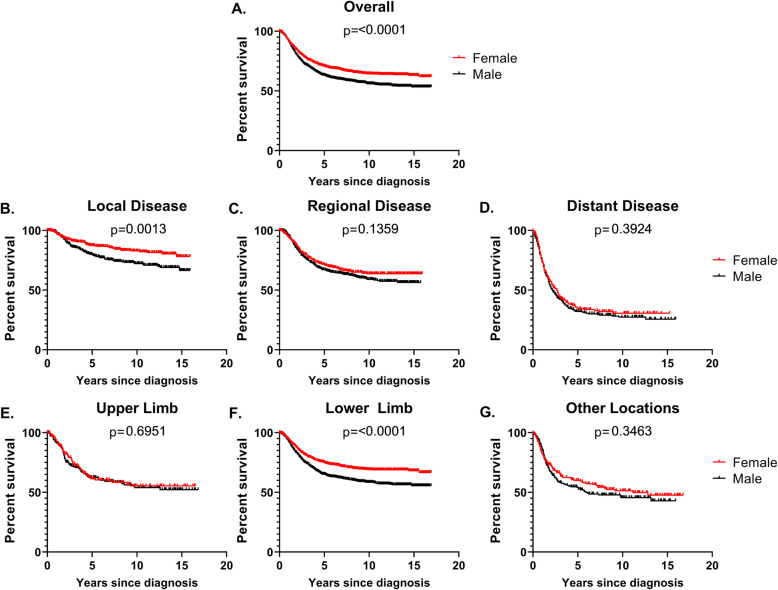
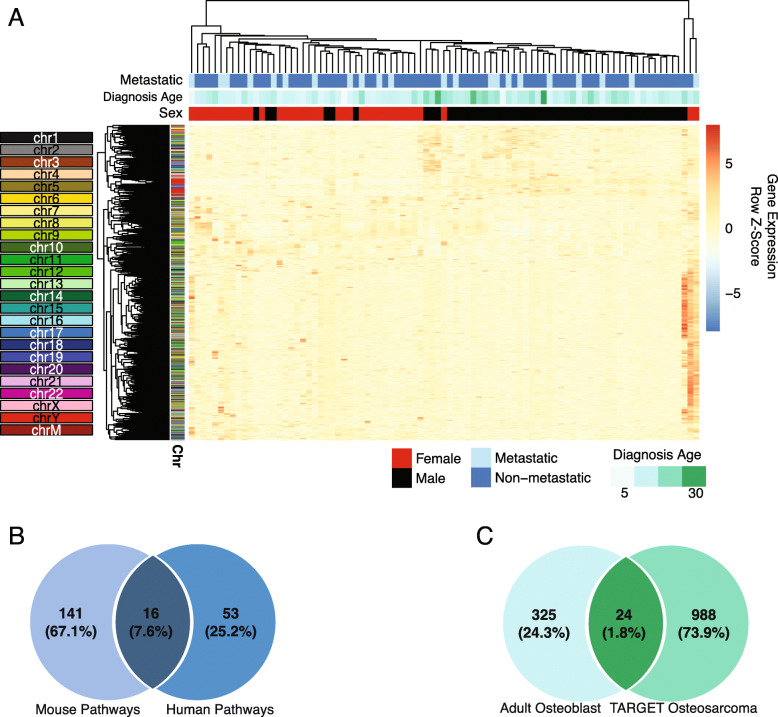
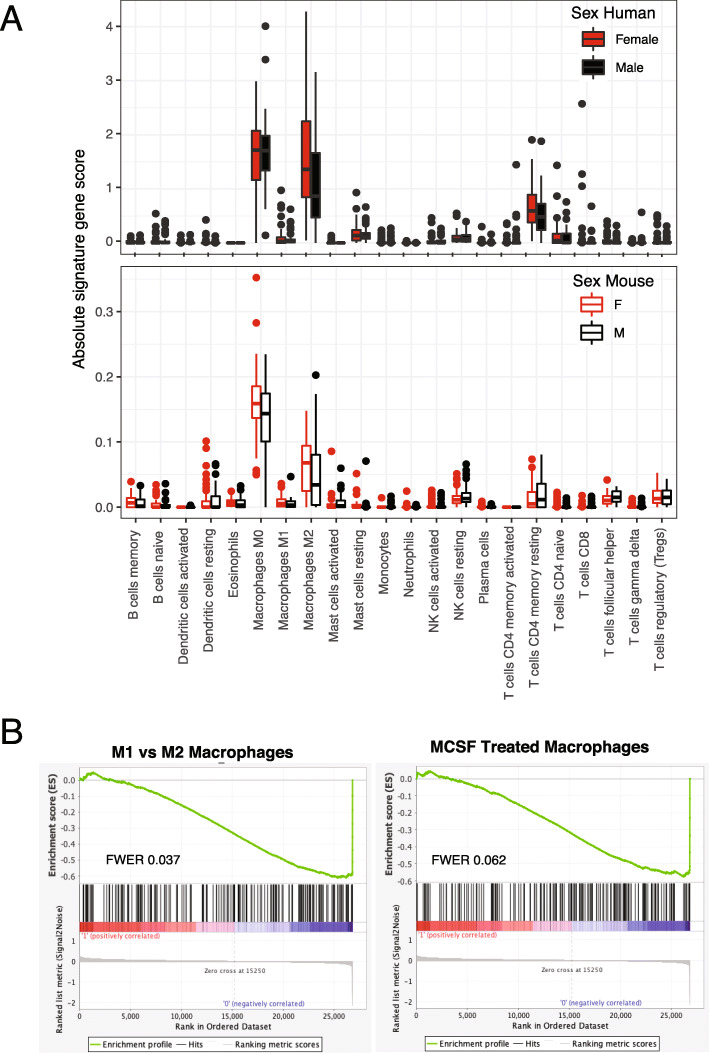
Abstract Background Males < 40 years old are more likely to be diagnosed with and die from osteosarcoma (OS). The underlying mechanisms may depend on sex differences in immune response. Methods We used SEER data to estimate survival differences between males and females aged < 40 years at OS diagnosis. In NCI TARGET-OS cases, we determined sex differences in gene expression, conducted Gene Set Enrichment Analysis (GSEA), and applied the LM22 signature to identify biologic sex differences. We compared sex differences in gene expression profiles in TARGET-OS to those observed inSleeping Beauty(SB) transposon mutagenesis acceleratedTrp53R270H-mutant mouse-OS and healthy adult osteoblasts. Results Males had worse 17-year overall survival than females (SEERp< 0.0001). From 87 TARGET-OS cases, we observed 1018 genes and 69 pathways that differed significantly by sex (adjustedp< 0.05). Pathway and gene lists overlapped with those from mice (p= 0.03) and healthy osteoblasts (p= 0.017), respectively. Pathways that differed significantly by sex were largely immune-based and included the PD-1/PD-L1 immunotherapy pathway. We observed sex differences in M2 macrophages (LM22;p= 0.056) and M1-M2 macrophage transition (GSEA;p= 0.037) in TARGET-OS. LM22 trends were similar in mice. Twenty-four genes differentially expressed by sex in TARGET-OS had existing cancer therapies. Conclusions Sex differences in OS gene expression were similar across species and centered on immune pathways. Identified sex-specific therapeutic targets may improve outcomes in young individuals with OS.
Overview
The claims and statistics of this paper haven’t been checked yet.
Free: it reads the open-access text and checks the first 5 claims that cite a source we can check. Create a free account to check every claim.
Integrity signals
Registry
Cites
Statistics
Figures
Verification
Claims the paper makes
The claims and statistics of this paper haven’t been checked yet.
Free: it reads the open-access text and checks the first 5 claims that cite a source we can check. Create a free account to check every claim.
Claims other papers make about this one
Each is checked against this paper’s own text: does it say what the citing paper says it does?
The cited source says what the claim attributes to it.
In the citing paper
“the greater proportion of males in the LEN-IE vs IE arm (25 patients [62.5%] vs 21 patients [51.2%]) may have influenced the efficacy outcomes in OLIE, as previous research has suggested that males with osteosarcoma have worse outcomes than females.”
From Lenvatinib Plus Ifosfamide and Etoposide in Children and Young Adults With Relapsed Osteosarcoma (2024) · cites this paper as [45]
The cited source says what the claim attributes to it.
In the citing paper
“previous research has suggested that males with osteosarcoma have worse outcomes than females.”
From Lenvatinib Plus Ifosfamide and Etoposide in Children and Young Adults With Relapsed Osteosarcoma (2024) · cites this paper as [45]
Self-check
Percentages, sums and reported differences re-computed from the paper’s own numbers.
The self-check needs the paper’s full text.
Citations
Cites
Subramanian, A., Tamayo, P., Mootha, V. K., Mukherjee, S., Ebert, B. L., Gillette, M. A., Paulovich, A., Pomeroy, S. L., Golub, T. R., Lander, E. S., et al. (2005) · Proceedings of the National Academy of Sciences · doi:10.1073/pnas.0506580102 · Cited by 53,625 · cited 1×
“In the GSEA immunologic gene set (C7) [24] (Supplemental Table 8 and 9), few strong enrichments emerged in mouse-OS and in TARG ET-OS females.”
BackgroundRobust enumeration of cell subsets from tissue expression profiles
Newman, A. M., Liu, C. L., Green, M. R., Gentles, A. J., Feng, W., Xu, Y., Hoang, C. D., Diehn, M., & Alizadeh, A. A. (2015) · Nature Methods · doi:10.1038/nmeth.3337 · Cited by 13,224
Sex differences in immune responses
Klein, S. L., & Flanagan, K. L. (2016) · Nature Reviews Immunology · doi:10.1038/nri.2016.90 · Cited by 6,370
The Reactome pathway Knowledgebase
Fabregat, A., Sidiropoulos, K., Garapati, P., Gillespie, M., Hausmann, K., Haw, R., Jassal, B., Jupe, S., Korninger, F., McKay, S., et al. (2016) · Nucleic Acids Research · doi:10.1093/nar/gkv1351 · Cited by 5,605
Visualizing and interpreting cancer genomics data via the Xena platform
Goldman, M. J., Craft, B., Hastie, M., Repečka, K., McDade, F., Kamath, A., Banerjee, A., Luo, Y., Rogers, D., Brooks, A. N., et al. (2020) · Nature Biotechnology · doi:10.1038/s41587-020-0546-8 · Cited by 4,481 · cited 1×
“87 of the 285 TARGET cases to determine sex differences in gene expression [21].”
BackgroundMassive genomic rearrangement acquired in a single catastrophic event during cancer development
Stephens, P. J., Greenman, C. D., Fu, B., Yang, F., Bignell, G. R., Mudie, L. J., Pleasance, E. D., Lau, K. W., Beare, D., Stebbings, L. A., et al. (2011) · Cell · doi:10.1016/j.cell.2010.11.055 · Cited by 2,414 · cited 1×
“Investigations into the somatic landscape of pediatric OS have reported much lower mutation frequencies than adult tumors [8], shown complex karyotypes characterized by chromosome arms losses/gains [9], and found frequent chromothripsis [10].”
BackgroundMirabello, L., Troisi, R. J., & Savage, S. A. (2009) · Cancer · doi:10.1002/cncr.24121 · Cited by 2,199 · cited 1×
“OS has dismal 5-year survival at 60-70% [6].”
BackgroundThe reactome pathway knowledgebase
Jassal, B., Matthews, L., Viteri, G., Gong, C., Lorente, P., Fabregat, A., Sidiropoulos, K., Cook, J., Gillespie, M., Haw, R., et al. (2019) · Nucleic Acids Research · doi:10.1093/nar/gkz1031 · Cited by 2,159
The landscape of genomic alterations across childhood cancers
ICGC PedBrain-Seq Project, Gröbner, S. N., ICGC MMML-Seq Project, Worst, B. C., Weischenfeldt, J., Buchhalter, I., Kleinheinz, K., Rudneva, V. A., Johann, P. D., Balasubramanian, G. P., et al. (2018) · Nature · doi:10.1038/nature25480 · Cited by 1,572 · cited 1×
“Investigations into the somatic landscape of pediatric OS have reported much lower mutation frequencies than adult tumors [8], shown complex karyotypes characterized by chromosome arms losses/gains [9], and found frequent chromothripsis [10].”
BackgroundOsteosarcoma: Current Treatment and a Collaborative Pathway to Success
Isakoff, M. S., Bielack, S. S., Meltzer, P., & Gorlick, R. (2015) · Journal of Clinical Oncology · doi:10.1200/jco.2014.59.4895 · Cited by 1,567 · cited 1×
“These findings suggest there may be opportunities to use existing therapies in a sexspecific manner to improve the outcomes for OS, which would be a welcomed advancement in a cancer with poor outcomes and little treatment progress since the mid-80s [26].”
BackgroundTranslational biology of osteosarcoma
Kansara, M., Teng, M. W., Smyth, M. J., & Thomas, D. M. (2014) · Nature Reviews Cancer · doi:10.1038/nrc3838 · Cited by 1,294
The X chromosome in immune functions: when a chromosome makes the difference
Libert, C., Dejager, L., & Pinheiro, I. (2010) · Nature Reviews Immunology · doi:10.1038/nri2815 · Cited by 781
Revisiting Li-Fraumeni Syndrome From TP53 Mutation Carriers
Bougeard, G., Renaux-Petel, M., Flaman, J.-M., Charbonnier, C., Fermey, P., Belotti, M., Gauthier-Villars, M., Stoppa-Lyonnet, D., Consolino, E., Brugières, L., et al. (2015) · Journal of Clinical Oncology · doi:10.1200/jco.2014.59.5728 · Cited by 760
TAMeless traitors: macrophages in cancer progression and metastasis
Aras, S., & Zaidi, M. R. (2017) · British Journal of Cancer · doi:10.1038/bjc.2017.356 · Cited by 609 · cited 1×
“Macrophages, an important immune system component with an identified role in cancer metastasis, including OS [16, 35–37], were identified as differing by sex in TARGET-OS and mouse-OS [38].”
BackgroundPerry, J. A., Kiezun, A., Tonzi, P., Van Allen, E. M., Carter, S. L., Baca, S. C., Cowley, G. S., Bhatt, A. S., Rheinbay, E., Pedamallu, C. S., et al. (2014) · Proceedings of the National Academy of Sciences · doi:10.1073/pnas.1419260111 · Cited by 481 · cited 6×
“malities, genomic studies have also found that OS frequently harbors TP53 mutations [12], which echoes”
BackgroundInfluentialGermline and somatic genetics of osteosarcoma — connecting aetiology, biology and therapy
Gianferante, D. M., Mirabello, L., & Savage, S. A. (2017) · Nature Reviews Endocrinology · doi:10.1038/nrendo.2017.16 · Cited by 477
SEX DIFFERENCES IN SUSCEPTIBILITY TO INFECTIONS
Washburn, T. C., Medearis, D. N., & Childs, B. (1965) · Pediatrics · doi:10.1542/peds.35.1.57 · Cited by 299
Immuno-genomic landscape of osteosarcoma
Wu, C.-C., Beird, H. C., Andrew Livingston, J., Advani, S., Mitra, A., Cao, S., Reuben, A., Ingram, D., Wang, W.-L., Ju, Z., et al. (2020) · Nature Communications · doi:10.1038/s41467-020-14646-w · Cited by 251
Mirabello, L., Zhu, B., Koster, R., Karlins, E., Dean, M., Yeager, M., Gianferante, M., Spector, L. G., Morton, L. M., Karyadi, D., et al. (2020) · JAMA Oncology · doi:10.1001/jamaoncol.2020.0197 · Cited by 243 · cited 3×
“Specifically, CDK4 [12], LCK [16, 25], HLA-DOA [16], ROS1 [16, 25], FLT3 [16], and TP53 [12].”
BackgroundSelf-citationSex-associated molecular differences for cancer immunotherapy
Ye, Y., Jing, Y., Li, L., Mills, G. B., Diao, L., Liu, H., & Han, L. (2020) · Nature Communications · doi:10.1038/s41467-020-15679-x · Cited by 243 · cited 1×
“It is hypothesized that the female immune environment has higher baseline activity so the addition of immunotherapy does not create as large of an effect [42, 43]; however, this remains to be evaluated in the pediatric and young adult populations but should be studied to determine the potential clinical benefit of imm…”
BackgroundMoriarity, B. S., Otto, G. M., Rahrmann, E. P., Rathe, S. K., Wolf, N. K., Weg, M. T., Manlove, L. A., LaRue, R. S., Temiz, N. A., Molyneux, S. D., et al. (2015) · Nature Genetics · doi:10.1038/ng.3293 · Cited by 240 · cited 2×
“As such, our aim was to evaluate sex differences in OS gene expression among children and young adults using the publicly available NCI Therapeutically Applicable Research to Generate Effective Treatments (TARGET) initiative data and place these findings in context to those observed in a genetically engineered mouse m…”
MethodSelf-citationComplement genes contribute sex-biased vulnerability in diverse disorders
Schizophrenia Working Group of the Psychiatric Genomics Consortium, Kamitaki, N., Sekar, A., Handsaker, R. E., de Rivera, H., Tooley, K., Morris, D. L., Taylor, K. E., Whelan, C. W., Tombleson, P., et al. (2020) · Nature · doi:10.1038/s41586-020-2277-x · Cited by 238
Cells of origin in osteosarcoma: Mesenchymal stem cells or osteoblast committed cells?
Mutsaers, A. J., & Walkley, C. R. (2014) · Bone · doi:10.1016/j.bone.2014.02.003 · Cited by 233
Heymann, M.-F., Lézot, F., & Heymann, D. (2019) · Cellular Immunology · doi:10.1016/j.cellimm.2017.10.011 · Cited by 233
Langbecker, D., & Janda, M. (2015) · Frontiers in Oncology · doi:10.3389/fonc.2015.00001 · Cited by 228
Enhanced T-Cell Immunity to Osteosarcoma Through Antibody Blockade of PD-1/PD-L1 Interactions
Lussier, D. M., O’Neill, L., Nieves, L. M., McAfee, M. S., Holechek, S. A., Collins, A. W., Dickman, P., Jacobsen, J., Hingorani, P., & Blattman, J. N. (2015) · Journal of Immunotherapy · doi:10.1097/cji.0000000000000065 · Cited by 197 · cited 1×
“In vitro and in vivo studies have shown that PD-1 blockade enhances cisplatin effectiveness and may improve outcomes in humans [40, 41].”
BackgroundSex Differences in Cancer Immunotherapy Efficacy, Biomarkers, and Therapeutic Strategy
Wang, S., Cowley, L. A., & Liu, X.-S. (2019) · Molecules · doi:10.3390/molecules24183214 · Cited by 180 · cited 1×
“It is hypothesized that the female immune environment has higher baseline activity so the addition of immunotherapy does not create as large of an effect [42, 43]; however, this remains to be evaluated in the pediatric and young adult populations but should be studied to determine the potential clinical benefit of imm…”
BackgroundDysregulation of macrophage polarization is associated with the metastatic process in osteosarcoma
Dumars, C., Ngyuen, J.-M., Gaultier, A., Lanel, R., Corradini, N., Gouin, F., Heymann, D., & Heymann, M.-F. (2016) · Oncotarget · doi:10.18632/oncotarget.13055 · Cited by 174
Effects of Halogen, Chalcogen, Pnicogen, and Tetrel Bonds on IR and NMR Spectra
Lu, J., & Scheiner, S. (2019) · Molecules · doi:10.3390/molecules24152822 · Cited by 160
Germline TP53 Variants and Susceptibility to Osteosarcoma
Mirabello, L., Yeager, M., Mai, P. L., Gastier-Foster, J. M., Gorlick, R., Khanna, C., Patiño-Garcia, A., Sierrasesúmaga, L., Lecanda, F., Andrulis, I. L., et al. (2015) · JNCI Journal of the National Cancer Institute · doi:10.1093/jnci/djv101 · Cited by 155
Frequent amplification and rearrangement of chromosomal bands 6p12‐p21 and 17p11.2 in osteosarcoma
Lau, C. C., Harris, C. P., Lu, X., Perlaky, L., Gogineni, S., Chintagumpala, M., Hicks, J., Johnson, M. E., Davino, N. A., Huvos, A. G., et al. (2004) · Genes, Chromosomes and Cancer · doi:10.1002/gcc.10291 · Cited by 148 · cited 1×
“Investigations into the somatic landscape of pediatric OS have reported much lower mutation frequencies than adult tumors [8], shown complex karyotypes characterized by chromosome arms losses/gains [9], and found frequent chromothripsis [10].”
BackgroundM2 macrophages promote NSCLC metastasis by upregulating CRYAB
Guo, Z., Song, J., Hao, J., Zhao, H., Du, X., Li, E., Kuang, Y., Yang, F., Wang, W., Deng, J., et al. (2019) · Cell Death & Disease · doi:10.1038/s41419-019-1618-x · Cited by 140
Height at diagnosis and birth-weight as risk factors for osteosarcoma
Mirabello, L., Pfeiffer, R., Murphy, G., Daw, N. C., Patiño-Garcia, A., Troisi, R. J., Hoover, R. N., Douglass, C., Schüz, J., Craft, A. W., et al. (2011) · Cancer Causes & Control · doi:10.1007/s10552-011-9763-2 · Cited by 116
Relationship Between Timing of Peak Height Velocity and Pubertal Staging in Boys and Girls
Granados, A., Gebremariam, A., & Lee, J. M. (2015) · Journal of Clinical Research in Pediatric Endocrinology · doi:10.4274/jcrpe.2007 · Cited by 116
Scott, M. C., Temiz, N. A., Sarver, A. E., LaRue, R. S., Rathe, S. K., Varshney, J., Wolf, N. K., Moriarity, B. S., O'Brien, T. D., Spector, L. G., et al. (2018) · Cancer Research · doi:10.1158/0008-5472.can-17-0576 · Cited by 113 · cited 3×
“Specifically, CDK4 [12], LCK [16, 25], HLA-DOA [16], ROS1 [16, 25], FLT3 [16], and TP53 [12].”
BackgroundSelf-citationSex ratio among childhood cancers by single year of age
Williams, L. A., Richardson, M., Marcotte, E. L., Poynter, J. N., & Spector, L. G. (2019) · Pediatric Blood & Cancer · doi:10.1002/pbc.27620 · Cited by 113 · cited 3×
“Based on our previous work examining sex differences in childhood cancer incidence and outcomes [2, 7], we hypothesized that the female immune system may contribute to their better survival, particularly for OS.”
BackgroundSelf-citationHow job stress influences job performance among Chinese healthcare workers: a cross-sectional study
Deng, J., Guo, Y., Ma, T., Yang, T., & Xu, T. (2019) · Environmental Health and Preventive Medicine · doi:10.1186/s12199-018-0758-4 · Cited by 102
Population genomics in a disease targeted primary cell model
Grundberg, E., Kwan, T., Ge, B., Lam, K. C. L., Koka, V., Kindmark, A., Mallmin, H., Dias, J., Verlaan, D. J., Ouimet, M., et al. (2009) · Genome Research · doi:10.1101/gr.095224.109 · Cited by 94 · cited 2×
“As such, our aim was to evaluate sex differences in OS gene expression among children and young adults using the publicly available NCI Therapeutically Applicable Research to Generate Effective Treatments (TARGET) initiative data and place these findings in context to those observed in a genetically engineered mouse m…”
MethodResultKim, J., Park, K., Jung, H. H., Lee, E., Cho, E. Y., Lee, K. H., Bae, S. Y., Lee, S. K., Kim, S. W., Lee, J. E., et al. (2016) · Cancer Research and Treatment · doi:10.4143/crt.2015.430 · Cited by 77 · cited 1×
“In adult breast cancers, missense and deletion mutations had differential impacts on gene expression that were associated with prognoses [29].”
BackgroundGender disparity in pediatrics: a review of the current literature
Piccini, P., Montagnani, C., & de Martino, M. (2018) · The Italian Journal of Pediatrics/Italian journal of pediatrics · doi:10.1186/s13052-017-0437-x · Cited by 69
Immunotherapy of Childhood Sarcomas
Roberts, S. S., Chou, A. J., & Cheung, N.-K. V. (2015) · Frontiers in Oncology · doi:10.3389/fonc.2015.00181 · Cited by 65 · cited 1×
“It is hypothesized that the female immune environment has higher baseline activity so the addition of immunotherapy does not create as large of an effect [42, 43]; however, this remains to be evaluated in the pediatric and young adult populations but should be studied to determine the potential clinical benefit of imm…”
BackgroundSurvival Differences Between Males and Females Diagnosed With Childhood Cancer
Williams, L. A., & Spector, L. G. (2019) · JNCI Cancer Spectrum · doi:10.1093/jncics/pkz032 · Cited by 63 · cited 4×
“Based on our previous work examining sex differences in childhood cancer incidence and outcomes [2, 7], we hypothesized that the female immune system may contribute to their better survival, particularly for OS.”
BackgroundMethodSelf-citationLee, J. M., Park, C. K., Yoon, H. K., Jo, Y., Woo, I. S., Kim, H. R., Kim, S. Y., & Kim, T. J. (2018) · Thoracic Cancer · doi:10.1111/1759-7714.12917 · Cited by 50 · cited 1×
“ROS1 is important in lung cancer with a correlative relationship to PD-L1 expression [28].”
BackgroundBlocking the PD-1/PD-L1 axis enhanced cisplatin chemotherapy in osteosarcoma in vitro and in vivo
Liu, X., He, S., Wu, H., Xie, H., Zhang, T., & Deng, Z. (2019) · Environmental Health and Preventive Medicine · doi:10.1186/s12199-019-0835-3 · Cited by 49 · cited 1×
“In vitro and in vivo studies have shown that PD-1 blockade enhances cisplatin effectiveness and may improve outcomes in humans [40, 41].”
BackgroundPrognostic value of programmed death-ligand 1 in sarcoma: a meta-analysis
Zhu, Z., Jin, Z., Zhang, M., Tang, Y., Yang, G., Yuan, X., Yao, J., & Sun, D. (2017) · Oncotarget · doi:10.18632/oncotarget.19168 · Cited by 45
Li, X., Seebacher, N. A., Garbutt, C., Ma, H., Gao, P., Xiao, T., Hornicek, F. J., & Duan, Z. (2018) · Cell Death & Disease · doi:10.1038/s41419-018-0474-4 · Cited by 41
A comparison of risk factors for metastasis at diagnosis in humans and dogs with osteosarcoma
Diessner, B. J., Marko, T. A., Scott, R. M., Eckert, A. L., Stuebner, K., Hohenhaus, A. E., Selting, K. A., Largaespada, D. A., Modiano, J. F., & Spector, L. G. (2019) · Cancer Medicine · doi:10.1002/cam4.2177 · Cited by 14 · cited 2×
“OS was categorized using ICD-O-3 codes 9180-9183, 9185-9187, 9192-9194; excluding OS in Paget disease (9184; date accessed: April 30, 2020) [20].”
MethodSelf-citationPanizza, D., Scaramuzzo, R. T., Moscuzza, F., Vannozzi, I., Ciantelli, M., Gentile, M., Baldoli, I., Tognarelli, S., Boldrini, A., & Cuttano, A. (2018) · The Italian Journal of Pediatrics/Italian journal of pediatrics · doi:10.1186/s13052-017-0435-z · Cited by 8
Research works printed but not linked: 1
- Mirabello L Troisi RJ Savage SA Osteosarcoma incidence and survival rates from 1973 to 2004: data from the surveillance, epidemiology, and end results program Cancer. 2009 115 7 1531 1543 19197972 PMC2813207 · DOI · Paper page
Cited by
Biz, C., Khamisy‐Farah, R., Puce, L., Szarpak, Ł., Converti, M., Ceylan, H. İ., Crimì, A., Bragazzi, N. L., & Ruggieri, P. (2024) · Biomedicines · doi:10.3390/biomedicines12050974 · Cited by 40
Zhao, Y., Chen, D., Yin, J., Xie, J., Sun, C., & Lu, M. (2022) · Frontiers in Genetics · doi:10.3389/fgene.2022.788580 · Cited by 40
“LM22 is a leukocyte gene signature matrix that contains the expression levels of 547 genes for distinguishing 22 human hematopoietic cell phenotypes (Mills et al., 2021).”
BackgroundLenvatinib Plus Ifosfamide and Etoposide in Children and Young Adults With Relapsed Osteosarcoma
Gaspar, N., Hung, G.-Y., Strauss, S. J., Campbell-Hewson, Q., Dela Cruz, F. S., Glade Bender, J. L., Koh, K.-N., Whittle, S. B., Chan, G. C.-F., Gerber, N. U., et al. (2024) · JAMA Oncology · doi:10.1001/jamaoncol.2024.4381 · Cited by 28
Williams, L. A., Barragan, S., Lu, Z., Weigel, B. J., & Spector, L. G. (2024) · Cancer Epidemiology · doi:10.1016/j.canep.2024.102565 · Cited by 18
Self-citationZhang, L., Jiang, H., & Ma, H. (2025) · Frontiers in Immunology · doi:10.3389/fimmu.2025.1548527 · Cited by 16
Metadata
- Authors
- Mills, L. J., Spector, L. G., Largaespada, D. A., & Williams, L. A.
- Affiliations
- University of Minnesota (US)
- Corresponding author
- Williams, Lindsay A.
- Venue
- Biology of Sex Differences
- Published
- 2021-01-06
- Volume
- 12
- Issue
- 1
- Pages
- 5-5
- ISSN
- 2042-6410 (ISSN-L)
- PMC
- PMC7789366
- OpenAlex
- W3120547481
- Cited by
- 17
- References
- 49
- Citations by year
- 2026: 3 · 2025: 3 · 2024: 5 · 2023: 2 · 2022: 3 · 2021: 1
- FWCI
- 1.78
- Type
- journal article
- Language
- en
- Open access
- gold
- doi.org
- Licence
- cc-by
- creativecommons.org/licenses/by/4.0/ (tdm)
- creativecommons.org/licenses/by/4.0/ (vor)
- Locations
- Biology of Sex Differences (publishedVersion, cc-by)
- Europe PMC (PubMed Central) (publishedVersion, other-oa)
- PubMed Central (publishedVersion, cc-by)
- PubMed (publishedVersion)
- DOAJ (DOAJ: Directory of Open Access Journals) (submittedVersion, cc-by-sa)
- Funders
- Children's Cancer Research Fund
- American Cancer Society
- Topics
- Health Sciences › Medicine › Oncology › Sarcoma Diagnosis and Treatment
- Health Sciences › Medicine › Oncology › Cancer Immunotherapy and Biomarkers
- Health Sciences › Medicine › Public Health, Environmental and Occupational Health › Sex and Gender in Healthcare
- Keywords
- osteosarcoma, sex differences, sex differences in gene expression, immune response, M2 macrophages, PD-1/PD-L1 pathway, immunotherapy, overall survival, osteoblasts
- MeSH terms
- Animals, Bone Neoplasms, Female, Male, Osteoblasts, Osteosarcoma, Sex Characteristics, Mice, Transcriptome
About these checks
Registry, retraction, Cites and statistics results are computed, not judged, with one exception: a printed reference that no index lists is read once by a model before it counts as a citation error. Claims are extracted by a model and kept only when their quote appears verbatim in the text; each cited source is then checked, with a model’s help, for whether it says what the claim relies on. Those verdicts can be wrong — read the claim’s quote and the cited source before relying on one.
Statistics and arithmetic are recomputed, not judged.
Confidence bands are shown only for fields calibrated on our annotated test set. None is calibrated yet, so no band is shown.
What counts as a claim ›How we measure confidence ›How we check this ›
Are you an author, or do you see a problem with this page? Request a review
Data sources
Bibliographic data: Semantic Scholar, OpenAlex, Crossref.
Contains information from the Semantic Scholar Academic Graph Datasets, made available under the ODC Attribution License (ODC-BY 1.0).
Semantic Scholar’s data is described in: Kinney, R., et al. (2023). The Semantic Scholar Open Data Platform. arXiv:2301.10140.
