

The DOI matches its Crossref record; 71 of the 71 references it cites were found in a registry or an index.
Deep-learning: investigating deep neural networks hyper-parameters and comparison of performance to shallow methods for modeling bioactivity data
Open accessAbstract
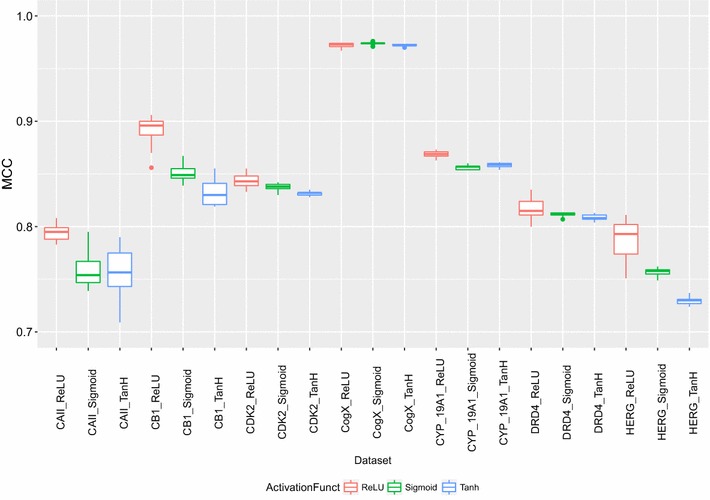
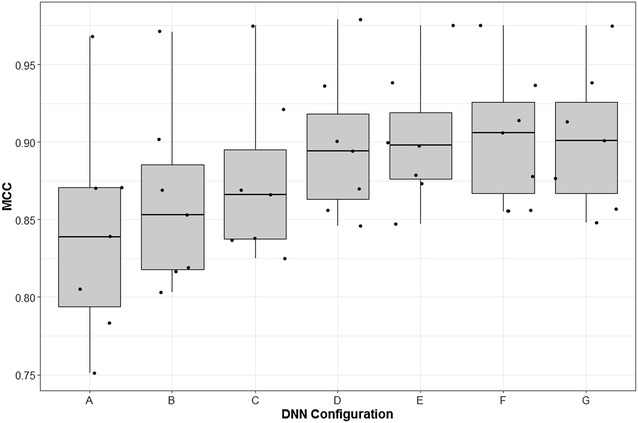
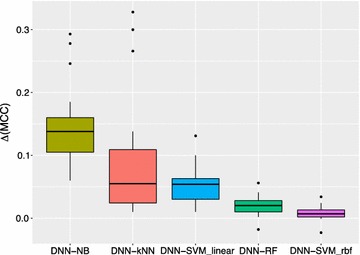
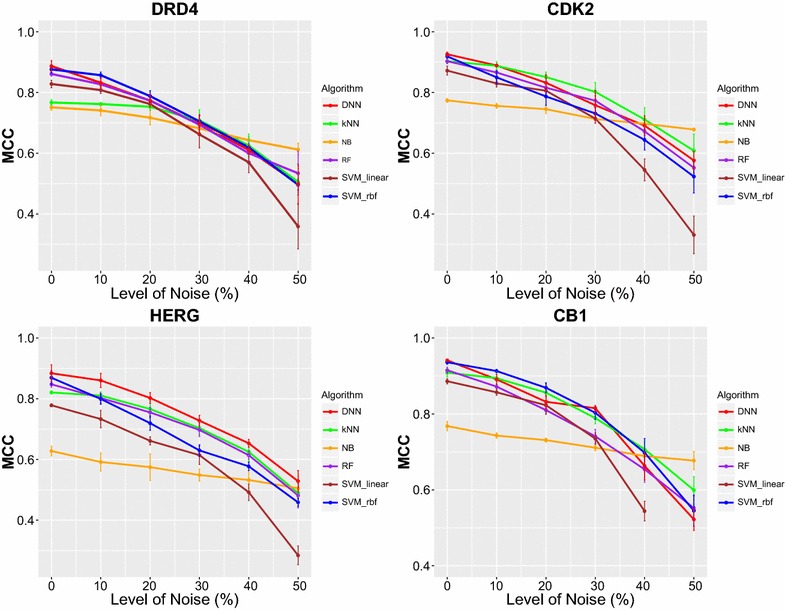
BACKGROUND: In recent years, research in artificial neural networks has resurged, now under the deep-learning umbrella, and grown extremely popular. Recently reported success of DL techniques in crowd-sourced QSAR and predictive toxicology competitions has showcased these methods as powerful tools in drug-discovery and toxicology research. The aim of this work was dual, first large number of hyper-parameter configurations were explored to investigate how they affect the performance of DNNs and could act as starting points when tuning DNNs and second their performance was compared to popular methods widely employed in the field of cheminformatics namely Naïve Bayes, k-nearest neighbor, random forest and support vector machines. Moreover, robustness of machine learning methods to different levels of artificially introduced noise was assessed. The open-source Caffe deep-learning framework and modern NVidia GPU units were utilized to carry out this study, allowing large number of DNN configurations to be explored. RESULTS: We show that feed-forward deep neural networks are capable of achieving strong classification performance and outperform shallow methods across diverse activity classes when optimized. Hyper-parameters that were found to play critical role are the activation function, dropout regularization, number hidden layers and number of neurons. When compared to the rest methods, tuned DNNs were found to statistically outperform, with p value <0.01 based on Wilcoxon statistical test. DNN achieved on average MCC units of 0.149 higher than NB, 0.092 than kNN, 0.052 than SVM with linear kernel, 0.021 than RF and finally 0.009 higher than SVM with radial basis function kernel. When exploring robustness to noise, non-linear methods were found to perform well when dealing with low levels of noise, lower than or equal to 20%, however when dealing with higher levels of noise, higher than 30%, the Naïve Bayes method was found to perform well and even outperform at the highest level of noise 50% more sophisticated methods across several datasets.
Overview
The claims and statistics of this paper haven’t been checked yet.
Run the check — free, no account needed. It reads the open-access text and checks the sources it cites.
Integrity signals
Registry
Cites
Statistics
Figures
Verification
Claims the paper makes
The claims and statistics of this paper haven’t been checked yet.
Run the check — free, no account needed. It reads the open-access text and checks the sources it cites.
Claims other papers make about this one
Each is checked against this paper’s own text: does it say what the citing paper says it does?
In the citing paper
“This comparison demonstrated that DNNs and support vector machines appear to be superior methods regardless of the descriptor type for training and 5-fold cross validation.”
From Exploiting machine learning for end-to-end drug discovery and development (2019) · cites this paper as [51]
In the citing paper
“Conversely, external testing of DNN models with a large test set did not perform as well as other machine learning methods.”
From Exploiting machine learning for end-to-end drug discovery and development (2019) · cites this paper as [51]
Self-check
Percentages, sums and reported differences re-computed from the paper’s own numbers.
The self-check needs the paper’s full text.
Citations
Cites
Breiman, L. (2001) · Machine Learning · doi:10.1023/a:1010933404324 · Cited by 133,538 · cited 1×
“RF was developed by Breiman and Cutler [60] and presents a number of advantages, which makes it attractive and well suited for chemin-formatic applications; (a) it is robust when dealing with large number of features, (b) achieves generally good performance, (c) resilient to over-fitting and (d)…”
LeCun, Y., Bengio, Y., & Hinton, G. (2015) · Nature · doi:10.1038/nature14539 · Cited by 84,126
Scikit-learn: Machine Learning in Python
Pedregosa, F., Varoquaux, G., Gramfort, A., Michel, V., Thirion, B., Grisel, O., Blondel, M., Müller, A., Nothman, J., Louppe, G., et al. (2012) · arXiv · doi:10.48550/arxiv.1201.0490 · Cited by 71,016
Cortes, C., & Vapnik, V. (1995) · Machine Learning · doi:10.1007/bf00994018 · Cited by 59,421
LIBSVM: A library for support vector machines
Chang, C.-C., & Lin, C.-J. (2011) · ACM Transactions on Intelligent Systems and Technology · doi:10.1145/1961189.1961199 · Cited by 40,918
Cortes, C., & Vapnik, V. N. (1995) · Machine Learning · doi:10.1023/a:1022627411411 · Cited by 34,565 · cited 1×
“SVMs was proposed by Cor-tes and Vapnik and can be applied for classification, regression and outliers detection tasks [65].”
(2014) · Cited by 33,419
Learning representations by back-propagating errors
Rumelhart, D. E., Hinton, G. E., & Williams, R. J. (1986) · Nature · doi:10.1038/323533a0 · Cited by 31,892 · cited 1×
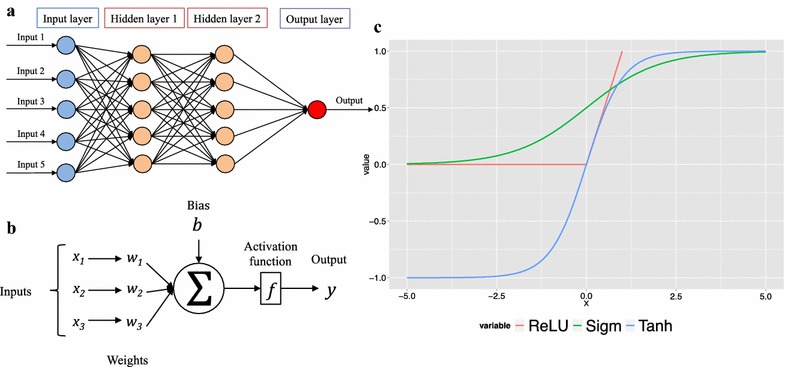
“Deep neural networks are typically trained, by updating and adjusting neurons weights and biases, utilizing the supervised learning back-propagation algorithm in conjunction with optimization technique such as stochastic gradient descent [29, 30].”
A logical calculus of the ideas immanent in nervous activity
McCulloch, W. S., & Pitts, W. (1943) · The Bulletin of Mathematical Biophysics · doi:10.1007/bf02478259 · Cited by 18,566
Individual Comparisons by Ranking Methods
Wilcoxon, F. (1945) · Biometrics Bulletin · doi:10.2307/3001968 · Cited by 15,354
Research works printed but not linked: 2
- Aspuru-Guzik A, Duvenaud D, Maclaurin D, Aguilera-Iparraguire J, Gomez-Bombarelli R, Hirzel TD, Adams RP (2015) Convolutional networks on graphs for learning molecular fingerprints. In: Proceedings of neural information processing systems, Quebec, pp 2224–2232
- Barrett SJ, Langdon WB (2006) Advances in the application of machine learning techniques in drug discovery. Des Dev 36:99–110
Cited by
Sorted by citations
Items 301–317 of 317
Lin, J., Chen, C., Wei, F., & Sun, Y. (2025) · Geomatics Natural Hazards and Risk · doi:10.1080/19475705.2025.2601817
“The search spaces of these hyperparameters were determined based on previous studies (Koutsoukas et al. 2017; Rachmatullah et al. 2021; Rodrigues et al. 2022).”
Jiang, D., Wu, Z., HSIEH, C., Chen, G., Liao, B., Wang, Z., Shen, C., Cao, D., Wu, J., & Hou, T. (2021) · Figshare · doi:10.6084/m9.figshare.14053380
Naga, D., Muster, W., Musvasva, E., & Ecker, G. F. (2022) · Figshare · doi:10.6084/m9.figshare.19728815
Naga, D., Muster, W., Musvasva, E., & Ecker, G. F. (2022) · Figshare · doi:10.6084/m9.figshare.19728818
Dutschmann, T.-M., Kinzel, L., ter Laak, A., & Baumann, K. (2024) · Figshare · doi:10.6084/m9.figshare.26585574
Naga, D., Muster, W., Musvasva, E., & Ecker, G. F. (2022) · Figshare · doi:10.6084/m9.figshare.19728812
Modeling ADME/Tox for Drug Discovery in the Age of Data
Aniceto, N., Freitas, A. A., & Ghafourian, T. (2025) · Springer handbooks · doi:10.1007/978-3-031-81728-1_18 · Cited by 2
Catalyzing Drug Discovery Using Artificial Intelligence With Traditional Medicine
Taktaz, F., & Ghoran, S. H. (2026) · Advances in computational intelligence and robotics book series · doi:10.4018/979-8-3373-5258-9.ch002
Flexible Vis/NIR Wireless Sensing and Estimation with DeepEnsemble Learning for Pork
Yin, M., Liu, D., Yang, H., Shi, X., Xiong, G., Zhang, M., Zhu, T., Chen, L., Zhang, R., & Xiao, X. (2026) · Agriculture · doi:10.3390/agriculture16060650
Rodrigues, C. A., & Landre, J. (2026) · Proceedings of the Institution of Mechanical Engineers Part D Journal of Automobile Engineering · doi:10.1177/09544070261439992
Assessing driver subjectivity in a vehicle dynamic simulator through a deep learning-based framework
Rodrigues, C. A., & Landre, J. (2026) · Proceedings of the Institution of Mechanical Engineers Part D Journal of Automobile Engineering · doi:10.1177/09544070261443615
Asare, E. A., Abdul-Wahab, D., Kaufmann, E. E., Wahi, R. B., Ngaini, Z., Buah-Kwofie, A., & Dickson, A. R. (2026) · Chemometrics and Intelligent Laboratory Systems · doi:10.1016/j.chemolab.2026.105742
CoviPredX: AI-driven bioactivity prediction for small molecule therapeutics against SARS-CoV-2
Das, R., Sinnarasan, V. S. P., Paul, D., Sheikh, M. M. R., & Venkatesan, A. (2026) · Computational Biology and Chemistry · doi:10.1016/j.compbiolchem.2026.109167
Machine Learning Based Surrogate Modeling for Yarn Tension Prediction in Braiding Processes
Li, Y., Li, B., Zhang, Y., Li, C., Wang, Y., (58952), X. L., & Mo, J. (2026) · International Conference on Computer, Control and Robotics (ICCCR) · doi:10.1109/icccr69988.2026.11642737
Scalable and fair deep neural networks for imbalanced data using a multilevel graph-based approach
Bennett, R., & Razzaghi, T. (2026) · Expert Systems with Applications · doi:10.1016/j.eswa.2026.134330
Spektral analiz görsellerinde ölçekleme etkisi: Derin öğrenmede gizli bir parametre
Demirci, O., & Özşen, S. (2026) · Gazi Üniversitesi Mühendislik-Mimarlık Fakültesi Dergisi · doi:10.17341/gazimmfd.1746081
Metadata
- Authors
- Koutsoukas, A., Monaghan, K. J., Li, X., & Huan, J.
- Affiliations
- University of Kansas (US)
- Corresponding author
- Huan, Jun
- ORCID
- Venue
- Journal of Cheminformatics
- Published
- 2017-06-28
- Volume
- 9
- Issue
- 1
- Pages
- 42-42
- ISSN
- 1758-2946 (ISSN-L)
- PMC
- PMC5489441
- OpenAlex
- W2731161895
- Cited by
- 315
- References
- 69
- Citations by year
- 2026: 12 · 2025: 25 · 2024: 40 · 2023: 42 · 2022: 53 · 2021: 55 · 2020: 32 · 2019: 33 · 2018: 22 · 2017: 1
- FWCI
- 18.06
- Type
- journal article
- Language
- en
- Open access
- gold
- doi.org
- Locations
- Journal of Cheminformatics (publishedVersion, cc-by)
- PubMed Central (publishedVersion, cc-by)
- PubMed (publishedVersion)
- National University of Singapore (submittedVersion, cc-by)
- DOAJ (DOAJ: Directory of Open Access Journals) (submittedVersion)
- Funders
- National Science Foundation (CNS 1337899)
- Topics
- Life Sciences › Pharmacology, Toxicology and Pharmaceutics › Drug Discovery › Computational Drug Discovery Methods
- Physical Sciences › Materials Science › Materials Chemistry › Machine Learning in Materials Science
- Physical Sciences › Computer Science › Artificial Intelligence › Neural Networks and Applications
- Keywords
- deep neural network, hyperparameter optimization, bioactivity prediction, QSAR, predictive toxicology, feedforward neural networks, noise robustness, activation functions, dropout regularization, Caffe, drug discovery, naive Bayes, k-nearest neighbors, random forest, support vector machine
About these checks
Registry, retraction, Cites and statistics results are computed, not judged, with one exception: a printed reference that no index lists is read once by a model before it counts as a citation error. Claims are extracted by a model and kept only when their quote appears verbatim in the text; each cited source is then checked, with a model’s help, for whether it says what the claim relies on. Those verdicts can be wrong — read the claim’s quote and the cited source before relying on one.
Statistics and arithmetic are recomputed, not judged.
Confidence bands are shown only for fields calibrated on our annotated test set. None is calibrated yet, so no band is shown.
What counts as a claim ›How we measure confidence ›How we check this ›
Are you an author, or do you see a problem with this page? Request a review
