

Multiplexed CRISPR/Cas9 gene knockout with simple crRNA:tracrRNA co-transfection
The DOI matches its Crossref record; 8 of the 8 references it cites were found in a registry or an index.
Abstract
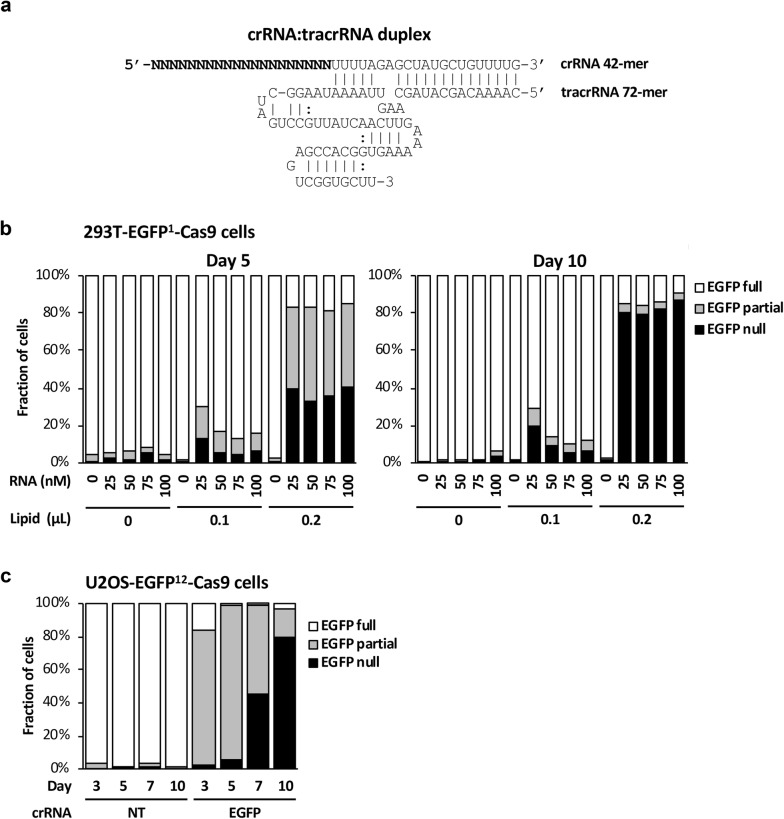
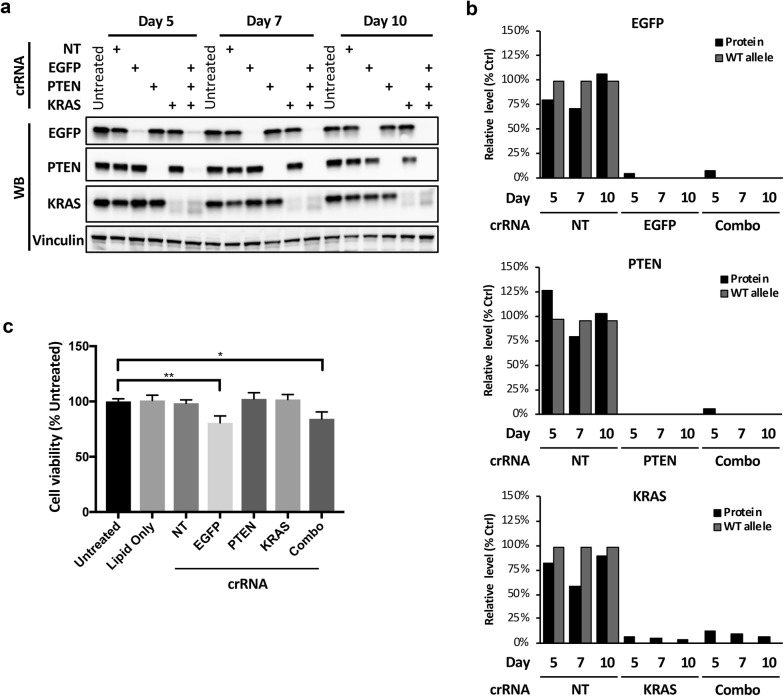
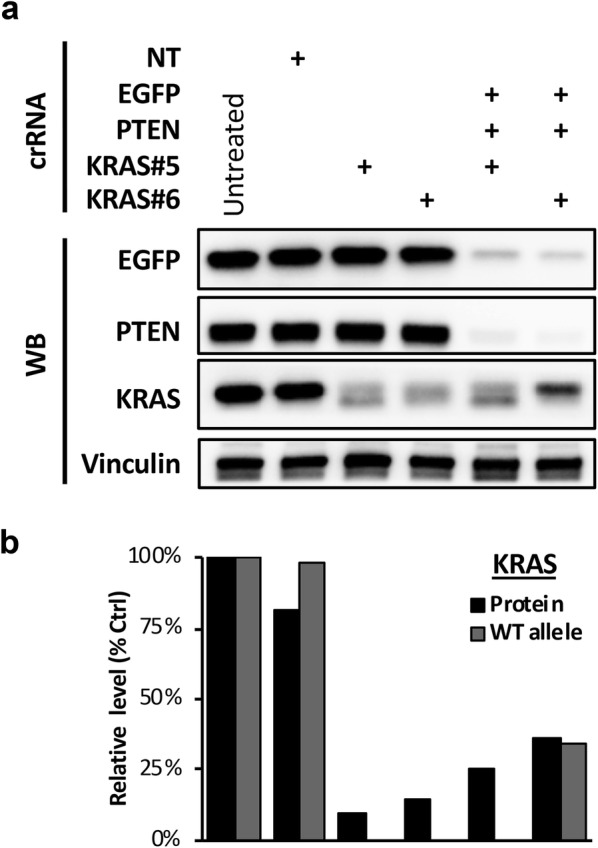
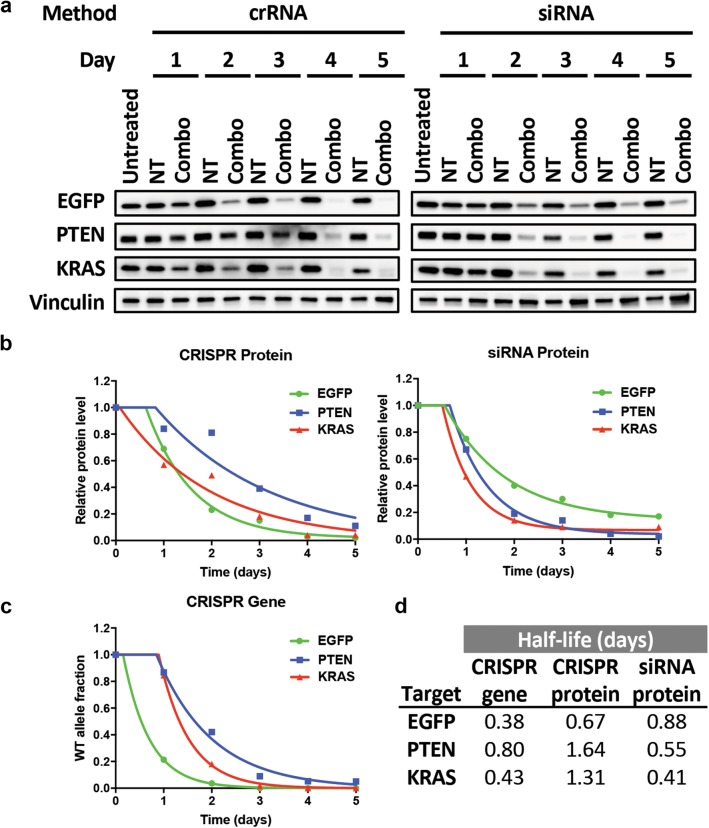
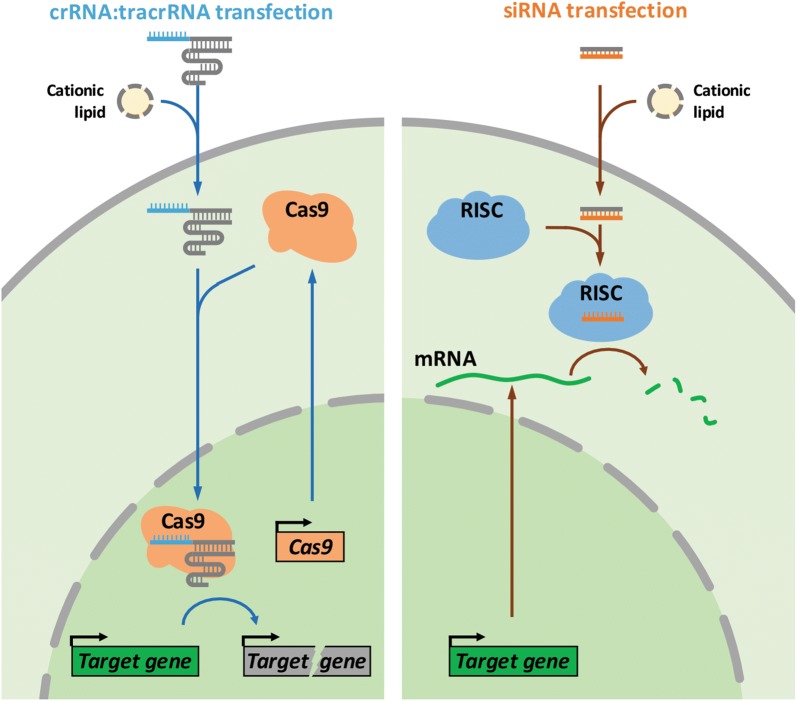
BACKGROUND: CRISPR/Cas9 mediated gene knockout is a powerful tool for genome editing with the ability to target multiple genes simultaneously. Establishing an efficient, multiplexed gene knockout system using CRISPR/Cas9 that is both simple and robust in its application would further advance the adoption of CRISPR/Cas9 for genetic studies. RESULTS: In this study, we present a simple, versatile and highly efficient method to achieve acute gene knockout with CRISPR/Cas9 using chemically synthesized crRNA and tracrRNA oligos. We demonstrate that co-transfection of the crRNA:tracrRNA duplex into Cas9-expressing cells leads to target gene mutation and loss of target protein expression in the majority of the cell population. We also show that delivering three crRNAs targeting EGFP, KRAS and PTEN in the same reaction leads to the simultaneous knockout of all three genes. Direct comparison of multiplexed gene targeting by crRNA:tracrRNA and by siRNA indicates that these two methods are comparable in their efficiency and kinetics of gene silencing. CONCLUSIONS: Our method is a convenient yet powerful tool to enable rapid and scalable gene knockout using CRISPR/Cas9 in mammalian cells.
Overview
The claims and statistics of this paper haven’t been checked yet.
Free: it reads the open-access text and checks the first 5 claims that cite a source we can check. Create a free account to check every claim.
Integrity signals
Registry
Cites
Statistics
Figures
Verification
Claims the paper makes
The claims and statistics of this paper haven’t been checked yet.
Free: it reads the open-access text and checks the first 5 claims that cite a source we can check. Create a free account to check every claim.
Claims other papers make about this one
Each is checked against this paper’s own text: does it say what the citing paper says it does?
The cited source says what the claim attributes to it.
In the citing paper
“CRISPR/Cas9‐based gene‐editing by utilizing synthetic guide RNAs in the Cas9‐expressing cells can produce results similar to those obtained with the stably expressed sgRNAs introduced by viral transduction.12, 13, 14”
Self-check
Percentages, sums and reported differences re-computed from the paper’s own numbers.
The self-check needs the paper’s full text.
Citations
Cites
Easy quantitative assessment of genome editing by sequence trace decomposition
Brinkman, E. K., Chen, T., Amendola, M., & van Steensel, B. (2014) · Nucleic Acids Research · doi:10.1093/nar/gku936 · Cited by 2,390
Identification and characterization of essential genes in the human genome
Wang, T., Birsoy, K., Hughes, N. W., Krupczak, K. M., Post, Y., Wei, J. J., Lander, E. S., & Sabatini, D. M. (2015) · Science · doi:10.1126/science.aac7041 · Cited by 1,617
Adamson, B., Norman, T. M., Jost, M., Cho, M. Y., Nuñez, J. K., Chen, Y., Villalta, J. E., Gilbert, L. A., Horlbeck, M. A., Hein, M. Y., et al. (2016) · Cell · doi:10.1016/j.cell.2016.11.048 · Cited by 1,193
Genomic Copy Number Dictates a Gene-Independent Cell Response to CRISPR/Cas9 Targeting
Aguirre, A. J., Meyers, R. M., Weir, B. A., Vazquez, F., Zhang, C.-Z., Ben-David, U., Cook, A., Ha, G., Harrington, W. F., Doshi, M. B., et al. (2016) · Cancer Discovery · doi:10.1158/2159-8290.cd-16-0154 · Cited by 577
Seki, A., & Rutz, S. (2018) · Journal of Experimental Medicine · doi:10.1084/jem.20171626 · Cited by 372
Munoz, D. M., Cassiani, P. J., Li, L., Billy, E., Korn, J. M., Jones, M. D., Golji, J., Ruddy, D. A., Yu, K., McAllister, G., et al. (2016) · Cancer Discovery · doi:10.1158/2159-8290.cd-16-0178 · Cited by 359
Bak, R. O., Dever, D. P., Reinisch, A., Cruz Hernandez, D., Majeti, R., & Porteus, M. H. (2017) · eLife · doi:10.7554/elife.27873 · Cited by 122
Development of siRNA Payloads to Target KRAS -Mutant Cancer
Yuan, T. L., Fellmann, C., Lee, C.-S., Ritchie, C. D., Thapar, V., Lee, L. C., Hsu, D. J., Grace, D., Carver, J. O., Zuber, J., et al. (2014) · Cancer Discovery · doi:10.1158/2159-8290.cd-13-0900 · Cited by 113
Self-citation
Research works printed but not linked: 13
- Jinek M Chylinski K Fonfara I Hauer M Doudna JA Charpentier E A programmable dual-RNA-guided DNA endonuclease in adaptive bacterial immunity Science 2012 337 816 821 10.1126/science.1225829 22745249 PMC6286148 · DOI · Paper page
- Sternberg SH Redding S Jinek M Greene EC Doudna JA DNA interrogation by the CRISPR RNA-guided endonuclease Cas9 Nature 2014 507 62 67 10.1038/nature13011 24476820 PMC4106473 · DOI · Paper page
- Cong L Ran FA Cox D Lin S Barretto R Habib N Hsu PD Wu X Jiang W Marraffini LA Zhang F Multiplex genome engineering using CRISPR/Cas systems Science 2013 339 819 823 10.1126/science.1231143 23287718 PMC3795411 · DOI · Paper page
- Tan J Martin SE Validation of synthetic CRISPR reagents as a tool for arrayed functional genomic screening PLoS ONE 2016 11 e0168968 10.1371/journal.pone.0168968 28030641 PMC5193459 · DOI
- Su K-C Tsang M-J Emans N Cheeseman IM CRISPR/Cas9-based gene targeting using synthetic guide RNAs enables robust cell biological analyses Mol Biol Cell 2018 10.1091/mbc.E18-04-0214 30091644 PMC6233062 · DOI · Paper page
- Wang H Yang H Shivalila CS Dawlaty MM Cheng AW Zhang F Jaenisch R One-step generation of mice carrying mutations in multiple genes by CRISPR/Cas-mediated genome engineering Cell 2013 153 910 918 10.1016/j.cell.2013.04.025 23643243 PMC3969854 · DOI · Paper page
- Mali P Yang L Esvelt KM Aach J Guell M DiCarlo JE Norville JE Church GM RNA-guided human genome engineering via Cas9 Science 2013 339 823 826 10.1126/science.1232033 23287722 PMC3712628 · DOI · Paper page
- Kabadi AM Ousterout DG Hilton IB Gersbach CA Multiplex CRISPR/Cas9-based genome engineering from a single lentiviral vector Nucleic Acids Res 2014 42 e147 10.1093/nar/gku749 25122746 PMC4231726 · DOI · Paper page
- Han K Jeng EE Hess GT Morgens DW Li A Bassik MC Synergistic drug combinations for cancer identified in a CRISPR screen for pairwise genetic interactions Nat Biotechnol 2017 35 463 474 10.1038/nbt.3834 28319085 PMC5557292 · DOI · Paper page
- Erard N Knott SRV Hannon GJ A CRISPR resource for individual, combinatorial, or multiplexed gene knockout Mol Cell 2017 67 348–354 e4 PMC5526787 28732207
- Nishimasu H Ran FA Hsu PD Konermann S Shehata SI Dohmae N Ishitani R Zhang F Nureki O Crystal structure of Cas9 in complex with guide RNA and target DNA Cell 2014 156 935 949 10.1016/j.cell.2014.02.001 24529477 PMC4139937 · DOI · Paper page
- Yuen G Khan FJ Gao S Stommel JM Batchelor E Wu X Luo J CRISPR/Cas9-mediated gene knockout is insensitive to target copy number but is dependent on guide RNA potency and Cas9/sgRNA threshold expression level Nucleic Acids Res 2017 45 12039 12053 10.1093/nar/gkx843 29036671 PMC5714203 · DOI
- Doench JG Fusi N Sullender M Hegde M Vaimberg EW Donovan KF Smith I Tothova Z Wilen C Orchard R Virgin HW Listgarten J Root DE Optimized sgRNA design to maximize activity and minimize off-target effects of CRISPR-Cas9 Nat Biotechnol 2016 34 184 191 10.1038/nbt.3437 26780180 PMC4744125 · DOI · Paper page
Cited by
Zhou, L., Li, R., Zhang, R., Peng, R., Chen, K., Gao, P., Zhang, J., Zhang, R., & Li, J. (2020) · Journal of Clinical Laboratory Analysis · doi:10.1002/jcla.23256 · Cited by 4
Metadata
- Authors
- Khan, F. J., Yuen, G., & Luo, J.
- ORCID
- Luo, Ji
- Venue
- Cell & Bioscience
- Published
- 2019-05-20
- Volume
- 9
- Issue
- 1
- ISSN
- 2045-3701
- PMC
- PMC6528186
- Cited by
- 21
- References
- 8
- Language
- en
- Licence
- creativecommons.org/licenses/by/4.0/ (tdm)
- creativecommons.org/licenses/by/4.0/ (vor)
- Funders
- National Cancer Institute (ZIA BC 011304)
About these checks
Registry, retraction, Cites and statistics results are computed, not judged, with one exception: a printed reference that no index lists is read once by a model before it counts as a citation error. Claims are extracted by a model and kept only when their quote appears verbatim in the text; each cited source is then checked, with a model’s help, for whether it says what the claim relies on. Those verdicts can be wrong — read the claim’s quote and the cited source before relying on one.
Statistics and arithmetic are recomputed, not judged.
Confidence bands are shown only for fields calibrated on our annotated test set. None is calibrated yet, so no band is shown.
What counts as a claim ›How we measure confidence ›How we check this ›
Are you an author, or do you see a problem with this page? Request a review
Data sources
Bibliographic data: Semantic Scholar, OpenAlex, Crossref.
Contains information from the Semantic Scholar Academic Graph Datasets, made available under the ODC Attribution License (ODC-BY 1.0).
Semantic Scholar’s data is described in: Kinney, R., et al. (2023). The Semantic Scholar Open Data Platform. arXiv:2301.10140.
