

The DOI matches its Crossref record; 105 of the 105 references it cites were found in a registry or an index.
Principles of fluid management and stewardship in septic shock: it is time to consider the four D’s and the four phases of fluid therapy
Open accessAbstract
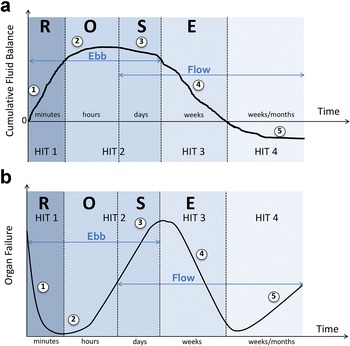
In patients with septic shock, the administration of fluids during initial hemodynamic resuscitation remains a major therapeutic challenge. We are faced with many open questions regarding the type, dose and timing of intravenous fluid administration. There are only four major indications for intravenous fluid administration: aside from resuscitation, intravenous fluids have many other uses including maintenance and replacement of total body water and electrolytes, as carriers for medications and for parenteral nutrition. In this paradigm-shifting review, we discuss different fluid management strategies including early adequate goal-directed fluid management, late conservative fluid management and late goal-directed fluid removal. In addition, we expand on the concept of the "four D's" of fluid therapy, namely drug, dosing, duration and de-escalation. During the treatment of patients with septic shock, four phases of fluid therapy should be considered in order to provide answers to four basic questions. These four phases are the resuscitation phase, the optimization phase, the stabilization phase and the evacuation phase. The four questions are "When to start intravenous fluids?", "When to stop intravenous fluids?", "When to start de-resuscitation or active fluid removal?" and finally "When to stop de-resuscitation?" In analogy to the way we handle antibiotics in critically ill patients, it is time for fluid stewardship.
Overview
The claims and statistics of this paper haven’t been checked yet.
Run the check — free, no account needed. It reads the open-access text and checks the sources it cites.
Integrity signals
Registry
Cites
Statistics
Figures
Verification
Claims the paper makes
The claims and statistics of this paper haven’t been checked yet.
Run the check — free, no account needed. It reads the open-access text and checks the sources it cites.
Claims other papers make about this one
Each is checked against this paper’s own text: does it say what the citing paper says it does?
The source backs part of the claim, not all of it — or backs it for a different population, condition or comparison.
In the citing paper
“Poor or incomplete source control may additionally lead to a state of ongoing capillary leak and fluid accumulation, referred to as GIPS (global increased permeability syndrome) [8].”
From Nutrition in Sepsis: A Bench-to-Bedside Review. (2020) · cites this paper as [8]
Experimental — accuracy not yet measuredThe cited source says what the claim attributes to it.
In the citing paper
“since nutrition may also contribute to fluid accumulation [8].”
From Nutrition in Sepsis: A Bench-to-Bedside Review. (2020) · cites this paper as [8]
Self-check
Percentages, sums and reported differences re-computed from the paper’s own numbers.
The self-check needs the paper’s full text.
Citations
Cites
Early goal-directed therapy in the treatment of severe sepsis and septic shock
Rivers, E., Nguyen, B., Havstad, S., Ressler, J., Muzzin, A., Knoblich, B., Peterson, E., & Tomlanovich, M. (2001) · New England Journal of Medicine · doi:10.1056/nejmoa010307 · Cited by 10,743
Surviving Sepsis Campaign: International Guidelines for Management of Severe Sepsis and Septic Shock
Dellinger, R. P., Levy, M. M., Rhodes, A., Annane, D., Gerlach, H., Opal, S. M., Sevransky, J. E., Sprung, C. L., Douglas, I. S., Jaeschke, R., et al. (2013) · Critical Care Medicine · doi:10.1097/ccm.0b013e31827e83af · Cited by 9,694
Intravenous Fluids and Acute Kidney Injury
Ding, X., Cheng, Z., & Qian, Q. (2017) · Blood Purification · doi:10.1159/000452702 · Cited by 6,869
Surviving Sepsis Campaign: International guidelines for management of sepsis and septic shock: 2016.
Rhodes, A., Evans, L. E., Alhazzani, W., Levy, M. M., Antonelli, M., Ferrer, R., Kumar, A., Sevransky, J. E., Sprung, C. L., Nunnally, M. E., et al. (2017) · Intensive Care Medicine · doi:10.1007/s00134-017-4683-6 · Cited by 6,621
Sepsis in European intensive care units: Results of the SOAP study*
Vincent, J., Sakr, Y. L., Sprung, C. L., Ranieri, V. M., Reinhart, K., Gerlach, H., Moreno, R. P., Carlet, J. M., Gall, J. L., & Payen, D. M. (2006) · Critical Care Medicine · doi:10.1097/01.ccm.0000194725.48928.3a · Cited by 2,823
A randomized trial of protocol-based care for early septic shock.
The ProCESS Investigators (2014) · New England Journal of Medicine · doi:10.1056/nejmoa1401602 · Cited by 2,414
Time to treatment and mortality during mandated emergency care for sepsis.
Seymour, C. W., Gesten, F., Prescott, H. C., Friedrich, M. E., Iwashyna, T. J., Phillips, G. S., Lemeshow, S., Osborn, T., Terry, K. M., & Levy, M. M. (2017) · New England Journal of Medicine · doi:10.1056/nejmoa1703058 · Cited by 2,225
Goal-Directed Resuscitation for Patients with Early Septic Shock
The ARISE Investigators and the ANZICS Clinical Trials Group (2014) · New England Journal of Medicine · doi:10.1056/nejmoa1404380 · Cited by 2,055
Hydroxyethyl Starch 130/0.42 versus Ringer's Acetate in Severe Sepsis
Perner, A., Haase, N., Guttormsen, A. B., Tenhunen, J. J., Klemenzson, G., Åneman, A., Madsen, K. R., Møller, M. H., Elkjær, J. M., Poulsen, L. M., et al. (2012) · New England Journal of Medicine · doi:10.1056/nejmoa1204242 · Cited by 1,808
Hydroxyethyl Starch or Saline for Fluid Resuscitation in Intensive Care
Myburgh, J., Finfer, S. R., Bellomo, R., Billot, L., Cass, A., Gattas, D. J., Glass, P., Lipman, J., Liu, B. C., McArthur, C. J., et al. (2012) · New England Journal of Medicine · doi:10.1056/nejmoa1209759 · Cited by 1,681
Research works printed but not linked: 1
- Monnet, 2016, Prediction of fluid responsiveness: an update, Ann Intensive Care, 6, 111, 10.1186/s13613-016-0216-7 · DOI
Cited by
Sorted by citations
Items 501–600 of 643
Resuscitation in Obstetric Hemorrhage: “Less Is More”
Silva, J. A. V., Olvera, O. I. A., & Aguirre-Gómez, G. A. (2024) · IntechOpen eBooks · doi:10.5772/intechopen.1004328
Fernández, J. J. D., Sánchez, J. I. A., Ruiz, J. D., Narváez, G. A. R., Gonzales, J. C. B., Amaya, D., Ramírez, N. A. Z., Ospina-Tascón, G. A., & Martínez, L. E. C. (2023) · Revista Repertorio de Medicina y Cirugía · doi:10.31260/repertmedcir.01217372.1414
Scorza, W. E., & Maynard, S. I. (2024) · Wiley eBooks · doi:10.1002/9781119820260.ch6
Fonseca, S. D. M., & Shimoda, E. (2024) · Revista Científica da Faculdade de Medicina de Campos · doi:10.29184/1980-7813.rcfmc.1050.vol.19.n1.2024
Ahmed, A., Khan, N., Haq, M. U., Siddique, M. K., Ayaz, M., & Shah, F. (2024) · Pakistan Journal of Health Sciences · doi:10.54393/pjhs.v5i06.1756
Human albumin solution for on-pump cardiac surgery: benefit or burden? Author’s reply
Wigmore, G. J., Deane, A. M., Presneill, J., Bellomo, R., & the HAS FLAIR-II investigators (2024) · Intensive Care Medicine · doi:10.1007/s00134-024-07646-7
Cerrahi Hemşireliği ve Bakım En İyi Bakım Uygulamaları
Altınbaş, Y., Kırtıl, İ., ŞAHİN, S. K., Öztekin, A., Kuzu, M., Er, Ö. S., Yeşilyurt, M., Yüksel, S., Ay, A., Sayılan, A. A., et al. (2024) · Akademisyen Kitabevi eBooks · doi:10.37609/akya.3212
Fluid management in critically ill pregnant patient
Lashkari, K. (2024) · Elsevier eBooks · doi:10.1016/b978-0-443-21473-8.00016-1
A Mini-Fluid Challenge to Predict Fluid Responsiveness in Swine
Yoshida, K. (2024) · Journal of the American Association for Laboratory Animal Science · doi:10.30802/aalas-jaalas-24-000026
Restrepo, L. M., Arévalo, S. V. C., Miño–Bernal, J. F., & Alvarez, I. (2024) · Revista Colombiana de Nefrología · doi:10.22265/acnef.11.2.744
Monard, C., & Schneider, A. G. (2024) · Springer eBooks · doi:10.1007/978-3-031-66541-7_33
Cha, S., Diaz, J., & Szerlip, H. M. (2024) · Research Square · doi:10.21203/rs.3.rs-5412547/v1
Krenov, K. Y., & СУХОДОЛЯ, А. І. (2024) · Bulletin of Problems Biology and Medicine · doi:10.29254/2077-4214-2024-4-175-381-388
Ji, J. Y., Kim, D. H., Seo, Y. H., Jung, H. S., Chun, H. R., Gong, H. Y., Park, J. S., & Shin, Y. E. (2024) · Soonchunhyang Medical Science · doi:10.15746/sms.24.012
Study based on bibliometric analysis: potential research trends in fluid management for sepsis
Liu, S., Pei, H., Wang, J., Qiao, L., & Wang, H. (2025) · Frontiers in Medicine · doi:10.3389/fmed.2024.1492396
Serafini, S. C., Cinotti, R., Asehnoune, K., Battaglini, D., Robba, C., Neto, A. S., Pisani, L., Mazzinari, G., Tschernko, E., & Schultz, M. J. (2025) · Revista Española de Anestesiología y Reanimación · doi:10.1016/j.redar.2024.501690
Pfortmueller, C. A., Dąbrowski, W., Wise, R., Regenmortel, N. V., & Malbrain, M. L. N. G. (2025) · Annals of Intensive Care · doi:10.1186/s13613-024-01403-1
Self-citationSerafini, S. C., Cinotti, R., Asehnoune, K., Battaglini, D., Robba, C., Neto, A. S., Pisani, L., Mazzinari, G., Tschernko, E., & Schultz, M. J. (2025) · Revista Española de Anestesiología y Reanimación (English Edition) · doi:10.1016/j.redare.2025.501690
Samprathi, M. (2025) · Indian Pediatrics · doi:10.1007/s13312-025-00014-8
Malinverni, S., Dumay, P., Domont, D., Claus, M., Herpain, A., Grignard, J., Matta, S., Bouazza, F.-Z., & Ochogavia, Q. (2025) · Resuscitation Plus · doi:10.1016/j.resplu.2025.100933
Sustainable Pharmacy Practice in the ICU
Hunfeld, N., & Dzierba, A. L. (2025) · Springer eBooks · doi:10.1007/978-3-031-77335-8_45
Medicina crítica y cuidado intensivo en obstetricia: en búsqueda del legado
Grillo‐Ardila, C. F., Triana, L. C., & Sanabria-Rodríguez, O. O. (2025) · Revista Colombiana de Obstetricia y Ginecología · doi:10.18597/rcog.4445
Guan, J., Hu, Y., Huang, Y., & Chen, C. (2025) · Journal of Critical Care · doi:10.1016/j.jcrc.2025.155081
Understanding nursing perceptions of intravenous fluid management practices
Crowe, S. (2024) · Journal of the Association for Vascular Access · doi:10.2309/1557-1289-29.4.49
Fluid therapy should be as short as possible
Gomes, R. A. D. S., Ferreira, A. R., Rodrigues, A. T., de Melo, M. D. C. B., & da Fonseca, J. G. (2025) · Critical Care Science · doi:10.62675/2965-2774.20250310
Zhao, C., Zhao, M. Y., Wang, H., Zhi, D., Ji, X., Duan, M., & Lin, J. (2025) · Renal Failure · doi:10.1080/0886022x.2025.2511277
Bhardwaj, V., & Arshad, N. N. (2025) · Indian Journal of Critical Care Medicine · doi:10.5005/jaypee-journals-10071-24933.22
Pediatric fluid resuscitation: an oxymoron?
Díaz, F., Riderelli, J., & Jabornisky, R. (2025) · Frontiers in Pediatrics · doi:10.3389/fped.2025.1594336
Bauer, P. R. (2025) · Oxford University Press eBooks · doi:10.1093/med/9780197628638.003.0060
Práticas de gestão e monitorização hemodinâmica em unidades de cuidados intensivos em Portugal
Gonzalez, F. A., Silva, J. P., Costa, P. G., Bento, L. F. N., Silva, D., Milet, I., Pinto, A. C. C. D. S., & Tavares, M. (2025) · Rebrame · doi:10.5935/2764-1449.20250004
rong, L., Zhu, Y., Xianyue, Z., Hua, H., Zhang, A., Gu, J., Yu, J. M., Hailing, L., & Wang, L. (2025) · SSRN Electronic Journal · doi:10.2139/ssrn.5319603
Nasa, P., & Malbrain, M. L. N. G. (2025) · Springer eBooks · doi:10.1007/978-981-96-5633-2_20
Self-citationJohn, S. M., Angurana, S. K., Jayashree, M., Bansal, A., Nallasamy, K., & Ram, S. (2026) · European Journal of Pediatrics · doi:10.1007/s00431-026-07015-0
Role of artificial intelligence as adjuvant therapy for sepsis fluid resuscitation
Ni, K.-G., Ling, B., & Xiu, G.-H. (2025) · New medicine. · doi:10.61958/nmrv5643
Adrian, R. J., Osman, A., & Acuña, J. (2025) · Springer eBooks · doi:10.1007/978-3-031-85308-1_23
Assessment of Fluid Responsiveness
Monnet, X. (2025) · Respiratory medicine · doi:10.1007/978-3-031-80038-2_53
Self-citationNeonatal and Pediatric Critical Care
Racette, M. A. (2025) · Veterinary Clinics of North America Small Animal Practice · doi:10.1016/j.cvsm.2025.05.001
Individualized fluid resuscitation for sepsis: A mini review
Xu, J., Yao, Y., & Shang, X. (2025) · Journal of Translational Critical Care Medicine · doi:10.1097/jtccm-d-24-00033
Caro, J. J. G., Ramos, M. G. C., de Paula, G. S., Oliveira, M., Lima, L. D. C. A., Oliveira, A. L. N. D., Bezerra, T. V. D., Sarturi, G., Santos, G. D. D., Delfino, O. D. M., et al. (2025) · LUMEN ET VIRTUS · doi:10.56238/levv16n53-007
Caro, J. J. G., Ramos, M. G. C., de Paula, G. S., de Oliveira, M. M., Lima, L. D. C. A., de Oliveira, A. L. N., Bezerra, T. V. D., Sarturi, G., dos Santos, G. D., Delfino, O. D. M., et al. (2025) · Seven Global Congress of Multidisciplinary Studies · doi:10.56238/1stcongresssevenmultidisciplinarystudies-231
Hyperosmolar Dehydration in Sepsis: Implications for Initial Fluid Management
Lee, K.-E., Lee, J., Lee, S. M., Oh, D. K., Lee, S. Y., Hyun, D., Park, M. H., Lim, C., Lee, H. Y., & on behalf of the Korean Sepsis Alliance (KSA) Investigators (2025) · Critical Care Medicine · doi:10.1097/ccm.0000000000006891
Sepsis in Pregnancy: Exploring Recent Advances in Diagnosis and Management
LeBeau, O. S., Murrin, E. M., Howell, H. H., & Saad, A. (2025) · Current Obstetrics and Gynecology Reports · doi:10.1007/s13669-025-00444-y
Fluid therapy for acute brain injury
Александрович, С. В., Tsentsiper, L. M., Sokolova, M. M., Lochekhina, E. B., Владимирович, К. В., & Кirov, М. Y. (2025) · Russian Journal of Anesthesiology and Reanimatology · doi:10.17116/anaesthesiology2025051108
Nie, S., Wang, B., Yu, J., Yu, H., Liu, F., Zhang, J., Yang, H., Liu, W., Wang, X., & Su, C. (2025) · Science Progress · doi:10.1177/00368504251387235
Fluid and Electrolyte Therapy in the Patient with Vomiting and Diarrhea
Ngwenyama, T. T. (2025) · Veterinary Clinics of North America Small Animal Practice · doi:10.1016/j.cvsm.2025.09.021
Kopp, S., Sagoschen, I., Karbach, S. H., Rußwurm, M., Lurz, P. C., Münzel, T. F., & Wild, J. (2025) · Biomedicines · doi:10.3390/biomedicines13112644
Li, C., Zhang, J., & Tang, Y. M. (2025) · Frontiers in Medicine · doi:10.3389/fmed.2025.1641271
Studi Retrospektif Kejadian Pyometra pada Pasien Kucing di Beberapa Klinik di Kota Mataram
Sofyan, I., Pradana, M., Dharmawibawa, I. D., & Janah, M. (2025) · Biocaster Jurnal Kajian Biologi · doi:10.36312/biocaster.v5i4.642
Hayat, M. Z., Tariq, M., Arshad, S., & Yahya, T. (2025) · Journal of Ultrasound in Medicine · doi:10.1002/jum.70109
Albanese, S. P. R., Sanches, C. T., de Oliveira, K. S., Albanese, M. L., Tanita, M. T., & Grion, C. M. C. (2025) · Revista da Escola de Enfermagem da USP · doi:10.1590/1980-220x-reeusp-2025-0022es
Albanese, S. P. R., Sanches, C. T., de Oliveira, K. S., Albanese, M. L., Tanita, M. T., & Grion, C. M. C. (2025) · Revista da Escola de Enfermagem da USP · doi:10.1590/1980-220x-reeusp-2025-0022pt
Albanese, S. P. R., Sanches, C. T., de Oliveira, K. S., Albanese, M. L., Tanita, M. T., & Grion, C. M. C. (2025) · Revista da Escola de Enfermagem da USP · doi:10.1590/1980-220x-reeusp-2025-0022en
Gustomo, R., Setiawan*, P., & Semedi, B. P. (2025) · Vascular and Endovascular Review · doi:10.64149/j.ver.8.2.12-19
Kříž, M., Nalos, M., Vintrych, P., Müller, J., Raděj, J., & Matějovič, M. (2025) · Anesteziologie a intenzivní medicína · doi:10.36290/aim.2025.047
Kattan, E., Glenn Hernández, P., Ospina-Tascón, G., Valenzuela, E. D., Bakker, J., & Castro, R. (2020) · Figshare · doi:10.6084/m9.figshare.12870073
Kattan, E., Glenn Hernández, P., Ospina-Tascón, G., Valenzuela, E. D., Bakker, J., & Castro, R. (2020) · Figshare · doi:10.6084/m9.figshare.12870067
Messina, A., Uryga, A., Giardina, A., Ciliberti, P., Battaglini, D., Patroniti, N., Czosnyka, M., Monnet, X., Cecconi, M., & Robba, C. (2024) · Figshare · doi:10.6084/m9.figshare.26668374
Self-citationLai, C., Shi, R., Beurton, A., Moretto, F., Ayed, S., Fage, N., Gavelli, F., Pavot, A., Dres, M., Teboul, J., et al. (2023) · Figshare · doi:10.6084/m9.figshare.22624726
Self-citationPařízková, R. Č., Martı́nková, J., Havel, E., Šafránek, P., Kaška, M., Astapenko, D., Bezouška, J., Chládek, J., & Černý, V. (2021) · Figshare · doi:10.6084/m9.figshare.15000155
Ma, P., Liu, J., Shen, F., 廖雪莲, Xiu, M., Zhao, H., Zhao, M., Xie, J., Wang, P., Huang, M., et al. (2021) · Figshare · doi:10.6084/m9.figshare.14966254
Adda, I., Lai, C., Teboul, J., Guérin, L., Gavelli, F., & Monnet, X. (2021) · Figshare · doi:10.6084/m9.figshare.16305451
Self-citationJorda, A., Douglas, I. S., Staudinger, T., Heinz, G., Bergmann, F., Oberbauer, R., Sengölge, G., Zeitlinger, M. A., Jilma, B., Shapiro, N. I., et al. (2024) · Figshare · doi:10.6084/m9.figshare.26265007
Jessen, M. K., Andersen, L. W., Thomsen, M.-L. H., Kristensen, P., Hayeri, W., Hassel, R. E., Perner, A., Petersen, J. A. K., & Kirkegaard, H. (2022) · Figshare · doi:10.6084/m9.figshare.19451302
Messina, A., Albini, M., Samuelli, N., Brunati, A., Costantini, E., Lionetti, G., Lubian, M., Greco, M., Matronola, G. M., Piccirillo, F., et al. (2024) · Figshare · doi:10.6084/m9.figshare.26761682
Self-citationSukudom, S., Smart, L., & Macdonald, S. P. J. (2024) · Figshare · doi:10.6084/m9.figshare.26683261
Jeong, H., Park, I., Lee, J. H., Kim, D., Baek, S., Kim, S., & Jo, Y. H. (2023) · Figshare · doi:10.6084/m9.figshare.22598924
Kattan, E., Glenn Hernández, P., Ospina-Tascón, G., Valenzuela, E. D., Bakker, J., & Castro, R. (2020) · Figshare · doi:10.6084/m9.figshare.12870070
Cihoric, M., Kehlet, H., Højlund, J., Lauritsen, M. L., Kanstrup, K., & Foss, N. B. (2024) · Figshare · doi:10.6084/m9.figshare.26561683
Messina, A., Albini, M., Samuelli, N., Brunati, A., Costantini, E., Lionetti, G., Lubian, M., Greco, M., Matronola, G. M., Piccirillo, F., et al. (2024) · Figshare · doi:10.6084/m9.figshare.26761722
Self-citationMa, P., Liu, J., Shen, F., Liao, X., Xiu, M., Zhao, H., Zhao, M., Xie, J., Wang, P., Huang, M., et al. (2021) · Figshare · doi:10.6084/m9.figshare.14966257
de Carvalho, E. B., Battaglini, D., Robba, C., Malbrain, M. L. N. G., Pelosi, P. P., Rocco, P. R., & Silva, P. L. (2024) · Figshare · doi:10.6084/m9.figshare.26598266
Self-citationCihoric, M., Kehlet, H., Højlund, J., Lauritsen, M. L., Kanstrup, K., & Foss, N. B. (2024) · Figshare · doi:10.6084/m9.figshare.26561686
Cihoric, M., Kehlet, H., Højlund, J., Lauritsen, M. L., Kanstrup, K., & Foss, N. B. (2024) · Figshare · doi:10.6084/m9.figshare.26561680
Ugalde, D., Montoya, J., Medel, J. N., Eisen, D., & Vieillard‐Baron, A. (2025) · Journal of Critical Care · doi:10.1016/j.jcrc.2025.155420
Çolak, Ö. Y., İşevi, M., Akman, T. S., Malkoç, B., Akdemir, N. Ü., & Ülger, F. (2025) · Harran Üniversitesi Tıp Fakültesi Dergisi · doi:10.35440/hutfd.1692086
Ponce, J., Obando, E., Tomás-Alvarado, E., Banille, E., Bravo, P., G., L. M. F., Cantillano, M., Portelles, A. C. R., Flores, D. P. R., Fernández‐Sarmiento, J., et al. (2026) · Critical Care & Emergency Medicine · doi:10.58281/ccem060126-rev-nar-11
Stavi, D., Gal‐Oz, A., Adi, N., Dayan, R. R., Angel, Y., Nevo, A., Khoury, N., Moshkovits, I., Lichter, Y., Wald, R., et al. (2026) · Journal of Clinical Medicine · doi:10.3390/jcm15020764
Fluid stewardship and fluid restriction: do think of maintenance and fluid creep
Nagachandan, S., Nasa, P., & Malbrain, M. L. N. G. (2025) · Journal of Nepalese Society of Critical Care Medicine · doi:10.3126/jnsccm.v3i2.81129
Self-citationBaladima, A., Kokkoris, S., Tzalas, D., Kolonia, K., Ntaidou, T., Pittaras, T., Trikas, A., Vasileiadis, I., & Routsi, C. (2026) · Journal of Clinical Medicine · doi:10.3390/jcm15041551
The ROSE framework for fluid therapy in critically ill pediatric patients
Gomes, R. A. D. S., Malbrain, M. L. N. G., Rodrigues, A. T., de Melo, M. D. C. B., Valério, F. C., da Fonseca, J. G., Dutra, G. C. S., & Ferreira, A. R. (2026) · Anaesthesiology Intensive Therapy · doi:10.5114/ait/217698
Self-citationElamir, N., Toema, K., Ahmed, W., & Abdelbaky, S. (2026) · The Egyptian Journal of Critical Care Medicine · doi:10.1007/s44349-026-00042-8
Han, R., Tao, X., Hu, S., Su, C., & Yan, X. (2026) · The American Journal of the Medical Sciences · doi:10.1016/j.amjms.2026.03.004
การประเมนสารนำโดย Venous Excess Ultrasound
ตระการวนิช, ธ., & ล้ำเลิศกุล, ณ. (2026) · Journal of the Nephrology Society of Thailand · doi:10.63555/jnst.2026.284179
Zhong, M., Chen, W.-J., Huang, S., Xu, D., Qu, H., Mao, E.-Q., Yang, Z.-T., Chen, E., & Chen, Y. (2026) · Scientific Reports · doi:10.1038/s41598-026-44583-5
Lee, J., Kang, D., Paek, J. H., Lee, J., An, J. N., Jeon, J., Lee, K., Jang, H. R., Rhee, H., Kim, H. J., et al. (2026) · Electrolytes & Blood Pressure · doi:10.5049/ebp.2026.24.e1
Cocktail-style multifunctional resuscitation fluids: Where are we now in 2026?
Liu, G. L., Hollifield, L. C., Chen, F., & Liu, H. (2026) · Journal of Anesthesia and Translational Medicine · doi:10.1016/j.jatmed.2026.02.001
Kuriyama, A., Kato, Y., & Suzuki, Y. (2026) · Journal of Critical Care · doi:10.1016/j.jcrc.2026.155577
Huang, J., Xu, Z., Huang, J., Huang, J., Zhou, G., Xiong, W., Xu, S., Li, J., Chen, Y., Liang, S., et al. (2026) · Shock · doi:10.1097/shk.0000000000002815
Estiri, E., & Mirinejad, H. (2026) · Journal of Dynamic Systems Measurement and Control · doi:10.1115/1.4071694
Turcato, G., Zaboli, A., Bionda, A. E., Maggi, M., Lucente, F., Caregnato, A., Milazzo, D., Ferretto, P., & Wiedermann, C. J. (2026) · Journal of Clinical Medicine · doi:10.3390/jcm15093203
Management of Suspected Heparin Resistance Among Patients in the Cardiac Intensive Care Setting
Tam, A. E., Donahue, K. R., Abdulla, A., Stefanos, S. S., Barakeh, D., & Morton, C. (2026) · Annals of Pharmacotherapy · doi:10.1177/10600280261435674
Fluid Tolerance: The Missing Piece in Personalised Intravenous Fluid Therapy
Chandramohan, D. (2026) · Journal of onco-anaesthesiology and perioperative medicine. · doi:10.4103/joapm.joapm_45_25
Eede, M. V., & Regenmortel, N. V. (2026) · Annals of Intensive Care · doi:10.1016/j.aicoj.2026.100074
How to perform fluid de-escalation in critical care
Bircher, R. E., Ostini, A., Pfortmueller, C. A., & Messmer, A. S. (2026) · Annals of Intensive Care · doi:10.1016/j.aicoj.2026.100075
Monard, C., Ferlay, C., Whiting, L., Trächsel, B., & Schneider, A. (2026) · Journal of Intensive Medicine · doi:10.1016/j.jointm.2026.03.002
Pilot study of fluid shift assessment using bioelectrical impedance spectroscopy
Choi, J. (2026) · Biomedical Physics & Engineering Express · doi:10.1088/2057-1976/ae6d01
Lee, Z. Y., & Chin, W. V. (2026) · World Journal of Critical Care Medicine · doi:10.5492/wjccm.v15.i2.114264
Waskowski, J., Maggisano, G. M. E. A., Hahn, M., Hofer, D. M., Faltys, M., & Pfortmueller, C. A. (2026) · Journal of Critical Care · doi:10.1016/j.jcrc.2026.155619
Luo, J., Mou, T., Ma, L., Feng, W.-T., Yue, R.-M., Pan, C., Huang, X.-B., Kattan, E., Zhang, Y., & Pan, L.-A. (2026) · BMJ Open · doi:10.1136/bmjopen-2025-110628
Beyond Blood Pressure: The Emerging Role of Wearable Doppler Ultrasound in Prehospital Care
Bojic, D., Drennan, I. R., & Nolan, B. (2026) · Prehospital Emergency Care · doi:10.1080/10903127.2026.2677176
Metadata
- Authors
- Malbrain, M. L. N. G., Van Regenmortel, N., Saugel, B., De Tavernier, B., Van Gaal, P.-J., Joannes-Boyau, O., Teboul, J.-L., Rice, T. W., Mythen, M., & Monnet, X.
- Affiliations
- Vrije Universiteit Brussel (BE)
- University Medical Center Hamburg-Eppendorf (DE)
- Université Paris-Sud (FR)
- University College London (GB)
- Vanderbilt University (US)
- Corresponding author
- Malbrain, Manu L. N.G.
- Venue
- Annals of Intensive Care
- Publisher
- Elsevier BV
- Published
- 2018
- Volume
- 8
- Issue
- 1
- Pages
- 66
- ISSN
- 2110-5820 (ISSN-L)
- PMC
- PMC5964054
- OpenAlex
- W2807356795
- Cited by
- 632
- References
- 105
- Citations by year
- 2026: 84 · 2025: 92 · 2024: 76 · 2023: 96 · 2022: 70 · 2021: 84 · 2020: 76 · 2019: 41 · 2018: 13
- FWCI
- 7.68
- Type
- journal article
- Language
- en
- Open access
- gold
- doi.org
- Licence
- Locations
- Annals of Intensive Care (publishedVersion, cc-by)
- Europe PMC (PubMed Central) (publishedVersion, cc-by)
- PubMed Central (publishedVersion, cc-by)
- PubMed (publishedVersion)
- HAL (submittedVersion)
- DOAJ (DOAJ: Directory of Open Access Journals) (submittedVersion, cc-by-sa)
- UCL Discovery (University College London) (submittedVersion)
- VUBIR (Vrije Universiteit Brussel) (submittedVersion)
- Topics
- Health Sciences › Medicine › Critical Care and Intensive Care Medicine › Sepsis Diagnosis and Treatment
- Health Sciences › Medicine › Surgery › Hemodynamic Monitoring and Therapy
- Health Sciences › Medicine › Surgery › Abdominal Surgery and Complications
- Keywords
- septic shock, fluid management, goal-directed fluid therapy, fluid resuscitation, intravenous fluid therapy, fluid removal
About these checks
Registry, retraction, Cites and statistics results are computed, not judged, with one exception: a printed reference that no index lists is read once by a model before it counts as a citation error. Claims are extracted by a model and kept only when their quote appears verbatim in the text; each cited source is then checked, with a model’s help, for whether it says what the claim relies on. Those verdicts can be wrong — read the claim’s quote and the cited source before relying on one.
Statistics and arithmetic are recomputed, not judged.
Confidence bands are shown only for fields calibrated on our annotated test set. None is calibrated yet, so no band is shown.
What counts as a claim ›How we measure confidence ›How we check this ›
Are you an author, or do you see a problem with this page? Request a review
