

Convergent and sequential synthesis designs: implications for conducting and reporting systematic reviews of qualitative and quantitative evidence
Open accessThe DOI matches its Crossref record; 63 of the 72 references it cites were found in a registry or an index; 1 of the 12 sources its claims cite were checked for support.
Abstract
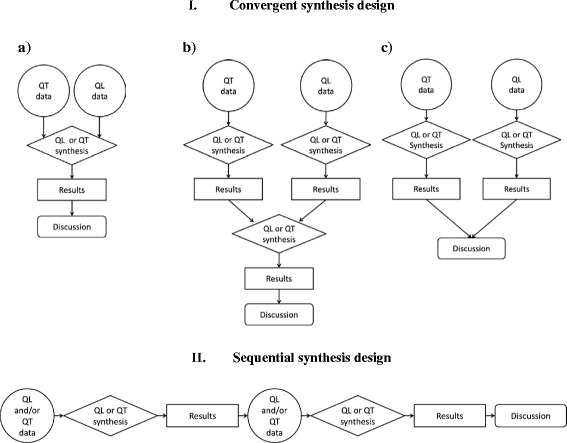
BACKGROUND: Systematic reviews of qualitative and quantitative evidence can provide a rich understanding of complex phenomena. This type of review is increasingly popular, has been used to provide a landscape of existing knowledge, and addresses the types of questions not usually covered in reviews relying solely on either quantitative or qualitative evidence. Although several typologies of synthesis designs have been developed, none have been tested on a large sample of reviews. The aim of this review of reviews was to identify and develop a typology of synthesis designs and methods that have been used and to propose strategies for synthesizing qualitative and quantitative evidence. METHODS: A review of systematic reviews combining qualitative and quantitative evidence was performed. Six databases were searched from inception to December 2014. Reviews were included if they were systematic reviews combining qualitative and quantitative evidence. The included reviews were analyzed according to three concepts of synthesis processes: (a) synthesis methods, (b) sequence of data synthesis, and (c) integration of data and synthesis results. RESULTS: A total of 459 reviews were included. The analysis of this literature highlighted a lack of transparency in reporting how evidence was synthesized and a lack of consistency in the terminology used. Two main types of synthesis designs were identified: convergent and sequential synthesis designs. Within the convergent synthesis design, three subtypes were found: (a) data-based convergent synthesis design, where qualitative and quantitative evidence is analyzed together using the same synthesis method, (b) results-based convergent synthesis design, where qualitative and quantitative evidence is analyzed separately using different synthesis methods and results of both syntheses are integrated during a final synthesis, and (c) parallel-results convergent synthesis design consisting of independent syntheses of qualitative and quantitative evidence and an interpretation of the results in the discussion. CONCLUSIONS: Performing systematic reviews of qualitative and quantitative evidence is challenging because of the multiple synthesis options. The findings provide guidance on how to combine qualitative and quantitative evidence. Also, recommendations are made to improve the conducting and reporting of this type of review.
Overview
CoChat Summary
TL;DR
This review of reviews of 459 systematic mixed studies reviews identified two main synthesis designs—convergent and sequential—with three convergent subtypes: data-based, results-based, and parallel-results. It also documents substantial gaps in reporting synthesis methods, terminology, and justification for combining qualitative and quantitative evidence.
Key findings
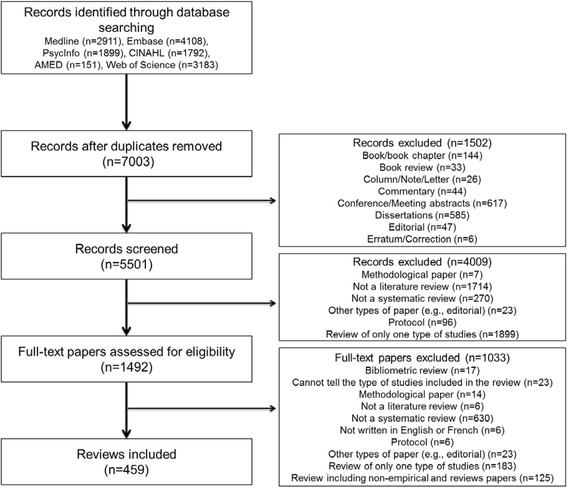
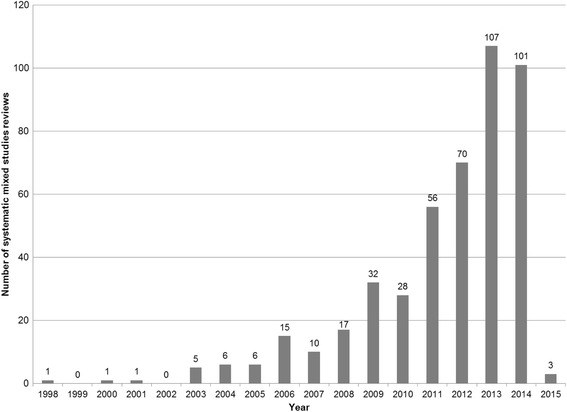
- From 7003 records, 459 systematic mixed studies reviews were included; publications rose from nearly 10 per year to more than 100 per year over the preceding decade.
- Convergent designs dominated: data-based convergent 69.7%, parallel-results convergent 17.2%, and results-based convergent 8.5%; sequential synthesis designs were found in 4.6% of reviews.
- Reporting was often incomplete: only 24% (n = 110) gave a clear rationale for combining quantitative and qualitative evidence, and only 39% (n = 179) fully described synthesis methods with methodological references; 90 reviews provided no synthesis information.
- The most commonly mentioned synthesis method was thematic synthesis (n = 129), followed by narrative synthesis (n = 64), narrative summary (n = 30), content analysis (n = 30), meta-analysis (n = 27), and meta-synthesis (n = 25).
Methods
- A review of systematic reviews combining qualitative and quantitative evidence was conducted; six databases (Medline, PsycInfo, Embase, CINAHL, AMED, Web of Science) were searched from inception to December 8, 2014, with free-text searching and English/French limits.
- Reviews were included if they combined qualitative, quantitative, and/or mixed methods studies, described search and selection strategies, and appraised included studies; a three-step selection process with independent screening was used.
- Data were extracted in NVivo 10 and analyzed using visual mapping and a deductive-inductive “process-data conceptualization” focused on synthesis methods, sequence of data synthesis, and integration of data and synthesis results.
Limitations
- The authors state the search was not comprehensive: it was limited to six mainly health-related databases, no hand searching was performed, and only peer-reviewed journal articles were included, potentially missing gray literature or conference abstracts.
- The authors also state that synthesis methods were not classified as aggregative versus configurative, and that interpretation of some synthesis methods was debatable.
- Evident from the text: data extraction was performed by one reviewer, and the included reviews were not critically appraised for quality, although the authors justify this by focusing on synthesis processes rather than review findings.
Model-written summary. Check it against the paper before relying on it.
Integrity signals
Registry
Cites
Statistics
Figures
Verification
Claims the paper makes
1 Valid · 0 Not valid · 9 Not checked · 55 Own results and interpretations
Every source the paper cites for this claim was checked and supports it.
In the paper
“However, a focus on quantitative evidence is insufficient in areas where research is not dominated by RCTs [2].”
§ Convergent and sequential synthesis designs: implications for conducting and reporting systematic reviews of qualitative and quantitative evidence > Background
What the sources say
- Supportedcites [2] Goldsmith MR Bankhead CR Austoker J Synthesising quantitative and qualitative research in evidence-based patient information J Epidemiol Community Health 2007 61 3 262 270 10.1136/jech.2006.046110 17325406 PMC2652927 source
The 'LIMITATIONS OF TRADITIONAL HIERARCHIES OF EVIDENCE' section states that hierarchies taking the randomised trial as the premier form of evidence 'become problematic in areas of research dominated by nontrial quantitative evidence', and that wider questions ('How does it work?', 'What are patients' experiences?') are 'best answered by evidence from a variety of sources'. The 'QUALITATIVE RESEARCH' section adds that qualitative evidence answers questions 'not easily evaluated by experimental studies' and may 'inform evidence-based practice independently of other research methodologies', and 'IMPORTANCE OF A RANGE OF EVIDENCE' frames synthesis of different research types as an unresolved methodological need. Together these carry the paraphrased point that a purely quantitative/RCT-centred focus is insufficient where research is not RCT-dominated. (LLM, conf=0.85)
plain- Asserted: passes — The authors put it forward as true.
- Checkable: passes — It can be checked against evidence.
- Load-bearing: passes — The paper’s conclusions depend on it.
- Based: passes — The paper gives a reason why it holds.
- Supported
A result the paper reports from its own data — it cites no other source for it, so there is none to check. The quote shows it is in the paper.
In the paper
“Only 39% (n = 179) of included reviews provided a full description of the synthesis method(s) with methodological references.”
§ Convergent and sequential synthesis designs: implications for conducting and reporting systematic reviews of qualitative and quantitative evidence > Results > Description of included reviews
plainn = 179- Asserted: passes — The authors put it forward as true.
- Checkable: passes — It can be checked against evidence.
- Load-bearing: passes — The paper’s conclusions depend on it.
- Based: passes — The paper gives a reason why it holds.
A result the paper states — it cites no source for it, so there is none to check. The quote shows it is in the paper.
In the paper
“Two main types of synthesis designs were identified: convergent and sequential synthesis designs.”
- Also stated in: § Synthesis of results · plain
“Based on the sequence and integration concepts, two main types of synthesis designs were identified (Fig. 3): convergent and sequential synthesis designs.”
§ Convergent and sequential synthesis designs: implications for conducting and reporting systematic reviews of qualitative and quantitative evidence > Abstract > Results
plain- Asserted: passes — The authors put it forward as true.
- Checkable: passes — It can be checked against evidence.
- Load-bearing: passes — The paper’s conclusions depend on it.
- Based: passes — The paper gives a reason why it holds.
- Rests on an assumption not shown here.
- Also stated in: § Synthesis of results · plain
A result the paper reports from its own data — it cites no other source for it, so there is none to check. The quote shows it is in the paper.
In the paper
“Among the SMSRs that provided information on the synthesis methods, the most common method mentioned was thematic synthesis (n = 129)”
§ Convergent and sequential synthesis designs: implications for conducting and reporting systematic reviews of qualitative and quantitative evidence > Results > Description of included reviews
plainn = 129- Asserted: passes — The authors put it forward as true.
- Checkable: passes — It can be checked against evidence.
- Load-bearing: unclear — It is unclear whether the paper’s conclusions depend on it.
- Based: passes — The paper gives a reason why it holds.
- Rests on an assumption not shown here.
A result the paper reports from its own data — it cites no other source for it, so there is none to check. The quote shows it is in the paper.
In the paper
“Within the convergent synthesis design, three subtypes were found: data-based, results-based, and parallel-results convergent synthesis designs.”
§ Convergent and sequential synthesis designs: implications for conducting and reporting systematic reviews of qualitative and quantitative evidence > Results > Synthesis of results
plain- Asserted: passes — The authors put it forward as true.
- Checkable: passes — It can be checked against evidence.
- Load-bearing: passes — The paper’s conclusions depend on it.
- Based: passes — The paper gives a reason why it holds.
- Rests on an assumption not shown here.
24 more claims
Create a free account to see all 65 claims and to verify the 11 references still open.
- Probably not a substantial claim. 20
- It may state two separate claims as one. 23
Claims other papers make about this one
Each is checked against this paper’s own text: does it say what the citing paper says it does?
The cited source says what the claim attributes to it.
In the citing paper
“a data-driven convergent synthesis approach was selected for thematic syntheses of LLM applications and limitations in patient care19.”
From Current applications and challenges in large language models for patient care: a systematic review (2025) · cites this paper as [19]
Citations
Cites
Three Approaches to Qualitative Content Analysis
Hsieh, H.-F., & Shannon, S. E. (2005) · Qualitative Health Research · doi:10.1177/1049732305276687 · Cited by 44,601 · cited 1×
“Qualitative content analysis [29] To understand a phenomenon of interest by focusing on the manifest (patent) content or contextual meaning of text.”
BackgroundContent Analysis: An Introduction to its Methodology.
Shelley, M., & Krippendorff, K. (1984) · Journal of the American Statistical Association · doi:10.2307/2288384 · Cited by 24,312
The integrative review: updated methodology
Whittemore, R., & Knafl, K. (2005) · Journal of Advanced Nursing · doi:10.1111/j.1365-2648.2005.03621.x · Cited by 10,241 · cited 3×
“Whittemore R, Knafl K.”
BackgroundMethodMethods for the thematic synthesis of qualitative research in systematic reviews
Thomas, J., & Harden, A. (2008) · BMC Medical Research Methodology · doi:10.1186/1471-2288-8-45 · Cited by 9,312
Achieving integration in mixed methods designs-principles and practices
Fetters, M. D., Curry, L. A., & Creswell, J. W. (2013) · Health Services Research · doi:10.1111/1475-6773.12117 · Cited by 7,219 · cited 1×
“and the interpretation and reporting [35, 36].”
(2006) · Cited by 7,081
Strategies for Theorizing from Process Data
Langley, A. (1999) · The Academy of Management Review · doi:10.5465/amr.1999.2553248 · Cited by 7,008 · cited 1×
“Thus, a “process-data conceptualization” was conducted [16] using a deductive-inductive approach, i.”
MethodPrimary, Secondary, and Meta-Analysis of Research
GLASS, G. V. (1976) · Educational Researcher · doi:10.3102/0013189x005010003 · Cited by 4,890 · cited 1×
“Secondary analysis is used to designate the reanalysis of primary data to answer new questions [52] Table 1 Typology of synthesis designs suggested in the literature”
MethodRealist review - a new method of systematic review designed for complex policy interventions
Pawson, R., Greenhalgh, T., Harvey, G., & Walshe, K. (2005) · Journal of Health Services Research & Policy · doi:10.1258/1355819054308530 · Cited by 3,190 · cited 1×
“Realist synthesis [67, 68] To unpack how interventions work in particular contexts through theoretical explanation (middle-range theory).”
BackgroundConfigurational Comparative Methods: Qualitative Comparative Analysis (QCA) and Related Techniques
Rihoux, B., & Ragin, C. (2009) · SAGE Publications · doi:10.4135/9781452226569 · Cited by 3,089
Research works printed but not linked: 5
- Dixon-Woods M Agarwal S Jones D Young B Sutton A Integrative approaches to qualitative and quantitative evidence 2004 London, UK Health Development Agency
- Plano Clark VL Ivankova NV Mixed methods research: a guide to the field. SAGE mixed methods research series 2015 Thousand Oaks SAGE Publications
- Neuendorf KA. The content analysis guidebook. Thousand Oaks: SAGE Publications; 2002.
- Creswell JW. Research design: qualitative, quantitative, and mixed methods approaches. Thousand Oaks: SAGE Publications; 2013.
- Denzin NK, Lincoln YS. The Sage handbook of qualitative research. Thousand Oaks: SAGE Publications; 2005.
Cited by
Items 101–200 of 751
Cunha, A. S., Pedro, A. R., & Cordeiro, J. V. (2023) · Journal of Medical Internet Research · doi:10.2196/44188 · Cited by 55
“Second, in line with the methodology proposed by Thomas and Harden [54], a thematic synthesis of the results was performed in the following sequential steps: text coding, construction of descriptive themes, and creation of analytical themes [50,54-56].”
Wollmann, K., van der Keylen, P., Tomandl, J., Meerpohl, J. J., Sofroniou, M., Maun, A., & Voigt-Radloff, S. (2021) · Patient Education and Counseling · doi:10.1016/j.pec.2021.01.020 · Cited by 52
Neibling, B. A., Jackson, S. M., Hayward, K. S., & Barker, R. N. (2021) · Journal of NeuroEngineering and Rehabilitation · doi:10.1186/s12984-021-00819-1 · Cited by 51
Thompson, Z., Baker, F. A., Tamplin, J., & Clark, I. N. (2021) · Frontiers in Psychology · doi:10.3389/fpsyg.2021.764372 · Cited by 56
Tharani, A. J., Hecke, A. V., Ali, T. S., & Duprez, V. (2021) · International Journal of Nursing Studies · doi:10.1016/j.ijnurstu.2021.103983 · Cited by 58
Kakyo, T. A., Xiao, L. D., & Chamberlain, D. J. (2021) · International Nursing Review · doi:10.1111/inr.12730 · Cited by 47
Professional Identity Formation in Allied Health: A Systematic Review with Narrative Synthesis
Lewis, A., Jamieson, J., & Smith, C. A. (2023) · Teaching and Learning in Medicine · doi:10.1080/10401334.2023.2290608 · Cited by 67
Health technology assessment in sub-Saharan Africa: a descriptive analysis and narrative synthesis
Hollingworth, S., Fenny, A. P., Yu, S., et al. (2021) · Cost Effectiveness and Resource Allocation · doi:10.1186/s12962-021-00293-5 · Cited by 42
Murtagh, E., Calderón, A., Scanlon, D., & MacPhail, A. (2023) · European Physical Education Review · doi:10.1177/1356336x231155793 · Cited by 64
Systematic reviews: A brief historical overview
Hong, Q. N., & Pluye, P. (2018) · Education for Information · doi:10.3233/efi-180219 · Cited by 73
Self-citationA rapid review of educational preparedness of advanced clinical practitioners
Dover, N., Lee, G., Raleigh, M., Baker, E. J., Starodub, R., Bench, S. D., & Garry, B. (2019) · Journal of Advanced Nursing · doi:10.1111/jan.14105 · Cited by 42
John, J. M., Gropper, H., & Thiel, A. (2019) · Psychology of sport and exercise · doi:10.1016/j.psychsport.2019.101565 · Cited by 55
Spacey, A., Porter, S., M. Board, & Scammell, J. (2021) · Palliative Medicine · doi:10.1177/02692163211029806 · Cited by 35
Sapeta, P., Centeno, C., Belar, A., & Arantzamendi, M. (2021) · Palliative Medicine · doi:10.1177/02692163211047149 · Cited by 59
Ho, J., See, M. T. A., Tan, A. J. Q., Levett-Jones, T. L., Lau, T. C., Zhou, W., & Liaw, S. Y. (2023) · Patient Education and Counseling · doi:10.1016/j.pec.2023.107965 · Cited by 60
Sabet, F., Prost, A., Rahmanian, S., Qudah, H. A., Cardoso, M. N., Carlin, J. B., Sawyer, S. M., & Patton, G. C. (2023) · The Lancet · doi:10.1016/s0140-6736(23)01682-3 · Cited by 50
Déry, J., Ruiz, A. B., Routhier, F., Gagnon, M., Côté, A., Aït-Kadi, D., Bélanger, V., Deslauriers, S., & Lamontagne, M. (2019) · Systematic Reviews · doi:10.1186/s13643-019-0992-x · Cited by 44
Lovell, H., Silverio, S. A., Story, L., Skelton, E., & Matthew, J. (2023) · PLOS ONE · doi:10.1371/journal.pone.0282088 · Cited by 39
Design, delivery and effectiveness of health practitioner regulation systems: an integrative review
Leslie, K., Bourgeault, I. L., Carlton, A.-L., Balasubramanian, M., Mirshahi, R., Short, S. D., Carè, J., Cometto, G., & Lin, V. (2023) · Human Resources for Health · doi:10.1186/s12960-023-00848-y · Cited by 38
“…various contexts and perspectives, providing the opportunity to examine a range of evidence (arising from qualitative, quantitative, correlation, economic, policy, regulatory, and other sources) to summarize the global literature on HPR at practitioner, organizational, and societal levels [15–17].”
BackgroundMethodKosiol, J., Silvester, T., Cooper, H., Alford, S., & Fraser, L. (2024) · BMC Health Services Research · doi:10.1186/s12913-024-11099-5 · Cited by 74
Encountering Patient Suicide During Psychiatric Training: An Integrative, Systematic Review
Leaune, É., Ravella, N., Vieux, M., Poulet, E., Chauliac, N., & Terra, J. (2019) · Harvard Review of Psychiatry · doi:10.1097/hrp.0000000000000208 · Cited by 46
Quality of life in adults with Down syndrome: A mixed methods systematic review
Ijezie, O. A., Healy, J. C., Davies, P., Balaguer‐Ballester, E., & Heaslip, V. (2023) · PLoS ONE · doi:10.1371/journal.pone.0280014 · Cited by 56
Moffat, K. R., Shi, W., Cannon, P., & Sullivan, F. (2023) · Trials · doi:10.1186/s13063-022-06865-x · Cited by 49
Darlington, C. K., Clark, R. R. S., Jacoby, S. F., Terplan, M., Alexander, K., & Compton, P. A. (2023) · Drug and Alcohol Dependence · doi:10.1016/j.drugalcdep.2023.110944 · Cited by 47
Hodgson, C. R., Mehra, R., & Franck, L. S. (2025) · Children · doi:10.3390/children12030290 · Cited by 38
Variations of mixed methods reviews approaches: A case study
Hong, Q. N., Rees, R. W., Sutcliffe, K., & Thomas, J. (2020) · Research Synthesis Methods · doi:10.1002/jrsm.1437 · Cited by 60
Self-citationFlow in youth sport, physical activity, and physical education: A systematic review
Jackman, P. C., Dargue-Fox, E. J., Johnston, J., & Hawkins, R. M. (2020) · Psychology of sport and exercise · doi:10.1016/j.psychsport.2020.101852 · Cited by 62
Interventions to reduce loneliness and social isolation in rural settings: A mixed-methods review
Williams, T. M., Lakhani, A., & Spelten, E. R. (2022) · Journal of Rural Studies · doi:10.1016/j.jrurstud.2022.02.001 · Cited by 50
Morgenthaler, T., Schulze, C., Pentland, D., & Lynch, H. (2023) · International Journal of Environmental Research and Public Health · doi:10.3390/ijerph20031763 · Cited by 55
Crossland, N., Kingdon, C., Balaam, M., Betrán, A. P., & Downe, S. M. (2020) · Reproductive Health · doi:10.1186/s12978-020-00915-w · Cited by 42
Siegel, M., Assenmacher, C., Meuwly, N., & Zemp, M. (2021) · Frontiers in Psychology · doi:10.3389/fpsyg.2021.644258 · Cited by 39
Gonella, S., Mitchell, G., Bavelaar, L., Conti, A., Vanalli, M., Basso, I., & Cornally, N. (2021) · Palliative Medicine · doi:10.1177/02692163211066733 · Cited by 46
Balushi, H. A., Watts, H., & Akudjedu, T. N. (2024) · Radiography · doi:10.1016/j.radi.2024.01.012 · Cited by 48
Lestienne, L., Leaune, É., Haesebaert, J., Poulet, E., & Andriessen, K. (2021) · Preventive Medicine · doi:10.1016/j.ypmed.2021.106583 · Cited by 48
Coon, J. T., Gwernan‐Jones, R., Garside, R., Nunns, M., Shaw, L., Meléndez‐Torres, G. J., & Moore, D. A. (2019) · Research Synthesis Methods · doi:10.1002/jrsm.1383 · Cited by 39
The psychology of mountaineering: a systematic review
Jackman, P. C., Hawkins, R. M., Burke, S. M., Swann, C., & Crust, L. (2020) · International Review of Sport and Exercise Psychology · doi:10.1080/1750984x.2020.1824242 · Cited by 45
Benzinger, P., Kuru, S., Keilhauer, A., Hoch, J., Prestel, P., Bauer, J. M., & Wahl, H.-W. (2021) · Zeitschrift für Gerontologie und Geriatrie · doi:10.1007/s00391-021-01859-x · Cited by 41
Faraday, J., Abley, C., Beyer, F. R., Exley, C., Moynihan, P. J., & Patterson, J. M. (2021) · Dementia · doi:10.1177/14713012211002041 · Cited by 38
Zhao, Y., Quadros, W., Nagraj, S., Wong, G., English, M., & Leckcivilize, A. (2024) · BMC Medicine · doi:10.1186/s12916-024-03509-6 · Cited by 43
van der Keylen, P., Tomandl, J., Wollmann, K., Mohler, R. A., Sofroniou, M., Maun, A., Voigt-Radloff, S., & Frank, L. (2020) · Journal of Medical Internet Research · doi:10.2196/18816 · Cited by 38
Duffy, D. J., Richards, D., Hisler, G. C., & Timulák, L. (2025) · Journal of Medical Internet Research · doi:10.2196/47927 · Cited by 43
Nimbley, E., Sharpe, H., Maloney, E., Gillespie‐Smith, K., Tchanturia, K., & Duffy, F. (2024) · International Journal of Eating Disorders · doi:10.1002/eat.24311 · Cited by 41
Facchin, F., Buggio, L., & Saita, E. (2020) · Journal of Psychosomatic Research · doi:10.1016/j.jpsychores.2020.110213 · Cited by 38
Kohanová, D., Solgajová, A., & Cubelo, F. (2024) · Journal of Clinical Nursing · doi:10.1111/jocn.17182 · Cited by 53
Fuentes, N. S., Rogers, A. E., & Portillo, M. C. (2019) · BMC Public Health · doi:10.1186/s12889-019-7467-9 · Cited by 37
Cerigo, H., & Quesnel‐Vallée, A. (2020) · International Journal of Public Health · doi:10.1007/s00038-020-01386-3 · Cited by 39
Chan, C. K. Y., & Chen, S. W. (2021) · Educational Research Review · doi:10.1016/j.edurev.2021.100431 · Cited by 51
Bujold, M., Pluye, P., Légaré, F., the Participatory Review Team, Hong, Q. N., Beaulieu, M., Bush, P. L., Couturier, Y., Sherif, R. E., Gagnon, J., et al. (2022) · BMC Family Practice · doi:10.1186/s12875-022-01879-5 · Cited by 44
Self-citationValanci, S., Alhassan, N. S., Feldman, L. S., Landry, T., Mastropietro, V., Fiore, J. F., Lee, L., Fried, G. M., & Mueller, C. (2020) · Journal of surgical education · doi:10.1016/j.jsurg.2020.01.007 · Cited by 32
Xanthoma of the temporal bone and skull base.
Jackler, R. K., & Brackmann, D. E. (1987) · PubMed · Cited by 34
Transition in care from paramedics to emergency department nurses: a systematic review protocol
Reay, G., Norris, J. M., Hayden, A., Abraham, J., Yokom, K., Nowell, L. S., Lazarenko, G., & Lang, E. (2017) · Systematic Reviews · doi:10.1186/s13643-017-0651-z · Cited by 36
Cooper, K., Kirkpatrick, P., Brand, C., Rolfe, A., & Florida-James, S. (2019) · Seizure · doi:10.1016/j.seizure.2019.10.002 · Cited by 30
Osokpo, O. H., James, R., & Riegel, B. J. (2021) · Journal of Advanced Nursing · doi:10.1111/jan.14804 · Cited by 42
Abboah‐Offei, M., Bayuo, J., Salifu, Y., Afolabi, O. A., & Akudjedu, T. N. (2024) · BMC Cancer · doi:10.1186/s12885-024-11911-9 · Cited by 29
Patients' Experience to MRI Examinations—A Systematic Qualitative Review With Meta‐Synthesis
Alvarez, I. N., Madl, J., Becker, L., & Amft, O. (2024) · Journal of Magnetic Resonance Imaging · doi:10.1002/jmri.29365 · Cited by 30
Bolster‐Foucault, C., Vedel, I., Busa, G., Hacker, G., Sourial, N., & Quesnel‐Vallée, A. (2024) · Age and Ageing · doi:10.1093/ageing/afae166 · Cited by 44
Exploring the impact of Osteogenesis Imperfecta on families: A mixed-methods systematic review
Hill, M. K., Lewis, C., Riddington, M., Crowe, B., DeVile, C. J., Gotherstrom, C. O. T., & Chitty, L. S. (2018) · Disability and health journal · doi:10.1016/j.dhjo.2018.12.003 · Cited by 40
Marr, C., Reale, S., Breeze, P. R., & Caton, S. J. (2020) · Obesity Reviews · doi:10.1111/obr.13157 · Cited by 29
Food and alcohol disturbance among US college students: a mixed methods scoping review
Shepherd, C., Berry, K. A., Ye, X., & Li, K. (2021) · Journal of American College Health · doi:10.1080/07448481.2021.1947300 · Cited by 38
Ellis-Smith, C. I., Tunnard, I., Dawkins, M., Gao, W., Higginson, I. J., Evans, C., SPACE, O. B. O., Ellis-Smith, ̆, Y., Gao, et al. (2021) · BMC Palliative Care · doi:10.1186/s12904-021-00845-9 · Cited by 39
Siegel, M., Legler, M., Neziraj, F., Goldberg, A. E., & Zemp, M. (2022) · Children · doi:10.3390/children9091364 · Cited by 38
Bujold, M., Pluye, P., Légaré, F., Haggerty, J. L., Gore, G. C., Sherif, R. E., Poitras, M.-È., Beaulieu, M., Beaulieu, M., Bush, P. L., et al. (2017) · BMJ Open · doi:10.1136/bmjopen-2017-016400 · Cited by 37
Self-citationElliott, A., & Gibson, S. (2022) · Journal of Human Nutrition and Dietetics · doi:10.1111/jhn.13063 · Cited by 31
Clinical decision fatigue: a systematic and scoping review with meta-synthesis
Grignoli, N., Manoni, G., Gianini, J., Schulz, P. J., Gabutti, L., & Petrocchi, S. (2025) · Family Medicine and Community Health · doi:10.1136/fmch-2024-003033 · Cited by 40
Brückner, S., Sadare, O., Fesl, S., Scheibe, M., Lang, C., & Gilbert, S. (2025) · npj Digital Medicine · doi:10.1038/s41746-025-01568-4 · Cited by 33
Vandewalle, J., Van Bos, L., Goossens, P., Beeckman, D., Van Hecke, A., Deproost, E., & Verhaeghe, S. (2020) · International Journal of Nursing Studies · doi:10.1016/j.ijnurstu.2020.103692 · Cited by 28
Unjai, S., Forster, E., Mitchell, A. E., & Creedy, D. K. (2024) · International Journal of Nursing Studies Advances · doi:10.1016/j.ijnsa.2024.100242 · Cited by 55
Alsaggaf, F., & Coyne, I. (2020) · Journal of Advanced Nursing · doi:10.1111/jan.14404 · Cited by 24
Burt, K. G., Mayer, G., & Paul, R. (2020) · Local Environment · doi:10.1080/13549839.2020.1861589 · Cited by 34
The impact of strike action on patient morbidity: A systematic literature review
Essex, R., Milligan, W., Williams, G., & Weldon, S. M. (2022) · The International Journal of Health Planning and Management · doi:10.1002/hpm.3418 · Cited by 27
Ingram, L., Stafford, C. L., Deming, M. E., Anderson, J. D., Robillard, A., & Li, X. (2019) · Journal of the Association of Nurses in AIDS Care · doi:10.1097/jnc.0000000000000076 · Cited by 29
Austin, A., Favril, L., Craft, S., Thliveri, P., & Freeman, T. P. (2023) · International Journal of Drug Policy · doi:10.1016/j.drugpo.2023.104248 · Cited by 40
Ramli, A. H. M., Manaf, L. A., Zulkeflee, Z., & Andriyono, S. (2024) · Sustainable Production and Consumption · doi:10.1016/j.spc.2024.08.018 · Cited by 34
Andarge, E., Stephens, J. H., Gesesew, H. A., et al. (2024) · BMC Family Practice · doi:10.1186/s12875-024-02612-0 · Cited by 26
Las Revisiones Sistemáticas y la Educación Basada en Evidencias
Martín, M. S., Navarro‐Mateu, F., & Sánchez‐Meca, J. (2022) · ESPIRAL CUADERNOS DEL PROFESORADO · doi:10.25115/ecp.v15i30.7860 · Cited by 71
Sanusi, A., Elsey, H., Golder, S., Sanusi, O., & Oluyase, A. O. (2023) · PLOS Global Public Health · doi:10.1371/journal.pgph.0001496 · Cited by 40
Online peer support communities in the infertility journey: A systematic mixed-studies review
Lin, J. W., & Shorey, S. (2023) · International Journal of Nursing Studies · doi:10.1016/j.ijnurstu.2023.104454 · Cited by 37
The rise of resilient healthcare research during COVID-19: scoping review of empirical research
Ellis, L. A., Saba, M., Long, J. C., Lyng, H. B., Haraldseid-Driftland, C., Churruca, K., Wiig, S., Austin, E. E., Clay‐Williams, R., Carrigan, A., et al. (2023) · BMC Health Services Research · doi:10.1186/s12913-023-09839-0 · Cited by 35
Willis, N., Dowling, A. P. C., & O'Reilly, G. (2022) · European Journal of Trauma & Dissociation · doi:10.1016/j.ejtd.2022.100311 · Cited by 36
Armstrong, R. M., Schimke, E. A. E., Mathew, A., & Scarinci, N. (2023) · Language Speech and Hearing Services in Schools · doi:10.1044/2023_lshss-22-00168 · Cited by 36
Sherif, R. E., Pluye, P., Hong, Q. N., & Rihoux, B. (2024) · Research Synthesis Methods · doi:10.1002/jrsm.1698 · Cited by 39
Self-citationAccess, acceptance and adherence to cancer prehabilitation: a mixed-methods systematic review
Watts, T. E., Courtier, N., Fry, S., Gale, N., Gillen, E., McCutchan, G. M., Patil, M., Rees, T., Roche, D., Wheelwright, S. J., et al. (2024) · Journal of Cancer Survivorship · doi:10.1007/s11764-024-01605-3 · Cited by 37
Cook, G. M., Fletcher, D., & Carroll, C. (2020) · International Review of Sport and Exercise Psychology · doi:10.1080/1750984x.2020.1802769 · Cited by 38
Regmi, K., & Mudyarabikwa, O. (2020) · Public Health · doi:10.1016/j.puhe.2020.07.027 · Cited by 35
Uhm, J., Choi, M., & Lee, H. (2020) · Nursing and Health Sciences · doi:10.1111/nhs.12786 · Cited by 31
Woods, C., Kim, B., Guo, K., Nyguen, T., Taplayan, S., & Aronowitz, T. B. (2021) · Journal of the American Psychiatric Nurses Association · doi:10.1177/10783903211038050 · Cited by 30
How Do Children of Parents With Mental Illness Experience Stigma? A Systematic Mixed Studies Review
Dobener, L.-M., Fahrer, J., Purtscheller, D., Bauer, A., Paul, J. L., & Christiansen, H. (2022) · Frontiers in Psychiatry · doi:10.3389/fpsyt.2022.813519 · Cited by 39
Fear of relapse in schizophrenia: a mixed-methods systematic review
Zukowska, Z., Allan, S., Eisner, E., Ling, L., & Gumley, A. I. (2022) · Social Psychiatry and Psychiatric Epidemiology · doi:10.1007/s00127-022-02220-2 · Cited by 40
Gosak, L., Svenšek, A., Lorber, M., & Štiglic, G. (2023) · Applied Sciences · doi:10.3390/app13052823 · Cited by 31
Nowell, L. S., Ovie, G., Berenson, C., Kenny, N., & Hayden, A. (2018) · Education Research International · doi:10.1155/2018/5950739 · Cited by 30
Russo, G., Jesus, T. S., Gassasse, Z., Filippon, J., Rotulo, A., & Kondilis, E. (2021) · Health Policy and Planning · doi:10.1093/heapol/czaa180 · Cited by 30
Nguyen, N. T., Kim, B., & Aronowitz, T. B. (2023) · Journal of Psychiatric and Mental Health Nursing · doi:10.1111/jpm.12972 · Cited by 38
Chiarino, N., Enríquez, C. R., Curione, K., Machado, A., Bonilla, M., Aspirot, L., Garófalo, L., & Olveira, B. (2024) · Actualidades Investigativas en Educación · doi:10.15517/aie.v24i2.57306 · Cited by 71
Ong, C. S. B., Fok, R. W., Tan, R. C. A., Fung, S. M., Sun, S. H.-L., & Ngeow, J. Y. Y. (2022) · Family Medicine and Community Health · doi:10.1136/fmch-2021-001515 · Cited by 34
Iupati, S., Stanley, J., Egan, R., MacLeod, R., Davies, C., Spence, H. K., Iupati, D., Middlemiss, T., & Gwynne-Robson, I. (2023) · Journal of Palliative Medicine · doi:10.1089/jpm.2022.0461 · Cited by 33
Hamzeh, J., Pluye, P., Bush, P. L., Ruchon, C., Vedel, I., & Hudon, C. (2018) · Evaluation and Program Planning · doi:10.1016/j.evalprogplan.2018.12.003 · Cited by 27
Self-citationO'Connell, M., Barry, J., Hartigan, I., Cornally, N., & Saab, M. M. (2024) · Journal of Clinical Nursing · doi:10.1111/jocn.17114 · Cited by 28
Abdulazeem, H. M., Meckawy, R., Schwarz, S., Novillo-Ortiz, D., & Klug, S. J. (2025) · International Journal of Medical Informatics · doi:10.1016/j.ijmedinf.2025.105945 · Cited by 41
Dunn, J. L., Nusem, E., Straker, K., Gregory, S. D., & Wrigley, C. (2019) · Annals of Biomedical Engineering · doi:10.1007/s10439-019-02303-3 · Cited by 26
Uhm, J., & Choi, M. (2020) · Healthcare · doi:10.3390/healthcare8040506 · Cited by 23
Metadata
- Authors
- Hong, Q. N., Pluye, P., Bujold, M., & Wassef, M.
- Affiliations
- McGill University (CA)
- Corresponding author
- Hong, Quan Nha
- Venue
- Systematic Reviews
- Published
- 2017-03-23
- Volume
- 6
- Issue
- 1
- Pages
- 61-61
- ISSN
- 2046-4053 (ISSN-L)
- PMC
- PMC5364694
- OpenAlex
- W2599225410
- Semantic Scholar
- 7d52e90b26094da10fe066037dcdcf7e8742aea0
- Cited by
- 754
- References
- 72
- Citations by year
- 2026: 72 · 2025: 104 · 2024: 139 · 2023: 118 · 2022: 90 · 2021: 109 · 2020: 69 · 2019: 34 · 2018: 14 · 2017: 4
- FWCI
- 8.18
- Type
- journal article
- Language
- en
- Open access
- gold
- doi.org
- Licence
- cc-by
- Locations
- Systematic Reviews (publishedVersion, cc-by)
- PubMed Central (publishedVersion, cc-by)
- PubMed (publishedVersion)
- eScholarship@McGill (McGill) (submittedVersion, cc-by)
- Funders
- Fonds de Recherche du Québec - Santé (29308)
- Canadian Institutes of Health Research (301011)
- Topics
- Social Sciences › Decision Sciences › Statistics, Probability and Uncertainty › Meta-analysis and systematic reviews
- Health Sciences › Health Professions › General Health Professions › Health Policy Implementation Science
- Social Sciences › Education › Qualitative Research Methods and Applications
- Keywords
- convergent synthesis, sequential synthesis, reporting transparency, terminology consistency
- MeSH terms
- Evaluation Studies as Topic, Humans, Research Design, Qualitative Research
About these checks
Registry, retraction, Cites and statistics results are computed, not judged, with one exception: a printed reference that no index lists is read once by a model before it counts as a citation error. Claims are extracted by a model and kept only when their quote appears verbatim in the text; each cited source is then checked, with a model’s help, for whether it says what the claim relies on. Those verdicts can be wrong — read the claim’s quote and the cited source before relying on one.
A language model drew the claims from the paper on 2026-10-05, under version 3 of the claim definition (model deepseek-v4.1-flash, prompt extract-v3).
A second model labelled each claim on 2026-10-05 (model jev-1.13-20260917, definition revision gold-guideline-v0.2).
Cited sources are checked with a language model’s help (qwen3.8-omni-flash).
Statistics and arithmetic are recomputed, not judged.
Confidence bands are shown only for fields calibrated on our annotated test set. None is calibrated yet, so no band is shown.
What counts as a claim ›How we measure confidence ›How we check this ›
Are you an author, or do you see a problem with this page? Request a review
Data sources
Bibliographic data: Semantic Scholar, OpenAlex, Crossref.
Contains information from the Semantic Scholar Academic Graph Datasets, made available under the ODC Attribution License (ODC-BY 1.0).
Semantic Scholar’s data is described in: Kinney, R., et al. (2023). The Semantic Scholar Open Data Platform. arXiv:2301.10140.
