

Convergent and sequential synthesis designs: implications for conducting and reporting systematic reviews of qualitative and quantitative evidence
Open accessThe DOI matches its Crossref record; 63 of the 72 references it cites were found in a registry or an index; 1 of the 12 sources its claims cite were checked for support.
Abstract
BACKGROUND: Systematic reviews of qualitative and quantitative evidence can provide a rich understanding of complex phenomena. This type of review is increasingly popular, has been used to provide a landscape of existing knowledge, and addresses the types of questions not usually covered in reviews relying solely on either quantitative or qualitative evidence. Although several typologies of synthesis designs have been developed, none have been tested on a large sample of reviews. The aim of this review of reviews was to identify and develop a typology of synthesis designs and methods that have been used and to propose strategies for synthesizing qualitative and quantitative evidence. METHODS: A review of systematic reviews combining qualitative and quantitative evidence was performed. Six databases were searched from inception to December 2014. Reviews were included if they were systematic reviews combining qualitative and quantitative evidence. The included reviews were analyzed according to three concepts of synthesis processes: (a) synthesis methods, (b) sequence of data synthesis, and (c) integration of data and synthesis results. RESULTS: A total of 459 reviews were included. The analysis of this literature highlighted a lack of transparency in reporting how evidence was synthesized and a lack of consistency in the terminology used. Two main types of synthesis designs were identified: convergent and sequential synthesis designs. Within the convergent synthesis design, three subtypes were found: (a) data-based convergent synthesis design, where qualitative and quantitative evidence is analyzed together using the same synthesis method, (b) results-based convergent synthesis design, where qualitative and quantitative evidence is analyzed separately using different synthesis methods and results of both syntheses are integrated during a final synthesis, and (c) parallel-results convergent synthesis design consisting of independent syntheses of qualitative and quantitative evidence and an interpretation of the results in the discussion. CONCLUSIONS: Performing systematic reviews of qualitative and quantitative evidence is challenging because of the multiple synthesis options. The findings provide guidance on how to combine qualitative and quantitative evidence. Also, recommendations are made to improve the conducting and reporting of this type of review.
Overview
CoChat Summary
TL;DR
This review of reviews of 459 systematic mixed studies reviews identified two main synthesis designs—convergent and sequential—with three convergent subtypes: data-based, results-based, and parallel-results. It also documents substantial gaps in reporting synthesis methods, terminology, and justification for combining qualitative and quantitative evidence.
Key findings
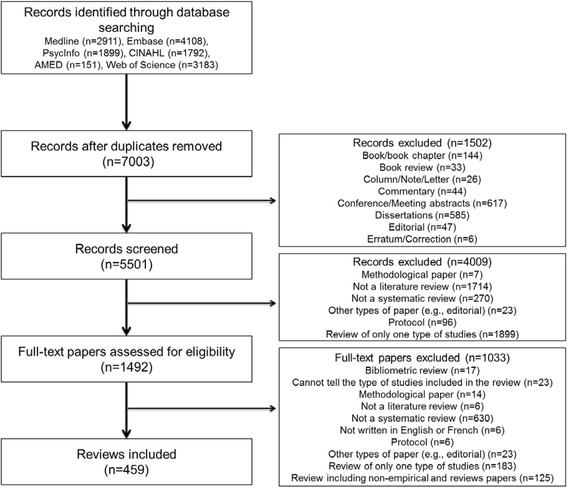
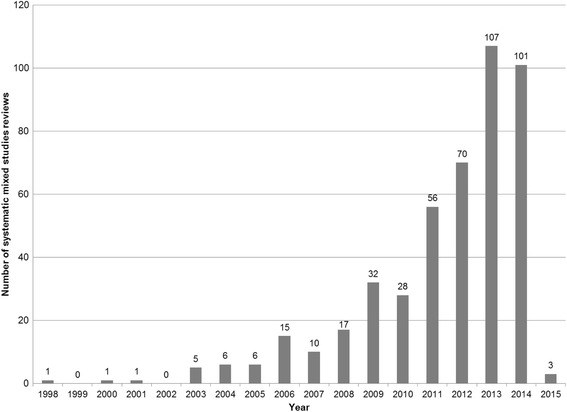
- From 7003 records, 459 systematic mixed studies reviews were included; publications rose from nearly 10 per year to more than 100 per year over the preceding decade.
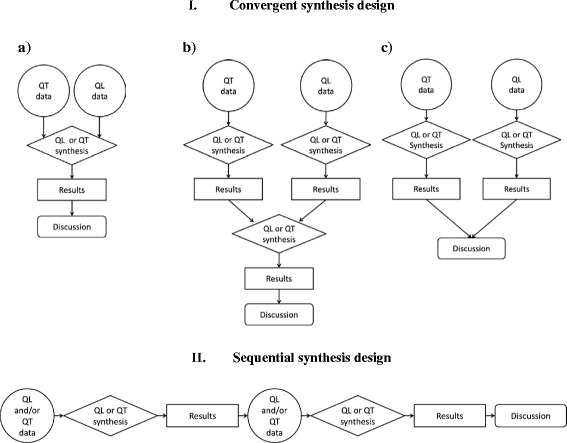
- Convergent designs dominated: data-based convergent 69.7%, parallel-results convergent 17.2%, and results-based convergent 8.5%; sequential synthesis designs were found in 4.6% of reviews.
- Reporting was often incomplete: only 24% (n = 110) gave a clear rationale for combining quantitative and qualitative evidence, and only 39% (n = 179) fully described synthesis methods with methodological references; 90 reviews provided no synthesis information.
- The most commonly mentioned synthesis method was thematic synthesis (n = 129), followed by narrative synthesis (n = 64), narrative summary (n = 30), content analysis (n = 30), meta-analysis (n = 27), and meta-synthesis (n = 25).
Methods
- A review of systematic reviews combining qualitative and quantitative evidence was conducted; six databases (Medline, PsycInfo, Embase, CINAHL, AMED, Web of Science) were searched from inception to December 8, 2014, with free-text searching and English/French limits.
- Reviews were included if they combined qualitative, quantitative, and/or mixed methods studies, described search and selection strategies, and appraised included studies; a three-step selection process with independent screening was used.
- Data were extracted in NVivo 10 and analyzed using visual mapping and a deductive-inductive “process-data conceptualization” focused on synthesis methods, sequence of data synthesis, and integration of data and synthesis results.
Limitations
- The authors state the search was not comprehensive: it was limited to six mainly health-related databases, no hand searching was performed, and only peer-reviewed journal articles were included, potentially missing gray literature or conference abstracts.
- The authors also state that synthesis methods were not classified as aggregative versus configurative, and that interpretation of some synthesis methods was debatable.
- Evident from the text: data extraction was performed by one reviewer, and the included reviews were not critically appraised for quality, although the authors justify this by focusing on synthesis processes rather than review findings.
Model-written summary. Check it against the paper before relying on it.
Integrity signals
Registry
Cites
Statistics
Figures
Verification
Claims the paper makes
1 Valid · 0 Not valid · 9 Not checked · 55 Own results and interpretations
Every source the paper cites for this claim was checked and supports it.
In the paper
“However, a focus on quantitative evidence is insufficient in areas where research is not dominated by RCTs [2].”
§ Convergent and sequential synthesis designs: implications for conducting and reporting systematic reviews of qualitative and quantitative evidence > Background
What the sources say
- Supportedcites [2] Goldsmith MR Bankhead CR Austoker J Synthesising quantitative and qualitative research in evidence-based patient information J Epidemiol Community Health 2007 61 3 262 270 10.1136/jech.2006.046110 17325406 PMC2652927 source
The 'LIMITATIONS OF TRADITIONAL HIERARCHIES OF EVIDENCE' section states that hierarchies taking the randomised trial as the premier form of evidence 'become problematic in areas of research dominated by nontrial quantitative evidence', and that wider questions ('How does it work?', 'What are patients' experiences?') are 'best answered by evidence from a variety of sources'. The 'QUALITATIVE RESEARCH' section adds that qualitative evidence answers questions 'not easily evaluated by experimental studies' and may 'inform evidence-based practice independently of other research methodologies', and 'IMPORTANCE OF A RANGE OF EVIDENCE' frames synthesis of different research types as an unresolved methodological need. Together these carry the paraphrased point that a purely quantitative/RCT-centred focus is insufficient where research is not RCT-dominated. (LLM, conf=0.85)
plain- Asserted: passes — The authors put it forward as true.
- Checkable: passes — It can be checked against evidence.
- Load-bearing: passes — The paper’s conclusions depend on it.
- Based: passes — The paper gives a reason why it holds.
- Supported
A result the paper reports from its own data — it cites no other source for it, so there is none to check. The quote shows it is in the paper.
In the paper
“Only 39% (n = 179) of included reviews provided a full description of the synthesis method(s) with methodological references.”
§ Convergent and sequential synthesis designs: implications for conducting and reporting systematic reviews of qualitative and quantitative evidence > Results > Description of included reviews
plainn = 179- Asserted: passes — The authors put it forward as true.
- Checkable: passes — It can be checked against evidence.
- Load-bearing: passes — The paper’s conclusions depend on it.
- Based: passes — The paper gives a reason why it holds.
A result the paper states — it cites no source for it, so there is none to check. The quote shows it is in the paper.
In the paper
“Two main types of synthesis designs were identified: convergent and sequential synthesis designs.”
- Also stated in: § Synthesis of results · plain
“Based on the sequence and integration concepts, two main types of synthesis designs were identified (Fig. 3): convergent and sequential synthesis designs.”
§ Convergent and sequential synthesis designs: implications for conducting and reporting systematic reviews of qualitative and quantitative evidence > Abstract > Results
plain- Asserted: passes — The authors put it forward as true.
- Checkable: passes — It can be checked against evidence.
- Load-bearing: passes — The paper’s conclusions depend on it.
- Based: passes — The paper gives a reason why it holds.
- Rests on an assumption not shown here.
- Also stated in: § Synthesis of results · plain
A result the paper reports from its own data — it cites no other source for it, so there is none to check. The quote shows it is in the paper.
In the paper
“Among the SMSRs that provided information on the synthesis methods, the most common method mentioned was thematic synthesis (n = 129)”
§ Convergent and sequential synthesis designs: implications for conducting and reporting systematic reviews of qualitative and quantitative evidence > Results > Description of included reviews
plainn = 129- Asserted: passes — The authors put it forward as true.
- Checkable: passes — It can be checked against evidence.
- Load-bearing: unclear — It is unclear whether the paper’s conclusions depend on it.
- Based: passes — The paper gives a reason why it holds.
- Rests on an assumption not shown here.
A result the paper reports from its own data — it cites no other source for it, so there is none to check. The quote shows it is in the paper.
In the paper
“Within the convergent synthesis design, three subtypes were found: data-based, results-based, and parallel-results convergent synthesis designs.”
§ Convergent and sequential synthesis designs: implications for conducting and reporting systematic reviews of qualitative and quantitative evidence > Results > Synthesis of results
plain- Asserted: passes — The authors put it forward as true.
- Checkable: passes — It can be checked against evidence.
- Load-bearing: passes — The paper’s conclusions depend on it.
- Based: passes — The paper gives a reason why it holds.
- Rests on an assumption not shown here.
24 more claims
Create a free account to see all 65 claims and to verify the 11 references still open.
- Probably not a substantial claim. 20
- It may state two separate claims as one. 23
Claims other papers make about this one
Each is checked against this paper’s own text: does it say what the citing paper says it does?
The cited source says what the claim attributes to it.
In the citing paper
“a data-driven convergent synthesis approach was selected for thematic syntheses of LLM applications and limitations in patient care19.”
From Current applications and challenges in large language models for patient care: a systematic review (2025) · cites this paper as [19]
Citations
Cites
Three Approaches to Qualitative Content Analysis
Hsieh, H.-F., & Shannon, S. E. (2005) · Qualitative Health Research · doi:10.1177/1049732305276687 · Cited by 44,601 · cited 1×
“Qualitative content analysis [29] To understand a phenomenon of interest by focusing on the manifest (patent) content or contextual meaning of text.”
BackgroundContent Analysis: An Introduction to its Methodology.
Shelley, M., & Krippendorff, K. (1984) · Journal of the American Statistical Association · doi:10.2307/2288384 · Cited by 24,312
The integrative review: updated methodology
Whittemore, R., & Knafl, K. (2005) · Journal of Advanced Nursing · doi:10.1111/j.1365-2648.2005.03621.x · Cited by 10,241 · cited 3×
“Whittemore R, Knafl K.”
BackgroundMethodMethods for the thematic synthesis of qualitative research in systematic reviews
Thomas, J., & Harden, A. (2008) · BMC Medical Research Methodology · doi:10.1186/1471-2288-8-45 · Cited by 9,312
Achieving integration in mixed methods designs-principles and practices
Fetters, M. D., Curry, L. A., & Creswell, J. W. (2013) · Health Services Research · doi:10.1111/1475-6773.12117 · Cited by 7,219 · cited 1×
“and the interpretation and reporting [35, 36].”
(2006) · Cited by 7,081
Strategies for Theorizing from Process Data
Langley, A. (1999) · The Academy of Management Review · doi:10.5465/amr.1999.2553248 · Cited by 7,008 · cited 1×
“Thus, a “process-data conceptualization” was conducted [16] using a deductive-inductive approach, i.”
MethodPrimary, Secondary, and Meta-Analysis of Research
GLASS, G. V. (1976) · Educational Researcher · doi:10.3102/0013189x005010003 · Cited by 4,890 · cited 1×
“Secondary analysis is used to designate the reanalysis of primary data to answer new questions [52] Table 1 Typology of synthesis designs suggested in the literature”
MethodRealist review - a new method of systematic review designed for complex policy interventions
Pawson, R., Greenhalgh, T., Harvey, G., & Walshe, K. (2005) · Journal of Health Services Research & Policy · doi:10.1258/1355819054308530 · Cited by 3,190 · cited 1×
“Realist synthesis [67, 68] To unpack how interventions work in particular contexts through theoretical explanation (middle-range theory).”
BackgroundConfigurational Comparative Methods: Qualitative Comparative Analysis (QCA) and Related Techniques
Rihoux, B., & Ragin, C. (2009) · SAGE Publications · doi:10.4135/9781452226569 · Cited by 3,089
Research works printed but not linked: 5
- Dixon-Woods M Agarwal S Jones D Young B Sutton A Integrative approaches to qualitative and quantitative evidence 2004 London, UK Health Development Agency
- Plano Clark VL Ivankova NV Mixed methods research: a guide to the field. SAGE mixed methods research series 2015 Thousand Oaks SAGE Publications
- Neuendorf KA. The content analysis guidebook. Thousand Oaks: SAGE Publications; 2002.
- Creswell JW. Research design: qualitative, quantitative, and mixed methods approaches. Thousand Oaks: SAGE Publications; 2013.
- Denzin NK, Lincoln YS. The Sage handbook of qualitative research. Thousand Oaks: SAGE Publications; 2005.
Cited by
Items 201–300 of 751
Sebastian, A., Carroll, J. C., Oldfield, L. E., Mighton, C. E., Shickh, S., Uleryk, E. M., & Bombard, Y. (2021) · Genetics in Medicine · doi:10.1038/s41436-020-01045-1 · Cited by 24
Essex, R., Bruce, G., Dibley, M., Newton, P. D., & Dibley, L. B. (2021) · International Journal of Orthopaedic and Trauma Nursing · doi:10.1016/j.ijotn.2021.100844 · Cited by 23
Dawson, S., Bierce, A., Feder, G. S., Macleod, J., Turner, K. M., Zammit, S., & Lewis, N. V. (2021) · BMJ Open · doi:10.1136/bmjopen-2020-042112 · Cited by 29
The Systematic Review-lution: A Manifesto to Promote Rigour and Inclusivity in Research Synthesis
Rogers, K., & Seaborn, K. (2023) · CHI Conference Extended Abstracts on Human Factors in Computing Systems (CHI EA) · doi:10.1145/3544549.3582733 · Cited by 29
Xie, E. B., Jung, J. W., Kaur, J., Benzies, K., Tomfohr‐Madsen, L. M., & Keys, E. (2023) · Journal of Medical Internet Research · doi:10.2196/43219 · Cited by 32
Movsisyan, A., Rehfuess, E. A., & Norris, S. L. (2020) · BMC Medical Research Methodology · doi:10.1186/s12874-020-01132-6 · Cited by 28
Determinants of Self-Stigma in People with Parkinson’s Disease: A Mixed Methods Scoping Review
Hanff, A.-M., Leist, A. K., Fritz, J. V., Pauly, C., Krüger, R., & Halek, M. (2021) · Journal of Parkinson s Disease · doi:10.3233/jpd-212869 · Cited by 50
Lokubal, P., Corcuera, I., Balil, J. M., Frischer, S. R., Nalwadda, C. K., Kurinczuk, J. J., Opondo, C., & Nair, M. (2022) · EClinicalMedicine · doi:10.1016/j.eclinm.2022.101694 · Cited by 26
Redvers, N., Wright, K., Hartmann‐Boyce, J., & Tonkin-Crine, S. K. (2023) · The Lancet Planetary Health · doi:10.1016/s2542-5196(23)00050-5 · Cited by 30
Huff, N. R., Dunderdale, L., Kellogg, A. J., & Isbell, L. M. (2024) · Clinical Psychology Review · doi:10.1016/j.cpr.2024.102504 · Cited by 36
Mixed-methods research in nephrology
Bailey, P. K., Hole, B. D., Plumb, L. A., & Caskey, F. J. (2022) · Kidney International · doi:10.1016/j.kint.2022.01.027 · Cited by 21
Laging, B., Slocombe, G., Liu, P., Radford, K., & Gorelik, A. (2022) · International Journal of Nursing Studies · doi:10.1016/j.ijnurstu.2022.104281 · Cited by 23
Hanley, E., Martin, A., Dalton, C., & Lehane, E. A. (2022) · Journal of Intellectual Disabilities · doi:10.1177/17446295221115914 · Cited by 33
Chou, H. S., Thong, L. T., Chew, H. S. J., & Lau, Y. (2023) · Technology Knowledge and Learning · doi:10.1007/s10758-022-09637-3 · Cited by 29
Wittenberg-Lyles, E. M., Goldsmith, J. V., Chen, C., & Prince‐Paul, M. (2024) · PEC Innovation · doi:10.1016/j.pecinn.2024.100254 · Cited by 22
Eustaquio, P. C., Smyth, J. M., & Salisi, J. A. (2024) · AIDS and Behavior · doi:10.1007/s10461-024-04393-0 · Cited by 26
A Scoping Review of Methods Used to Assess Medication Adherence in Patients with Chronic Conditions
Konstantinou, P., Kasinopoulos, O., Karashiali, C., Georgiou, G., Panayides, A. S., Papageorgiou, A., Wozniak, G., Kassianos, A. P., & Karekla, M. (2021) · Annals of Behavioral Medicine · doi:10.1093/abm/kaab080 · Cited by 25
Mbengo, F., Adama, E. A., Towell‐Barnard, A., Bhana, A., & Zgambo, M. (2022) · BMC Infectious Diseases · doi:10.1186/s12879-022-07649-z · Cited by 29
Racine, L., D’Souza, M. S., & Tinampay, C. (2022) · Journal of Nursing Scholarship · doi:10.1111/jnu.12818 · Cited by 21
Factors influencing the work of researchers in Scientific Initiation: A systematic review protocol
da Costa, W. P., Fernandes, M. D. S. V., Memon, A. R., Noll, P. R. E. S., Sousa, M. D. M., & Noll, M. A. (2024) · PLoS ONE · doi:10.1371/journal.pone.0297186 · Cited by 33
A Mixed-Studies Review of the School-to-Prison Pipeline and a Call to Action for School Nurses
Aronowitz, S. V., Kim, B., & Aronowitz, T. B. (2020) · The Journal of School Nursing · doi:10.1177/1059840520972003 · Cited by 25
Moyes, E., Nutman, G., & Mirman, J. H. (2022) · Journal of Child & Adolescent Trauma · doi:10.1007/s40653-022-00454-5 · Cited by 19
Nurse leaders' interpersonal communication competence: A mixed‐method systematic review
Kämäräinen, P., Mikkola, L., Nurmeksela, A., Wright, M. M. M., & Kvist, T. A. (2024) · Journal of Advanced Nursing · doi:10.1111/jan.16184 · Cited by 31
de Guzmán, E. N., García, L. M., González‐González, A. I., Heijmans, M., Huaringa-Marcelo, J., Immonen, K., Ninov, L., Orrego, C., Bracchiglione, J., Salas-Gama, K., et al. (2020) · F1000Research · doi:10.12688/f1000research.22125.1 · Cited by 20
Dillon, C. B., Saab, M. M., Meehan, E., Goodwin, J., Murphy, M., Heffernan, M., Greaney, S., Kilty, C., Hartigan, I., Chambers, D., et al. (2020) · Journal of Affective Disorders · doi:10.1016/j.jad.2020.07.113 · Cited by 28
Granikov, V., Sherif, R. E., Bouthillier, F., & Pluye, P. (2021) · Journal of the Association for Information Science and Technology · doi:10.1002/asi.24596 · Cited by 22
Self-citationSharrock, J., Happell, B., & Jeong, S. (2022) · International Journal of Mental Health Nursing · doi:10.1111/inm.12994 · Cited by 29
Sherif, R. E., Pluye, P., & Ibekwe-Sanjuan, F. (2022) · Journal of Medical Internet Research · doi:10.2196/34345 · Cited by 28
Self-citationValli, C., Maraj, M., Prokop‐Dorner, A., Kaloteraki, C., Steiner, C., Rabassa, M., Solà, I., Zając, J., Johnston, B. C., Guyatt, G. H., et al. (2022) · International Journal of Environmental Research and Public Health · doi:10.3390/ijerph20010286 · Cited by 25
Cénat, J. M., Dromer, É., Darius, W. P., Dalexis, R. D., Furyk, S. E., Poisson, H., Bekarkhanechi, F. M., Diao, D. G., Gedeon, A. P., Shah, M. S., et al. (2023) · The Canadian Journal of Psychiatry · doi:10.1177/07067437231178957 · Cited by 23
Afaya, A., Kim, S., Park, H. S., Lim, M. C., Jung, M. S., Nam, E. J., Park, J. S., Jeong, J., Ryu, J. M., Kim, J. H., et al. (2024) · Familial Cancer · doi:10.1007/s10689-024-00379-y · Cited by 27
Degroote, S., Bermúdez‐Tamayo, C., & Ridde, V. (2018) · Infectious Diseases of Poverty · doi:10.1186/s40249-018-0479-3 · Cited by 22
Jabin, M. S. R., Mirza, A., Ilodibe, A., Eldabi, T., & Vann Yaroson, E. (2025) · JMIR Aging · doi:10.2196/73925 · Cited by 18
“A result-based convergent synthesis design was used in which all types of studies, such as quantitative and qualitative, were analyzed and presented [39].”
Nelson, E., Kelly, D., Bhriain, O. N., Garry, F., Clifford, A. M., & Allardyce, J. M. (2023) · Health Promotion International · doi:10.1093/heapro/daad077 · Cited by 28
Alodan, H. A., Sutt, A., Hill, R., Alsadhan, J., & Cross, J. (2024) · Australian Critical Care · doi:10.1016/j.aucc.2024.04.006 · Cited by 22
Mills, F., Drury, J., Hall, C. E., Weston, D., Symons, C., Amlôt, R., & Carter, H. (2025) · Communications Psychology · doi:10.1038/s44271-025-00217-6 · Cited by 28
Jauniaux, B., Anand, A., Abbas, R. O., et al. (2025) · Journal of Robotic Surgery · doi:10.1007/s11701-025-02649-y · Cited by 18
Balante, J., van den Broek, D., & White, K. (2021) · Journal of Advanced Nursing · doi:10.1111/jan.14814 · Cited by 21
Gallione, C., Barisone, M., Molon, A., Pavani, M., Torgano, C., Bassi, E., & Molin, A. D. (2022) · Acta bio-medica dell'Ateneo parmense/Acta biomedica · doi:10.23750/abm.v93i3.12942 · Cited by 42
Sharp, M. K., Baki, D. A. B. A., Quigley, J. M., Tyner, B., Devane, D., Mahtani, K. R., Smith, S. M., O’Neill, M., Ryan, M., & Clyne, B. (2022) · Implementation Science · doi:10.1186/s13012-022-01243-2 · Cited by 19
Timofeyev, Y., Дремова, О., & Jakovljević, M. (2022) · Journal of Medical Economics · doi:10.1080/13696998.2022.2160608 · Cited by 23
Madawala, S., Quach, A., Lim, J. Y., Varatharaj, S., Perera, B., Osadnik, C. R., & Barton, C. (2023) · BMJ Open Respiratory Research · doi:10.1136/bmjresp-2022-001514 · Cited by 19
Zhu, T., Martina, D., van der Heide, A., Korfage, I. J., & Rietjens, J. A. C. (2023) · Palliative Medicine · doi:10.1177/02692163231179255 · Cited by 21
de Guzmán, E. N., Bracchiglione, J., Ballester, M., Groene, O., Heijmans, M., García, L. M., Noordman, J., Orrego, C., Rocha, C. A., Suñol, R., et al. (2023) · Archives of Public Health · doi:10.1186/s13690-023-01153-9 · Cited by 28
Kim, E. Y. Y., Nelson, L. E., Pereira, T. L., & Shorey, S. (2023) · Trauma Violence & Abuse · doi:10.1177/15248380231209435 · Cited by 34
Huang, S., Yau, S. Y., Lee, Y. K. L., Song, J., Guo, Y., & Dong, D. (2024) · International Journal of Nursing Studies · doi:10.1016/j.ijnurstu.2024.104934 · Cited by 28
Exploring the barriers to data-driven learning in the classroom: a systematic qualitative synthesis
Sun, A. X., & Mizumoto, A. (2025) · Applied Corpus Linguistics · doi:10.1016/j.acorp.2025.100126 · Cited by 21
McGrath, M., Bagul, D., & du Toit, S. H. J. (2021) · Scandinavian Journal of Occupational Therapy · doi:10.1080/11038128.2021.1898675 · Cited by 17
Shin, J., Konlan, K. D., & Mensah, E. (2021) · PLoS ONE · doi:10.1371/journal.pone.0260411 · Cited by 28
Alzailai, N., Barriball, K. L., & Xyrichis, A. (2023) · Worldviews on Evidence-Based Nursing · doi:10.1111/wvn.12633 · Cited by 23
Revisitando las revisiones sistemáticas desde la perspectiva metodológica
Anguera, M. T. (2023) · RELIEVE - Revista Electrónica de Investigación y Evaluación Educativa · doi:10.30827/relieve.v29i1.27758 · Cited by 27
Fotland, S.-L. S., Midtbø, V., Vik, J., Zakariassen, E., & Johansen, I. H. (2024) · Systematic Reviews · doi:10.1186/s13643-024-02580-7 · Cited by 27
Differential diagnosis of diarrhoea in patients with neuroendocrine tumours: A systematic review
Khan, M. S., Walter, T., Buchanan-Hughes, A., Worthington, E., Keeber, L., Feuilly, M., & Grande, E. (2020) · World Journal of Gastroenterology · doi:10.3748/wjg.v26.i30.4537 · Cited by 20
van der Wal, R., Loutfi, D., Hong, Q. N., Vedel, I., Cockcroft, A., Johri, M., & Andersson, N. (2021) · Journal of the International AIDS Society · doi:10.1002/jia2.25787 · Cited by 18
Self-citationThe influence of social media on student nurses: A systematic mixed-studies review
Tan, M. Y. N., Ni, Z., Liu, A. S. H., & Shorey, S. (2023) · Nurse Education Today · doi:10.1016/j.nedt.2023.106000 · Cited by 26
Harper, K. J., McAuliffe, K., & Parsons, D. N. (2022) · Australian Occupational Therapy Journal · doi:10.1111/1440-1630.12823 · Cited by 16
Liu, H., Wan, Y.-Y., Yang, W.-T., Gong, Z.-J., Hu, X.-Y., & Ma, G. (2024) · Applied Research in Quality of Life · doi:10.1007/s11482-024-10318-9 · Cited by 22
Druye, A. A., Agyare, D. F., Akoto-Buabeng, W., Zutah, J., Odonkor, F. O., Nabe, B., Ofori, G. O., Alhassan, A., Anumel, B. K., Cobbinah, G., et al. (2024) · Diseases · doi:10.3390/diseases12070156 · Cited by 16
Harris, D., Dlima, S. D., Gluchowski, A., Hall, A., Elliott, E., & Munford, L. A. (2024) · International Journal of Behavioral Nutrition and Physical Activity · doi:10.1186/s12966-024-01666-8 · Cited by 29
Tolotti, A., Bonetti, L., Pedrazzani, C., Bianchi, M., Moser, L., Pagnucci, N., Sari, D., & Valcarenghi, D. (2021) · BMC Nursing · doi:10.1186/s12912-021-00699-9 · Cited by 20
Sasseville, M., Supper, W., Gartner, J., Layani, G., Amil, S., Sheffield, P., Gagnon, M., Hudon, C., Lambert, S., Attisso, E. A., et al. (2025) · Journal of Medical Internet Research · doi:10.2196/63639 · Cited by 24
Steindal, S. A., Nes, A. A. G., Godskesen, T., Lind, S., Dihle, A., Winger, A., Österlind, J., Pettersen, F. S., Holmen, H., & Klarare, A. (2021) · JMIR Research Protocols · doi:10.2196/22626 · Cited by 19
Ivanova, D., Bishop, F. L., Newell, D., Field, J. R., & Walsh, M. (2022) · Chiropractic & Manual Therapies · doi:10.1186/s12998-022-00442-4 · Cited by 18
Kline, A., Williams, J. M., Steinberg, M. L., Mattern, D., Chesin, M. S., Borys, S. V., & Chaguturu, V. (2023) · Journal of Substance Use and Addiction Treatment · doi:10.1016/j.josat.2023.209028 · Cited by 14
Empathy training for service employees: A mixed-methods systematic review
Lajante, M., Prete, M. D., Sasseville, B., Rouleau, G., Gagnon, M., & Pelletier, N. (2023) · PLoS ONE · doi:10.1371/journal.pone.0289793 · Cited by 48
Ageism directed at older nurses in their workplace: A systematic review
Chen, C., Shannon, K., Napier, S., Neville, S. J., & Montayre, J. (2024) · Journal of Clinical Nursing · doi:10.1111/jocn.17088 · Cited by 23
Luu, X., Keilar, C., Paras, L., Tavener, M., James, E. L., & Johnson, N. (2024) · Mental Health & Prevention · doi:10.1016/j.mhp.2024.200338 · Cited by 21
Batista, D. R. O., Silva, K. V. C., Torres, M. M., da Costa, W. P., Monfort-Pañego, M., Noll, P. R. E. S., & Noll, M. A. (2025) · PLoS ONE · doi:10.1371/journal.pone.0319533 · Cited by 20
Vedel, I., Sheets, D. J., McAiney, C. A., Clare, L., Brodaty, H., Mann, J., Anderson, N. D., Liu-Ambrose, T. Y. L., Rojas‐Rozo, L., Loftus, L., et al. (2020) · Alzheimer s & Dementia Translational Research & Clinical Interventions · doi:10.1002/trc2.12086 · Cited by 20
Celik, A., Forde, R., Racaru, S., Forbes, A., & Sturt, J. A. (2021) · Current Diabetes Reviews · doi:10.2174/1573399817666210118144743 · Cited by 15
Catania, J., Beaver, S., Kamath, R. S., Worthington, E., Lu, M., Gandhi, H., Waters, H. C., & Malone, D. C. (2024) · JMIR Mental Health · doi:10.2196/57401 · Cited by 26
Chen, L., Sleeman, K. E., Bradshaw, A., Sakharang, W., Mo, Y., & Ellis-Smith, C. I. (2024) · Journal of the American Medical Directors Association · doi:10.1016/j.jamda.2024.105036 · Cited by 17
Múñoz, Ó., Guyatt, G. H., Devji, T., Zhang, Y., Li, S., Alexander, P. E., Henao, D. C., Gomez, A.-M., & Ruiz, Á. J. (2019) · Diabetes Technology & Therapeutics · doi:10.1089/dia.2018.0346 · Cited by 16
Flike, K., & Aronowitz, T. B. (2021) · Journal of the American Psychiatric Nurses Association · doi:10.1177/1078390320985286 · Cited by 16
Defining an enabling environment for those with chronic disease: an integrative review
Loizeau, V., Morvillers, J., Bertrand, D. P., Kilpatrick, K., & Rothan‐Tondeur, M. (2021) · BMC Nursing · doi:10.1186/s12912-021-00741-w · Cited by 15
Stuart‐Röhm, K., Baker, F. A., & Clark, I. N. (2023) · Aging & Mental Health · doi:10.1080/13607863.2023.2180485 · Cited by 16
Considering the team in team formulation: a systematic review
Short, V., Covey, J. A., Webster, L. A. D., Wadman, R., Reilly, J. G., Hay‐Gibson, N. V., & Stain, H. J. (2019) · Mental Health Review Journal · doi:10.1108/mhrj-12-2017-0055 · Cited by 14
Patients’ and Nurses’ Perceptions of the Effectiveness of an Oral Cancer Agent Education Process
Tolotti, A., Pedrazzani, C., Bonetti, L., Bianchi, M., & Valcarenghi, D. (2020) · Cancer Nursing · doi:10.1097/ncc.0000000000000790 · Cited by 14
Cleaver, K., Essex, R., Malamateniou, C., Narramore, N., Shekede, H., Vargo, E. J., & Weldon, S. M. (2021) · Clinical Simulation in Nursing · doi:10.1016/j.ecns.2020.11.008 · Cited by 18
Jabin, M. S. R., Schultz, T., Mandel, C., Bessen, T., Hibbert, P., Wiles, L., & Runciman, W. (2022) · Journal of Patient Safety · doi:10.1097/pts.0000000000000709 · Cited by 13
Rouleau, G., Hong, Q. N., Kaur, N., Gagnon, M., Côté, J., Bouix‐Picasso, J., & Pluye, P. (2021) · Journal of Mixed Methods Research · doi:10.1177/15586898211054243 · Cited by 15
Self-citationReviewing and revising Black et al’s adjustment model(s)
Caldwell, H., Donnelly, R., & Yang, H. (2023) · The International Journal of Human Resource Management · doi:10.1080/09585192.2023.2297827 · Cited by 19
Tang, L. K., Yobas, P. K., Wong, D. N. X., Pikkarainen, M. A., Zhang, R., Ho, D., & He, H. G. (2024) · Journal of Nursing Scholarship · doi:10.1111/jnu.12973 · Cited by 15
Game changer—talent transfer pathways in sport: a systematic review
Green, A., Fleischman, D., Mulcahy, R. F., & Kean, B. (2024) · Frontiers in Sports and Active Living · doi:10.3389/fspor.2024.1401409 · Cited by 15
Elliott, J., Hodges, C., Boots, M., Pattinson, R., Gillen, E., Whybrow, D., & Bundy, C. (2024) · Radiography · doi:10.1016/j.radi.2024.05.016 · Cited by 15
Ribeiro, N. Q., Mendonça, C. R., da Costa, W. P., Terra, L. F., da Cruz, R. V. P., Sorpreso, I. C. E., Noll, P. R. E. S., & Noll, M. A. (2024) · MethodsX · doi:10.1016/j.mex.2024.103003 · Cited by 18
Association between climate change and patient health outcomes: a mixed-methods systematic review
Turzáková, J., Kohanová, D., Solgajová, A., & Sollár, T. (2024) · BMC Nursing · doi:10.1186/s12912-024-02562-z · Cited by 24
Indravudh, P. P., McGee, K., Sibanda, E. L., Corbett, E. L., Fielding, K., & Terris‐Prestholt, F. (2025) · PLOS Global Public Health · doi:10.1371/journal.pgph.0004304 · Cited by 20
Measurement instruments for quantifying physical resilience in aging: a scoping review protocol
Peters, S., Cosco, T. D., Mackey, D. C., Sarohia, G. S., Leong, J., & Wister, A. (2019) · Systematic Reviews · doi:10.1186/s13643-019-0950-7 · Cited by 13
Camões‐Costa, V., Loganathan, J., Barton, C., Chakraborty, S. P., Hewitt, A. E., Lin, X., & Brijnath, B. (2022) · BMC Geriatrics · doi:10.1186/s12877-022-03105-4 · Cited by 13
Wen, Y., Xing, Y., Ding, Y., Xu, W., & Wang, X. (2022) · International Journal of Nursing Sciences · doi:10.1016/j.ijnss.2022.12.017 · Cited by 20
Bush, P. L., Pluye, P., Loignon, C., Granikov, V., Wright, M. T., Repchinsky, C. A., Haggerty, J. L., Bartlett, G., Parry, S., Pelletier, J., et al. (2018) · BMC Health Services Research · doi:10.1186/s12913-018-3775-5 · Cited by 20
Self-citationEvans, R., Boffey, M., MacDonald, S., Noyes, J., Meléndez‐Torres, G. J., Morgan, H. E., Trubey, R., Robling, M. R., Willis, S., & Wooders, C. (2021) · BMJ Open · doi:10.1136/bmjopen-2020-042815 · Cited by 18
Bujold, M., Granikov, V., Sherif, R. E., & Pluye, P. (2018) · Education for Information · doi:10.3233/efi-180222 · Cited by 11
Self-citationProctor, A., Baxter, H., & Booker, M. J. (2021) · BMJ Open · doi:10.1136/bmjopen-2021-049443 · Cited by 16
Alharbi, A. B., Berrou, I., Umaru, N., Hamid, A. A., & Shebl, N. A. (2022) · Research in Social and Administrative Pharmacy · doi:10.1016/j.sapharm.2022.07.003 · Cited by 16
Tsitsani, P., Katsaras, G. Ν., & Soteriades, E. S. (2023) · Pediatric Reports · doi:10.3390/pediatric15030043 · Cited by 21
Zhang, J., Jiang, N., Xu, H., Wu, Y., Cheng, S., & Liang, B. (2023) · International Journal of Nursing Studies · doi:10.1016/j.ijnurstu.2023.104679 · Cited by 21
Midwives’ experience of telehealth and remote care: a systematic mixed methods review
Golden, B., El-Refaay, S. M. M., McLemore, M. R., Alspaugh, A., Baltzell, K., & Franck, L. S. (2024) · BMJ Open · doi:10.1136/bmjopen-2023-082060 · Cited by 22
Liu, H., Topping, A. E., & Guo, P. (2024) · Frontiers in Public Health · doi:10.3389/fpubh.2024.1422134 · Cited by 15
Metadata
- Authors
- Hong, Q. N., Pluye, P., Bujold, M., & Wassef, M.
- Affiliations
- McGill University (CA)
- Corresponding author
- Hong, Quan Nha
- Venue
- Systematic Reviews
- Published
- 2017-03-23
- Volume
- 6
- Issue
- 1
- Pages
- 61-61
- ISSN
- 2046-4053 (ISSN-L)
- PMC
- PMC5364694
- OpenAlex
- W2599225410
- Semantic Scholar
- 7d52e90b26094da10fe066037dcdcf7e8742aea0
- Cited by
- 754
- References
- 72
- Citations by year
- 2026: 72 · 2025: 104 · 2024: 139 · 2023: 118 · 2022: 90 · 2021: 109 · 2020: 69 · 2019: 34 · 2018: 14 · 2017: 4
- FWCI
- 8.18
- Type
- journal article
- Language
- en
- Open access
- gold
- doi.org
- Licence
- cc-by
- Locations
- Systematic Reviews (publishedVersion, cc-by)
- PubMed Central (publishedVersion, cc-by)
- PubMed (publishedVersion)
- eScholarship@McGill (McGill) (submittedVersion, cc-by)
- Funders
- Fonds de Recherche du Québec - Santé (29308)
- Canadian Institutes of Health Research (301011)
- Topics
- Social Sciences › Decision Sciences › Statistics, Probability and Uncertainty › Meta-analysis and systematic reviews
- Health Sciences › Health Professions › General Health Professions › Health Policy Implementation Science
- Social Sciences › Education › Qualitative Research Methods and Applications
- Keywords
- convergent synthesis, sequential synthesis, reporting transparency, terminology consistency
- MeSH terms
- Evaluation Studies as Topic, Humans, Research Design, Qualitative Research
About these checks
Registry, retraction, Cites and statistics results are computed, not judged, with one exception: a printed reference that no index lists is read once by a model before it counts as a citation error. Claims are extracted by a model and kept only when their quote appears verbatim in the text; each cited source is then checked, with a model’s help, for whether it says what the claim relies on. Those verdicts can be wrong — read the claim’s quote and the cited source before relying on one.
A language model drew the claims from the paper on 2026-10-05, under version 3 of the claim definition (model deepseek-v4.1-flash, prompt extract-v3).
A second model labelled each claim on 2026-10-05 (model jev-1.13-20260917, definition revision gold-guideline-v0.2).
Cited sources are checked with a language model’s help (qwen3.8-omni-flash).
Statistics and arithmetic are recomputed, not judged.
Confidence bands are shown only for fields calibrated on our annotated test set. None is calibrated yet, so no band is shown.
What counts as a claim ›How we measure confidence ›How we check this ›
Are you an author, or do you see a problem with this page? Request a review
Data sources
Bibliographic data: Semantic Scholar, OpenAlex, Crossref.
Contains information from the Semantic Scholar Academic Graph Datasets, made available under the ODC Attribution License (ODC-BY 1.0).
Semantic Scholar’s data is described in: Kinney, R., et al. (2023). The Semantic Scholar Open Data Platform. arXiv:2301.10140.
