

An allied research paradigm for epidemiology research with Indigenous peoples
Open accessThe DOI matches its Crossref record; 59 of the 62 references it cites were found in a registry or an index.
Abstract
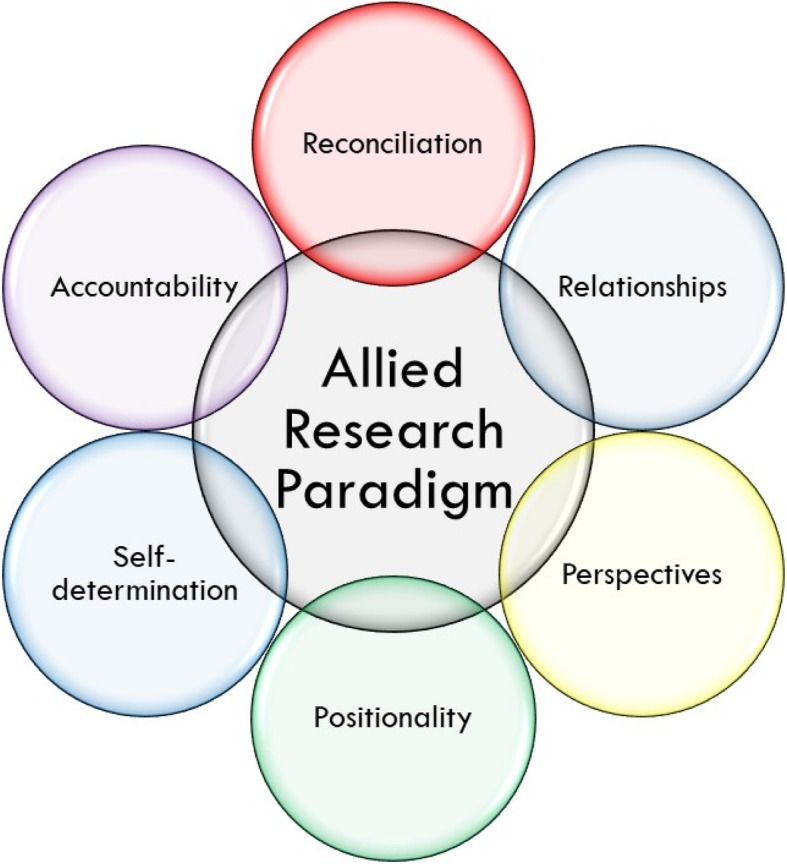
BACKGROUND: There is no shortage of epidemiology research describing the ill health of Indigenous peoples in Canada and globally and many of these studies have had negative repercussions on Indigenous communities. However, epidemiology can also be a helpful tool for supporting the health and health services of communities. This paper challenges the reader to consider the harms of epidemiology which essentialize Indigenous communities as sick and in need of help. It then discusses, from the perspective of a settler physician and clinical epidemiology student, how we may be able reconcile the field of epidemiology research with the needs of Indigenous communities. In doing so, it describes an allied research paradigm for epidemiology. RESULTS: Although qualitative research has been substantially informed by critical feminist theories, uptake in quantitative research has been sparser. It is even more rare for Indigenous methodologies to be used to inform quantitative research. This paper is written from a personal perspective, reflecting on the author's prior experiences as well as existing literature on critical feminist theory and Indigenous methodologies, to describe an allied research paradigm. This allied research paradigm follows an ontology that explores the subjectivity within epidemiology and the influence of the positionality of the researcher. It follows an epistemology that understands that knowledge can be generated through many ways including, but not limited to statistical analyses. It follows an axiology that research aims to affect social change and improve the lives of the communities participating in the research. It follows a methodology that is participatory and empowers community partners to meaningfully contribute to statistical research. This allied research paradigm, which makes no claims to universality, describes several important principles: reconciliation, relationships, perspective, positionality, self-determination and accountability. CONCLUSION: Researchers who wish to engage in research in allyship with Indigenous communities must understand the colonial history embedded in health research, commit to a process that honours meaningful relationships with community partners, and carefully consider the implications of their work.
Overview
The claims and statistics of this paper haven’t been checked yet.
Free: it reads the open-access text and checks the first 5 claims that cite a source we can check. Create a free account to check every claim.
Integrity signals
Registry
Cites
Statistics
Figures
Verification
Claims the paper makes
The claims and statistics of this paper haven’t been checked yet.
Free: it reads the open-access text and checks the first 5 claims that cite a source we can check. Create a free account to check every claim.
Claims other papers make about this one
Each is checked against this paper’s own text: does it say what the citing paper says it does?
The source backs part of the claim, not all of it — or backs it for a different population, condition or comparison.
In the citing paper
“For the last two decades, researchers in colonized countries have been calling for a specifically Indigenous epidemiology that recognizes the limits of Western epidemiological methods, incorporates more Indigenous research methodologies and CBPR methods, builds capacity by training more Indigenous epidemiologists (both in and outside of academia), and supports Indigenous self-determination”
From Addressing the need for indigenous and decolonized quantitative research methods in Canada (2021) · cites this paper as Jaworsky, 2019
Experimental — accuracy not yet measuredThe cited source says what the claim attributes to it.
In the citing paper
“When epidemiological research negatively portrays Indigenous communities without historical contextualization, it can be used to “justify paternalism and threaten efforts of Indigenous self-determination” (Jaworsky, 2019, p. 2; see also O’Neil, Reading, & Leader, 1998).”
From Addressing the need for indigenous and decolonized quantitative research methods in Canada (2021) · cites this paper as Jaworsky, 2019
The cited source says what the claim attributes to it.
In the citing paper
“A researcher's positionality underpins their research as their societal position and worldview affect a series of conscious and unconscious choices made in the quantitative study design, which in turn, influences the results to be showcased (Jaworsky, 2019).”
From Addressing the need for indigenous and decolonized quantitative research methods in Canada (2021) · cites this paper as Jaworsky, 2019
Self-check
Percentages, sums and reported differences re-computed from the paper’s own numbers.
The self-check needs the paper’s full text.
Citations
Cites
8 Decolonizing Methodologies: Research and Indigenous Peoples
Tuhiwai Smith, L. (2024) · Foundational Concepts of Decolonial and Southern Epistemologies · doi:10.21832/9781800418868-012 · Cited by 9,810
(2014) · The Reflective Practitioner in Professional Education · doi:10.1057/9781137399595.0007 · Cited by 8,325
Decolonizing Methodologies: Research and Indigenous Peoples
Hall, T. D., & Smith, L. T. (2000) · Contemporary Sociology · doi:10.2307/2653993 · Cited by 7,420
Męcfal, S. (2012) · University of Lodz Repository (University of Łódź) · Cited by 6,617
Bowleg, L. (2012) · American Journal of Public Health · doi:10.2105/ajph.2012.300750 · Cited by 2,996
(2009) · Cited by 2,537
Qualitative Research Methods in Human Geography
Hay, I. (2001) · Cited by 2,022
Indigenous Research Methodologies
Hanson, C. (2012) · International Journal of Critical Indigenous Studies · doi:10.5204/ijcis.v5i1.97 · Cited by 1,700
Handbook of Critical and Indigenous Methodologies
Denzin, N., Lincoln, Y., & Smith, L. (2008) · doi:10.4135/9781483385686 · Cited by 1,637
Bauer, G. R. (2014) · Social Science & Medicine · doi:10.1016/j.socscimed.2014.03.022 · Cited by 1,620
United Nations Declaration on the Rights of Indigenous Peoples
(2007) · International Journal of Cultural Property · doi:10.1017/s0940739107070270 · Cited by 1,334
Bartlett, C., Marshall, M., & Marshall, A. (2012) · Journal of Environmental Studies and Sciences · doi:10.1007/s13412-012-0086-8 · Cited by 1,193
Indigenous Research Methodologies
Chilisa, B. (2011) · Cited by 1,158
Power and positionality: negotiating insider/outsider status within and across cultures
Merriam, S. B., Johnson-Bailey, J., Lee, M.-Y., Kee, Y., Ntseane, G., & Muhamad, M. (2001) · International Journal of Lifelong Education · doi:10.1080/02601370120490 · Cited by 1,134
Bauer, G. R., Hammond, R., Travers, R., Kaay, M., Hohenadel, K. M., & Boyce, M. (2009) · Journal of the Association of Nurses in AIDS Care · doi:10.1016/j.jana.2009.07.004 · Cited by 928
Community-based participatory research for health: advancing social and health equity
Cook, T. (2019) · Educational Action Research · doi:10.1080/09650792.2018.1520135 · Cited by 762 · cited 1×
“butions to community-based participatory research methodologies [36].”
The SAGE Encyclopedia of Action Research
Coghlan, D., & Brydon-Miller, M. (2014) · SAGE Publications Ltd eBooks · doi:10.4135/9781446294406 · Cited by 707
Muhammad, M., Wallerstein, N., Sussman, A. L., Avila, M., Belone, L., & Duran, B. (2015) · Critical Sociology · doi:10.1177/0896920513516025 · Cited by 587
Leung, M. W. (2004) · International Journal of Epidemiology · doi:10.1093/ije/dyh010 · Cited by 565
Schnarch, B. (2004) · International Journal of Indigenous Health · doi:10.18357/ijih11200412290 · Cited by 524 · cited 1×
“Reconciliation respects and fosters Indigenous self-determination in health and health research [55] and allied researchers can turn to the Ownership, Control, Access and Possession (OCAPTM) principles of the First Nations Information Governance Centre for guidance [59].”
BackgroundIndigenous knowledges in global contexts: multiple readings of our world
(2001) · Choice Reviews Online · doi:10.5860/choice.38-5645 · Cited by 523
Colonialism as a broader social determinant of health
Czyzewski, K. (2011) · International Indigenous Policy Journal · doi:10.18584/iipj.2011.2.1.5 · Cited by 486
Coloring the Field: Gender, “Race,” and the Politics of Fieldwork
Kobayashi, A. (1994) · The Professional Geographer · doi:10.1111/j.0033-0124.1994.00073.x · Cited by 458
Indigenous statistics: a quantitative research methodology
(2014) · Choice Reviews Online · doi:10.5860/choice.51-4519 · Cited by 434
Cashman, S. B., Adeky, S., Allen, A. J., Corburn, J., Israel, B. A., Montaño, J., Rafelito, A., Rhodes, S. D., Swanston, S., Wallerstein, N., et al. (2008) · American Journal of Public Health · doi:10.2105/ajph.2007.113571 · Cited by 348
Standing With and Speaking as Faith: A Feminist-Indigenous Approach to Inquiry
TallBear, K. (2014) · DOAJ (DOAJ: Directory of Open Access Journals) · Cited by 329
Identity Work in Social Movements
Reger, J., Myers, D. J., & Einwohner, R. L. (2008) · Project Muse (Johns Hopkins University) · Cited by 258
The SAGE encyclopedia of action research
(2015) · Choice Reviews Online · doi:10.5860/choice.188110 · Cited by 255 · cited 1×
“Ashley Heaslip, a settler physician and ally in health research to Indigenous peoples, describes allyship as a concept “imbued with the notion of cultivating, building and strengthening relationships between two differing individuals, groups or communities based on respectful, meaningful and beneficial interactions [1…”
BackgroundEveryday decolonization: living a decolonizing queer politics
Hunt, S., & Holmes, C. (2015) · Journal of Lesbian Studies · doi:10.1080/10894160.2015.970975 · Cited by 235
Becoming an Ally: Breaking the Cycle of Oppression in People
Bishop, A. H. (2015) · Cited by 234
Leaving the Hospital Against Medical Advice Among People Who Use Illicit Drugs: A Systematic Review
Ti, L., & Ti, L. (2015) · American Journal of Public Health · doi:10.2105/ajph.2015.302885 · Cited by 234
(2020) · Building Confidence, Resilience and Emotional Intelligence in Young Children · doi:10.5040/9781805015185.ch-005 · Cited by 208
Inhorn, M. C., & Whittle, K. L. (2001) · Social Science & Medicine · doi:10.1016/s0277-9536(00)00360-9 · Cited by 188
Community-based participatory research for health advancing social and health equity
Wallerstein, N., Duran, B., Oetzel, J. G., & Minkler, M. (n.d.) · Cited by 185
Man-Made Medicine and Women's Health: The Biopolitics of Sex/Gender and Race/Ethnicity
Krieger, N., & Fee, E. (1994) · International Journal of Health Services · doi:10.2190/lwlh-nmcj-uacl-u80y · Cited by 149
What Explains the Publicʼs Health?—A Call for Epidemiologic Theory
Krieger, N., & Zierler, S. (1996) · Epidemiology · doi:10.1097/00001648-199601000-00020 · Cited by 143 · cited 3×
“Research does not end with a peer-reviewed publication and accountability in research is essential [7, 35].”
BackgroundInfluentialKnowledge translation and indigenous knowledge
Smylie, J., Martin, C. M., Kaplan-Myrth, N., Steele, L., Tait, C., & Hogg, W. (2004) · International Journal of Circumpolar Health · doi:10.3402/ijch.v63i0.17877 · Cited by 143
Pholi, K., Black, D. A., & Richards, C. E. (2009) · Cited by 138
Cassell, E. (2017) · British Journal of Canadian Studies · Cited by 124
Negotiating Research Relationships with Inuit Communities: a Guide for Researchers.
Nickels, S., Shirley, J., Laidler, G. J., & Kanatami, I. T. (2007) · IOC of UNESCO (Intergovernmental Oceanographic Commission) · doi:10.25607/obp-1259 · Cited by 124
O'Neil, J., Reading, J., & Leader, A. (1998) · Human Organization · doi:10.17730/humo.57.2.b7628vwvg7q127m8 · Cited by 123
Indigenous Positioning in Health Research: The importance of Kaupapa Māori theory-informed practice
Curtis, E. (2016) · AlterNative An International Journal of Indigenous Peoples · doi:10.20507/alternative.2016.12.4.5 · Cited by 114
Cannella, G. S., & Manuelito, K. D. (2008) · Sage eBooks · doi:10.4135/9781483385686.n3 · Cited by 89 · cited 1×
“Reflexivity is a way to constantly examine our work and apply a critical lens so that our work does not inadvertently fortify oppressive structures and colonial agendas [15].”
BackgroundHow Political, satirical cartoons illustrate Australia's WorkChoices debate
Townsend, K., McDonald, P. K., & Esders, L. P. (2008) · Australian review of public affairs · Cited by 67
Critical epidemiology in action: Research for and by indigenous peoples
Prussing, E. (2018) · SSM - Population Health · doi:10.1016/j.ssmph.2018.09.003 · Cited by 60
(2010) · PubMed · Cited by 47
Ji, P. Y. (2007) · Journal of Gay & Lesbian Psychotherapy · doi:10.1300/j236v11n03_10 · Cited by 43
The Activist Polis: Topologies of Conflict in Indigenous Solidarity Activism
Mott, C. (2015) · Antipode · doi:10.1111/anti.12167 · Cited by 32
A Kaupapa Māori approach to a community cohort study of heart disease in New Zealand
Pitama, S. G., Wells, J. E., Faatoese, A. F., Tikao‐Mason, K., Robertson, P., Huria, T., Gillies, T., Doughty, R. N., WHALLEY, G. A., Troughton, R. W., et al. (2011) · Australian and New Zealand Journal of Public Health · doi:10.1111/j.1753-6405.2011.00702.x · Cited by 32
Pyett, P. M., & Unit, T. V. K. H. R. A. C. D. (2002) · Contemporary Nurse · doi:10.5172/conu.14.1.56 · Cited by 26
The Whiteness of Silence: A Critical Autoethnographic Tale of a Strategic Rhetoric
Potter, J. (2015) · The Qualitative Report · doi:10.46743/2160-3715/2015.2290 · Cited by 24
Simmonds, S., Robson, B., Cram, F., & Purdie, G. (2008) · Australasian epidemiologist · Cited by 22
Promoting an egalitarian approach to research with vulnerable populations of women
Mkandawire‐Valhmu, L., Rice, E. I., & Bathum, M. E. (2009) · Journal of Advanced Nursing · doi:10.1111/j.1365-2648.2009.05045.x · Cited by 12
(2012) · PubMed · Cited by 11
Bridges, B., Benoit, A. C., Younger, J., Beaver, K., Jackson, R., Loutfy, M. R., Masching, R., Nobis, T., Nowgesic, E., O’Brien-Teengs, D., et al. (2017) · Canadian Journal of Public Health · doi:10.17269/cjph.108.5708 · Cited by 10
Self-citationTeaching Activists for Social Change: Coming to Grips with Questions of Subjectivity and Domination
Razack, S. H. (1993) · Canadian Journal for the Study of Adult Education · doi:10.56105/cjsae.v7i2.2230 · Cited by 8
Bridges, B., Benoit, A. C., Younger, J., Beaver, K., Jackson, R., Loutfy, M. R., Masching, R., Nobis, T., Nowgesic, E., O’Brien-Teengs, D., et al. (2016) · Antiviral Therapy · doi:10.3851/imp3114 · Cited by 7
Self-citationNorthern perspectives on medical elective tourism: a qualitative study
Coke, S., Kuper, A., Richardson, L., & Cameron, A. (2016) · CMAJ Open · doi:10.9778/cmajo.20160001 · Cited by 4
Unlearning Privilege and Becoming and Ally: It Is Never too Young to Start
Ferber, A. L. (2010) · Reflections: Narratives of Professional Helping · Cited by 1
Research works printed but not linked: 12
- Matiation S HIV testing and confidentiality: issues for the aboriginal community. Ottawa: Canadian HIV/AIDS legal network 1999
- Yee J Allyship and youth Our schools, our selves 2009 18 2 103
- Hooks B Taylor & Francis eBooks Feminism is for everybody 2015 2 New York and London Routledge
- Bishop A Halifax Becoming an ally: Breaking the cycle of oppression in people 2001 2 Nova Scotia Fernwood
- Max K Chapter four: anti-colonial research: working as an ally with aboriginal peoples Counterpoints. 2005 252 79 94
- Madge C Raghuram P Skelton T Willis K Williams J Women and Geography Study Group Methods and methodologies in feminist geographies: politics, practice, power 1997 New York and London Prentice Hall 86 111
- Baskin C Koleszar-Green R Hendry J Lavallée L Murrin J We pass the talking stick to you: forming alliances and identities in the academy Can J Nativ Educ 2008 31 1 89
- First Nations Centre OCAP: ownership, control, access and possession. Ottawa: National Aboriginal Health Organization 2007
- Benoit AC Jaworsky D Hull M Masching R Raboud J Hogg R Building bridges: a model for community engagement in epidemiology research. 24th annual Canadian conference on HIV/AIDS research 2015 Canada Toronto
- Jaworsky D Ranville F Nicholson V Price R Kellman C Benson E Antiretroviral therapy treatment interruption among indigenous peoples living with HIV in Canada: a building bridges study guided by community J Indigenous HIV Res 2018 9 22 37
- Manuel A Grand chief Derrickson R. the reconciliation manifesto: recovering the land, rebuilding the economy 2017 Toronto Lorimer
- Centre M Principles of ethical Métis research. Ottawa: National Aboriginal Health Organization 2011
Cited by
Lin, C. Y., Sánchez, A. L., Boyling, E., & Barnabe, C. C. M. (2020) · BMJ Open · doi:10.1136/bmjopen-2020-039736 · Cited by 90
Addressing the need for indigenous and decolonized quantitative research methods in Canada
Hayward, A., Wodtke, L., Craft, A., Robin, T., Smylie, J., McConkey, S., Nychuk, A., Healy, C., Star, L., & Cidro, J. (2021) · SSM - Population Health · doi:10.1016/j.ssmph.2021.100899 · Cited by 69
“The questions asked by the researchers are primarily deficit-based (Bailie & Paradies, 2005; Fontaine, 2018; Green & Haines, 2011; Jaworsky, 2019; Morgan & Ziglio, 2007).”
BackgroundInfluentialTemperature and place associations with Inuit mental health in the context of climate change
Middleton, J., Cunsolo, A., Pollock, N. J., Jones‐Bitton, A., Wood, M., Shiwak, I., Flowers, C., & Harper, S. L. (2021) · Environmental Research · doi:10.1016/j.envres.2021.111166 · Cited by 52
Doering, N. N., Dudeck, S., Elverum, S., Fisher, C., Henriksen, J. E., Herrmann, T. M., Kramvig, B., Laptander, R., Milton, J., Omma, E. M., et al. (2022) · Environmental Research Letters · doi:10.1088/1748-9326/ac72b5 · Cited by 55
Exploring the perspectives of community members as research partners in rural and remote areas
Pelletier, C., Pousette, A., Ward, K., & Fox, G. (2020) · Research Involvement and Engagement · doi:10.1186/s40900-020-0179-6 · Cited by 46
Metadata
- Authors
- Jaworsky, D.
- Affiliations
- University of British Columbia (CA)
- Corresponding author
- Jaworsky, Denise
- ORCID
- Jaworsky, Denise
- Venue
- Archives of Public Health
- Published
- 2019-05-20
- Volume
- 77
- Issue
- 1
- Pages
- 22-22
- ISSN
- 0778-7367 (ISSN-L)
- 2049-3258
- PMC
- PMC6526603
- OpenAlex
- W2947150845
- Cited by
- 23
- References
- 62
- Citations by year
- 2026: 4 · 2025: 2 · 2024: 3 · 2023: 3 · 2022: 3 · 2021: 4 · 2020: 4
- FWCI
- 2.68
- Type
- journal article
- Language
- en
- Open access
- gold
- doi.org
- Licence
- cc-by
- creativecommons.org/licenses/by/4.0/ (tdm)
- creativecommons.org/licenses/by/4.0/ (vor)
- Locations
- Archives of Public Health (publishedVersion, cc-by)
- PubMed Central (publishedVersion, cc-by)
- PubMed (publishedVersion)
- TSpace (University of Toronto) (submittedVersion, cc-by)
- cIRcle (University of British Columbia) (submittedVersion, cc-by)
- DOAJ (DOAJ: Directory of Open Access Journals) (submittedVersion, cc-by-sa)
- Open Collections
- Funders
- Canadian Institutes of Health Research (Post-Doctoral Fellowship)
- Topics
- Social Sciences › Health › Indigenous Health, Education, and Rights
- Social Sciences › Sociology and Political Science › Qualitative Research Methods and Ethics
- Social Sciences › Anthropology › Race, Genetics, and Society
- Keywords
- indigenous peoples, research paradigms, allyship, Indigenous research methodologies, critical feminist theory, settler colonialism, Indigenous health, community participation, researcher positionality, Indigenous self-determination, reconciliation, health research ethics
About these checks
Registry, retraction, Cites and statistics results are computed, not judged, with one exception: a printed reference that no index lists is read once by a model before it counts as a citation error. Claims are extracted by a model and kept only when their quote appears verbatim in the text; each cited source is then checked, with a model’s help, for whether it says what the claim relies on. Those verdicts can be wrong — read the claim’s quote and the cited source before relying on one.
Statistics and arithmetic are recomputed, not judged.
Confidence bands are shown only for fields calibrated on our annotated test set. None is calibrated yet, so no band is shown.
What counts as a claim ›How we measure confidence ›How we check this ›
Are you an author, or do you see a problem with this page? Request a review
Data sources
Bibliographic data: Semantic Scholar, OpenAlex, Crossref.
Contains information from the Semantic Scholar Academic Graph Datasets, made available under the ODC Attribution License (ODC-BY 1.0).
Semantic Scholar’s data is described in: Kinney, R., et al. (2023). The Semantic Scholar Open Data Platform. arXiv:2301.10140.
