

Validation of the AUDIT-C in adults seeking help with their drinking online
Open accessThe DOI matches its Crossref record; 54 of the 57 references it cites were found in a registry or an index.
Abstract
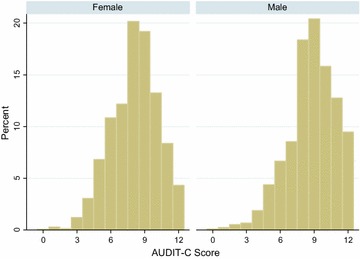
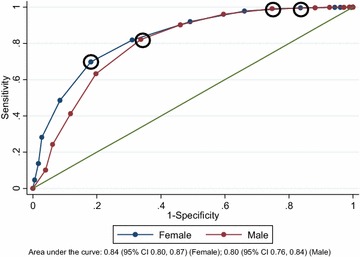
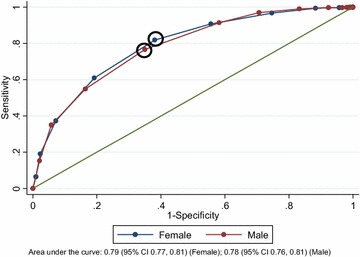
BACKGROUND: The abbreviated Alcohol Use Disorder Identification Test for Consumption (AUDIT-C) is rapidly becoming the alcohol screening tool of choice for busy practitioners in clinical settings and by researchers keen to limit assessment burden and reactivity. Cut-off scores for detecting drinking above recommended limits vary by population, setting, country and potentially format. This validation study aimed to determine AUDIT-C thresholds that indicated risky drinking among a population of people seeking help over the Internet. METHOD: The data in this study were collected in the pilot phase of the Down Your Drink trial, which recruited people seeking help over the Internet and randomised them to a web-based intervention or an information-only website. Sensitivity, specificity, and positive and negative likelihood ratios were calculated for AUDIT-C scores, relative to weekly consumption that indicated drinking above limits and higher risk drinking. Receiver-operating characteristic (ROC) curves were created to assess the performance of different cut-off scores on the AUDIT-C for men and women. Past week alcohol consumption was used as the reference-standard and was collected via the TOT-AL, a validated online measure of past week drinking. RESULTS: AUDIT-C scores were obtained from 3720 adults (2053 female and 1667 male) searching the internet for help with drinking, mostly from the UK. The area under the ROC curve for risky drinking was 0.84 (95% CI 0.80, 0.87) (female) and 0.80 (95% CI 0.76, 0.84) (male). AUDIT-C cut-off scores for detecting risky drinking that maximise the sum of sensitivity and specificity were ≥8 for women and ≥8 for men; whereas those identifying the highest proportion of correctly classified individuals were ≥4 for women and ≥5 for men. AUDIT-C cut-off scores for detecting higher risk drinking were also calculated. CONCLUSIONS: AUDIT-C cut-off scores for identifying alcohol consumption above weekly limits in this largely UK based study population were substantially higher than those reported in other validation studies. Researchers and practitioners should select AUDIT-C cut-off scores according to the purpose of identifying risky drinkers and hence the relative importance of sensitivity and/or specificity.
Overview
The claims and statistics of this paper haven’t been checked yet.
Free: it reads the open-access text and checks the first 5 claims that cite a source we can check. Create a free account to check every claim.
Integrity signals
Registry
Cites
Statistics
Figures
Verification
Claims the paper makes
The claims and statistics of this paper haven’t been checked yet.
Free: it reads the open-access text and checks the first 5 claims that cite a source we can check. Create a free account to check every claim.
Claims other papers make about this one
Each is checked against this paper’s own text: does it say what the citing paper says it does?
The source backs part of the claim, not all of it — or backs it for a different population, condition or comparison.
In the citing paper
“Both the English and French versions of AUDIT have favorable psychometric properties, including high sensitivity and specificity (approximately 90%), and this also concerns the AUDIT-C [75-77].”
From A Virtual Reality-Assisted Cognitive Behavioral Therapy for and With Inuit in Québec: Protocol for a Proof-of-Concept Randomized Controlled Trial (2023) · cites this paper as [75]
Experimental — accuracy not yet measured
Self-check
Percentages, sums and reported differences re-computed from the paper’s own numbers.
The self-check needs the paper’s full text.
Citations
Cites
Bush, K. (1998) · Archives of Internal Medicine · doi:10.1001/archinte.158.16.1789 · Cited by 6,196
(2001) · Cited by 5,455
Effectiveness of brief alcohol interventions in primary care populations
Kaner, E. F., Beyer, F. R., Muirhead, C., Campbell, F., Pienaar, E. D., Bertholet, N., Daeppen, J. B., Saunders, J. B., & Burnand, B. (2018) · Cochrane Database of Systematic Reviews · doi:10.1002/14651858.cd004148.pub4 · Cited by 1,665
The alcohol use disorders identification test: an update of research findings
Reinert, D. F., & Allen, J. P. (2007) · Alcoholism: Clinical and Experimental Research · doi:10.1111/j.1530-0277.2006.00295.x · Cited by 1,397 · cited 4×
“Studies in the US, Germany and Scandinavia identified in the small number of reviews in this field [13, 14] have validated the AUDIT-C for detecting risky drinking in the general population, all of which administered measures in-person.”
BackgroundMethodInfluentialTourangeau, R., & Smith, T. W. (1996) · Public Opinion Quarterly · doi:10.1086/297751 · Cited by 1,295 · cited 1×
“There is also some evidence that being self-administered, online screening is likely to generate more honest reporting of risky alcohol use, in comparison with a face-to-face interview [27, 28].”
BackgroundGlobal strategy to reduce the harmful use of alcohol
Ray, R., & Anish, P. K. (2012) · The Indian Journal of Medical Research · Cited by 888
Mesa Grande: a methodological analysis of clinical trials of treatments for alcohol use disorders
Miller, W. R., & Wilbourne, P. L. (2002) · Addiction · doi:10.1046/j.1360-0443.2002.00019.x · Cited by 805 · cited 1×
“Background Early identification of people drinking at risky levels followed by brief intervention is the key individual-level intervention approach for reducing alcohol intake to safer levels [1, 2], with efficacy demonstrated in a range of settings including primary care, emergency departments, higher education and t…”
BackgroundEffectiveness of brief alcohol interventions in primary care populations
Kaner, E. F. S., Dickinson, H. O., Beyer, F. R., Campbell, F., Schlesinger, C., Heather, N., Saunders, J. B., Burnand, B., & Pienaar, E. D. (2007) · Cochrane Database of Systematic Reviews · doi:10.1002/14651858.cd004148.pub3 · Cited by 746
Dawson, D. A., Grant, B. F., Stinson, F. S., & Zhou, Y. (2005) · Alcoholism: Clinical & Experimental Research · doi:10.1097/01.alc.0000164374.32229.a2 · Cited by 702 · cited 2×
“Two studies included in this review found ‘optimal’ AUDIT-C scores (defined as those that maximise the sum of sensitivity and specificity) for detecting drinking above recommended limits in the general population of ≥5 in Germany [15] and ≥5 (men) and ≥3 (women) in the US [16].”
BackgroundMethodIndividual-level interventions to reduce college student drinking: A meta-analytic review
Carey, K. B., Scott-Sheldon, L. A. J., Carey, M. P., & DeMartini, K. S. (2007) · Addictive Behaviors · doi:10.1016/j.addbeh.2007.05.004 · Cited by 699
Research works printed but not linked: 3
- NICE Public Health Guidance 24 Alcohol-use disorders: preventing the development of hazardous and harmful drinking 2010 London National Institute for Health and Clinical Excellence
- Department of Health The health of the nation: a strategy for health in England 1992 London HMSO
- Department of Health UK Chief Medical Officers’ alcohol guidelines review 2016 Summary of the proposed new guidelines London Department of Health
Cited by
Alpers, S. E., Skogen, J. C., Mæland, S., Pallesen, S., Rabben, Å. K., Lunde, L.-H., & Fadnes, L. T. (2021) · International Journal of Environmental Research and Public Health · doi:10.3390/ijerph18031220 · Cited by 104
“AUDIT-C cut-off scores for identifying alcohol consumption above recommended limits vary by population, setting, and culture [18].”
BackgroundNew onset alcohol use disorder following bariatric surgery
Ibrahim, N. I., Alameddine, M. B., Brennan, J. R., Sessine, M. S., Holliday, C. L., & Ghaferi, A. A. (2018) · Surgical Endoscopy · doi:10.1007/s00464-018-6545-x · Cited by 93
Morris, J. K., Albery, I. P., Heather, N., & Moss, A. C. (2020) · Addictive Behaviors · doi:10.1016/j.addbeh.2020.106292 · Cited by 68
The “alcoholic other”: Harmful drinkers resist problem recognition to manage identity threat
Morris, J. K., Moss, A. C., Albery, I. P., & Heather, N. (2021) · Addictive Behaviors · doi:10.1016/j.addbeh.2021.107093 · Cited by 56
Khan, M. R., Young, K. E., Caniglia, E. C., Fiellin, D. A., Maisto, S. A., Marshall, B. D. L., Edelman, E. J., Gaither, J. R., Chichetto, N. E., Tate, J., et al. (2020) · JAMA Network Open · doi:10.1001/jamanetworkopen.2020.0895 · Cited by 44
Metadata
- Authors
- Khadjesari, Z., White, I. R., McCambridge, J., Marston, L., Wallace, P., Godfrey, C., & Murray, E.
- Affiliations
- King's College London (GB)
- MRC Biostatistics Unit (GB)
- University of York (GB)
- The Royal Free Hospital (GB)
- Corresponding author
- Marston, Louise
- ORCID
- Venue
- Addiction Science & Clinical Practice
- Published
- 2017-01-04
- Volume
- 12
- Issue
- 1
- Pages
- 2-2
- ISSN
- 1940-0632 (ISSN-L)
- 1940-0640
- PMC
- PMC5209877
- OpenAlex
- W2561239935
- Cited by
- 106
- References
- 57
- Citations by year
- 2026: 8 · 2025: 16 · 2024: 15 · 2023: 7 · 2022: 15 · 2021: 15 · 2020: 13 · 2019: 7 · 2018: 6 · 2017: 2
- FWCI
- 6.00
- Type
- journal article
- Language
- en
- Open access
- gold
- doi.org
- Licence
- cc-by
- Locations
- Addiction Science & Clinical Practice (publishedVersion, cc-by)
- PubMed Central (publishedVersion, cc-by)
- PubMed (publishedVersion)
- Research Portal (King's College London) (acceptedVersion, cc-by)
- UEA Digital Repository (University of East Anglia) (acceptedVersion)
- White Rose Research Online (University of Leeds, The University of Sheffield, University of York) (acceptedVersion)
- UCL Discovery (University College London) (submittedVersion)
- Apollo (University of Cambridge) (submittedVersion, cc-by)
- Apollo
- Funders
- NIHR School for Primary Care Research Fellowship
- Topics
- Health Sciences › Medicine › Epidemiology › Substance Abuse Treatment and Outcomes
- Health Sciences › Medicine › Pathology and Forensic Medicine › Alcohol Consumption and Health Effects
- Health Sciences › Medicine › Public Health, Environmental and Occupational Health › Smoking Behavior and Cessation
- Keywords
- AUDIT-C, alcohol screening, cut-off values, hazardous drinking, online help-seeking, online intervention, alcohol consumption limits, diagnostic accuracy, sensitivity and specificity, gender differences
- MeSH terms
- Help-Seeking Behavior, Adult, Alcoholism, Female, United Kingdom, Humans, Male, Middle Aged, Psychometrics, Surveys and Questionnaires, Self Disclosure, Reproducibility of Results, Internet
About these checks
Registry, retraction, Cites and statistics results are computed, not judged, with one exception: a printed reference that no index lists is read once by a model before it counts as a citation error. Claims are extracted by a model and kept only when their quote appears verbatim in the text; each cited source is then checked, with a model’s help, for whether it says what the claim relies on. Those verdicts can be wrong — read the claim’s quote and the cited source before relying on one.
Statistics and arithmetic are recomputed, not judged.
Confidence bands are shown only for fields calibrated on our annotated test set. None is calibrated yet, so no band is shown.
What counts as a claim ›How we measure confidence ›How we check this ›
Are you an author, or do you see a problem with this page? Request a review
How to cite
Cite CoChat for the checks on this page, and the paper for its own findings.
- This page
- CoChat. (2026). Citation check: Validation of the AUDIT-C in adults seeking help with their drinking online. https://app.cochat.ai/papers/10.1186/s13722-016-0066-5
- The paper
- Khadjesari, Z., White, I. R., McCambridge, J., Marston, L., Wallace, P., Godfrey, C., & Murray, E. (2017). Validation of the AUDIT-C in adults seeking help with their drinking online. Addiction Science & Clinical Practice. https://doi.org/10.1186/s13722-016-0066-5
Data sources
Bibliographic data: Semantic Scholar, OpenAlex, Crossref.
Contains information from the Semantic Scholar Academic Graph Datasets, made available under the ODC Attribution License (ODC-BY 1.0).
Semantic Scholar’s data is described in: Kinney, R., et al. (2023). The Semantic Scholar Open Data Platform. arXiv:2301.10140.
