

Validation of the AUDIT-C in adults seeking help with their drinking online
Open accessThe DOI matches its Crossref record; 55 of the 57 references it cites were found in a registry or an index.
Abstract
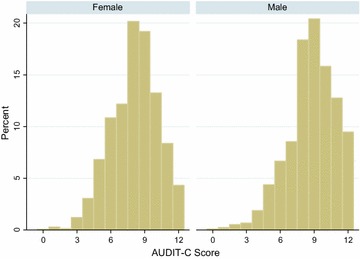
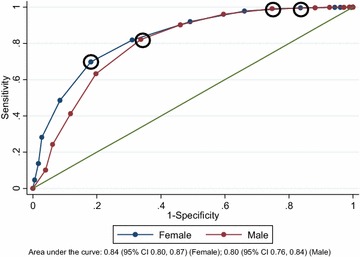
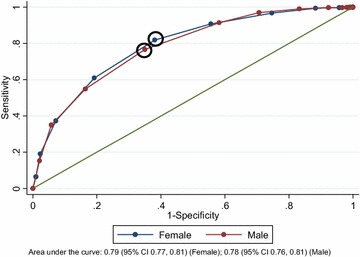
BACKGROUND: The abbreviated Alcohol Use Disorder Identification Test for Consumption (AUDIT-C) is rapidly becoming the alcohol screening tool of choice for busy practitioners in clinical settings and by researchers keen to limit assessment burden and reactivity. Cut-off scores for detecting drinking above recommended limits vary by population, setting, country and potentially format. This validation study aimed to determine AUDIT-C thresholds that indicated risky drinking among a population of people seeking help over the Internet. METHOD: The data in this study were collected in the pilot phase of the Down Your Drink trial, which recruited people seeking help over the Internet and randomised them to a web-based intervention or an information-only website. Sensitivity, specificity, and positive and negative likelihood ratios were calculated for AUDIT-C scores, relative to weekly consumption that indicated drinking above limits and higher risk drinking. Receiver-operating characteristic (ROC) curves were created to assess the performance of different cut-off scores on the AUDIT-C for men and women. Past week alcohol consumption was used as the reference-standard and was collected via the TOT-AL, a validated online measure of past week drinking. RESULTS: AUDIT-C scores were obtained from 3720 adults (2053 female and 1667 male) searching the internet for help with drinking, mostly from the UK. The area under the ROC curve for risky drinking was 0.84 (95% CI 0.80, 0.87) (female) and 0.80 (95% CI 0.76, 0.84) (male). AUDIT-C cut-off scores for detecting risky drinking that maximise the sum of sensitivity and specificity were ≥8 for women and ≥8 for men; whereas those identifying the highest proportion of correctly classified individuals were ≥4 for women and ≥5 for men. AUDIT-C cut-off scores for detecting higher risk drinking were also calculated. CONCLUSIONS: AUDIT-C cut-off scores for identifying alcohol consumption above weekly limits in this largely UK based study population were substantially higher than those reported in other validation studies. Researchers and practitioners should select AUDIT-C cut-off scores according to the purpose of identifying risky drinkers and hence the relative importance of sensitivity and/or specificity.
Overview
The claims and statistics of this paper haven’t been checked yet.
Free: it reads the open-access text and checks the first 5 claims that cite a source we can check. Create a free account to check every claim.
Integrity signals
Registry
Cites
Statistics
Figures
Verification
Claims the paper makes
The claims and statistics of this paper haven’t been checked yet.
Free: it reads the open-access text and checks the first 5 claims that cite a source we can check. Create a free account to check every claim.
Claims other papers make about this one
Each is checked against this paper’s own text: does it say what the citing paper says it does?
The source backs part of the claim, not all of it — or backs it for a different population, condition or comparison.
In the citing paper
“Both the English and French versions of AUDIT have favorable psychometric properties, including high sensitivity and specificity (approximately 90%), and this also concerns the AUDIT-C [75-77].”
From A Virtual Reality-Assisted Cognitive Behavioral Therapy for and With Inuit in Québec: Protocol for a Proof-of-Concept Randomized Controlled Trial (2023) · cites this paper as [75]
Experimental — accuracy not yet measured
Self-check
Percentages, sums and reported differences re-computed from the paper’s own numbers.
The self-check needs the paper’s full text.
Citations
Cites
Bush, K. (1998) · Archives of Internal Medicine · doi:10.1001/archinte.158.16.1789 · Cited by 6,196
(2001) · Cited by 5,455
Effectiveness of brief alcohol interventions in primary care populations
Kaner, E. F., Beyer, F. R., Muirhead, C., Campbell, F., Pienaar, E. D., Bertholet, N., Daeppen, J. B., Saunders, J. B., & Burnand, B. (2018) · Cochrane Database of Systematic Reviews · doi:10.1002/14651858.cd004148.pub4 · Cited by 1,665
The alcohol use disorders identification test: an update of research findings
Reinert, D. F., & Allen, J. P. (2007) · Alcoholism: Clinical and Experimental Research · doi:10.1111/j.1530-0277.2006.00295.x · Cited by 1,397 · cited 4×
“Studies in the US, Germany and Scandinavia identified in the small number of reviews in this field [13, 14] have validated the AUDIT-C for detecting risky drinking in the general population, all of which administered measures in-person.”
BackgroundMethodInfluentialTourangeau, R., & Smith, T. W. (1996) · Public Opinion Quarterly · doi:10.1086/297751 · Cited by 1,295 · cited 1×
“There is also some evidence that being self-administered, online screening is likely to generate more honest reporting of risky alcohol use, in comparison with a face-to-face interview [27, 28].”
BackgroundGlobal strategy to reduce the harmful use of alcohol
Ray, R., & Anish, P. K. (2012) · The Indian Journal of Medical Research · Cited by 888
Mesa Grande: a methodological analysis of clinical trials of treatments for alcohol use disorders
Miller, W. R., & Wilbourne, P. L. (2002) · Addiction · doi:10.1046/j.1360-0443.2002.00019.x · Cited by 805 · cited 1×
“Background Early identification of people drinking at risky levels followed by brief intervention is the key individual-level intervention approach for reducing alcohol intake to safer levels [1, 2], with efficacy demonstrated in a range of settings including primary care, emergency departments, higher education and t…”
BackgroundEffectiveness of brief alcohol interventions in primary care populations
Kaner, E. F. S., Dickinson, H. O., Beyer, F. R., Campbell, F., Schlesinger, C., Heather, N., Saunders, J. B., Burnand, B., & Pienaar, E. D. (2007) · Cochrane Database of Systematic Reviews · doi:10.1002/14651858.cd004148.pub3 · Cited by 746
Dawson, D. A., Grant, B. F., Stinson, F. S., & Zhou, Y. (2005) · Alcoholism: Clinical & Experimental Research · doi:10.1097/01.alc.0000164374.32229.a2 · Cited by 702 · cited 2×
“Two studies included in this review found ‘optimal’ AUDIT-C scores (defined as those that maximise the sum of sensitivity and specificity) for detecting drinking above recommended limits in the general population of ≥5 in Germany [15] and ≥5 (men) and ≥3 (women) in the US [16].”
BackgroundMethodIndividual-level interventions to reduce college student drinking: A meta-analytic review
Carey, K. B., Scott-Sheldon, L. A. J., Carey, M. P., & DeMartini, K. S. (2007) · Addictive Behaviors · doi:10.1016/j.addbeh.2007.05.004 · Cited by 699
The impact of brief alcohol interventions in primary healthcare: a systematic review of reviews
O'Donnell, A., Anderson, P., Newbury-Birch, D., Schulte, B., Schmidt, C., Reimer, J., & Kaner, E. (2014) · Alcohol and Alcoholism · doi:10.1093/alcalc/agt170 · Cited by 613
Knight, J. R., Sherritt, L., Harris, S. K., Gates, E. C., & Chang, G. (2003) · Alcoholism: Clinical and Experimental Research · doi:10.1111/j.1530-0277.2003.tb02723.x · Cited by 420 · cited 1×
“Previous research has found that lower cutoff scores may be necessary in younger age groups [49], and the Royal College of Psychiatrists have advocated that lower recommended limits are introduced for people over the age of 65 [50].”
BackgroundMethodological issues in measuring alcohol use.
Dawson, D. A. (2003) · PubMed Central · Cited by 370
Correcting for Optimistic Prediction in Small Data Sets
Smith, G. C. S., Seaman, S. R., Wood, A. M., Royston, P., & White, I. R. (2014) · American Journal of Epidemiology · doi:10.1093/aje/kwu140 · Cited by 352 · cited 1×
“When the same data are used both to select a cut-off score and to evaluate performance (sensitivity, specificity, likelihood ratios or accuracy) at the cut-off, performance tends to be over-estimated—a phenomenon known as “optimism” or “overfitting” [42].”
MethodSelf-citationEffectiveness of the AUDIT-C as a Screening Test for Alcohol Misuse in Three Race/Ethnic Groups
Frank, D., DeBenedetti, A. F., Volk, R. J., Williams, E. C., Kivlahan, D. R., & Bradley, K. A. (2008) · Journal of General Internal Medicine · doi:10.1007/s11606-008-0594-0 · Cited by 336 · cited 1×
“Previous research findings are mixed as to the need for different cut-off scores for different ethnicities [51, 52].”
BackgroundMiller, E. T., Neal, D. J., Roberts, L. J., Baer, J. S., Cressler, S. O., Metrik, J., & Marlatt, G. A. (2002) · Psychology of Addictive Behaviors · doi:10.1037/0893-164x.16.1.56 · Cited by 332
Rumpf, H.-J. (2002) · Alcohol and Alcoholism · doi:10.1093/alcalc/37.3.261 · Cited by 325 · cited 3×
“Studies in the US, Germany and Scandinavia identified in the small number of reviews in this field [13, 14] have validated the AUDIT-C for detecting risky drinking in the general population, all of which administered measures in-person.”
BackgroundMethodThe use of “overall accuracy” to evaluate the validity of screening or diagnostic tests
Alberg, A. J., Park, J. W., Hager, B. W., Brock, M. V., & Diener-West, M. (2004) · Journal of General Internal Medicine · doi:10.1111/j.1525-1497.2004.30091.x · Cited by 295 · cited 1×
“When selecting a suitable threshold for the identification of risky drinkers there are various factors that need to be considered, such as prevalence, the regularity of screening, and any physical, psychological and economic costs related to the identification of false positives or false negatives [44].”
BackgroundWhat’s next for WHO’s global strategy to reduce the harmful use of alcohol?
Jernigan, D. H., & Trangenstein, P. J. (2020) · Bulletin of the World Health Organization · doi:10.2471/blt.19.241737 · Cited by 251
Havard, A., Shakeshaft, A., & Sanson‐Fisher, R. (2008) · Addiction · doi:10.1111/j.1360-0443.2007.02072.x · Cited by 250
Interpreting diagnostic accuracy studies for patient care
Mallett, S., Halligan, S., Thompson, M., Collins, G. S., & Altman, D. G. (2012) · BMJ · doi:10.1136/bmj.e3999 · Cited by 248 · cited 1×
“It has been suggested that ‘optimal’ cut-off scores, which maximise sensitivity and specificity, are nonsensical as they often combine accuracy data from thresholds that are not clinically relevant [46].”
BackgroundMeasuring Quantity, Frequency, and Volume of Drinking
Rehm, J. (1998) · Alcoholism: Clinical and Experimental Research · doi:10.1111/j.1530-0277.1998.tb04368.x · Cited by 211 · cited 3×
“This helps minimise task-related errors, though the nature of the behaviour being reported upon is intrinsically difficult to measure retrospectively, as recall must contend with variations in drinking patterns over time [41, 47].”
Background(2003) · PubMed · doi:10.1097/01.alc.0000046598.59317.3a · Cited by 176
Berner, M. M., Kriston, L., Bentele, M., & Härter, M. (2007) · Journal of Studies on Alcohol and Drugs · doi:10.15288/jsad.2007.68.461 · Cited by 165 · cited 1×
“There is now a substantial literature demonstrating the validity of the AUDIT in settings beyond primary care, such as inpatient hospital wards, emergency departments, universities, workplaces, outpatient settings and psychiatric services [10].”
BackgroundLundin, A., Hallgren, M., Balliu, N., & Forsell, Y. (2015) · Alcoholism: Clinical and Experimental Research · doi:10.1111/acer.12593 · Cited by 151 · cited 1×
“One recently published study based in the adult general population in Sweden found the ‘optimal’ AUDIT-C cut-off score for detecting drinking above recommended limits (termed “risk drinking”) was ≥6 (men) and ≥4 (women) [20].”
BackgroundAn Internet-based survey method for college student drinking research
Kypri, K., Gallagher, S., & Cashell‐Smith, M. L. (2004) · Drug and Alcohol Dependence · doi:10.1016/j.drugalcdep.2004.04.001 · Cited by 136
Ethnic and Sex Bias in Primary Care Screening Tests for Alcohol Use Disorders
Steinbauer, J. R., Cantor, S. B., Holzer III, C. E., & Volk, R. J. (1998) · Annals of Internal Medicine · doi:10.7326/0003-4819-129-5-199809010-00002 · Cited by 134 · cited 1×
“Previous research findings are mixed as to the need for different cut-off scores for different ethnicities [51, 52].”
BackgroundWeb-Based Alcohol Screening and Brief Intervention for University Students: A Randomized Trial
Kypri, K., Vater, T., Bowe, S. J., Saunders, J. B., Cunningham, J. A., Horton, N. J., & McCambridge, J. (2014) · JAMA · doi:10.1001/jama.2014.2138 · Cited by 118 · cited 1×
“The AUDIT-C has been used to screen for eligibility in two trials of web-based alcohol screening and brief intervention delivered to students in New Zealand (≥4 for men and women) [29, 30] and two trials of facilitated access to an online intervention delivered in primary care in Italy and Spain (≥5 for men and ≥4 wom…”
MethodSelf-citationWallace, P., Murray, E., McCambridge, J., Khadjesari, Z., White, I. R., Thompson, S. G., Kalaitzaki, E., Godfrey, C., & Linke, S. (2011) · PLoS ONE · doi:10.1371/journal.pone.0014740 · Cited by 114 · cited 1×
“Methods The data for this study were collected during the eight month pilot phase (February to October 2007) of an online randomised controlled trial investigating the effectiveness of an internet-based intervention (called Down Your Drink—DYD [33] for people looking for help or information on their drinking [34, 35].”
MethodSelf-citationMeta-analysis: Are 3 Questions Enough to Detect Unhealthy Alcohol Use?
Kriston, L., Hölzel, L., Weiser, A.-K., Berner, M. M., & Härter, M. (2008) · Annals of Internal Medicine · doi:10.7326/0003-4819-149-12-200812160-00007 · Cited by 112 · cited 4×
“Studies in the US, Germany and Scandinavia identified in the small number of reviews in this field [13, 14] have validated the AUDIT-C for detecting risky drinking in the general population, all of which administered measures in-person.”
BackgroundMethodInfluentialElectronic Interventions for Alcohol Misuse and Alcohol Use Disorders: A Systematic Review
Dedert, E. A., McDuffie, J. R., Stein, R., McNiel, J. M., Kosinski, A. S., Freiermuth, C. E., Hemminger, A., & Williams, J. W. (2015) · Annals of Internal Medicine · doi:10.7326/m15-0285 · Cited by 110 · cited 1×
“Screening and brief intervention delivered over the Internet has grown in popularity over the past decade and is now a substantial field of research [21].”
BackgroundA systematic review of work‐place interventions for alcohol‐related problems
Webb, G., Shakeshaft, A., Sanson‐Fisher, R., & Havard, A. (2009) · Addiction · doi:10.1111/j.1360-0443.2008.02472.x · Cited by 106
CROME, I. B., Dar, K., Janikiewicz, S., Rao, R., & Tarbuck, A. F. (2011) · Cited by 100
Measuring Quantity, Frequency, and Volume of Drinking
Rehm, J. T. (1998) · Alcoholism Clinical and Experimental Research · doi:10.1097/00000374-199802001-00002 · Cited by 96
Kypri, K., McCambridge, J., Vater, T., Bowe, S. J., Saunders, J. B., Cunningham, J. A., & Horton, N. J. (2013) · Addiction · doi:10.1111/j.1360-0443.2012.04067.x · Cited by 90 · cited 1×
“The AUDIT-C has been used to screen for eligibility in two trials of web-based alcohol screening and brief intervention delivered to students in New Zealand (≥4 for men and women) [29, 30] and two trials of facilitated access to an online intervention delivered in primary care in Italy and Spain (≥5 for men and ≥4 wom…”
MethodSelf-citationEffectiveness of Structured Questionnaires for Screening Heavy Drinking in Middle‐Aged Women
Aalto, M., Tuunanen, M., Sillanaukee, P., & Seppä, K. (2006) · Alcoholism Clinical and Experimental Research · doi:10.1111/j.1530-0277.2006.00233.x · Cited by 86
Binge drinking and its detection among middle‐aged men using AUDIT, AUDIT‐C and AUDIT‐3
TUUNANEN, M., AALTO, M., & SEPPÄ, K. (2007) · Drug and Alcohol Review · doi:10.1080/09595230701247756 · Cited by 84
Selin, K. H. (2006) · Substance Use & Misuse · doi:10.1080/10826080601025532 · Cited by 78
Development of a Psychologically Enhanced Interactive Online Intervention for Hazardous Drinking
Linke, S., McCambridge, J., Khadjesari, Z., Wallace, P., & Murray, E. (2008) · Alcohol and Alcoholism · doi:10.1093/alcalc/agn066 · Cited by 68 · cited 2×
“The data for this study were collected during the eight month pilot phase (February to October 2007) of an online randomised controlled trial investigating the effectiveness of an internet-based intervention (called Down Your Drink—DYD [33] for people looking for help or information on their drinking [34, 35].”
MethodSelf-citationThomas, B. A., & McCambridge, J. (2008) · Drug and Alcohol Dependence · doi:10.1016/j.drugalcdep.2008.02.010 · Cited by 56
Self-citationShould brief interventions in primary care address alcohol problems more strongly?
McCambridge, J., & Rollnick, S. (2014) · Addiction · doi:10.1111/add.12388 · Cited by 53 · cited 1×
“This also limits the generalisability of this study, if one is interested in identifying people who are experiencing current problems and may be more receptive to interventions than those who are not [48].”
BackgroundSelf-citationSchulte, B., O’Donnell, A. J., Kastner, S., Schmidt, C. S., Schäfer, I., & Reimer, J. (2014) · Frontiers in Psychiatry · doi:10.3389/fpsyt.2014.00131 · Cited by 49
Quality of life among hazardous and harmful drinkers: EQ-5D over a 1-year follow-up period
Essex, H. N., White, I. R., Khadjesari, Z., Linke, S., McCambridge, J., Murray, E., Parrott, S., & Godfrey, C. (2013) · Quality of Life Research · doi:10.1007/s11136-013-0521-7 · Cited by 38
Self-citationMurray, E., McCambridge, J., Khadjesari, Z., White, I. R., Thompson, S. G., Godfrey, C., Linke, S., & Wallace, P. (2007) · BMC Public Health · doi:10.1186/1471-2458-7-306 · Cited by 38
Self-citationMcCabe, S. E., Boyd, C. J., Young, A. M., Crawford, S. D., & Pope, D. (2004) · Addictive Behaviors · doi:10.1016/j.addbeh.2004.08.012 · Cited by 36
Khadjesari, Z., Murray, E., Kalaitzaki, E., White, I. R., McCambridge, J., Godfrey, C., & Wallace, P. (2008) · Addictive Behaviors · doi:10.1016/j.addbeh.2008.11.010 · Cited by 35 · cited 2×
“A high level of agreement between measurements was also observed in a Bland– Altman analysis [39].”
BackgroundSelf-citationScreening for Transmission Behaviors Among HIV-Infected Adults
Wight, R. G., Rotheram-Borus, M. J., Klosinski, L., Ramos, B., Calabro, M., & Smith, R. (2000) · AIDS Education and Prevention · doi:10.1521/aeap.2000.12.5.431 · Cited by 30 · cited 1×
“There is also some evidence that being self-administered, online screening is likely to generate more honest reporting of risky alcohol use, in comparison with a face-to-face interview [27, 28].”
BackgroundLópez-Pelayo, H., Wallace, P., Segura, L., Miquel, L., Díaz, E., Teixidó, L., Baena, B., Struzzo, P., Palacio-Vieira, J., Casajuana, C., et al. (2014) · BMJ Open · doi:10.1136/bmjopen-2014-007130 · Cited by 29
Self-citationShort forms of the AUDIT in a Web‐based study of young drinkers
McCambridge, J., & Thomas, B. A. (2009) · Drug and Alcohol Review · doi:10.1111/j.1465-3362.2008.00010.x · Cited by 24
Self-citationStruzzo, P., Scafato, E., McGregor, R., Vedova, R. D., Verbano, L., Lygidakis, C., Tersar, C., Crapesi, L., Tubaro, G., Freemantle, N., et al. (2013) · BMJ Open · doi:10.1136/bmjopen-2012-002304 · Cited by 15 · cited 1×
“The AUDIT-C has been used to screen for eligibility in two trials of web-based alcohol screening and brief intervention delivered to students in New Zealand (≥4 for men and women) [29, 30] and two trials of facilitated access to an online intervention delivered in primary care in Italy and Spain (≥5 for men and ≥4 wom…”
MethodSelf-citationScreening for Unhealthy Alcohol Use
Bradley, K. A., & Berger, D. B. (2012) · Springer eBooks · doi:10.1007/978-1-4614-4779-5_2 · Cited by 9
Wallace, P., Struzzo, P., Vedova, R. D., Tersar, C., Verbano, L., Lygidakis, C., MacGregor, R. G., Freemantle, N., & Scafato, E. (2013) · Addiction Science & Clinical Practice · doi:10.1186/1940-0640-8-s1-a83 · Cited by 7
Self-citationPilot and main trial data from the Down Your Drink Trial
Murray, E., Khadjesari, K., & Wallace, P. K. (2014) · UCL Discovery (University College London) · Cited by 1
Self-citation
Research works printed but not linked: 3
- NICE Public Health Guidance 24 Alcohol-use disorders: preventing the development of hazardous and harmful drinking 2010 London National Institute for Health and Clinical Excellence
- Department of Health The health of the nation: a strategy for health in England 1992 London HMSO
- Department of Health UK Chief Medical Officers’ alcohol guidelines review 2016 Summary of the proposed new guidelines London Department of Health
Cited by
Alpers, S. E., Skogen, J. C., Mæland, S., Pallesen, S., Rabben, Å. K., Lunde, L.-H., & Fadnes, L. T. (2021) · International Journal of Environmental Research and Public Health · doi:10.3390/ijerph18031220 · Cited by 104
“AUDIT-C cut-off scores for identifying alcohol consumption above recommended limits vary by population, setting, and culture [18].”
BackgroundNew onset alcohol use disorder following bariatric surgery
Ibrahim, N. I., Alameddine, M. B., Brennan, J. R., Sessine, M. S., Holliday, C. L., & Ghaferi, A. A. (2018) · Surgical Endoscopy · doi:10.1007/s00464-018-6545-x · Cited by 93
Morris, J. K., Albery, I. P., Heather, N., & Moss, A. C. (2020) · Addictive Behaviors · doi:10.1016/j.addbeh.2020.106292 · Cited by 68
The “alcoholic other”: Harmful drinkers resist problem recognition to manage identity threat
Morris, J. K., Moss, A. C., Albery, I. P., & Heather, N. (2021) · Addictive Behaviors · doi:10.1016/j.addbeh.2021.107093 · Cited by 56
Khan, M. R., Young, K. E., Caniglia, E. C., Fiellin, D. A., Maisto, S. A., Marshall, B. D. L., Edelman, E. J., Gaither, J. R., Chichetto, N. E., Tate, J., et al. (2020) · JAMA Network Open · doi:10.1001/jamanetworkopen.2020.0895 · Cited by 44
Metadata
- Authors
- Khadjesari, Z., White, I. R., McCambridge, J., Marston, L., Wallace, P., Godfrey, C., & Murray, E.
- Affiliations
- King's College London (GB)
- MRC Biostatistics Unit (GB)
- University of York (GB)
- The Royal Free Hospital (GB)
- Corresponding author
- Marston, Louise
- ORCID
- Venue
- Addiction Science & Clinical Practice
- Published
- 2017-01-04
- Volume
- 12
- Issue
- 1
- Pages
- 2-2
- ISSN
- 1940-0632 (ISSN-L)
- 1940-0640
- PMC
- PMC5209877
- OpenAlex
- W2561239935
- Cited by
- 106
- References
- 57
- Citations by year
- 2026: 8 · 2025: 16 · 2024: 15 · 2023: 7 · 2022: 15 · 2021: 15 · 2020: 13 · 2019: 7 · 2018: 6 · 2017: 2
- FWCI
- 6.00
- Type
- journal article
- Language
- en
- Open access
- gold
- doi.org
- Licence
- cc-by
- Locations
- Addiction Science & Clinical Practice (publishedVersion, cc-by)
- PubMed Central (publishedVersion, cc-by)
- PubMed (publishedVersion)
- Research Portal (King's College London) (acceptedVersion, cc-by)
- UEA Digital Repository (University of East Anglia) (acceptedVersion)
- White Rose Research Online (University of Leeds, The University of Sheffield, University of York) (acceptedVersion)
- UCL Discovery (University College London) (submittedVersion)
- Apollo (University of Cambridge) (submittedVersion, cc-by)
- Apollo
- Funders
- NIHR School for Primary Care Research Fellowship
- Topics
- Health Sciences › Medicine › Epidemiology › Substance Abuse Treatment and Outcomes
- Health Sciences › Medicine › Pathology and Forensic Medicine › Alcohol Consumption and Health Effects
- Health Sciences › Medicine › Public Health, Environmental and Occupational Health › Smoking Behavior and Cessation
- Keywords
- AUDIT-C, alcohol screening, cut-off values, hazardous drinking, online help-seeking, online intervention, alcohol consumption limits, diagnostic accuracy, sensitivity and specificity, gender differences
- MeSH terms
- Help-Seeking Behavior, Adult, Alcoholism, Female, United Kingdom, Humans, Male, Middle Aged, Psychometrics, Surveys and Questionnaires, Self Disclosure, Reproducibility of Results, Internet
About these checks
Registry, retraction, Cites and statistics results are computed, not judged, with one exception: a printed reference that no index lists is read once by a model before it counts as a citation error. Claims are extracted by a model and kept only when their quote appears verbatim in the text; each cited source is then checked, with a model’s help, for whether it says what the claim relies on. Those verdicts can be wrong — read the claim’s quote and the cited source before relying on one.
Statistics and arithmetic are recomputed, not judged.
Confidence bands are shown only for fields calibrated on our annotated test set. None is calibrated yet, so no band is shown.
What counts as a claim ›How we measure confidence ›How we check this ›
Are you an author, or do you see a problem with this page? Request a review
Data sources
Bibliographic data: Semantic Scholar, OpenAlex, Crossref.
Contains information from the Semantic Scholar Academic Graph Datasets, made available under the ODC Attribution License (ODC-BY 1.0).
Semantic Scholar’s data is described in: Kinney, R., et al. (2023). The Semantic Scholar Open Data Platform. arXiv:2301.10140.
