

Advancing a cascading train-the-trainer model of frontline HIV service providers in South Africa: protocol of an implementation trial
Open accessThe DOI matches its Crossref record; 54 of the 54 references it cites were found in a registry or an index.
Abstract
Background: South Africa is marked by high rates of both HIV and alcohol use, and there is a detrimental synergistic relationship between these two epidemics. The Institute of Medicine recommends integrated care for alcohol use treatment and HIV, but implementation of integrated services remains a challenge in South Africa. This protocol describes a study designed to evaluate trainer, provider-, and patient encounter-level outcomes relating to the national rollout of a cascade train-the-trainer model of task-sharing to build capacity of the HIV workforce to deliver Screening, Brief Intervention, and Referral to Treatment (SBIRT) to address risky alcohol use. Methods: This 5 year protocol consists of two phases. First, we will finalize development of a robust SBIRT train-the-trainer model, which will include an SBIRT Trainer Manual, Provider Resource Guide, fidelity observational coding system, case vignettes, and a curriculum for ongoing consultation sessions. Materials will be designed to build the capacity of novice trainers to train lay workers to deliver SBIRT with fidelity. Second, we will recruit 24–36 trainers and 900 providers in order to evaluate the effects of the SBIRT train-the-trainer model on trainer- (e.g., fidelity, knowledge), provider- (e.g., SBIRT attitudes, confidence, acceptability), and patient encounter- (e.g., proportion receiving screening, brief intervention, referral to treatment) level variables. Data on patient encounters will be tracked by providers on programmed tablets or scannable paper forms in real-time. Providers will report on SBIRT delivery on an ongoing basis over a 6-months period. Additionally, we will test the hypothesis that trainer-level factors will account for a substantial proportion of variability in provider-level factors which will, in turn, account for a substantial proportion of variability in patient encounter-level outcomes. Discussion: This protocol will allow us to take advantage of a unique national training initiative to gather comprehensive data on multi-level factors associated with the implementation of SBIRT in HIV service settings. In the long-term, this research can help to advance the implementation of integrated alcohol-HIV services, providing lessons that can extend to other low-and-middle income countries confronting dual epidemics.
Overview
The claims and statistics of this paper haven’t been checked yet.
Free: it reads the open-access text and checks the first 5 claims that cite a source we can check. Create a free account to check every claim.
Integrity signals
Registry
Cites
Statistics
Figures
Verification
Claims the paper makes
The claims and statistics of this paper haven’t been checked yet.
Free: it reads the open-access text and checks the first 5 claims that cite a source we can check. Create a free account to check every claim.
Self-check
Percentages, sums and reported differences re-computed from the paper’s own numbers.
The self-check needs the paper’s full text.
Citations
Cites
Hierarchical Linear Models: Applications and Data Analysis Methods.
Longford, N. T., Bryk, A. S., & Raudenbush, S. W. (1993) · Contemporary Sociology · doi:10.2307/2075823 · Cited by 18,724 · cited 1×
“Consistent with Raudenbush and Bryk’s multilevel modeling strategy, the proportion of variance to be explained at each level will be examined as an initial step [63].”
BackgroundHierarchical Linear Models: Applications and Data Analysis Methods
Davidian, M. (2003) · Journal of the American Statistical Association · doi:10.1198/jasa.2003.s288 · Cited by 13,723
SAUNDERS, J. B., AASLAND, O. G., BABOR, T. F., DE LA FUENTE, J. R., & GRANT, M. (1993) · Addiction · doi:10.1111/j.1360-0443.1993.tb02093.x · Cited by 13,597 · cited 8×
“The SBIRT training curriculum will use the risk categories shown in Table 1, which align with recommendations of the South African Medical Research Council and the World Health Organization [42].”
MethodInfluentialProctor, E., Silmere, H., Raghavan, R., Hovmand, P., Aarons, G., Bunger, A., Griffey, R., & Hensley, M. (2011) · Administration and Policy in Mental Health and Mental Health Services Research · doi:10.1007/s10488-010-0319-7 · Cited by 8,721 · cited 1×
“Answering this question requires comprehensive assessment of implementation outcomes [33], which are fundamentally distinct from traditional clinical outcomes.”
BackgroundPsychometric assessment of three newly developed implementation outcome measures
Weiner, B. J., Lewis, C. C., Stanick, C., Powell, B. J., Dorsey, C. N., Clary, A. S., Boynton, M. H., & Halko, H. (2017) · Implementation Science · doi:10.1186/s13012-017-0635-3 · Cited by 2,819 · cited 1×
“This collection of measures was developed by Weiner and colleagues [56] to facilitate pragmatic assessment of leading indicators of implementation success: the measures can be used separately or together and are designed to allow customization to a specific evidence-based intervention strategy.”
BackgroundA conceptual framework for implementation fidelity
Carroll, C., Patterson, M., Wood, S., Booth, A., Rick, J., & Balain, S. (2007) · Implementation Science · doi:10.1186/1748-5908-2-40 · Cited by 2,559
Intention-to-treat concept: A review
Gupta, S. (2011) · Perspectives in Clinical Research · doi:10.4103/2229-3485.83221 · Cited by 1,921 · cited 1×
“For Aim 2, all SBIRT trainers (n = 24–36) and all providers who receive SBIRT training (minimum n = 900) will be included in the statistical analyses [57, 58].”
BackgroundProctor, E. K., Landsverk, J., Aarons, G., Chambers, D., Glisson, C., & Mittman, B. (2009) · Administration and Policy in Mental Health and Mental Health Services Research · doi:10.1007/s10488-008-0197-4 · Cited by 1,894 · cited 1×
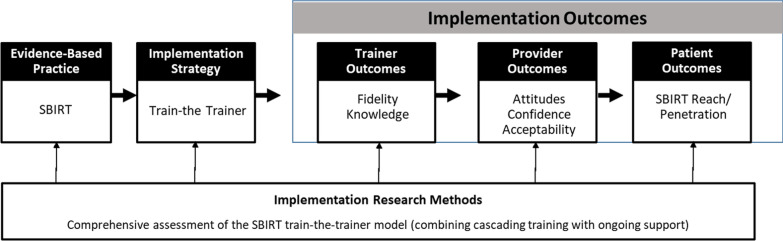
“Consistent with the Conceptual Model of Implementation Research developed by Proctor and colleagues [39], Fig.”
MethodThe prevention and treatment of missing data in clinical trials
Little, R. J., D'Agostino, R., Cohen, M. L., Dickersin, K., Emerson, S. S., Farrar, J. T., Frangakis, C., Hogan, J. W., Molenberghs, G., Murphy, S. A., et al. (2012) · New England Journal of Medicine · doi:10.1056/nejmsr1203730 · Cited by 1,884
An introduction to implementation science for the non-specialist
Bauer, M. S., Damschroder, L., Hagedorn, H., Smith, J., & Kilbourne, A. M. (2015) · BMC Psychology · doi:10.1186/s40359-015-0089-9 · Cited by 1,611 · cited 1×
“alcohol‐HIV treatment Implementation science has been defined as the “the scientific study of methods to promote the systematic uptake of research findings and other evidence-based practices into routine practice, and hence, to improve the quality and effectiveness of health services [28].”
BackgroundBabor, T. F., McRee, B. G., Kassebaum, P. A., Grimaldi, P. L., Ahmed, K., & Bray, J. (2007) · Substance Abuse · doi:10.1300/j465v28n03_03 · Cited by 1,100
A Randomized Trial of Methods to Help Clinicians Learn Motivational Interviewing.
Miller, W. R., Yahne, C. E., Moyers, T. B., Martinez, J., & Pirritano, M. (2004) · Journal of Consulting and Clinical Psychology · doi:10.1037/0022-006x.72.6.1050 · Cited by 1,075 · cited 1×
“Consistent with the growing recognition that didactic training is more effective when paired with ongoing consultation [49, 50], all health professionals and lay workers that receive SBIRT training will have the opportunity to join monthly videoconference consultation calls, led by SBIRT trainers and coordinated by th…”
BackgroundHuman resources for mental health care: current situation and strategies for action
Kakuma, R., Minas, H., van Ginneken, N., Dal Poz, M. R., Desiraju, K., Morris, J. E., Saxena, S., & Scheffler, R. M. (2011) · The Lancet · doi:10.1016/s0140-6736(11)61093-3 · Cited by 979 · cited 1×
“Task sharing, a strategy recommended by the World Health Organization, involves the re-distribution of treatment tasks to non-specialists with less skills and experience with health interventions, who in turn receive training and supervision from specialists [29, 30].”
BackgroundHERMAN, A. A. B., Stein, D. J., Seedat, S., Heeringa, S. G., Moomal, H., & Williams, D. R. (2009) · PubMed · Cited by 668
Self-citationHealth workforce skill mix and task shifting in low income countries: a review of recent evidence
Fulton, B. D., Scheffler, R. M., Sparkes, S. P., Auh, E. Y., Vujicic, M., & Soucat, A. (2011) · Human Resources for Health · doi:10.1186/1478-4491-9-1 · Cited by 540 · cited 1×
“In the HIV field, studies of task sharing show that lay workers without specialized training can be trained to deliver effective health interventions in South Africa and other low- and middle-income countries [31, 32].”
BackgroundSAUNDERS, J. B., AASLAND, O. G., AMUNDSEN, A., & GRANT, M. (1993) · Addiction · doi:10.1111/j.1360-0443.1993.tb00822.x · Cited by 480 · cited 1×
“Screening tool selection The South Africa International TTC train-the-trainer curriculum will center around the Alcohol Use Disorders Identification Test (AUDIT), a 10-item questionnaire that was developed using data from a World Health Organization multi-national collaborative study, as the primary tool [40].”
MethodThe Global Distribution of Average Volume of Alcohol Consumption and Patterns of Drinking
Rehm, J., Rehn, N., Room, R., Monteiro, M., Gmel, G., Jernigan, D., & Frick, U. (2003) · European Addiction Research · doi:10.1159/000072221 · Cited by 471 · cited 1×
“Moreover, even though rates of alcohol use in South Africa are comparable to other countries, harms experienced per liter of alcohol are much higher in South Africa than in other regions globally [6].”
BackgroundMultilevel structural equation models for assessing moderation within and across levels of analysis.
Preacher, K. J., Zhang, Z., & Zyphur, M. J. (2016) · Psychological Methods · doi:10.1037/met0000052 · Cited by 466 · cited 1×
“Next, following a decomposed-first strategy that advocates for starting with moderationfocused hypotheses to avoid biases associated with conflated effects, we will conduct multilevel regressions testing the extent to which any putative covariates significantly moderate the hypothesized relationship among the variable…”
MethodMyer, L., Smit, J., Roux, L. L., Parker, S., Stein, D. J., & Seedat, S. (2008) · AIDS Patient Care and STDs · doi:10.1089/apc.2007.0102 · Cited by 450
Self-citationAzar, M. M., Springer, S. A., Meyer, J. P., & Altice, F. L. (2010) · Drug and Alcohol Dependence · doi:10.1016/j.drugalcdep.2010.06.014 · Cited by 394 · cited 1×
“Meta-analyses show that among people living with HIV, alcohol use is significantly associated with unprotected sex [12], poorer adherence to antiretroviral therapy and lower utilization of health services [13].”
BackgroundFisher, J. C., Bang, H., & Kapiga, S. H. (2007) · Sexually Transmitted Diseases · doi:10.1097/olq.0b013e318067b4fd · Cited by 350
Generalized Estimating Equations in Longitudinal Data Analysis: A Review and Recent Developments
Wang, M. (2014) · Advances in Statistics · doi:10.1155/2014/303728 · Cited by 313 · cited 1×
“The longitudinal models will be estimated using generalized estimation equations which lead to robust standard error and statistical inferences [61].”
MethodAlcohol consumption and risk of incident human immunodeficiency virus infection: a meta-analysis
Baliunas, D., Rehm, J., Irving, H., & Shuper, P. (2010) · International Journal of Public Health · doi:10.1007/s00038-009-0095-x · Cited by 307
Causal Considerations on Alcohol and HIV/AIDS -- A Systematic Review
Shuper, P. A., Neuman, M., Kanteres, F., Baliunas, D., Joharchi, N., & Rehm, J. (2010) · Alcohol and Alcoholism · doi:10.1093/alcalc/agp091 · Cited by 306 · cited 1×
“Biologically, alcohol use is linked to both increased viral replication and diminished immune function, with a causal effect on the worsening of disease course for HIV [9].”
BackgroundWilliams, E. C., Hahn, J. A., Saitz, R., Bryant, K., Lira, M. C., & Samet, J. H. (2016) · Alcoholism: Clinical and Experimental Research · doi:10.1111/acer.13204 · Cited by 294
Newton, M. S., Estabrooks, C. A., Norton, P., Birdsell, J. M., Adewale, A. J., & Thornley, R. (2007) · Implementation Science · doi:10.1186/1748-5908-2-1 · Cited by 264
Agerwala, S. M., & McCance-Katz, E. F. (2012) · Journal of Psychoactive Drugs · doi:10.1080/02791072.2012.720169 · Cited by 258 · cited 1×
“There is robust evidence in support of SBIRT in South Africa [25, 26] and several implementation initiatives have demonstrated that it is feasible to train a range of health professionals to deliver SBIRT [27].”
BackgroundBabor, T. F., Del Boca, F., & Bray, J. W. (2017) · Addiction · doi:10.1111/add.13675 · Cited by 244
Walton, H., Spector, A., Tombor, I., & Michie, S. (2017) · British Journal of Health Psychology · doi:10.1111/bjhp.12260 · Cited by 238 · cited 1×
“To date, implementation science efforts have yielded a plethora of provider fidelity scales [37, 38], but a dearth of trainer fidelity measures, which are essential to the task-sharing model.”
BackgroundSensitivity analysis after multiple imputation under missing at random: a weighting approach
Carpenter, J. R., Kenward, M. G., & White, I. R. (2007) · Statistical Methods in Medical Research · doi:10.1177/0962280206075303 · Cited by 233 · cited 1×
“We will test the appropriateness of assumptions underlying the use of multiple imputation using sensitivity analyses [60].”
MethodVermont Hub-and-Spoke Model of Care for Opioid Use Disorder: Development, Implementation, and Impact
Brooklyn, J. R., & Sigmon, S. C. (2017) · Journal of Addiction Medicine · doi:10.1097/adm.0000000000000310 · Cited by 232 · cited 1×
“the consultation calls is to form a virtual hub-and-spoke knowledge sharing network, with the SBIRT trainers as the “hub” and the health professionals and lay workers as the “spokes” delivering SBIRT nationwide [51].”
Background7 Intention to Treat in Clinical Trials
Fisher, L., Dixon, D., Herson, J., Frankowski, R., Hearron, M., & Peace, K. (2017) · Statistical Issues in Drug Research and Development · doi:10.1201/9780203738610-8 · Cited by 227
Samet, J. H., Friedmann, P., & Saitz, R. (2001) · Archives of Internal Medicine · doi:10.1001/archinte.161.1.85 · Cited by 225 · cited 1×
“Benefits of service integration have been noted at the patient-, provider-, and societal-levels, including decreased healthcare costs and improved treatment outcomes [15].”
BackgroundThe implementation of inclusive education in South Africa after ten years of democracy
Engelbrecht, P. (2006) · European Journal of Psychology of Education · doi:10.1007/bf03173414 · Cited by 217 · cited 1×
“This scaling of materials to a secondary school level is critical because many lay workers may have been denied access to education during the Apartheid regime but are capable of quality SBIRT delivery [43, 44].”
BackgroundPowell, B. J., Stanick, C. F., Halko, H. M., Dorsey, C. N., Weiner, B. J., Barwick, M. A., Damschroder, L. J., Wensing, M., Wolfenden, L., & Lewis, C. C. (2017) · Implementation Science · doi:10.1186/s13012-017-0649-x · Cited by 144
Simbayi, L. C., Zuma, K. K., Zungu, N. P., Moyo, S., Marinda, E. T., Jooste, S., Mabaso, M., Ramlagan, S., North, A., van Zyl, J., et al. (2019) · Cited by 132
the MASH Research Team, Scott-Sheldon, L. A. J., Walstrom, P., Carey, K. B., Johnson, B. T., & Carey, M. P. (2013) · Current HIV/AIDS Reports · doi:10.1007/s11904-013-0177-5 · Cited by 104
Barbosa, C., Cowell, A. J., Bray, J. W., & Aldridge, A. (2015) · Journal of Substance Abuse Treatment · doi:10.1016/j.jsat.2015.01.003 · Cited by 104
Schneider, M., Chersich, M., Temmerman, M., & Parry, C. D. (2016) · Globalization and Health · doi:10.1186/s12992-016-0201-9 · Cited by 81
Patterns of substance use in South Africa: results from the South African Stress and Health study.
Heerden, M. S. V., Grimsrud, A., Seedat, S., Myer, L., Williams, D. R., & Stein, D. J. (2009) · PubMed · Cited by 80
Self-citationMagidson, J. F., Joska, J. A., Regenauer, K. S., Satinsky, E., Andersen, L. S., Seitz-Brown, C. J., Borba, C. P. C., Safren, S. A., & Myers, B. (2019) · International Journal of Drug Policy · doi:10.1016/j.drugpo.2018.11.004 · Cited by 80 · cited 1×
“Task-sharing has been successfully used in HIV care [35, 36], and despite its promise for addressing barriers to substance use treatment, it has only recently been applied to alcohol interventions.”
BackgroundMorojele, N. K., Nkosi, S., Kekwaletswe, C. T., Shuper, P. A., Manda, S. O., Myers, B., & Parry, C. D. H. (2017) · Journal of Studies on Alcohol and Drugs · doi:10.15288/jsad.2017.78.88 · Cited by 79 · cited 1×
“The AUDIT will be used as a focal screening tool because it is the only publicly available questionnaire that has been developed specifically for international use, has been translated into over 20 languages, and has demonstrated strong psychometric properties in South African treatment settings [41].”
MethodAddington, D. E., Birchwood, M. J., Jones, P. B., Killackey, E. J., McDaid, D., Melau, M., Mizuno, M., Mueser, K. T., & Nordentoft, M. (2018) · Early Intervention in Psychiatry · doi:10.1111/eip.12684 · Cited by 61 · cited 1×
“To date, implementation science efforts have yielded a plethora of provider fidelity scales [37, 38], but a dearth of trainer fidelity measures, which are essential to the task-sharing model.”
BackgroundKiwanuka, N., Ssetaala, A., Ssekandi, I., Nalutaaya, A., Kitandwe, P. K., Ssempiira, J., Bagaya, B. S., Balyegisawa, A. P., Kaleebu, P., Hahn, J. A., et al. (2017) · PLoS ONE · doi:10.1371/journal.pone.0171200 · Cited by 49
Knopf-Amelung, S., Gotham, H. J., Kuofie, A. A., Young, P. R., Manney, R., Lynn, J., Barker, K. L., & Hildreth, J. (2017) · Nurse Educator · doi:10.1097/nne.0000000000000439 · Cited by 46 · cited 1×
“This 20-item scale is based on an SBIRT Knowledge Test previously used in an SBIRT training initiative funded by Knopf-Amelung and colleagues [54], and has been tailored for the South African context.”
MethodAccess to Schooling in a Post-Apartheid South Africa: Linking Concepts to Context
Fataar, A. (1997) · International Review of Education · doi:10.1023/a:1003075806523 · Cited by 35 · cited 1×
“This scaling of materials to a secondary school level is critical because many lay workers may have been denied access to education during the Apartheid regime but are capable of quality SBIRT delivery [43, 44].”
BackgroundSpedding, M. F., Stein, D. J., & Sorsdahl, K. R. (2014) · South African Health Review · Cited by 35
Self-citationvan der Westhuizen, C., Myers, B., Malan, M., Naledi, T., Roelofse, M., Stein, D. J., Lahri, S., & Sorsdahl, K. (2019) · PLOS ONE · doi:10.1371/journal.pone.0224951 · Cited by 32 · cited 1×
“There is robust evidence in support of SBIRT in South Africa [25, 26] and several implementation initiatives have demonstrated that it is feasible to train a range of health professionals to deliver SBIRT [27].”
BackgroundSelf-citationKuo, C., Mathews, C., Giovenco, D., Atujuna, M., Beardslee, W. R., Hoare, J., Stein, D. J., & Brown, L. K. (2020) · AIDS Education and Prevention · doi:10.1521/aeap.2020.32.1.67 · Cited by 29 · cited 1×
“Our research team has developed and tested pre-programmed tablets as assessment administration and data collection tools with health professionals and lay workers in prior studies in South Africa [53]; the system has been applied in a wide range of contexts in South Africa ranging from no- to low-bandwidth, intermitte…”
MethodSelf-citationMcGuire, M., Farhat, J. B., Pédrono, G., Szumilin, E., Heinzelmann, A., Chinyumba, Y. N., Goossens, S., Makombe, S. D., & Pujades‐Rodríguez, M. (2013) · PLoS ONE · doi:10.1371/journal.pone.0074090 · Cited by 25
Kakuma, R., Minas, H., van Ginneken, N., Poz, M. R. D., Desiraju, K., Morris, J. E., Saxena, S., & Scheffler, R. M. (2011) · The Lancet · Cited by 14
Scott, K., Sibeko, G., Cummings, B., Myers, B., Sorsdahl, K., Stein, D. J., Kuo, C., & Becker, S. J. (2020) · Training and Education in Professional Psychology · doi:10.1037/tep0000286 · Cited by 13 · cited 1×
“In 2017, as part of the South Africa TTC formation, we conducted a needs assessment [21] of 67 national stakeholders and policy makers to prioritize the areas of greatest training need throughout the country: respondents were from government departments (28.”
MethodSelf-citationvan der Westhuizen, C., Malan, M., Naledi, T., Roelofse, M., MYERS, B. J., Stein, D. J., & Sorsdahl, K. R. (2018) · Abstracts · doi:10.1136/injuryprevention-2018-safety.676 · Cited by 1
Self-citation(2002)
Research works printed but not linked: 3
- Simbayi L, Zuma K, Zungu N, Moyo S, Marinda E, Jooste S, et al. South African National HIV prevalence, incidence, behaviour and communication survey [Internet]. HSRC Press; 2017. www.rienner.com
- World Health Organization A report of the assessment of the mental health system in South Africa using the World Health Organization—Assessment Instrument for Mental Health Systems (WHO-AIMS) 2007 Geneva World Health Organization
- Cohen J Statistical power analysis for the behavioral sciences Lawrence 1988 Hillsdale Earlbaum Associates 20 26
Cited by
Wechsberg, W. M., van der Drift, I. M., Howard, B. N., MYERS, B. J., Browne, F. A., Bonner, C. P., Carney, T., Ndirangu, J., & Washio, Y. (2022) · International Journal of Environmental Research and Public Health · doi:10.3390/ijerph19148661 · Cited by 16
Yang, L. H., Bass, J. K., Le, P. D., Singh, R., Gurung, D., Velasco, P. R., Grivel, M. M., Susser, E., Cleland, C. M., Alvarado, R., et al. (2024) · BMC Health Services Research · doi:10.1186/s12913-024-11783-6 · Cited by 7
M., I. S., Mimi, K. K. R., Mariama, L. K., & Elizabeth, M. J. F. (2024) · African Journal of Health Nursing and Midwifery · doi:10.52589/ajhnm-zvvwncwy · Cited by 4
Yang, L. H., Bass, J. K., Le, P. D., Singh, R., Gurung, D., Velasco, P. R., Grivel, M. M., Susser, E., Cleland, C. M., Alvarado, R., et al. (2024) · Research Square · doi:10.21203/rs.3.rs-3877031/v1 · Cited by 2
Anaba, H., Thrul, J., Oborevwori, E., Oluwayomi, O., & Alexander, G. C. (2025) · PLOS Global Public Health · doi:10.1371/journal.pgph.0005597
“Although SBIRT has been piloted in specialized settings in sub-Saharan Africa, including emergency departments, antenatal services, and HIV clinics, its integration into routine PHC remains limited [12–14].”
Metadata
- Authors
- Kuo, C. C., Sibeko, G., Akande, M., Allie, S., Tisaker, N., Stein, D. J., & Becker, S. J.
- Affiliations
- University of Cape Town (ZA)
- Brown University (US)
- Corresponding author
- Becker, Sara J.
- Venue
- Addiction Science & Clinical Practice
- Published
- 2021-04-30
- Volume
- 16
- Issue
- 1
- Pages
- 27-27
- ISSN
- 1940-0632 (ISSN-L)
- 1940-0640
- PMC
- PMC8085637
- OpenAlex
- W3157353959
- Cited by
- 8
- References
- 54
- Citations by year
- 2026: 1 · 2025: 3 · 2024: 3 · 2022: 1
- FWCI
- 1.12
- Type
- journal article
- Language
- en
- Open access
- gold
- doi.org
- Licence
- cc-by
- creativecommons.org/licenses/by/4.0/ (tdm)
- creativecommons.org/licenses/by/4.0/ (vor)
- Locations
- Addiction Science & Clinical Practice (publishedVersion, cc-by)
- PubMed Central (publishedVersion, cc-by)
- PubMed (publishedVersion)
- DOAJ (DOAJ: Directory of Open Access Journals) (submittedVersion, cc-by-sa)
- Funders
- National Institute on Alcohol Abuse and Alcoholism (P01 AA019072)
- Topics
- Health Sciences › Health Professions › General Health Professions › Health Policy Implementation Science
- Health Sciences › Medicine › Epidemiology › Substance Abuse Treatment and Outcomes
- Health Sciences › Medicine › Infectious Diseases › HIV/AIDS Research and Interventions
- Keywords
- trainer training, SBIRT, HIV service providers, task sharing, alcohol screening, brief intervention, referral to treatment, risky alcohol use, implementation fidelity, South Africa
- MeSH terms
- Humans, Mass Screening, Referral and Consultation, South Africa, HIV Infections, Substance-Related Disorders
About these checks
Registry, retraction, Cites and statistics results are computed, not judged, with one exception: a printed reference that no index lists is read once by a model before it counts as a citation error. Claims are extracted by a model and kept only when their quote appears verbatim in the text; each cited source is then checked, with a model’s help, for whether it says what the claim relies on. Those verdicts can be wrong — read the claim’s quote and the cited source before relying on one.
Statistics and arithmetic are recomputed, not judged.
Confidence bands are shown only for fields calibrated on our annotated test set. None is calibrated yet, so no band is shown.
What counts as a claim ›How we measure confidence ›How we check this ›
Are you an author, or do you see a problem with this page? Request a review
Data sources
Bibliographic data: Semantic Scholar, OpenAlex, Crossref.
Contains information from the Semantic Scholar Academic Graph Datasets, made available under the ODC Attribution License (ODC-BY 1.0).
Semantic Scholar’s data is described in: Kinney, R., et al. (2023). The Semantic Scholar Open Data Platform. arXiv:2301.10140.
