

The DOI matches its Crossref record; 90 of the 90 references it cites were found in a registry or an index.
The contribution of culturomics to the repertoire of isolated human bacterial and archaeal species
Open accessAbstract
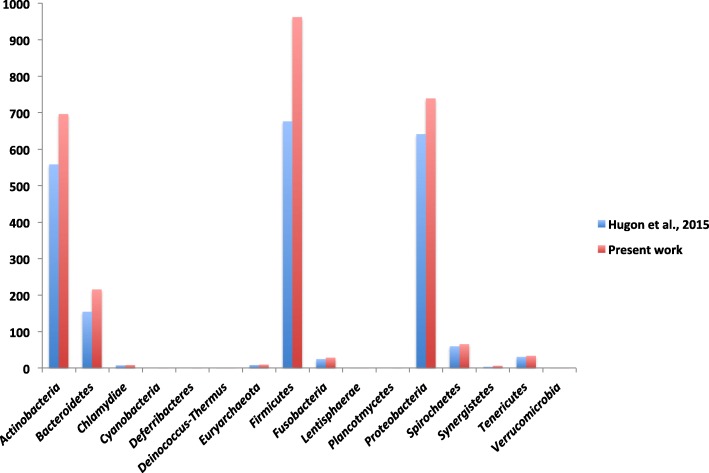
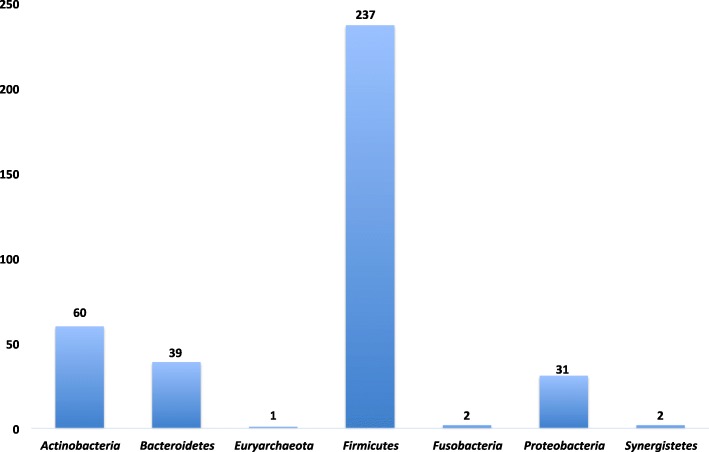
After a decade of research and metagenomic analyses, our knowledge of the human microbiota appears to have reached a plateau despite promising results. In many studies, culture has proven to be essential in describing new prokaryotic species and filling metagenomic gaps. In 2015, only 2172 different prokaryotic species were reported to have been isolated at least once from the human body as pathogens or commensals. In this review, we update the previous repertoire by reporting the different species isolated from the human body to date, increasing it by 28% to reach a total of 2776 species associated with human beings. They have been classified into 11 different phyla, mostly the Firmicutes, Proteobacteria, Bacteroidetes, and Actinobacteria. Finally, culturomics contributed up to 66.2% towards updating this repertoire by reporting 400 species, of which 288 were novel. This demonstrates the need to continue the culturing work, which seems essential in order to decipher the hidden human microbial content.
Overview
The claims and statistics of this paper haven’t been checked yet.
Run the check — free, no account needed. It reads the open-access text and checks the sources it cites.
Integrity signals
Registry
Cites
Statistics
Figures

Verification
Claims the paper makes
The claims and statistics of this paper haven’t been checked yet.
Run the check — free, no account needed. It reads the open-access text and checks the sources it cites.
Claims other papers make about this one
Each is checked against this paper’s own text: does it say what the citing paper says it does?
The source backs part of the claim, not all of it — or backs it for a different population, condition or comparison.
In the citing paper
“These have been classified into 11 different phyla with Proteobacteria, Firmicutes, Actinobacteria and Bacteroidetes comprising over 90% of the microbiome (Bilen et al., 2018;Hu-gon et al., 2015;Li et al., 2014)”
From The Microbiota-Gut-Brain Axis (2019) · cites this paper as Bilen et al., 2018
Experimental — accuracy not yet measuredThe source backs part of the claim, not all of it — or backs it for a different population, condition or comparison.
In the citing paper
“Current combined Human Microbiome Project and MetaHIT data estimate that there are at least 2776 prokaryotic species that have been isolated from human fecal matter.”
From The Microbiota-Gut-Brain Axis (2019) · cites this paper as Bilen et al., 2018
Experimental — accuracy not yet measured
Self-check
Percentages, sums and reported differences re-computed from the paper’s own numbers.
The self-check needs the paper’s full text.
Citations
Cites
3 retracted
Lagier, J.-C., Khelaifia, S., Alou, M. T., Ndongo, S., Dione, N., Hugon, P., Caputo, A., Cadoret, F., Traore, S. I., Seck, E. H., et al. (2016) · Nature Microbiology · doi:10.1038/nmicrobiol.2016.203 · Cited by 951
Self-citationRetractedMillion, M., Alou, M. T., Khelaifia, S., Bachar, D., Lagier, J., Dione, N., Brah, S., Hugon, P., Lombard, V., Armougom, F., et al. (2016) · Scientific Reports · doi:10.1038/srep26051 · Cited by 204
Self-citationRetractedPfleiderer, A., Lagier, J., Armougom, F., Robert, C., Vialettes, B., & Raoult, D. (2013) · European Journal of Clinical Microbiology & Infectious Diseases · doi:10.1007/s10096-013-1900-2 · Cited by 158
Self-citationRetractedAn obesity-associated gut microbiome with increased capacity for energy harvest
Turnbaugh, P. J., Ley, R. E., Mahowald, M. A., Magrini, V., Mardis, E. R., & Gordon, J. I. (2006) · Nature · doi:10.1038/nature05414 · Cited by 12,444
Structure, function and diversity of the healthy human microbiome
The Human Microbiome Project Consortium (2012) · Nature · doi:10.1038/nature11234 · Cited by 11,726
Human gut microbes associated with obesity
Ley, R. E., Turnbaugh, P. J., Klein, S., & Gordon, J. I. (2006) · Nature · doi:10.1038/4441022a · Cited by 8,785
Diversity of the Human Intestinal Microbial Flora
Eckburg, P. B., Bik, E. M., Bernstein, C. N., Purdom, E., Dethlefsen, L., Sargent, M., Gill, S. R., Nelson, K. E., & Relman, D. A. (2005) · Science · doi:10.1126/science.1110591 · Cited by 7,913
Obesity alters gut microbial ecology
Ley, R. E., Bäckhed, F., Turnbaugh, P., Lozupone, C. A., Knight, R. D., & Gordon, J. I. (2005) · Proceedings of the National Academy of Sciences · doi:10.1073/pnas.0504978102 · Cited by 6,176
Turnbaugh, P. J., Ley, R. E., Hamady, M., Fraser-Liggett, C. M., Knight, R., & Gordon, J. I. (2007) · Nature · doi:10.1038/nature06244 · Cited by 6,091
Gut microbiome influences efficacy of PD-1-based immunotherapy against epithelial tumors
Routy, B., Le Chatelier, E., Derosa, L., Duong, C. P. M., Alou, M. T., Daillère, R., Fluckiger, A., Messaoudene, M., Rauber, C., Roberti, M. P., et al. (2018) · Science · doi:10.1126/science.aan3706 · Cited by 5,671
Self-citation
Cited by
Sorted by citations
Cryan, J. F., O'Riordan, K. J., Cowan, C. S. M., Sandhu, K. V., Bastiaanssen, T. F. S., Boehme, M., Codagnone, M. G., Cussotto, S., Fulling, C., Golubeva, A. V., et al. (2019) · Physiological Reviews · doi:10.1152/physrev.00018.2018 · Cited by 5,286
Sex differences in gut microbiota
Kim, Y. S., Unno, T., Kim, B.-Y., & Park, M.-S. (2020) · The World Journal of Men s Health · doi:10.5534/wjmh.190009 · Cited by 610
Gut Bacteria and Neurotransmitters
Dicks, L. M. T. (2022) · Microorganisms · doi:10.3390/microorganisms10091838 · Cited by 482
Montero, C. G., Fraile‐Μartinez, O., Gomez-Lahoz, A. M., Pekarek, L., Castellanos, A. J., Noguerales-Fraguas, F., Coca, S., Guijarro, L. G., García‐Honduvilla, N., Asúnsolo, Á., et al. (2021) · Nutrients · doi:10.3390/nu13020699 · Cited by 487
Next generation probiotics in disease amelioration
Chang, C., Lin, T., Tsai, Y., Wu, T.-R., Lai, W.-F., Lu, C., & Lai, H. (2019) · Journal of Food and Drug Analysis · doi:10.1016/j.jfda.2018.12.011 · Cited by 398
Metadata
- Authors
- Bilen, M., Dufour, J.-C., Lagier, J.-C., Cadoret, F., Daoud, Z., Dubourg, G., & Raoult, D.
- Affiliations
- University of Balamand (LB)
- Inserm (FR)
- Aix-Marseille Université (FR)
- Assistance Publique Hôpitaux de Marseille (FR)
- King Abdulaziz University (SA)
- Corresponding author
- Raoult, Didier
- ORCID
- Venue
- Microbiome
- Published
- 2018-05-24
- Volume
- 6
- Issue
- 1
- Pages
- 94-94
- ISSN
- 2049-2618 (ISSN-L)
- PMC
- PMC5966928
- OpenAlex
- W2807527107
- Cited by
- 231
- References
- 90
- Citations by year
- 2026: 15 · 2025: 19 · 2024: 28 · 2023: 38 · 2022: 27 · 2021: 26 · 2020: 36 · 2019: 31 · 2018: 10
- FWCI
- 2.53
- Type
- journal article
- Language
- en
- Open access
- gold
- doi.org
- Licence
- Locations
- Microbiome (publishedVersion, cc-by)
- Europe PMC (PubMed Central) (publishedVersion, other-oa)
- PubMed Central (publishedVersion, cc-by)
- PubMed (publishedVersion)
- HAL (submittedVersion, other-oa)
- DOAJ (DOAJ: Directory of Open Access Journals) (submittedVersion, cc-by-sa)
- Funders
- IHU Méditerranée Infection
- Topics
- Life Sciences › Biochemistry, Genetics and Molecular Biology › Molecular Biology › Gut microbiota and health
- Physical Sciences › Environmental Science › Ecology › Microbial Community Ecology and Physiology
- Health Sciences › Medicine › Microbiology (medical) › Bacterial Identification and Susceptibility Testing
- Keywords
- culturomics, human microbiota, new species, Firmicutes, Proteobacteria, Bacteroidetes, actinobacteria
- MeSH terms
- Firmicutes, Bacillota, Gastrointestinal Microbiome, Archaea, Bacteria, DNA, Bacterial, Humans, DNA, Archaeal, Proteobacteria, Actinobacteria, Bacteroidetes, Metagenomics
About these checks
Registry, retraction, Cites and statistics results are computed, not judged, with one exception: a printed reference that no index lists is read once by a model before it counts as a citation error. Claims are extracted by a model and kept only when their quote appears verbatim in the text; each cited source is then checked, with a model’s help, for whether it says what the claim relies on. Those verdicts can be wrong — read the claim’s quote and the cited source before relying on one.
Statistics and arithmetic are recomputed, not judged.
Confidence bands are shown only for fields calibrated on our annotated test set. None is calibrated yet, so no band is shown.
What counts as a claim ›How we measure confidence ›How we check this ›
Are you an author, or do you see a problem with this page? Request a review
