

Epigenetic inheritance and the missing heritability
Open accessThe DOI matches its Crossref record; 111 of the 111 references it cites were found in a registry or an index.
Abstract
Genome-wide association studies of complex physiological traits and diseases consistently found that associated genetic factors, such as allelic polymorphisms or DNA mutations, only explained a minority of the expected heritable fraction. This discrepancy is known as "missing heritability", and its underlying factors and molecular mechanisms are not established. Epigenetic programs may account for a significant fraction of the "missing heritability." Epigenetic modifications, such as DNA methylation and chromatin assembly states, reflect the high plasticity of the genome and contribute to stably alter gene expression without modifying genomic DNA sequences. Consistent components of complex traits, such as those linked to human stature/height, fertility, and food metabolism or to hereditary defects, have been shown to respond to environmental or nutritional condition and to be epigenetically inherited. The knowledge acquired from epigenetic genome reprogramming during development, stem cell differentiation/de-differentiation, and model organisms is today shedding light on the mechanisms of (a) mitotic inheritance of epigenetic traits from cell to cell, (b) meiotic epigenetic inheritance from generation to generation, and (c) true transgenerational inheritance. Such mechanisms have been shown to include incomplete erasure of DNA methylation, parental effects, transmission of distinct RNA types (mRNA, non-coding RNA, miRNA, siRNA, piRNA), and persistence of subsets of histone marks.
Overview
The claims and statistics of this paper haven’t been checked yet.
Free: it reads the open-access text and checks the first 5 claims that cite a source we can check. Create a free account to check every claim.
Integrity signals
Registry
Cites
Statistics
Figures
Verification
Claims the paper makes
The claims and statistics of this paper haven’t been checked yet.
Free: it reads the open-access text and checks the first 5 claims that cite a source we can check. Create a free account to check every claim.
Claims other papers make about this one
Each is checked against this paper’s own text: does it say what the citing paper says it does?
The cited source says what the claim attributes to it.
In the citing paper
“Indeed, inherited epigenetic patterns (254–256) and environmental factors (257, 258) other than childhood trauma (such as heavy metals (259), parenting style, and early trauma such as maternal separation (260)) may all impact the epigenetic pattern and hence childhood trauma-induced differential health outcomes.”
From Epigenetic Modifications in Stress Response Genes Associated With Childhood Trauma (2019) · cites this paper as [254]
Self-check
Percentages, sums and reported differences re-computed from the paper’s own numbers.
The self-check needs the paper’s full text.
Citations
Cites
The language of covalent histone modifications
Strahl, B. D., & Allis, C. D. (2000) · Nature · doi:10.1038/47412 · Cited by 8,679 · cited 2×
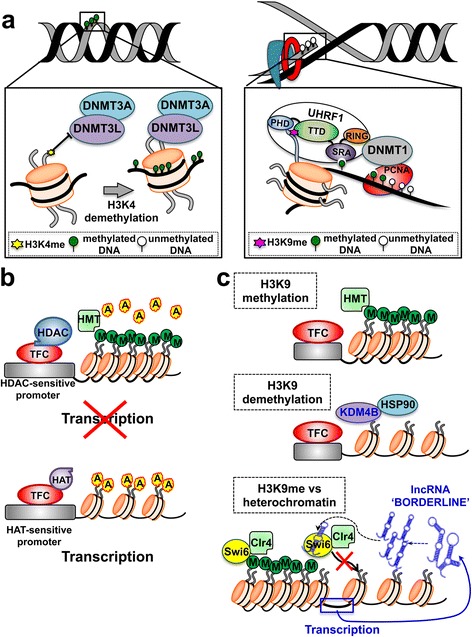
“the bromodomain motif that docks onto acetylated lysines [92]), which drive chromatin packaging around nucleosomes [88, 91] (Fig.”
BackgroundFinding the missing heritability of complex diseases
Manolio, T. A., Collins, F. S., Cox, N. J., Goldstein, D. B., Hindorff, L. A., Hunter, D. J., McCarthy, M. I., Ramos, E. M., Cardon, L. R., Chakravarti, A., et al. (2009) · Nature · doi:10.1038/nature08494 · Cited by 8,336 · cited 1×
“Epistatic components need to be integrated by estimates of the contribution of non-genetic factors, globally designated as the “missing heritability” [7, 8].”
BackgroundOkano, M., Bell, D. W., Haber, D. A., & Li, E. (1999) · Cell · doi:10.1016/s0092-8674(00)81656-6 · Cited by 6,143 · cited 4×
“Recent findings showed that in the absence of histone H3, DNMT3A exists in an autoinhibitory form, in which the ATRX–DNMT3–DNMT3L (ADD) domain binds to diseasesa Molecular defects thic folds; flat nasal bridge; p; everted lower lip; Mutations in ATRX gene, hypomethylation of specific repeat and satellite sequences fac…”
BackgroundInfluentialConversion of 5-Methylcytosine to 5-Hydroxymethylcytosine in Mammalian DNA by MLL Partner TET1
Tahiliani, M., Koh, K. P., Shen, Y., Pastor, W. A., Bandukwala, H., Brudno, Y., Agarwal, S., Iyer, L. M., Liu, D. R., Aravind, L., et al. (2009) · Science · doi:10.1126/science.1170116 · Cited by 5,836 · cited 1×
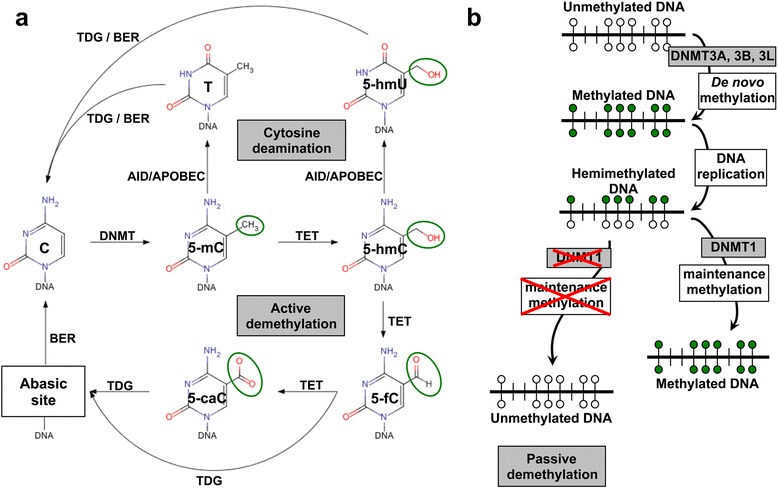
“5-hmC is then converted to 5-formylcytosine (5-fC) and 5-carboxylcytosine (5-caC) [30].”
BackgroundChen, X., Xiu, M., Xing, J., Yu, S., Min, D., & Guo, F. (2017) · Cellular Physiology and Biochemistry · doi:10.1159/000479439 · Cited by 5,742
Common SNPs explain a large proportion of the heritability for human height
Yang, J., Benyamin, B., McEvoy, B. P., Gordon, S., Henders, A. K., Nyholt, D. R., Madden, P. A., Heath, A. C., Martin, N. G., Montgomery, G. W., et al. (2010) · Nature Genetics · doi:10.1038/ng.608 · Cited by 4,446 · cited 1×
“Although dedicated procedures for SNP-associated analyses have significantly increased their combined predictive power [15], a large amount of heritable heightassociated factors remains undetectable by conventional GWAS, suggesting that such non-DNA sequence-linked information may be associated to epigenetic heredity.”
BackgroundEsteller, M. (2008) · New England Journal of Medicine · doi:10.1056/nejmra072067 · Cited by 3,662
Tet-Mediated Formation of 5-Carboxylcytosine and Its Excision by TDG in Mammalian DNA
He, Y.-F., Li, B.-Z., Li, Z., Liu, P., Wang, Y., Tang, Q., Ding, J., Jia, Y., Chen, Z., Li, L., et al. (2011) · Science · doi:10.1126/science.1210944 · Cited by 2,770 · cited 2×
“This leaves an abasic site that is subsequently processed through the base excision repair (BER) pathway [33] (Fig.”
BackgroundEpigenetic Transgenerational Actions of Endocrine Disruptors and Male Fertility
Anway, M. D., Cupp, A. S., Uzumcu, M., & Skinner, M. K. (2005) · Science · doi:10.1126/science.1108190 · Cited by 2,563 · cited 1×
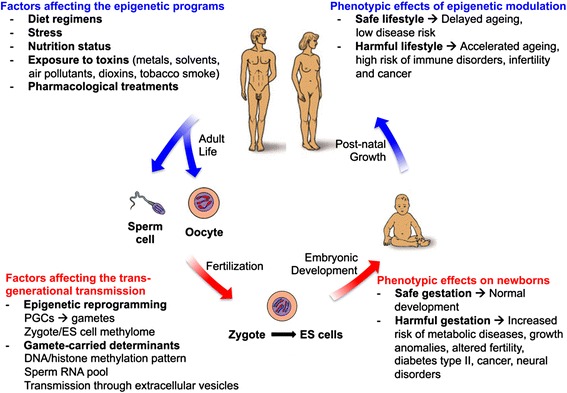
“Remarkably, transgenerational transmission of these effects through the male germ line was then observed in F1 to F4 generations [82].”
BackgroundGenome-scale DNA methylation maps of pluripotent and differentiated cells
Meissner, A., Mikkelsen, T. S., Gu, H., Wernig, M., Hanna, J., Sivachenko, A., Zhang, X., Bernstein, B. E., Nusbaum, C., Jaffe, D. B., et al. (2008) · Nature · doi:10.1038/nature07107 · Cited by 2,536 · cited 1×
“It has been shown that during early mitotic divisions of a mammalian embryo, daughter cells derived from the zygote have a globally hypomethylated genome [50] and a transcriptionally active chromatin due to histone H4 acetylation [51].”
Background
Cited by
Items 301–332 of 332
Ma, Z., Wang, Y., Quan, Y., Wang, Z., Liu, Y., & Ding, Z. (2022) · Figshare · doi:10.6084/m9.figshare.20761517
Ma, Z., Wang, Y., Quan, Y., Wang, Z., Liu, Y., & Ding, Z. (2022) · Figshare · doi:10.6084/m9.figshare.20761529
Ma, Z., Wang, Y., Quan, Y., Wang, Z., Liu, Y., & Ding, Z. (2022) · Figshare · doi:10.6084/m9.figshare.20761532
Ma, Z., Wang, Y., Quan, Y., Wang, Z., Liu, Y., & Ding, Z. (2022) · Figshare · doi:10.6084/m9.figshare.20761520
Can social adversity alter the epigenome, trigger oral disease, and affect future generations?
Khalid, S., Kearney, M., & McReynolds, D. E. (2024) · Irish Journal of Medical Science (1971 -) · doi:10.1007/s11845-024-03697-3 · Cited by 1
“Certain mechanisms have been described to explain how epigenetic traits and modifications may be transmitted inter-generationally [27, 28].”
BackgroundYe, Z., Jiang, Y., Yang, H., Huang, Y., Wang, S., Han, S., & Ma, L. (2025) · Health engineering. · doi:10.26599/he.2025.9460007
Epigenetics of Aging and Epigenetic Modifications of Aging-Associated Diseases
Ramesh, T., Singh, R., & Barage, S. H. (2025) · IGI Global eBooks · doi:10.4018/979-8-3693-9730-5.ch007
Emerging multifaceted roles of the microbiome in cancer susceptibility
Chang, H., Pérez‐Losada, J., & Mao, J. (2025) · World Journal of Clinical Oncology · doi:10.5306/wjco.v16.i9.111379
Rehabilitation Program Can Save Lives
Danandeh, K., & Rezaei, N. (2025) · Springer eBooks · doi:10.1007/978-3-032-00775-9_415 · Cited by 1
Ocaranza, F. J., & Sáez, J. C. (2025) · IntechOpen eBooks · doi:10.5772/intechopen.1012583
Additional file 1 of Genetic impacts on DNA methylation: research findings and future perspectives
Villicaña, S., & Bell, J. T. (2021) · Figshare · doi:10.6084/m9.figshare.14524594
Broeck, A. V., Meese, T., Verschelde, P., Cox, K., Heinze, B., Deforce, D., Meester, E. D., & Van Nieuwerburgh, F. (2024) · Figshare · doi:10.6084/m9.figshare.26677268
Broeck, A. V., Meese, T., Verschelde, P., Cox, K., Heinze, B., Deforce, D., Meester, E. D., & Van Nieuwerburgh, F. (2024) · Figshare · doi:10.6084/m9.figshare.26677265
Broeck, A. V., Meese, T., Verschelde, P., Cox, K., Heinze, B., Deforce, D., Meester, E. D., & Van Nieuwerburgh, F. (2024) · Figshare · doi:10.6084/m9.figshare.26677259
Broeck, A. V., Meese, T., Verschelde, P., Cox, K., Heinze, B., Deforce, D., Meester, E. D., & Van Nieuwerburgh, F. (2024) · Figshare · doi:10.6084/m9.figshare.26677256
Broeck, A. V., Meese, T., Verschelde, P., Cox, K., Heinze, B., Deforce, D., Meester, E. D., & Van Nieuwerburgh, F. (2024) · Figshare · doi:10.6084/m9.figshare.25150606
Broeck, A. V., Meese, T., Verschelde, P., Cox, K., Heinze, B., Deforce, D., Meester, E. D., & Van Nieuwerburgh, F. (2024) · Figshare · doi:10.6084/m9.figshare.25150718
Broeck, A. V., Meese, T., Verschelde, P., Cox, K., Heinze, B., Deforce, D., Meester, E. D., & Van Nieuwerburgh, F. (2024) · Figshare · doi:10.6084/m9.figshare.26677271
Broeck, A. V., Meese, T., Verschelde, P., Cox, K., Heinze, B., Deforce, D., Meester, E. D., & Van Nieuwerburgh, F. (2024) · Figshare · doi:10.6084/m9.figshare.26677262
Broeck, A. V., Meese, T., Verschelde, P., Cox, K., Heinze, B., Deforce, D., Meester, E. D., & Van Nieuwerburgh, F. (2024) · Figshare · doi:10.6084/m9.figshare.26677274
Mookerjee, S. (2026) · Biomedical visualization · doi:10.1007/978-3-032-06520-9_1
Stochastic modeling of epigenetic memory
Bruno, S., & Vecchio, D. D. (2026) · npj Systems Biology and Applications · doi:10.1038/s41540-026-00664-9
Blay, C. (2017) · theses.fr (ABES) · doi:10.70675/5e34491ez30a8z4492za19az85207b6a2dad · Cited by 1
Méthylation de H3K27 : régulation et rôle dans le cartilage articulaire
Allas, L. (2019) · theses.fr (ABES) · doi:10.70675/0b801552z0546z4765za411z263c0baf83ef
Tournayre, J. (2019) · theses.fr (ABES) · doi:10.70675/36fbfa89z7986z4449za6b7zea878c97acec
Multi-omic molecular signatures from peripheral blood samples of patients with mood disorders
Mokhtari, A. (2022) · theses.fr (ABES) · doi:10.70675/6e6b049ez0ae2z40f2za015z47c5c58102d3
Matika, O., Tarsani, E., McIntosh, K., Desire, S., Kebede, F. G., Talenti, A., Rae, A. M., Kranis, A., & Watson, K. A. (2026) · BMC Genomics · doi:10.1186/s12864-026-12855-z · Cited by 2
“Others attribute the lack of concordance between markers and traditional methods to lack of capturing additive epigenetic variances [66, 73].”
Gong, A., Zhan, Y., Zhang, L., Jia, A., Yu, B., Liu, Y., & Wu, S. (2026) · Interdisciplinary Sciences Computational Life Sciences · doi:10.1007/s12539-026-00836-5
Grillakis, C. E., Madden, S. V., Brick, L. A. D., & Merrill, S. M. (2026) · Frontiers in Psychology · doi:10.3389/fpsyg.2026.1875411
“DNAm, sometimes referred to as cellular “memory” (Raynal et al., 2012), is a stable and mitotically heritable (Trerotola et al., 2015) bio-marker that can reflect enduring and persistent biological changes associated with prior environmental exposures (Nwanaji-Enwerem and Colicino, 2020;…”
Role of epigenetic factors during blockade of the renin-angiotensin system across aging
de Cavanagh, E. M. V., Inserra, F., & Ferder, L. (2026) · American Journal of Physiology-Heart and Circulatory Physiology · doi:10.1152/ajpheart.00417.2026
Metadata
- Authors
- Trerotola, M., Relli, V., Simeone, P., & Alberti, S.
- Affiliations
- University of Chieti-Pescara (IT)
- Corresponding author
- Alberti, Saverio
- Venue
- Human Genomics
- Published
- 2015-07-28
- Volume
- 9
- Issue
- 1
- Pages
- 17-17
- ISSN
- 1473-9542 (ISSN-L)
- 1479-7364
- PMC
- PMC4517414
- OpenAlex
- W1580250799
- Cited by
- 318
- References
- 111
- Citations by year
- 2026: 9 · 2025: 22 · 2024: 26 · 2023: 61 · 2022: 31 · 2021: 26 · 2020: 28 · 2019: 30 · 2018: 25 · 2017: 24 · 2016: 30 · 2015: 3
- FWCI
- 2.65
- Type
- journal article
- Language
- en
- Open access
- gold
- doi.org
- Locations
- Human Genomics (publishedVersion, cc-by)
- PubMed Central (publishedVersion, cc-by)
- PubMed (publishedVersion)
- Funders
- Italian Ministry of Health (RF-EMR-2006-361866)
- Italian Ministry of Development (Made in Italy MI0100424)
- Compagnia di San Paolo (Grant 2489IT)
- Fondazione Cassa di Risparmio della Provincia di Chieti (ᅟ)
- Topics
- Life Sciences › Biochemistry, Genetics and Molecular Biology › Molecular Biology › Epigenetics and DNA Methylation
- Life Sciences › Biochemistry, Genetics and Molecular Biology › Genetics › Genetic Syndromes and Imprinting
- Health Sciences › Medicine › Pediatrics, Perinatology and Child Health › Birth, Development, and Health
- Keywords
- missing heritability, epigenetic inheritance, DNA methylation, chromatin inheritance, complex traits, transgenerational epigenetic inheritance, parental effects, histone modifications, genome reprogramming, nutritional epigenetics, height, fertility, food metabolism
- MeSH terms
- Cell Differentiation, Gene Expression Regulation, Humans, Meiosis, Mitosis, DNA Methylation, Chromatin Assembly and Disassembly, Epigenesis, Genetic, Genome-Wide Association Study, Cellular Reprogramming
About these checks
Registry, retraction, Cites and statistics results are computed, not judged, with one exception: a printed reference that no index lists is read once by a model before it counts as a citation error. Claims are extracted by a model and kept only when their quote appears verbatim in the text; each cited source is then checked, with a model’s help, for whether it says what the claim relies on. Those verdicts can be wrong — read the claim’s quote and the cited source before relying on one.
Statistics and arithmetic are recomputed, not judged.
Confidence bands are shown only for fields calibrated on our annotated test set. None is calibrated yet, so no band is shown.
What counts as a claim ›How we measure confidence ›How we check this ›
Are you an author, or do you see a problem with this page? Request a review
Data sources
Bibliographic data: Semantic Scholar, OpenAlex, Crossref.
Contains information from the Semantic Scholar Academic Graph Datasets, made available under the ODC Attribution License (ODC-BY 1.0).
Semantic Scholar’s data is described in: Kinney, R., et al. (2023). The Semantic Scholar Open Data Platform. arXiv:2301.10140.
