

The DOI matches its Crossref record; 71 of the 72 references it cites were found in a registry or an index.
Attentional and affective consequences of technology supported mindfulness training: a randomised, active control, efficacy trial
Open accessAbstract
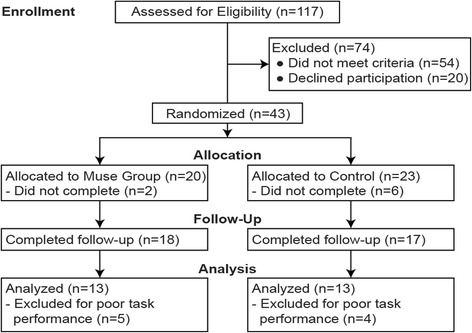
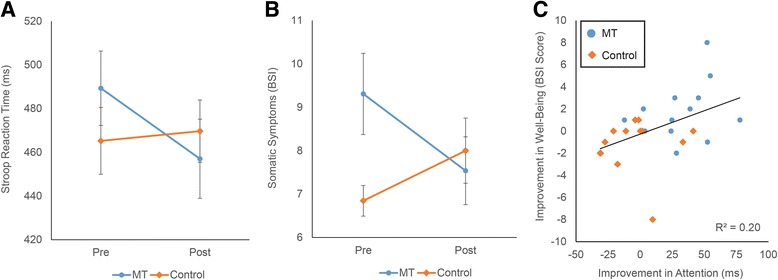
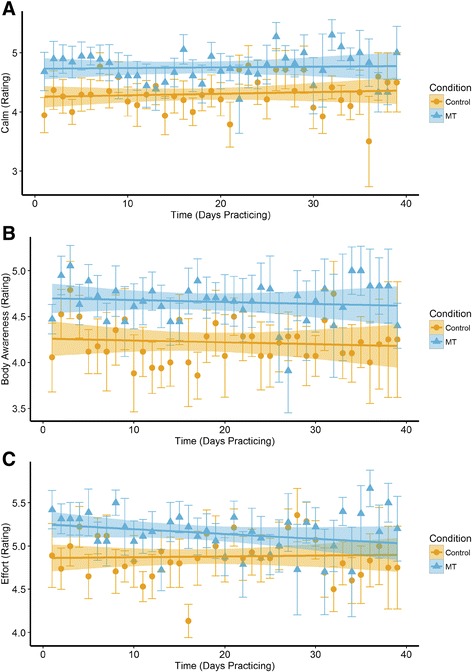
BACKGROUND: Mindfulness training (MT) programs represent an approach to attention training with well-validated mental health benefits. However, research supporting MT efficacy is based predominantly on weekly-meeting, facilitator-led, group-intervention formats. It is unknown whether participants might benefit from neurofeedback-assisted, technology-supported MT (N-tsMT), in which meditation is delivered individually, without the need for a facilitator, travel to a training site, or the presence of a supportive group environment. Mirroring the validation of group MT interventions, the first step in addressing this question requires identifying whether N-tsMT promotes measurable benefits. Here, we report on an initial investigation of a commercial N-tsMT system. METHODS: In a randomized, active control trial, community-dwelling healthy adult participants carried out 6 weeks of daily practice, receiving either N-tsMT (n = 13), or a control condition of daily online math training (n = 13). Training effects were assessed on target measures of attention and well-being. Participants also completed daily post-training surveys assessing effects on mood, body awareness, calm, effort, and stress. RESULTS: Analysis revealed training effects specific to N-tsMT, with attentional improvements in overall reaction time on a Stroop task, and well-being improvements via reduced somatic symptoms on the Brief Symptom Inventory. Attention and well-being improvements were correlated, and effects were greatest for the most neurotic participants. However, secondary, exploratory measures of attention and well-being did not show training-specific effects. N-tsMT was associated with greater body awareness and calm, and initially greater effort that later converged with effort in the control condition. CONCLUSIONS: Preliminary findings indicate that N-tsMT promotes modest benefits for attention and subjective well-being in a healthy community sample relative to an active control condition. However, the findings would benefit from replication in a larger sample, and more intensive practice or more comprehensive MT instruction might be required to promote the broader benefits typically reported in group format, facilitated MT. TRIAL REGISTRATION: Current Controlled Trials ISRCTN43629398 . Retrospectively registered on June 16, 2016.
Overview
The claims and statistics of this paper haven’t been checked yet.
Run the check — free, no account needed. It reads the open-access text and checks the sources it cites.
Integrity signals
Registry
Cites
Statistics
Figures
Verification
Claims the paper makes
The claims and statistics of this paper haven’t been checked yet.
Run the check — free, no account needed. It reads the open-access text and checks the sources it cites.
Claims other papers make about this one
Each is checked against this paper’s own text: does it say what the citing paper says it does?
The cited source says what the claim attributes to it.
In the citing paper
“Self-help, mindfulness-based interventions have been validated in student samples (Cavanagh et al., 2013;Hazlett-Stevens & Oren, 2017;Lever Taylor et al., 2014), the general population (Bhayee et al., 2016;Krusche, Cyhlarova, King, & Williams, 2012;Wimberley, Mintz, & Suh, 2016), and clinical populations (Dimidjian et al., 2014;Morledge et al., 2013).”
From A Mindfulness-Based Intervention: Differential Effects on Affective and Processual Evolution (2018) · cites this paper as Bhayee et al., 2016
In the citing paper
“More recent studies using neurofeedback-assisted technology-supported mindfulness training (N-tsMT) have revealed selective attention improvement and enhancement in well-being in healthy individuals150.”
From Paying attention to attention in depression (2019) · cites this paper as [150]
Self-check
Percentages, sums and reported differences re-computed from the paper’s own numbers.
The self-check needs the paper’s full text.
Citations
Cites
R: A Language and Environment for Statistical Computing
R Core Team (2000) · doi:10.32614/r.manuals · Cited by 355,893
Statistical power analyses using G∗Power 3.1: tests for correlation and regression analyses
Faul, F., Erdfelder, E., Buchner, A., & Lang, A.-G. (2009) · Behavior Research Methods · doi:10.3758/brm.41.4.1149 · Cited by 37,615
Development and validation of brief measures of positive and negative affect: The PANAS scales.
Watson, D., Clark, L. A., & Tellegen, A. (1988) · Journal of Personality and Social Psychology · doi:10.1037/0022-3514.54.6.1063 · Cited by 32,433
Studies of interference in serial verbal reactions
Stroop, J. R. (1935) · Journal of Experimental Psychology · doi:10.1037/h0054651 · Cited by 18,622
nlme : Linear and nonlinear mixed effects models
DebRoy, S. (2006) · Medical Entomology and Zoology · Cited by 10,009
Mindfulness-based interventions in context: Past, present, and future
Kabat-Zinn, J. (2003) · Clinical Psychology: Science and Practice · doi:10.1093/clipsy.bpg016 · Cited by 8,615 · cited 1×
“MT involves changing how one relates to life experience, a transformation initiated by intentionally directing attention away from conceptual thought towards physical sensations with an attitude of curiosity, acceptance and kindness [5].”
BackgroundMindfulness-based interventions in context: Past, present, and future.
Kabat-Zinn, J. (2003) · Clinical Psychology: Science and Practice · doi:10.1093/clipsy/bpg016 · Cited by 8,612
(2008) · Medical Entomology and Zoology · Cited by 7,477
Bootstrap Methods and their Application
Davison, A. C., & Hinkley, D. V. (1997) · doi:10.1017/cbo9780511802843 · Cited by 7,350
The brief symptom inventory: an introductory report.
Derogatis, L. R., & Melisaratos, N. (1983) · Psychological Medicine · doi:10.1017/s0033291700048017 · Cited by 6,650
Research works printed but not linked: 3
- Kabat-Zinn J, Santorelli S. Mindfulness-Based Stress Reduction Professional Training Resource Manual. Worchester: Center for Mindfulness in Medicine, Health Care and Society; 1999.
- Derogatis LR, Spencer P. Brief symptom inventory: BSI. 4th ed. Upper Saddle River: Pearson; 1993.
- Weschler D, Coalson D, Raiford S. Wechsler Adult Intelligence Test: Fourth Edition Technical and Interpretive Manual. San Antonio: Pearson; 2008.
Cited by
Sorted by citations
Items 101–118 of 118
Neuroenhancement at the workplace: boosting organizations’ mind
Balconi, M., & Anioletti, L. (2020) · IRCCAN · doi:10.7359/952-2020-bal6
How to manage stress at the workplace: neuroscientific applications
Balconi, M., & Anioletti, L. (2020) · IRCCAN · doi:10.7359/952-2020-bal5
Moslehi, A. H. (2021) · QSpace (Queen's University Library)
Neuroenhancement at the workplace: boosting organizations’ mind
Balconi, M., & Anioletti, L. (2020) · IRCCAN · doi:10.7359/945-2020-bal6
How to manage stress at the workplace: neuroscientific applications
Balconi, M., & Anioletti, L. (2020) · IRCCAN · doi:10.7359/945-2020-bal5
Meditation accuracy detection system using deep learning
Welekar, R. R., Dubey, A., & Hablani, S. (2023) · Multimedia Tools and Applications · doi:10.1007/s11042-023-15273-5
The Effect of Mindfulness-Based Interventions on Children’s Self-Regulation
Vekety, B. (2023) · Eötvös Loránd Tudományegyetem · doi:10.15476/elte.2022.122
Influência de instrução em vídeo na velocidade do chute de futebol em jogadores jovens
Chinaglia, A. G. (2023) · Digital Library of Theses and Dissertations (Universidade de São Paulo) · doi:10.11606/d.17.2023.tde-05012024-154406
Cook, P. F., Aagaard, L. M., Avery, L. K., Long, N., Alford, A., & Sandella, D. (2025) · Frontiers in Psychology · doi:10.3389/fpsyg.2025.1539079
Prakash, R. S., Phansikar, M., Fisher, M. E., Dove, S., Andridge, R., Scharre, D. W., Wright, K., Head, E., O’Callaghan, C., Meyerson, Q. K., et al. (2025) · doi:10.2196/preprints.86276
Fostering Psychophysical Well-Being via Remote Self-Managed Empowerment Protocols: A Scoping Review
Crivelli, D., & Vignati, B. (2025) · Brain Sciences · doi:10.3390/brainsci15111194 · Cited by 1
Prakash, R. S., Phansikar, M., Fisher, M. E., Dove, S., Andridge, R., Scharre, D. W., Wright, K., Head, E., O’Callaghan, C., Meyerson, Q. K., et al. (2025) · JMIR Research Protocols · doi:10.2196/86276
Pavani, J. (2018) · theses.fr (ABES) · doi:10.70675/16f34d7fz712dz43fbzbefdz3377aaaad9bc
Devillers-Réolon, L. (2023) · theses.fr (ABES) · doi:10.70675/75486083zdc50z4f3az9c14z9aa2902a1270
Cognitive Dimension of Learning and Education
Ghanizadeh, A. (2026) · Springer texts in education · doi:10.1007/978-3-032-20315-1_6
Cognitive Dysfunction and Suicide
Sunzeri, F. (2026) · Springer eBooks · doi:10.1007/978-3-032-14465-2_19
Mapping Protocols and Evidence on Combined EEG Neurofeedback and Meditation: A Systematic Review
Aristizabal, J.-P., Dayrell, V. D. M., Pedra, A. C., Cunha, L. S. M., Lapenta, O. M., & de Souza, W. C. (2026) · NeuroRegulation · doi:10.15540/nr.13.2.154
Cerazy, D., & Kraszewski, S. (2026) · doi:10.2196/preprints.115272
Metadata
- Authors
- Bhayee, S., Tomaszewski, P., Lee, D. H., Moffat, G., Pino, L., Moreno, S., & Farb, N. A. S.
- Affiliations
- University of Toronto (CA)
- University of Colorado Boulder (US)
- InteraXon (Canada) (CA)
- Simon Fraser University (CA)
- Corresponding author
- Farb, Norman A. S.
- Venue
- BMC Psychology
- Published
- 2016-11-29
- Volume
- 4
- Issue
- 1
- Pages
- 60-60
- ISSN
- 2050-7283 (ISSN-L)
- PMC
- PMC5127005
- OpenAlex
- W2557883384
- Cited by
- 118
- References
- 72
- Citations by year
- 2026: 5 · 2025: 10 · 2024: 10 · 2023: 17 · 2022: 9 · 2021: 14 · 2020: 26 · 2019: 11 · 2018: 11 · 2017: 5
- FWCI
- 12.04
- Type
- journal article
- Language
- en
- Open access
- gold
- doi.org
- Licence
- Locations
- BMC Psychology (publishedVersion, cc-by)
- Europe PMC (PubMed Central) (publishedVersion, cc-by)
- PubMed Central (publishedVersion, cc-by)
- PubMed (publishedVersion)
- TSpace (University of Toronto) (submittedVersion, cc-by)
- Funders
- Ontario Centres for Excellence (22511)
- Topics
- Social Sciences › Psychology › Clinical Psychology › Mindfulness and Compassion Interventions
- Social Sciences › Psychology › Applied Psychology › Digital Mental Health Interventions
- Social Sciences › Psychology › Social Psychology › Psychological Well-being and Life Satisfaction
- Keywords
- mindfulness training, neurofeedback, technology-based interventions, attention, subjective well-being, Stroop task, reaction time, body awareness, tranquility, effort, stress, neuroticism, healthy adults
- MeSH terms
- Adult, Affect, Attention, Electroencephalography, Female, Humans, Male, Quality of Life, Reaction Time, Stress, Psychological, Treatment Outcome, Stroop Test, Neurofeedback, Mindfulness
About these checks
Registry, retraction, Cites and statistics results are computed, not judged, with one exception: a printed reference that no index lists is read once by a model before it counts as a citation error. Claims are extracted by a model and kept only when their quote appears verbatim in the text; each cited source is then checked, with a model’s help, for whether it says what the claim relies on. Those verdicts can be wrong — read the claim’s quote and the cited source before relying on one.
Statistics and arithmetic are recomputed, not judged.
Confidence bands are shown only for fields calibrated on our annotated test set. None is calibrated yet, so no band is shown.
What counts as a claim ›How we measure confidence ›How we check this ›
Are you an author, or do you see a problem with this page? Request a review
