

The DOI matches its Crossref record; 71 of the 72 references it cites were found in a registry or an index.
Attentional and affective consequences of technology supported mindfulness training: a randomised, active control, efficacy trial
Open accessAbstract
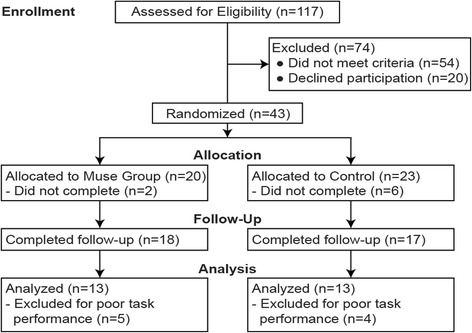
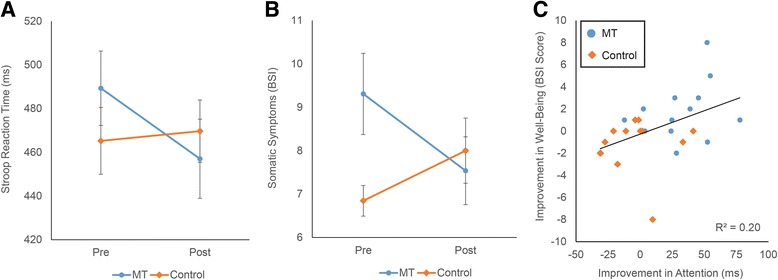
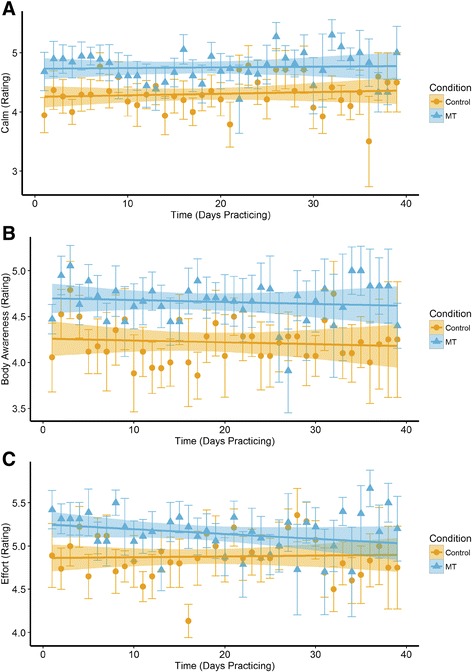
BACKGROUND: Mindfulness training (MT) programs represent an approach to attention training with well-validated mental health benefits. However, research supporting MT efficacy is based predominantly on weekly-meeting, facilitator-led, group-intervention formats. It is unknown whether participants might benefit from neurofeedback-assisted, technology-supported MT (N-tsMT), in which meditation is delivered individually, without the need for a facilitator, travel to a training site, or the presence of a supportive group environment. Mirroring the validation of group MT interventions, the first step in addressing this question requires identifying whether N-tsMT promotes measurable benefits. Here, we report on an initial investigation of a commercial N-tsMT system. METHODS: In a randomized, active control trial, community-dwelling healthy adult participants carried out 6 weeks of daily practice, receiving either N-tsMT (n = 13), or a control condition of daily online math training (n = 13). Training effects were assessed on target measures of attention and well-being. Participants also completed daily post-training surveys assessing effects on mood, body awareness, calm, effort, and stress. RESULTS: Analysis revealed training effects specific to N-tsMT, with attentional improvements in overall reaction time on a Stroop task, and well-being improvements via reduced somatic symptoms on the Brief Symptom Inventory. Attention and well-being improvements were correlated, and effects were greatest for the most neurotic participants. However, secondary, exploratory measures of attention and well-being did not show training-specific effects. N-tsMT was associated with greater body awareness and calm, and initially greater effort that later converged with effort in the control condition. CONCLUSIONS: Preliminary findings indicate that N-tsMT promotes modest benefits for attention and subjective well-being in a healthy community sample relative to an active control condition. However, the findings would benefit from replication in a larger sample, and more intensive practice or more comprehensive MT instruction might be required to promote the broader benefits typically reported in group format, facilitated MT. TRIAL REGISTRATION: Current Controlled Trials ISRCTN43629398 . Retrospectively registered on June 16, 2016.
Overview
The claims and statistics of this paper haven’t been checked yet.
Run the check — free, no account needed. It reads the open-access text and checks the sources it cites.
Integrity signals
Registry
Cites
Statistics
Figures
Verification
Claims the paper makes
The claims and statistics of this paper haven’t been checked yet.
Run the check — free, no account needed. It reads the open-access text and checks the sources it cites.
Claims other papers make about this one
Each is checked against this paper’s own text: does it say what the citing paper says it does?
The cited source says what the claim attributes to it.
In the citing paper
“Self-help, mindfulness-based interventions have been validated in student samples (Cavanagh et al., 2013;Hazlett-Stevens & Oren, 2017;Lever Taylor et al., 2014), the general population (Bhayee et al., 2016;Krusche, Cyhlarova, King, & Williams, 2012;Wimberley, Mintz, & Suh, 2016), and clinical populations (Dimidjian et al., 2014;Morledge et al., 2013).”
From A Mindfulness-Based Intervention: Differential Effects on Affective and Processual Evolution (2018) · cites this paper as Bhayee et al., 2016
In the citing paper
“More recent studies using neurofeedback-assisted technology-supported mindfulness training (N-tsMT) have revealed selective attention improvement and enhancement in well-being in healthy individuals150.”
From Paying attention to attention in depression (2019) · cites this paper as [150]
Self-check
Percentages, sums and reported differences re-computed from the paper’s own numbers.
The self-check needs the paper’s full text.
Citations
Cites
R: A Language and Environment for Statistical Computing
R Core Team (2000) · doi:10.32614/r.manuals · Cited by 355,893
Statistical power analyses using G∗Power 3.1: tests for correlation and regression analyses
Faul, F., Erdfelder, E., Buchner, A., & Lang, A.-G. (2009) · Behavior Research Methods · doi:10.3758/brm.41.4.1149 · Cited by 37,615
Development and validation of brief measures of positive and negative affect: The PANAS scales.
Watson, D., Clark, L. A., & Tellegen, A. (1988) · Journal of Personality and Social Psychology · doi:10.1037/0022-3514.54.6.1063 · Cited by 32,433
Studies of interference in serial verbal reactions
Stroop, J. R. (1935) · Journal of Experimental Psychology · doi:10.1037/h0054651 · Cited by 18,622
nlme : Linear and nonlinear mixed effects models
DebRoy, S. (2006) · Medical Entomology and Zoology · Cited by 10,009
Mindfulness-based interventions in context: Past, present, and future
Kabat-Zinn, J. (2003) · Clinical Psychology: Science and Practice · doi:10.1093/clipsy.bpg016 · Cited by 8,615 · cited 1×
“MT involves changing how one relates to life experience, a transformation initiated by intentionally directing attention away from conceptual thought towards physical sensations with an attitude of curiosity, acceptance and kindness [5].”
BackgroundMindfulness-based interventions in context: Past, present, and future.
Kabat-Zinn, J. (2003) · Clinical Psychology: Science and Practice · doi:10.1093/clipsy/bpg016 · Cited by 8,612
(2008) · Medical Entomology and Zoology · Cited by 7,477
Bootstrap Methods and their Application
Davison, A. C., & Hinkley, D. V. (1997) · doi:10.1017/cbo9780511802843 · Cited by 7,350
The brief symptom inventory: an introductory report.
Derogatis, L. R., & Melisaratos, N. (1983) · Psychological Medicine · doi:10.1017/s0033291700048017 · Cited by 6,650
How do you feel? Interoception: The sense of the physiological condition of the body
Craig, A. D. (2002) · Nature Reviews Neuroscience · doi:10.1038/nrn894 · Cited by 6,006
Half a century of research on the Stroop effect: An integrative review.
MacLeod, C. M. (1991) · Psychological Bulletin · doi:10.1037/0033-2909.109.2.163 · Cited by 5,500
Bootstrap Methods and Their Application
Loughin, T. M., Davison, A. C., & HINKLEY, D. V. (1999) · Journal of the American Statistical Association · doi:10.2307/2669707 · Cited by 5,478
Skevington, S. M., Lotfy, M., & O'Connell, K. A. (2004) · Quality of Life Research · doi:10.1023/b:qure.0000018486.91360.00 · Cited by 4,686
Kabat-Zinn, J. (1982) · General Hospital Psychiatry · doi:10.1016/0163-8343(82)90026-3 · Cited by 4,255
Mindfulness-based stress reduction and health benefits
Grossman, P., Niemann, L., Schmidt, S., & Walach, H. (2004) · Journal of Psychosomatic Research · doi:10.1016/s0022-3999(03)00573-7 · Cited by 3,958
Alterations in brain and immune function produced by mindfulness meditation
Davidson, R. J., Kabat-Zinn, J., Schumacher, J., Rosenkranz, M., Muller, D., Santorelli, S. F., Urbanowski, F., Harrington, A., Bonus, K., & Sheridan, J. F. (2003) · Psychosomatic Medicine · doi:10.1097/01.psy.0000077505.67574.e3 · Cited by 2,925 · cited 1×
“Mindfulness-based Stress Reduction (MBSR) and related programs have been found to improve mood and self-reported emotional health [29], and are associated with improvements in immune system functioning [30], stress [31], and emotion regulation [32].”
BackgroundEffects of mindfulness on psychological health: A review of empirical studies
Keng, S.-L., Smoski, M. J., & Robins, C. J. (2011) · Clinical Psychology Review · doi:10.1016/j.cpr.2011.04.006 · Cited by 2,687
Meditation Programs for Psychological Stress and Well-being: A Systematic Review and Meta-analysis
Goyal, M., Singh, S., Sibinga, E. M. S., Gould, N. F., Rowland-Seymour, A., Sharma, R., Berger, Z., Sleicher, D., Maron, D. D., Shihab, H. M., et al. (2014) · JAMA Internal Medicine · doi:10.1001/jamainternmed.2013.13018 · Cited by 2,380
Fundamentals of Clinical Trials
Friedman, L. M., Furberg, C. D., DeMets, D. L., Reboussin, D. M., & Granger, C. B. (2015) · doi:10.1007/978-3-319-18539-2 · Cited by 2,237
Meditation states and traits: EEG, ERP, and neuroimaging studies.
Cahn, B. R., & Polich, J. (2006) · Psychological Bulletin · doi:10.1037/0033-2909.132.2.180 · Cited by 1,734
Mindfulness-based stress reduction for healthy individuals: A meta-analysis
Khoury, B., Sharma, M., Rush, S. E., & Fournier, C. (2015) · Journal of Psychosomatic Research · doi:10.1016/j.jpsychores.2015.03.009 · Cited by 1,617
Mindfulness training modifies subsystems of attention
JHA, A. P., KROMPINGER, J., & BAIME, M. J. (2007) · Cognitive, Affective, & Behavioral Neuroscience · doi:10.3758/cabn.7.2.109 · Cited by 1,580
Measuring mindfulness—The Freiburg Mindfulness Inventory (FMI)
Walach, H., Buchheld, N., Buttenmüller, V., Kleinknecht, N., & Schmidt, S. (2006) · Personality and Individual Differences · doi:10.1016/j.paid.2005.11.025 · Cited by 1,475 · cited 2×
“To gauge levels of dispositional mindfulness that may have been sensitive and/ or predictive of the training intervention, participants completed the Freiburg Mindfulness Inventory (FMI) [63].”
MethodMindfulness-based stress reduction and health benefits: A meta-analysis
Grossman, P., Niemann, L., Schmidt, S., & Walach, H. (2003) · Focus on Alternative and Complementary Therapies · doi:10.1111/j.2042-7166.2003.tb04008.x · Cited by 1,394 · cited 1×
“As participants learn these skills, top-down control processes are thought to regulate affective appraisals that lead to a reduction in stress responses [33].”
BackgroundMindfulness meditation improves cognition: evidence of brief mental training
Zeidan, F., Johnson, S. K., Diamond, B. J., David, Z., & Goolkasian, P. (2010) · Consciousness and Cognition · doi:10.1016/j.concog.2010.03.014 · Cited by 1,363
Mindfulness-based cognitive therapy for depression
TEASDALE, J. D. (2006) · Routledge eBooks · doi:10.4324/9780203098899-33 · Cited by 1,332
Meditation, mindfulness and cognitive flexibility
Moore, A., & Malinowski, P. (2009) · Consciousness and Cognition · doi:10.1016/j.concog.2008.12.008 · Cited by 1,220 · cited 1×
“Experienced meditators have shown elevated performance on classic tests of attention such as the Stroop task and the D2 Concentration and Endurance task [25].”
Koster, E. H. W., De Lissnyder, E., Derakshan, N., & De Raedt, R. (2011) · Clinical Psychology Review · doi:10.1016/j.cpr.2010.08.005 · Cited by 916
Mental Training Affects Distribution of Limited Brain Resources
Slagter, H. A., Lutz, A., Greischar, L. L., Francis, A. D., Nieuwenhuis, S., Davis, J. M., & Davidson, R. J. (2007) · PLoS Biology · doi:10.1371/journal.pbio.0050138 · Cited by 757
A systematic review of neurobiological and clinical features of mindfulness meditations
Chiesa, A., & Serretti, A. (2010) · Psychological Medicine · doi:10.1017/s0033291709991747 · Cited by 749
Carlson, L. E., Speca, M., Faris, P., & Patel, K. D. (2007) · Brain, Behavior, and Immunity · doi:10.1016/j.bbi.2007.04.002 · Cited by 688
Are expressive suppression and cognitive reappraisal associated with stress-related symptoms?
Moore, S. A., Zoellner, L. A., & Mollenholt, N. (2008) · Behaviour Research and Therapy · doi:10.1016/j.brat.2008.05.001 · Cited by 653
Mental balance and well-being: building bridges between Buddhism and Western psychology
Wallace, B. A., & Shapiro, S. L. (2006) · American Psychologist · doi:10.1037/0003-066x.61.7.690 · Cited by 605
Gruzelier, J. H. (2013) · Neuroscience & Biobehavioral Reviews · doi:10.1016/j.neubiorev.2013.09.015 · Cited by 596
Nyklíček, I., & Kuijpers, K. F. (2008) · Annals of Behavioral Medicine · doi:10.1007/s12160-008-9030-2 · Cited by 532
Fundamentals of Clinical Trials
Friedman, L. M., Furberg, C. D., & DeMets, D. L. (2010) · Springer eBooks · doi:10.1007/978-1-4419-1586-3 · Cited by 532
Neurofeedback training of the upper alpha frequency band in EEG improves cognitive performance
Zoefel, B., Huster, R. J., & Herrmann, C. S. (2010) · NeuroImage · doi:10.1016/j.neuroimage.2010.08.078 · Cited by 522
Minding one’s emotions: Mindfulness training alters the neural expression of sadness.
Farb, N. A. S., Anderson, A. K., Mayberg, H., Bean, J., McKeon, D., & Segal, Z. V. (2010) · Emotion · doi:10.1037/a0017151 · Cited by 521
Self-citationMental training enhances attentional stability: Neural and behavioral evidence
Lutz, A., Slagter, H. A., Rawlings, N. B., Francis, A. D., Greischar, L. L., & Davidson, R. J. (2009) · The Journal of Neuroscience · doi:10.1523/jneurosci.1614-09.2009 · Cited by 489
The d2 Test of Attention: Construct validity and extensions in scoring techniques
Bates, M. E., & Lemay, E. P. (2004) · Journal of the International Neuropsychological Society · doi:10.1017/s135561770410307x · Cited by 388
The SCL-90-R and Brief Symptom Inventory (BSI) in Primary Care
Savitz, L. R. D. A. K. L. (2000) · Routledge eBooks · doi:10.4324/9781315827346-11 · Cited by 384
(2014) · Springer eBooks · doi:10.1007/978-94-007-0753-5_100334 · Cited by 376
Effects of Meditation Experience on Functional Connectivity of Distributed Brain Networks
Hasenkamp, W., & Barsalou, L. W. (2012) · Frontiers in Human Neuroscience · doi:10.3389/fnhum.2012.00038 · Cited by 367
Kerr, C. E., Sacchet, M. D., Lazar, S. W., Moore, C. I., & Jones, S. R. (2013) · Frontiers in Human Neuroscience · doi:10.3389/fnhum.2013.00012 · Cited by 355
The Mindful Way through Depression: Freeing Your Self from Chronic Unhappiness
Adler‐Collins, J. K. (2008) · Journal of Psychiatric and Mental Health Nursing · doi:10.1111/j.1365-2850.2007.01138.x · Cited by 329
Teper, R., & Inzlicht, M. (2013) · Social Cognitive and Affective Neuroscience · doi:10.1093/scan/nss045 · Cited by 323
Effects of Brief and Sham Mindfulness Meditation on Mood and Cardiovascular Variables
Zeidan, F., Johnson, S. K., Gordon, N. S., & Goolkasian, P. (2010) · The Journal of Alternative and Complementary Medicine · doi:10.1089/acm.2009.0321 · Cited by 319 · cited 1×
“nitive, affective and physiological benefits [12, 13].”
The Mindful Way through Depression: Freeing Yourself from Chronic Unhappiness
Williams, J. M. G. (2012) · Cited by 309
Egner, T., & Gruzelier, J. H. (2001) · Neuroreport · doi:10.1097/00001756-200112210-00058 · Cited by 307
Neurofeedback training improves attention and working memory performance
Wang, J.-R., & Hsieh, S. (2013) · Clinical Neurophysiology · doi:10.1016/j.clinph.2013.05.020 · Cited by 245
Bieling, P. J., Hawley, L. L., Bloch, R. T., Corcoran, K. M., Levitan, R. D., Young, L. T., MacQueen, G. M., & Segal, Z. V. (2012) · Journal of Consulting and Clinical Psychology · doi:10.1037/a0027483 · Cited by 241
Decentring and distraction reduce overgeneral autobiographical memory in depression
WATKINS, E., TEASDALE, J. D., & WILLIAMS, R. M. (2000) · Psychological Medicine · doi:10.1017/s0033291799002263 · Cited by 231
Garrison, K. A., Santoyo, J. F., Davis, J. H., Thornhill, T. A., Kerr, C. E., & Brewer, J. A. (2013) · Frontiers in Human Neuroscience · doi:10.3389/fnhum.2013.00440 · Cited by 219
Individual alpha neurofeedback training effect on short term memory
Nan, W., Rodrigues, J., Ma, J., Qu, X., Wan, F., Mak, P., Mak, P. U., Vai, M. I., & Rosa, A. C. (2012) · International Journal of Psychophysiology · doi:10.1016/j.ijpsycho.2012.07.182 · Cited by 210
Hammond, D. C. (2007) · Journal of Neurotherapy · doi:10.1300/j184v10n04_04 · Cited by 203
Awareness of subtle emotional feelings: a comparison of long-term meditators and nonmeditators
Nielsen, L., & Kaszniak, A. W. (2006) · Emotion · doi:10.1037/1528-3542.6.3.392 · Cited by 202
Sahdra, B. K., MacLean, K. A., Ferrer, E., Shaver, P. R., Rosenberg, E. L., Jacobs, T. L., Zanesco, A. P., King, B. G., Aichele, S. R., Bridwell, D. A., et al. (2011) · Emotion · doi:10.1037/a0022764 · Cited by 197
The Enhancement of Visuospatial Processing Efficiency Through Buddhist Deity Meditation
Kozhevnikov, M., Louchakova, O., Josipovic, Z., & Motes, M. A. (2009) · Psychological Science · doi:10.1111/j.1467-9280.2009.02345.x · Cited by 170
The connected discourses of the Buddha : a translation of the Saṃyutta Nikāya
Bodhi, B. (2000) · Wisdom Publications eBooks · Cited by 166
Baron Short, E., Kose, S., Mu, Q., Borckardt, J., Newberg, A., George, M. S., & Kozel, F. A. (2010) · Evidence-Based Complementary and Alternative Medicine · doi:10.1093/ecam/nem163 · Cited by 159
Age effects on attentional blink performance in meditation
van Leeuwen, S., Müller, N. G., & Melloni, L. (2009) · Consciousness and Cognition · doi:10.1016/j.concog.2009.05.001 · Cited by 144
Meachen, S.-J., Hanks, R. A., Millis, S. R., & Rapport, L. J. (2008) · Archives of Physical Medicine and Rehabilitation · doi:10.1016/j.apmr.2007.12.028 · Cited by 143
(2008) · PubMed · Cited by 105
Jarrett, R. B., Minhajuddin, A., Borman, P. D., Dunlap, L., Segal, Z. V., Kidner, C. L., Friedman, E. S., & Thase, M. E. (2012) · Behaviour Research and Therapy · doi:10.1016/j.brat.2012.01.008 · Cited by 72
The Buddhist roots of mindfulness training: a practitioners view
Maex, E. (2011) · Contemporary Buddhism · doi:10.1080/14639947.2011.564835 · Cited by 71
From Retreat Center to Clinic to Boardroom? Perils and Promises of the Modern Mindfulness Movement
Farb, N. A. S. (2014) · Religions · doi:10.3390/rel5041062 · Cited by 49
Self-citationStuder, P., Kratz, O., Gevensleben, H., Rothenberger, A., Moll, G. H., Hautzinger, M., & Heinrich, H. (2014) · Frontiers in Human Neuroscience · doi:10.3389/fnhum.2014.00555 · Cited by 43
Canty, A. J., & Davison, A. C. (2016) · Wiley StatsRef: Statistics Reference Online · doi:10.1002/9781118445112.stat06177.pub2 · Cited by 41
Rubik, B. (2011) · The Journal of Alternative and Complementary Medicine · doi:10.1089/acm.2009.0191 · Cited by 31
Neurofeedback training for peak performance
Graczyk, M., Pąchalska, M., Ziółkowski, A., Mańko, G., Łukaszewska, B., Kochanowicz, K., Mirski, A., & Kropotov, I. (2014) · Annals of Agricultural and Environmental Medicine · doi:10.5604/12321966.1129950 · Cited by 19
Research works printed but not linked: 3
- Kabat-Zinn J, Santorelli S. Mindfulness-Based Stress Reduction Professional Training Resource Manual. Worchester: Center for Mindfulness in Medicine, Health Care and Society; 1999.
- Derogatis LR, Spencer P. Brief symptom inventory: BSI. 4th ed. Upper Saddle River: Pearson; 1993.
- Weschler D, Coalson D, Raiford S. Wechsler Adult Intelligence Test: Fourth Edition Technical and Interpretive Manual. San Antonio: Pearson; 2008.
Cited by
Sorted by citations
A systematic review and meta-analysis of psychological interventions to improve mental wellbeing
van Agteren, J., Iasiello, M., Lo, L., Bartholomaeus, J., Kopsaftis, Z., Carey, M., & Kyrios, M. (2021) · Nature Human Behaviour · doi:10.1038/s41562-021-01093-w · Cited by 510
Paying attention to attention in depression
Keller, A. S., Leikauf, J. E., Holt-Gosselin, B., Staveland, B. R., & Williams, L. M. (2019) · Translational Psychiatry · doi:10.1038/s41398-019-0616-1 · Cited by 329
Gál, É., Ștefan, S., & Cristea, I. A. (2021) · Journal of Affective Disorders · doi:10.1016/j.jad.2020.09.134 · Cited by 289
Meditation, Mindfulness, and Attention: a Meta-analysis
Sumantry, D., & Stewart, K. E. (2021) · Mindfulness · doi:10.1007/s12671-021-01593-w · Cited by 192
Taj-Eldin, M., Ryan, C., O’Flynn, B., & Galvin, P. (2018) · Sensors · doi:10.3390/s18124271 · Cited by 142
Metadata
- Authors
- Bhayee, S., Tomaszewski, P., Lee, D. H., Moffat, G., Pino, L., Moreno, S., & Farb, N. A. S.
- Affiliations
- University of Toronto (CA)
- University of Colorado Boulder (US)
- InteraXon (Canada) (CA)
- Simon Fraser University (CA)
- Corresponding author
- Farb, Norman A. S.
- Venue
- BMC Psychology
- Published
- 2016-11-29
- Volume
- 4
- Issue
- 1
- Pages
- 60-60
- ISSN
- 2050-7283 (ISSN-L)
- PMC
- PMC5127005
- OpenAlex
- W2557883384
- Cited by
- 118
- References
- 72
- Citations by year
- 2026: 5 · 2025: 10 · 2024: 10 · 2023: 17 · 2022: 9 · 2021: 14 · 2020: 26 · 2019: 11 · 2018: 11 · 2017: 5
- FWCI
- 12.04
- Type
- journal article
- Language
- en
- Open access
- gold
- doi.org
- Licence
- Locations
- BMC Psychology (publishedVersion, cc-by)
- Europe PMC (PubMed Central) (publishedVersion, cc-by)
- PubMed Central (publishedVersion, cc-by)
- PubMed (publishedVersion)
- TSpace (University of Toronto) (submittedVersion, cc-by)
- Funders
- Ontario Centres for Excellence (22511)
- Topics
- Social Sciences › Psychology › Clinical Psychology › Mindfulness and Compassion Interventions
- Social Sciences › Psychology › Applied Psychology › Digital Mental Health Interventions
- Social Sciences › Psychology › Social Psychology › Psychological Well-being and Life Satisfaction
- Keywords
- mindfulness training, neurofeedback, technology-based interventions, attention, subjective well-being, Stroop task, reaction time, body awareness, tranquility, effort, stress, neuroticism, healthy adults
- MeSH terms
- Adult, Affect, Attention, Electroencephalography, Female, Humans, Male, Quality of Life, Reaction Time, Stress, Psychological, Treatment Outcome, Stroop Test, Neurofeedback, Mindfulness
About these checks
Registry, retraction, Cites and statistics results are computed, not judged, with one exception: a printed reference that no index lists is read once by a model before it counts as a citation error. Claims are extracted by a model and kept only when their quote appears verbatim in the text; each cited source is then checked, with a model’s help, for whether it says what the claim relies on. Those verdicts can be wrong — read the claim’s quote and the cited source before relying on one.
Statistics and arithmetic are recomputed, not judged.
Confidence bands are shown only for fields calibrated on our annotated test set. None is calibrated yet, so no band is shown.
What counts as a claim ›How we measure confidence ›How we check this ›
Are you an author, or do you see a problem with this page? Request a review
