

The DOI matches its Crossref record; 71 of the 72 references it cites were found in a registry or an index.
Attentional and affective consequences of technology supported mindfulness training: a randomised, active control, efficacy trial
Open accessAbstract
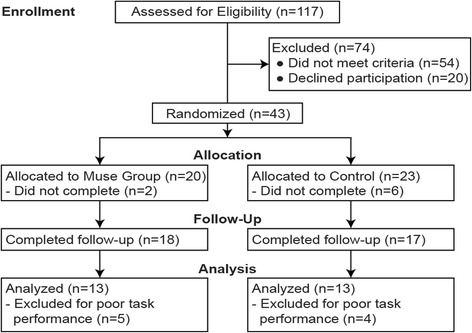
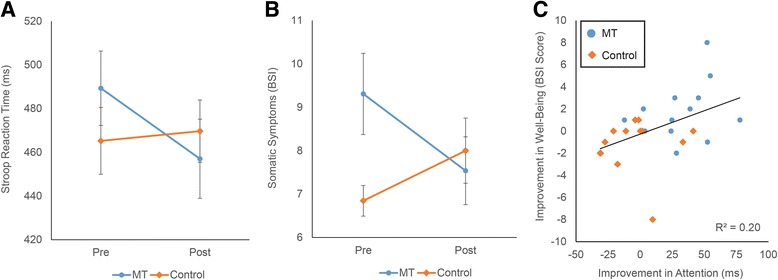
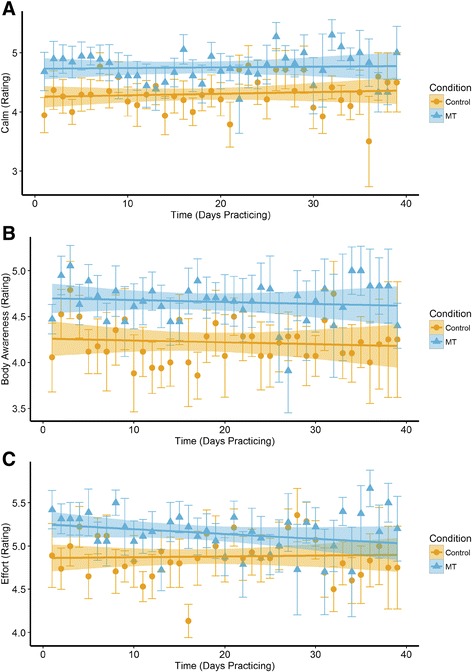
BACKGROUND: Mindfulness training (MT) programs represent an approach to attention training with well-validated mental health benefits. However, research supporting MT efficacy is based predominantly on weekly-meeting, facilitator-led, group-intervention formats. It is unknown whether participants might benefit from neurofeedback-assisted, technology-supported MT (N-tsMT), in which meditation is delivered individually, without the need for a facilitator, travel to a training site, or the presence of a supportive group environment. Mirroring the validation of group MT interventions, the first step in addressing this question requires identifying whether N-tsMT promotes measurable benefits. Here, we report on an initial investigation of a commercial N-tsMT system. METHODS: In a randomized, active control trial, community-dwelling healthy adult participants carried out 6 weeks of daily practice, receiving either N-tsMT (n = 13), or a control condition of daily online math training (n = 13). Training effects were assessed on target measures of attention and well-being. Participants also completed daily post-training surveys assessing effects on mood, body awareness, calm, effort, and stress. RESULTS: Analysis revealed training effects specific to N-tsMT, with attentional improvements in overall reaction time on a Stroop task, and well-being improvements via reduced somatic symptoms on the Brief Symptom Inventory. Attention and well-being improvements were correlated, and effects were greatest for the most neurotic participants. However, secondary, exploratory measures of attention and well-being did not show training-specific effects. N-tsMT was associated with greater body awareness and calm, and initially greater effort that later converged with effort in the control condition. CONCLUSIONS: Preliminary findings indicate that N-tsMT promotes modest benefits for attention and subjective well-being in a healthy community sample relative to an active control condition. However, the findings would benefit from replication in a larger sample, and more intensive practice or more comprehensive MT instruction might be required to promote the broader benefits typically reported in group format, facilitated MT. TRIAL REGISTRATION: Current Controlled Trials ISRCTN43629398 . Retrospectively registered on June 16, 2016.
Overview
The claims and statistics of this paper haven’t been checked yet.
Run the check — free, no account needed. It reads the open-access text and checks the sources it cites.
Integrity signals
Registry
Cites
Statistics
Figures
Verification
Claims the paper makes
The claims and statistics of this paper haven’t been checked yet.
Run the check — free, no account needed. It reads the open-access text and checks the sources it cites.
Claims other papers make about this one
Each is checked against this paper’s own text: does it say what the citing paper says it does?
The cited source says what the claim attributes to it.
In the citing paper
“Self-help, mindfulness-based interventions have been validated in student samples (Cavanagh et al., 2013;Hazlett-Stevens & Oren, 2017;Lever Taylor et al., 2014), the general population (Bhayee et al., 2016;Krusche, Cyhlarova, King, & Williams, 2012;Wimberley, Mintz, & Suh, 2016), and clinical populations (Dimidjian et al., 2014;Morledge et al., 2013).”
From A Mindfulness-Based Intervention: Differential Effects on Affective and Processual Evolution (2018) · cites this paper as Bhayee et al., 2016
In the citing paper
“More recent studies using neurofeedback-assisted technology-supported mindfulness training (N-tsMT) have revealed selective attention improvement and enhancement in well-being in healthy individuals150.”
From Paying attention to attention in depression (2019) · cites this paper as [150]
Self-check
Percentages, sums and reported differences re-computed from the paper’s own numbers.
The self-check needs the paper’s full text.
Citations
Cites
R: A Language and Environment for Statistical Computing
R Core Team (2000) · doi:10.32614/r.manuals · Cited by 355,893
Statistical power analyses using G∗Power 3.1: tests for correlation and regression analyses
Faul, F., Erdfelder, E., Buchner, A., & Lang, A.-G. (2009) · Behavior Research Methods · doi:10.3758/brm.41.4.1149 · Cited by 37,615
Development and validation of brief measures of positive and negative affect: The PANAS scales.
Watson, D., Clark, L. A., & Tellegen, A. (1988) · Journal of Personality and Social Psychology · doi:10.1037/0022-3514.54.6.1063 · Cited by 32,433
Studies of interference in serial verbal reactions
Stroop, J. R. (1935) · Journal of Experimental Psychology · doi:10.1037/h0054651 · Cited by 18,622
nlme : Linear and nonlinear mixed effects models
DebRoy, S. (2006) · Medical Entomology and Zoology · Cited by 10,009
Mindfulness-based interventions in context: Past, present, and future
Kabat-Zinn, J. (2003) · Clinical Psychology: Science and Practice · doi:10.1093/clipsy.bpg016 · Cited by 8,615 · cited 1×
“MT involves changing how one relates to life experience, a transformation initiated by intentionally directing attention away from conceptual thought towards physical sensations with an attitude of curiosity, acceptance and kindness [5].”
BackgroundMindfulness-based interventions in context: Past, present, and future.
Kabat-Zinn, J. (2003) · Clinical Psychology: Science and Practice · doi:10.1093/clipsy/bpg016 · Cited by 8,612
(2008) · Medical Entomology and Zoology · Cited by 7,477
Bootstrap Methods and their Application
Davison, A. C., & Hinkley, D. V. (1997) · doi:10.1017/cbo9780511802843 · Cited by 7,350
The brief symptom inventory: an introductory report.
Derogatis, L. R., & Melisaratos, N. (1983) · Psychological Medicine · doi:10.1017/s0033291700048017 · Cited by 6,650
Research works printed but not linked: 3
- Kabat-Zinn J, Santorelli S. Mindfulness-Based Stress Reduction Professional Training Resource Manual. Worchester: Center for Mindfulness in Medicine, Health Care and Society; 1999.
- Derogatis LR, Spencer P. Brief symptom inventory: BSI. 4th ed. Upper Saddle River: Pearson; 1993.
- Weschler D, Coalson D, Raiford S. Wechsler Adult Intelligence Test: Fourth Edition Technical and Interpretive Manual. San Antonio: Pearson; 2008.
Cited by
Sorted by citations
A systematic review and meta-analysis of psychological interventions to improve mental wellbeing
van Agteren, J., Iasiello, M., Lo, L., Bartholomaeus, J., Kopsaftis, Z., Carey, M., & Kyrios, M. (2021) · Nature Human Behaviour · doi:10.1038/s41562-021-01093-w · Cited by 510
Paying attention to attention in depression
Keller, A. S., Leikauf, J. E., Holt-Gosselin, B., Staveland, B. R., & Williams, L. M. (2019) · Translational Psychiatry · doi:10.1038/s41398-019-0616-1 · Cited by 329
Gál, É., Ștefan, S., & Cristea, I. A. (2021) · Journal of Affective Disorders · doi:10.1016/j.jad.2020.09.134 · Cited by 289
Meditation, Mindfulness, and Attention: a Meta-analysis
Sumantry, D., & Stewart, K. E. (2021) · Mindfulness · doi:10.1007/s12671-021-01593-w · Cited by 192
Taj-Eldin, M., Ryan, C., O’Flynn, B., & Galvin, P. (2018) · Sensors · doi:10.3390/s18124271 · Cited by 142
How can technology support ageing in place in healthy older adults? A systematic review
Ollevier, A., Noury, G. A., Palomino, M. A., & Simpelaere, I. S. (2020) · Public health reviews · doi:10.1186/s40985-020-00143-4 · Cited by 156
Mindfulness-based positive psychology interventions: a systematic review
George, A. J., Romate, J., & Rajkumar, E. (2021) · BMC Psychology · doi:10.1186/s40359-021-00618-2 · Cited by 170
Verhaeghen, P. (2020) · Mindfulness · doi:10.1007/s12671-020-01532-1 · Cited by 151
Mitsea, E., Drigas, A. S., & Skianis, C. A. (2023) · Behavioral Sciences · doi:10.3390/bs13121008 · Cited by 130
“Although the results of the current systematic review demonstrate the positive effects of digitally assisted mindfulness training in self-regulation, special focus must be given to the risks and challenges derived from the use of technologies.”
ResultLinardon, J., Messer, M., Goldberg, S. B., & Fuller‐Tyszkiewicz, M. (2023) · Clinical Psychology Review · doi:10.1016/j.cpr.2023.102370 · Cited by 78
Wexler, A., & Thibault, R. T. (2018) · Journal of Cognitive Enhancement · doi:10.1007/s41465-018-0091-2 · Cited by 76
Meditation and the Wandering Mind: A Theoretical Framework of Underlying Neurocognitive Mechanisms
Brandmeyer, T., & Arnaud Delorme, A. (2020) · Perspectives on Psychological Science · doi:10.1177/1745691620917340 · Cited by 86
Elor, A., Powell, M. O., Mahmoodi, E., Hawthorne, N., Teodorescu, M., & Kurniawan, S. (2020) · ACM Transactions on Computing for Healthcare · doi:10.1145/3396249 · Cited by 71
Crivelli, D., Fronda, G., Venturella, I., & Balconi, M. (2018) · Mindfulness · doi:10.1007/s12671-018-0975-3 · Cited by 64
Zhang, Y., Xue, J., & Huang, Y. (2020) · Medicine · doi:10.1097/md.0000000000020493 · Cited by 63
Orndorff-Plunkett, F., Singh, F., Aragón, O. R., & Pineda, J. A. (2017) · Brain Sciences · doi:10.3390/brainsci7080095 · Cited by 67
Herman, K., Ciechanowski, L., & Przegalińska, A. (2021) · Sustainability · doi:10.3390/su13042212 · Cited by 62
Opening up the Design Space of Neurofeedback Brain--Computer Interfaces for Children
Antle, A. N., Chesick, L., & McLaren, E.-S. (2017) · ACM Transactions on Computer-Human Interaction · doi:10.1145/3131607 · Cited by 66
Stress and neurocognitive efficiency in managerial contexts
Crivelli, D., Fronda, G., Venturella, I., & Balconi, M. (2019) · International Journal of Workplace Health Management · doi:10.1108/ijwhm-07-2018-0095 · Cited by 62
Mindfulness and Attention: Current State-of-Affairs and Future Considerations
Prakash, R. S., Fountain‐Zaragoza, S., Kramer, A. F., Samimy, S., & Wegman, J. (2020) · Journal of Cognitive Enhancement · doi:10.1007/s41465-019-00144-5 · Cited by 64
Renfrew, M. E., Morton, D. P., Morton, J. K., Hinze, J. S., Beamish, P., Przybylko, G., & Craig, B. A. (2020) · Journal of Medical Internet Research · doi:10.2196/15592 · Cited by 54
Leveraging technology to personalize cognitive enhancement methods in aging
Ziegler, D. A., Anguera, J. A., Gallen, C. L., Hsu, W.-Y., Wais, P. E., & Gazzaley, A. (2022) · Nature Aging · doi:10.1038/s43587-022-00237-5 · Cited by 50
Hunkin, H., King, D. L., & Zajac, I. (2020) · Mindfulness · doi:10.1007/s12671-020-01541-0 · Cited by 44
Acabchuk, R. L., Simon, M. A., Low, S., Brisson, J. M., & Johnson, B. T. (2021) · Mindfulness · doi:10.1007/s12671-020-01497-1 · Cited by 44
Neuro-Empowerment of Executive Functions in the Workplace: The Reason Why
Balconi, M., Angioletti, L., & Crivelli, D. (2020) · Frontiers in Psychology · doi:10.3389/fpsyg.2020.01519 · Cited by 44
Hawley, L. L., Rector, N. A., DaSilva, A., Laposa, J. M., & Richter, M. A. (2020) · Behaviour Research and Therapy · doi:10.1016/j.brat.2020.103757 · Cited by 51
Gaming Beyond the Novelty Effect of Immersive Virtual Reality for Physical Rehabilitation
Elor, A., Powell, M. O., Mahmoodi, E., Teodorescu, M., & Kurniawan, S. (2021) · IEEE Transactions on Games · doi:10.1109/tg.2021.3069445 · Cited by 48
Mitsea, E., Drigas, A. S., & Skianis, C. A. (2024) · Electronics · doi:10.3390/electronics13122253 · Cited by 46
Effects of mindfulness on psychological and psychophysiological responses during self‐paced walking
Bigliassi, M., Galano, B. M., Lima‐Silva, A. E., & Bertuzzi, R. (2020) · Psychophysiology · doi:10.1111/psyp.13529 · Cited by 42
Antle, A. N., Chesick, L., Sridharan, S. K., & Cramer, E. S. (2018) · Personal and Ubiquitous Computing · doi:10.1007/s00779-018-1166-x · Cited by 40
Hunkin, H., King, D. L., & Zajac, I. T. (2019) · Clinical Psychology Science and Practice · doi:10.1111/cpsp.12290 · Cited by 39
Balconi, M., Crivelli, D., & Angioletti, L. (2019) · Frontiers in Neuroscience · doi:10.3389/fnins.2019.00996 · Cited by 40
Heart rate variability during mindful breathing meditation
Natarajan, A. (2023) · Frontiers in Physiology · doi:10.3389/fphys.2022.1017350 · Cited by 37
Victorson, D. E., Sauer, C. M., Wolters, L., Maletich, C., Lukoff, K., & Sufrin, N. (2020) · Mindfulness · doi:10.1007/s12671-020-01373-y · Cited by 33
Lodha, S., & Gupta, R. (2022) · Journal of Cognitive Enhancement · doi:10.1007/s41465-022-00254-7 · Cited by 34
Gray, S. (2017) · Medical Acupuncture · doi:10.1089/acu.2017.1220 · Cited by 35
Neto, O. L., Haenni, S., Phuka, J. C., Ozella, L., Paolotti, D., Cattuto, C., Robles, D., & Lichand, G. F. (2021) · JMIR Public Health and Surveillance · doi:10.2196/23154 · Cited by 27
Kelm, D. J., Ridgeway, J. L., Gas, B. L., Mohan, M., Cook, D. A., Nelson, D. R., & Benzo, R. P. (2018) · Teaching and Learning in Medicine · doi:10.1080/10401334.2018.1462186 · Cited by 28
Viczko, J., Tarrant, J., & Jackson, R. (2021) · Frontiers in Virtual Reality · doi:10.3389/frvir.2021.618381 · Cited by 28
The Impact of Mindfulness Training on Middle Grades Students’ Office Discipline Referrals
Martinez, T., & Zhao, Y. (2018) · RMLE Online · doi:10.1080/19404476.2018.1435840 · Cited by 25
Hybrid Harmony: A Multi-Person Neurofeedback Application for Interpersonal Synchrony
Chen, P., Hendrikse, S. C. F., Sargent, K., Romani, M., Oostrik, M., Wilderjans, T. F., Koole, S. L., Dumas, G., Medine, D., & Dikker, S. (2021) · Frontiers in Neuroergonomics · doi:10.3389/fnrgo.2021.687108 · Cited by 22
A Mindfulness-Based Intervention: Differential Effects on Affective and Processual Evolution
Antoine, P., Congard, A., Andreotti, E., Dauvier, B., Illy, J., & Poinsot, R. (2018) · Applied Psychology: Health and Well-Being · doi:10.1111/aphw.12137 · Cited by 23
“Significant results were found in this intervention study, although the constitutive elements usually found in group mindfulness-based interventions—such as peer influence, trained mindfulness professional support, and didactic content (Bhayee et al., 2016)—were not introduced.”
BackgroundResultInfluentialVekety, B., Logemann, H. N. A., & Takács, Z. K. (2022) · Brain Sciences · doi:10.3390/brainsci12010103 · Cited by 32
Andreotti, E., Congard, A., Vigouroux, S. L., Dauvier, B., Illy, J., Poinsot, R., & Antoine, P. (2018) · Journal of Cognitive Psychotherapy · doi:10.1891/0889-8391.32.2.127 · Cited by 23
Bajestani, G. S., Ghanizadeh, A., Makhloughi, F., Kharrazi, F. H., Hosseini, A., & Toosi, M. B. (2024) · Mindfulness · doi:10.1007/s12671-024-02317-6 · Cited by 22
Evaluating the viewer experience of interactive virtual reality movies
Carpio, R., Baumann, O., & Birt, J. (2023) · Virtual Reality · doi:10.1007/s10055-023-00864-2 · Cited by 21
Combining frontal gamma asymmetry neurofeedback with virtual reality: A proof of concept case study
Tarrant, J., & Cope, H. (2018) · NeuroRegulation · doi:10.15540/nr.5.2.57 · Cited by 20
Portable EEG monitoring for older adults with dementia and chronic pain - A feasibility study
Pu, L., Lion, K., Todorovic, M., & Moyle, W. (2020) · Geriatric Nursing · doi:10.1016/j.gerinurse.2020.12.008 · Cited by 20
Cochrane, K. A., Loke, L., de Bérigny, C., & Campbell, A. (2018) · Australian Conference on Computer-Human Interaction (OzCHI) · doi:10.1145/3292147.3292215 · Cited by 20
Ghosh, K., Nanda, S., Hurt, R., Schroeder, D., West, C., Fischer, K. M., Bauer, B., Fokken, S. C., Ganesh, R., Hanson, J. L., et al. (2023) · Journal of Primary Care & Community Health · doi:10.1177/21501319231162308 · Cited by 16
Multimodal assessment of effects of urban environments on psychological wellbeing
Baumann, O., & Brooks-Cederqvist, B. (2023) · Heliyon · doi:10.1016/j.heliyon.2023.e16433 · Cited by 19
“Previous studies have shown that modern portable Muse EEG devices can reliably replicate EEG effects related to emotion and stress in outdoor settings [56,57].”
Liebherr, M., Brandtner, A., Brand, M., & Tang, Y. (2024) · Annals of the New York Academy of Sciences · doi:10.1111/nyas.15095 · Cited by 31
“,39,50 Notably, one of these studies also encompassed broader executive functions, which, due to the constrained categorization, we have categorized as executive regulation.”
BackgroundMethodResultInfluentialKeep the books on the shelves: Library space as intrinsic facilitator of the reading experience
Donovan, J. M. (2019) · The Journal of Academic Librarianship · doi:10.1016/j.acalib.2019.102104 · Cited by 16
Lee, E., Hong, J. K., Choi, H., & Yoon, I. (2024) · Journal of Korean Medical Science · doi:10.3346/jkms.2024.39.e94 · Cited by 17
Pavani, J., Berna, G., Andreotti, E., Guiller, T., Antoine, P., Dauvier, B., & Congard, A. (2019) · Applied Psychology Health and Well-Being · doi:10.1111/aphw.12189 · Cited by 15
Polich, G. R., Gray, S., Tran, D., Morales-Quezada, L., & Glenn, M. B. (2020) · Brain Injury · doi:10.1080/02699052.2020.1802781 · Cited by 15
GomezRomero-Borquez, J., Puerto-Flores, J. A. D., & Del-Valle-Soto, C. (2023) · Future Internet · doi:10.3390/fi15080264 · Cited by 16
Human enhancement through the lens of experimental and speculative neurotechnologies
Teunisse, W., Youssef, S., & Schmidt, M. R. (2019) · Human Behavior and Emerging Technologies · doi:10.1002/hbe2.179 · Cited by 13
Dunham, C. M., Burger, A. L., Hileman, B. M., Chance, E. A., Hutchinson, A. E., Kohli, C. M., DeNiro, L., Tall, J. M., & Lisko, P. (2019) · Frontiers in Psychology · doi:10.3389/fpsyg.2019.02153 · Cited by 14
Consumer-Grade Neurofeedback With Mindfulness Meditation: Meta-Analysis
Treves, I. N., Bajwa, Z., Greene, K. D., Bloom, P. A., Kim, N., Wool, E., Goldberg, S. B., Whitfield, S., & Auerbach, R. P. (2025) · Journal of Medical Internet Research · doi:10.2196/68204 · Cited by 15
Mitsea, E., Drigas, A. S., & Skianis, C. A. (2023) · Research Society and Development · doi:10.33448/rsd-v12i3.40247 · Cited by 12
Designing meditation for doctor well-being: can ‘Om’ help obstetrics and gynaecology doctors?
Allen, R., Robinson, A., Allen, S., Nathan, E., Coghlan, E., & Leung, Y. C. (2020) · Australasian Psychiatry · doi:10.1177/1039856219891589 · Cited by 12
Wrede, S. J. S., Esch, T., & Michaelsen, M. M. (2025) · BMC Digital Health · doi:10.1186/s44247-025-00186-0 · Cited by 14
Hepner, K. A., Bloom, E. L., Newberry, S. J., Sousa, J., Osilla, K. C., Booth, M. S., Bialas, A., & Rutter, C. M. (2022) · Rand health quarterly · doi:10.7249/rhq-10-01-09 · Cited by 11
Shaw, S. B., Levy, Y., Mizzi, A. L., Herman, G., McKinnon, M. C., Heisz, J. J., & Becker, S. (2022) · Frontiers in Human Neuroscience · doi:10.3389/fnhum.2022.838614 · Cited by 11
Kimura, I., Noyama, H., Onagawa, R., Takemi, M., Osu, R., & Kawahara, J. (2023) · Imaging Neuroscience · doi:10.1162/imag_a_00053 · Cited by 12
Mindfulness and PERMA Well-Being: Intervention Effects and Mechanism of Change
Liu, B., Ye, G., Jing, H., Hofmann, S. G., & Liu, X. (2022) · Psychology · doi:10.4236/psych.2022.135046 · Cited by 11
Chen, P., Kirk, U., & Dikker, S. (2022) · Frontiers in Psychology · doi:10.3389/fpsyg.2022.915345 · Cited by 14
Time evolution of affective processes in a mindfulness-based intervention
Congard, A., Vigouroux, S. L., Andreotti, E., Dauvier, B., Illy, J., Poinsot, R., & Antoine, P. (2019) · Current Psychology · doi:10.1007/s12144-019-00548-8 · Cited by 11
Ng, J. Y. (2025) · Integrative Medicine Research · doi:10.1016/j.imr.2025.101142 · Cited by 8
Technology supported mindfulness for obsessive compulsive disorder: The role of obsessive beliefs
Hawley, L. L., Rector, N. A., & Richter, M. A. (2021) · Journal of Anxiety Disorders · doi:10.1016/j.janxdis.2021.102405 · Cited by 10
The Cognitive Control Model of Work-related Flow
Weintraub, J., Nolan, K. P., & Sachdev, A. R. (2023) · Frontiers in Psychology · doi:10.3389/fpsyg.2023.1174152 · Cited by 9
Angioletti, L., & Fronda, G. (2024) · Social Neuroscience · doi:10.1080/17470919.2024.2369290 · Cited by 7
Closed-Loop Systems and Real-Time Neurofeedback in Mindfulness Meditation Research
Chen, J., & Ziegler, D. A. (2024) · Biological Psychiatry Cognitive Neuroscience and Neuroimaging · doi:10.1016/j.bpsc.2024.10.012 · Cited by 6
Heredia, L., Ventura, D., Torrente, M., & Vicens, P. (2024) · Mind Brain and Education · doi:10.1111/mbe.12419 · Cited by 7
The MindfulBreather: Motion Guided Mindfulness
Mole, T. B., Galante, J., Walker, I., Dawson, A. F., Hannah, L. A., Mackeith, P., Ainslie, M., & Jones, P. B. (2017) · Frontiers in Human Neuroscience · doi:10.3389/fnhum.2017.00613 · Cited by 5
Balconi, M., Angioletti, L., & Crivelli, D. (2023) · Frontiers in Rehabilitation Sciences · doi:10.3389/fresc.2023.1056972 · Cited by 5
Motolese, F., Stelitano, D., Lanzone, J., Albergo, G., Cruciani, A., Masciulli, C., Musumeci, G., Pilato, F., Rossi, M., Ribolsi, M., et al. (2023) · Multiple Sclerosis and Related Disorders · doi:10.1016/j.msard.2023.104931 · Cited by 6
Sard-Peck, T. E., Martín-Asuero, A., Oller, M. T., Calvo, A., & Santesteban‐Echarri, O. (2019) · Psiquiatría Biológica · doi:10.1016/j.psiq.2019.03.001 · Cited by 5
Trait mindfulness predicts inter-brain coupling during naturalistic face-to-face interactionsPreprint
Chen, P., Kirk, U., & Dikker, S. (2021) · bioRxiv (Cold Spring Harbor Laboratory) · doi:10.1101/2021.06.28.448432 · Cited by 5
van der Schoot, A., Wilpert, J., & van Horn, J. E. (2024) · Frontiers in Psychology · doi:10.3389/fpsyg.2024.1354997 · Cited by 3
Vignati, B., & Crivelli, D. (2025) · Frontiers in Psychology · doi:10.3389/fpsyg.2025.1660000 · Cited by 7
Mindfulness-Based Interventions (MBIs) as a Way for Treating EFs in Addiction-Related Disorders
Balconi, M., & Angioletti, L. (2021) · Advances in mental health and addiction · doi:10.1007/978-3-030-82408-2_6 · Cited by 3
Brain Sensing with Wearable Headband(ACP2)
Akter, N., Hossain, N., & Sattar, A. (2021) · International Conference on Electrical, Computer and Communication Technologies (ICECCT) · doi:10.1109/icecct52121.2021.9616810 · Cited by 3
Rashidi, N. A. N. N., Izhar, L. I., Sebastian, P., Elamvazuthi, I., & Idris, S. A. (2022) · IEEE International Symposium in Robotics and Manufacturing Automation (ROMA) · doi:10.1109/roma55875.2022.9915694 · Cited by 2
Hawley, L. L., Lisi, D., Richter, M. A., Selchen, S., & Rector, N. A. (2024) · Clinical Psychology & Psychotherapy · doi:10.1002/cpp.3018 · Cited by 3
Beheshti, M., & Bilkstein, P. (2020) · ACM International Conference on Interaction Design and Children (IDC) · doi:10.1145/3397617.3402033 · Cited by 2
Meditation, Mindfulness, and Mental Health
Gupta, S. K. (2021) · Advances in psychology, mental health, and behavioral studies (APMHBS) book series · doi:10.4018/978-1-7998-8682-2.ch001 · Cited by 2
Cook, S., Baecker, R. M., Munteanu, C., & Walker, A. (2017) · Lecture Notes in Computer Science · doi:10.1007/978-3-319-58625-0_31 · Cited by 5
Golshan, F., Sun, G., Francisco, J., Alibolandi, P., Zade, M. N., Mousavi, A., Lysenko, R., O’Connell, M. E., Block, H., Masiowski, P., et al. (2025) · Journal of Clinical Neuroscience · doi:10.1016/j.jocn.2025.111685 · Cited by 1
Shrestha, A., & Al-Ameen, M. N. (2026) · Behaviour and Information Technology · doi:10.1080/0144929x.2026.2675644 · Cited by 1
Neuromanagement. People and Organizations
Balconi, M. (2020) · Cited by 1
EEG-Based Brain-Computer Interface for Actuating Car Commands using the MUSE Headband
Hassan, A., Bernadin, S., Waheed, M. F., & Destinoble, H. (2025) · IEEE SoutheastCon · doi:10.1109/southeastcon56624.2025.10971512 · Cited by 1
A Survey on Effects of Various Meditation Interventions on Overall Performance of College Students
Nargundkar, S., Manage, P. S., & Desai, V. (2020) · IEEE Bangalore Humanitarian Technology Conference (B-HTC) · doi:10.1109/b-htc50970.2020.9297859 · Cited by 1
Lee, E.-Y., Hong, J. K., Choi, H., & Yoon, I. (2022) · Research Square · doi:10.21203/rs.3.rs-1907600/v1 · Cited by 1
Motolese, F., Stelitano, D., Lanzone, J., Albergo, G., Cruciani, A., Masciulli, C., Musumeci, G., Pilato, F., Rossi, M., Ribolsi, M., et al. (2023) · doi:10.22541/au.168416824.49652226/v1 · Cited by 1
Tan, W. J., Ding, Y., Lin, X. B., Robinson, N., Zeng, Q., Zhang, S., Wai, A. A. P., Lee, T.-S. W., & Guan, C. (2024) · medRxiv · doi:10.1101/2024.03.01.24303187 · Cited by 1
Cohen, J. D., & Mullen, S. P. (2019) · Illinois Digital Environment for Access to Learning and Scholarship (University of Illinois at Urbana-Champaign) · doi:10.17605/osf.io/xkv6t
Applicare il potenziamento neurocognitivo in azienda per “stimolare” i cervelli dell’organizzazione
Balconi, M., & Angioletti, L. (2020) · Studi e ricerche · doi:10.7359/954-2020-bal7
Balconi, M., & Angioletti, L. (2020) · Studi e ricerche · doi:10.7359/954-2020-bal6
Metadata
- Authors
- Bhayee, S., Tomaszewski, P., Lee, D. H., Moffat, G., Pino, L., Moreno, S., & Farb, N. A. S.
- Affiliations
- University of Toronto (CA)
- University of Colorado Boulder (US)
- InteraXon (Canada) (CA)
- Simon Fraser University (CA)
- Corresponding author
- Farb, Norman A. S.
- Venue
- BMC Psychology
- Published
- 2016-11-29
- Volume
- 4
- Issue
- 1
- Pages
- 60-60
- ISSN
- 2050-7283 (ISSN-L)
- PMC
- PMC5127005
- OpenAlex
- W2557883384
- Cited by
- 118
- References
- 72
- Citations by year
- 2026: 5 · 2025: 10 · 2024: 10 · 2023: 17 · 2022: 9 · 2021: 14 · 2020: 26 · 2019: 11 · 2018: 11 · 2017: 5
- FWCI
- 12.04
- Type
- journal article
- Language
- en
- Open access
- gold
- doi.org
- Licence
- Locations
- BMC Psychology (publishedVersion, cc-by)
- Europe PMC (PubMed Central) (publishedVersion, cc-by)
- PubMed Central (publishedVersion, cc-by)
- PubMed (publishedVersion)
- TSpace (University of Toronto) (submittedVersion, cc-by)
- Funders
- Ontario Centres for Excellence (22511)
- Topics
- Social Sciences › Psychology › Clinical Psychology › Mindfulness and Compassion Interventions
- Social Sciences › Psychology › Applied Psychology › Digital Mental Health Interventions
- Social Sciences › Psychology › Social Psychology › Psychological Well-being and Life Satisfaction
- Keywords
- mindfulness training, neurofeedback, technology-based interventions, attention, subjective well-being, Stroop task, reaction time, body awareness, tranquility, effort, stress, neuroticism, healthy adults
- MeSH terms
- Adult, Affect, Attention, Electroencephalography, Female, Humans, Male, Quality of Life, Reaction Time, Stress, Psychological, Treatment Outcome, Stroop Test, Neurofeedback, Mindfulness
About these checks
Registry, retraction, Cites and statistics results are computed, not judged, with one exception: a printed reference that no index lists is read once by a model before it counts as a citation error. Claims are extracted by a model and kept only when their quote appears verbatim in the text; each cited source is then checked, with a model’s help, for whether it says what the claim relies on. Those verdicts can be wrong — read the claim’s quote and the cited source before relying on one.
Statistics and arithmetic are recomputed, not judged.
Confidence bands are shown only for fields calibrated on our annotated test set. None is calibrated yet, so no band is shown.
What counts as a claim ›How we measure confidence ›How we check this ›
Are you an author, or do you see a problem with this page? Request a review
