

Targeting of M2-like tumor-associated macrophages with a melittin-based pro-apoptotic peptide
Open accessThe DOI matches its Crossref record; 51 of the 52 references it cites were found in a registry or an index.
Abstract
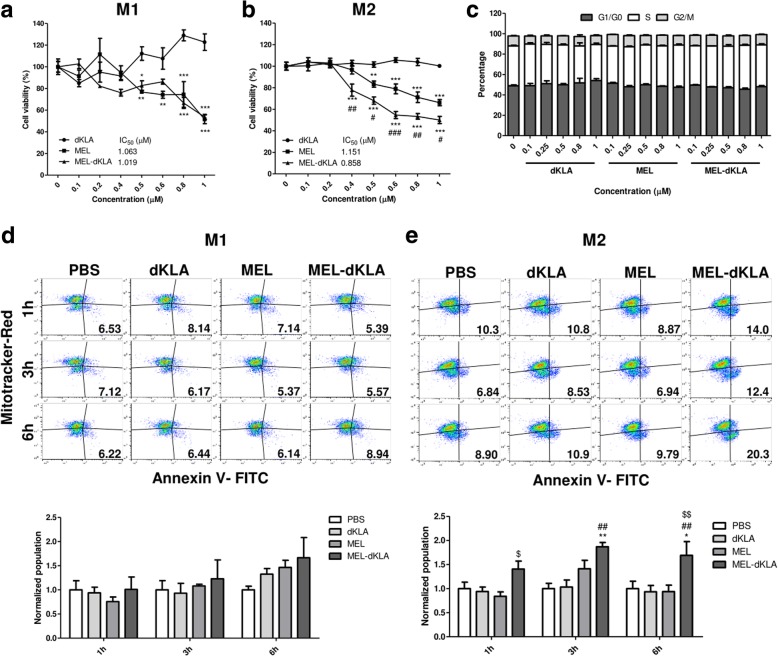
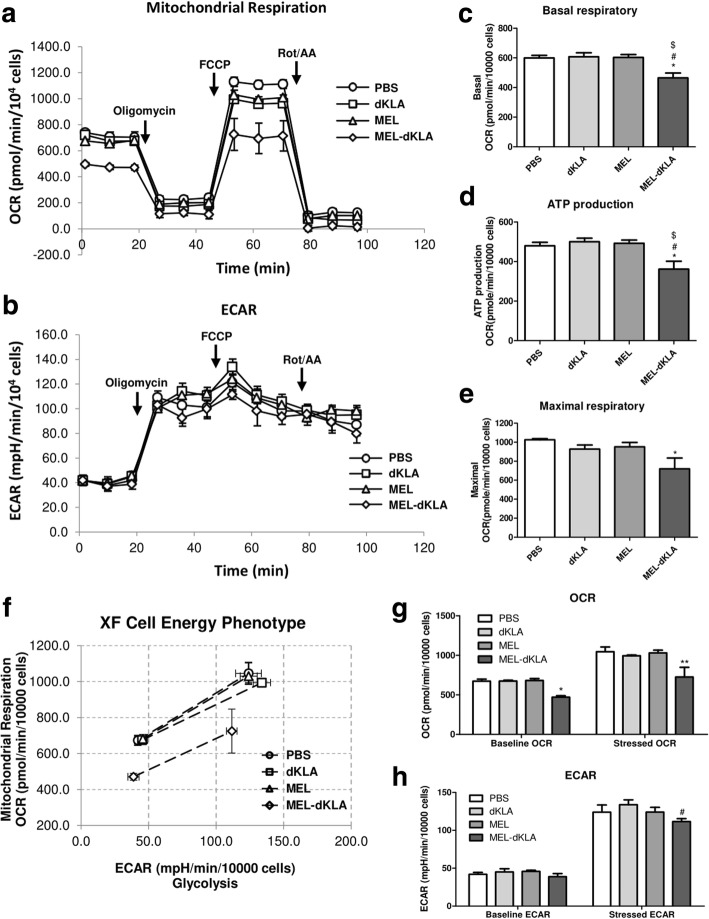
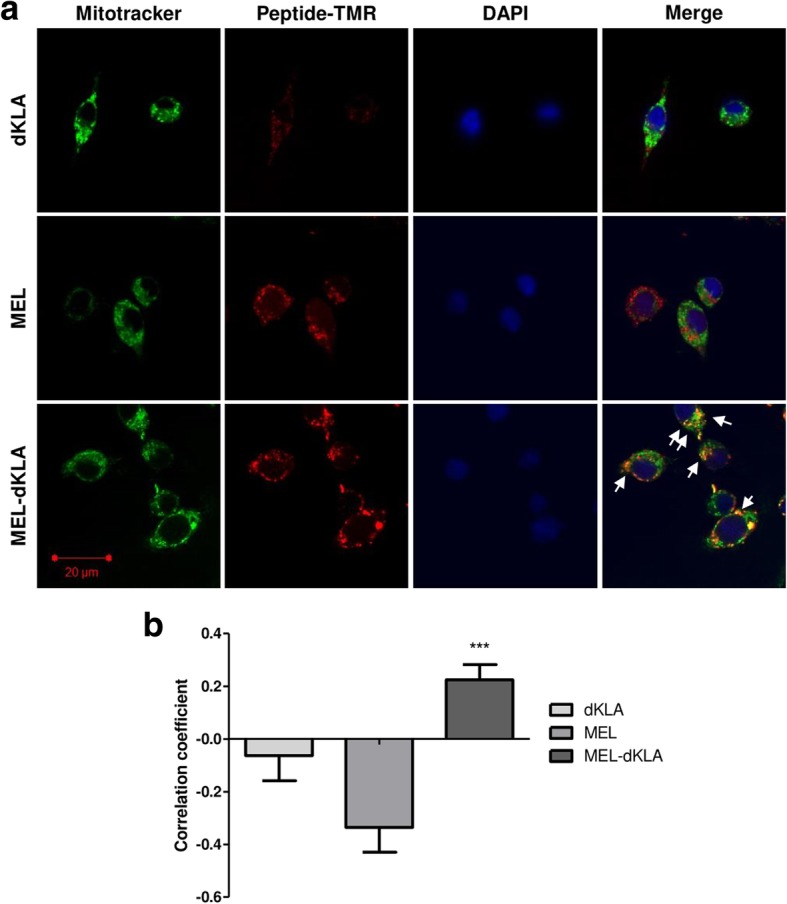
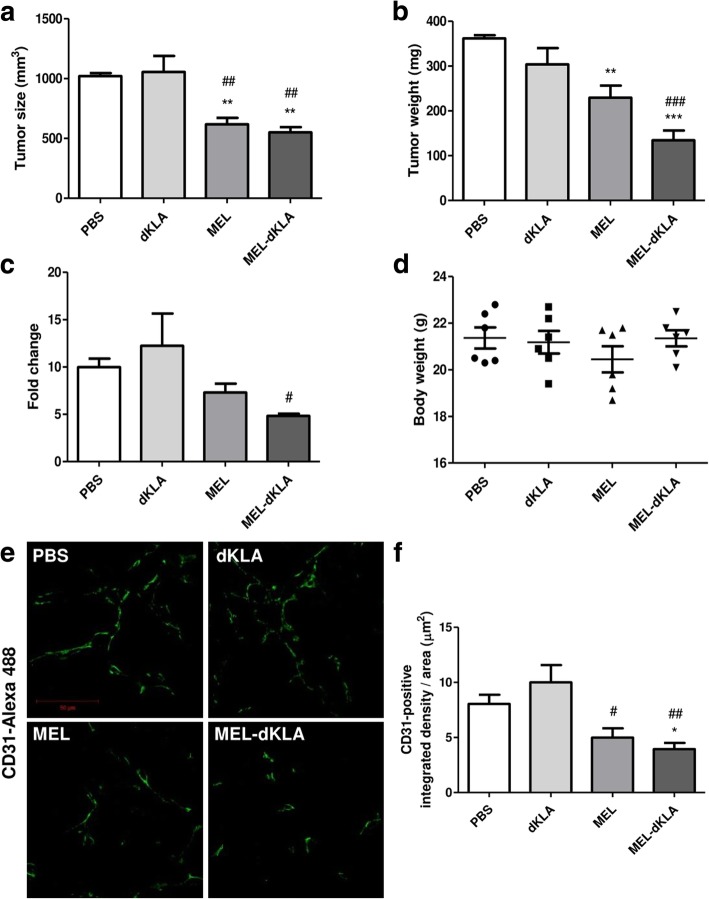
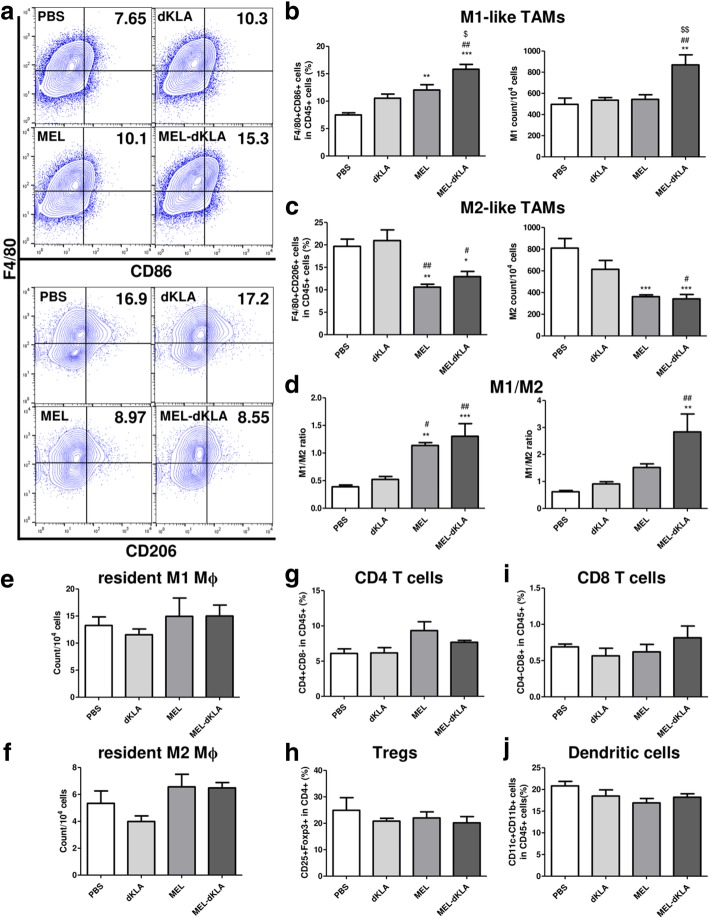
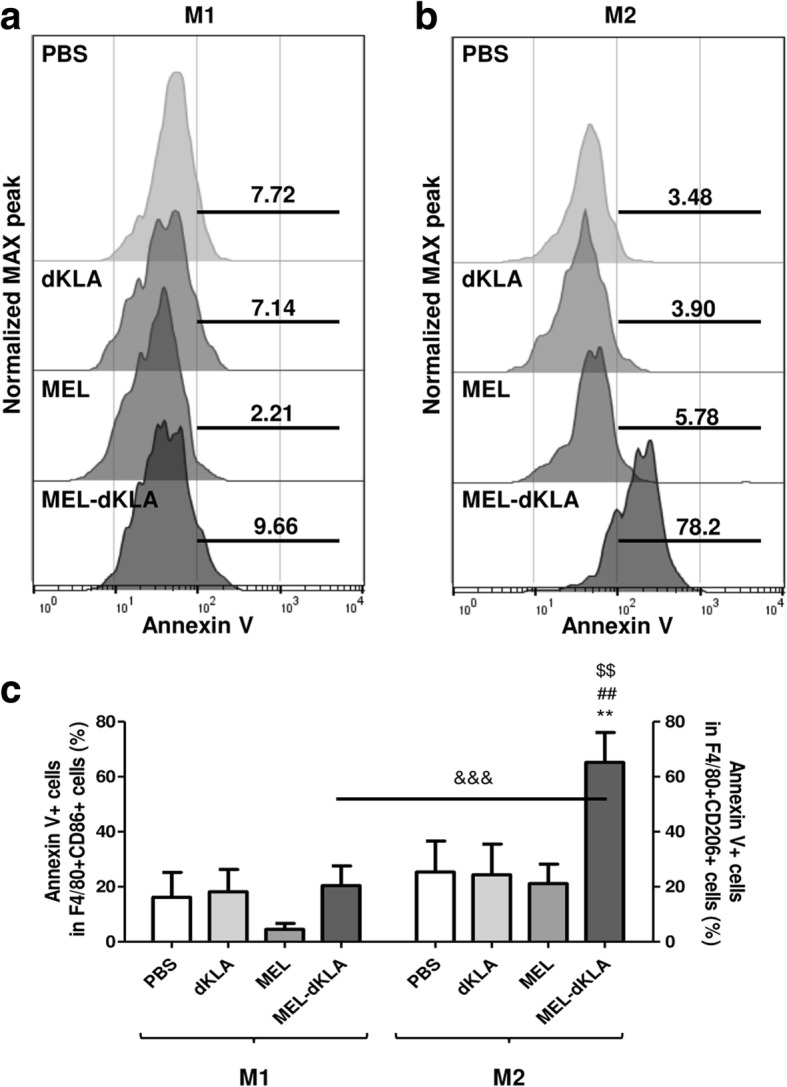
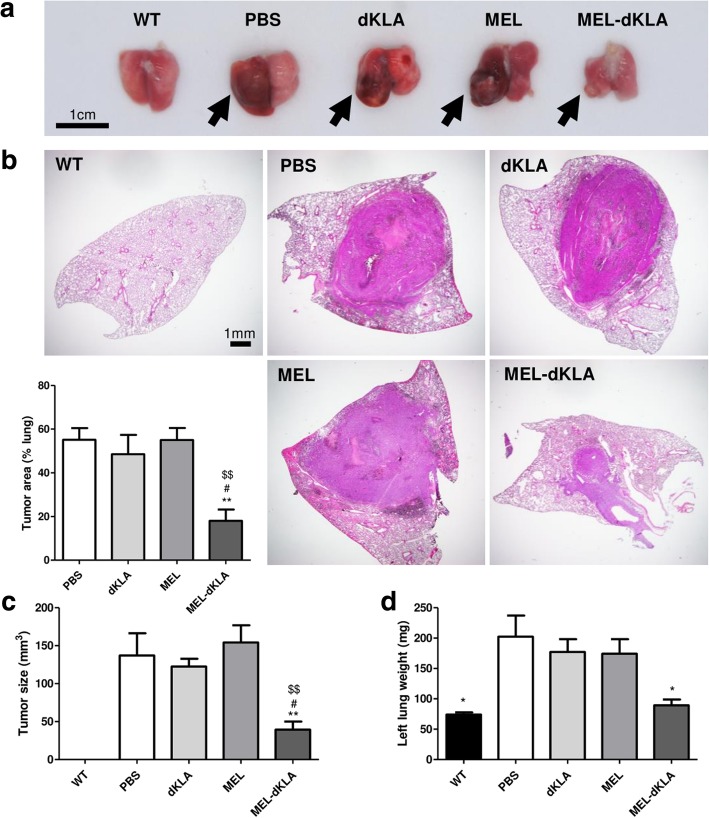
Background Tumor-associated macrophages (TAMs) are the major component of tumor-infiltrating immune cells. Macrophages are broadly categorized as M1 or M2 types, and TAMs have been shown to express an M2-like phenotype. TAMs promote tumor progression and contribute to resistance to chemotherapies. Therefore, M2-like TAMs are potential targets for the cancer immunotherapy. In this study, we targeted M2-like TAMs using a hybrid peptide, MEL-dKLA, composed of melittin (MEL), which binds preferentially to M2-like TAMs, and the pro-apoptotic peptide d (KLAKLAK)2 (dKLA), which induces mitochondrial death after cell membrane penetration. Methods The M1 or M2-differentiated RAW264.7 cells were used for mitochondrial colocalization and apoptosis test in vitro. For in vivo study, the murine Lewis lung carcinoma cells were inoculated subcutaneously in the right flank of mouse. The dKLA, MEL and MEL-dKLA peptides were intraperitoneally injected at 175 nmol/kg every 3 days. Flow cytometry analysis of tumor-associated macrophages and immunofluorescence staining were performed to investigate the immunotherapeutic effects of MEL-dKLA. Results We showed that MEL-dKLA induced selective cell death of M2 macrophages in vitro, whereas MEL did not disrupt the mitochondrial membrane. We also showed that MEL-dKLA selectively targeted M2-like TAMs without affecting other leukocytes, such as T cells and dendritic cells, in vivo. These features resulted in lower tumor growth rates, tumor weights, and angiogenesis in vivo. Importantly, although both MEL and MEL-dKLA reduced numbers of CD206+ M2-like TAMs in tumors, only MEL-dKLA induced apoptosis in CD206+ M2-like TAMs, and MEL did not induce cell death. Conclusion Taken together, our study demonstrated that MEL-dKLA could be used to target M2-like TAMs as a promising cancer therapeutic agent.
Overview
The claims and statistics of this paper haven’t been checked yet.
Free: it reads the open-access text and checks the first 5 claims that cite a source we can check. Create a free account to check every claim.
Integrity signals
Registry
Cites
Statistics
Figures
Verification
Claims the paper makes
The claims and statistics of this paper haven’t been checked yet.
Free: it reads the open-access text and checks the first 5 claims that cite a source we can check. Create a free account to check every claim.
Claims other papers make about this one
Each is checked against this paper’s own text: does it say what the citing paper says it does?
The source backs part of the claim, not all of it — or backs it for a different population, condition or comparison.
In the citing paper
“In turn, TAMs promote angiogenesis [by releasing vascular endothelial growth factor (VEGF) and interleukin (IL)-8] and ECM remodeling (via MMP production) [49].”
From 3D In Vitro Model (R)evolution: Unveiling Tumor–Stroma Interactions (2021) · cites this paper as [49]
Experimental — accuracy not yet measuredThe source backs part of the claim, not all of it — or backs it for a different population, condition or comparison.
In the citing paper
“In turn, TAMs promote angiogenesis [by releasing vascular endothelial growth factor (VEGF) and interleukin (IL)-8] and ECM remodeling (via MMP production) [49].”
From 3D In Vitro Model (R)evolution: Unveiling Tumor–Stroma Interactions (2021) · cites this paper as [49]
Experimental — accuracy not yet measured
Self-check
Percentages, sums and reported differences re-computed from the paper’s own numbers.
The self-check needs the paper’s full text.
Citations
Cites
Exploring the full spectrum of macrophage activation
Mosser, D. M., & Edwards, J. P. (2008) · Nature Reviews Immunology · doi:10.1038/nri2448 · Cited by 9,144
Alternative activation of macrophages
Gordon, S. (2003) · Nature Reviews Immunology · doi:10.1038/nri978 · Cited by 6,189
MANTOVANI, A., SOZZANI, S., LOCATI, M., ALLAVENA, P., & SICA, A. (2002) · Trends in Immunology · doi:10.1016/s1471-4906(02)02302-5 · Cited by 5,528
Monocyte and macrophage heterogeneity
Gordon, S., & Taylor, P. R. (2005) · Nature Reviews Immunology · doi:10.1038/nri1733 · Cited by 5,190
Macrophage Diversity Enhances Tumor Progression and Metastasis
Qian, B.-Z., & Pollard, J. W. (2010) · Cell · doi:10.1016/j.cell.2010.03.014 · Cited by 5,188
Fate Mapping Reveals Origins and Dynamics of Monocytes and Tissue Macrophages under Homeostasis
Yona, S., Kim, K.-W., Wolf, Y., Mildner, A., Varol, D., Breker, M., Strauss-Ayali, D., Viukov, S., Guilliams, M., Misharin, A., et al. (2013) · Immunity · doi:10.1016/j.immuni.2012.12.001 · Cited by 3,245
Immune-related adverse events with immune checkpoint blockade: a comprehensive review
Michot, J. M., Bigenwald, C., Champiat, S., Collins, M., Carbonnel, F., Postel-Vinay, S., Berdelou, A., Varga, A., Bahleda, R., Hollebecque, A., et al. (2016) · European Journal of Cancer · doi:10.1016/j.ejca.2015.11.016 · Cited by 2,127
Understanding the Mysterious M2 Macrophage through Activation Markers and Effector Mechanisms
Rőszer, T. (2015) · Mediators of Inflammation · doi:10.1155/2015/816460 · Cited by 1,762
DeNardo, D. G., Brennan, D. J., Rexhepaj, E., Ruffell, B., Shiao, S. L., Madden, S. F., Gallagher, W. M., Wadhwani, N., Keil, S. D., Junaid, S. A., et al. (2011) · Cancer Discovery · doi:10.1158/2159-8274.cd-10-0028 · Cited by 1,715
Macrophages, innate immunity and cancer: balance, tolerance, and diversity
Mantovani, A., & Sica, A. (2010) · Current Opinion in Immunology · doi:10.1016/j.coi.2010.01.009 · Cited by 1,484
Cited by
3D In Vitro Model (R)evolution: Unveiling Tumor–Stroma Interactions
Rodrigues, J., Heinrich, M. A., Teixeira, L. M., & Prakash, J. (2021) · Trends in Cancer · doi:10.1016/j.trecan.2020.10.009 · Cited by 405
“In turn, TAMs promote angiogenesis [by releasing vascular endothelial growth factor (VEGF) and interleukin (IL)-8] and ECM remodeling (via MMP production) [49].”
BackgroundTumor-Associated Macrophage Subsets: Shaping Polarization and Targeting
Zhang, Q., & Sioud, M. (2023) · International Journal of Molecular Sciences · doi:10.3390/ijms24087493 · Cited by 300
He, W., Kapate, N., Shields, C. W., & Mitragotri, S. (2020) · Advanced Drug Delivery Reviews · doi:10.1016/j.addr.2019.12.001 · Cited by 236
Ge, Z., & Ding, S. (2020) · Frontiers in Oncology · doi:10.3389/fonc.2020.590941 · Cited by 222
Galectin-3 as a Next-Generation Biomarker for Detecting Early Stage of Various Diseases
Hara, A., Niwa, M., Noguchi, K., Kanayama, T., Niwa, A., Matsuo, M., Hatano, Y., & Tomita, H. (2020) · Biomolecules · doi:10.3390/biom10030389 · Cited by 214
Necroptosis contributes to chronic inflammation and fibrosis in aging liver
Mohammed, S., Thadathil, N., Selvarani, R., Nicklas, E. H., Wang, D., Miller, B. F., Richardson, A., & Deepa, S. S. (2021) · Aging Cell · doi:10.1111/acel.13512 · Cited by 192
Function of Macrophages in Disease: Current Understanding on Molecular Mechanisms
Zhang, C., Yang, M., & Ericsson, A. C. (2021) · Frontiers in Immunology · doi:10.3389/fimmu.2021.620510 · Cited by 163
“Treatment of the hybrid peptide resulted in apoptosis of CD206 M2-like TAMs and reduction of tumor growth and angiogenesis, showing as a promising cancer therapeutic agent (94).”
BackgroundApplications and evolution of melittin, the quintessential membrane active peptide
Guha, S., Ferrie, R. P., Ghimire, J., Ventura, C. R., Wu, E., Sun, L., Kim, S. Y., Wiedman, G. R., Hristova, K., & Wimley, W. C. (2021) · Biochemical Pharmacology · doi:10.1016/j.bcp.2021.114769 · Cited by 158
Miyamoto, T., Murakami, R., Hamanishi, J., Tanigaki, K., Hosoe, Y., Mise, N., Takamatsu, S., Mise, Y., Ukita, M., Taki, M., et al. (2021) · Cancer Immunology Research · doi:10.1158/2326-6066.cir-21-0407 · Cited by 169
Hallmarks of cancer resistance
Tufail, M., Hu, J.-J., Liang, J., He, C., Wan, W., Huang, Y., Jiang, C., Wu, H., & Li, N. (2024) · iScience · doi:10.1016/j.isci.2024.109979 · Cited by 151
“51 Regulatory T cells (Tregs) are a subset of T lymphocytes that play a crucial role in regulating the immune system.”
BackgroundCancer-induced nerve injury promotes resistance to anti-PD-1 therapy
Baruch, E. N., Gleber‐Netto, F. O., Nagarajan, P., Rao, X., Akhter, S., Eichwald, T., Xie, T., Balood, M., Adewale, A., Na’ara, S., et al. (2025) · Nature · doi:10.1038/s41586-025-09370-8 · Cited by 156
The role of tumor-associated macrophages in osteosarcoma progression – therapeutic implications
Huang, Q., Liang, X., Ren, T., Huang, Y., Zhang, H., Yu, Y., Chen, C., Wang, W., Niu, J., Lou, J., et al. (2021) · Cellular Oncology · doi:10.1007/s13402-021-00598-w · Cited by 118
“They also exhibit pro-inflammatory, immunogenic and anti-tumorigenic properties [38, 39].”
BackgroundMiska, J. M., Rashidi, A., Lee-Chang, C., Gao, P., Lopez‐Rosas, A., Zhang, P., Burga, R. A., Castro, B. A., Xiao, T., Han, Y., et al. (2021) · Science Advances · doi:10.1126/sciadv.abc8929 · Cited by 127
Targeting tumor‑associated macrophages in the tumor microenvironment (Review)
Zhou, K., Cheng, T., Zhan, J., Peng, X., Zhang, Y., Wen, J., Chen, X., & Ying, M. (2020) · Oncology Letters · doi:10.3892/ol.2020.12097 · Cited by 114
“For example, a hybrid peptide of MEL‐dKLA selectively triggered M2‐like TAM apoptosis without affecting other leukocytes, such as T cells and DCs, and increased the M1/M2 ratio, which reduced tumor growth rates, tumor weights and angiogenesis in a lung cancer mouse model (83) (Table III).”
BackgroundMacrophage Modification Strategies for Efficient Cell Therapy
Poltavets, A. S., Vishnyakova, P., Elchaninov, A. V., Sukhikh, G. T., & Fatkhudinov, T. (2020) · Cells · doi:10.3390/cells9061535 · Cited by 122
Miyamoto, T., Murakami, R., Hamanishi, J., Tanigaki, K., Hosoe, Y., Mise, N., Takamatsu, S., Mise, Y., Ukita, M., Taki, M., et al. (2022) · Institutional Repositories DataBase (IRDB) · doi:10.14989/doctor.k23801 · Cited by 113
Ma, L., Wang, L., Nelson, A. T., Han, C., He, S., Henn, M. A., Menon, K., Chen, J. J., Baek, A. E., Vardanyan, A., et al. (2020) · Cancer Letters · doi:10.1016/j.canlet.2020.08.020 · Cited by 98
“Tumor-associated macrophages (TAMs) are known to have a diverse set of polarities, with an M2-like phenotype dominating [30, 31].”
BackgroundIroning Out the Details: How Iron Orchestrates Macrophage Polarization
Xia, Y., Li, Y., Wu, X., Zhang, Q., Chen, S., Ma, X., & Yu, M. (2021) · Frontiers in Immunology · doi:10.3389/fimmu.2021.669566 · Cited by 105
Matrix stiffness‐mediated effects on macrophages polarization and their LOXL2 expression
Xing, X., Wang, Y., Zhang, X., Gao, X., Li, M., Wu, S., Zhao, Y., Chen, J., Gao, D., Chen, R., et al. (2021) · The FEBS Journal · doi:10.1111/febs.15566 · Cited by 92
Pandey, P., Khan, F., Khan, M. A., Kumar, R., & Upadhyay, T. K. (2023) · Nutrients · doi:10.3390/nu15143111 · Cited by 102
Drug resistance and tumor immune microenvironment: An overview of current understandings (Review)
Liu, Y., Liang, J., Zhang, Y., & Guo, Q. (2024) · International Journal of Oncology · doi:10.3892/ijo.2024.5684 · Cited by 107
“Involvement in the recruitment and differentiation of TANs by CAFs .”
BackgroundInfluentialKeeley, T. S., Costanzo-Garvey, D. L., & Cook, L. M. (2019) · Trends in cancer · doi:10.1016/j.trecan.2019.10.013 · Cited by 88
An, Y., & Yang, Q. F. (2019) · Life Sciences · doi:10.1016/j.lfs.2019.117162 · Cited by 96
Yuan, Y., Lee, J. S., Yost, S. E., Frankel, P. H., Ruel, C., Egelston, C. A., Guo, W., Gillece, J. D., Folkerts, M., Reining, L., et al. (2020) · The Oncologist · doi:10.1002/onco.13583 · Cited by 91
“M2 macrophages inhibit inflammation and promote tissue remodeling and angiogenesis [56].”
BackgroundAufschnaiter, A., Kohler, V., Khalifa, S. A. M., El‐Wahed, A. A. A., Du, M., El-Seedi, H. R., & Büttner, S. (2020) · Toxins · doi:10.3390/toxins12020066 · Cited by 93
Evaluating the impact of age on immune checkpoint therapy biomarkers
Erbe, R., Wang, Z., Wu, S. K., Xiu, J., Zaidi, N., La, J., Tuck, D. P., Fillmore, N. R., Giraldo, N. A., Topper, M. J., et al. (2021) · Cell Reports · doi:10.1016/j.celrep.2021.109599 · Cited by 85
“For example, there are several strategies currently in development to target tumor-associated macrophages (Chanmee et al., 2014; Lee et al., 2019; Poh and Ernst, 2018).”
Yu, X. M., Jia, S., Yu, S., Chen, Y., Zhang, C., Chen, H., & Dai, Y. (2023) · Journal of Nanobiotechnology · doi:10.1186/s12951-023-02223-4 · Cited by 80
“On this basis, Lee et al. designed the novel fusion peptide MEL-dKLA containing the pro-apoptotic peptide dKLA, which could specifically induce apoptosis of CD206 + M2-like TAMs in the murine tumor stroma without affecting M1-like macrophages and other leukocytes [117].”
BackgroundSingh, M. P., Sethuraman, S. N., Miller, C., Malayer, J. R., & Ranjan, A. (2020) · Theranostics · doi:10.7150/thno.49517 · Cited by 83
Shao, R., Liu, C., Xue, R., Deng, X., Liu, L., Song, C., Xie, J., Tang, H., & Liu, W. (2024) · International Journal of Biological Sciences · doi:10.7150/ijbs.91154 · Cited by 81
“Macrophages display adaptability in response to various stimuli and can be differentiated into unique functional phenotypes, namely, classical activation (M1) or alternative activation (M2) [6-10].”
The current landscape of the antimicrobial peptide melittin and its therapeutic potential
Zhang, H.-Q., Sun, C., Xu, N., & Liu, W. (2024) · Frontiers in Immunology · doi:10.3389/fimmu.2024.1326033 · Cited by 98
“Lee and colleagues (177) demonstrated that melittin-dKLA selectively inhibited M2-like TAMs in cancer mouse model bearing murine Lewis lung carcinoma cells in vivo.”
BackgroundCell-Penetrating Peptides Derived from Animal Venoms and Toxins
Rádis‐Baptista, G. (2021) · Toxins · doi:10.3390/toxins13020147 · Cited by 78
“, GIGAVLKVLTTGLPALISWIKRKRQQGGGGSd[KLAKLAKKLAKLAK]) efficiently induced the selective mitochondrial-mediated apoptotic cell death of M2 macrophages in vitro and (CD206+) M2-like tumor-associated macrophages in vivo, reducing tumor growth rates, tumor mass and angiogenesis [53].”
BackgroundTargeting macrophages: a novel treatment strategy in solid tumors
Liu, M., Liu, L., Song, Y., Li, W., & Xu, L. (2022) · Journal of Translational Medicine · doi:10.1186/s12967-022-03813-w · Cited by 78
Baicalein Potentiated M1 Macrophage Polarization in Cancer Through Targeting PI3Kγ/ NF-κB Signaling
He, S., Wang, S., Liu, S., Li, Z., Liu, X., & Wu, J. (2021) · Frontiers in Pharmacology · doi:10.3389/fphar.2021.743837 · Cited by 67
“The M1 phenotype typically produces tumor necrosis factor (TNF), interleukin (IL)-12 and interferon-γ (IFN-γ) inducible chemokines C-X-C motif chemokine ligand (CXCL) 9 and CXCL10 to exert proinflammatory and antitumor effects, whereas M2 macrophages, mainly identified by the production of IL-10 and Arg-1, are known t…”
BackgroundPancreatic Cancer and Cellular Senescence: Tumor Microenvironment under the Spotlight
Cortesi, M., Zanoni, M., Pirini, F., Tumedei, M. M., Ravaioli, S., Rapposelli, I. G., Frassineti, G. L., & Bravaccini, S. (2021) · International Journal of Molecular Sciences · doi:10.3390/ijms23010254 · Cited by 65
Zhang, H., Zhang, Y., Zhang, C., Yu, H., Ma, Y., Li, Z., & Shi, N. (2023) · Pharmaceutics · doi:10.3390/pharmaceutics15082093 · Cited by 61
Peptide-based targeting of immunosuppressive cells in cancer
Trac, N. T., & Chung, E. J. (2020) · Bioactive Materials · doi:10.1016/j.bioactmat.2020.01.006 · Cited by 65
Delivery Strategies for Melittin-Based Cancer Therapy
Zhou, J., Wan, C., Cheng, J. Q., Huang, H., Lovell, J. F., & Jin, H. (2021) · ACS Applied Materials & Interfaces · doi:10.1021/acsami.1c03640 · Cited by 60
Kim, H., Park, H., Chang, H. W., Back, J. H., Lee, S. J., Park, Y. E., Kim, E. H., Hong, Y., Kwak, G., Kwon, I. C., et al. (2022) · Bioactive Materials · doi:10.1016/j.bioactmat.2022.07.021 · Cited by 75
Self-citationUnderstanding the Mechanisms by Which Epigenetic Modifiers Avert Therapy Resistance in Cancer
Quagliano, A., Gopalakrishnapillai, A., & Barwe, S. P. (2020) · Frontiers in Oncology · doi:10.3389/fonc.2020.00992 · Cited by 56
Aria, H., & Rezaei, M. (2023) · Biomedicine & Pharmacotherapy · doi:10.1016/j.biopha.2023.114503 · Cited by 59
Target tumor microenvironment by innate T cells
Li, Y.-R., Wilson, M., & Yang, L. (2022) · Frontiers in Immunology · doi:10.3389/fimmu.2022.999549 · Cited by 64
Asare, P. F., Roscioli, E., Hurtado, P. R., Tran, H. B., Mah, C. Y., & Hodge, S. (2020) · Frontiers in Oncology · doi:10.3389/fonc.2020.01298 · Cited by 50
Zhang, Y., Zhao, Y., Li, Q., & Wang, Y. (2021) · Frontiers in Immunology · doi:10.3389/fimmu.2021.685978 · Cited by 59
“Tumor-Promoting Effects of Macrophages Macrophages in the TIME are often called TAMs; M0 macrophages are mostly polarized into M2 macrophages (50) following induction by IL-4, IL-10, and IL-13 (51–53).”
BackgroundYang, C., Shi, S., Su, Y., Tong, J., & Li, L. (2020) · Journal of Cellular and Molecular Medicine · doi:10.1111/jcmm.15708 · Cited by 51
“M1 and M2 are the major classes of TAMs that display polar effects on tumors(8, 9).”
BackgroundZheng, J., Jiang, J., Pu, Y., Xu, T., Sun, J., Zhang, Q., He, L., & Liang, X. (2023) · Frontiers in Bioengineering and Biotechnology · doi:10.3389/fbioe.2023.1248421 · Cited by 55
Benzo[a]pyrene immunogenetics and immune archetype reprogramming of lung
El-Fattah, E. E. A., & Abdelhamid, A. M. (2021) · Toxicology · doi:10.1016/j.tox.2021.152994 · Cited by 50
Arora, S., Singh, P. K., Ahmad, S., Ahmad, T., Dohare, R., Almatroodi, S. A., Alrumaihi, F., Rahmani, A. H., & Syed, M. A. (2021) · Cells · doi:10.3390/cells10082091 · Cited by 48
TAM-targeted reeducation for enhanced cancer immunotherapy: Mechanism and recent progress
Shen, X., Zhou, S., Yang, Y., Tu, H., Xiang, Z., Zhao, J., Zhu, C., Zeng, L., & Zhang, L. L. (2022) · Frontiers in Oncology · doi:10.3389/fonc.2022.1034842 · Cited by 47
“For example, precise targeting with short peptides has exhibited certain potential for intracellular delivery of therapeutically relevant molecules (53).”
BackgroundM1 Macrophage-Derived Exosome-Mimetic Nanovesicles with an Enhanced Cancer Targeting Ability
Baek, S., Jeon, M., Jung, H. N., Lee, W., Hwang, J.-E., Lee, J. S., Choi, Y., & Im, H. (2022) · ACS Applied Bio Materials · doi:10.1021/acsabm.2c00246 · Cited by 48
CCR2-targeted micelles for anti-cancer peptide delivery and immune stimulation
Trac, N. T., Chen, L., Zhang, A., Liao, C., Poon, C. J., Wang, J., Ando, Y., Joo, J., Garri, C., Shen, K., et al. (2020) · Journal of Controlled Release · doi:10.1016/j.jconrel.2020.09.054 · Cited by 48
Natural peptides for immunological regulation in cancer therapy: Mechanism, facts and perspectives
Zhang, Y., Liu, C., Wu, C., & Song, L. (2023) · Biomedicine & Pharmacotherapy · doi:10.1016/j.biopha.2023.114257 · Cited by 46
Dong, H., Yang, Y., Gao, C., Sun, H., Wang, H., Hong, C., Wang, J., Gong, F., & Gao, X. (2020) · Journal for ImmunoTherapy of Cancer · doi:10.1136/jitc-2019-000339 · Cited by 47
Tumor-associated macrophage polarization promotes the progression of esophageal carcinoma
Yuan, X., Li, Y., Zhang, A. Z., Jiang, C. H., Li, F. P., Xie, Y., Li, J. F., Liang, W. H., Zhang, H. J., Liu, C. X., et al. (2020) · Aging · doi:10.18632/aging.202201 · Cited by 45
“Particular cytokines in the TME induce TAMs to obtain a tumor-promoting (M2) phenotype and thus exert immunosuppressive effects [8].”
BackgroundVenom peptides in cancer therapy: An updated review on cellular and molecular aspects
Mirzaei, S., Fekri, H. S., Hashemi, F., Hushmandi, K., Mohammadinejad, R., Ashrafizadeh, M., Zarrabi, A., & Garg, M. (2020) · Pharmacological Research · doi:10.1016/j.phrs.2020.105327 · Cited by 48
Melittin and phospholipase A2: Promising anti-cancer candidates from bee venom
Cui, Z., Zhou, Z., Sun, Z., Duan, J., Liu, R., Cheng, Q., & Yan, C. (2024) · Biomedicine & Pharmacotherapy · doi:10.1016/j.biopha.2024.117385 · Cited by 55
Chintamaneni, P. K., Pindiprolu, S. K. S. S., Swain, S. S., Karri, V. V. S. R., Nesamony, J., Selvam, C., & Bhaskaran, M. (2024) · Cancer Letters · doi:10.1016/j.canlet.2024.216782 · Cited by 46
Peptides that immunoactivate the tumor microenvironment
Furukawa, N., & Popel, A. S. (2021) · Biochimica et Biophysica Acta (BBA) - Reviews on Cancer · doi:10.1016/j.bbcan.2020.188486 · Cited by 37
“To boost the capability to eliminate M2 macrophages, they conjugated melittin with the proapoptotic peptide dKLA (MEL-dKLA) [109].”
BackgroundYakupova, E. I., Maleev, G. V., Krivtsov, A. V., & Plotnikov, E. Y. (2022) · Experimental Biology and Medicine · doi:10.1177/15353702221080130 · Cited by 42
pH-labile artificial natural killer cells for overcoming tumor drug resistance
Li, Q., Shi, Z., Ou, M., Li, Z., Luo, M., Wu, M., Dong, X., Li, L., Lv, F., Zhang, F., et al. (2022) · Journal of Controlled Release · doi:10.1016/j.jconrel.2022.10.042 · Cited by 41
Su, P., Li, O., Ke, K., Jiang, Z., Wu, J., Wang, Y., Mou, Y., & Jin, W. (2024) · International Journal of Oncology · doi:10.3892/ijo.2024.5648 · Cited by 47
“Research studies have also shown that MEL‑dKLA is capable of selec‑ tively binding to CD206 + M2‑type TAMs while protecting the function of anti‑tumor immune cells (164).”
BackgroundExploring the Chemical Features and Biomedical Relevance of Cell-Penetrating Peptides
Moreno‐Vargas, L. M., & Prada‐Gracia, D. (2024) · International Journal of Molecular Sciences · doi:10.3390/ijms26010059 · Cited by 52
Crosstalk Between Mesenchymal Stromal Cells and Tumor-Associated Macrophages in Gastric Cancer
Zheng, P., & Li, W. (2020) · Frontiers in Oncology · doi:10.3389/fonc.2020.571516 · Cited by 45
“Although the polarized states of macrophages are dictated by cues from the TME, TAMs have been demonstrated to possess an M2-like phenotype prominently in tumor tissues (37, 38).”
BackgroundWu, R., Zhou, T., Xiong, J., Zhang, Z., Tian, S., Wang, Y., Chen, J., & Tian, X. (2022) · Frontiers in Bioscience-Landmark · doi:10.31083/j.fbl2712323 · Cited by 40
“Although it has been reported that M1-polarized TAM may enhance the viability of HCC through the NF-κ B/FAK pathway [42], it is generally believed that M2 TAM can promote tumor growth, while M1 TAM inhibit tumor growth [43,44].”
BackgroundTumor-associated macrophages: Prognostic and therapeutic targets for cancer in humans and dogs
Brady, R. V., & Thamm, D. H. (2023) · Frontiers in Immunology · doi:10.3389/fimmu.2023.1176807 · Cited by 35
Hassan, G., & Seno, M. (2020) · Cells · doi:10.3390/cells9051293 · Cited by 43
Guo, R.-C., Zhang, X., Ji, L., Wei, Z., Duan, Z., Qiao, Z., & Wang, H. (2020) · Biomaterials Science · doi:10.1039/d0bm01358g · Cited by 37
Chen, Z., Chen, G., & Zhao, H. (2020) · Journal of Cellular and Molecular Medicine · doi:10.1111/jcmm.15542 · Cited by 34
Cui, Y., Luo, Y., Qian, Q., Tian, J., Fang, Z., Wang, X., Zeng, Y., Wu, J., & Li, Y. (2022) · Frontiers in Oncology · doi:10.3389/fonc.2022.732860 · Cited by 37
“The experimental program was as described above (28, 29), where mice were sacrificed by cervical dislocation with adequate cleansing using 75% alcohol, and femora and tibiae of mice were separated, of which marrow cavities were flushed with PBS.”
MethodEl‐Asrar, A. M. A., Hertogh, G. D., Allegaert, E., Nawaz, M. I., Salama, S. A., Gikandi, P. W., Opdenakker, G., & Struyf, S. (2023) · International Journal of Molecular Sciences · doi:10.3390/ijms241713510 · Cited by 36
Melittin-incorporated nanomedicines for enhanced cancer immunotherapy
Duan, X., Zou, H., Yang, J.-Z., Liu, S., Xu, T., & Ding, J. (2024) · Journal of Controlled Release · doi:10.1016/j.jconrel.2024.08.047 · Cited by 38
Giribaldi, J., Smith, J. J. L., & Schroeder, C. I. (2021) · Biotechnology Advances · doi:10.1016/j.biotechadv.2021.107769 · Cited by 37
Sharifiaghdam, M., Shaabani, E., Sharifiaghdam, Z., Keersmaecker, H. D., Lucas, B., Lammens, J., Ghanbari, H., Teimoori‐Toolabi, L., Vervaet, C., Beer, T. D., et al. (2021) · Nanoscale · doi:10.1039/d1nr03830c · Cited by 35
Comprehensive analysis of prognostic gene signatures based on immune infiltration of ovarian cancer
Yan, S.-B., Fang, J., Chen, Y., Xie, Y., Zhang, S., Zhu, X., & Fang, F. (2020) · BMC Cancer · doi:10.1186/s12885-020-07695-3 · Cited by 38
Targeting tumor-associated macrophage: an adjuvant strategy for lung cancer therapy
Liu, L., Chen, G., Gong, S., Huang, R., & Fan, C. (2023) · Frontiers in Immunology · doi:10.3389/fimmu.2023.1274547 · Cited by 41
Kim, S., Choi, I., Han, I., & Bae, H. (2022) · International Journal of Molecular Sciences · doi:10.3390/ijms232415751 · Cited by 33
Self-citationChakiryan, N. H., Kimmel, G. J., Kim, Y., Hajiran, A. J., Aydın, A. M., Zemp, L. W., Katende, E. N., Nguyen, J. V., Lopez-Blanco, N., Chahoud, J., et al. (2021) · PLoS ONE · doi:10.1371/journal.pone.0245415 · Cited by 32
Nanoparticles Targeting Innate Immune Cells in Tumor Microenvironment
Jang, H., Kim, E. H., Chi, S.-G., Kim, S. H., & Yang, Y. (2021) · International Journal of Molecular Sciences · doi:10.3390/ijms221810009 · Cited by 34
Binmama, S., Dang, C. P., Visitchanakun, P., Hiengrach, P., Somboonna, N., Cheibchalard, T., Pisitkun, P., Chindamporn, A., & Leelahavanichkul, A. (2022) · International Journal of Molecular Sciences · doi:10.3390/ijms231810951 · Cited by 32
Melittin-Based Nanoparticles for Cancer Therapy: Mechanisms, Applications, and Future Perspectives
Rizkallah, J., Charbel, N., Yassine, A., Masri, A. F., Raffoul, C., Sardouk, O. E., Ghezzawi, M., Nasr, T. A., & Kreidieh, F. (2025) · Pharmaceutics · doi:10.3390/pharmaceutics17081019 · Cited by 33
“In a lung cancer mouse model, this construct successfully targeted M2-like TAMs and exerted anticancer effects, supporting the feasibility of TME-modulating strategies for melittin-based nanostructures [91].”
InfluentialLi, D., Yan, M., Sun, F., Jun-mei, S., Xing-sheng, H., Yu, S., Tang, L., & Deng, S. (2021) · Epigenomics · doi:10.2217/epi-2020-0341 · Cited by 28
Immunomodulatory Peptides for Tumor Treatment
Song, Y., Lei, L., Cai, X., Wei, H., & Yu, C. (2024) · Advanced Healthcare Materials · doi:10.1002/adhm.202400512 · Cited by 32
Cancer-Targeting Applications of Cell-Penetrating Peptides
Moreno‐Vargas, L. M., & Prada‐Gracia, D. (2024) · International Journal of Molecular Sciences · doi:10.3390/ijms26010002 · Cited by 31
Singer, M., Zhang, Z., Dayyani, F., Zhang, Z., Yaghmai, V., Choi, A., Valerin, J. B., Imagawa, D. K., & Abi‐Jaoudeh, N. (2024) · Cancers · doi:10.3390/cancers17010066 · Cited by 35
“The majority of TAMs fall under the category of M1-like and M2-like macrophages, indicating their alignment with the M2-like macrophage subtype that fosters tumor growth and suppresses immune reactions [4,5].”
Benfante, V., Stefano, A., Ali, M. U., Laudicella, R., Arancio, W., Cucchiara, A., Caruso, F., Cammarata, F. P., Coronnello, C., Russo, G. I., et al. (2023) · Diagnostics · doi:10.3390/diagnostics13071210 · Cited by 32
Ma, W.-P., Li, H., Liu, M., & Liu, H. (2021) · Carbohydrate Polymers · doi:10.1016/j.carbpol.2021.118484 · Cited by 29
Tumor and Peripheral Immune Status in Soft Tissue Sarcoma: Implications for Immunotherapy
Sousa, L. M., Almeida, J. S., Fortes-Andrade, T., Santos-Rosa, M., Freitas-Tavares, P., Casanova, J., & Rodrigues‐Santos, P. (2021) · Cancers · doi:10.3390/cancers13153885 · Cited by 34
Therapeutic Effect of Melittin–dKLA Targeting Tumor-Associated Macrophages in Melanoma
Han, I., Jeong, C., Yang, J., Park, S., Hwang, D., & Bae, H. (2022) · International Journal of Molecular Sciences · doi:10.3390/ijms23063094 · Cited by 27
Self-citationPeptide therapeutics in the management of metastatic cancers
Bose, D., Roy, L., & Chatterjee, S. (2022) · RSC Advances · doi:10.1039/d2ra02062a · Cited by 28
The antitumor properties of atractylenolides: Molecular mechanisms and signaling pathways
Jiang, Y., Guo, K., Wang, P., Zhu, Y., Huang, J., & Ruan, S. (2022) · Biomedicine & Pharmacotherapy · doi:10.1016/j.biopha.2022.113699 · Cited by 28
Park, K., Ahn, J. W., Kim, J., & Kim, J. W. (2022) · International Journal of Biological Macromolecules · doi:10.1016/j.ijbiomac.2022.07.159 · Cited by 25
Huang, Z., Xiao, Z., Yu, L., Liu, J., Yang, Y., & Ouyang, W. (2024) · Critical Reviews in Oncology/Hematology · doi:10.1016/j.critrevonc.2024.104284 · Cited by 33
Cheng, B., Li, C., Li, J., Gong, L., Liang, P., Chen, Y., Zhan, S., Xiong, S., Zhong, R., Liang, H., et al. (2024) · Signal Transduction and Targeted Therapy · doi:10.1038/s41392-024-01799-z · Cited by 27
Li, D., Chung, G., & Kim, S. K. (2020) · Toxins · doi:10.3390/toxins12120775 · Cited by 28
Yan, K., Wang, Y., Lu, Y., & Yan, Z. (2021) · Journal of Immunology Research · doi:10.1155/2021/6664791 · Cited by 28
“used a mixed peptide MEL-DKLA to induce the death of M2 macrophages, resulting in a slower tumor growth rate [29].”
MethodMetformin modulate immune fitness in hepatocellular carcinoma: Molecular and cellular approach
El-Fattah, E. E. A., & Zakaria, A. Y. (2022) · International Immunopharmacology · doi:10.1016/j.intimp.2022.108889 · Cited by 25
Zhao, F., Yue, Z., Zhang, L., Qi, Y., Sun, Y., Wang, S., & Tian, Q. (2025) · Journal of Innate Immunity · doi:10.1159/000546476 · Cited by 25
“The targeted induction of apoptosis in CD206 + M2-TAMs, without significant effects on M1 macrophages and other leukocytes, has been shown to effectively reduce tumor growth and angiogenesis in the mouse Lewis lung cancer model [99].”
SFMBT2-Mediated Infiltration of Preadipocytes and TAMs in Prostate Cancer
Gwak, J., Jeong, H., Lee, K., Shin, J. Y., Sim, T., Na, J., Kim, J., & Ju, B. (2020) · Cancers · doi:10.3390/cancers12092718 · Cited by 22
Self-citationCell-specific drug targeting in the lung
Abed, S., Turner, R. A., Serniuck, N. J., Tat, V., Naiel, S., Hayat, A. I., Mekhael, O., Vierhout, M., Ask, K., & Rullo, A. F. (2021) · Biochemical Pharmacology · doi:10.1016/j.bcp.2021.114577 · Cited by 21
Mo, Y., Kang, H., Bang, J.-Y., Shin, J. W., Kim, H. Y., Cho, S., & Kang, H. (2022) · Scientific Reports · doi:10.1038/s41598-022-14846-y · Cited by 21
Self-citationSharen, G., Cheng, H., Hu, X., Miao, J., & Zhao, D. (2022) · Molecular Medicine Reports · doi:10.3892/mmr.2022.12847 · Cited by 21
“In general, TAMs are reported to closely resemble M2 macrophages (25,26), but in the present study, M2 macrophages were not detected.”
Background
Metadata
- Authors
- Lee, C., Jeong, H., Bae, Y., Shin, K., Kang, S., Kim, H., Oh, J., & Bae, H.
- Affiliations
- Kyung Hee University (KR)
- Corresponding author
- Bae, Hyunsu
- Venue
- Journal for ImmunoTherapy of Cancer
- Publisher
- BMJ
- Published
- 2019-06-07
- Volume
- 7
- Issue
- 1
- Pages
- 147-147
- ISSN
- 2051-1426 (ISSN-L)
- PMC
- PMC6555931
- OpenAlex
- W2948475148
- Cited by
- 211
- References
- 52
- Citations by year
- 2026: 3 · 2025: 18 · 2024: 34 · 2023: 32 · 2022: 35 · 2021: 38 · 2020: 48 · 2019: 3
- FWCI
- 12.36
- Type
- journal article
- Language
- en
- Open access
- gold
- doi.org
- Licence
- cc-by
- creativecommons.org/licenses/by/4.0/ (tdm)
- Locations
- Journal for ImmunoTherapy of Cancer (publishedVersion, cc-by)
- PubMed Central (publishedVersion, cc-by)
- PubMed (publishedVersion)
- DOAJ (DOAJ: Directory of Open Access Journals) (submittedVersion, cc-by-sa)
- Funders
- National Research Foundation of Korea (2017R1A2B3009574, 2017M3A9E4057926)
- Topics
- Life Sciences › Immunology and Microbiology › Immunology › Immune cells in cancer
- Health Sciences › Medicine › Pharmacology (medical) › Healthcare and Venom Research
- Life Sciences › Biochemistry, Genetics and Molecular Biology › Biotechnology › Bacterial Cancer Therapy
- Keywords
- tumor-associated macrophages, M2 macrophages, melittin, proapoptotic peptide, hybrid peptides, CD206, mitochondrial apoptosis, Lewis lung carcinoma, cancer immunotherapy, tumor growth inhibition, angiogenesis, RAW 264.7 macrophages
- MeSH terms
- Animals, Flow Cytometry, Humans, Immunotherapy, Macrophages, Melitten, Peptides, Apoptosis, Carcinoma, Lewis Lung, Mice
About these checks
Registry, retraction, Cites and statistics results are computed, not judged, with one exception: a printed reference that no index lists is read once by a model before it counts as a citation error. Claims are extracted by a model and kept only when their quote appears verbatim in the text; each cited source is then checked, with a model’s help, for whether it says what the claim relies on. Those verdicts can be wrong — read the claim’s quote and the cited source before relying on one.
Statistics and arithmetic are recomputed, not judged.
Confidence bands are shown only for fields calibrated on our annotated test set. None is calibrated yet, so no band is shown.
What counts as a claim ›How we measure confidence ›How we check this ›
Are you an author, or do you see a problem with this page? Request a review
Data sources
Bibliographic data: Semantic Scholar, OpenAlex, Crossref.
Contains information from the Semantic Scholar Academic Graph Datasets, made available under the ODC Attribution License (ODC-BY 1.0).
Semantic Scholar’s data is described in: Kinney, R., et al. (2023). The Semantic Scholar Open Data Platform. arXiv:2301.10140.
